


Place
Biarritz
France Updated Aug 2026
At high tide, the sand at Biarritz’s Côte des Basques disappears beneath the Atlantic, leaving surfers to wait above the seawall while waves strike the cliffs. That tide-made vanishing act captures the city’s character: part old whaling port, part imperial seaside theater, part serious surf town. Biarritz, France, rewards visitors who look past the grand façades and listen for the Basque rhythm underneath.
 Photo: Daniel J. Schwarz / Pexels
- Attractions
- 10
- Trip length
- 3–5 days
- Best season
- May and September–October
Why Biarritz
Built from cited sources · see the method · How we make our guides →
Napoleon III and Empress Eugénie turned a small coastal settlement into a courtly retreat in the 1850s, leaving behind the rose-red Hôtel du Palais, the tiled Chapelle Impériale, and villas built for Russian princes, couturiers, and restless aristocrats. The Hôtel du Palais still carries imperial bees in its entrance carpet, a tiny emblem of how much ceremony once gathered around this stretch of ocean.
The city’s daily life is less polished and more delicious than its palaces suggest. At Les Halles, fishmongers, bakers, and charcutiers work from early morning; by late morning, counters fill with Bayonne ham, Ossau-Iraty and black cherry jam, gâteau basque, and glasses of local wine, while the streets around Rue des Halles turn toward pintxos and cider after 6:30 p.m.
Biarritz changed European surf culture in 1956 and 1957, when filmmaker Peter Viertel brought the sport to the Côte des Basques while filming The Sun Also Rises. Yet the city’s older relationship with the sea remains visible at the Port des Pêcheurs, where brightly painted crampottes serve grilled sardines and chipirons beneath cliffs once used to watch for whales. Seen this way, Biarritz is not simply a resort beside the Atlantic; it is a town repeatedly remade by whoever arrives from the water.
Europe’s surf origin story
American filmmaker Peter Viertel helped popularize surfing at the Côte des Basques in 1956–1957 while filming The Sun Also Rises. The beach vanishes beneath the tide, leaving waves pressed against the seawall and Villa Belza hanging above the rocks.An imperial seaside stage
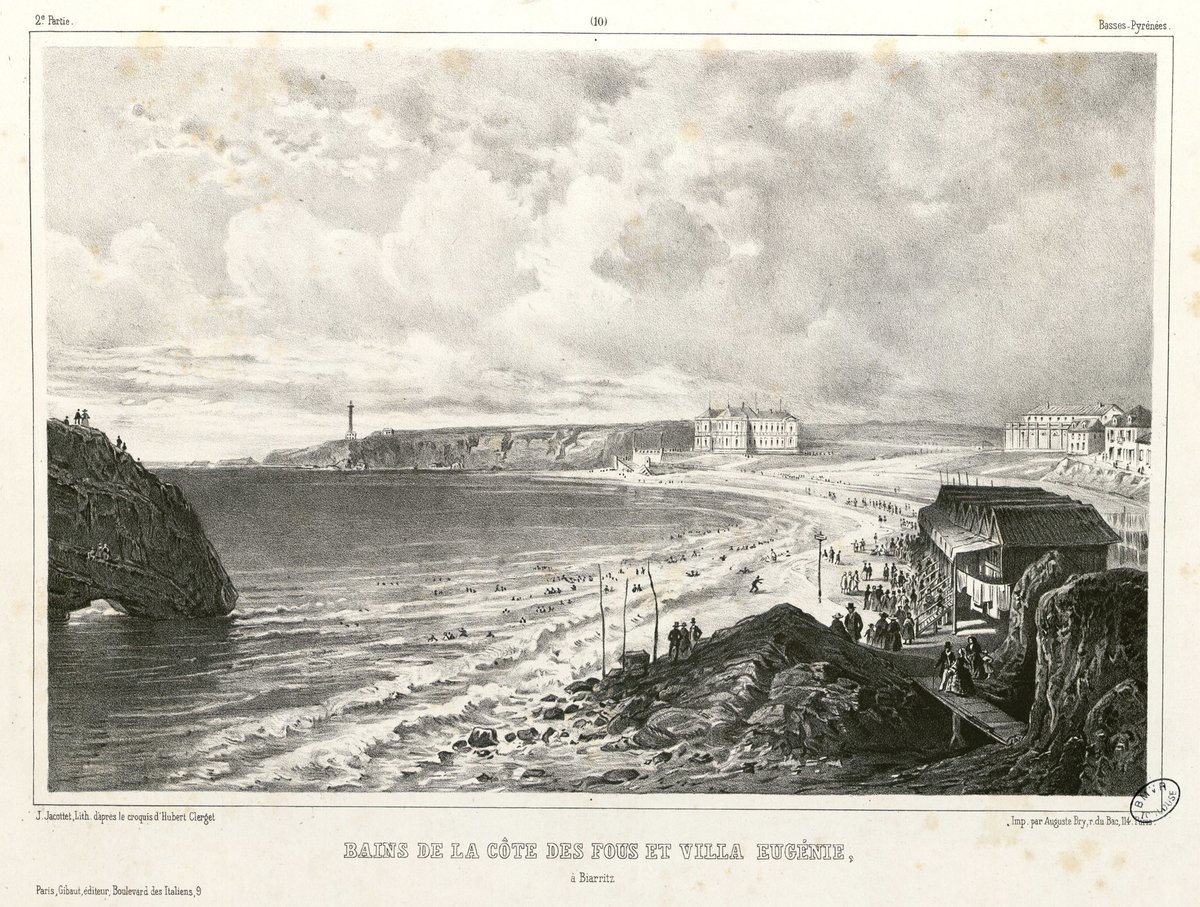
Napoleon III and Empress Eugénie turned Biarritz into a courtly resort, beginning with Villa Eugénie in 1855. The rebuilt Hôtel du Palais still carries that drama in its rose-red façade, while the 1864 Chapelle Impériale mixes Romano-Byzantine forms with Seville tilework.Cliffs, light, and open sea
The statue on Rocher de la Vierge was installed in 1865, reached by a 75-meter footbridge through the rock, with views toward the Bay of Biscay and the Pyrenees. At Pointe Saint-Martin, the 1834 lighthouse rises 73 meters above sea level; climb its 248 steps for a different reading of the coast.Market life with a Basque accent
Les Halles is Biarritz’s daily meeting point, where fish counters, Bayonne ham, Ossau-Iraty, pintxos, and gâteau basque spill into the surrounding cafés. For seafood with salt still in the air, follow the steps down to the Port des Pêcheurs and its painted crampottes.
Places to Visit
Not every monument, just the ones we'd walk you past ourselves.
-
Synagogue of Biarritz Nestled in the heart of the elegant Basque coastal city of Biarritz, the Synagogue of Biarritz stands as a significant landmark that encapsulates the rich…

-
Hôtel Du Palais Nestled on the picturesque Basque coast, the Hôtel du Palais in Biarritz stands as a majestic emblem of French imperial elegance and luxury hospitality.
-
Le Musée De La Mer Le Musée de la Mer, also known as the Aquarium de Biarritz, is a distinguished cultural and scientific landmark situated on the scenic Plateau de l’Atalaye in…

- Parc Des Sports Aguiléra Nestled in the heart of Biarritz, France, Parc des Sports Aguiléra stands as a historic and cultural beacon that captures the essence of Basque sporting…
- Ancienne Église Anglicane Saint-Andrew De Biarritz Nestled in the heart of the picturesque seaside city of Biarritz, the Ancienne Église Anglicane Saint-Andrew stands as a remarkable beacon of the city’s rich…
- Gare De Biarritz Nestled on the picturesque Basque coast, Gare de Biarritz stands as a pivotal gateway connecting travelers to the vibrant city of Biarritz, France, and its…
- War Memorial of Biarritz Nestled in the picturesque city of Biarritz in southwestern France, the War Memorial of Biarritz serves as a solemn and enduring tribute to the local soldiers…
Neighborhoods
Where to wander, by quarter — each with its own rhythm.
Quartier des Halles
Around Rue des Halles, Rue Victor Hugo, and Rue Gambetta, Biarritz gathers around its covered market: one pavilion for fish and seafood, another for produce, cheese, charcuterie, and pastries. Come early for oysters and coffee, then return after 6:30 p.m. when pintxos counters, wine bars, and small restaurants turn the market quarter into the city’s easiest evening circuit.Port des Pêcheurs
Tucked below the cliffs between Grande Plage and the Rocher de la Vierge, this miniature harbor dates from the 1860s and is lined with crampottes, the fishermen’s cabins marked by red, green, and blue doors. The setting is intimate rather than grand: order grilled sardines, chipirons, or a seafood platter and watch the light settle on the basin.Côte des Basques and Beaurivage
Above the city’s historic surf beach, cafés and terraces face a break that helped introduce surfing to Europe in 1956–57. The mood is relaxed and surf-led, with clifftop drinks at Etxola Bibi and sunset views toward Villa Belza, whose neo-Gothic silhouette seems to have been designed for a storm.Saint-Charles
North of the center, Saint-Charles has the feel of a polished neighborhood rather than a ceremonial resort quarter. Artisan bakeries, cheese shops, local food markets, and small bistros make it a good place to see how Biarritz eats when nobody is posing for a postcard.Grande Plage and the Imperial Quarter
The central beach is framed by Belle Époque and Art Deco buildings, with the Hôtel du Palais dominating the northern end in rose-red Second Empire brick. Nearby, the Russian Orthodox Church’s blue dome and the former Villa Eugénie reveal the city’s 19th-century courtly ambitions; the echoes here belong as much to wintering aristocrats as to swimmers.Plateau de l’Atalaye and the Old Port
This rocky headland links the Port des Pêcheurs to the Rocher de la Vierge and occupies one of Biarritz’s most revealing viewpoints. Medieval watchmen once used the plateau to signal approaching whales; today, footsteps, gulls, and the Atlantic replace the old lookout calls.La Négresse and Iraty
South and inland from the historic waterfront, the Docks de Biarritz occupy a converted industrial district rather than a postcard setting. Former warehouses now hold concept stores, craft breweries, contemporary bistros, and seasonal markets, giving this quarter a more experimental evening character.Pointe Saint-Martin
At the northern edge of Biarritz, the lighthouse rises 73 meters above sea level and marks the change from the sandy Landes coast to the rocky Basque shore. Climb its 248 steps for a wide view across the Atlantic, the coastline, and the hills toward Spain; the effort leaves your legs remembering the view.
Plan your trip
Before you go
- Getting There
- Fly into Biarritz Pays Basque Airport (BIQ), about 2.5–3 km from the center; San Sebastián Airport (EAS) is roughly 30 km away, Pau Pyrénées (PUF) 93 km, and Bordeaux-Mérignac (BOD) 190 km. SNCF’s Gare de Biarritz, in La Négresse, is the local rail station; Gare de Bayonne is the larger nearby interchange, with TER trains continuing to Saint-Jean-de-Luz-Ciboure and Hendaye. By car, the A63 links Bordeaux, Bayonne, Biarritz, and Spain, while the A64 brings traffic from Toulouse and Pau into the Bayonne connection.
- Getting Around
- Biarritz has no metro or subway in 2026; TXIK TXAK runs the area’s two-line electric Tram’bus system, with T1 linking Mairie de Biarritz to Bayonne’s Hauts de Bayonne and T2 serving the wider Bayonne–Tarnos corridor. Around 30 urban lines and 45 regional routes reach the coast, while free electric shuttles cover the center with six routes in winter and up to 10 in summer. A ride costs €1.30 before the scheduled 29 June 2026 adjustment and €1.40 after it; the 1-day pass is €3.80, the 3-day pass €8.70, and the 7-day pass €14.60, with contactless fares capped at €3.70 per day after three rides.
- Walking & Cycling
- The waterfront can be walked from the Phare de Biarritz past Grande Plage, Port des Pêcheurs, Rocher de la Vierge, and Côte des Basques, though the cliffs bring real slopes and stairs. La Vélodyssée follows the Atlantic coast, and local tracks connect Gare de Biarritz with the center, Milady, Lake Mouriscot, and Ilbarritz; Pony provides more than 800 shared electric two-seater bikes, with over 600 public bike racks around town.
- Climate & Best Time
- Average daytime highs run about 14–18°C in spring, 21–24°C in summer, 14–22°C in autumn, and 11–12°C in winter, with cooler nights ranging from roughly 6°C in winter to 17°C in August. July and August are the driest months at about 70 mm of rain each, while November is the wettest at 171 mm; peak crowds arrive in July–August, so May and September–October offer milder streets, surfable water, and fewer visitors.
- Safety
- Biarritz has low violent-crime levels, but keep phones and wallets close around Les Halles, Port-Vieux bars, and crowded summer promenades. The serious hazard is the Atlantic: baïnes and strong rip currents can form quickly, the Côte des Basques disappears at high tide, and a triangular red flag means swimming is forbidden; use supervised bathing zones during lifeguard hours.
From Whalers’ Smoke to Surfboards
A fishing settlement remade by emperors, war, and Atlantic waves
- c. 100,000 BCE
Early Footprints on the Cliffs
Worked stone tools found on Biarritz’s clifftops and coastal terraces point to Middle Paleolithic habitation, perhaps around 100,000 BCE. Wind, salt, and open sightlines made these high shelves useful long before hotels and promenades altered the shore.
- c. 1st century CE
Roman Foundations on Atalaye
Foundations uncovered on the Atalaye promontory point to a Roman presence on the coast. The same high ground later carried a medieval fortress and whalers’ lookout, so Biarritz’s famous view began as a practical military asset.
- 1023–1152
Biarritz Enters Written History
A document generally dated to 1023 gives the settlement the Basque or Gascon name Bayarrits, the earliest written form tied to Biarritz. In 1152, Eleanor of Aquitaine’s marriage to Henry Plantagenet brought Labourd under English suzerainty, beginning roughly three centuries of Plantagenet rule.
- 1284
Whaling Rights Become Law
Authorities in Labourd and the Duchy of Aquitaine reaffirmed Biarrot fishermen’s rights to hunt whales after disputes with Bayonne. Harpoons, rendered blubber, and whale oil supported the small port, while lookouts on the Atalaye watched for dark backs beyond the breakers.
- 1342
Fish Charter, Fortress Recorded
A royal charter dated May 26, 1342, allowed Biarrots to carry and sell fresh saltwater fish directly in Bayonne. The same record mentions Château de Belay, or Ferragus, a four-towered English fort with a drawbridge above the harbor.
- 1451–1453
French Crown Reclaims Labourd
French forces took Bayonne and Labourd between 1451 and 1453, ending English rule along this coast after the Hundred Years’ War. Biarritz now answered to the French Crown, though its boats, markets, and speech kept their Basque character.
Show the full timeline (30 moments)
- 1603–1739
Ferragus Becomes a Sea Beacon
Henry IV’s letters patent of 1603 confirmed Château de Ferragus as an observation and defense post. After most of the fortress vanished, its surviving tower carried a daymark by 1739, a signal against the reefs of the Bay of Biscay.
- 1765–1767
Bathing Roads Open the Coast
Road improvements between Bayonne and Biarritz in 1765 made sea bathing easier for visitors arriving from inland. In 1767, magistrate Malesherbes praised the ocean’s therapeutic effects, helping turn salt water from a fisherman’s workplace into a fashionable prescription.
- 1790
Revolution Recasts the Commune
The Revolution abolished Labourd as a historic province in 1790 and placed Biarritz in the new Basses-Pyrénées department. Administrative borders changed; the surf, fishing coves, and Basque speech did not.
- 1834
The Lighthouse Begins Its Vigil
Biarritz’s lighthouse began operating in 1834 on Pointe Saint-Martin, where the sandy Landes coast gives way to the rockier Basque shore. Its tower rises 73 meters above sea level, and 248 steps lead through the salt-bright interior to the lantern.
- 1835
Eugénie Finds Her Coast
Eugénie de Montijo first visited Biarritz in 1835 with her mother, years before she became Empress of the French. She remembered the coast’s light and dunes; after her marriage, that affection would draw an imperial court to the town.
- 1843
Victor Hugo Fears Fashion
Victor Hugo visited in 1843, when Biarritz was still a small whaling and fishing port. He admired its greenery and sea air, then warned that fashion might make the village hideous—a complaint the future seems to have treated as a building brief.
- 1854
Napoleon Buys the Dunes
In 1854, Napoleon III bought nearly 50 acres of coastal dunes facing the Grande Plage for a summer residence for Eugénie and their court. His decision shifted Biarritz’s economy toward palaces, roads, and imperial display; the sand itself became valuable real estate.
- 1855
Villa Eugénie Opens
Villa Eugénie rose in 1855 in Second Empire style, its red-brick and pale-stone façade facing the Atlantic. The imperial family returned for many summer seasons, drawing European royalty, diplomats, and an expensive new clientele behind them.
- 1862
Bismarck Visits the Imperial Court
Prussian minister Otto von Bismarck visited Napoleon III in Biarritz in October 1862 for talks that touched the balance of power in Europe. Behind the palace’s polished rooms, diplomacy moved through cigar smoke, sea wind, and calculations about German unity.
- 1865
The Virgin Arrives on Rock
A statue of the Virgin Mary was installed on the Rocher de la Vierge in 1865. Local tradition says it honored whalers who survived a violent gale, and the white figure still faces the boats as if keeping watch over the Bay of Biscay.
- 1881
Bridge Reaches the Virgin’s Rock
In 1881, a 75-meter metal footbridge linked the mainland to the offshore rock. Records and local accounts attribute the work to the Schryvers workshops in Hautmont, although popular retellings often attach Eiffel’s name to it.
- 1892
Russian Church Serves the Court
The Russian Orthodox Church of Saint Alexander Nevsky was consecrated in 1892 for the Russian aristocracy vacationing on the coast. Its domes and incense-filled interior gave Biarritz’s resort society a distinctly eastern courtly accent.
- 1893
Villa Eugénie Becomes a Hotel
Villa Eugénie reopened as the Hôtel du Palais in 1893 after Empress Eugénie sold the property to a private consortium. The former summer residence became a hotel where imperial memory was folded into room keys, dining rooms, and Atlantic-facing balconies.
- 1903
Fire Rewrites the Palace
Fire gutted the Hôtel du Palais on February 1, 1903, tearing through its roof and interior. Édouard-Jean Niermans rebuilt and enlarged it in an E-shaped plan for Eugénie, turning disaster into the palace’s Belle Époque silhouette.
- 1915
Chanel Opens Her Biarritz Salon
In 1915, Gabrielle “Coco” Chanel opened her first couture house at 2 avenue Édouard VII, serving wealthy clients displaced or sheltering during the First World War. Biarritz’s seaside ease suited the looser clothes she was beginning to cut, far from the stiff etiquette of an imperial ballroom.
- 1918
Picasso Paints the Basque Coast
Pablo Picasso spent the summer of 1918 in Biarritz with Olga Khokhlova, staying at the villa of art patron Madame Errázuriz. He painted beach scenes and bathers influenced by the coast, including work associated with the lighthouse, while Europe was still at war.
- 1929–1933
Art Deco Arrives by the Sea
The Art Deco Casino Municipal opened on the Grande Plage in 1929, as the old luxury economy struggled through the Great Depression. The Musée de la Mer followed in 1933, putting aquariums, sea creatures, and ocean science behind a façade above the Rocher de la Vierge.
- 1940
Occupation Fortifies the Coast
German troops entered Biarritz on June 27, 1940, requisitioning hotels and the Parme airfield. Concrete bunkers, coastal guns, and tunnels then threaded the shore as part of the Atlantic Wall, giving holiday architecture an abrupt military underside.
- March 27, 1944
The Bombing Misses Its Target
On March 27, 1944, American B-24 Liberators dropped roughly 44–45 tonnes of bombs aimed at Parme airfield and Latécoère factories, but drift sent much of the raid over Biarritz. Between 117 and 145 civilians died, 375 houses were destroyed, and about 1,200 people lost their homes; the target was damaged, too.
- August 24, 1944
Freedom Returns to Biarritz
French Resistance fighters and Allied units liberated Biarritz on August 24, 1944, as German forces withdrew from southwestern France. In 1945–46, the former resort hosted Biarritz American University, where more than 10,000 U.S. servicemen took university courses while waiting for demobilization.
- 1956
Surfing Crosses the Atlantic
In 1956, American screenwriter Peter Viertel brought a Californian surfboard to the Côte des Basques while visiting for The Sun Also Rises. He left the board behind, and local riders such as Joël de Rosnay and Georges Hennebutte turned an imported curiosity into a durable Biarritz culture.
- 2011
The Palace Receives Palace Status
The Hôtel du Palais received France’s official Palace distinction in 2011, joining a small group of top luxury establishments recognized beyond the five-star rating. Its imperial bees, grand staircases, and rebuilt E-shaped plan now carry a modern business: selling the memory of Napoleon III’s summers.
- August 24–26, 2019
G7 Leaders Gather by the Atlantic
Biarritz hosted the 45th G7 Summit from August 24 to 26, 2019, with meetings at the Hôtel du Palais and Bellevue Casino. Security closures reached across roads, beaches, and the sea, briefly turning the resort into a guarded diplomatic compound.
- October 23–29, 2022
Pelota Championships Fill the Courts
From October 23 to 29, 2022, Biarritz hosted the World Pelota Championships, bringing about 600 athletes for 18 medal disciplines. The crack of balls in the courts reasserted a Basque sporting tradition beside the town’s more famous surfboard.
Who lived here
-
Empress · 1826–1920
Eugénie de Montijo
Villa Eugénie commissioned for her in 1855
Empress Eugénie made Biarritz her Atlantic retreat when Napoleon III commissioned Villa Eugénie for her in 1855. The rose-red palace still faces Grande Plage; she might find its life as a hotel an odd but pleasing afterlife for a private summer house.
-
Emperor · 1808–1873
Charles-Louis-Napoléon Bonaparte
Acquired land and built Villa Eugénie in Biarritz
Napoleon III acquired land in Biarritz in 1854 and built the imperial couple’s seaside residence, turning the town into a courtly summer address. He would recognize the palace and shoreline today, though the surfers below Grande Plage might seem less obedient than his imperial guests.
Where to Eat
Where locals actually book dinner — not the tourist menus.
-
Pintxos at Les Halles
Basque pintxos are small, carefully assembled bites served at market counters and nearby bars, often held together with a toothpick. Go late morning, when the market smells of coffee, warm bread, fish, and peppers, and pair them with a local glass of wine.
-
Gâteau basque
This Basque pastry is built from tender, buttery dough with either pastry cream or black-cherry filling. Try both versions if you can; the cream is soft and vanilla-scented, while the fruit gives the pastry a darker, sharper edge.
-
Chipirons
Small squid, usually grilled or cooked simply, arrive with a gentle char and a faint sweetness from the sea. The crampottes at Port des Pêcheurs are the natural setting, especially when the harbor lights begin to catch on the water.
-
Grilled sardines
Fresh sardines grilled over high heat are one of the port’s plainest pleasures: smoky skin, oily flesh, and the Atlantic just beyond the tables. Order them at the fishermen’s harbor rather than in a polished dining room.
-
Ossau-Iraty
This sheep’s-milk cheese from the Basque Country and Béarn is firm, nutty, and gently grassy. At Les Halles, try it with black-cherry jam, the sweet-tart partner that makes the cheese taste even more pastoral.
-
Bayonne ham
Air-cured Jambon de Bayonne has a clean saltiness and a soft, almost silky texture. Buy a few thin slices at Les Halles for a picnic, preferably with crusty bread and something sharp enough to cut through the richness.
-
Piment d’Espelette
The AOP pepper from Espelette brings warm, fruity heat rather than a blunt burn, and it appears across Basque cooking in sauces, stews, and cured meats. Look for strings of dried peppers or jars of powder in market stalls and specialist food shops.
-
Irouléguy wine
Irouléguy is a small-production wine from the inland Basque Country, made in red, white, and rosé styles. Its local connection makes it a better harbor-side pour than a generic house wine, especially beside grilled fish or chipirons.
Insider tips
Small things that change how the city treats you.
Respect the flags
Swim only inside marked supervised zones and never enter the water when the triangular red flag is displayed. Baïnes and heavy shorebreaks can create powerful currents, while Côte des Basques may disappear at high tide.Tap for cheap rides
Use a contactless card or phone on TXIK TXAK buses: rides cost €1.30–€1.40, with a daily cap of €3.70 after three journeys. One card can validate up to five passengers.Use free shuttles
Biarritz’s electric city shuttles link the center, beaches, shopping streets, and car parks free of charge. From the airport, buses 3 and 4 reach downtown in roughly 10–15 minutes.Shop Les Halles early
Marché des Halles opens daily from 7:30 a.m. to 2 p.m.; arrive between 7:30 and 8:30 a.m. for the widest seafood choice and a calmer look around. Summer evening openings usually run from 6 to 9 p.m.Eat on Basque time
Plan a proper lunch between noon and 2 p.m., pintxos around 6:30–8 p.m., and dinner from about 8 p.m. onward. Reserve sit-down restaurants in summer, especially for holiday weekends.Greet before ordering
Start at a counter or shop with “Bonjour” or “Bonsoir,” then use “s’il vous plaît” and “merci.” Service is included in French restaurant bills; rounding up €1–€2 is polite but optional.Choose the shoulder season
May and September–October bring mild temperatures of roughly 18–22°C, warm surf water, and fewer visitors than July and August. Pack a light rain layer: showers occur year-round, with November averaging 171 mm of rain.
Gallery
The city, as it actually looks.


Watch
-
Burak's Journey First Time Biarritz? Watch This BEFORE You Go – Hidden Basque Gem of France 🇫🇷
-
Emma | Travel & adventures 5 things you need to know before you visit Biarritz #travel
-
FRANCE 24 France : l'éclipse solaire dope le tourisme, Biarritz se prépare à un spectacle presque total
-
Jean-Luc Ichard BIARRITZ - FRANCE (City tour of Biarritz, France in 4K)
Frequently asked
Is Biarritz worth visiting?
Yes, especially if you want Atlantic beaches, Basque food, surf culture, and a concentrated dose of imperial history. The center is compact enough to explore on foot, while Bayonne, Saint-Jean-de-Luz, and the Spanish border make easy regional outings.
How many days do you need in Biarritz?
Plan on 3–5 days for Biarritz and a few nearby coastal towns. Three days covers the lighthouse, Rocher de la Vierge, market, beaches, and a proper pintxos evening; five allows time for surfing, cycling, or Bayonne and Saint-Jean-de-Luz.
How do you get from Biarritz airport to the city center?
Take TXIK TXAK bus 3 or 4 from Biarritz Pays Basque Airport; the ride to downtown takes about 10–15 minutes. Tickets are sold at terminal machines, and contactless cards can be tapped aboard; a taxi to central Biarritz usually costs about €15–€25.
Can you get around Biarritz without a car?
Yes, and a car can be more trouble than help in the center. Biarritz is compact and walkable, free electric shuttles serve central beaches and car parks, and TXIK TXAK’s T1 links Biarritz with Anglet and Bayonne in under 30 minutes.
How much does public transport cost in Biarritz?
A TXIK TXAK single ride costs €1.30–€1.40, while a day pass costs €3.80 and a 3-day pass €8.70. Contactless payment caps fares at €3.70 per day after three rides, making it useful for sightseeing across the urban area.
Is Biarritz safe for solo travelers and families?
Yes, Biarritz has low violent-crime levels and is generally safe for solo visitors and families. Keep an eye on bags around Les Halles, Port Vieux, and crowded promenades, and treat ocean conditions as the bigger risk.
What is the best time to visit Biarritz?
May and September–October offer the best balance of mild weather, usable surf, and lighter crowds. July and August are the warmest and driest months, while November is the wettest, averaging 171 mm of precipitation.
Can you swim at Côte des Basques in Biarritz?
Yes, but only in the supervised zone and when the flags permit swimming. The beach can vanish completely at high tide, and strong currents and shorebreaks make tide checks essential before descending the stairs.
All Places to Visit.
7 places to discover
Pick up where you left off
Saved and recently read places — kept on this device only.
Photo credits (6)
- Daniel J. Schwarz — Pexels License (https://www.pexels.com/license/) — Source: https://www.pexels.com/photo/38478359/
- Barco ocultándose en el horizonte (Biarritz) 1 — Artistosteles — CC BY-SA 4.0 (https://creativecommons.org/licenses/by-sa/4.0/) — Source: https://commons.wikimedia.org/wiki/File:Barco_ocultándose_en_el_horizonte_(Biarritz)_1.png
- Barco ocultándose en el horizonte (Biarritz) 3 — Artistosteles — CC BY-SA 4.0 (https://creativecommons.org/licenses/by-sa/4.0/) — Source: https://commons.wikimedia.org/wiki/File:Barco_ocultándose_en_el_horizonte_(Biarritz)_3.jpg
- Barco ocultándose en el horizonte (Biarritz) 2 — Artistosteles — CC BY-SA 4.0 (https://creativecommons.org/licenses/by-sa/4.0/) — Source: https://commons.wikimedia.org/wiki/File:Barco_ocultándose_en_el_horizonte_(Biarritz)_2.jpg
- Barco ocultándose en el horizonte (Biarritz) 1 — Artistosteles — CC BY-SA 4.0 (https://creativecommons.org/licenses/by-sa/4.0/) — Source: https://commons.wikimedia.org/wiki/File:Barco_ocultándose_en_el_horizonte_(Biarritz)_1.jpg
- Barco ocultándose en el horizonte (Biarritz) 2 — Artistosteles — CC BY-SA 4.0 (https://creativecommons.org/licenses/by-sa/4.0/) — Source: https://commons.wikimedia.org/wiki/File:Barco_ocultándose_en_el_horizonte_(Biarritz)_2.png
Photos may have been resized or cropped.