Annecy
France Updated Apr 2026
Water slips under stone arches with the quiet confidence of a city that has been living beside canals for centuries, while paragliders drift above the ridge like bright punctuation marks. Annecy, France, surprises because it gives you lake light, mountain air, and a medieval core within a few minutes' walk. The Thiou runs cold and clear through the old town, and suddenly the postcard version starts to look incomplete.
 Photo: Hugo Magalhaes / Pexels
- Attractions
- 12
- Audio
- 1 h 46 min
- Trip length
- 2-3 days
- Best season
- Late spring to early autumn (May-September)
Why Annecy
Built from cited sources · see the method · How we make our guides →
Annecy's old center is not pretty by accident. Rue Sainte-Claire still carries arcades built for trade and shelter, the Palais de l'Île still sits in the canal like a stone ship, and the fortified gates at Perrière and Sainte-Claire remind you this was once a controlled town, not a film set. Look closer and the place gets better: a washhouse on Quai des Cordeliers, narrow passages behind Saint-Pierre, guild names carved into the Puits Saint-Jean.
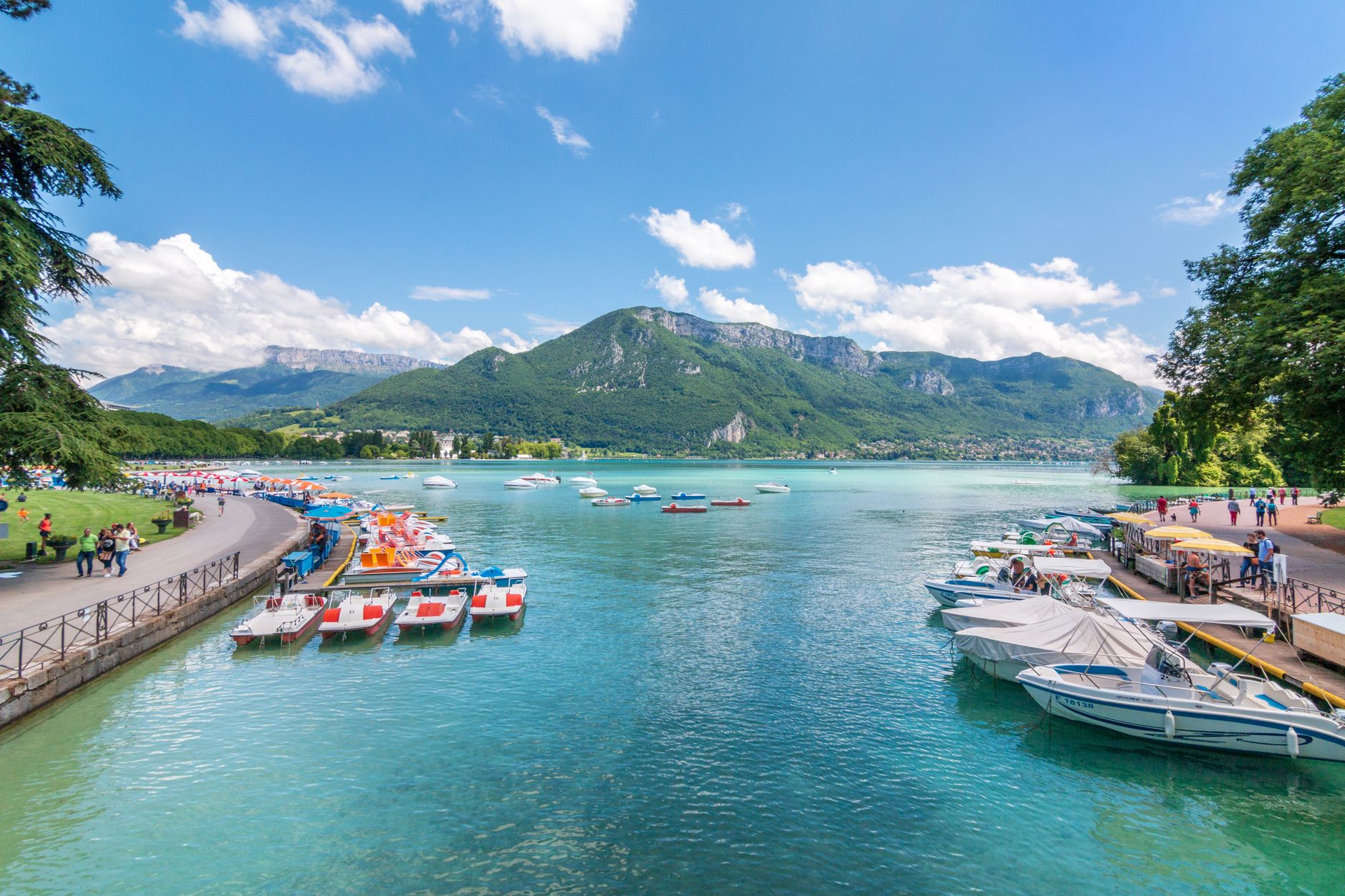
The lake changes the city's tempo. Le Pâquier opens 7 hectares of grass between the streets and the water, the Jardins de l'Europe soften the edge, and the Promenade d'Albigny shows Annecy acting like itself rather than posing for visitors: rowing clubs, cyclists, people eating ice cream too fast before it melts. Come in the late afternoon. The light turns the water silver, then blue again.
Annecy carries more than Alpine prettiness. Records of bishops exiled from Geneva shaped its churches, Savoyard food still anchors the table, and CITIA's animation industry gives the city a modern identity that has nothing to do with nostalgia. That's the real trick here: Annecy can smell of reblochon and cold stone in the morning, then feel like a contemporary cultural city by evening.
Lake and City in One Frame
Annecy's trick is scale: a 27-square-kilometre Alpine lake, a medieval core, and mountain walls all packed into a city you can cross on foot. Walk from the canals of the Vieille Ville to Le Pâquier in minutes, and the whole place shifts from stone, to water, to snowline.Canals With Teeth
The Thiou looks gentle now, all reflections and flower boxes, but it powered mills, hammers, workshops, and Annecy's working life for centuries. Stand by Pont Morens or Quai de la Cathédrale and the postcard scene gets sharper.Savoyard Layers
Palais de l'Île is the obvious landmark, though the real pleasure is how many histories stack around it: prison, courthouse, bishop's refuge, market town, lakeside resort. Up at Château d'Annecy, the view explains the geography in one sweep.Animation City
Annecy isn't preserved in amber. CITIA, the International Animation Film Festival, Bonlieu Scène nationale, and Le Brise Glace give the city a present tense, which keeps the old stones from turning into mere backdrop.
Neighborhoods
Where to wander, by quarter — each with its own rhythm.
Vieille Ville
This is the Annecy everyone comes to see, and for once the cliché is justified. Canals slip past the Palais de l'Île, Rue Sainte-Claire fills with market stalls on Tuesdays, Fridays, and Sundays, and the bridges at Perrière, Morens, and République each frame the water differently. Go early if you want the sound of footsteps on stone instead of suitcase wheels.Faubourg Sainte-Claire
Just beyond the old-town postcard zone, Faubourg Sainte-Claire feels more lived-in and less eager to impress. You'll find bistros, bars, and a looser rhythm here, with the castle above and the canal crowds thinning out. Good place to eat when you want Annecy rather than everyone else's idea of Annecy.Centre-Ville around Rue Vaugelas and Rue Sommeiller
This is modern central Annecy: cocktail bars, specialty coffee, shopping streets, and the city after office hours. Bonlieu brings theater and dance to the area, Slake and other cafes keep the daytime energy going, and the whole quarter works well when the old town starts feeling too polished. Nightlife in Annecy is modest. It lives here.Le Pâquier and Jardins de l'Europe
This stretch matters because it explains the city's relationship with the lake better than any single monument can. Le Pâquier keeps a broad, protected opening between the buildings and the water, while the Jardins de l'Europe offer old trees, benches, and the sort of light that makes people slow down without admitting it. Pont des Amours sits on the edge, but the real pleasure is walking the whole line.Albigny
Albigny is Annecy in leisure mode: beach, promenade, rowing clubs, bike traffic, and long summer evenings facing the water. Plage d'Albigny and the promenade are where you see local habits rather than heritage staging, with swimmers, families, and runners all sharing the same view toward the mountains. Stay near sunset. The city softens here.Les Romains
Les Romains is useful precisely because it isn't polished for visitors. The Tuesday market brings out everyday shopping rather than souvenir browsing, and the neighborhood gives you a clearer sense of how Annecy functions beyond the canals. Come if you want produce, local rhythm, and a break from the old-town performance.Novel
Novel rarely makes the first round of visitor research, which is part of its value. The Thursday market and residential streets show a more ordinary Annecy, one built around errands, schools, and routine instead of views. If the old town feels too edited, this district restores proportion.Pommaries
On the Annecy-le-Vieux side, Pommaries sits closer to the lake and local daily life than to medieval scenery. Its Wednesday market is one reason to come, but the bigger appeal is the quieter, residential feel before the shoreline takes over again. This is where Annecy starts behaving like a town by the water, not an image of one.
Plan your trip
Before you go
- Getting There
- Most visitors arrive via Geneva Airport (GVA), 50 km away, rather than Annecy Haute-Savoie Mont-Blanc Airport, which mainly handles business and private aviation. Direct coach line 272 links Annecy and GVA in about 1 hour 10 minutes with 21 daily connections in the 2025-2026 timetable period; the main rail hub is Gare d'Annecy, with regular TER links from Geneve Cornavin and Lyon Part-Dieu. By road, Annecy sits off the A41, the main motorway connection toward Geneva, Chambery, and Grenoble.
- Getting Around
- Annecy has no metro or tram in 2026; the city runs on the Sibra bus network, with 19 regular routes including 3 high-frequency Rythmo lines and 7 evening routes. A single Sibra ticket costs EUR 2, a 10-trip adult carnet EUR 13, and a 7-day pass EUR 18.20 from the current 2026 e-ticket fares. Cycling makes real sense here: Grand Annecy has 132 km of bike infrastructure, VeloNeCy shared e-bikes cost EUR 1.50 for the first hour with the first 30 minutes free, and the Voie Verte gives you a mostly traffic-free 33 km ride along the lake.
- Climate & Best Time
- Spring runs roughly 5-20 C, summer 13-27 C, autumn 3-21 C, and winter about -1 to 8 C, with annual rainfall around 1,250 mm. July and August bring the warmest lake weather and the heaviest visitor pressure; September stays attractive but wetter, and April can be surprisingly damp. Mid-May to mid-September is the safest window for long daylight, boat weather, and lake swims without the full August crush.
- Language & Currency
- French comes first, though visitor-facing places in Annecy usually cope well with English. Start with 'Bonjour' before asking a question; in France that small courtesy still matters. Currency is the euro, and while cards are widely accepted in 2026, some small businesses or market stalls may set a minimum card amount, so keep a little cash.
- Safety
- Annecy's practical risks are usually water, heat, traffic, and mountain access rather than any well-known tourist trouble spot. In summer, lakeside roads and trailheads clog quickly, so buses, bikes, and park-and-ride options save both time and temper. For emergencies in France, call 112, or 15 for medical, 17 for police, and 18 for fire.
Annecy Between Water, Stone, and Savoy
From prehistoric lake dwellers to a modern Alpine city with an old stubborn soul
- c. 3100 BCE
Lake Villages Rise
Most scholars date the first pile-dwelling settlements on the lake shore to around 3100 BCE. Timber houses stood above the water on driven posts, with smoke, fish, and wet wood shaping daily life. Annecy's story starts here: people learning that the lake could feed them, defend them, and define them.
- 121 BCE
Rome Breaks the Allobroges
Roman armies defeated the Allobroges, the Gallic people who controlled this stretch of Alpine ground. The conquest did not turn Annecy into a city overnight, but it changed the balance of power for good. Roads, taxes, and Roman order were coming.
- c. 50 BCE
Boutae Joins the Roman World
A Roman vicus called Boutae took shape in the Plaine des Fins, north of today's old town. Records and archaeology point to baths, a forum, and a small theater, all built where routes from Geneva, Italy, and the Savoy valleys crossed. You can still feel the logic of the place: Annecy sat where movement had to slow down.
- 259
The Roman Town Burns
Late Roman instability reached Boutae in the third century, and the settlement suffered attacks and fire. Trade thinned out. Stone survived better than confidence.
- 443
Life Climbs the Hills
As Roman authority weakened, people abandoned the exposed plain and shifted toward the safer heights of Annecy-le-Vieux. The old roadside town faded. A hill was easier to defend than a memory.
- 1107
Annecy-Le-Neuf Appears in Records
A document from 1107 mentions Annecy-le-Neuf, the new settlement below the older hilltop site. This is the moment the medieval town steps into clear written history. The city by the Thiou begins to look less accidental.
Show the full timeline (29 moments)
- 1132
Palais de l'Île Takes Shape
A fortified house rose on the rocky island in the Thiou, the narrow canal splitting around it like cold silver. That building would become the Palais de l'Île, later prison, courthouse, and office block with excellent views and grim working conditions. Annecy's postcard image began as a machine of control.
- 1170
The Tuesday Market Begins
A weekly market was established, and Tuesday became Annecy's trading pulse. Cloth, grain, livestock, gossip, and debt all changed hands under arcades and open sky. Markets build cities more reliably than speeches do.
- 1219
Counts of Geneva Move In
Driven from Geneva by long conflict with bishops, the Counts of Geneva made Annecy their seat in the late twelfth and early thirteenth centuries. Population and status jumped. Workshops multiplied along the Thiou, whose fast water could turn wheels all day.
- 1342
Jean de Brogny Is Born
Jean Allarmet de Brogny was born in the hamlet of Brogny, just outside Annecy, and rose to become a cardinal and one of the great church diplomats of his age. His career reached the Council of Constance, but his local mark mattered too: he endowed religious institutions that tied Annecy more tightly to learned Catholic Europe. Small places produce ambitious men.
- 1401
Savoy Takes Annecy
The County of Geneva passed to the House of Savoy, and Annecy entered a new political orbit. Savoy brought fresh investment, courtly attention, and hard dynastic calculation. The city stopped being a border capital and became a useful piece on a larger board.
- 1412
Fire Devours the Lower Town
A major fire tore through Annecy on 3 February 1412, destroying much of the lower town and damaging the castle complex. Rebuilding followed in timber, stone, and stubbornness. Medieval cities were always one spark away from starting over.
- 1444
The Castle Becomes a Residence
During the fifteenth century, the Château d'Annecy was enlarged and adapted into a proper princely residence under the Savoy line. Towers, loggias, and administrative rooms climbed the hillside above the town. Power wanted a view.
- 1536
Geneva's Bishopric Finds Refuge
After the Reformation triumphed in Geneva, Catholic clergy fled south and Annecy became the refuge seat of the bishops of Geneva. That shift changed everything. A provincial town turned into a frontier headquarters for the Catholic response.
- 1567
Francis de Sales Enters the Story
Francis de Sales was born in 1567, and Annecy would become the city most closely tied to his voice and work. As bishop from 1602, he preached with unusual clarity and founded institutions that still shape the place. His prose was gentle; his political moment was not.
- 1606
A Literary Academy Opens
The Académie Florimontane was founded in Annecy in 1606 by Francis de Sales, Antoine Favre, and Claude Favre de Vaugelas. It was a humanist circle in a devout town, which is more interesting than it sounds. Prayer and polished language often shared the same rooms here.
- 1610
Jeanne de Chantal Founds a New Order
Jeanne de Chantal worked with Francis de Sales in Annecy to found the Order of the Visitation in 1610. The convent brought a quieter form of religious life into a century that preferred hard edges. Her presence still lingers uphill at the Basilica of the Visitation, where the city gives its saints the long view over the lake.
- 1728
Rousseau Arrives Young and Impressionable
Jean-Jacques Rousseau reached Annecy as a restless sixteen-year-old and met Madame de Warens here, a turning point he never forgot. The city entered his memory as a place of awakening, desire, and reinvention. Annecy was not just scenery in his story; it was ignition.
- 1792
Revolutionary France Crosses the Border
French troops invaded Savoy in 1792, and Annecy was absorbed into revolutionary France. Feudal rights were abolished, church property was seized, and old loyalties broke fast. The bells still rang, but for a different state.
- 1815
Savoy Returns After Napoleon
The Congress of Vienna restored Annecy to the Kingdom of Sardinia under the House of Savoy. The city swung back from French revolutionary administration to dynastic rule. Europe liked to redraw maps in quiet rooms and let border towns live with the result.
- 1860
Annecy Becomes French Again
The Treaty of Turin transferred Savoy to France in 1860, and Annecy became prefecture of the new department of Haute-Savoie. That was a bureaucratic promotion with real consequences: more state presence, more roads, more administrative gravity. Paperwork can remake a city.
- 1866
The Railway Reaches the Lake
Rail service arrived in Annecy in 1866 and pulled the city into a wider rhythm of commerce and tourism. Visitors could now step off a train and smell lake air within minutes. Distance shrank; Annecy's future widened.
- 1907
Pont des Amours Opens
The iron Pont des Amours was installed between the Pâquier and the Jardins de l'Europe in 1907. It gave Annecy one of its best views: swans below, mountains ahead, and that sharp Alpine light bouncing off the canal. Romantic name, solid engineering.
- 1921
Louis Lachenal Is Born
Louis Lachenal was born in Annecy in 1921 and grew up in a region where mountains are less backdrop than instruction. In 1950 he became one of the first two climbers to reach Annapurna's summit. Annecy has always produced people who look uphill.
- 1944
Resistance and Liberation
During the Second World War, Annecy lived under occupation while nearby Haute-Savoie became one of the strongest centers of Resistance, especially around the Glières Plateau. Liberation came in 1944, and the region remembered who had hidden, fought, betrayed, and endured. Mountain country keeps accounts.
- 1956
The Castle Becomes a Museum
After years of decline, the Château d'Annecy reopened as a museum in 1956. That mattered because the city chose preservation over demolition just as postwar France was learning to value its older fabric again. Stone got a second career.
- 1960
The Lake Gets Defended
By the 1960s, local officials and residents pushed hard to protect Lake Annecy from the pollution that had already damaged other European waters. Sewer systems were upgraded and environmental controls tightened. Clean water here was not an Alpine miracle; it was policy.
- 1963
Animation Finds Its Capital
The Annecy International Animation Film Festival began in 1963 and slowly turned the city into a global meeting point for animators. For one week each year, medieval streets and lakefront lawns fill with storyboards, industry gossip, and people arguing about drawn movement. It suits Annecy more than you might expect.
- 2017
Greater Annecy Becomes One City
On 1 January 2017, Annecy merged with Annecy-le-Vieux, Cran-Gevrier, Meythet, Pringy, and Seynod to form a larger commune. The change was administrative, but it matched daily reality: one urban life spread around the lake edge and foothills. Old borders survived mostly in habit and property prices.
Who lived here
-
Bishop and writer · 1567–1622
Francis de Sales
Bishop in Annecy, 1602–1622
Annecy became his working stage when the bishops of Geneva were forced to operate from here after the Reformation. He preached, wrote, and gave the city a Catholic identity that still clings to its hilltop basilica and quiet church interiors; he would probably recognize the bells before the souvenir shops.
-
Religious founder · 1572–1641
Jeanne de Chantal
Co-founded the Visitation order here
She built something lasting in Annecy with Francis de Sales: the Order of the Visitation, rooted in discipline, care, and a kind of spiritual plainness. The city still carries her in stone and ritual, though she'd likely raise an eyebrow at how many visitors climb uphill for the view before they notice the tombs.
-
Philosopher and writer · 1712–1778
Jean-Jacques Rousseau
Lived here for several years
Rousseau arrived in Annecy young and unsettled, and this is where he met Madame de Warens, the woman who would alter the course of his life. He might still recognize the narrow streets that once felt full of possibility, though the camera phones at the canals would test his patience.
-
Novelist · 1804–1857
Eugene Sue
Lived his final years in Annecy-le-Vieux
Sue spent the last stretch of his life in exile near Annecy, far from the Paris that made him famous through The Mysteries of Paris. The calm lake air must have felt like a strange landing place for a writer of crowded, feverish cities.
-
Composer · 1845–1924
Gabriel Faure
Stayed in Annecy-le-Vieux for several years
Faure spent time in Annecy-le-Vieux, where the lake and mountain horizon offered the kind of quiet his music understands well. You can imagine him approving the evening hour here, when the water turns silver and every sound seems slightly delayed.
-
Mountaineer · 1921–1955
Louis Lachenal
Born here
Lachenal grew up with the Annecy basin as his backdrop long before he helped make the first ascent of Annapurna in 1950. His name on a promenade makes sense: this city looks soft from the lakefront, but the mountains behind it have always trained harder people than the postcard suggests.
Where to Eat
Where locals actually book dinner — not the tourist menus.
Insider tips
Small things that change how the city treats you.
Market Timing
Hit the Old Town market early on Tuesday if you care about food rather than souvenirs. Friday and Sunday are larger, but the extra stalls make Rue Sainte-Claire feel more crowded by mid-morning.Cycle the Shore
Rent a bike for the lakefront instead of circling for parking around Albigny. The cycle path and Promenade d'Albigny make more sense of Annecy than sitting in summer traffic.Eat Both Sides
Don't do fondue three nights running. Have one Savoyard cheese dinner, then switch to lake fish such as fera or omble chevalier so you taste the city, not just its winter clichés.Swim Earlier
Plage d'Albigny gets busy on hot afternoons. Go in the morning for calmer water, easier towel space, and a clearer view of how locals actually use the lake.Save the Panorama
If you want the big lake view without a full mountain day, keep Semnoz or Col de la Forclaz for clear weather. Cloudy afternoons flatten the whole point.Use the Thiou
Walk the Thiou and the canal bridges instead of treating Annecy as one postcard stop. Pont Perriere, Pont Morens, and the quieter Quai de la Cathedrale show the city at human scale.Skip Lakefront Menus
Restaurants right on the busiest canals charge for the view. For better value, eat a market lunch or book a Bib Gourmand address such as Brasserie Brunet or Mazette! away from the photo bottlenecks.
Gallery
The city, as it actually looks.


Frequently asked
Is Annecy worth visiting?
Yes, especially if you want lake, mountains, and an old town you can cross on foot in minutes. Annecy works because the pieces sit close together: a 12th-century palace in the canal, market streets under arcades, then open water and peaks a short walk away.
How many days in Annecy?
Two to three days is the sweet spot. One day covers the old town and lakefront, while a second gives you time for a market morning, castle museum, beach or cruise, and an uphill viewpoint such as the Basilique de la Visitation or Semnoz.
How do you get around Annecy without a car?
Very easily in the center. The old town, Le Paquier, Jardins de l'Europe, the castle, and much of the lakefront are walkable, and bikes make the Albigny side and longer shore stretches far easier than driving.
Is Annecy expensive?
It can be, especially around the canals and lakefront in summer. You can cut costs by staying a little outside the postcard core, eating at the market, walking rather than parking, and saving one proper Savoyard dinner instead of making every meal a cheese event.
Is Annecy safe for tourists?
Yes, Annecy is generally safe for visitors. The main annoyances are pickpocket-style opportunism in crowded market lanes and summer congestion around the lake, so keep bags zipped and don't leave valuables in a parked car.
What is the best time to visit Annecy?
Late spring to early autumn is the easiest stretch, with May, June, and September usually giving the best balance of light, lake access, and manageable crowds. July and August have the full summer mood, but they also bring packed promenades and pricier rooms.
Can you swim in Lake Annecy?
Yes, and Plage d'Albigny is one of the easiest city options. Go early on hot days, because the beach fills quickly and the calm morning water is better than the churned-up late afternoon version.
Do you need a car for Annecy day trips?
Not always, but it helps for places such as Col de la Forclaz, Roc de Chere, and Menthon-Saint-Bernard if you want flexibility. If you stay local, Annecy itself gives you plenty on foot, by bike, and by boat.
Pick up where you left off
Saved and recently read places — kept on this device only.
Photo credits (4)
- Hugo Magalhaes — Pexels License (https://www.pexels.com/license/) — Source: https://www.pexels.com/photo/16156548/
- Magda Ehlers — Pexels License (https://www.pexels.com/license/) — Source: https://www.pexels.com/photo/12780953/
- Le sixième rêve — Pexels License (https://www.pexels.com/license/) — Source: https://www.pexels.com/photo/33565377/
- Robert Pügner — Pexels License (https://www.pexels.com/license/) — Source: https://www.pexels.com/photo/12266770/
Photos may have been resized or cropped.