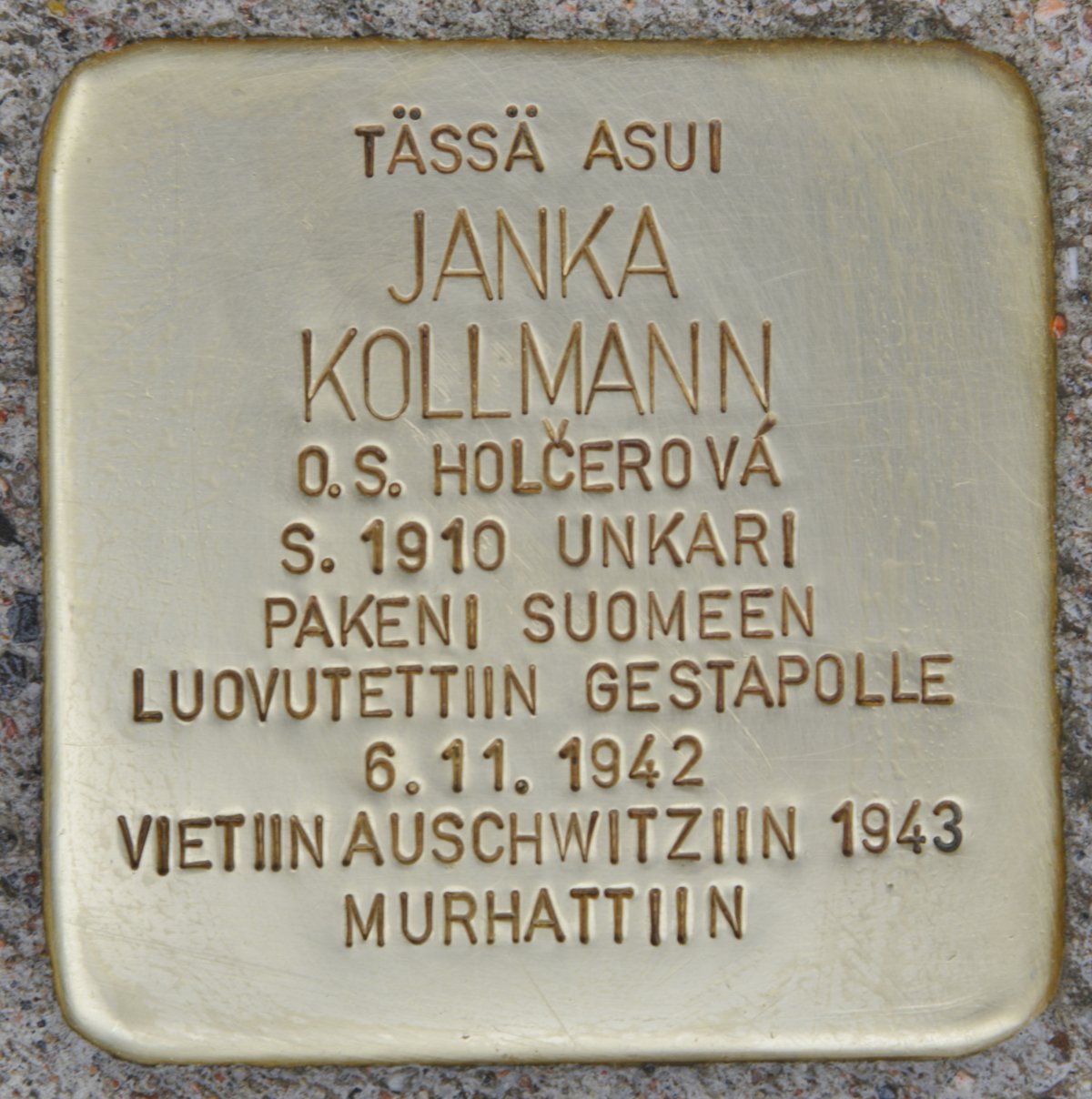
Plan and listen to Stolperstein Dedicated To Janka Kollmann with Audiala.
Audio guide in your pocket, itinerary in your browser. Built for the way you actually visit.
Introduction
The Stolperstein dedicated to Janka Kollmann in Helsinki is a deeply evocative memorial that invites visitors to reflect on Finland’s role in the Holocaust and the personal tragedies that unfolded during World War II. As part of the Stolperstein (“stumbling stone”) project initiated by German artist Gunter Demnig, these small brass plaques embedded in city sidewalks commemorate victims of Nazi persecution by marking their last freely chosen residences (Stichting Stolpersteine). The Janka Kollmann Stolperstein, situated in the tranquil Munkkiniemi district, stands as a testament to the experiences of Jewish refugees in Finland and the enduring importance of remembrance.
This comprehensive guide covers the historical context of the Kollmann family, details about visiting the Stolperstein, travel tips, cultural context, and recommendations for a meaningful visit. Whether you are a history enthusiast, a cultural traveler, or someone seeking to honor the memory of Holocaust victims, this memorial offers a powerful and intimate experience that contributes to ongoing remembrance and education efforts in Helsinki and beyond.

Historical Context: The Kollmann Family and Jewish Refugees in Finland
The Kollmann family’s story is emblematic of the experience of Jewish refugees in Finland during World War II. Janka Kollmann, her husband Georg, and their young son Franz Olof fled Austria following the 1938 Anschluss and increasing anti-Jewish persecution. They joined a small but growing Jewish refugee community in Helsinki (fi.wikipedia.org).
Settling in the Munkkiniemi district, the family found relative safety until the shifting alliances and pressures of war put them in grave danger. Franz Olof was born in May 1941, as Finland’s alliance with Nazi Germany heightened the risks for Jewish residents and refugees alike.
Finland’s Wartime Policies and the Fate of Refugees
After the Winter War (1939–1940), Finland allied with Nazi Germany in 1941, leading to increased pressure from German officials to surrender Jewish refugees (fi.wikipedia.org). In October 1942, Janka and her son were arrested by Finnish authorities, and Georg, already interned, was also taken into custody. The family was among eight Jewish refugees handed over to the Gestapo and deported to Auschwitz. Janka and Franz Olof were murdered; only Georg survived (YLE; Finland Today).
The Stolperstein Project: European and Local Significance
The Stolperstein project, begun by Gunter Demnig in the 1990s, is now the world’s largest decentralized Holocaust memorial, with over 75,000 stones across Europe (Stichting Stolpersteine). Each stone is a 10 x 10 cm brass plaque inscribed with the victim’s name and fate, embedded outside their last freely chosen residence. The project’s guiding motto, “A person is only forgotten when his or her name is forgotten,” underscores the power of individualized remembrance.
Helsinki’s Stolpersteine, including those for the Kollmann family, were installed in 2018 and represent Finland’s growing commitment to acknowledging its role during the Holocaust (Finland Today; Traces of War).
Visiting the Janka Kollmann Stolperstein: Location, Hours, and Accessibility
- Address: Munkkiniemen puistotie 18B, 00330 Helsinki, Finland (Traces of War)
- Coordinates: Approximately 60.197608, 24.877944
- Hours: The Stolperstein is outdoors and accessible 24/7, year-round.
- Entry Fee: Free; no tickets required.
- Accessibility: The stone is set in a level public sidewalk, suitable for wheelchair users and visitors with limited mobility.
How to Get There
- Public Transport: Helsinki’s efficient tram and bus network connects the city center to Munkkiniemi. Use the HSL app for route planning (Faraway Worlds).
- Walking/Biking: The site is about 45 minutes on foot or 20 minutes by bike from the city center.
- Best Time to Visit: Late spring through early autumn (May–September) offers the most pleasant conditions. Winters can be icy, potentially obscuring the stone.
Travel Tips and Nearby Attractions
- Combine Visits: The Stolpersteine for Dr. Georg Kollmann and Franz Olof Kollmann are also at the same address, allowing reflection on the family’s fate (Finland Today).
- Explore Munkkiniemi: Enjoy the tranquil parks and local cafes for quiet contemplation.
- Nearby Cultural Sites: Consider visiting the Finnish Jewish Museum, the National Museum of Finland, or the “Hjälpsökande händer” memorial at Tähtitorninmäki Hill.
- Guided Tours: While there are no regular tours focused solely on Stolpersteine, some Helsinki walking tours include them. Private guides may tailor visits on request.
Cultural and Educational Context
The Stolperstein for Janka Kollmann is a rare and powerful public acknowledgment of Finland’s Holocaust history. It serves as a bridge between personal memory and collective responsibility, encouraging both reflection and education (Holokaustin uhrien muisto ry). Finnish schools increasingly incorporate Holocaust education, and organizations such as Holokaustin uhrien muisto ry help foster ongoing remembrance and learning.
Visitor Etiquette and Recommendations
- Respectful Conduct: Speak quietly, do not litter, and avoid obstructing the sidewalk.
- Commemorative Gestures: Placing a small stone or flower is a meaningful act rooted in Jewish tradition (Timo Heinonen).
- Photography: Discreet photos are welcome, but respect the privacy of local residents.
- Reporting Damage: If the stone is damaged or obscured, notify Holokaustin uhrien muisto ry (Holokaustin uhrien muisto ry).
Frequently Asked Questions (FAQ)
Where is the Stolperstein for Janka Kollmann located?
At Munkkiniemen puistotie 18B, Helsinki, embedded in the sidewalk in front of the Kollmann family’s former home (Traces of War).
What are the visiting hours?
The memorial is accessible 24 hours a day, all year round.
Is there an entry fee?
No, visiting the Stolperstein is free of charge.
Is the site wheelchair accessible?
Yes, the stone is flush with the pavement and accessible to all.
Are guided tours available?
Some Helsinki walking tours include Stolpersteine; private guides can tailor visits.
Listen to the full story in the app
The whole Stolperstein Dedicated To Janka Kollmann,
told well.
Audio guides for 1,100+ cities across 96 countries. History, stories, and local insight — offline ready.
Verified, and shown.
Researched and written by the Audiala editorial team from historical records, architectural archives, and local expertise.
Researched from Wikidata, Wikipedia & official sources · fact-checked · How we make our guides →