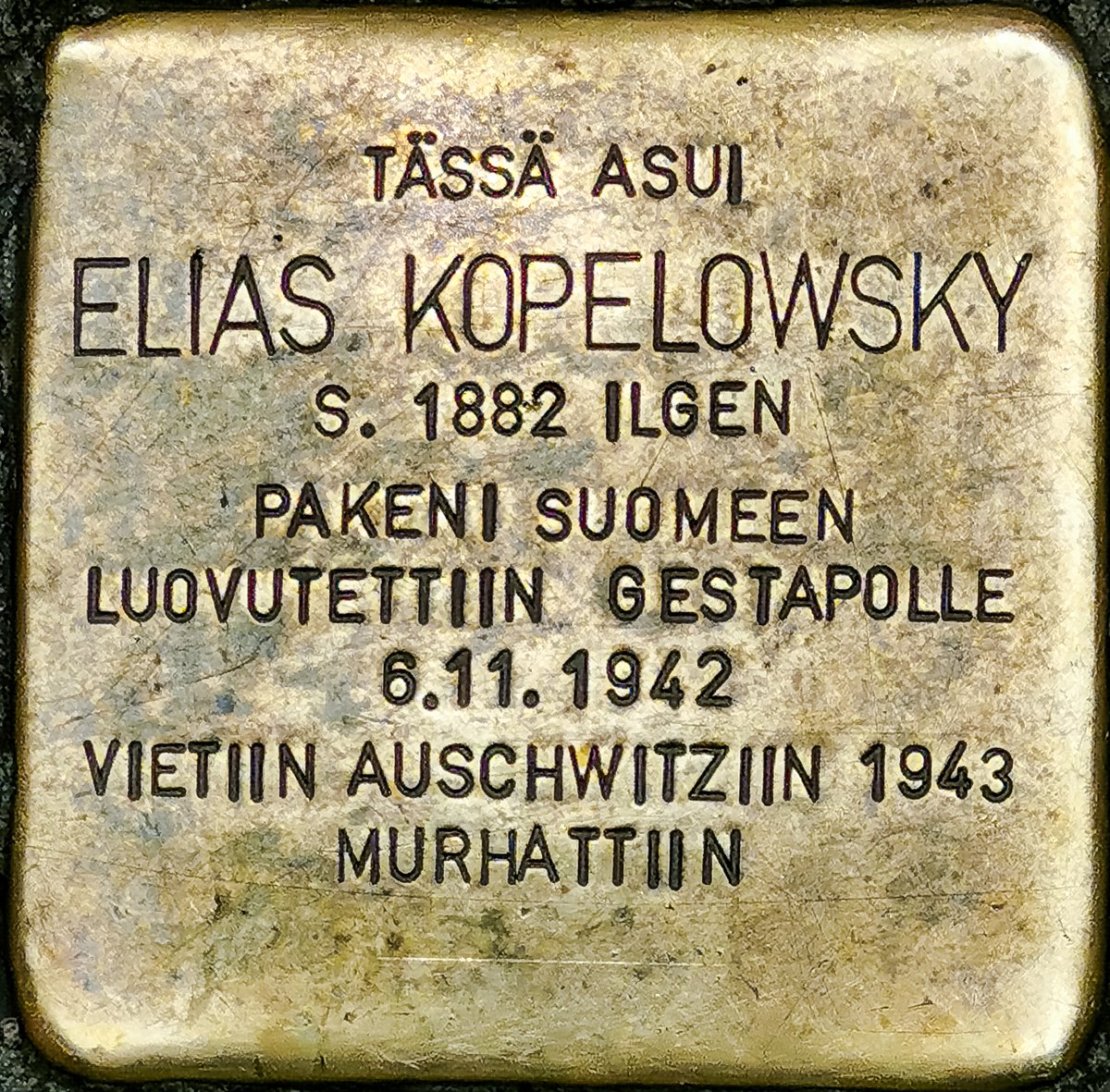
Plan and listen to Stolperstein Dedicated To Elias Kopelowsky with Audiala.
Audio guide in your pocket, itinerary in your browser. Built for the way you actually visit.
Introduction
The Stolperstein dedicated to Elias Kopelowsky in Helsinki stands as a deeply impactful memorial, offering visitors a personal connection to the stories of Holocaust victims and Finland’s complex wartime history. Stolpersteine—or "stumbling stones"—are small brass plaques set into public pavements across Europe, each commemorating an individual persecuted or murdered by the Nazis. Conceived by artist Gunter Demnig in the early 1990s, this decentralized memorial project brings remembrance into everyday urban life, encouraging reflection among all who pass by (Stolpersteine.eu).
The Elias Kopelowsky Stolperstein, installed in 2019 outside Hotel Torni at Yrjönkatu 26, honors a Jewish refugee from Latvia who was handed over by Finnish authorities to the Gestapo in 1942 and murdered at Auschwitz. The stone marks both a personal tragedy and a national reckoning, as it commemorates one of eight Jewish refugees deported from Finland during World War II—a chapter for which Finland has since issued an official apology (HS.fi; Kotimaa).
Accessible at all times and free to visit, the site invites personal reflection and serves as an educational touchstone for understanding the broader impact of the Holocaust in Finland and Europe. Visitors can enrich their experience by combining this visit with nearby landmarks such as the Helsinki Synagogue and the Finnish Jewish Museum (Jewish Traveler; myhelsinki.fi).
This comprehensive guide details the origins, context, visiting information, and cultural significance of the Elias Kopelowsky Stolperstein, helping you engage meaningfully with this important memorial.

Historical Background: Elias Kopelowsky and the 1942 Deportations
Elias Kopelowsky, a Jewish timber merchant from Latvia, sought refuge in Finland during World War II, staying at Hotel Torni in Helsinki from August 1942. On October 29, 1942, he was quietly arrested by the Finnish State Police (Valpo), allowed only two suitcases, and his personal notes were confiscated. Kopelowsky was held in a Helsinki police prison before being transferred, along with seven other Jewish refugees, to the Gestapo in Tallinn, Estonia, on November 6, 1942. Of the eight deported, only one survived; Kopelowsky was murdered in Auschwitz (HS.fi; de.wikipedia.org; Kotimaa).
This episode remains a somber point in Finnish history, prompting official reflection and a government apology issued decades later (ICEJ).
The Stolperstein Project: Origins and European Context
Initiated by German artist Gunter Demnig in the early 1990s, the Stolperstein project seeks to commemorate individual victims of the Nazi regime—Jews, Roma, political prisoners, LGBTQ individuals, and others—by embedding brass-plated concrete cubes into pavements at their last known voluntary residence or workplace (Stolpersteine.eu; pragueviews.com).
Each Stolperstein measures 10 x 10 cm and bears an inscription with the victim’s name, birthdate, deportation details, and fate. As of 2024, more than 116,000 Stolpersteine have been placed in over 1,860 cities and towns across 31 European countries, making it the world’s largest decentralized memorial project.
Stolpersteine are intentionally unobtrusive, inviting passersby to "stumble" upon them and reflect on each individual's story.
Visiting the Elias Kopelowsky Stolperstein
Location and Access
- Address: Yrjönkatu 26, outside Hotel Torni, central Helsinki
- How to Get There: Easily reached by foot from Helsinki Central Railway Station, or via tram and bus lines serving the city center (myhelsinki.fi).
- Landmark: Hotel Torni is a prominent city center building; the Stolperstein is embedded in the pavement by its entrance.
Visiting Hours and Tickets
- Open Access: The Stolperstein is outdoors and freely accessible 24/7.
- Admission: No ticket or fee required.
Practical Visitor Tips
-
Best Times to Visit: The memorial can be visited year-round. Summer brings more activity, while winter and early morning or late afternoon visits offer quiet contemplation (touristplaces.guide).
-
How to Visit Respectfully:
- Pause to reflect and read the inscription.
- Avoid stepping directly on the stone.
- Discreet photography is permitted; avoid disrespectful poses.
- On Holocaust Remembrance Day (January 27), locals and visitors often clean the stones using a soft cloth (pragueviews.com).
- Maintain respectful silence, especially during ceremonies.
-
Accessibility: The pavement is flat and suitable for wheelchairs and strollers.
Guided Tours and Events
- Local organizations and guides offer walking tours that include the Elias Kopelowsky Stolperstein and other Holocaust memorials in Helsinki.
- Special commemorative events may be held on Holocaust Remembrance Day and other anniversaries (myhelsinki.fi).
Photography and Accessibility
- Discreet photography is allowed.
- The site is pedestrian-friendly and accessible for those with mobility challenges.
Cultural and Historical Significance
Stolpersteine foster a culture of remembrance, making the memory of Holocaust victims part of daily urban life. The Elias Kopelowsky stone is particularly significant in Finland, marking a site where a Jewish refugee was handed over to Nazi authorities—a painful chapter that has led to ongoing national dialogue (pebblegalaxy.blog; fi.wikipedia.org).
Each Stolperstein transforms abstract history into a personal story, challenging visitors to remember and reflect on individual lives and the consequences of prejudice. The project also commemorates victims from other marginalized groups persecuted by the Nazis.
Integrating the Visit into a Helsinki Itinerary
The Stolperstein’s central location makes it easy to include in a walking tour of Helsinki’s historical sites. Recommended nearby attractions:
- Helsinki Synagogue: Bulevardi 34, with free entry and guided tours by appointment (Jewish Traveler).
- Finnish Jewish Museum: Offers rotating exhibitions on Jewish history (Jewish Museum of Finland).
- Helsinki Cathedral, Market Square, Amos Rex Museum: Key city landmarks (touristplaces.guide; theworldwasherefirst.com).
- Other Stolpersteine in Helsinki: Found in districts such as Munkkiniemi, Korkeavuorenkatu, and Hakaniemi (fi.wikipedia.org).
FAQ
Q: Are there tickets or fees to visit the Elias Kopelowsky Stolperstein?
A: No, the memorial is freely accessible at all times.
Q: Is the Stolperstein accessible for those with disabilities?
A: Yes, the site is on flat pavement and suitable for wheelchairs and strollers.
Q: Are guided tours available?
A: Yes, several local organizations offer tours that include the Stolperstein.
Q: Can I take photos?
A: Discreet photography is permitted. Please be respectful.
Q: What else can I visit nearby?
A: The Helsinki Synagogue, Jewish Museum, and other central landmarks.
Discover More
The Elias Kopelowsky Stolperstein is more than a memorial stone—it is a powerful reminder of the individual lives lost to the Holocaust and Finland’s own wartime complexities. By situating remembrance in public spaces, Stolpersteine transform abstract tragedy into tangible experience.
We encourage all visitors to approach the memorial with respect, take time for quiet reflection, and consider joining guided tours or participating in commemorative events to deepen your understanding. For more information, updates, and guided historical walks, download the Audiala app and follow local organizations on social media.
Listen to the full story in the app
The whole Stolperstein Dedicated To Elias Kopelowsky,
told well.
Audio guides for 1,100+ cities across 96 countries. History, stories, and local insight — offline ready.
Verified, and shown.
Researched and written by the Audiala editorial team from historical records, architectural archives, and local expertise.
Researched from Wikidata, Wikipedia & official sources · fact-checked · How we make our guides →