Northern Stelae Park
AksumEthiopia 14° N · 38° E Verified Aug 2026
Aksum's Great Stele never stood — 520 tonnes toppled during erection, crushing the tomb beneath. Its neighbour spent 68 years in Mussolini's Rome.
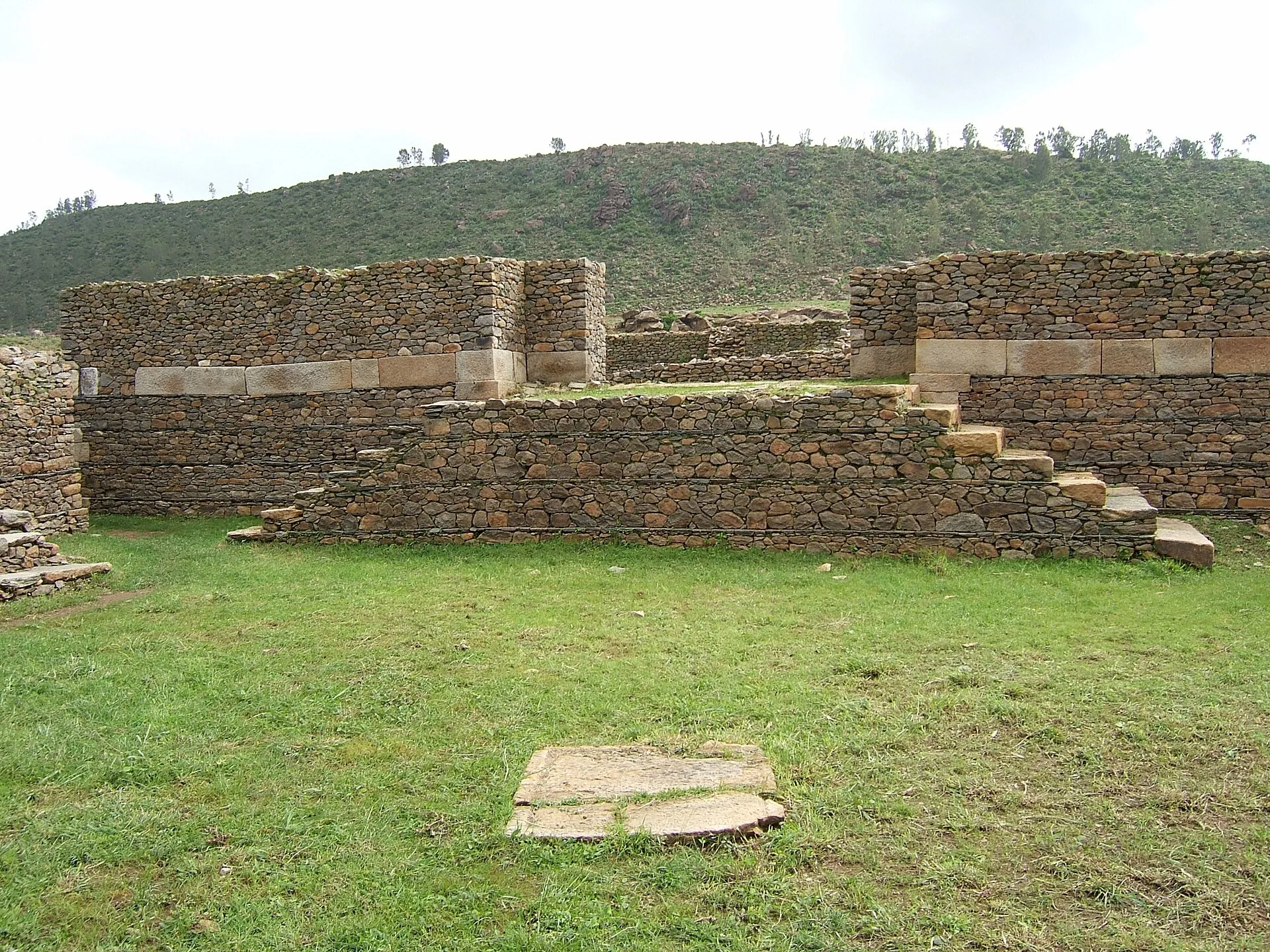 Photo: Giustino · CC BY 2.0
- Time needed
- 2-3 hours (2 days for all Aksum sites)
- Entry
- Combined archaeological ticket, valid 3 days across 7 sites — verify current price on site
- Best season
- October-March (dry season)
The largest stone ever quarried and carved as a single piece by human hands lies flat on its back in a field in Aksum, northern Ethiopia — broken into five sections, and scholars still can't agree whether it ever stood upright at all. That possible failure is the best reason to visit Northern Stelae Park. Around 520 tonnes of nepheline syenite, heavier than three fully loaded jumbo jets, came down here sometime in the third or fourth century AD, and its surviving neighbours were carved to look like multi-storey palaces, complete with false doors and stone window frames. Ethiopia's first great kingdom kept its records in granite here, and you can read them in an afternoon.
Everyone calls them obelisks. They aren't. An obelisk tapers to a pyramid point; these are hawelti — stelae — and they end in a rounded, shield-like crown that Andrea Manzo has argued may echo a Nubian shield rather than serving as pure ornament. Guides in Aksum will use the local word if you use it first.
What they marked is the part most visitors skip. Every one of the giants stood over an underground tomb, and the field around them is riddled with rock-cut burial chambers, offering platforms, and at least one funerary structure the Great Stele appears to have smashed on its way down. Bring a torch. The dark is where the actual architecture is.
The park sits inside the Aksum property, inscribed on the UNESCO World Heritage List in 1980, at roughly 2,130 m — high enough that the light goes hard and white by mid-morning and the carved storeys flatten out. Come at seven, or come at five. The low sun rakes across the false doors and suddenly the stone reads as a building.
What to see
-
King Ezana's Stele — the one that never fell
Come through the west gate and the first thing overhead is a 23-metre shaft of grey-green stone carved to look like a nine-storey building. Count the tiers of false windows yourself; the storeys are all there, stacked like floors of a palace. No Aksumite building of nine floors has ever been excavated, which means the carvers cut a fantasy — architecture grander than anything that actually stood on this plateau.
Look closer at the rows of small round bosses running across each tier. Those are timber beam-ends, reproduced in solid rock. Aksumite builders laid horizontal wooden tie-beams through their stone walls and let the ends poke out; here a carver copied that joinery into a monolith where it holds up precisely nothing.
And it's not granite, whatever the guidebook says. Phonolite — a fine-grained volcanic stone, named for the ring it gives when struck. This is the only one of the three great royal stelae still upright when Henry Salt drew it in the early 1800s and Mabel Bent photographed it in 1893. Stand where they stood. Everything around the stone has changed; the stone hasn't.
-
The Great Stele — 33 metres of failure, lying where it landed
Somewhere in the third or fourth century AD, Aksum's engineers tried to raise a single piece of stone 33 metres tall — roughly the length of two city buses parked end to end, standing on its nose. Probably the largest monolith any human society has ever attempted to erect. It came down during or just after the raising, and nobody ever tried again.
It broke the Nafas Machau temple on the way down. Those ruins are still there, a few steps off the path, unmarked and walked past by nearly everyone.
What makes this the emotional centre of the field is the angle. You walk along it rather than crane up at it, and the carved false door at its base — the symbolic entrance for the dead into the tomb below — sits at eye level instead of twenty metres over your head. Photographers: this is the one subject here that composes from the ground. The standing stelae fight the sky and blow out at midday.
-
The returned stele — and the hole it left
The 24-metre, 160-tonne stele near the centre of the field spent 68 years in Rome. Italian troops cut it into three pieces in 1937 and trucked it to Massawa in five separate trips over two months; it reached Naples on 27 March and was raised at Porta Capena on 28 October, timed to the fifteenth anniversary of the March on Rome. Italy agreed to give it back in 1947. The last segment flew into Aksum airport in 2005, and it was standing again by 2008.
Everyone photographs the stele. Almost nobody looks at the pit. Its original foundation hole is six metres deep and about ten square metres across, and it sat empty for seven decades — the most eloquent thing on the site is a hole in the ground.
Walk round the base while you're there and find the two false doors, complete with carved lock and handle, plus false windows on all four faces. The semi-circular top was once framed in fixed metal plate.
-
The 45-minute walk that makes the field make sense
This is a site that rewards knowing rather than looking, so do it in order. West gate and Ezana's stele first — count the nine storeys, find the stone beam-ends. Then cut across to the crude, rough, undecorated slabs standing right beside the carved royal ones: thirty seconds of walking takes you from a lesser noble's one-metre marker to a king's nine-storey palace in stone, which is the whole social hierarchy of Aksum laid out in a single glance.
Then the fallen giant, then the empty pit, then down into the Tomb of the False Door — the carved door up top is symbolic; this is the real one. The underground chambers flood, and the nearby Tomb of the Brick Arches sits ten metres below modern ground level in poor condition, so expect the subterranean part to be the first thing shut during and after the summer rains.
Finish standing on the car park, laid in 1963. Ground-penetrating radar in 2004–05 found vast funerary chambers underneath it. Every visitor parks on an unopened royal cemetery and drives away never knowing. One more thing: hire your guide from the Aksum Tourism Office by the field, not from the men who intercept you at the gate. The hawkers here are pushier than anywhere else in Tigray, and the accredited guides get you into compound areas you can't otherwise reach.
Plan your visit
- Getting There
- Read the security notice first: as of August 2026 the UK FCDO advises against all travel to Tigray, and civilian flights to Axum Airport have been suspended since 29 January 2026, with foreign nationals reportedly barred from Tigray airports. Under normal conditions the park sits on the northern edge of Aksum town centre — roughly 400 m north of the tourist commission roundabout, about five minutes on foot from the Axum Hotel, and directly below the Yeha Hotel bluff. Historic overland options were one long day by shared car from Addis Ababa (~1,000 km) or a day by bus from Gondar via Shire; short in-town hops go by bajaj three-wheeler, fare agreed before you climb in.
- Opening Hours
- Travel sources list daily opening 08:30–17:00 for 2026, but no official ARCCH or Tigray tourism page confirms this, and the regional situation makes any published hour provisional. Aksum sites often shut for lunch around 12:00–14:30, so aim for a morning slot. Expect crowding and disruption around Hidar Tsion on 30 November, when pilgrims fill the streets around the adjacent church complex.
- Time Needed
- Forty-five minutes gets you the three headline stelae — the fallen 33 m Great Stele, the returned Rome stele, and King Ezana's 21 m survivor. Two hours covers all 120-plus stones at a walking pace, which is what the standard guided tour runs to. Add the underground tombs and the on-site Aksum Archaeological Museum and you're at three to four hours; the whole town deserves two full days, whatever the guidebooks say about half a day.
- Tickets & Cost
- Entry works through a combined Aksum archaeological ticket valid three days across seven sites, including the Gudit Stelae Field — the multi-day validity is the durable fact, the price is not. Reported figures for 2026 range from about 200 to 300 birr for foreigners, with churches such as St Mary of Zion ticketed separately at around 200 birr; birr devaluation since the 2024 float has scrambled every published number. Cash only, no online booking, bought at the tourist commission office off the roundabout or at the gate; guides from the Axum Guides Association next door run roughly US$20 for two hours.
- Accessibility
- No official accessibility information exists for this site, so treat the following as inference rather than fact. The field is broadly flat compacted earth and gravel, and the three main stelae plus the fallen Great Stele blocks sit within reach of the main path — a wheelchair user could plausibly see them. The underground tombs are another matter: stone stairs, low headroom, dim light, no lift, and the Tomb of the Brick Arches has been closed at times for safety. At 2,130 m, unacclimatised visitors feel the exertion sooner than they expect.
History
Stone Houses for the Dead
Aksum controlled the Red Sea trade between Rome and India for centuries, and it was the only ancient African state south of the Sahara to mint its own coinage — gold, silver and bronze. Wealth on that scale needs somewhere to be seen. The stelae field is where the kingdom spent it.
The carving tells you what the money bought. Stacked storeys, projecting beam-ends, window frames, and a false door at ground level with a fake lock and a doorknob carved in relief: each stele is a stone version of an aristocratic house, standing upright over a tomb. UNESCO, the Madain Project and the Cambridge literature agree on this reading — these were dwellings for the dead, and their height was a statement of rank.
The turning point
The King Who Stopped Building Them
King Ezana ruled Aksum in the middle of the fourth century — scholars usually give roughly 320 to 360, though the regnal dates are soft and shift by decades depending on which inscription you weight. He inherited a state whose entire visual argument for kingship stood in this field: bigger stone, bigger king, older cult. Then he converted to Christianity.
What was at stake for Ezana personally was his own legitimacy, and after that his own grave. The stelae tradition ran on pre-Christian funerary ritual — records show altars at the bases of some monuments, cut with grooves that appear designed to drain sacrificial blood. A Christian king could not credibly be buried under that. Recent work in Aethiopica argues Ezana played this carefully, pitching different messages to different audiences the way Constantine did, keeping the old formulas alive in some inscriptions while the coinage quietly swapped its disc-and-crescent for a cross.
The turning point is visible in the negative. After his reign, nobody raised another giant carved stele at Aksum. The field simply stops — which makes this the exact seam where one Ethiopia ends and the one that still stands on the hill above you begins. Worth saying plainly: the label 'King Ezana's Stele' on the tallest standing monument is traditional, not proven. No epigraphic evidence ties that particular stone to that particular man.
The Failure That Made It Famous
Rome, 1937 to 2008
Tips for visitors
Hire A Guide
Reviewers say the same thing over and over: signage is thin and the field doesn't explain itself, so without a guide you're looking at big carved rocks. Book through the Axum Guides Association office beside the ticket office — the legitimate channel, and the same person will negotiate your bajaj fares and know which restaurant is actually open.Say Hawulti, Not Obelisk
These are hawulti — stelae. True obelisks taper to a pyramidion, and these don't; the false doors and log-end beam rows copy the facades of Aksumite multi-storey palaces instead. Guides notice which word you use.October To March
The dry months make walking between sites pleasant and keep the tomb steps out of the mud. June to September brings rain that turns access difficult, and late August is when Ashenda fills the region with drums and braided hair if you'll take wet feet for it. Golden hour is the shot — the granite goes copper and the shadows lengthen across the fallen Great Stele.Dress For The Church
The park itself has no dress code, but it stands five minutes from the holiest site in Ethiopian Orthodoxy in a pilgrimage town — cover shoulders and knees and you're right everywhere. Women should bring a light scarf for church interiors, wear slip-on shoes since footwear comes off at sacred thresholds, and know that the 17th-century Old Church admits men only while the 1965 New Cathedral is open to all.Photography Limits
Shooting the stelae field is fine and nobody will stop you; climb Gobodura Hill, 4 km out and the quarry the stones came from, early for the panorama over town. Always ask before photographing priests, deacons or worshippers, and expect a tip request from clergy who pose. Do not approach the Chapel of the Tablet for a shot — only the Guardian Monk enters, ever, and edging closer is the worst behavioural mistake available here.Assume Drones Are Banned
Ethiopia requires civil aviation permits for drone operation nationally, and Tigray is a post-conflict region with heavy security screening and military presence. Flying over a World Heritage site here risks confiscation and detention. No permit, no flight.Sellers And Small Guides
Souvenir sellers cluster at the gate and visitors consistently advise walking past them. Children will attach themselves and lead you to harder-to-find spots such as the Lioness of Gobodra — agree a small payment up front, since compensating them is the local norm, and skip the pens and sweets. Pickpocketing is not a documented problem at the park itself, but Hidar Tsion draws crowds of 100,000-plus and that is exactly the density where it happens.Order Tihlo
Tihlo is the Tigrayan dish you can't get in Addis: roasted barley dough rolled into balls, speared with a small two-pronged wooden fork and swirled through spiced meat sauce from a shared dish. Ask your restaurant in advance — it takes preparation time. The Yeha Hotel terrace above the park is the closest sit-down option with a view straight down onto the stelae, though every venue listed online predates the war, so confirm locally. Vegans do unusually well here: Orthodox fasting on Wednesdays and Fridays means a full no-animal-product beyaynetu platter is standard, not a special request.
Frequently asked
Is Northern Stelae Park worth visiting?
Yes, but only if someone explains it to you first — this site rewards knowing, not looking. Without a guide you see big carved rocks; with one you see 120+ stone skyscrapers carved as nine-storey palace facades, false doors and all, standing over royal tombs from the third and fourth centuries AD. Critical caveat as of August 2026: the UK FCDO advises against all travel to Tigray, and civilian flights to the region were suspended in late January 2026. Check advisories before you plan anything.
How long do you need at Northern Stelae Park?
Two hours covers the field properly, including the small archaeological museum at the back. Visitors who only want the three headline stelae — Ezana's, the returned Rome stele, and the fallen Great Stele — get through in 30 to 45 minutes. Add the underground tombs and an unhurried guided walk and you're at three to four hours; the whole of Aksum deserves two full days.
What is the best time to visit Northern Stelae Park?
October to March, and go early in the morning. The rains from roughly June to September turn the ground muddy, make regional travel hard, and flood the underground chambers — the Tomb of the Brick Arches, ten metres below modern ground level, has a documented flooding problem. Late November brings the Hidar Tsion pilgrimage to the neighbouring St Mary of Zion church, when the town fills with white-robed pilgrims and the stelae field becomes overflow ground.
Can you visit Northern Stelae Park for free?
No — entry runs on a combined Aksum archaeological ticket, historically 300 birr and valid three days across several sites, with the churches ticketed separately at around 200 birr. Cash in birr, bought at the gate or the tourist commission office about 400 metres south off the roundabout. No online booking exists, no free days are documented, and the birr's 2024 float means every published price is stale — confirm on arrival.
How do I get to Northern Stelae Park from Aksum town centre?
You walk — the field sits on the northern edge of the town centre, five minutes from most hotels. Yeha Hotel is on the bluff directly above the stelae, Axum Hotel is about five minutes away on foot, and a bajaj tuk-tuk covers anything longer for a small fixed fare agreed before you board. Getting to Aksum itself is the hard part: Axum Airport has been closed or restricted since 2020, and Tigray air links were suspended again in January 2026.
What should I not miss at Northern Stelae Park?
The empty pit where the Rome stele stood for 68 years — six metres deep, roughly ten square metres, and almost nobody photographs it. Everyone shoots the re-erected 24-metre stele that Mussolini's forces cut apart and hauled off in 1937; few look at the hole it left, or at the crushed ruins of Nefas Mawcha, the funerary chamber the 33-metre Great Stele destroyed when it fell during erection. Also walk the fallen giant lengthwise: it's the only place where the carved beam-ends of a monument taller than a ten-storey building sit at eye level instead of twenty metres overhead.
Do you need a guide at Northern Stelae Park?
Effectively yes — signage is poor and visitors repeatedly say they couldn't tell what they were looking at. Hire from the Aksum Guides Association office next to the ticket office, not from anyone who approaches you at the gate; expect around $20 for a two-hour tour, and note that guided accompaniment is what gets you into the underground tombs. A good guide also negotiates prices, knows which tombs are open, and may take you to the 5 a.m. Ark procession, which no guidebook lists.
Why is the biggest stele at Aksum lying on the ground?
Because it almost certainly never stood — the Great Stele, roughly 33 metres and somewhere north of 500 tonnes, appears to have collapsed during or just after erection. UNESCO states it lies where it fell, and its collapse struck Nefas Mawcha, the burial structure it was meant to glorify. The honest superlative is "largest monolith humans ever attempted to raise," not the largest ever raised.
Sources & attribution 15
- UNESCO World Heritage Centre — Aksum (ref. 15) — 1980 inscription, 3rd–4th century dating of the stelae, Ezana's Stele as nine-storey carving, Great Stele lying where it fell, 2005 return and 2008 re-erection, conservation and flooding risks.
- UNESCO World Heritage Centre — Aksum obelisk news — Dimensions and weight of the Rome stele, its 6 m-deep empty foundation pit, destruction of Nefas Mawcha, geo-radar findings of tombs under the 1963 car park, Mount Beta Giyorgis backdrop.
- UNESCO — final block of the Aksum obelisk reinstalled — 31 July 2008 mounting of the last block and the on-site celebrations.
- Wikipedia — Obelisk of Axum — 24 m / 160 tonnes phonolite stele, false doors and windows, 1937 looting and transport to Rome, 68 years at Porta Capena, return timeline.
- Madain Project — Northern Stelae Park — Field of 120+ stelae as grave markers, hawulti terminology, sacrificial altars at stele bases, dating estimates.
- Wikivoyage — Axum — Combined 3-day archaeological ticket (300 birr) and separate 200-birr church ticket, ticket office 400 m south of the field, bajaj fares, walking distances, lunch-closure risk.
- Africa Tour Operators — Aksum stelae — Opening hours 08:30–17:00, ticket coverage of Gudit field and museum, Aksum Guides Association next to the ticket office, ~$20 two-hour guided tour.
- destination.com — Aksum travel guide — Two-hour standard visit duration, early-morning advice, park entry pricing.
- Far and Wild — complete guide to visiting Axum — Wet-season access problems, two full days for Aksum, tomb access closures for safety reasons.
- TripAdvisor — Northern Stelae Park reviews — Visitor timings, poor signage, sellers at the gate, the 5 a.m. Ark procession, museum condition.
- UK FCDO — Ethiopia regional risks — Advice against all travel to Tigray and suspension of civilian flights to the region from 29 January 2026.
- Wikipedia — Axum Airport — Airport damage in November 2020 and closure status since 2023.
- Met Museum — monumental architecture and stelae of the Aksumite empire — Stelae as carved representations of multi-storey Aksumite buildings, including timber beam-ends rendered in stone.
- CulturalHeritageOnline — Aksum Stelae Park — Site overview, funerary function, Rome stele restitution framing, post-war security notes.
- Poissonnier — the giant stelae of Aksum in light of the 1999 excavations — Evidence for the Great Stele failing during erection and the rough-hewn lower portions of the giant stelae.
Built from cited sources · see the method · How we make our guides →
Pick up where you left off
Saved and recently read places — kept on this device only.
Photo credits (8)
- Aksum, stele 1 (stele grande) 03 — Sailko — CC BY 3.0 (https://creativecommons.org/licenses/by/3.0/) — Source: https://commons.wikimedia.org/wiki/File:Aksum,_stele_1_(stele_grande)_03.jpg
- Aksum, stele 3 detta di re ezana, l'unica mai crollata 01 — Sailko — CC BY 3.0 (https://creativecommons.org/licenses/by/3.0/) — Source: https://commons.wikimedia.org/wiki/File:Aksum,_stele_3_detta_di_re_ezana,_l'unica_mai_crollata_01.jpg
- Aksum, stele 2 (stele di roma) 01 — Sailko — CC BY 3.0 (https://creativecommons.org/licenses/by/3.0/) — Source: https://commons.wikimedia.org/wiki/File:Aksum,_stele_2_(stele_di_roma)_01.jpg
- Aksum, stele 2 (stele di roma) 12 falsa porta — Sailko — CC BY 3.0 (https://creativecommons.org/licenses/by/3.0/) — Source: https://commons.wikimedia.org/wiki/File:Aksum,_stele_2_(stele_di_roma)_12_falsa_porta.jpg
- Aksum, tomba di nefas mewecha, con gigantesco monolite come tetto 01 — Sailko — CC BY 3.0 (https://creativecommons.org/licenses/by/3.0/) — Source: https://commons.wikimedia.org/wiki/File:Aksum,_tomba_di_nefas_mewecha,_con_gigantesco_monolite_come_tetto_01.jpg
- Aksum, tomba della falsa porta, 490 dc ca. 01 — Sailko — CC BY 3.0 (https://creativecommons.org/licenses/by/3.0/) — Source: https://commons.wikimedia.org/wiki/File:Aksum,_tomba_della_falsa_porta,_490_dc_ca._01.jpg
- Main Stelae Field at Sunset - Axum (Aksum) - Ethiopia (8702243506) — Adam Jones from Kelowna, BC, Canada — CC BY-SA 2.0 (https://creativecommons.org/licenses/by-sa/2.0/) — Source: https://commons.wikimedia.org/wiki/File:Main_Stelae_Field_at_Sunset_-_Axum_(Aksum)_-_Ethiopia_(8702243506).jpg
- Ruins in Aksum, Ethiopia — Giustino — CC BY 2.0 (https://creativecommons.org/licenses/by/2.0/) — Source: https://commons.wikimedia.org/wiki/File:Ruins_in_Aksum,_Ethiopia.jpg
Photos may have been resized or cropped.