Destinations

Equatorial Guinea

"Equatorial Guinea is where Spanish-speaking Africa meets volcanic Atlantic islands and near-empty rainforest, a country that rewards travelers who prefer texture over convenience."

location_city

Capital

Malabo

translate

Language

Spanish, French, Portuguese

payments

Currency

Central African CFA franc (XAF)

calendar_month

Best season

June-August; secondary dry season December-February

schedule

Trip length

7-10 days

badge

EntryVisa required for most travelers; yellow fever certificate required.

Introduction

Equatorial Guinea travel guide: Spanish-speaking Africa, volcanic islands, gorilla forest, and cities like Malabo and Bata still far from the usual route.

Equatorial Guinea is one of the few places where a country page still feels like a dispatch from the edge. You land in Malabo and find a capital set on a volcanic island, where Spanish colonial facades sit under the shadow of Pico Basile and the air smells of sea salt, diesel, and wet forest. Across the water, Bata spreads low and wide along the mainland coast, less theatrical than the capital and more useful for understanding how the country actually moves. This is not an easy destination, and that is part of its shape. Roads can be excellent, logistics can be awkward, and the rewards tend to come in silence rather than spectacle.

The pull is geographic first. Bioko gives you black-sand beaches, crater lakes, cloud forest, and the high cool slopes around Moka, while the mainland opens toward Monte Alen's dense rainforest and the long road east through Evinayong, Mongomo, Añisoc, and Ebebiyín. Luba and Riaba feel close on a map, then suddenly very far once rain, checkpoints, or transport plans intervene. That friction changes the pace of travel. You pay attention. A grilled fish lunch in Malabo harbor, a mountain road curling above the Gulf of Guinea, a humid market stop in Bata: small scenes land harder here because so little has been staged for outsiders.

History gives the country its odd, memorable voltage. This is the only Spanish-speaking nation in sub-Saharan Africa, with Bubi history on Bioko, Fang-majority communities on the mainland, and a capital that may one day share its role with Oyala, the planned inland administrative city built to redirect the country's center of gravity. You hear Spanish in hotels and ministries, Fang in everyday life, and traces of older Atlantic stories in the ports and old quarters. Come for wildlife or remoteness if you like. What stays with most travelers is the sense of a place that never agreed to become easy.

A History Told Through Its Eras

Bioko Before the Flag: Priests, Shorelines, and the Men Who Came in Ships

Island Kingdoms and Atlantic First Contact, pre-1472-1778

Mist clings to the upper slopes of Bioko at dawn, and the mountain now called Pico Basile still looks like a place that could refuse strangers. Long before Malabo had a cathedral square or a governor's palace, Bubi-speaking communities settled this volcanic island and called it Ëtulá. They did not build a single centralized kingdom. They lived through clans, chiefs, ritual authority, and a sacred politics in which the Lóbëla mattered because people believed he could speak to rain, harvest, and misfortune.

Ce que l'on ignore souvent, c'est que this was not an easy shore to claim. Portuguese sailors who began probing the Gulf of Guinea in the late 15th century found an island whose people knew exactly how dangerous outsiders could be. Oral tradition describes coastal settlements withdrawing inland, villages emptied before landing parties arrived, and an old Bubi instinct that a stranger must be absorbed or rejected, never left ambiguously on the threshold.

In 1472 Fernão do Pó gave the island his own name, which tells you much about Europe and almost nothing about the place itself. He saw a strategic landmark on the Atlantic route south. The Bubi saw a mountain home with its own laws. That mismatch would shape centuries of history.

Far to the southwest, Annobón followed a different path. The Portuguese found the island apparently uninhabited and turned it into an Atlantic experiment of missionaries, forced settlement, and slavery. Out of that violence came a small, tenacious society with its own creole language, Fa d'Ambô, its own Catholic calendar, and habits of self-rule that would later surprise every empire that tried to govern it. The sea had opened the story. It had also split the country before the country existed.

The shadowy Lóbëla of Bubi memory was less a king in the European sense than a ritual sovereign, feared because crops, storms, and legitimacy all seemed to pass through his hands.

A recent scholarly reading of the Annobón tale of Lohodann suggests that echoes of medieval Carolingian epic survived on this tiny Gulf of Guinea island through missionary storytelling.

From El Pardo to Port Clarence: The Century When Everyone Claimed the Coast

Creole Ports and Reluctant Empire, 1778-1900

A treaty signed in Europe in 1778, under chandeliers and ink-stained diplomacy, handed Spain islands and mainland rights it barely knew how to use. The Treaty of El Pardo transferred Fernando Poo, Annobón, and claims on the mainland from Portugal to Spain. On paper, Madrid had gained a foothold in the Gulf of Guinea. On the ground, it had inherited distance, disease, and populations with no intention of bowing neatly.

Annobón made that plain at once. The first Spanish governor met resistance so sharp that effective authority collapsed almost before it began. For decades the island managed much of its own life, which is one reason San Antonio de Palé still feels, even today, like a place the state reaches only after the sea has had its say.

Then came Britain, not as sovereign but as an impatient maritime power with a mission and an agenda. In the 1820s the Royal Navy used Fernando Poo as a base for anti-slavery patrols, and Port Clarence rose on the site of present-day Malabo. Freed captives from many parts of West Africa were settled there. Their children and grandchildren became the Fernandinos: Protestant, commercial, bilingual, precise in business, elegant in dress, and very good at keeping papers that colonial officials later found inconveniently valid.

This is one of the country's great forgotten dramas. While Spain hesitated, a creole society was already taking shape around trade, cacao, chapels, warehouses, and family names that linked Bioko to Sierra Leone, Lagos, Liverpool, and Fernando Poo all at once. By the time Spain reasserted control in the mid-19th century, it was not arriving in an empty colony but in a society that had learned to negotiate, stall, and survive.

By 1900, after European border-making with France fixed the limits of Río Muni, the outlines of modern Equatorial Guinea were finally visible. But only just. The map existed before the nation did.

Maximiliano C. Jones, merchant and cacao planter, understood that in a colony the sharpest weapon was often a deed, a ledger, or a contract filed at the right moment.

British officers described consulting a powerful Fernandino woman in early Santa Isabel before dealing with inland chiefs, yet the archives never bothered to preserve her name.

Cacao, Catechisms, and the Brutal Order of a Late Colony

Spanish Guinea, 1900-1968

Walk through the old center of Malabo and the Spanish colonial geometry is still there: arcades, facades, church towers, administrative lines drawn as if symmetry could prove legitimacy. On Bioko, especially around Malabo, Luba, Riaba, and Moka, the colony tightened in the first half of the 20th century through plantations, missions, and racial hierarchy. Cocoa made fortunes. Almost none of them belonged to the people who worked the land.

The regime liked to present itself as paternal and civilizing. Reality was harsher. Labor was extracted through coercive systems, migrant workers were brought in under grim conditions, and the Bubi of Bioko saw their island folded into a plantation economy that treated old authority as folklore and European profit as law. Bata, on the mainland, grew in importance as Spanish attention to Río Muni increased, but growth did not mean dignity for most inhabitants.

Ce que l'on ignore souvent, c'est que Spanish Guinea became one of the most profitable African colonies per capita in the late colonial period. That fact sounds almost triumphant until you ask the only useful question: profitable for whom? The answer leads to segregated schools, forced labor practices, mission discipline, and a political awakening that the administration mistook for ingratitude.

That awakening had names. Acacio Mañé Ela emerged as an early nationalist voice among the Fang and paid dearly for it. In the final years of empire, Spain granted limited autonomy, drafted institutions in haste, and discovered too late that a colony governed through fear does not smoothly evolve into citizenship.

Independence arrived in 1968 with flags, speeches, and expectation. But the habits of arbitrary power had already been rehearsed. The tragedy to come was not born from nowhere.

Acacio Mañé Ela stood at the hinge between submission and politics, a man who asked colonized subjects to think of themselves as citizens before the state was ready to hear it.

Spanish Guinea was once cited as one of Spain's economic success stories overseas, a boast built on cocoa wealth and on labor systems many families remembered with dread.

The Palace, the Prison, and the Petroleum Sea

Independence, Terror, and Oil-State Reinvention, 1968-present

Independence should have opened with ceremony. It opened, instead, onto fear. Francisco Macías Nguema became the first president in 1968 and quickly turned sovereignty into personal terror: executions, purges, shuttered schools, churches silenced, professionals fleeing, families learning not to speak above a murmur. In a country so small, everyone knew someone who had vanished.

This was not merely dictatorship. It was a dismantling of ordinary life. Malabo, then still carrying the marks of Santa Isabel, became a capital of suspicion. Bata felt the same pressure on the mainland. Villages emptied of teachers and administrators. The educated fled to Cameroon, Gabon, Spain, anywhere that offered a road away from the state.

In 1979 Teodoro Obiang Nguema Mbasogo overthrew Macías, who was later tried and executed. The coup ended one nightmare and began a far longer chapter. Order returned. So did prisons, patronage, and a political system built around one family and one ruling circle. Then offshore oil was discovered in the 1990s, and suddenly Equatorial Guinea had skyscraper ambitions, presidential motorcades, and revenues vast enough to transform the map without always improving the daily life behind it.

You can read that contradiction in geography. Malabo remained the official capital on Bioko. Bata expanded on the mainland. Oyala, planned inland as Ciudad de la Paz, was conceived almost like a court city in search of a kingdom: broad avenues first, civic life later. It is a deeply monarchical gesture, in fact, this desire to found a capital from will and stone. But palaces do not erase memory.

And memory is the key to the present. Behind the polished conference halls and oil-era facades lies a country of Bubi grief, Fang power, island distance, mainland ambition, and extraordinary natural wealth from Corisco to Monte Alén to the remote waters off San Antonio de Palé. The next chapter, if it comes, will depend on whether the state finally learns to trust the people it has spent so long instructing, silencing, and taxing.

Teodoro Obiang ruled long enough to turn a coup leader into a dynastic statesman, though the family resemblance between court ritual and republic has never quite disappeared.

In the oil years, the government began shifting administrative weight toward Oyala, building a future capital in the forest while many travelers still found basic cash access unreliable in Malabo and Bata.

The Cultural Soul

A Tongue Wears Three Jackets

Spanish in Equatorial Guinea behaves like a diplomat who has spent too long in the tropics. It arrives with grammar from Madrid, loses its stiffness in Malabo, picks up Fang cadence in Bata, then lets Bubi or Pidgin English slip through the seams. A sentence can begin in one empire and end in a family.

Listen at a market stall and you hear rank, intimacy, caution. Fang on the mainland is not decoration. It places people. Bubi on Bioko does the same, with the added pleasure of island secrecy. French exists in official rooms and border logic. Portuguese sits in the constitutional wardrobe like a ceremonial coat worn rarely and with intent.

Greetings matter more than eloquence. Two hands offered to an elder say what perfect grammar cannot. The left hand alone says the opposite. In Malabo, a young man may lower his eyes by a fraction while speaking to someone older, and that fraction contains an entire education.

A country reveals itself by what it calls a person close enough to trust. In Fang, mbom goes beyond friend. It means the one who would stay after the lights fail and the explanations end. Language here does not describe society. It arranges it.

Palm Oil Is a Theology

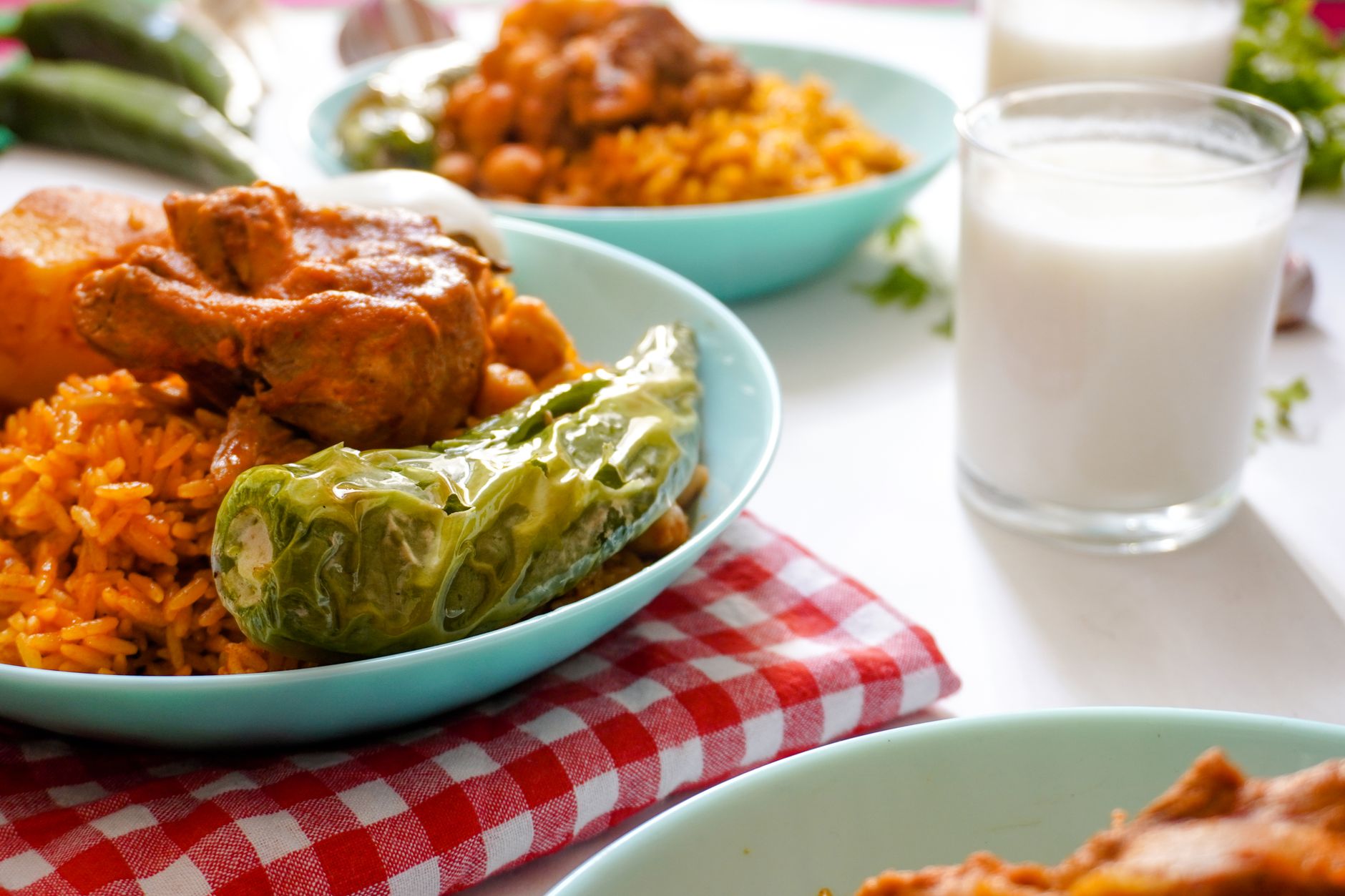
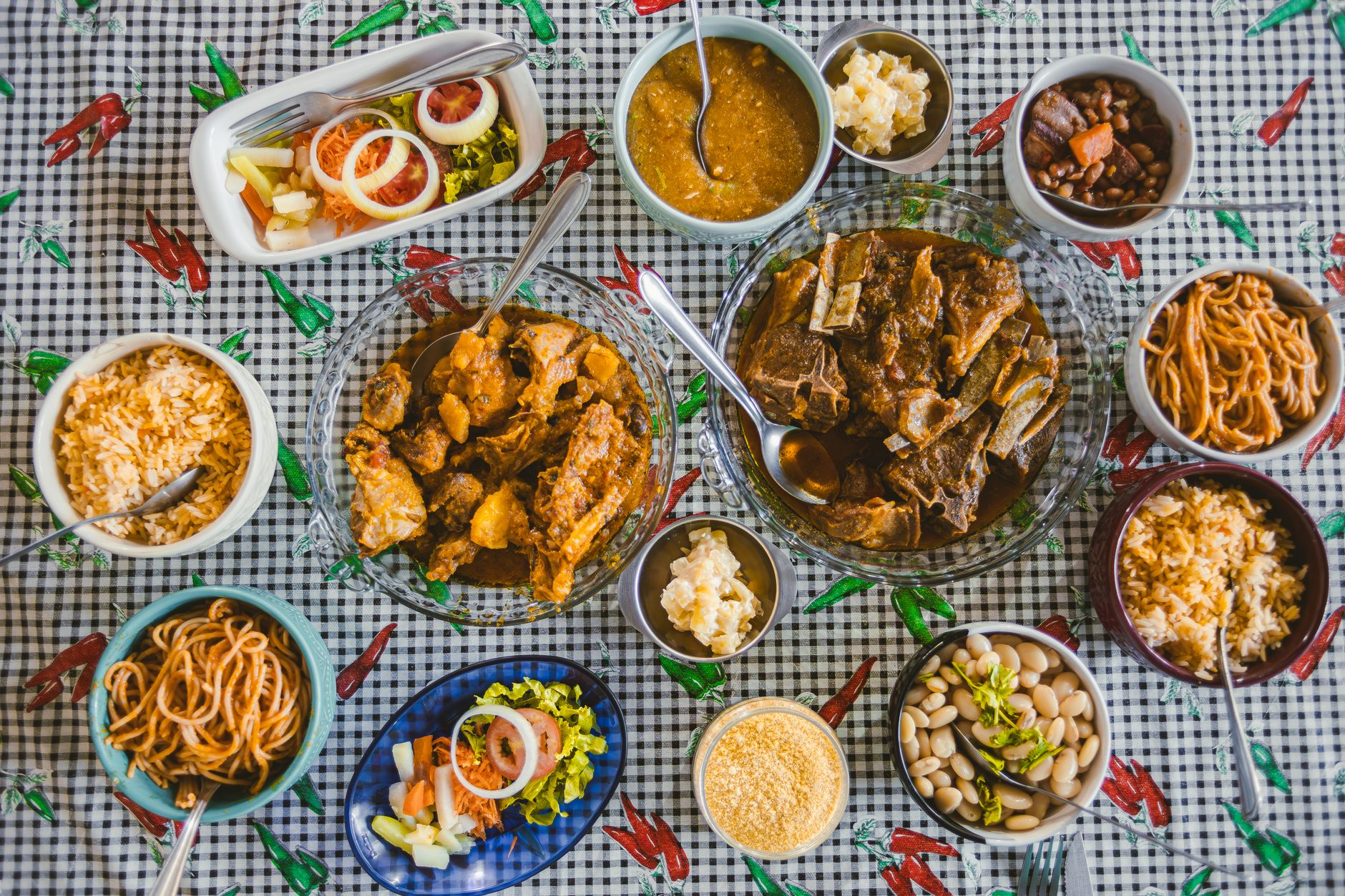
Food in Equatorial Guinea begins with cassava, plantain, fish, palm oil, peanuts. Five nouns. A complete doctrine. The plate in Bata often looks humble until the first mouthful, when the peanut sauce darkens into something almost ferrous, almost sweet, and your rice becomes less a side dish than a witness.

Communal eating is not picturesque custom. It is social grammar. A shared bowl settles hierarchy, affection, appetite, even mood. Refusing to share requires finesse. Accepting with the right hand and the right tempo says you understand the room.

On Bioko, the harbor grill remains the purest argument for civilization. In Malabo, fish comes off charcoal with the skin still cracking, fried plantain on the side, hot sauce rough as a confession, and the sea a few meters away like an accomplice. You eat with fingers because cutlery would only slow the truth.

Then comes palm wine, or fish soup at breakfast, or baton de manioc unwrapped from banana leaf in a roadside pause outside Bata. A country is a table set for strangers. Equatorial Guinea sets it with cassava and tests whether you know how to sit down.

Drums for the Rain and the Clerk

Music here has two lineages that should not coexist and yet do. One comes from ritual, village memory, bodies moving in a circle older than the state. The other comes from ports, mission schools, brass bands, radios, colonial parlors, the absurd dignity of imported jackets in impossible humidity. They met anyway.

The old Fernandino world in what is now Malabo produced a creole elegance that loved choir harmony, hymn structure, account books, and dance. Nothing is more human. People pray in measured chords and then let percussion correct the balance. On the mainland, Fang and Ndowe traditions keep rhythm closer to the ground, closer to feet, closer to the part of memory that refuses paperwork.

Listen long enough and you hear an argument between drum and choir. Neither wins. A song can carry church discipline in the top line and ancestral insistence underneath, like polished shoes hiding bare feet. That doubleness is not confusion. It is accuracy.

Even recorded pop in Bata often keeps one door open to call-and-response. Someone sings. Someone answers. Culture survives by refusing the solo.

The Ceremony of the Right Hand

Etiquette in Equatorial Guinea is exact, which is to say beautiful. The right hand gives, takes, greets, pays, receives. The left may assist discreetly, but it does not present itself alone unless one wishes to announce fatigue with civilization. Good manners here are not decorative. They are muscular.

Age orders the room before anyone speaks. Elders are greeted first. Voices lower slightly. Pace changes. A younger person who arrives in a courtyard in Riaba or Moka and rushes to the practical matter without the proper greetings reveals either ignorance or bad breeding; the difference matters less than you might hope.

Hospitality has edges. Food offered should be accepted with tact, at least in part. Time is spent before business is named. WhatsApp may arrange the meeting, but flesh-and-blood ritual still legitimizes it. The modern world sends the message. Courtesy opens the door.

What charms me is the seriousness of these gestures. They assume that a human encounter is not trivial. In many countries, politeness has become a costume. Here, in the best moments, it is still a belief.

Saints Under Equatorial Rain

Catholicism in Equatorial Guinea did not arrive alone. No religion ever does. It came with Spanish missions, bells, catechisms, feast days, architecture, and the old colonial certainty that heaven required administration. Then it met Fang and Bubi cosmologies, ancestral presence, healing practice, sacred groves, and the stubborn fact that spirits do not resign because a bishop has landed.

So the result is not a clean conversion story. It is overlap. Sunday Mass in Malabo may be Roman in form, but the emotional weather around it belongs to older systems of obligation and protection. A saint can receive devotion with one hand while the family remembers other intermediaries with the other. Contradiction? Not even close.

On Annobón, in San Antonio de Palé, this layering reaches a rare intensity. The island's Portuguese creole history, Catholic ritual, Atlantic isolation, and inherited African practice produce a spiritual atmosphere that feels both intimate and oceanic, as if every prayer had salt in it.

Religion here is less about doctrine than permeability. The visible world leaks. The dead remain interested. Ceremony exists to manage that interest with dignity.

Balconies Facing the Volcano

Architecture in Equatorial Guinea has the bad manners of history. In Malabo, Spanish colonial buildings stand in the damp like officials who never got the telegram that the empire ended. Arcades, balconies, stucco, administrative symmetry: all of it facing a volcanic island that refuses symmetry at every turn. The cathedral keeps its posture. The sky laughs and pours.

This tension is the pleasure. Imported forms meet equatorial weather, local labor, island topography, and time. Paint peels. Iron rusts. Verandas become the true center of domestic intelligence because shade matters more than theory. A building that ignores rain and heat will be corrected quickly.

Bata offers a different lesson. The mainland city has broader avenues, government ambition, concrete pragmatism, port logic. Then farther inland, places like Evinayong or Mongomo reveal another scale altogether, where official architecture speaks the language of the state while ordinary houses remain loyal to climate, kinship, and available materials.

And then there is Oyala, also called Ciudad de la Paz, that extraordinary modern proposition in the forest: administrative will poured into grand axes and monumental plans. It is a capital imagined before it is inhabited. Some cities grow like vines. Others are declared. Equatorial Guinea has chosen to test both methods.

The Novel Hides in the Clearing

A country with this much linguistic tension was never going to produce dull literature. Equatorial Guinean writing lives with a permanent double demand: speak in the inherited language, and betray nothing essential. Spanish becomes the page, but Fang, Bubi, oral memory, proverb, and village cosmology keep pressing from underneath like roots lifting stone.

María Nsue Angüe understood this with frightening precision. Her novel Ekomo is not merely a landmark because it came first for many readers outside the country. It matters because it lets the visible and invisible share a house without apology. That is not magical decoration. That is social fact rendered honestly.

Much of the national literature has had to write around silence: dictatorship, exile, censorship, distance, the strange loneliness of being a Spanish-language African writer whom readers in Spain often exoticize and readers elsewhere often forget. A brutal condition. Also a productive one, at least artistically, because pressure forces precision.

Literature here behaves like a person speaking softly in a room of liars. You lean in. Then you realize the soft voice is the only one telling the truth.

What Makes Equatorial Guinea Unmissable

volcano

Bioko's volcanic spine

Bioko Island rises steeply from the Gulf of Guinea, with Pico Basile reaching 3,011 meters above Malabo. The road into the highlands around Moka trades heat for cloud, moss, and views that feel improbably close to Cameroon.

pets

Rainforest without crowds

Monte Alen and the mainland forest hold western lowland gorillas, chimpanzees, forest elephants, and drill monkeys with barely a tourism wrapper around them. Wildlife here still feels like fieldwork, not a queue.

church

Spanish Africa, for real

Equatorial Guinea is the only country in sub-Saharan Africa where Spanish is an official language and a daily tool of travel. In Malabo and Bata, that history shows up in street grids, facades, and the way colonial power still shapes the built landscape.

restaurant

Harbor grills and cassava

The country's food is built on cassava, plantain, palm oil, peanuts, and Atlantic fish rather than polished restaurant culture. Eat grilled catch by the water in Malabo or a fish soup in Bata and the point becomes obvious fast.

map

A split-country itinerary

This is a nation in pieces: Bioko, the Rio Muni mainland, and far-off islands like Annobon. Moving between Malabo, Bata, Luba, Riaba, and San Antonio de Pale gives the trip a fractured, memorable rhythm.

Cities

Cities in Equatorial Guinea

Malabo

"A Spanish colonial cathedral faces an oil-boom skyline on a volcanic island 40 km from Cameroon — the capital that geography forgot to attach to its own country."

Bata

"The mainland's largest city hums with Fang market life, Atlantic fish smoke, and the low-frequency energy of a place that knows it does the real economic work while Malabo gets the postcards."

Luba

"A small port on Bioko's southwest coast where fishing pirogues share the black-sand waterfront with leatherback turtles that have been navigating to this beach far longer than any human settlement here."

Riaba

"Bioko's windward coast road ends here in a village backed by cloud-draped rainforest, where the rainfall gauge regularly hits figures that make the Amazon look restrained."

Mongomo

"Deep in the mainland interior near the Gabon border, this is the ancestral home of the Obiang family and therefore one of the most surreally over-built small towns in Central Africa — a stadium, a basilica, and almost no"

Evinayong

"The highland crossroads of Río Muni, sitting at roughly 600 metres where the air finally cools and the Fang village architecture — raffia, hardwood, red laterite paths — looks exactly as it should."

Ebebiyín

"A three-border town where Equatorial Guinea, Cameroon, and Gabon nearly touch, and where the market on any given morning is doing quiet, efficient business in three currencies and four languages."

Añisoc

"A mainland town that serves as the practical staging point for Monte Alén National Park, meaning the last cold beer before the forest swallows you and the gorilla tracking begins."

Oyala

"Called Ciudad de la Paz on the maps, this purpose-built administrative capital rising from jungle clearings is one of Africa's most ambitious — and emptiest — urban experiments, still waiting for the government it was de"

Moka

"A highland village on Bioko at around 1,400 metres where the temperature drops enough to need a jacket and the crater lakes sit in mist like something borrowed from the Scottish Highlands and relocated to the equator."

San Antonio De Palé

"The only real settlement on Annobón Island, 700 km from anywhere, where the descendants of Portuguese-era enslaved people still speak Fa d'Ambô, a creole that exists nowhere else on earth."

Corisco

"A flat coral island near the Gabon border whose Ndowe-speaking community maintained trade networks across the Bight of Biafra for centuries, and whose beaches remain almost entirely unknown to the outside world."

Regions

Malabo

Bioko North

Malabo is the practical front door to Equatorial Guinea, but the city matters for more than airport logistics. Spanish colonial facades, port traffic, ministries, and oil money all sit under a volcano that keeps reminding you the island came first and the bureaucracy came later.

placeMalabo placeLuba placePico Basile road viewpoints

Moka

Bioko Highlands

Moka sits high enough to cool the air and change the tempo. This is the Bioko of cloud, crater landscapes, and long wet afternoons, with roads that feel close on paper and slower in real life once the mist moves in.

placeMoka placeRiaba placeLake Biao area placePico Basile slopes

Bata

Mainland Coast

Bata is the mainland's commercial hinge: wider avenues, beach humidity, port traffic, and a more open urban rhythm than Malabo. From here, you can read the country's logistics clearly, because almost everything on the mainland either comes through Bata or passes by it.

placeBata placeCorisco placeBata waterfront placemainland beaches south of town

Evinayong

Central Mainland Forest Belt

Evinayong is the gateway to the greener middle of Río Muni, where the road leaves the coast behind and the country turns inward. This region is about forest, distance, and travel time rather than monuments, which is exactly why it gives a better sense of how the mainland actually works.

placeEvinayong placeMonte Alén access zone placeinterior forest roads

Ebebiyín

Northeast Borderlands

Ebebiyín sits near the Cameroon and Gabon frontier, and you feel that border pressure in markets, language shifts, and traffic patterns. Añisoc and Mongomo belong to the same inland story: administrative power, cross-border movement, and fewer outsiders than the coast sees.

placeEbebiyín placeAñisoc placeMongomo placeOyala

San Antonio de Palé

Far Southern Islands

San Antonio de Palé is for travelers who understand that remoteness is not a brand word but a logistical fact. Annobón runs on a different clock from Malabo and Bata, and that isolation is the reason to go, not an inconvenience to explain away.

placeSan Antonio de Palé placeAnnobón crater landscapes placeremote Atlantic coastline

Suggested Itineraries

3 days

3 Days: Bioko Island in Short Stages

This is the fastest route that still shows why Bioko feels unlike the mainland: colonial streets in Malabo, wet highlands around Moka, and the steeper coast near Riaba and Luba. Distances look short on a map, but mountain weather, curves, and rain make this a better trip at island pace than as a checklist.

MalaboMokaRiabaLuba

Best for: first-timers with limited time who want scenery over logistics

7 days

7 Days: Mainland Axis from Bata to Mongomo

Start in Bata for the coast and practical footing, then move inland through Evinayong and Oyala before finishing in Mongomo near the Gabon and Cameroon frontier. This route works best for travelers who want to see how the mainland shifts from Atlantic humidity to administrative boulevards and border-country trade towns.

BataEvinayongOyalaMongomo

Best for: road trippers and travelers curious about the mainland beyond the port cities

10 days

10 Days: Northern Río Muni and the Border Towns

This loop leans into the country most visitors never see: the commercial life of Bata, the greener interior around Añisoc, and the northern edge at Ebebiyín where Cameroon is close enough to shape the daily rhythm. Go slowly, hire a driver who knows the checkpoints, and treat the journey itself as the point.

BataAñisocEbebiyín

Best for: repeat Africa travelers comfortable with long drives and light infrastructure

14 days

14 Days: Islands and Off-Grid Edges

This is the ambitious version: begin in Malabo, then push out to San Antonio de Palé on Annobón and finish with Corisco for a very different slice of island life. It only works if you can tolerate schedule changes, but that is precisely why the route feels rare rather than packaged.

MalaboSan Antonio de PaléCorisco

Best for: experienced independent travelers chasing remote islands and flexible plans

Notable Figures

Fernão do Pó

15th century · Portuguese navigator
Sailed past Bioko in 1472 and gave the island its enduring colonial name

He belongs to that age of mariners who renamed places as if naming were possession. Yet his brief encounter with Bioko tells a subtler story: the Portuguese could chart the coast, but they could not easily bend the island's people to their will.

King Malabo Lopelo Mëlaka

19th century · Bubi king
The capital Malabo is named after him

Malabo was not a decorative tribal figure trotted out for folklore. He was a real Bubi ruler navigating the pressure of missionaries, colonial intrusion, and a changing island world, and the capital's modern name quietly restores an indigenous sovereign to a landscape long labeled in Spanish.

Maximiliano C. Jones

1871-1938 · Fernandino merchant and cacao planter
One of the leading figures of the Fernandino elite on Bioko

Jones understood paperwork better than many officials sent to govern him. In the old colonial economy of Malabo and the plantations beyond, he used commerce, education, and legal skill to defend Fernandino interests in a system designed to push them aside.

Acacio Mañé Ela

c. 1904-1959 · Nationalist organizer
An early anti-colonial voice from Río Muni

He is one of the men who saw, before independence, that colonial subjects had to become political actors or remain labor for someone else's empire. His arrest and death turned him into a martyr of Equatorial Guinea's unfinished argument about power, dignity, and who gets to speak for the nation.

Francisco Macías Nguema

1924-1979 · First president of Equatorial Guinea
Led the country from independence in 1968 until his overthrow in 1979

Macías entered history as the face of liberation and stayed in it as the architect of catastrophe. The early republic under his rule became a chamber of fear, and nearly every family in Malabo, Bata, or the interior can place some private sorrow under his years.

Teodoro Obiang Nguema Mbasogo

born 1942 · President and former coup leader
Has dominated Equatorial Guinea's political life since 1979

He overthrew Macías and presented himself as the man who had rescued the state from madness. Then he built a much longer system of controlled order, oil wealth, court-style power, and dynastic influence that still shapes life from Malabo to Mongomo and Oyala.

María Nsue Angüe

1945-2017 · Novelist and educator
Author of "Ekomo," one of the foundational novels of Equatorial Guinean literature

Her work did something politics often fails to do: it made interior life visible. Through village memory, illness, gender, and loss, she gave Equatorial Guinea a literary mirror that was not written from Madrid or Paris but from within the country's own fractures.

Raquel Ilonbé

1938-1992 · Writer and poet
One of the earliest female literary voices associated with Equatorial Guinea

Born into the entangled world of colony and migration, she wrote with the ache of distance and belonging. Her pages matter because they remind you that Equatorial Guinea is not only a story of presidents and plantations, but of women negotiating race, memory, and exile in the shadow of empire.

Juan Tomás Ávila Laurel

born 1966 · Writer and essayist
Born on Annobón and one of the country's sharpest contemporary witnesses

Ávila Laurel writes from the edge of the map and makes that edge impossible to ignore. His connection to Annobón gives him a rare vantage point on the country's center: he sees how power looks from a remote island that the state remembers selectively.

Practical Information

passport

Visa

Assume you need a visa before you travel. The Equatorial Guinea embassy in Washington currently lists a US$200 standard fee, 5 to 7 working days for processing, a passport valid for at least 6 months, and tourism proof of funds of at least US$1,000 per month of stay; UK guidance also says to print the e-visa approval letter for arrival.

payments

Currency

Equatorial Guinea uses the Central African CFA franc (XAF), fixed at 655.957 XAF to 1 euro. Treat the country as cash-first: cards work in only a few major hotels, ATMs are mostly in Malabo and Bata, and EUR cash is the safest backup.

flight

Getting There

Most travelers arrive through Malabo International Airport on Bioko Island, with Bata Airport the main mainland alternative. International links are thin and shift often, so check schedules close to booking and leave slack if you are connecting onward to Bata, Mongomo, or San Antonio de Palé.

directions_car

Getting Around

Domestic flights are the cleanest way to move between Malabo and Bata. On the ground, major roads on Bioko and the mainland are mostly paved, but police and military checkpoints are routine, ferries can change without much notice, and rural roads slow sharply in the rains.

wb_sunny

Climate

June to August is the easiest window for travel, with a drier spell and slightly cooler air, especially useful for road trips and hikes around Moka or Riaba. December to February is the second-best stretch; March to May and October to November are much wetter, and Bioko is noticeably rainier than the mainland.

wifi

Connectivity

Spanish is the working language for almost every practical exchange, from hotels to checkpoints, while English is limited outside oil-sector properties. Mobile coverage is usable in Malabo, Bata, and other larger towns, but data speeds and electricity are less dependable once you head inland or offshore, so download maps before leaving town.

health_and_safety

Safety

Equatorial Guinea is manageable, but not casual. Use hotel-arranged or known drivers in Malabo and Bata, carry your passport and visa copy for roadblocks, avoid night travel outside cities, and keep your yellow fever certificate within reach because officials may ask for it at entry.

Taste the Country

restaurantpollo en salsa de cacahuete

Shared plate. Lunch or Sunday table. Rice, spoon, right hand, family.

restaurantcassava fufu

Pinch, roll, dip, swallow. Stew bowl, evening meal, group silence.

restaurantgrilled fish on the harbor

Charcoal, fingers, plantain, hot sauce. Sunset in Malabo, friends, plastic chairs.

restaurantmbanga soup

Palm nut broth, fish, fufu. Noon meal, house gathering, long simmer.

restaurantbaton de manioc

Banana leaf unwrap, bite, chew. Roadside breakfast near Bata, vendors, commuters.

restaurantfish soup for breakfast

Broth, plantain, spoon, steam. Early morning on Bioko, family table, harbor workers.

restaurantpalm wine

Pour, pass, sip. Ceremony, visit, argument, reconciliation.

Tips for Visitors

euro
Bring Real Cash

Carry enough euros for several days, then break larger notes in Malabo or Bata when you can. ATMs exist, but relying on them is optimistic rather than smart.

train
No Trains

Do not build any plan around rail. Every intercity move is by road, domestic flight, or an occasional boat that needs to be confirmed on the ground.

hotel
Book Drivers Early

Ask your hotel to line up airport transfers and longer road trips before you arrive. A known driver is worth more here than a small saving on the fare.

wifi
Download Offline Maps

Google Maps helps in Malabo and Bata, but route quality and live timing are not reliable inland. Save offline maps and key hotel pins before leaving the main cities.

health_and_safety
Carry Your Papers

Keep your passport, visa copy, hotel address, and yellow fever certificate easy to reach. Roadblocks are common, and a neat stack of documents saves time.

payments
Tip Light, Not Loud

Tipping is modest. Round up in casual restaurants, leave 5 to 10% for strong service, and think in the 500 to 1,000 XAF range for porters or housekeeping.

translate
Use Spanish First

A few practical Spanish phrases will do more for you than English, especially outside business hotels. Even simple basics like price, time, road, and police checkpoint smooth the day.

Explore Equatorial Guinea with a personal guide in your pocket

Your Personal Curator, in Your Pocket.

Audio guides for 1,100+ cities across 96 countries. History, stories, and local insight — offline ready.

smartphone

Audiala App

Available on iOS & Android

download Download Now

Join 50k+ Curators

Frequently Asked

Do I need a visa for Equatorial Guinea as a US, UK, EU, Canadian, or Australian traveler? add

Yes, in practice you should assume you need a visa in advance. Current embassy and government guidance says foreign passport holders need a valid visa, and you should travel with a printed approval letter if you used the e-visa system.

Do I need a yellow fever certificate to enter Equatorial Guinea? add

Yes. Officials can ask for proof on arrival, and travelers without a valid yellow fever certificate may be denied entry or face vaccination at the airport.

Is Equatorial Guinea expensive for travelers? add

Yes, usually more expensive than Cameroon or Gabon for the same comfort level. Hotels, imported food, and private transport push costs up fast, while true budget options are limited outside local guesthouses and simple eateries.

Can I use credit cards in Malabo and Bata? add

Only sometimes, and mostly at upper-end hotels. For day-to-day travel, especially outside Malabo and Bata, cash in XAF is what actually works.

What is the best month to visit Equatorial Guinea? add

June to August is the safest bet for easier road travel and lighter rain. December to February also works, while March to May and October to November are wetter and more disruptive, especially on Bioko.

Is it safe to take taxis in Malabo or Bata? add

Not as a default plan. Government travel advice specifically warns about taxi crime, so hotel-arranged drivers or drivers personally recommended to you are the better option.

How do you get from Malabo to Bata? add

The practical answer is a domestic flight. It is much faster and more reliable than trying to stitch together sea and road transport, especially if you have fixed hotel bookings on the mainland.

Is English widely spoken in Equatorial Guinea? add

No. Spanish is far more useful in Malabo, Bata, Luba, and inland towns, while English tends to be limited to some oil-sector hotels, guides, and expat-facing businesses.

Is Annobón worth visiting from San Antonio de Palé? add

Yes, but only if you are comfortable with delays and thin infrastructure. Annobón rewards patience with genuine isolation, not polished visitor services, so it suits travelers who value rarity more than convenience.

Sources

Last reviewed: