Memphis
Mit RahinaEgypt 29° N · 31° E Updated Aug 2026
Egypt got its name from this buried ancient capital, where a fallen colossus of Ramses II still lies beneath a modern pavilion amid quiet rural palm groves.
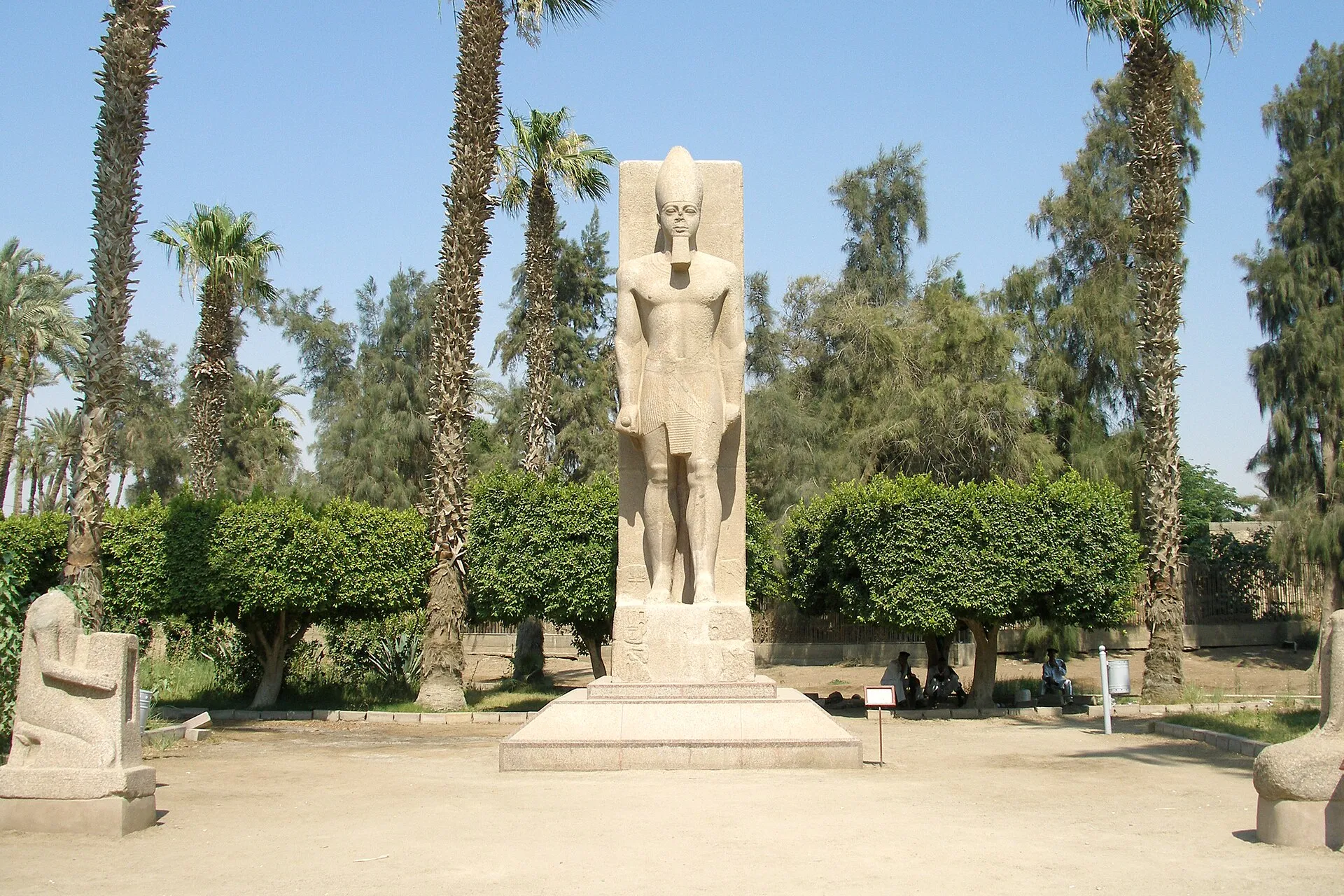 Photo: Vyacheslav Argenberg · CC BY 4.0
- Time needed
- 30–45 minutes
- Access
- Uneven outdoor surfaces; confirm assistance directly with the site
Memphis, beside modern Mit Rahina, was one of ancient Egypt's great capitals and the centre of the cult of Ptah. The surviving visitor site is a compact open-air museum rather than an intact city: its principal objects include the reclining colossus of Ramesses II and the alabaster sphinx.
Ancient Memphis wasn't a single temple or statue. It was a metropolis of more than 30 square kilometres—roughly 4,200 football pitches—stretching from Kôm Tuman in the north to Kôm el-Qal'a in the south. Most of it hasn't disappeared. It sits two to six metres beneath the village of Mit Rahina, under date palms, buffalo sheds, and tarmac.
The open-air museum shows you only a sliver. You'll see a fallen colossus of Ramesses II, once ten metres tall and carved from a single block, lying on its back inside a barn-like shelter. Outside, an alabaster sphinx sits among trees, its face softened by centuries of weather, easier to walk past than to read.
Come for the dissonance. This was the seat of power that organised the pyramid fields to the west. Now the loudest sound is often the pump from a neighbouring irrigation ditch and the cawing of crows. Stand near the Apis embalming tables and you're metres from both a souvenir stall and the spot where a living bull was prepared for eternity.
What to see
-
The Colossus of Ramesses II
The first thing you notice is how much is missing: the lower legs snapped off in antiquity, leaving almost 13 metres of Tura limestone suspended at chest height. Walk the mezzanine balcony and look straight down at the pleated kilt — a ceremonial dagger with twin falcon heads is tucked into the belt. Circle to the side that spent over a millennium face-down in Nile mud and it still gleams like fresh-cut stone, while the exposed side is pitted and rough; that contrast is exactly why Egyptians called Memphis 'the White Walls'. -
Alabaster Sphinx and the Open-Air Sculpture Garden
The yellow-banded alabaster sphinx sits low on the lawn, carved from one block of Egyptian travertine that glows like honey when mid-morning light hits it. At over 8 metres long and 4 metres high, it weighs around 80 to 90 tonnes — the second-largest single-block sphinx in Egypt after Giza. Look along the chest and flank and you'll see the calcite growth rings ripple across the body in translucent bands, while palm shadows move across the path and doves call from the open beams overhead; a standing red granite colossus of Ramesses II keeps watch from the garden's east edge. -
A Slow Walk Through the Temple of Ptah and the Apis Embalming House
Most visitors rush through Memphis in 45 minutes and miss the quieter western edge, where the Apis bull embalming tables lie under shade. These monolithic calcite beds, linked to Shoshenq I of Dynasty 22, run over 5 metres long and are cut with sloping gutters that drained fluids during the 70-day mummification of each living incarnation of Ptah. After standing where the bulls were prepared, push past the wire fence's sightline to the palm groves north of the museum: half-submerged column capitals from the Temple of Ptah poke out of the reeds, and you realise the whole village of Mit Rahina is sitting on the drowned centre of ancient Egypt.
Plan your visit
- Getting There
- Memphis is south of central Cairo beside Mit Rahina. A hired car or taxi is the simplest option, especially when combining it with Saqqara or Dahshur. Agree the full itinerary and return arrangement in advance, and verify the route on the day.
- Opening Hours
- Egypt's official ticket portal currently lists all-day schedules with opening at 08:00 and last entry at 16:00 in summer and winter. During Ramadan it lists 09:00 opening and 15:00 last entry. Check the official portal again before travel.
- Time Needed
- A quick highlight visit—Ramses II colossus, Alabaster Sphinx, and key stelae—takes 45–60 minutes. A thorough read of signage and photography runs 1.5–2 hours. Most travelers pair it with Saqqara (10–15 minutes away) and Dahshur for a full day.
- Accessibility
- The museum includes outdoor surfaces and the colossus pavilion has more than one viewing level. The official ticket listing does not publish a detailed accessibility guide, so contact the site before travel if you require a step-free route or assistance.
- Cost & Tickets
- Egypt's official ticket portal currently lists foreign admission at EGP 200 for adults and EGP 100 for eligible students; Egyptian admission is EGP 10 for adults and EGP 5 for students. Children below six and specified Egyptian groups qualify for free entry. Verify current prices and eligibility on the official portal.
Photo Gallery


History
The City That Named Egypt
Memphis was the capital of unified Egypt for more than a thousand years, and a major administrative and religious centre for almost three thousand. Its location at the apex of the Nile Delta gave it control over trade between Upper and Lower Egypt. The city had many names—Inebu-hedj, 'The White Walls'; Ankh-Tawy, 'Life of the Two Lands'; Men-nefer, 'Enduring and Beautiful'. The Greeks turned Hut-ka-Ptah, the temple enclosure of the god Ptah, into Aigyptos. That's how Egypt got its name.
The old capital didn't simply fade. It was dismantled on purpose, its limestone casings and granite columns carted across the river to build medieval Cairo. What remains is a shallow archaeological imprint, a handful of colossal statues, and the strange feeling of standing on top of lost streets.
The turning point
The Prince Who Refused to Forget
On the surface, Memphis is a capital of builders: Narmer, Djoser, Ramesses II raising walls and colossi. Prince Khaemweset, Ramesses II's fourth son, looks like the perfect son of that world—High Priest of Ptah and master of the temple workshops.
But by Khaemweset's lifetime, around 1281–1225 BC, the monuments of the Pyramid Age were already ruins. Many rulers took the practical route: quarry old stones for new projects. Khaemweset did something stranger. He hacked back sand, repaired cracked masonry, and re-carved the names of forgotten kings, adding inscriptions that recorded exactly what he had restored.
The stakes were personal. As sem-priest of Ptah, Khaemweset controlled the temple precinct that legitimised his father's reign. Restoring their names wasn't nostalgia. It was a claim about continuity—the same continuity the crown needed. This shift from building new monuments to curating old ones marked the moment Memphis began treating its past as a resource. He also organised the first subterranean galleries for the Apis bulls at the Serapeum, reshaping how Memphis buried its living god.
More than a thousand years later, Ptolemaic tales reinvented him as Setne Khamwas, a magician prowling cursed tombs for the Book of Thoth. When you stand in front of the fallen colossus of his father, you're seeing the product of the same precinct Khaemweset managed. His inscriptions have mostly gone, but his impulse—to keep the past legible—is why you can still read this city at all.
The White Walls (c. 3100–2686 BC)
The Old Kingdom Capital (2686–2181 BC)
Captures and Continuity (728–196 BC)
Tips for visitors
Cover shoulders and knees
Mit Rahina is a traditional rural village; modest dress matters more in nearby lanes than inside the museum. Loose, breathable clothing also spares you from sun and dust on open paths.No drones, no flash
Handheld phones and cameras are free across the site. Flash is banned indoors to protect painted limestone; drones are confiscated countrywide without defense ministry permits.Baksheesh at the colossus
Self-appointed 'caretakers' inside the pavilion may offer unsolicited commentary or photo angles then expect cash. Decline politely with 'La, shukran' unless you want the help. Buy tickets only at the official Ministry window.Arrive before 10 or after 3
Midday sun hits the open-air garden hard, and the colossus pavilion gets stuffy. Early morning gives softer light on the alabaster sphinx; late afternoon means fewer tour buses and cooler paths.Book a triangle car
Hiring a driver for the full Memphis–Saqqara–Dahshur loop costs far less than separate Ubers, especially since return taxis from Mit Rahina are rare. Confirm the total price in EGP before you set off.
Frequently asked
Is Memphis Egypt worth visiting?
Yes, but with adjusted expectations—Memphis is now a small open-air museum at Mit Rahina, not a standing city like Luxor. The payoff is a 13-metre limestone colossus of Ramesses II you can view from a balcony above his carved dagger and royal cartouches, plus an 80-ton alabaster sphinx. Pair it with Saqqara and Dahshur for a half-day stop, not a standalone excursion.
How long do you need at Memphis Egypt?
Budget 45 to 60 minutes for the main highlights, or up to two hours if you read every label and wander the garden slowly. The museum is compact; most visitors pair Memphis with Saqqara, 10–15 minutes away, and Dahshur for a full day. Go early to avoid the 10am–1pm tour bus surge.
How do I get to Memphis Egypt from Cairo?
Memphis is south of Cairo beside Mit Rahina. A hired car or taxi is the most straightforward option, particularly for a combined Memphis–Saqqara–Dahshur day. Agree the route, total fare, waiting time, and return in advance.
What is the best time to visit Memphis Egypt?
October to April offers temperatures around 18–26°C and the best outdoor conditions. Summer heat often exceeds 38°C, though you'd have the palm-shaded garden nearly to yourself after 8am. Arrive at 8am year-round to catch low sunlight on the alabaster sphinx and avoid the midday tour groups.
Can you visit Memphis Egypt for free?
Most visitors need a ticket. Egypt's official portal currently lists foreign adult admission at EGP 200 and eligible foreign students at EGP 100. It lists free admission for children below six and specified Egyptian groups; check the portal for current prices and eligibility.
What should I not miss at Memphis Egypt?
Do not miss the reclining limestone colossus of Ramesses II, the 80-ton alabaster sphinx, and the Apis bull embalming tables. Look down from the pavilion balcony to find the dagger tucked in Ramesses' belt with twin falcon heads. The embalming tables are the most overlooked—5-metre calcite slabs with carved lion-headed drains where sacred bulls were mummified for 70 days.
Why is Memphis Egypt famous?
Memphis was the first capital of unified Egypt, founded around 3100–3000 BC, and the cult center of Ptah. The temple's name Hut-ka-Ptah gave Greek speakers Aigyptos, the root of the word Egypt. The 196 BC Decree of Memphis became the Rosetta Stone.
What happened to the city of Memphis Egypt?
Memphis was dismantled over centuries and cannibalized for building stone after the Arab conquest in 641 AD when Fustat rose across the Nile. The city's limestone, granite, and basalt went into medieval Cairo's mosques, walls, and aqueducts. Today most of the 30-square-kilometre capital lies 2–6 metres under the village of Mit Rahina and palm groves.
Sources & attribution 11
- UNESCO World Heritage Centre — Founding of Memphis around 3100–3000 BC, Old Kingdom capital status, 1979 World Heritage inscription, and the city's later dismantling for medieval Cairo.
- Discover Egypt's Monuments — Confirms founding dates, Ramesses II's construction at the Ptah temple, and the 196 BC Decree of Memphis on the Rosetta Stone.
- Wikipedia — Etymology of Memphis from Hut-ka-Ptah to Aigyptos, the modern village name Mit Rahina, and the 641 AD shift to Fustat.
- Carrie Reed Travels — Practical details on opening hours, 1820 discovery of the Ramesses II colossus, 1912 sphinx discovery, accessibility, and the upper viewing balcony.
- Rehlat Egypt — Ticket pricing for adults and students, public transport routes, and road access from Cairo.
- Discovery Tours Egypt — Daily hours, Ramadan closures, private transport tips, and typical Memphis-Saqqara-Dahshur itineraries.
- Egyptra — Time budget of 45–60 minutes for highlights and advice that skip-the-line passes are unnecessary.
- Penn Museum — Pavilion layout, dagger detail on the colossus, Apis embalming tables, and the palm-grove setting with buried column capitals.
- Egypt Tour Packages — Dimensions and materials of the alabaster sphinx, Ramesses II colossus, and the 5-metre calcite embalming tables.
- Egypt Eye Tour — The alabaster sphinx's banded calcite and its single-block construction.
- Egypt Ministry official Memphis ticket listing — Current official admission prices, opening times, last entry, and free-entry policy.
Built from cited sources · see the method · How we make our guides →
Pick up where you left off
Saved and recently read places — kept on this device only.
Photo credits (8)
- Memphis, Ramses II, Ancient Egypt — Vyacheslav Argenberg — CC BY 4.0 (https://creativecommons.org/licenses/by/4.0/) — Source: https://commons.wikimedia.org/wiki/File:Memphis,_Ramses_II,_Ancient_Egypt.jpg
- Carte-Memphis-Necropolis — Carte-Memphis-Necropoles_0109.jpg: Neithsabes derivative work: JMCC1 (talk) — CC BY-SA 3.0 (https://creativecommons.org/licenses/by-sa/3.0/) — Source: https://commons.wikimedia.org/wiki/File:Carte-Memphis-Necropolis.JPG
- Bold Ramesses II — Bilal Detailz — CC BY-SA 4.0 (https://creativecommons.org/licenses/by-sa/4.0/) — Source: https://commons.wikimedia.org/wiki/File:Bold_Ramesses_II.jpg
- The loyal guard — Bilal Detailz — CC BY-SA 4.0 (https://creativecommons.org/licenses/by-sa/4.0/) — Source: https://commons.wikimedia.org/wiki/File:The_loyal_guard.jpg
- Carte-Memphis-Necropoles 0109 — Neithsabes — CC BY-SA 3.0 (https://creativecommons.org/licenses/by-sa/3.0/) — Source: https://commons.wikimedia.org/wiki/File:Carte-Memphis-Necropoles_0109.jpg
- Sphinx of Memphis II — Bilal Detailz — CC BY-SA 4.0 (https://creativecommons.org/licenses/by-sa/4.0/) — Source: https://commons.wikimedia.org/wiki/File:Sphinx_of_Memphis_II.jpg
- Carte-Memphis-Necropoles 0109 af — Neithsabes — CC BY-SA 3.0 (https://creativecommons.org/licenses/by-sa/3.0/) — Source: https://commons.wikimedia.org/wiki/File:Carte-Memphis-Necropoles_0109_af.jpg
- Ruins at Mit Rahina — Darer101 — CC BY-SA 4.0 (https://creativecommons.org/licenses/by-sa/4.0/) — Source: https://commons.wikimedia.org/wiki/File:Ruins_at_Mit_Rahina.jpg
Photos may have been resized or cropped.