Virtual Egypt: The Biggest Egyptian Temple - Karnak
Manuel Bravo
9 min
1M
LuxorEgypt 25° N · 32° E Updated Apr 2026
Built continuously for 2,000 years, Karnak is the largest religious complex ever constructed — and most visitors only see a fraction of it.

The woman who built Egypt's tallest obelisk was erased from history — and the very wall meant to hide her name is the reason it survived 3,400 years. Karnak, on the east bank of Luxor in Egypt, is the largest religious complex ever constructed: a 200-acre accumulation of temples, pylons, and sacred lakes that roughly 30 pharaohs spent two millennia building, each one trying to outdo the last. No single mind designed it. That's precisely what makes it extraordinary.
The ancient Egyptians called it Ipet-Isut — "The Most Select of Places." The name we use, Karnak, is a 19th-century European corruption of the Arabic Khurnaq, meaning fortified village. The original name was more accurate. This was the spiritual engine of an empire that stretched from the Euphrates to northern Sudan, the house of the god Amun-Ra and his family — Mut and Khonsu, the Theban Triad — and the place where pharaohs came to prove they deserved the double crown.
What you walk through today is not a ruin so much as a geological cross-section of power. Middle Kingdom limestone chapels sit inside New Kingdom pylons. Blocks from a heretic pharaoh's demolished sun-temple are stuffed inside later walls like guilty secrets. Coptic crosses are scratched over hieroglyphs. Two thousand years of ambition, rivalry, and devotion, stacked in sandstone.
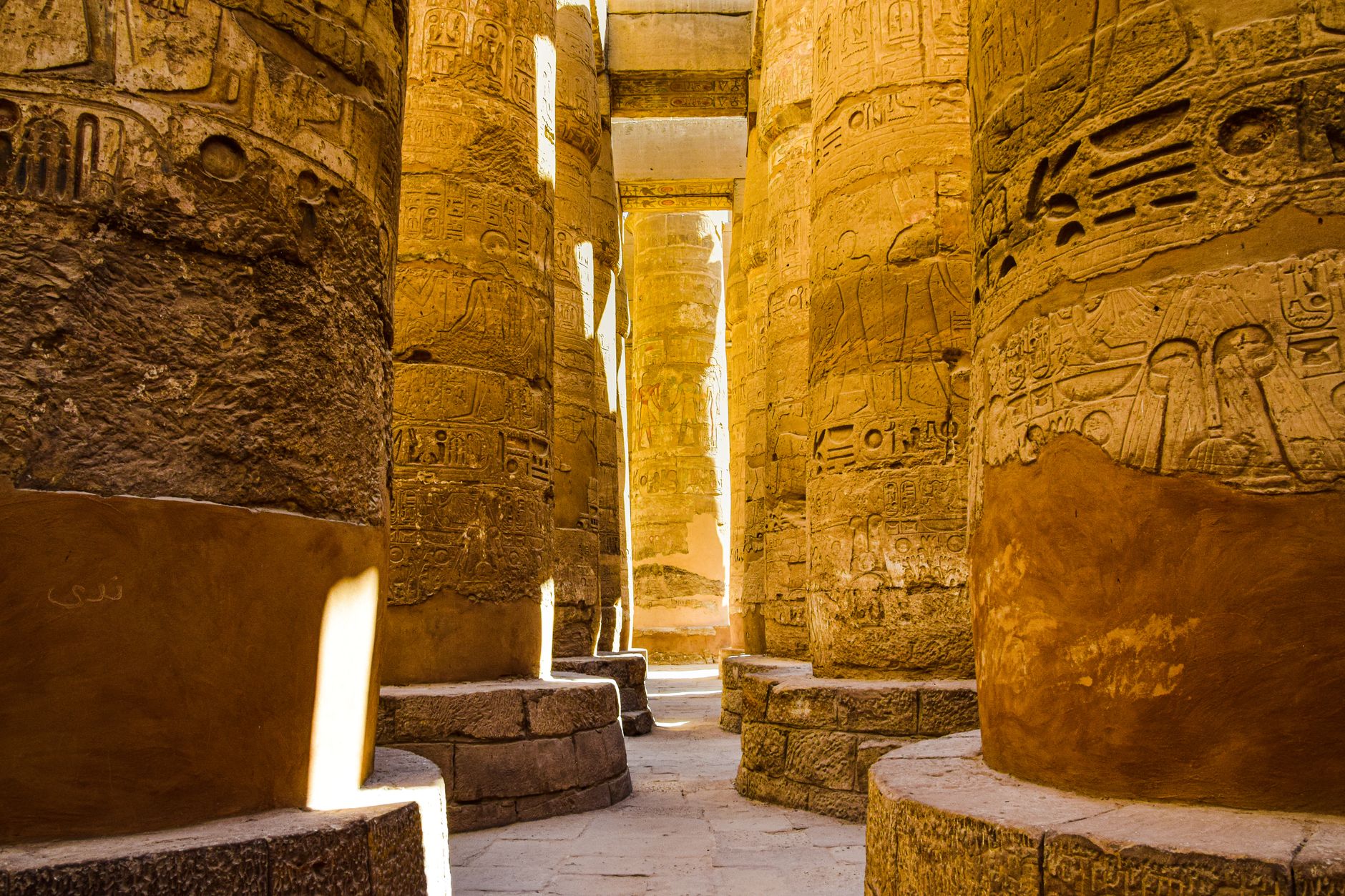
Arrive early. The light at 6 a.m. turns the Hypostyle Hall columns the color of raw honey, and for about twenty minutes you can stand among them with almost no one else. By 10 a.m. the tour buses have arrived and the temperature is climbing past 35°C. Karnak rewards those who set an alarm.
You think you're ready for it. You're not. Walk through the Second Pylon and 134 sandstone columns rise around you — a forest of stone planted by Seti I around 1290 BC and finished by his son Ramesses II. The central nave columns stand 20.4 meters tall with a diameter of 3.4 meters, wide enough that six adults linking arms couldn't wrap around one. At 5,000 square meters, this is still the largest room of any religious building on Earth — you could park two Boeing 747s inside and have space left for a picnic.
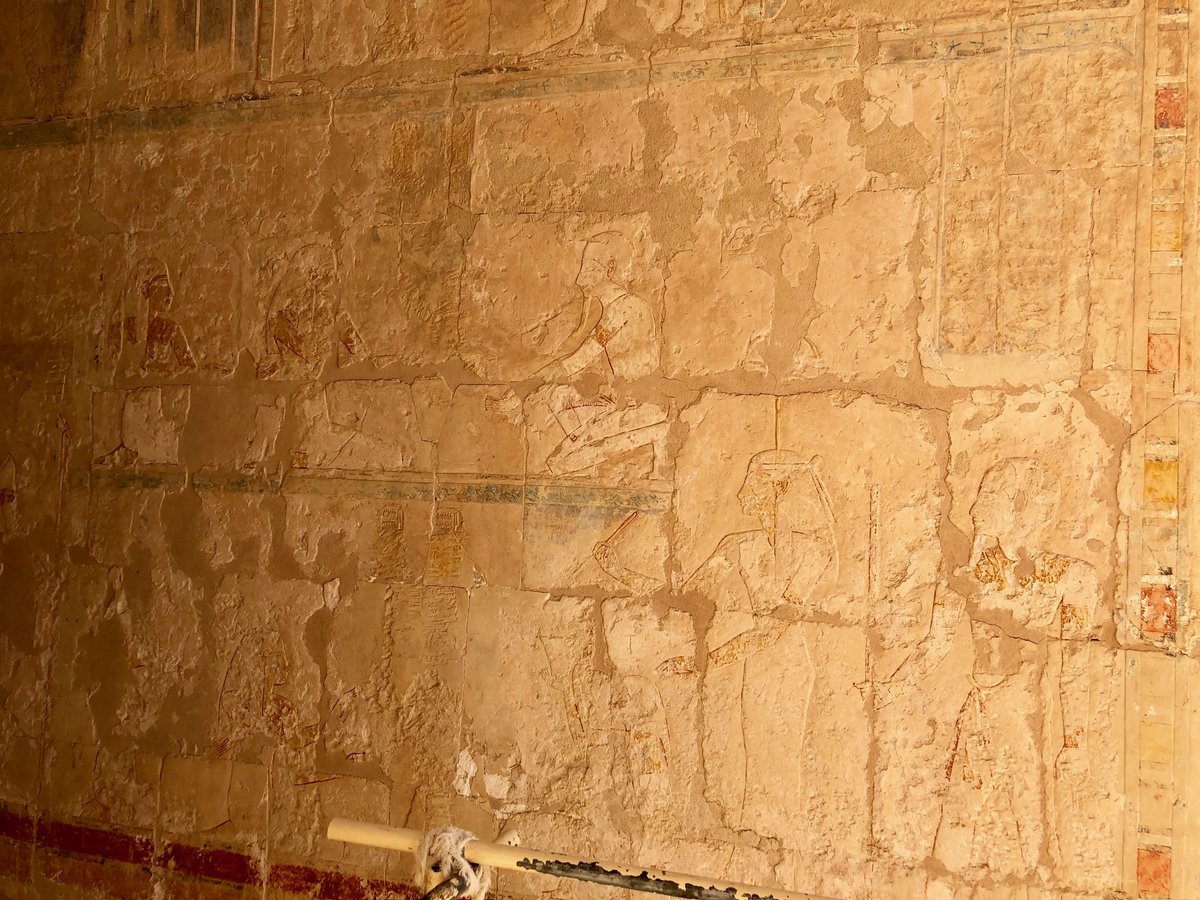
Here's what most visitors miss: the hall was originally roofed. The taller central columns supported a clerestory, letting angled shafts of light fall through stone window grilles onto a painted floor. Those columns were once plastered in bright pigment — look up at the capitals where shade has preserved faint traces of blue and ochre, 3,200 years old and still holding on. And skip the crowded central aisle. Slip into the outer rows, where you'll find yourself alone with the carvings. Under raking morning light, you can read palimpsests — Seti I's delicate sunk relief ghosting beneath Ramesses II's bolder overcuts, a father-son rivalry written in stone.
Behind the main temples, a rectangular lake stretches 129 by 77 meters — roughly the footprint of a city block — its edges still lined with the remains of priests' quarters and storerooms. This wasn't decorative. Priests purified themselves here before dawn rituals, and sacred barques were floated across its surface during ceremonies. Come in late afternoon, when the water goes still and the pylons reflect in warm gold. It's one of the quietest corners of the complex.
From the lake's edge, look up. Hatshepsut's obelisk — a single shaft of pink Aswan granite, the tallest surviving in Egypt — catches the last light like a needle threading the sky. She commissioned it around 1457 BC, and the inscriptions boast that it took just seven months to quarry and erect. Her stepson Thutmose III later walled up its lower half, trying to erase her name while accidentally preserving the base carvings for millennia. Bring binoculars: the royal cartouches carved near the top are too high for the naked eye, but they reward the effort.
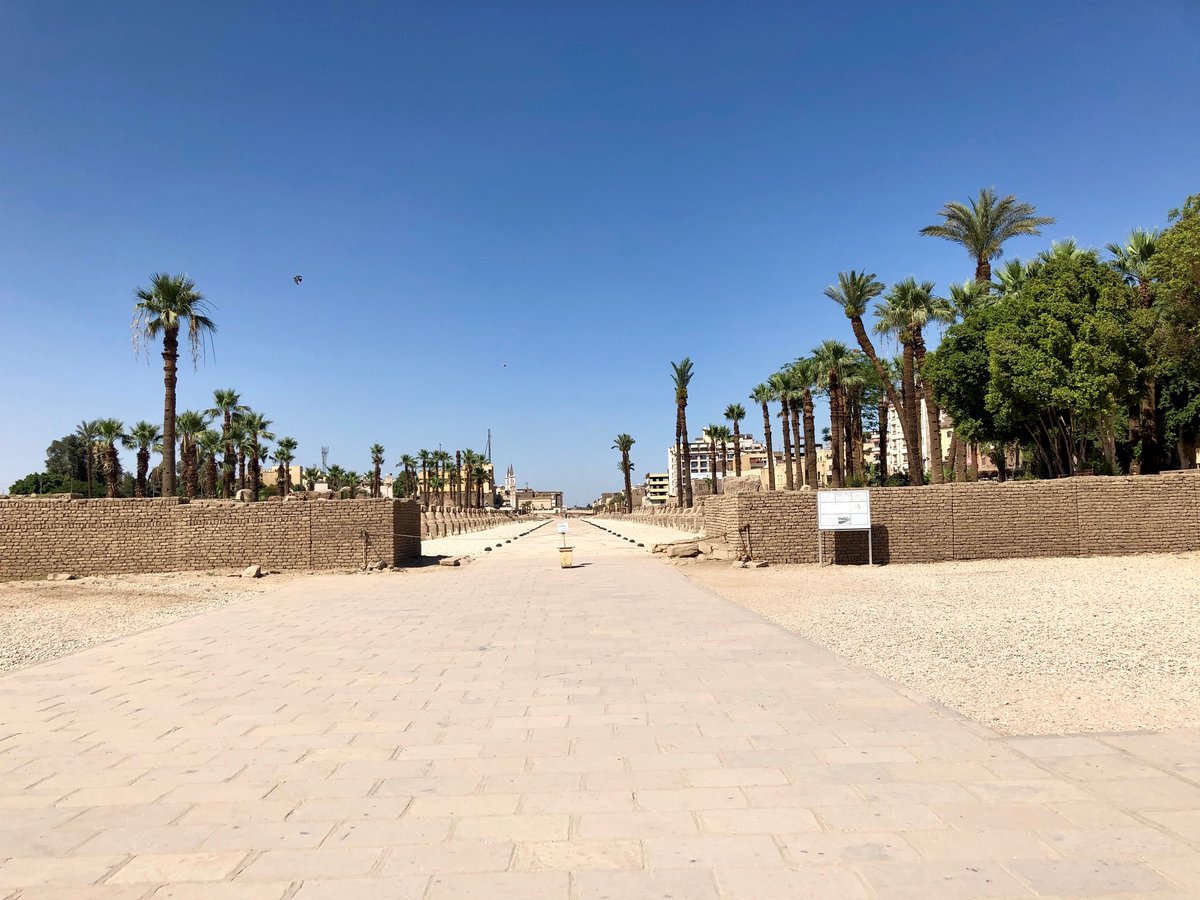
Start at the Avenue of Sphinxes — ram-headed criosphinxes that once lined the full 2.5-kilometer processional route south to Luxor Temple. Pass through the First Pylon into the Great Court, then into the Hypostyle Hall. Push deeper along the east-west solar axis past the obelisks and the granite sanctuary where Amun-Ra's barque rested at the climax of the annual Opet Festival. Then double back and find the Khonsu Temple in the southwest corner — most tour groups skip it entirely, and its compact reliefs are some of the cleanest carving in the complex.
Allow a minimum of two and a half hours. Three is better. The Precinct of Amun-Re alone could hold ten European cathedrals, and the quieter Precinct of Mut to the south rewards anyone willing to wander past the headline acts. Arrive at 6 AM when the gates open — the light is soft, the air is cool, and for a few minutes the columns belong only to you. Or return after dark for the Sound and Light show, when illuminated pylons reflect in the Sacred Lake and recorded voices narrate the temple's story from the grandstand. Either way, you'll leave understanding why every pharaoh from 2000 BC onward felt compelled to add one more stone.


History
Karnak's oldest surviving structure dates to the reign of Senusret I around 1971–1926 BCE — his elegant White Chapel, a limestone way-station for the god's barque. But the site may have been sacred even earlier; scholars point to traces possibly linked to Wahankh Intef II of the 11th Dynasty, around 2100 BCE, though this remains uncertain. What is clear is that once construction began, it never really stopped. Every New Kingdom pharaoh between roughly 1550 and 1069 BCE left a mark here, and Ptolemaic and Roman rulers were still adding chapels as late as the 1st century CE.
The result is less a temple than an argument between centuries. Walls contradict each other. Names are carved over names. A pharaoh's greatest monument becomes the next pharaoh's foundation fill. UNESCO recognized the complex in 1979 as part of Ancient Thebes with its Necropolis, calling it one of "the most fascinating realisations of Antiquity." That undersells it. Karnak is a place where you can press your hand against stone and feel the specific anxieties of people who ruled the known world.
The turning point
Around 1457 BCE, Hatshepsut — a woman ruling as king, not merely queen — ordered two granite obelisks quarried at Aswan and floated 200 km downriver to Karnak. Her own inscription claims the work took seven months. The surviving obelisk stands roughly 29.5 metres tall and weighs an estimated 323 tons. It remains the tallest ancient Egyptian obelisk still standing in its original position anywhere in the world. Hatshepsut needed it. A female pharaoh's legitimacy depended on visible, undeniable proximity to Amun-Ra, and nothing said divine favor like a needle of pink granite tipped in electrum catching the morning sun.
After her death, her stepson Thutmose III — a formidable military commander who had waited decades for sole rule — launched a campaign to erase her. Cartouches were chiseled off walls across Egypt. At Karnak, he built a sandstone enclosure wall around the lower portion of her obelisk, hiding her inscriptions from public view. The intention was obliteration. The effect was preservation. The masonry shielded the bottom six metres of carved text from wind, sand, and sun for over three millennia. Today you can see the contrast yourself: the weathered upper shaft versus the sharp, almost fresh-looking hieroglyphs below. Recent scholarship suggests the erasure may not even have been personal revenge — it may have come 20 years into Thutmose III's sole reign, possibly driven by his son Amenhotep II's succession politics rather than old grudges.
Stand at the base and look up. The electrum cap is long gone — whether plundered in antiquity, melted by Persian invaders under Cambyses in 525 BCE, or stripped in later centuries remains debated. But the stone endures, and so does Hatshepsut's name, precisely because someone tried to destroy it.
Absolutely — Karnak is the largest religious building ever constructed, and nothing else in Egypt gives you the same sense of accumulated pharaonic ambition across two thousand years. The Great Hypostyle Hall alone, with 134 columns filling a 5,000 m² room (bigger than most European cathedrals), justifies the trip. Pair it with nearby Luxor Temple via the restored Avenue of Sphinxes for the full ceremonial picture the ancients intended.
Plan for 2–3 hours if you want to see the main axis properly without rushing. A quick pass through the Hypostyle Hall and Sacred Lake takes about 90 minutes, but you'll miss the Khonsu Temple, the Open Air Museum, and the quieter precincts of Mut and Montu. For a deep visit with photography and side chapels, budget 3–4 hours and bring water.
Karnak sits about 3 km north of central Luxor — a short taxi ride of roughly 10 minutes. You can also walk the 2.7 km from Luxor Temple along the restored Avenue of Sphinxes, which is the ancient processional route and a rewarding experience in itself. Local minibuses marked "Karnak" depart from behind Luxor Train Station or behind Luxor Temple for the cheapest option; there's no metro in Luxor.
Arrive right at opening (6:00 AM) for the softest light, thinnest crowds, and coolest temperatures — the first pylon catches the sunrise head-on. The last two hours before the 5:00 PM close also work well, with warm golden-hour light that makes the granite obelisks glow. Avoid midday in summer unless you plan to shelter inside the Hypostyle Hall, which stays surprisingly cool even when the open courts are brutal.
Only children under 6, Egyptians over 60, and Egyptians with special needs enter free. Foreign adults pay EGP 600 and foreign students (with valid ID, age 24 or under) pay EGP 300 — that ticket now includes the Open Air Museum. The Mut Temple precinct costs an additional EGP 200 for foreigners.
Beyond the Great Hypostyle Hall, seek out Hatshepsut's obelisk — at roughly 29.5 metres it's the tallest ancient Egyptian obelisk still standing in situ, and its lower inscriptions were accidentally preserved for 3,400 years by the very wall her successor built to erase her. The "Botanical Garden" reliefs in Thutmose III's festival hall show exotic plants from his Syrian campaigns and are considered the world's earliest botanical illustrations. Most tour groups walk right past them.
Karnak opens daily 6:00 AM to 5:00 PM, with last entry at 4:00 PM year-round including Ramadan. Foreign adult tickets cost EGP 600 (EGP 300 for students); Egyptian adults pay EGP 40. You can book online at egymonuments.com, and mobile-phone photography is included free with any ticket.
Yes — the Karnak Sound and Light Show runs nightly after dark, with multiple showings in rotating languages. You walk through illuminated sections of the temple while narration plays, ending at a grandstand overlooking the Sacred Lake with the pylons lit up behind it. It's a different experience from the daytime visit and the only way to see the columns dramatically uplighted at night.
Built from cited sources · see the method · How we make our guides →
106 places to discover — a few worth pairing.
Saved and recently read places — kept on this device only.
Photos may have been resized or cropped.