An introduction.
Researched by the Audiala editorial team from historical records, architectural archives, and local expertise.
TThe most radical building in Egypt was designed by a woman whom history tried to erase — and the building itself became the instrument of her survival. Hatshepsut Temple rises from the desert floor at Deir el-Bahari on Luxor's West Bank, three pale limestone terraces pressed against 300-foot cliffs like a set of open palms. It is the finest mortuary temple in Egypt, and it was built 3,450 years ago by a pharaoh whose successor spent decades trying to chisel her name from existence.
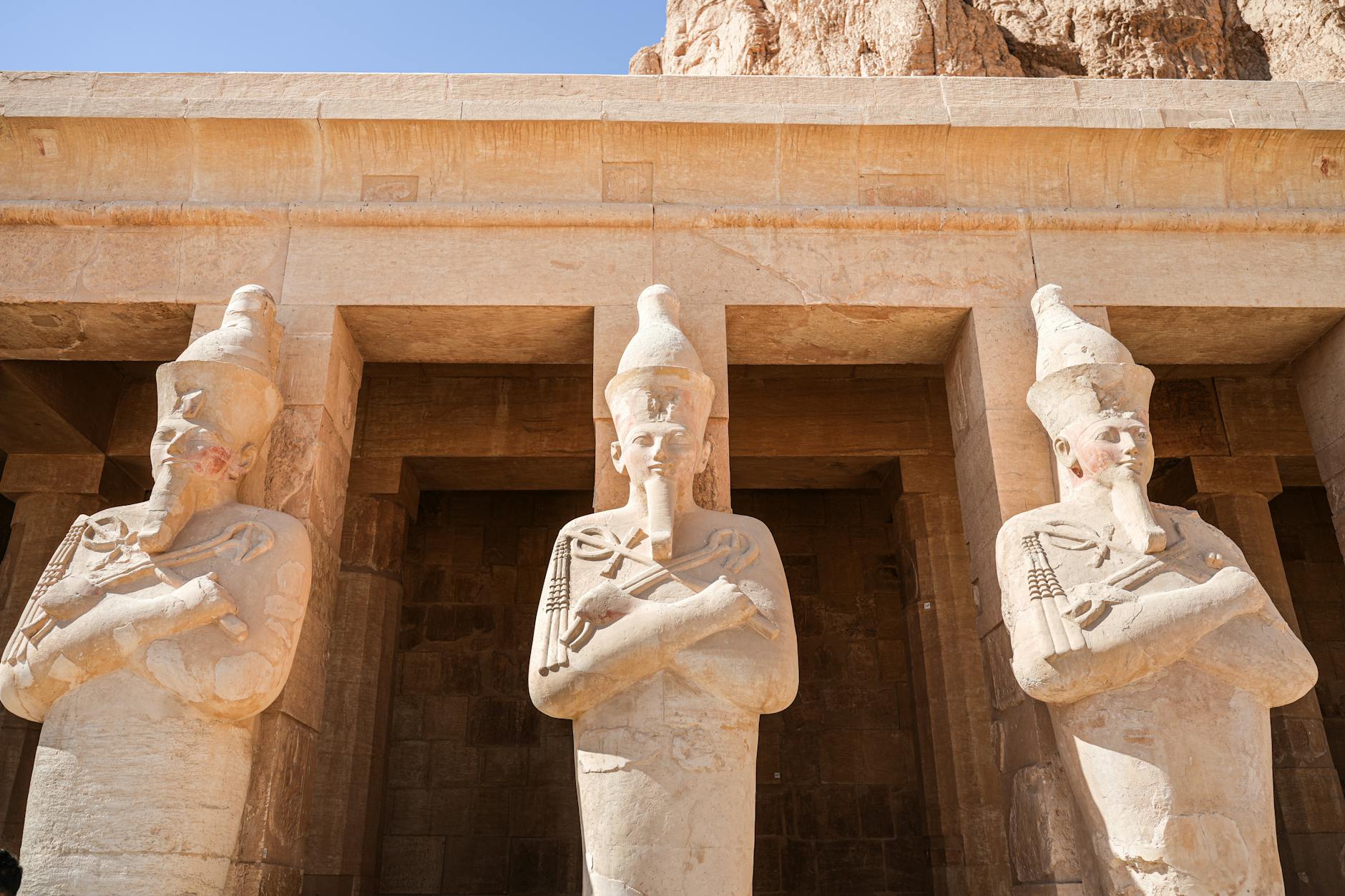
The ancient Egyptians called it Djeser-Djeseru — "Sublime of Sublimes." That name still fits. Where most Egyptian temples overwhelm with mass and darkness, this one breathes. Long colonnaded porticoes catch the morning sun. Ramps ascend in clean horizontal lines. The effect is closer to a modernist concert hall than to the heavy pylons of Karnak across the river.
What you're looking at is also a political argument carved in stone. Hatshepsut — one of the very few women to rule Egypt as full pharaoh, not regent — used every surface here to prove she deserved the double crown. Reliefs depict the god Amun himself fathering her. Others record a trading expedition to the distant Land of Punt that brought back myrrh trees, gold, and exotic animals. No other ancient Egyptian monument preserves such a complete record of a foreign trade mission.
The temple sits within the UNESCO-listed zone of Ancient Thebes, a short drive from the Valley of the Kings and the Valley of the Queens. A Polish conservation team has worked here since 1961, and the site reopened with stabilized colonnades in March 2023. Arrive early. The cliffs behind the temple glow amber at dawn, and by 10 a.m. the heat and the tour buses arrive together.
Egypts Most Expensive Tomb to visit, KV17 SETI I in valley of the kings Luxor
Sam Mayfair01 What to see.
The Three Terraces and the Cliff Face
The Punt Colonnade Reliefs
The Chapel of Hathor and the Sanctuary of Amun
A Morning on the West Bank
02 In pictures.



Watch & Explore Hatshepsut Temple.
Plan and listen to Hatshepsut Temple with Audiala.
Audio guide in your pocket, itinerary in your browser. Built for the way you actually visit.
03 Visitor logistics.
The practical scaffolding for a good visit — kept short.
Getting There
From Luxor's East Bank, cross the Nile by public ferry (opposite the Luxor Museum) then grab a taxi to Deir el-Bahari — about 15 minutes by road. Alternatively, hire a driver who'll take the bridge south of Luxor and deliver you directly to the parking area. No public buses serve the West Bank from the East Bank, so a taxi, private driver, or organized tour is your only real option.
Opening Hours
As of 2026, the temple opens daily at 6:00 AM. Last entry is 5:00 PM in summer and 4:00 PM in winter and during Ramadan. No weekly closing day — it's open every day of the year, though individual chapels or levels may be closed for restoration on any given visit.
Time Needed
A quick photo-and-terrace sweep takes 45–60 minutes. If you want to study the Punt expedition reliefs and peer into the Hathor and Anubis chapels, plan 1.5–2 hours. Add 15–20 minutes each way for the shuttle ride and walk from the parking area — the temple is roughly a kilometer from where vehicles stop.
Tickets
As of 2026, foreign adult entry is EGP 440 (students EGP 220 with valid ID, age 24 max). Children under 6 enter free. Buy tickets online via the official EgyMonuments platform or Experience Egypt app to skip the queue — Visa and Mastercard accepted both online and at the gate.
Accessibility
The ancient ramps between terraces make this more wheelchair-friendly than most Egyptian temples, but "friendly" is relative — expect long inclines, uneven sandstone, zero shade, and no elevators. The lower court and main approach are manageable with a strong companion pushing. The upper terrace and inner sanctuary involve steeper grades and narrow passages that will challenge most wheelchair users.
04 Tips for visitors.
Small things that change the day.
Arrive at Dawn
The limestone cliffs behind the temple act as a reflector oven — by 10 AM in summer, ground temperatures are brutal and shade is virtually nonexistent. Be at the gate when it opens at 6:00 AM: cooler air, golden light on the colonnades, and far fewer tour buses.
Photography Rules
Phone and standard camera photography is free and allowed everywhere outdoors. Flash is strictly prohibited inside the painted chapels (Hathor, Anubis, upper sanctum) — guards enforce this. Tripods require a separate Ministry photography permit; drones are banned at all Egyptian archaeological sites and will be confiscated.
Scams to Expect
Vendors near the entrance will press a "free" scarab or postcard into your hand, then demand payment — don't accept anything. If a man near the parking area tells you "the temple is closed today" and offers his brother's alabaster shop instead, he's lying. The temple is open daily.
Baksheesh Economy
Guards may offer to unlock a "closed" chapel or let you behind a rope for a photo — this is an informal but universal system. Have 20–50 EGP notes ready if you want to play along; it's optional but can get you into the Hathor Chapel's painted interior when it's otherwise roped off.
Eat on the West Bank
There's no real food at the temple itself beyond bottled water at the shuttle area. After your visit, try Africa Restaurant near Medinet Habu for solid Egyptian staples (mid-range, ~150–300 EGP) or grab fresh sugar cane juice from roadside carts for 5–10 EGP — Luxor governorate is Egypt's cane heartland and the juice is extraordinary.
Combine West Bank Sites
Hire a driver for a half-day West Bank circuit: Hatshepsut Temple first at 6 AM, then the Valley of the Kings and Colossi of Memnon on the way back. You'll finish all three before the worst midday heat, and a shared driver costs far less than three separate taxis.
05 A Queen's Proof, Buried and Unburied
Hatshepsut's temple was never just a tomb. Built during the 18th Dynasty of the New Kingdom (c. 1472–1458 BCE), it served simultaneously as a mortuary cult center for Hatshepsut and her father Thutmose I, a docking station for Amun's sacred barque during the annual Beautiful Festival of the Valley, and a billboard for the most audacious political claim of its era: that a woman could be pharaoh.
The site at Deir el-Bahari already carried weight. Beside it stood the 500-year-old mortuary temple of Mentuhotep II, whose terraced design against the cliffs provided the architectural seed. But Hatshepsut's architect took that seed and grew something entirely new — a building that merged with the cliff face rather than competing with it. What followed was 3,500 years of construction, destruction, conversion, burial, and painstaking resurrection.
Senenmut: The Architect Who Vanished
Senenmut was not born into power. He rose from provincial obscurity to become Chief Steward of Amun, Overseer of Royal Works, and tutor to the princess Neferure — making him, by most accounts, the most powerful non-royal figure in Egypt. His career was a bet placed entirely on one person: Hatshepsut. If she held the throne, he held the kingdom's purse strings. If she fell, he had nothing.
He designed Djeser-Djeseru to physically manifest her legitimacy. Three ascending terraces — a progression from the mortal desert floor toward the divine cliff sanctuary — made the pharaoh's authority feel as inevitable as geology. Senenmut embedded his own image in at least 60 statues and carved his likeness discreetly behind door panels within the temple, a quiet signature on his masterwork. He even began two tombs for himself (TT71 and TT353), the latter tunneled directly beneath the temple's first courtyard.
Then he disappeared. After Hatshepsut's death around 1458 BCE, Senenmut's name drops from every record. His statues were defaced. His tombs were left unfinished — TT353's painted ceiling of astronomical charts was never completed. No burial was ever found. Scholars remain divided: natural death, court purge, or quiet execution? The man who built Egypt's most elegant building left behind the most conspicuous absence in its archive.
The Cold Erasure of 1436 BCE
Monks, Earthquakes, and the Polish Rescue
Listen to the full story in the app
The whole Hatshepsut Temple,
told well.
Listen to sourced travel stories with local history and practical context — ready offline.

06 Frequently asked.
The questions travellers send us most about Hatshepsut Temple.
Is Hatshepsut Temple worth visiting?
Absolutely — it's one of the most architecturally striking monuments in Egypt, and unlike anything else you'll see on the West Bank. Three colonnaded terraces rise directly from the desert floor into 300-foot limestone cliffs, a design that was radical in 1470 BCE and still stops you cold today. The Punt expedition reliefs on the middle terrace are the most complete surviving record of an ancient Egyptian trade mission anywhere, and the Hathor and Anubis chapels still carry original painted pigment that glows in the dim light.
How long do you need at Hatshepsut Temple?
Plan 1 to 1.5 hours for a solid visit, or 2 hours if you want to study the reliefs and linger in the upper chapels. A quick photo-focused walk-through takes 45–60 minutes, but you'll miss the details that make this place extraordinary. Factor in extra time for the shuttle ride from the parking area and potential queues at the inner sanctuary.
How do I get to Hatshepsut Temple from Luxor?
From Luxor's East Bank, you need to cross the Nile — either by public ferry (departing near the Luxor Museum) then taxi from the West Bank landing, or by hiring a driver who takes the bridge south of town. There are no public buses serving the West Bank temples from the East Bank. The temple is at Deir el-Bahari, roughly 3 km from the Colossi of Memnon and a short drive from the Valley of the Kings, so most visitors combine all three in a single morning.
What is the best time to visit Hatshepsut Temple?
Arrive at 6 AM when the gates open — the cliffs form a natural amphitheater that traps and reflects heat, and by 10 AM the temperature can be brutal. Early morning also gives you the best light for photographs, with the sun hitting the colonnades at a low angle. Season-wise, October through March offers the most tolerable weather; summer midday temperatures regularly exceed 40°C (104°F) at the site.
Can you visit Hatshepsut Temple for free?
No — foreign adult tickets cost EGP 440 (roughly $9–14 depending on exchange rates), with a student rate of EGP 220 for valid ID holders under 24. Children under 6 enter free. You can buy tickets online through the official EgyMonuments platform or the Experience Egypt app, which helps you skip the queue at the gate.
What should I not miss at Hatshepsut Temple?
The Punt expedition reliefs on the middle terrace's south colonnade are irreplaceable — they depict Egyptian ships, stilt houses, exotic animals, and the ruler of Punt in extraordinary detail from roughly 1470 BCE. Don't rush past the Hathor Chapel (south side, middle terrace) or the Anubis Chapel (north side), where original painted pigments survive in near-darkness. On the upper terrace, look for the unfinished northern colonnade: the column sockets are carved but the drums were never placed, a physical freeze-frame of the moment Hatshepsut's reign ended.
Is Hatshepsut Temple accessible for wheelchairs?
Partially — the temple uses ramps between its three terraces rather than stairs, which helps, but the approach from the shuttle drop-off is long, exposed, and over uneven ground. The lower court and main ramp are manageable with assistance. Upper areas become difficult, there's almost no shade or seating, and no elevators exist on site.
Why was Hatshepsut Temple defaced?
The popular story is that Thutmose III destroyed it out of jealous rage, but the evidence tells a cooler, more calculated tale. The erasure campaign began around 1436 BCE — roughly 20 years after Hatshepsut's death — timed precisely to when Thutmose III's son Amenhotep II was approaching the throne. Scholars now read it as a dynastic consolidation move to remove the precedent of female rule, not a personal vendetta; crucially, the temple structure itself was preserved, and many defaced blocks were buried in fill walls, ironically saving them for modern archaeologists.
Verified, and shown.
Researched and written by the Audiala editorial team from historical records, architectural archives, and local expertise.
Construction dates, chronology of defacement and restoration phases, Coptic monastery period, excavation history, Polish PCMA conservation project
Official reign dates, Punt expedition details, divine birth narrative, Senenmut attribution, opening hours
Current ticket prices, seasonal opening hours, last-entry times, free-entry policies, photography rules
Booking channels, accepted payment methods, phone photography policy, drone restrictions
Online booking benefits and skip-the-line information
January 2025 Zahi Hawass Foundation discoveries: 1,000+ decorated blocks, foundation deposits, 17th Dynasty tombs beneath the causeway
Hatshepsut's reign dates, Punt expedition context, Thutmose III erasure narrative
Construction timeline, Senenmut as architect, visit duration estimates
Thutmose III's delayed erasure campaign, KV20 tomb context, mummy identification debate
Ongoing conservation methodology, anastylosis techniques, 2023 reopening details
Recent traveler reports on shuttle prices, walking distances, partial closures, on-site conditions
Visitor experiences regarding shade, seating, accessibility, cafe availability, crowd conditions
Visitor-reported visit duration estimates ranging from 45 minutes to 2 hours
Visitor routing, parking arrangements, shuttle transport policy at Deir el-Bahari
Practical transport advice: no public buses to West Bank, ferry crossing logistics
Transport options, nearby West Bank restaurant recommendations
Accessibility assessment of Hatshepsut Temple: ramps, terrain conditions, wheelchair feasibility
April 2026 restoration and visitor-development work at Deir el-Bahari
Confirmation of ongoing restoration work at Hatshepsut Temple area
Documentation of the 1997 Luxor massacre at Hatshepsut Temple
Hatshepsut biographical context, local naming conventions
Direct car route option via bridge south of Luxor
Thutmose III temple remains comparison, spatial memory studies at Deir el-Bahari
Architectural perception, Coptic monastery overlay, modern visitor experience analysis
Built from cited sources · see the method · How we make our guides →