Bubastis Portal
LuxorEgypt 25° N · 32° E Updated Aug 2026
The Bubastis Portal at Karnak records Shoshenq I's Levantine campaign with over 150 town name-rings, but the one name many pilgrims seek—Jerusalem—is missing.
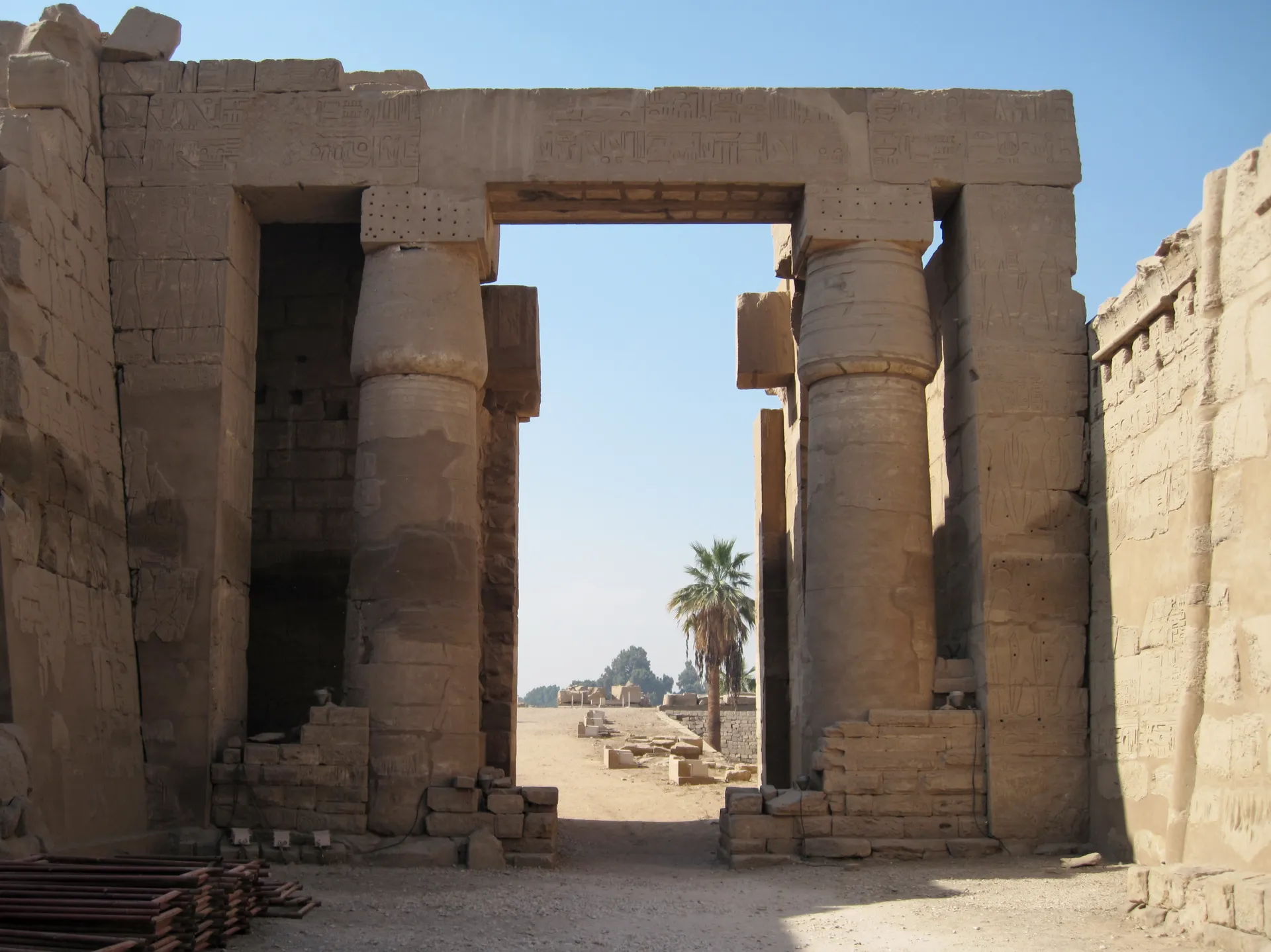 Photo: Olaf Tausch · CC BY 3.0
- Time needed
- 20-30 minutes
- Entry
- Included with Karnak Temple Complex entry
- Access
- Uneven sandstone paving; limited wheelchair access
Why does Egypt's most famous biblical victory wall never once mention Jerusalem? The Bubastis Portal in Luxor, Egypt — a sandstone gate wedged into the south-east corner of the Precinct of Amun-Re at Karnak Temple Complex — draws biblical pilgrims and hard-nosed epigraphers to the same cramped patch of stone. Its rows of captive name-rings seem to promise harder evidence than any prayer book. That promise is partly a trap.
By late afternoon the relief glows like burnt honey. The carved figure of Shoshenq I is smaller than most visitors expect; the real force is the dense grid of name-rings spreading around him. Most people photograph the wall and leave before noticing the second story scratched across it a century later.
The gate was never a lone victory monument. Records show Shoshenq I commissioned it around Year 21 of his reign, confirmed by a sandstone quarry stela at Gebel el-Silsilah signed by the master of works Haremsaf. It was the ceremonial southern entry to a festival court, not an afterthought to a raid.
So come for the biblical mystery. Stay for the civil-war diary carved directly over it. The portal does not confirm the story most people want; it tells a stranger, messier one.
What to see
-
The Smiting Scene of Shoshenq I
Stand in the narrow gap between the Second Pylon and Ramesses III's temple just after 7am, and the low raking light gouges black shadows into Shoshenq I's upraised mace. The pharaoh grips a knot of kneeling Levantine captives by the hair while Amun-Re extends a curved khopesh of victory. Most tours rush past this southeast corner of the Karnak Temple Complex, so the only sounds are pigeon wings clattering in the cornice niches. That silence is a gift — the carved sandstone, quarried at Gebel el-Silsilah, shifts from chalky ochre to honey-gold as the sun climbs. -
The Name-Rings of a Biblical War
Run your eyes along the lower third of the portal and you'll find over 150 crenellated ovals, each one a conquered settlement from Shoshenq I's Levantine campaign around 925 BCE. Megiddo, Taanach, Beth-Shean, Gibeon — they hang like a stone tapestry of bound captives, their elbows lashed behind them with carved ropes. One damaged oval may be the earliest extrabiblical mention of the 'Field of Abram,' though scholars still argue over the reading. Bring binoculars or stand close enough to feel the coarse, crystalline chisel cuts; this is the biblical Shishak made visible. -
The Southern Escape Route
Slip through the Bubastis Portal and keep walking south, away from the tour groups funneling into the Great Hypostyle Hall. The temperature drops the moment you leave the open forecourt; the high masonry traps a mineral coolness until mid-morning. Follow the processional axis toward the Temple of Khonsu, where the crowds thin to almost nothing and you can sit on low stone blocks between Ramesses III's wall and the Second Pylon. From here, the portal frames the open courtyard back north — a view that hasn't changed much since the 10th century BCE.
Plan your visit
- Getting There
- From Luxor Temple, walk the restored 2.7 km Avenue of Sphinxes north to Karnak's entrance plaza (about 35 minutes). White microbuses behind Luxor Railway Station run to Karnak for under EGP 10, or take a 10-minute Careem/taxi to the visitor center parking lot.
- Opening Hours
- Karnak opens daily 06:00–17:00 as of 2026, with last entry at 16:00. The portal closes with the rest of the complex; evening Sound and Light Show access doesn't include standard visits to the relief.
- Time Needed
- Give the portal itself 15–30 minutes to study Shoshenq I's smiting scene and the 150+ city rings. A highlights loop through Karnak's forecourt and hypostyle hall takes 90 minutes; a full complex visit runs 2.5–4 hours.
- Accessibility
- Ramps lead through the main entry axis into the First Court, and the portal sits on flat ground, making it one of Karnak's easier major reliefs to reach. Manual wheelchair users may need help over loose sand patches and raised stone thresholds.
- Cost/Tickets
- Entry is included in the Karnak ticket: EGP 600 for foreign adults, EGP 300 for foreign students with ISIC, EGP 40 for Egyptians, free under 6 as of 2026. Counters are card-only; buying online at egymonuments.com skips ticket-booth queues.
Photo Gallery


History
The Gate That Forgot Jerusalem
Shoshenq I founded the 22nd Dynasty around 943 BCE as a Meshwesh chief from Bubastis in the Nile Delta. In his second decade he ordered a monumental gate at Karnak, right where visitors now pause between the Second Pylon and the Temple of Ramesses III. The wall was to celebrate his Levantine campaign — the one many Egyptologists identify with the biblical Shishak.
But the portal kept being reused. A century after Shoshenq, Prince Osorkon turned the same surface into a public legal record. The result is no ordinary war memorial; it is a lapidary archive of dynastic pride and priestly score-settling.
The turning point
The Prince Who Used a Victory Wall as a Courtroom
The story most visitors absorb is easy to accept. Pharaoh Shoshenq I smites Levantine enemies, and more than 150 name-rings record what he conquered. Guides point to the figure of Shishak and read aloud from 1 Kings 14. For a moment, the Bible and the stone agree.
But look higher. A second layer of smaller, denser hieroglyphs cuts across the wall, carved nearly a century later. It does not glorify a pharaoh. It narrates expulsions, sieges, debt cancellations, and a burning. Why would a priest dare overwrite a king's monument?
The priest was Prince Osorkon, son of Pharaoh Takelot II and High Priest of Amun at Thebes. Theban factions had driven him out more than once; each time, his legitimacy and his life hung on retaking Karnak. When he returned with troops from Lower Egypt around 839 BCE, the Chronicle records that rebel ringleaders were burned alive at the gate — a rare and deliberate erasure of their afterlife. This was not decoration. It was jurisdiction, carved where every pilgrim and priest would have to see it.
Now the wall reads as two monuments set a century apart. Shoshenq's campaign list flatters a pharaoh; Osorkon's cramped text reads like a legal diary etched over a wound. Both men used the same stone to argue with the city.
Why Jerusalem Is Missing
The Cartouche at the Top
Tips for visitors
Cover Up, Hands Off
Karnak isn't a mosque, but Upper Egyptian norms still apply: keep shoulders and knees covered. Never trace or lean on the carved cartouches—finger oils speed up sandstone decay.Skip the Flash
Handheld photos and phones are fine, but flash is banned on painted and relief surfaces. Tripods and monopods need advance Ministry permits; drones are confiscated at Egyptian airports.Baksheesh at the Wall
Unofficial 'specialist guides' in the First Court may point at Shoshenq's cartouche, then demand large tips. A firm 'La, shukran' ends it; agree on taxi or hantour fares before boarding.Raking Light, No Shade
Arrive at opening to catch low raking light across the sunk reliefs—and to beat the 11:00–15:00 heat. The forecourt has zero overhead shade, so bring a hat and high-SPF sunscreen.Pair It With the Open-Air Museum
The portal sits at the southeast corner of the First Court. From here, walk northwest to the Open-Air Museum's White Chapel and Red Chapel, or south toward the Temple of Khonsu.One Ticket Covers It
Don't pay anyone selling a separate 'portal ticket'—it's included in standard Karnak entry. Buy online in advance to skip the card-only counter line.
Frequently asked
Is the Bubastis Portal worth visiting?
Yes, especially if biblical names or Third Intermediate Period politics interest you. Shoshenq I—the biblical Shishak—boasted over 150 conquered Levantine towns here around 925 BCE. Most tours hurry past toward the Great Hypostyle Hall, so you'll likely stand alone before the smiting scene and the captive name-rings.
How long do you need at the Bubastis Portal?
Fifteen to thirty minutes covers the smiting scene, the name-rings, and Champollion's cartouche. For Karnak overall, allow 90 minutes for a highlights circuit or 2.5 to 4 hours to explore properly. Low morning light helps the sunk relief read clearly.
How do I get to the Bubastis Portal from Luxor?
Walk the 2.7 km Avenue of Sphinxes north from Luxor to Karnak, or grab a taxi or white minibus to the Karnak visitor center. Once inside, find the Great Forecourt; the portal is wedged in the southeast corner between the Temple of Ramesses III and the Second Pylon. Flat, compacted ground makes it one of the more accessible reliefs in Karnak.
What is the best time to visit the Bubastis Portal?
Get there between 06:00 and 08:30, when raking sun carves black shadows into the sunk relief and the stone still holds the night's cool. Midday flattens the hieroglyphs and turns the sandstone into a heat sink. Winter mornings are pleasant but aim for 07:30 before tour buses swarm.
Can you visit the Bubastis Portal for free?
No—but it's included in the general Karnak ticket, so there's no separate charge. Foreign adults pay EGP 600, foreign students EGP 300; the last entry is 16:00 and counters are card-only. Egyptian citizens pay EGP 40, students EGP 20.
What should I not miss at the Bubastis Portal?
Look for the name-rings of Megiddo, Taanach, and Beth-Shean, plus the 'Field of Abram' cartouche in Row I. Don't skip the smiting scene: Shoshenq grips captives by the hair while Amun-Re offers him a curved khopesh. And study the masonry seam where 22nd-Dynasty blocks were cut to wrap over the older Temple of Ramesses III—an ancient lap joint in stone.
What is the Bubastis Portal famous for?
It's the Egyptian wall most tightly linked to the biblical Shishak's campaign. Champollion deciphered Shoshenq I's cartouche here in 1828, matching the relief to 1 Kings 14 and 2 Chronicles 12. The portal also carries the Chronicle of Prince Osorkon, a rare political diary of Theban rebellion, ritual executions by fire, and a lunar eclipse.
Sources & attribution 29
- UNESCO World Heritage Centre — Confirms Ancient Thebes with its Necropolis, including Karnak, as a 1979 UNESCO World Heritage Site.
- Wikipedia: Precinct of Amun-Re — Background on the Karnak precinct of Amun-Re where the Bubastis Portal is located.
- Wikipedia: Bubastite Portal — Dates, Shoshenq I, biblical Shishak identification, Champollion's 1828 visit, and the topographical name-ring list.
- The Epigraphic Survey: Reliefs and Inscriptions at Karnak, Volume 3: The Bubastite Portal — Year 21 quarry stela, master architect Haremsaf, portal construction, and the Chronicle of Prince Osorkon.
- Armstrong Institute of Biblical Archaeology — Shishak's Levantine campaign, biblical correlation, and the Jeroboam paradox.
- Bible Interp / University of Arizona — Scholarly analysis of the topographic list, missing Jerusalem, and campaign route debates.
- ISAC Chicago: OIP 74 Publication Page — University of Chicago Epigraphic Survey documentation of the Bubastite Portal.
- ISAC Chicago: OIP 74 PDF — Monument location, epigraphic details, and practical access information from the Epigraphic Survey.
- Ministry of Tourism and Antiquities - Karnak Archaeological Site — Official opening hours, ticket prices, and site rules for Karnak Temple Complex.
- Audiala - Karnak Visitor Guide 2026 — Practical visitor logistics, hours, ticket info, and access notes for Karnak.
- Ministry of Tourism and Antiquities Ticket Portal — Online booking, last entry at 16:00, and cashless ticket counters.
- Accessibility at Archaeological Sites in Luxor — Terrain, ramps, and wheelchair access details around the Karnak complex.
- Happy Egypt - Wheelchair Accessible Activities in Egypt — Wheelchair access and ramps at Karnak and Luxor archaeological sites.
- Soul of Egypt Travel — Why visit Karnak, sensory details, ideal exploration time, and quiet corners.
- Mapy.cz - Bubastite Portal — Mapping coordinates and campaign date reference for the Bubastis Portal.
- Tales from the Two Lands - Egypt Holiday 2014: Karnak Temple Complex — Processional context and location of the Bubastite Portal within Karnak.
- Carrie Reed Travels - Visiting Karnak Temple — Morning light, sensory texture, and best times for viewing reliefs.
- ISAC Chicago: The Epigraphic Survey SAC3 PDF — Epigraphic Survey academic publication citation and local archaeological research context.
- Madain Project - Bubastite Portal — Portal as a Third Intermediate Period bridge, location clarification, and common myths.
- Biblical Archaeology Review - Shishak's Campaign — Campaign route debates, missing Jerusalem question, and biblical-historical synchronization.
- Egypt Tours Portal - Karnak Temple — Opet Festival, Avenue of Sphinxes reopening, local heritage, and community role.
- Academia.edu - The Third Intermediate Period at Karnak — Chronicle of Prince Osorkon and Third Intermediate Period political-religious context.
- Scribd - Karnak: Development of the Temple of Amun-Ra — Temple development, processional function, and architectural context of Karnak.
- Bible Archaeology Report - Top Ten Discoveries Related to David — The 'Heights of David' / Yad Hammelek cartouche debate and biblical heritage tourism.
- Facebook ArcheoStory - Bubastite Inscription — Ritual and legal use of the portal, including the dead pharaoh accusation tradition.
- Smart-Guide - Karnak Uncovered — Opet Festival, Avenue of Sphinxes reopening, and local tourism context.
- Facebook - Amazigh Houara — Yennayer / Amazigh calendar connection to Shoshenq I and living North African heritage.
- Facebook - Nate Loper on the Bubastite Portal — Biblical archaeology connection and the David cartouche discussion.
- Facebook - Bibledigs Group — Oral guide commentary traditions on the 'Heights of David' reading at the portal.
Built from cited sources · see the method · How we make our guides →
More in Luxor.
106 places to discover — a few worth pairing.

Pick up where you left off
Saved and recently read places — kept on this device only.
Photo credits (14)
- Jeremy Zero — Unsplash License (https://unsplash.com/license) — Source: https://images.unsplash.com/photo-1568605117036-5fe5e7bab0b7
- Karnak Tempel Vorhof 16 — Olaf Tausch — CC BY 3.0 (https://creativecommons.org/licenses/by/3.0/) — Source: https://commons.wikimedia.org/wiki/File:Karnak_Tempel_Vorhof_16.JPG
- By ovedc - Karnak temple complex - 80 — Ovedc — CC BY-SA 4.0 (https://creativecommons.org/licenses/by-sa/4.0/) — Source: https://commons.wikimedia.org/wiki/File:By_ovedc_-_Karnak_temple_complex_-_80.jpg
- File by Alexander Baranov - . (6182061867) — Alexander Baranov from Montpellier, France — CC BY 2.0 (https://creativecommons.org/licenses/by/2.0/) — Source: https://commons.wikimedia.org/wiki/File:File_by_Alexander_Baranov_-_._(6182061867).jpg
- Bubastis portal at Karnak — Markh at English Wikipedia — CC BY-SA 3.0 (https://creativecommons.org/licenses/by-sa/3.0/) — Source: https://commons.wikimedia.org/wiki/File:Bubastis_portal_at_Karnak.jpg
- Flickr - Gaspa - Tempio di Karnak, ruderi — Francesco Gasparetti from Senigallia, Italy — CC BY 2.0 (https://creativecommons.org/licenses/by/2.0/) — Source: https://commons.wikimedia.org/wiki/File:Flickr_-_Gaspa_-_Tempio_di_Karnak,_ruderi.jpg
- File by Alexander Baranov - . (6182518744) — Alexander Baranov from Montpellier, France — CC BY 2.0 (https://creativecommons.org/licenses/by/2.0/) — Source: https://commons.wikimedia.org/wiki/File:File_by_Alexander_Baranov_-_._(6182518744).jpg
- Karnak R18 — Marc Ryckaert — CC BY-SA 4.0 (https://creativecommons.org/licenses/by-sa/4.0/) — Source: https://commons.wikimedia.org/wiki/File:Karnak_R18.jpg
- Karnak Sheshonq I — Neithsabes — CC BY-SA 3.0 (https://creativecommons.org/licenses/by-sa/3.0/) — Source: https://commons.wikimedia.org/wiki/File:Karnak_Sheshonq_I.jpg
- Karnak Tempel Bubastis-Portal 01 — Olaf Tausch — CC BY 3.0 (https://creativecommons.org/licenses/by/3.0/) — Source: https://commons.wikimedia.org/wiki/File:Karnak_Tempel_Bubastis-Portal_01.JPG
- Karnak Tempel Bubastis-Portal 02 — Olaf Tausch — CC BY 3.0 (https://creativecommons.org/licenses/by/3.0/) — Source: https://commons.wikimedia.org/wiki/File:Karnak_Tempel_Bubastis-Portal_02.JPG
- Karnak Tempel Bubastis-Portal 03 — Olaf Tausch — CC BY 3.0 (https://creativecommons.org/licenses/by/3.0/) — Source: https://commons.wikimedia.org/wiki/File:Karnak_Tempel_Bubastis-Portal_03.jpg
- Karnak Tempel Mauer Ramses’ II. 01 — Olaf Tausch — CC BY 3.0 (https://creativecommons.org/licenses/by/3.0/) — Source: https://commons.wikimedia.org/wiki/File:Karnak_Tempel_Mauer_Ramses’_II._01.jpg
- Karnak Tempel Mauer Ramses’ II. 02 — Olaf Tausch — CC BY 3.0 (https://creativecommons.org/licenses/by/3.0/) — Source: https://commons.wikimedia.org/wiki/File:Karnak_Tempel_Mauer_Ramses’_II._02.jpg
Photos may have been resized or cropped.