Introduction
Situated in the historic al-Darb al-Ahmar district, the Amir Qijmas Al-Ishaqi Mosque stands as an enduring symbol of Cairo’s late Mamluk artistic and urban heritage. Built between 1479 and 1481 CE by Amir Sayf al-Din Qijmas al-Ishaqi, a notable Burji Mamluk official, this mosque is renowned for its innovative adaptation to a triangular urban plot, its intricate ablaq masonry, and its distinctive minaret. Its location near Bab Zuweila, one of Cairo’s medieval gates, places it at the center of a vibrant tapestry of historic sites and bustling markets, making it a must-see for those seeking to understand the legacy of Islamic Cairo.
As an active place of worship and a destination for cultural tourism, the mosque offers visitors an immersive experience of spiritual ambiance and Mamluk artistry. The richly decorated prayer hall, wooden cupola, and the philanthropic sabil-kuttab (public fountain and school) highlight the mosque’s multifaceted role in the community. Its symbolic presence—featured on the Egyptian 50-pound banknote and marked by the patron’s blazon—emphasizes its importance in both religious and national identity.
This guide details the mosque’s history, architecture, visitor logistics (including hours, ticketing, and accessibility), and offers tips for making the most of your visit. Comprehensive sources such as Archnet, MIT OpenCourseWare, and Everything Explained Today are recommended for further research.
History and Patronage
Mamluk Urban Flourishing
Built during the prosperous reign of Sultan Qaytbay, the Amir Qijmas Al-Ishaqi Mosque reflects a period of artistic and architectural innovation. The mosque’s adaptation to a challenging triangular plot exemplifies late Mamluk ingenuity in integrating monumental structures into Cairo’s dense urban fabric (Archnet).
Amir Qijmas al-Ishaqi: The Patron
Sayf al-Din Qijmas al-Ishaqi was a high-ranking Mamluk amir, holding positions such as amir akhur (master of the stables) and amir al-hajj (commander of the pilgrimage caravan). The mosque, intended as both a Friday mosque and his mausoleum, stands as a testament to his status and piety. Although a mausoleum was constructed on site, Qijmas was ultimately buried in Damascus due to his later governorship there (Wikipedia).
Architectural Features
Typology and Plan
The mosque is an excellent example of the "qa’a-type" layout, derived from residential architecture and characterized by a central hall flanked by two iwans. The fan-shaped plan responds directly to the constraints of its triangular plot, maximizing usable space and integrating with the surrounding medieval street grid (MIT OpenCourseWare).
Exterior and Urban Context
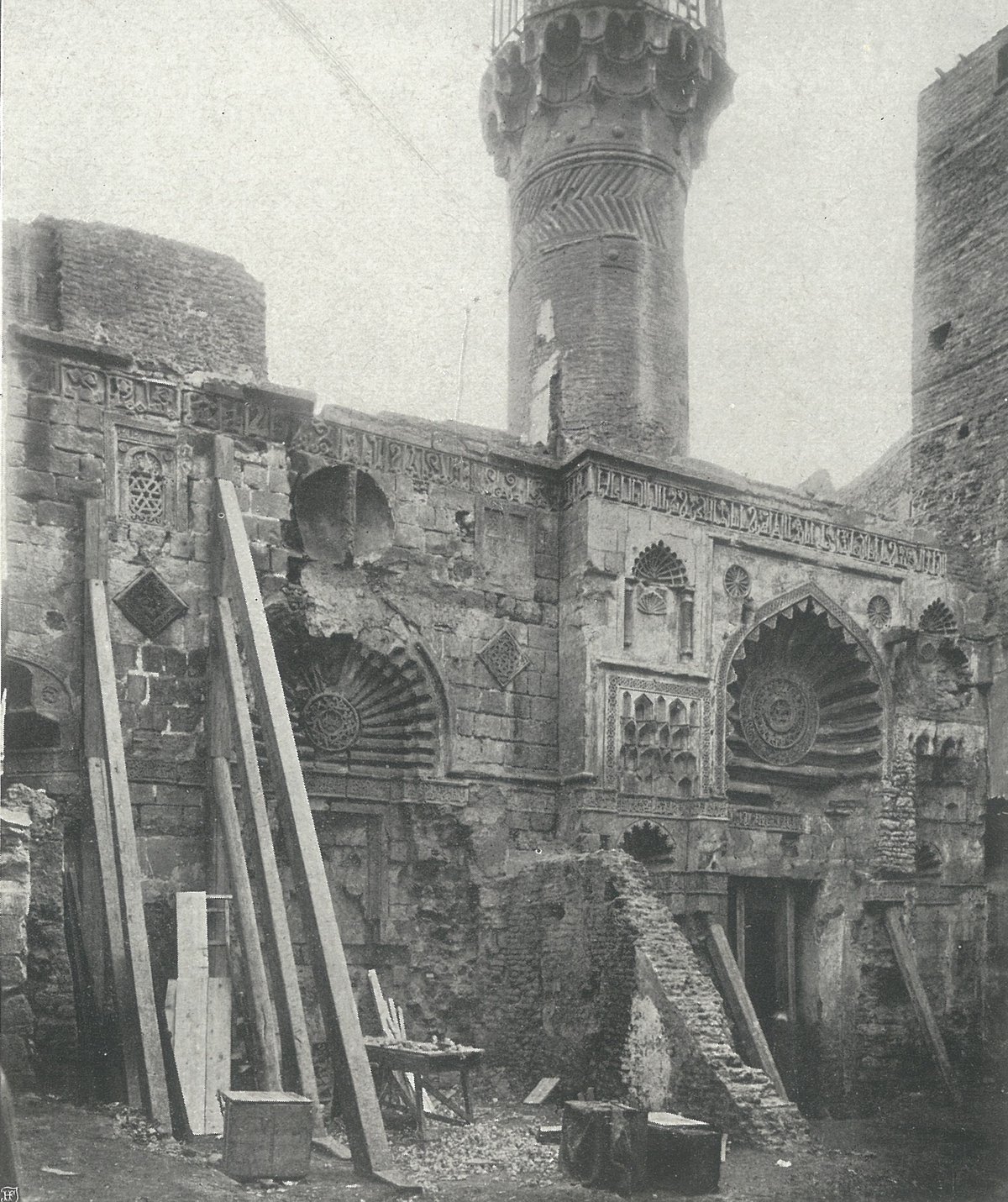
The mosque’s façade features alternating bands of light and dark stone (ablaq masonry), elaborate windows with metal grilles, carved stone panels, and a monumental entrance portal. A three-tiered minaret and a finely-carved dome rise above the bustling streets, serving as both visual landmarks and symbols of community identity. The sabil-kuttab, connected by an elevated passage, underscores the mosque’s social and charitable functions (Mosqpedia; static.the.akdn).
Decorative Elements
Rich ornamentation is found throughout. The prayer hall’s mihrab features pioneering use of white marble with black bitumen and red paste, forming intricate arabesques. Lead-brass alloy grilles with geometric and vegetal motifs protect windows and the sabil. The patron’s blazon—a cup, inkwell, and powder horns—appears on restored metalwork, symbolizing Qijmas’s elite status (journals.ekb.eg).
Adaptive Urban Strategies
The mosque’s recessed entrance creates a forecourt, while its minaret and dome serve as wayfinding points in the dense al-Darb al-Ahmar district. Rental shops on the ground floor (now below street level) provided income for upkeep, a common Mamluk practice (Aldarbalahmar).
Visitor Information
Visiting Hours
- Daily: 8:00 AM – 5:00 PM
- Note: Hours may vary during religious holidays and special events.
Tickets and Entrance
- Admission: Free. Donations for preservation are welcomed.
- Guided Tours: Some walking tours may include the mosque and charge a fee (The Historian Traveller).
Accessibility
- General Access: Stairs lead to the entrance, limiting access for those with mobility impairments.
- Wheelchair Access: A ramp is available at the main entrance, but some historic areas remain inaccessible.
Dress Code and Etiquette
- Dress Modestly: Women should cover hair, arms, and legs; men should avoid shorts and sleeveless shirts.
- Shoes: Remove before entering prayer areas; socks are recommended.
- Photography: Permitted without flash, but always be respectful of worshippers.
Cultural and Social Significance
Originally a Friday mosque and mausoleum, the site gained additional spiritual resonance when Sheikh Abu Heriba was buried under its dome in the 19th century, leading to the alternate name "Mosque of Abu Hurayba" (Aldarbalahmar). Its depiction on national currency highlights its significance in Egyptian identity.
The mosque has continuously served as a center for worship, education, and social welfare—hosting daily prayers, religious celebrations, and charitable activities. The sabil-kuttab provided both water and elementary education, reflecting the Mamluk commitment to public service (MIT OpenCourseWare).
Preservation and Restoration
Historical Restoration
The mosque was restored in 1896 by the Comité de Conservation des Monuments de l’Art Arabe, preserving its intricate decorations (Archnet). More recently, the Aga Khan Trust for Culture led conservation and urban renewal efforts, enhancing both the mosque and its surroundings (static.the.akdn).
Ongoing Challenges
Environmental factors such as pollution and traffic vibrations threaten the mosque’s stonework and metal features. Advanced conservation techniques are employed to mitigate corrosion and calcification (journals.ekb.eg). Community and international support remain vital for ongoing maintenance.
Visitor Tips and Practical Advice
- Best Times to Visit: Morning or late afternoon for optimal natural light and fewer visitors.
- Combine With: Visits to nearby sites like Bab Zuweila, Khan el-Khalili, Al-Azhar Mosque, and the Qalawun Complex for a full Islamic Cairo experience.
- Amenities: No restrooms or visitor centers on-site; facilities available nearby.
- Safety: Security is generally reliable; remain vigilant with personal belongings.
- Responsible Tourism: Dress appropriately, avoid flash photography, and support local businesses.
Nearby Attractions
- Khan el-Khalili Bazaar: Famous for traditional crafts and local food.
- Al-Azhar Mosque and University: Major center of Islamic scholarship.
- Bab Zuweila: One of Cairo’s last remaining medieval gates.
- Al-Azhar Park: Offers panoramic views of the city.
Combine these for a comprehensive exploration of Cairo’s Islamic heritage.
Frequently Asked Questions (FAQ)
Q: What are the visiting hours?
A: 8:00 AM to 5:00 PM daily; may vary during holidays.
Q: Is there an entrance fee?
A: No, entry is free. Donations are appreciated.
Q: Is the mosque accessible for people with disabilities?
A: Partial wheelchair access via a ramp; some areas remain inaccessible.
Q: Are non-Muslims welcome?
A: Yes, non-Muslim visitors are welcome outside of prayer times.
Q: Are guided tours available?
A: Yes, through local tour operators or as part of Islamic Cairo walking tours.
Summary
The Amir Qijmas Al-Ishaqi Mosque is a living monument to Cairo’s Mamluk legacy, blending architectural sophistication, community engagement, and enduring spirituality. Its welcoming ethos, free admission, and convenient location make it essential for anyone seeking to experience Islamic Cairo’s architectural and historical richness. For the fullest experience, plan your visit during quieter hours, respect local customs, and consider a guided tour for deeper insights. Be sure to explore nearby attractions for a comprehensive understanding of the area’s heritage.
For ongoing updates, travel tips, and immersive experiences, download the Audiala app and follow our social media channels.
Listen to the full story in the app
Your Personal Curator, in Your Pocket.
Audio guides for 1,100+ cities across 96 countries. History, stories, and local insight — offline ready.
Audiala App
Available on iOS & Android
Join 50k+ Curators
Sources
- verified
- verified
- verified
- verified
- verified
- verified
- verified
- verified
- verified
- verified
Last reviewed: