Type 2+ letters to search all countries, cities, and places
/Ctrl KEsc
travel_explore
Type 2+ letters to search all countries, cities, and places
Press Enter to open the top result
Al-Mansour Qalawun Complex (Madrassa, Tomb and Hospital)
Cairo·Egypt·30° N · 31° E·Updated Apr 2026
Built in 1284-1285 as tomb, school, mosque, and hospital, Qalawun's complex turns one stretch of Al-Mu'izz into a medieval lesson in power and charity.
Why do some listings send you to Al Nozha, Egypt, when the Complex of Sultan Qalawun belongs to a far older stage entirely? The reason to visit the Complex of Sultan Qalawun is that few buildings in Cairo confess so much at once: ambition, charity, violence, grief, repair. Today you step off al-Mu'izz Street into striped stone, Quranic bands cut deep into the facade, and a mausoleum where the light falls soft as dust through high windows while the traffic noise thins to a murmur.
At first glance, this looks like a grand Mamluk tomb with a school attached. That reading is too neat. Documented sources show that Sultan al-Mansur Qalawun built a combined mausoleum, madrasa, prayer space, and bimaristan between 1284 and 1285, turning one monument into a public argument about who deserved to rule Cairo.
The address matters. Bayn al-Qasrayn was the ceremonial spine of Fatimid Cairo, the kind of urban ground every later dynasty wanted to inherit, rewrite, or steal in plain sight.
Come for the beauty if you like. Stay for the unease. The dome above you is a 1903 reconstruction, the hospital that once made this place famous largely vanished, and the whole complex still carries the tension between piety offered to the public and power carved into stone.
Researched by the Audiala editorial team from historical records, architectural archives, and local expertise.
What to see
The Street Facade and Shadowed Entrance
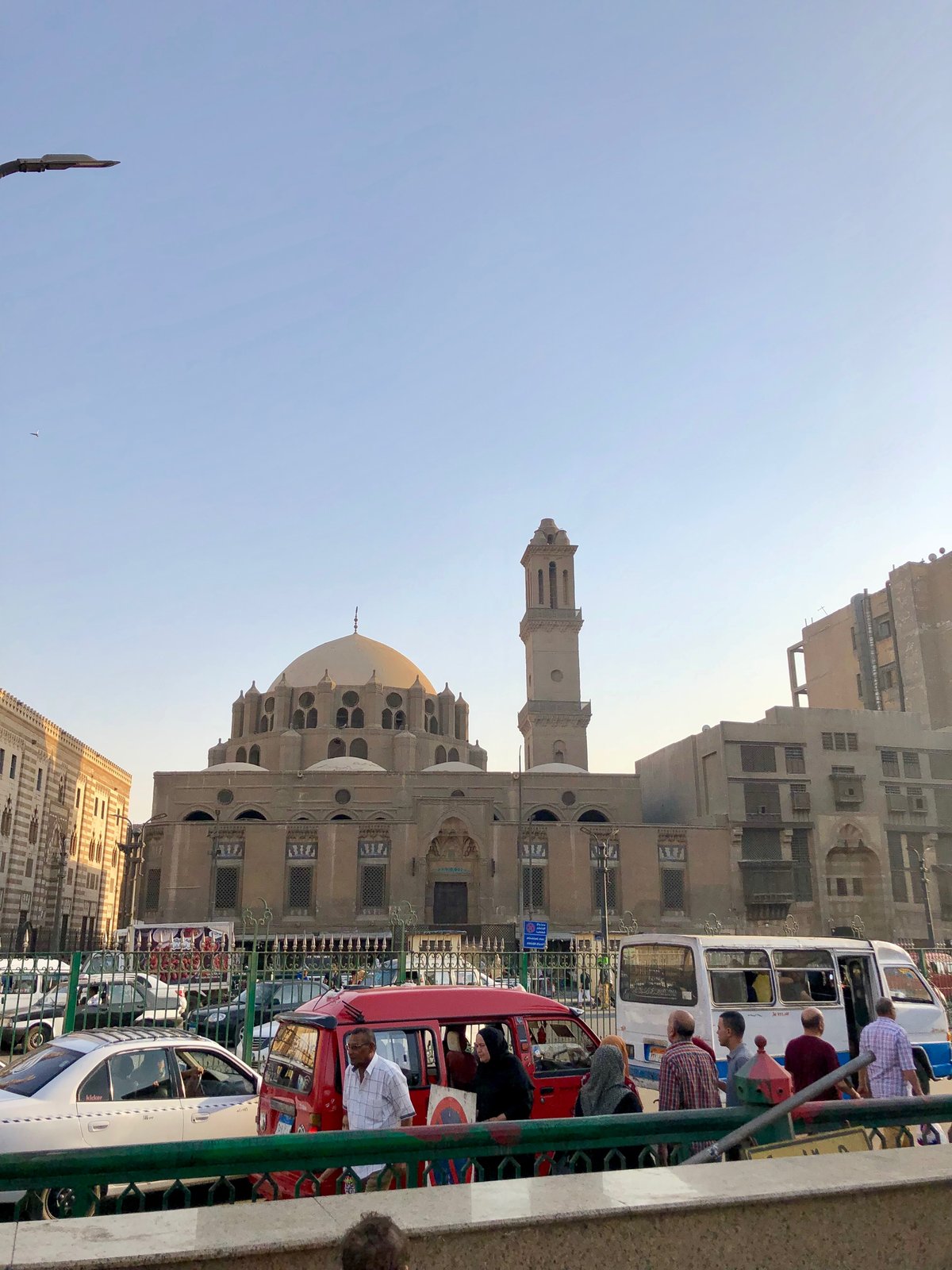
The surprise comes before you step inside: Qalawun’s 67-meter facade, about the length of seven London buses parked nose to tail, runs along Bayn al-Qasrayn like a piece of royal stagecraft dropped into a market street. Stand a little north on al-Mu'izz, let the vendors’ metal clang and conversation fill your ears, then look at the carved thuluth bands, the grilled windows, and the portal’s striped stone; Sultan al-Mansur Qalawun built this in 1284-1285 on the old Fatimid palace axis because power liked to perform in public, and the building still knows it.
The Mausoleum Chamber
The mausoleum changes the mood in a heartbeat: dark corridor, cooler air, then a chamber where marble, stucco, gilded wood, and a vast mihrab keep pulling your eye from the dome back to the walls. Look closely at the mother-of-pearl inlay and the thick window reveals, where the building quietly cheats the street line so the interior can face Mecca; that small spatial lie tells you more about medieval Cairo than any plaque will.
Walk the Full Sequence to the Hospital End
Most visitors stop at the mausoleum, which is a mistake. Walk the whole spine from portal to madrasa courtyard to the rear hospital remains, and watch the complex reveal its real intelligence: compression, release, shadow, brightness, prayer, study, treatment, all packed into a foundation completed between AH 683 and 684, roughly 1284-1285, in little more than a year according to later accounts; by the time you reach the quieter back courts, with the fountain remains and the dome framed behind you, the monument stops feeling like a tomb and starts reading as a machine for caring for bodies and souls.
Plan your visit
Getting There
This complex sits on al-Mu'izz li-Din Allah Street at Bayn al-Qasrayn in Historic Cairo, not in modern Al Nozha. The easiest run is Uber or taxi to Bab al-Futuh for a north-to-south walk, or to Al-Azhar Mosque if you want to join the street midstream; from Bab El Shaaria metro, expect about 9 minutes on foot, roughly the length of two Cairo blocks stitched together by market lanes.
Opening Hours
As of 2026, the Ministry listing gives daily hours of 9:00 AM to 4:00 PM. Older traveler reports often mention 5:00 PM, so go early and treat late-afternoon entry as unreliable; Ramadan and occasional locked sections can trim access without much warning.
Time Needed
Give it 30 to 45 minutes if you want the essential look inside, 45 to 75 minutes if you plan to linger in the mausoleum and read the stonework properly. Fold it into a longer al-Mu'izz walk and the number changes fast: 2 to 5 hours disappears here like afternoon light in the prayer hall.
Accessibility
Access is limited. Expect uneven historic paving, thresholds, stairs, and tight circulation in a dense street setting; a wheelchair user should assume partial access at best, and I found no evidence of elevators or formal sensory accommodations.
Cost & Tickets
As of 2026, the Ministry page lists the al-Mu'izz area ticket at EGP 220 for foreign adults, EGP 110 for foreign students, EGP 20 for Egyptian adults, and EGP 10 for Egyptian students. This is a bundled monument ticket rather than a polished timed-entry system, so buy on site and don't count on online booking or true skip-the-line access.
History
A Hospital, a Tomb, and a Seizure of Memory
Documented sources date the Complex of Sultan Qalawun to 1284-1285, when the Bahri Mamluks were turning Cairo into their capital of record. Qalawun did not choose a quiet plot. He planted his complex on Bayn al-Qasrayn, inside the old Fatimid palace zone, where every facade had to compete with dynastic memory already built into the street.
That choice changed the meaning of the building. This was never just a funerary monument for one ruler. It was a mausoleum tied to teaching, prayer, and a hospital, which meant burial, welfare, scholarship, and legitimacy all entered the same doorway.
The turning point
The Vow That Became a Power Play
The surface story is handsome and pious: Sultan al-Mansur Qalawun, grateful for recovery from illness, built a charitable hospital and then crowned it with one of Cairo's great mausoleums. According to tradition, treatment at Nur al-Din's bimaristan in Damascus moved him to found a similar institution in Cairo. Tourists usually stop there. Easy mistake.
The doubt begins with the speed and the setting. Documented sources place construction in 1284-1285, and later accounts describe a project completed in about 13 months on the most politically charged stretch of Cairo, under the supervision of Amir Alam al-Din Sanjar al-Shuja'i. That pace does not suggest patient devotion. It suggests urgency.
The revelation is harsher. Qalawun, a former military slave who had fought his way to the throne, needed more than a tomb; he needed proof that he belonged in the ceremonial heart of Cairo, and the turning point came after he secured his rule and then claimed Fatimid royal ground for his own dynasty. Contemporary and later reports describe forced labor, evictions, and the use of prisoners of war in the making of a building that advertised charity. Once you know that, the complex stops reading as pure devotion. You start seeing it as a public argument in stone, where every carved band says the same thing: I rule here now.
The Part People Forget
Most visitors remember the mausoleum because it survives in full theatrical form. Medieval Cairo may have judged the hospital more important. Documented and attributed sources alike treat the bimaristan as the public face of the foundation, the part where care for the sick turned royal money into moral authority.
Damage, Repair, Reinvention
The building you see is not frozen in 1285. Documented sources record damage in the earthquake of 1302-1303 and repair under al-Nasir Muhammad in 1303, while the original mausoleum dome disappeared by the 18th century. The dome above the complex today dates to 1903, when Max Herz Bey rebuilt it using the mausoleum of al-Ashraf Khalil as his model, which means one of the site's signature silhouettes is already an argument with loss.
Tips for visitors
Dress Respectfully
Cover shoulders and knees, and carry a scarf if you may step into prayer areas. Shoes should come off easily; old stone dust gets everywhere, and nobody wants to wrestle with laces at a mosque threshold.
Shoot Carefully
As of 2026, personal non-commercial photography is allowed in Egypt without a permit, but indoor flash is not. Leave the tripod and drone out of this plan unless you already have written clearance, and never point a camera at people praying unless they clearly agree.
Tip Trap
Some guards or unofficial helpers may imply a chamber is closed, then offer to open it for cash. Ask first whether access is already covered by the area ticket, keep small bills handy, and don't flash a thick wallet in the market crush.
Where To Eat
For old-cafe atmosphere, head to El Fishawi in Khan al-Khalili, budget level and better for tea than dinner. For a sit-down meal, Khan El Khalili Restaurant & Naguib Mahfouz Cafe is mid-range, while Zeeyara Moez works well for a rooftop dinner after dark.
Go Early
Morning is the smart move. You get cooler air, softer light on the facade, and a better chance of finding the interiors open before the street fills with families, tour groups, and the long human tide that rolls through al-Mu'izz after midday.
Pair The Street
Don't treat Qalawun as a lone stop. Walk it with al-Aqmar Mosque, the Madrasa of al-Nasir Muhammad ibn Qalawun, Barquq, and Khan al-Khalili; the whole sequence reads like one argument in stone, with each facade answering the last.
Where to Eat
local_dining
Don't Leave Without Trying
Ful medames – slow-cooked fava beans with garlic, lemon, and oilTaameya – Egyptian falafel, crispier and spicier than Middle Eastern versionsFetir meshaltet – flaky layered pastry, savory or sweetHawawshi – bread stuffed with spiced minced meatMolokhia – garlicky green herb stew, often with rabbit or chickenHamam mahshi – roasted pigeon stuffed with herbs and riceBesara – creamy fava-bean and herb dipKarkadeh – tart hibiscus tea, served hot or coldSahlab – warm, creamy milk drink with nuts and coconutArabic coffee – strong, cardamom-scented, served in small cups
فول فلافل محمد على
quick bite
Egyptian Street Food€€star5.0(12)
Order: The ful medames and taameya (Egyptian falafel) are the real deal—crispy, earthy, and made fresh every morning. Pair with warm pita and a squeeze of lemon.
This is where locals actually eat breakfast on Darb al-Mu'izz. No tourist menu, no frills, just authentic Egyptian street food that's been done the same way for decades.
Order: The mezze spreads and slow-cooked stews are reliable; come late at night or early morning when the kitchen is firing on all cylinders and the crowd is real locals, not tour groups.
Open 24 hours on the heart of al-Mu'izz Street, this is the spot locals grab a meal after midnight wandering or before dawn prayers. Honest food, no pretense.
Order: Ful and taameya sandwiches wrapped in warm baladi bread, topped with fresh tomatoes, onions, and hot sauce. Simple, perfect, and under 20 EGP.
Khan Gaafar is one of Historic Cairo's quieter lanes, and Abu Tariq's has been the neighborhood breakfast and lunch anchor for years. You'll eat standing up shoulder-to-shoulder with construction workers and office staff.
Order: Mint tea and Turkish coffee are the essentials here; if you want something sweet, ask for whatever baklava or konafa they have fresh that day.
Tucked down Darb Qarmuz, this 24-hour cafe is the real al-Gamaleya hangout—locals playing backgammon, sipping tea, and debating the day's news. No tourists, no Instagram vibe, just Cairo.
checkMost small eateries and street-food stalls on al-Mu'izz Street are cash-only; bring small bills.
checkBreakfast (7–10 AM) is the best time to eat ful and taameya—freshly made, least crowded, most authentic crowd.
checkLate-night eating (after 10 PM) is normal in Islamic Cairo; many 24-hour spots fill up with locals after evening prayers.
checkAlways check the bill at the counter before paying, especially at busy street stalls.
checkMint tea and coffee are social drinks meant to be lingered over; it's normal to sit for an hour with a single cup.
Food districts:Al-Mu'izz Street (Darb al-Mu'izz) – the historic spine of Islamic Cairo, lined with ful, taameya, and coffee stallsKhan el-Khalili Bazaar – spice vendors, sweet shops, and tourist-friendly cafes mixed with local hauntsSouq al-Attarin – the spice and herb market, best for browsing ingredients and street snacksKhan Gaafar – quieter lane with authentic neighborhood eateries and no tour groups
Restaurant data powered by Google
Frequently asked
Is the Complex of Sultan Qalawun worth visiting?
Yes, if you care about buildings that show power, faith, and public care in the same breath. This is not just a tomb: Qalawun built a mausoleum, madrasa, prayer space, and hospital here in 1284-1285 on Bayn al-Qasrayn, the ceremonial spine of Historic Cairo. The surprise is the shift from the noise of al-Mu'izz Street to dim corridors, cool stone, and a mausoleum lined with marble, stucco, and light that lands like dust on water.
How long do you need at the Complex of Sultan Qalawun?
Give it 45 to 75 minutes if you want more than a quick look. Half an hour covers the main interiors, but the place makes more sense when you slow down for the long entrance passage, the madrasa court, and the hospital end that many visitors skip. Fold it into a larger al-Mu'izz walk and you can easily spend 2 to 5 hours in the district.
How do I get to the Complex of Sultan Qalawun from Cairo?
The easiest route is a taxi or ride-share to Bab al-Futuh or Al-Azhar Mosque, then walk along al-Mu'izz Street to Bayn al-Qasrayn. If you want public transport, Bab El Shaaria metro is the usual nearest stop, about a short walk away, roughly the length of a few city blocks. One correction matters: the complex is in Historic Cairo, not modern Al Nozha.
What is the best time to visit the Complex of Sultan Qalawun?
Go in the morning or early afternoon, ideally between 9:00 AM and noon. Current official visitor information for the monument circuit lists daily opening around 9:00 AM to 4:00 PM, and the interiors feel better before the street crowds thicken and Cairo's heat starts pressing on the stone like a hand on a drum. Winter is kinder than summer if you want to linger.
Can you visit the Complex of Sultan Qalawun for free?
Usually no: it sits on the paid al-Mu'izz Street monument ticket. The current ministry listing gives EGP 220 for foreign adults and EGP 110 for foreign students, with lower prices for Egyptians, though ticket policies can change. Street access is free, so you can still study the facade, dome, and minaret from outside without buying entry.
What should I not miss at the Complex of Sultan Qalawun?
Don't miss the mausoleum mihrab, the long dark entrance corridor, and the hospital end at the back. Most people photograph the dome and move on, but the real confession of the building lies in its sequence: compressed passage, sudden courtyard light, then the jeweled burial chamber. Look up in the vestibule for the small muqarnas and study how the building twists to face Mecca while the street facade holds its line.
Is the Complex of Sultan Qalawun in Al Nozha?
No, and that mistake strips the place of its meaning. The complex stands on al-Mu'izz li-Din Allah Street at Bayn al-Qasrayn in Historic Cairo, inside the UNESCO-listed historic core. Put it in Al Nozha and you lose the whole point, because Qalawun built here to occupy Cairo's old ceremonial center.
Sources & attribution10
Researched and written by the Audiala editorial team from historical records, architectural archives, and local expertise. Last updated April 2026.
UNESCO World Heritage Centre — Confirmed that the monument belongs to Historic Cairo and provided the broader significance of Bayn al-Qasrayn within the UNESCO-listed urban fabric.
Museum With No Frontiers - Discover Islamic Art — Supplied the core historical description of the complex as a mausoleum, madrasa, prayer space, and bimaristan, plus the standard 1284-1285 construction date.
Archnet — Supported the architectural reading of the mausoleum, courtyard sequence, and later reconstruction history, including the present dome's restoration context.
Britannica - Qalaun complex — Confirmed the complex's role in Mamluk Cairo and helped frame the madrasa, mausoleum, and hospital as one political and religious foundation.
Wikipedia - Qalawun complex — Provided supporting detail on the entrance corridor, the order of spaces, and the commonly cited construction span of roughly 13 months.
Memphis Tours - Al Muizz Street — Helped with practical orientation on walking approaches from Bab al-Futuh and Al-Azhar Mosque, and with the street-level feel around the monument.
Airial - Qalawun Complex Cairo — Offered cross-checked visitor guidance on likely visit length, dress expectations, and current non-official practical advice.
Tripadvisor - Madrasa of Sultan Barquq — Used as a nearby same-ticket comparator for likely opening patterns on the al-Mu'izz monument circuit and for the Bab El Shaaria walking reference.
Qalawun VR Project — Supported the interpretation of the hospital end, internal viewpoints, and small architectural details that many visitors miss.
Saved and recently read places — kept on this device only.
Photo credits (7)
Qalawun complex 23 — Mohammed Ali Moussa — CC BY-SA 4.0 (https://creativecommons.org/licenses/by-sa/4.0/) — Source: https://commons.wikimedia.org/wiki/File:Qalawun_complex_23.jpg
Minaret of the Qalawun complex — Jorge Láscar from Melbourne, Australia — CC BY 2.0 (https://creativecommons.org/licenses/by/2.0/) — Source: https://commons.wikimedia.org/wiki/File:Minaret_of_the_Qalawun_complex.jpg
The Mausoleum of Sultan Qalawun — Bassem Abdelaziz — CC BY-SA 3.0 (https://creativecommons.org/licenses/by-sa/3.0/) — Source: https://commons.wikimedia.org/wiki/File:The_Mausoleum_of_Sultan_Qalawun.jpg
مدرسه السلطان قلاوون — Mostafa*barakat2 — CC BY-SA 4.0 (https://creativecommons.org/licenses/by-sa/4.0/) — Source: https://commons.wikimedia.org/wiki/File:مدرسه_السلطان_قلاوون.jpg
Moaz street 1 — Mohamed nabawy — CC BY-SA 3.0 (https://creativecommons.org/licenses/by-sa/3.0/) — Source: https://commons.wikimedia.org/wiki/File:Moaz_street_1.jpg
Qalawun Complex 2019 — Mohammed Moussa — CC BY-SA 4.0 (https://creativecommons.org/licenses/by-sa/4.0/) — Source: https://commons.wikimedia.org/wiki/File:Qalawun_Complex_2019.jpg
Flickr - HuTect ShOts - Interior view 2 - The Complex of Sultan Qalawun مجمع السلطان قلاوون - El.Muiz Le Din Allah Street - Cairo - Egypt - 29 05 2010 — Ahmed Al.Badawy from Cairo, Egypt — CC BY-SA 2.0 (https://creativecommons.org/licenses/by-sa/2.0/) — Source: https://commons.wikimedia.org/wiki/File:Flickr_-_HuTect_ShOts_-_Interior_view_2_-_The_Complex_of_Sultan_Qalawun_مجمع_السلطان_قلاوون_-_El.Muiz_Le_Din_Allah_Street_-_Cairo_-_Egypt_-_29_05_2010.jpg
Strictly necessary cookies keep the site working. Analytics (PostHog, Google Analytics) measures how each visitor uses our pages. Marketing loads YouTube videos and walking-route maps without a tap and lets Google Analytics set advertising cookies. We never sell your data. You can change this any time from the footer.
Analytics and marketing cookies are optional and only load if you agree. Details under Customize.
Privacy
Cookie preferences
Pick what you're okay with. You can change this any time from the footer.
Strictly necessary
Always on
Sign-in, language, navigation. Always on.
Product analytics
PostHog (EU) and Google Analytics record which pages you view and how you use them, under a random identifier stored in your browser. Helps us see which pages work and which need fixing. Google's ad personalisation stays off. No selling.
Marketing
Loads YouTube videos and the walking-route maps (OpenFreeMap) without a tap; without it, they load only when you tap them. If analytics is also on, Google Analytics may set advertising cookies. Ad personalisation stays off.