Type 2+ letters to search all countries, cities, and places
/Ctrl KEsc
travel_explore
Type 2+ letters to search all countries, cities, and places
Press Enter to open the top result
Philae Temple
Aswan·Egypt·Updated Apr 2026
The last hieroglyphic inscription on Earth was carved here in 394 CE. Philae Temple was then submerged, dismantled, and rebuilt stone by stone on a new island.
EGP 550 adults / EGP 275 students (foreigners) + boat fare
Best season
October to February (cooler temperatures)
The last sentence ever written in hieroglyphs — scratched into stone on 24 August 394 CE after 3,500 years of continuous use — sits on a wall at Philae Temple in Aswan, Egypt. A priest named Esmet-Akhom carved it while defying imperial law, and you can still see the marks. This alone would make Philae extraordinary, but the temple also helped crack the hieroglyphic code, gave birth to the concept of World Heritage, and spent seventy years underwater before engineers cut it into 40,000 numbered blocks and rebuilt it on an entirely different island.
You reach Philae by motorboat across the Aswan reservoir, the temple materializing against a backdrop of tawny granite and blue sky. What rises from Agilkia Island looks unmistakably pharaonic — massive pylons carved with gods, a forest of columns, the elegant open pavilion known as Trajan's Kiosk. But look closer at the cartouches. The names inside them belong to Augustus, Tiberius, Hadrian. Romans in pharaoh costume, performing a political fiction in stone.
The temple's real power is layered time. Nectanebo II built the oldest surviving structure here around 350 BCE. Ptolemaic Greeks raised the main sanctuary to Isis starting about 280 BCE. Roman emperors kept adding for another three centuries. Then Christians chiselled off the gods' faces and carved crosses into the walls. Two religions occupy the same stones, sometimes the same square metre. The damage is visible everywhere — gouged-out eyes, hacked-away hands — and it tells you more about the collision of faiths than any textbook.
Philae was the last functioning temple of ancient Egyptian religion. While every other sanctuary fell silent after Rome adopted Christianity, Isis-worship persisted here — records suggest as late as the 9th century CE, according to UNESCO's assessment. A geopolitical treaty with Nubian tribes kept the doors open centuries after the rest of paganism died. When those doors finally closed, an entire civilization's spiritual life ended on this small island above the First Cataract.
Researched by the Audiala editorial team from historical records, architectural archives, and local expertise.
What to see
The Temple of Isis and Its Palimpsest Walls
The main temple begins with a pair of 18-meter pylons — tall as a six-story building — carved with Ptolemy XII in the classic pharaonic smiting pose, a Greek king cosplaying as an Egyptian god. Step through the gateway and the drama shifts from political theater to religious war: the faces of nearly every deity on the inner walls have been chiseled flat by Coptic Christians who converted the temple into a church under Emperor Justinian around 540 CE. The headdresses survive, the offering tables survive, but the divine faces are gone, replaced by rough gouges you can feel under your fingertips.
Push deeper into the hypostyle hall — ten massive columns, once roofed — and the temperature drops by ten degrees or more. Look up at the ceiling soffits in shaded corners and you'll catch traces of original pigment: blue stars on a yellow sky, painted over two thousand years ago. On the columns themselves, three layers of belief coexist in a single surface: Ptolemaic relief, Coptic crosses carved directly into Isis's body, and later Arabic graffiti scratched above both. The inner sanctuary is a small, dark room that still holds its pink Aswan granite naos — the shrine box where a gold cult statue of Isis once stood. Most groups blow through in ninety seconds. Sit on the threshold instead. The silence is absolute, the cool air almost subterranean. Then find the stairway to the roof terrace, which many guides skip entirely: up top, the Osiris chambers contain astonishingly well-preserved reliefs of Isis reassembling her husband's body, sealed and forgotten for centuries. The view from there — black granite islands scattered across the reservoir — is the best on the site.
Kiosk of Trajan
This is the photograph everyone takes, and for once the cliché is earned. Fourteen columns with elaborate floral capitals hold up nothing — the roof is long gone — and that absence is exactly what makes it work. Light pours in from above and between the screen walls, shifting across the carved reliefs of Emperor Trajan offering wine and incense to Isis and Osiris. Late afternoon turns the sandstone molten gold; at sunset the whole structure becomes a silhouette against the reservoir, and the columns glow at their edges like heated iron.
But the kiosk wasn't decorative. It was functional — the ritual landing platform where the sacred barque of Isis was set down after processions across the water to Biga Island, where Osiris was believed to be buried. Stand inside facing the reservoir and you're occupying the exact spot where priests lowered a gilded statue onto stone. The acoustics are strange here: clap once and the sound simply dies, absorbed by the open columns with no echo at all. Before the temple's relocation, the kiosk was the highest point on old Philae Island, and from 1902 onward it was often the only structure visible above the floodwaters — photographs from that era show fish swimming between these same columns.
Hadrian's Gate and the Last Hieroglyph
On the western shore of Agilkia Island, facing the sunset, Hadrian's Gate contains the most refined depiction of the Osiris myth in all of Nubia — look for Hapi, the Nile god, kneeling inside a cave beneath the rocks of the First Cataract, pouring two streams of the Nile from vases. The ancient Egyptians believed this was the literal source of the river, and they carved it here because Philae sat at that mythological frontier.
But the gate holds something quieter and more devastating. Somewhere among the graffiti on its stones is the Graffito of Esmet-Akhom, dated 24 August 394 CE — the last hieroglyphic inscription ever written. It's tiny, easy to walk past, scratched by a priest named Esmet-Akhom at a moment when the rest of Egypt had already moved on. After roughly 3,500 years of continuous use, the writing system that built pyramids and recorded the Book of the Dead ended here, on this gate, on this island. Ask your guide to point it out. You'll be looking at the final sentence of an entire civilization's script.
How to Read the Island: A Slow Circuit
Most guided tours give you sixty to ninety minutes on Agilkia. That's not enough. If you can, come independently and budget three hours. Start at the west colonnade flanking the outer court — walk its length looking up, because no two column capitals are identical: lotus, papyrus, palm, vine, composite flowers, all different, a catalog of Ptolemaic botanical carving that most visitors never notice because they don't crane their necks. Then pass through the First Pylon and look low on the left side of the eastern gateway for a French inscription carved by Napoleon's soldiers in 1799, commemorating General Desaix's pursuit of the Mamluks upriver. Most guides skip it.
After the main temple, cross to the small Temple of Hathor on the eastern side — a quiet corner where reliefs show the dwarf-god Bes playing harp, tambourine, and dancing. Groups rarely stop here. Finally, before you leave, look at the base of any colonnade column and trace the faint horizontal line where the stone color shifts from pale honey above to a slightly darker, mineral-stained tone below. That's the waterline scar from the decades Philae spent half-submerged after the 1902 dam. When engineers dismantled and moved every numbered block to Agilkia in the 1970s, they reassembled them in the same orientation — so the high-water mark of a drowned island runs continuously around a building that has moved to dry land. Once you see it, you can't unsee it.
Plan your visit
Getting There
Philae sits on Agilkia Island, so you can't walk there — every visit requires a boat. Take a taxi from central Aswan (about 12 km, 20–25 minutes) to Shellal Marina near the old Aswan Low Dam, then a motorboat crosses to the island in 5–10 minutes. No metro exists in Aswan, and no reliable public bus route serves the marina, so a taxi or hired driver is the realistic option.
Opening Hours
As of 2026, Philae is open daily from 7:00 AM to 4:00 PM, with last entry at 3:00 PM — that cutoff applies year-round, including summer and Ramadan. No weekly closure day. A separate Sound & Light Show runs at 8:00 PM and 9:00 PM on select evenings.
Time Needed
A focused visit takes about 1–1.5 hours on the island, but factor in the boat ride each way and you're looking at 2 hours minimum. If you want to circle the entire complex, study the Hadrian Gate reliefs, and sit with the Trajan Kiosk, give yourself a full 2.5–3 hours from dock to dock.
Tickets & Costs
As of 2026, foreign adult entry is EGP 550, students EGP 275. An optional panorama ticket costs EGP 200/100. Buy online through EgyMonuments or the Experience Egypt app (Visa/Mastercard accepted), or pay at the on-site counter — tickets are non-refundable. Children under 6 enter free. The boat transfer to the island is a separate, negotiated fare with the boatmen at Shellal Marina.
Accessibility
Philae is a poor fit for independent wheelchair users. The biggest barrier is boarding and leaving the small motorboats at Shellal — there's no ramp or lift. On the island itself, expect gravel paths, uneven ancient stone, steps, and minimal paving. No elevators or step-free route maps exist.
History
The Island Where Three Thousand Years Came to Die
Philae sat at the edge of everything. The First Cataract of the Nile — a chaos of granite boulders and white water — marked the border between Egypt and Nubia for millennia. Whoever controlled worship here controlled the loyalty of peoples on both sides. The Ptolemies understood this. So did Rome. The temple you walk through today is the product of that calculation: six centuries of foreign rulers building in a dead architectural language to hold a frontier together.
Construction began modestly under one of the last native Egyptian pharaohs — most likely Nectanebo II, around 350 BCE, though scholars still debate whether the surviving kiosk belongs to him or his predecessor Nectanebo I. The main Temple of Isis rose under Ptolemy II Philadelphus starting about 280 BCE. Successive Ptolemies, then Roman emperors through Hadrian and Trajan, kept adding rooms, gates, and decorations for the next four hundred years. The result is a palimpsest: Greek ambition, Roman engineering, and Egyptian theology pressed into a single complex no larger than a city block.
The turning point
Esmet-Akhom and the Last Hieroglyph
By the summer of 394 CE, the Roman Empire had been officially Christian for three years. Emperor Theodosius's edict of 391 had outlawed pagan worship across every province. Temples from Alexandria to Antioch stood empty or smashed. But on Philae, a small community of Isis priests still performed the old rites — protected by a treaty signed nearly a century earlier under Diocletian, which guaranteed Nubian tribes the right to borrow the statue of Isis for annual processions southward. The treaty was geopolitics. For the priests, it was a lifeline.
One of them was Esmet-Akhom, a member of what scholars believe was the Wayekiye family — a hereditary priestly line with Meroitic roots who had served at Philae for generations. On 24 August 394, he carved a short dedication to the god Mandulis onto the Gate of Hadrian. The inscription is small, easy to miss among the hundreds of graffiti on the gate's surface. But it is, as far as Egyptologists can determine, the final hieroglyphic text ever written — the closing sentence of a script that had been in continuous use since roughly 3200 BCE.
Esmet-Akhom almost certainly didn't know he was the last. He was doing what his father and grandfather had done: maintaining a tradition in a world that had moved on. The priests held out for another 146 years. Then, in 540 CE, Emperor Justinian sent the general Narses to Philae. Soldiers arrested the remaining priests, confiscated the cult statues of Isis, and shipped them to Constantinople. Bishop Theodorus converted the inner sanctuary into the Church of Saint Stephen, and workers began chiselling the faces off every god on every wall. A Coptic inscription survives on a column of the pronaos: 'This good work was done by the well-beloved of God, the abbot-bishop Theodorus.' The old gods stare back, faceless.
The Obelisk That Cracked the Code
In September 1815, the Italian adventurer Giovanni Belzoni pried one of two obelisks from Philae's forecourt for the English collector William John Bankes. The operation nearly ended in the Nile — Belzoni's boat sank the obelisk during loading, and he spent days fishing it out. The stone eventually reached Kingston Lacy in Dorset, where its bilingual Greek and hieroglyphic inscription provided Jean-François Champollion with the cartouche of 'Cleopatra' — the second royal name he needed, alongside the Rosetta Stone's 'Ptolemy,' to decipher hieroglyphs in 1822. The empty obelisk base still sits in Philae's forecourt. Most visitors walk right past it, unaware that modern Egyptology was partly born on the spot where they're standing.
Drowned, Dismantled, Reborn
When the Aswan Low Dam was completed in 1902, Philae sank. For nine months each year, the temple sat submerged — visitors arrived by rowboat and peered down at columns wavering beneath green water. Painted reliefs lost their colour. Mud filled the sanctuaries. This went on for seventy years. Then the Aswan High Dam threatened permanent submersion. On 8 March 1960, UNESCO Director-General Vittorino Veronese launched the International Campaign to Save the Monuments of Nubia. Between 1972 and 1979, engineers dismantled every structure into roughly 40,000 catalogued blocks and reassembled them on nearby Agilkia Island, which had been reshaped with dynamite and bulldozers to mimic Philae's original contours. The campaign's success created the political momentum for the 1972 World Heritage Convention — meaning every World Heritage Site on Earth exists, in part, because of this temple's rescue.
Tips for visitors
Negotiate the Boat First
The boat fare at Shellal Marina is the single most stressful moment of the visit. Agree on the total price, round trip, wait time, and whether it's per boat or per person before you step aboard — boatmen routinely quote inflated rates and coordinate among themselves.
Photography Rules
Mobile phone photography is free and unrestricted. Tripods and professional lighting setups typically require a permit, flash is restricted in enclosed areas, and drones are effectively banned without Egyptian Ministry of Defense clearance — they will be confiscated.
Arrive at Opening
The 7:00 AM opening is your golden window — morning light hits the first pylon beautifully, the stone is still cool enough to touch, and cruise-ship groups tend to arrive from 9:00 AM onward. By midday in summer, the exposed island is punishing.
Eat Nubian Nearby
Solaih Nubian Restaurant (mid-range) sits on a nearby island with direct Philae views and serves clay-pot fish and Nubian stews — book ahead and arrange a boat. For something grander back in town, The Terrace at the Sofitel Old Cataract is a splurge with a storied Nile terrace. Skip the basic marina snack stands.
No Luggage Storage
There are no lockers or bag storage at the marina or on the island. Leave large bags at your hotel or with your taxi driver — you don't want to haul a suitcase onto a rocking motorboat.
Dress Modestly
No formal dress code is enforced, but Aswan is socially conservative and you'll pass through Nubian communities en route. Covering shoulders and knees is the respectful default and also protects you from the fierce Upper Egyptian sun.
Where to Eat
local_dining
Don't Leave Without Trying
Camel meat tagine — slow-cooked and unique to AswanFresh grilled or fried Nile fishNubian chicken tagine with lemonMolokhia — jute-leaf stew, often served as a sidePigeon (hamam mahshi) stuffed with rice or freekehFul medames — fava bean stew, the breakfast stapleNubian flatbreads fresh from the clay ovenBird's tongue soup (lesan asfour) — a comforting orzo brothRice with vermicelli (ruz bil sha'riya)Hibiscus tea (karkadeh) — Aswan's signature drink
Ismailia Restaurant
local favorite
Egyptian home cooking & seafood€€star4.8(401)
Order: Grilled chicken, fried Nile fish, and the thick, addictive mango juice — it's so good you'll order a second glass.
A tiny, family-run gem where locals eat, delivering honest Egyptian food at honest prices. Solo travellers love the warm, unhurried welcome that's hard to find in the tourist core.
Order: The camel meat tagine — a rarity outside Aswan, slow-cooked until fork-tender, plus a zesty lemon chicken with fresh-baked bread.
A Nubian-family-run haven on car-free Elephantine Island, with no haggling, home-cooked food, and the sort of relaxed village atmosphere that makes you forget the mainland noise.
Order: Smoky kofta and juicy grilled chicken, paired with an ice-cold Stella beer and a blueberry shisha at sunset.
Elephantine Island's unofficial hangout — killer Nile views from the terrace, live music, beer (a rare find here), and a proper Nubian tagine when you want one.
King Jamaica Restaurant & Café – Best Restaurant in Aswan
local favorite
Nubian-Egyptian with a view€€star4.7(1463)
Order: The mixed grill platter and a fresh juice while the sun melts into the Nile — the view is part of the dish.
Arrive via the restaurant's own ferry boat and step into a turquoise-painted dream with the best sunset perch on Elephantine Island. It's a whole evening experience, not just a meal.
checkCash in Egyptian pounds is king — most island and souk eateries don't accept cards, so stock up on small notes (5–50 EGP).
checkBaksheesh (tipping) is essential: add 10–15% in cash to your server, even if a service charge already appears on the bill.
checkLunch is the main meal of the day (1–3 PM); dinner is lighter and often eaten later, especially in summer after 9 PM.
checkDuring Ramadan, daytime eating is limited outside large hotels — plan meals around sunset (iftar) and pre-dawn (suhoor).
checkBargaining is expected at the Aswan Souk for spices and dry goods, but not in restaurants with printed menus.
checkNubian hospitality means generous portions and shared dishes — order a few things and pass them around.
checkCarry your own tissues or wet wipes; paper napkins can be scarce in neighbourhood spots.
checkTap water isn't safe to drink — stick to bottled water and avoid ice in unverified places.
Food districts:Elephantine Island — car-free Nubian village with rooftop restaurants and sunset terracesAswan Corniche — riverside cafés, street-food boats, and breezy evening strollsAswan Souk (Sharia as-Souk) — spice stalls, dried herbs, and tiny local eateries tucked behind the alleywaysWest Bank Nubian villages — family guesthouses serving home-cooked tagines in colourful courtyards
Restaurant data powered by Google
Watch & Explore Philae Temple.
Explore Aswan
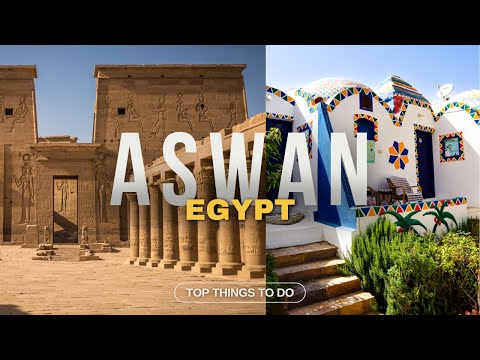
Aswan, Egypt Travel Guide (2026) | Nile Temples, Nubian Culture & What to Know
Erin Parro – The Scenic Route Traveler9 min8K
Explore Aswan
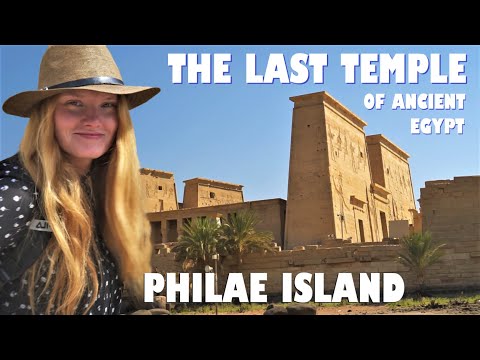
PHILAE ISLAND - THE LAST ANCIENT EGYPTIAN TEMPLE! ASWAN EGYPT
Ancient Sites Girl27 min18K
Frequently asked
Is Philae Temple worth visiting?
Absolutely — Philae is one of the best-preserved Ptolemaic temples in Egypt and the only major site you reach by boat, which gives it an atmosphere no other temple can match. The complex holds the last hieroglyphic inscription ever carved (dated 24 August 394 CE), visible Coptic crosses cut over pharaonic reliefs, and the iconic roofless Kiosk of Trajan rising above the reservoir. It also carries a remarkable backstory: the entire temple was dismantled into roughly 40,000 blocks and moved to a new island by UNESCO between 1972 and 1979 to save it from permanent submersion.
How long do you need at Philae Temple?
Plan about two hours including the boat ride each way for a solid first visit. If you want to explore the roof terrace with its well-preserved Osiris resurrection reliefs, linger in the Temple of Hathor, and hunt for the faint waterline scars left by decades of submersion, budget closer to three hours. Rushed group tours typically give you 60–90 minutes on the island, which isn't enough to see the rear chambers or Hadrian's Gate.
How do I get to Philae Temple from Aswan?
Take a taxi or hired car from central Aswan to Marina Shellal (also called Marina Philae), about 12 km south — roughly a 20-minute drive, typically costing around EGP 150–200 each way. From the marina you board a small motorboat for a 5–10 minute crossing to Agilkia Island, where the temple stands. There is no reliable numbered public bus route to the marina, so a taxi or pre-arranged driver is the practical option. Agree the boat fare, round-trip wait time, and whether the price is per person or per boat before you step on — the dock negotiation is the most complained-about part of the visit.
What is the best time to visit Philae Temple?
October through April, arriving right at the 7:00 AM opening, gives you the best combination of soft light, comfortable temperatures, and thin crowds. Summer visits (May–September) can hit 45°C with almost no shade outside the hypostyle hall — if you go in summer, be at the gate at opening or save it for the evening Sound & Light Show. For photography, late afternoon light turns the sandstone a deep gold against the dark granite islands behind the temple.
Can you visit Philae Temple for free?
Only children under six and Egyptians over 60 enter free. Foreign adult tickets are currently EGP 550, with a student rate of EGP 275. An optional panorama photography ticket costs an additional EGP 200. You can buy tickets online through the official EgyMonuments platform or the Experience Egypt app, or pay at the on-site counter with Visa or Mastercard.
What should I not miss at Philae Temple?
Don't leave without seeing four things most visitors walk past. First, the Kiosk of Trajan — the roofless 14-column pavilion at the water's edge that was the ancient landing platform for the sacred barque of Isis. Second, climb the stairway from the inner sanctuary to the roof terrace, where the Osiris chambers contain astonishingly well-preserved reliefs of Isis reassembling the body of Osiris, sealed for centuries. Third, find Hadrian's Gate on the western shore, where a carving shows the Nile god Hapi kneeling inside a cave beneath the First Cataract, pouring the river from two vases — the mythological source of the Nile. And look closely at the column bases for a faint horizontal color shift: the waterline scar from the decades when the original temple sat half-drowned after the 1902 dam.
Is Philae Temple wheelchair accessible?
Philae is a poor choice for independent wheelchair users. The biggest barrier is the boat transfer — boarding and leaving small motorboats at the marina and island dock requires significant physical ability or strong assistance. On the island itself, surfaces include gravel, uneven sandstone, steps, and gaps with no elevators or official step-free routes. Visitors who can manage some uneven walking with support will do better, but anyone with serious mobility limits should plan for substantial help.
Is there a Sound and Light Show at Philae Temple?
Yes — Philae runs a nightly Sound & Light Show with sessions typically at 8:00 PM and 9:00 PM, with the language rotating by day (English, French, Arabic, German, Spanish, Italian, Japanese). Tickets are $20 for adults and $11 for children aged 6–12, bookable through the official Sound & Light website. The second show usually requires a minimum of five foreign visitors unless booked online. The boat ride to the floodlit temple across the dark reservoir is widely cited as one of the most atmospheric moments in Egypt, though some recent visitors find the show itself dated.
Sources & attribution35
Researched and written by the Audiala editorial team from historical records, architectural archives, and local expertise. Last updated April 2026.
Strictly necessary cookies keep the site working. Analytics (PostHog, Google Analytics) measures how each visitor uses our pages. Marketing loads YouTube videos and walking-route maps without a tap and lets Google Analytics set advertising cookies. We never sell your data. You can change this any time from the footer.
Analytics and marketing cookies are optional and only load if you agree. Details under Customize.
Privacy
Cookie preferences
Pick what you're okay with. You can change this any time from the footer.
Strictly necessary
Always on
Sign-in, language, navigation. Always on.
Product analytics
PostHog (EU) and Google Analytics record which pages you view and how you use them, under a random identifier stored in your browser. Helps us see which pages work and which need fixing. Google's ad personalisation stays off. No selling.
Marketing
Loads YouTube videos and the walking-route maps (OpenFreeMap) without a tap; without it, they load only when you tap them. If analytics is also on, Google Analytics may set advertising cookies. Ad personalisation stays off.