An introduction.
Researched by the Audiala editorial team from historical records, architectural archives, and local expertise.
OOn the same wall of the same building, Ramesses II boasts of annihilating the Hittite army — and then introduces their king as his new father-in-law. That contradiction, carved in stone over three thousand years ago, tells you everything about Abu Simbel: this is a place where propaganda and power were engineered at a scale the ancient world had never seen, and where the line between truth and spectacle was never the point. Situated on the western bank of Lake Nasser in Egypt's Aswan Governorate, roughly 230 kilometres southwest of Aswan and a short drive from the Sudanese border, Abu Simbel is the reason UNESCO's World Heritage Convention exists — literally, the 1960s campaign to save it became the precedent for protecting cultural sites worldwide.
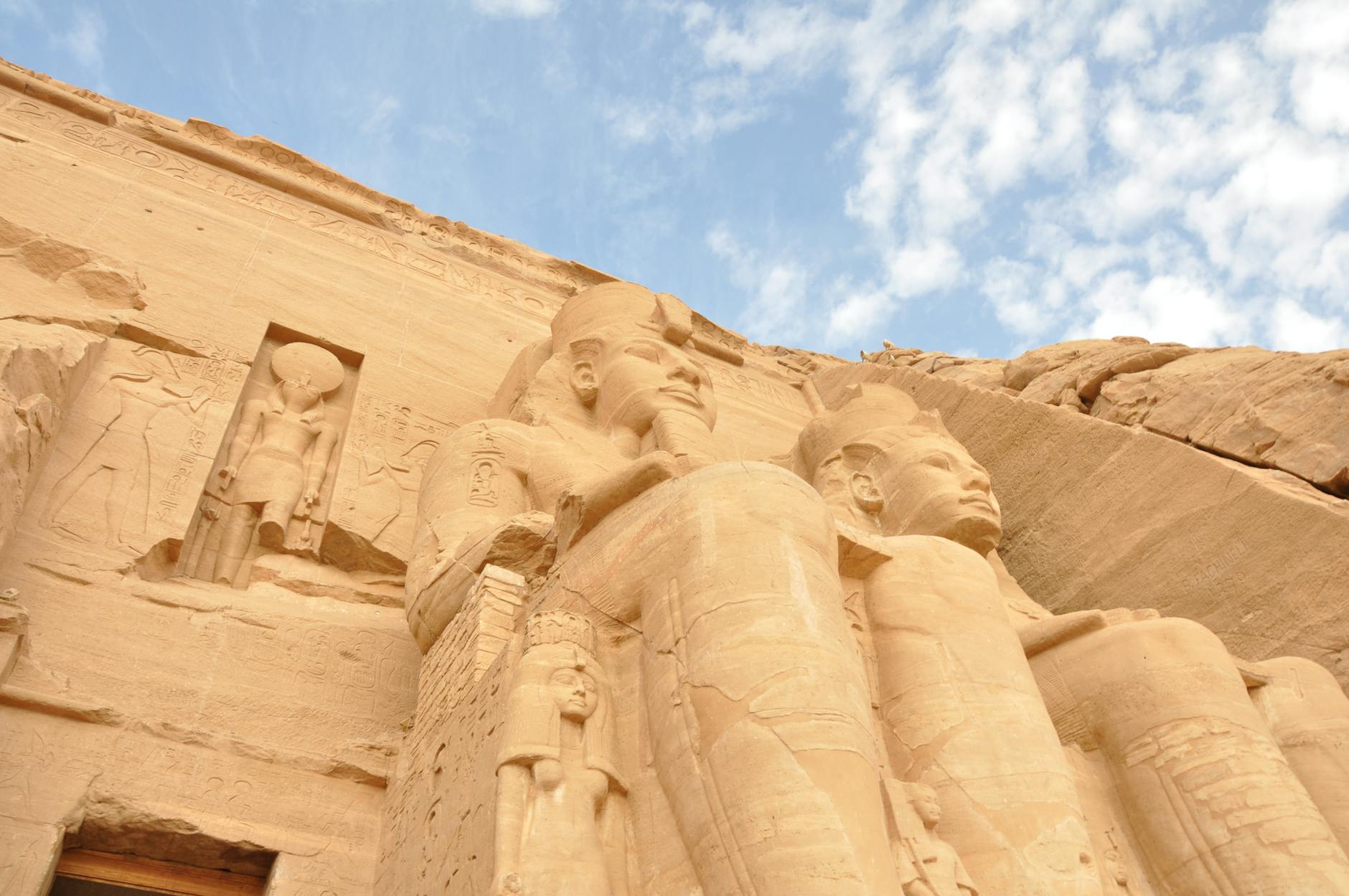
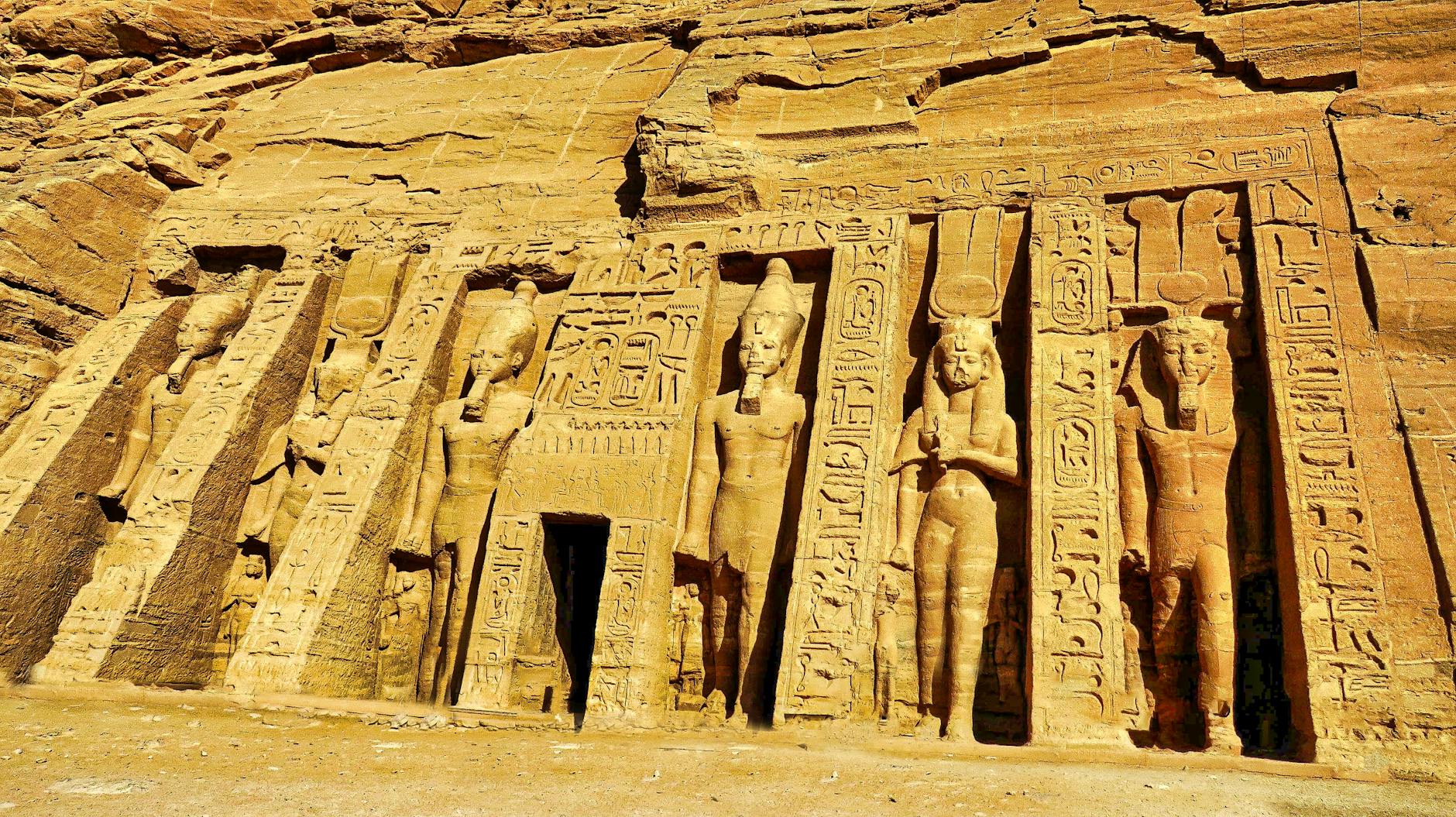
What you see today is a feat of engineering performed twice. Four colossal seated figures of Ramesses II, each standing about 20 metres tall — roughly the height of a six-storey building — guard the entrance to the Great Temple, their faces catching the first desert light. Beside them, slightly to the north, the smaller temple dedicated to Queen Nefertari and the goddess Hathor presents six standing figures carved into the rock face. The sandstone glows amber at dawn, deepens to copper by midday, and turns almost violet at dusk. The silence is enormous. You are closer to Khartoum than to Cairo.
But none of this is where it was built. Every block, every colossus, every painted ceiling was sawn apart in the 1960s, hauled 65 metres uphill and 180 metres inland, and reassembled on an artificial hilltop backed by a hollow concrete dome. The cliff behind the temples is a shell. The mountain is fake. The engineering is real twice over — once by Ramesses II's architects in the 13th century BC, and once by UNESCO's teams between 1964 and 1968.
Twice a year, around February 22 and October 22, the rising sun drives a beam of light 60 metres through the temple's dark interior to illuminate three of the four gods seated in the innermost sanctuary. The fourth, Ptah, god of the underworld, stays in shadow. Thousands gather before dawn for this moment. It is part ancient solar engineering, part modern festival, and part Nubian cultural celebration — a layering of meanings that makes Abu Simbel far stranger and more alive than any photograph prepares you for.
We had NO IDEA Egypt was like this! Aswan + Abu Simbel (2025) 🇪🇬
Liv & Lew01 What to see.
The Great Temple of Ramesses II
Four seated colossi, each roughly 20 metres tall — about the height of a six-storey building — stare out over Lake Nasser with an expression that hasn't changed since approximately 1244 BC. But look closer at the second figure from the left. One colossus is broken: its head and torso lie at its own feet, toppled by an ancient earthquake, and the Egyptians deliberately left the wreckage in place rather than restoring it. That archaeological honesty is one of the façade's most arresting details, and most visitors photograph right past it.
Step inside and the mood flips. The hypostyle hall drops you into shadow, eight Osiride pillars of the deified Ramesses pressing the ceiling down while carved reliefs of the Battle of Kadesh (c. 1274 BC) scroll across every surface. The rooms shrink as you move deeper — a deliberate compression toward the sanctuary at the back, where four seated gods wait in near-darkness. Twice a year, around 22 February and 22 October, dawn light travels the full 60-metre axis and illuminates three of those figures. The fourth, Ptah, god of the underworld, stays in shadow. That selective darkness is the entire point of the temple's alignment, and it still works after 3,200 years.
One more thing most people walk past: Greek mercenary graffiti carved into the legs of the southern colossi, dating to the 6th century BC. Soldiers scratching their names onto a monument already a thousand years old. It's a tiny, human counterweight to all that pharaonic scale.
The Small Temple of Hathor and Nefertari
Six standing figures line this façade — four of Ramesses II, two of Queen Nefertari — and every one of them is the same height. Stop and register that. In 3,000 years of pharaonic art, a queen shown at equal scale to the king is almost unheard of. Ramesses built plenty of monuments to his own glory, but here he gave Nefertari something extraordinary: parity carved in stone, roughly 10 metres tall.
Inside, the atmosphere shifts from the Great Temple's military swagger to something quieter and more intimate. Six pillars crowned with Hathor-headed capitals hold up a smaller hypostyle hall where the reliefs focus on ritual, music, and offerings rather than battlefield propaganda. The light is gentler. Crowds thin out here because most tour groups spend their energy next door, which means you can actually stand still, read the walls, and hear your own breathing echo off the sandstone. The inner sanctuary follows the same inward-narrowing logic as its larger neighbour but feels more personal — a temple built not to intimidate Nubia, but to honour a specific woman.
The Full Arc: Façade at Dawn, Rescue Story, Lake at Dusk
If you're day-tripping from Aswan — 300 kilometres by road, usually a 3 a.m. departure — you'll arrive with the early light, which is exactly right for the façades: low sun carves depth into the reliefs and warms the sandstone to amber. But the site rewards a longer stay. After the temples, visit the documentation centre, where the real 20th-century miracle comes into focus: between 1964 and 1968, engineers cut both temples into more than a thousand blocks, some weighing over 20 tonnes, and rebuilt them 65 metres higher and 180 metres inland to save them from the rising waters of Lake Nasser. The reinauguration was 22 September 1968. That story deserves as much of your attention as Ramesses does.
Then, if you've stayed overnight in the village, walk to the lake edge in late afternoon. The crowds have bussed back to Aswan. The water is wide and still. And the Sound and Light Show, projected onto the façade after dark with multilingual earpieces, reframes the whole site as theatre — which, honestly, is what Ramesses intended all along.
02 In pictures.





Watch & Explore Abu Simbel.
Plan and listen to Abu Simbel with Audiala.
Audio guide in your pocket, itinerary in your browser. Built for the way you actually visit.
03 Visitor logistics.
The practical scaffolding for a good visit — kept short.
Getting There
Abu Simbel sits 300 km south of Aswan by road — a 3.5-to-4-hour drive each way, with most organized tours departing around 04:00. EgyptAir flies daily from Aswan in about 45 minutes, and a free shuttle bus covers the 5-minute hop from Abu Simbel Airport to the temples. A public bus leaves Aswan around 08:00 and returns around 13:30, though schedules shift — confirm locally. No metro, no rail; it's road or air.
Opening Hours
As of 2026, the complex opens daily at 06:00 with last ticketed entry at 16:00. During Ramadan, doors open at 07:00 and last entry moves to 15:00. No routine weekly closures — the temples are open year-round, including the special sun-alignment dates of February 22 and October 22.
Time Needed
A focused visit covering both temple façades, interiors, and photos takes 60–90 minutes. For a comfortable pace — adding the visitor center film about the 1960s relocation, the panoramic terrace, and time to wait out crowd surges — plan 2–3 hours. If driving from Aswan, budget 8–10 hours door to door.
Tickets & Cost
As of 2026, foreign adult tickets are EGP 750 at the gate or EGP 822 through the official e-ticket portal (egymonuments.com), which includes a service fee. Sun-alignment days (Feb 22 / Oct 22) jump to EGP 1,200–1,272. Children under 6 enter free. The on-site ticket booth reportedly accepts credit cards only — no cash — so book online or bring a card.
Accessibility
Paved paths lead from the visitor center to both temples, though sections are sloped and fully exposed to sun — the walk takes about 15 minutes. Recent visitors report the exterior is wheelchair-accessible, and electric golf-cart shuttles may be available for mobility support (confirm on arrival). Temple interiors are narrow, dim, and uneven, so independent wheelchair access inside is uncertain.
04 Tips for visitors.
Small things that change the day.
Stay the Night
The 04:00 convoy from Aswan dumps hundreds of visitors at 07:00, who all leave by 09:00. Sleep in Abu Simbel village instead — you'll get the colossi at sunrise and sunset practically alone, and the Lake Nasser light at dusk is worth the extra hotel night.
Photography Rules Matter
Phone photography is officially free, but no flash is allowed inside the temples — guards enforce this. Tripods need a special permit, and drones are strictly forbidden: Abu Simbel sits in a military-sensitive border zone, and flying one can mean confiscation or arrest.
Eat at Eskaleh
Eskaleh Nubian Ecolodge Restaurant (mid-range, ~250–400 EGP/person) serves authentic Nubian clay-pot stews and grilled Lake Nasser fish in a lakeside setting run by Nubian musician Fikry Kachif. For budget grilled bolti and kofta, try Wadi El Nile (~80–150 EGP) near the village center.
Dodge the Scams
Self-appointed "guides" will tap your shoulder outside the temple, offer a free tour, then demand a large tip — politely decline and walk on. Agree on round-trip taxi prices in writing before leaving Aswan, and buy Nubian crafts from women's cooperatives in the village rather than temple-gate stalls, where prices run 3–5× higher.
Small Temple First
Everyone stampedes toward the Great Temple's four colossi. Start with Queen Nefertari's smaller temple to the right — you'll have it nearly to yourself for the first 20 minutes, then double back when the Great Temple crowd thins.
Carry Small Bills
The tip economy is real here. Guards who unlock side chambers or point out hidden reliefs expect 10–20 EGP. Keep a pocket of 5, 10, and 20 EGP notes separate from your main wallet — it smooths every interaction and occasionally opens doors that stay shut for other visitors.
Where to Eat
Don't Leave Without Trying
New Abu Simbel Restaurant
local favoriteOrder: The Fish Tagine with their famous starter soup is a must — simple, full of flavour, and made with fish brought in fresh.
The only real local eatery a stone’s throw from the temples, where villagers pile in for perfectly spiced tagines and warm, no-fuss hospitality. It’s open 24 hours, so you can refuel after that sunrise visit without any tourist mark‑up.
Nubian Dreams Restaurant & Cafe
local favoriteOrder: The camel tagine is the star — impossibly tender meat slow-cooked with Nubian spices. Also, their lemon chicken and home‑baked bread bowls are worth crossing the Nile for.
A family‑run jewel on Elephantine Island where home‑cooked Nubian food and genuine warmth make you forget the hassle of the mainland. It’s one of the few places in Egypt where you can try camel, and the owners often share stories and music — it feels like a dinner at a friend’s house.
EL amin cafe Restaurant
cafeOrder: Nubian coffee is a revelation here — rich, cardamom‑scented, and served with genuine pride. Pair it with the house popcorn or a sweet local pastry for a perfect riverside pause.
A tiny local hideaway that hardly any tourists find, so you’ll be among Aswanis sipping coffee and watching the Nile. They’ll pack you a breakfast box for the drive to Abu Simbel, which is a lifesaver for those 4‑a.m. departures.
Juzoor Restaurant
fine diningOrder: The Beef Fillet with Black Garlic Crème is as luxe as it sounds — perfectly cooked and deeply savoury. Finish with the Nile Moonrise, a light tropical dessert that matches the river view.
Tucked inside The Zen Wellness Resort, this is where you go for a grown‑up meal with impeccable service and a front‑row seat on the Nile. It’s a leap above the usual tagine joints, yet the spirit of Nubian produce shines through every elegant plate.
Dining Tips
- check Tipping (baksheesh) is deeply embedded: add 10–15% even if a service charge is included, and hand cash directly to the server — never leave it on the table.
- check Carry small Egyptian pound notes (5, 10, 20 EGP) for tips and small eateries — many places can’t break large bills, and change can be scarce.
- check Cash is king in Aswan; only mid‑range/upscale spots accept cards — always have enough pounds for a meal, taxi, and tips, especially on the islands.
- check On Elephantine Island there are no ATMs, so withdraw cash in Aswan town before taking the ferry to restaurants like Nubian Dreams or Bob Marley.
- check Lunch (1–3 PM) is the main meal of the day for locals; most tourist restaurants stay open continuously, but smaller kitchens may close between lunch and dinner.
- check Beer and wine aren’t served everywhere — if you want a drink with your meal, head to Nubian Dreams, Bob Marley, or hotel restaurants.
- check Street food and bakeries are freshest in the morning and evening — don’t miss ful medames or fresh flatbread for breakfast before your temple run.
Restaurant data powered by Google
05 The Pharaoh, the Spy, and the Sawn Mountain
Abu Simbel was carved into a sandstone cliff during the reign of Ramesses II, the 19th Dynasty pharaoh who ruled Egypt from 1279 to 1213 BC. Construction began around 1264 BC and took approximately twenty years. The Great Temple was dedicated to Ramesses himself alongside the gods Amun-Ra, Ra-Horakhty, and Ptah; the Small Temple honoured Queen Nefertari in the form of the goddess Hathor — an unprecedented elevation of a living queen to divine status. The purpose was blunt: project Egyptian power deep into Nubian territory, a region prized for its gold, and overawe the local population into submission.
For most of the last two and a half millennia, the temples were forgotten. By the 6th century BC, drifting sand had already buried the colossi to their knees. Greek mercenaries serving Pharaoh Psamtik II scratched graffiti into a colossus leg around 593 BC — one of the earliest known Greek inscriptions anywhere — and then the wider world moved on. For over two thousand years, only local Nubians knew the site existed.
The Man Who Saw the Heads and Walked Away
The story most visitors hear is simple: a Swiss explorer named Johann Ludwig Burckhardt discovered Abu Simbel in 1813. He saw the temples, told Europe, and the rest is archaeology. That's the surface. What actually happened is stranger and sadder. Burckhardt — born in Lausanne in 1784 — was not traveling as himself. He was operating under deep cover for the British Association for Promoting the Discovery of the Interior Parts of Africa, disguised as a Muslim merchant named Sheikh Ibrahim ibn Abdallah. He had spent years in Aleppo perfecting his Arabic and Islamic scholarship. If his cover failed, he would likely be killed.
In March 1813, Burckhardt was leaving the Small Temple of Nefertari — which was partly visible above the sand — when he glanced south along the cliff face. Four enormous heads protruded from the dunes. He recognized instantly that this was something far greater than the small temple, a monument of extraordinary scale. But he could not stop. He was alone, in character, and his Nubian guides were impatient. He recorded what he saw in his notebook and walked away. He never returned. Four years later, in October 1817, Burckhardt died of dysentery in Cairo at the age of 32 — the same year the Italian explorer Giovanni Battista Belzoni, a former circus strongman, finally dug through the sand and became the first European to enter the Great Temple's interior.
Here is what changes when you know this: Burckhardt is buried in a Muslim cemetery in Cairo under his cover name, Sheikh Ibrahim, his tombstone inscribed in Arabic. The man who reopened the greatest monument of pharaonic kingship to the Western world rests under a false identity. Stand in front of those four colossal faces and consider that the person who rediscovered them for the modern age saw only their tops, poking from the sand like drowning men, and had to keep walking.
The Battle That Wasn't Won
Saved Stones, Drowned Villages
Listen to the full story in the app
The whole Abu Simbel,
told well.
Listen to sourced travel stories with local history and practical context — ready offline.

06 Frequently asked.
The questions travellers send us most about Abu Simbel.
Is Abu Simbel worth visiting?
Yes — it is one of the most physically overwhelming ancient sites on Earth, and the 1960s engineering story of its rescue adds a second layer most visitors don't expect. Four 20-metre-tall colossi carved from living rock hit you all at once as you round the corner from the visitor centre; inside, the scale tightens room by room until you're standing in a sanctuary designed so precisely that sunlight reaches it only twice a year. The 300 km drive from Aswan is long, but staying overnight transforms the visit — you get sunset light raking across the facade and morning access before the tour buses arrive.
How long do you need at Abu Simbel?
Plan 1.5 to 2 hours on site for a comfortable visit of both temples, the visitor centre film about the UNESCO relocation, and time to wait for crowd gaps inside. If you're arriving on the standard day-trip convoy from Aswan, budget 8–10 hours door to door including the 3.5-hour drive each way. Staying overnight is the better option if you want to see the Sound and Light show, explore the Nubian village, or photograph the colossi without 200 other people in frame.
How do I get to Abu Simbel from Aswan?
Three options: a 3.5-hour drive (about 300 km by road, most tours depart around 4 AM), a 45-minute EgyptAir flight with a free shuttle bus from the airport to the temples, or a public bus leaving Aswan around 8 AM and arriving around noon. The flight is dramatically easier if time matters — the road trip is scenic but exhausting, especially on the return leg in midday heat. Private car hire typically costs less than the flight but requires agreeing the round-trip price in writing before departure.
What is the best time to visit Abu Simbel?
Early morning gives the best light on the east-facing facade and the coolest temperatures — arrive by 6 AM opening if possible. October through March offers comfortable weather (summer exceeds 45°C and flattens the carved detail in photographs). The solar alignment days of February 22 and October 22 are spectacular but mobbed: thousands queue from 3 AM, tickets cost EGP 1,200 instead of 750, and hotels sell out months ahead.
Can you visit Abu Simbel for free?
No — foreign adult tickets cost EGP 750 at the gate or about EGP 822 through the official online portal (the difference appears to be a booking fee). Children under 6 enter free, and foreign students with valid ID pay half price. On the solar alignment dates of February 22 and October 22, prices jump to EGP 1,200 for foreign adults.
What should I not miss at Abu Simbel?
Three things most visitors walk past: the 6th-century BCE Greek mercenary graffiti carved into the leg of the second southern colossus (one of the earliest Greek inscriptions anywhere), the fallen head and torso of the collapsed colossus left deliberately unrestored at the statue's feet, and the hollow concrete dome behind the temples — the structural skeleton of the 1960s rescue, accessible through a small rear door. Also look up above the colossi at the frieze of 22 squatting baboons greeting the sunrise; nearly everyone photographs the giant heads and misses the animals entirely.
Is there a dress code for Abu Simbel?
No official dress code exists on the Ministry of Tourism pages, since the temples are archaeological rather than active religious sites. That said, Aswan Governorate is conservative — covering shoulders and knees is respectful and practical. Lightweight cotton, a hat, and strong sunscreen matter more than modesty rules: there is zero shade at the facade, and the walk from the visitor centre takes about 15 minutes in full sun.
Can you take photos inside Abu Simbel?
Yes — the official ticket portal confirms that photography with a mobile phone is free of charge. Non-commercial personal photography with ordinary cameras is allowed nationally without a permit. Flash and tripods are not permitted inside the temples, and drones are strictly forbidden because Abu Simbel sits in a military-sensitive border zone near Sudan.
Verified, and shown.
Researched and written by the Audiala editorial team from historical records, architectural archives, and local expertise.
Detailed account of the 1960s UNESCO rescue campaign, dismantling timeline, and reinauguration date.
Official inscription details, 1979 World Heritage status, and site description.
Construction dates, Burckhardt rediscovery, Greek graffiti, temple dedications, and historical context.
Ramesses II reign dates, temple architecture, solar alignment, Greek mercenary inscriptions, and 1817 exploration.
Official opening hours, ticket prices, parking fees, solar alignment dates, and site description.
Online booking prices, seasonal hours, Ramadan schedule, free entry policy, and photography rules.
First-hand visitor logistics: credit-card-only ticket booth, airport shuttle, walking directions, and luggage issues.
Confirmed November 1963 cutting start, 22 September 1968 inauguration, 64m elevation and 180m inland relocation.
Interior room descriptions, Hathor-headed pillars, Small Temple layout, and Nefertari's equal-height colossi.
Lighting advice, crowd-avoidance tactics, seasonal differences, and best photo times.
Greek graffiti location on second southern colossus, overnight stay benefits, and dawn/dusk recommendations.
Tour departure times, drive duration, and crowd-avoidance strategies.
Public bus schedule, dress recommendations, and total day-trip time estimates.
Visitor accessibility notes, nearby restaurants, and time-on-site estimates.
Evening show times and multilingual presentation details.
National policy on personal-use photography without permits at archaeological sites.
Original alignment dates (Feb 21/Oct 21), one-day shift after relocation, and birthday/coronation theory as unconfirmed.
Burckhardt's Muslim identity, burial in Cairo under Arabic name, and Mecca pilgrimage.
Hollow concrete dome structure, Burckhardt discovery details, and visible saw-cut joints.
Marriage Stele details, 22 baboons frieze, and Kadesh/Hittite contradiction on the same building.
2014 oral histories of displaced Nubians documenting vanishing traditions and submerged villages.
Nubian language, traditions, food, crafts, and folkloric performance still practiced near Abu Simbel.
General site facts and annual Sun Festival celebrations.
Sun Festival logistics, pre-dawn gathering details, and illumination duration.
Visitor centre and documentation centre confirmation, 2023 interpretation improvement project.
Sanctuary light logic and Ptah remaining in shadow.
Returnee Nubian communities along Lake Nasser shores and cultural meanings of resettlement architecture.
Contemporary Nubian identity narratives, displacement grief, and right-of-return activism.
Nubian music, dance, crafts, and displacement context for Abu Simbel area.
Public bus timetable, bus station location, and walking distance from Abu Simbel bus stop to temples.
22-minute illumination duration and folk-art troupe participation at Sun Festival.
Built from cited sources · see the method · How we make our guides →