Introduction
Ecuador travel guide starts with one hard truth: few countries pack glaciers, cloud forest, Amazon rivers, and volcanic islands into such short distances.
Ecuador makes sense once you stop thinking in size and start thinking in altitude. In one trip, you can wake in Quito at 2,850 meters, eat lunch in the cloud forest near Mindo, then keep dropping toward the Amazon around Tena. A few days later, you could be walking Cuenca's stone streets or watching sea lions doze in the Galápagos Islands. That range is the real draw. Not variety in the abstract, but fast, tangible shifts in light, temperature, food, and rhythm. The country feels edited with unusual discipline: four regions, clear contrasts, very little wasted distance.
The Andes give Ecuador its backbone. North to south, the Sierra runs past volcanoes that sound invented until you see them on the horizon: Cotopaxi at 5,897 meters, Chimborazo at 6,263, Tungurahua above Baños. Markets and colonial centers sit between them. Otavalo still pulls travelers for textiles and Saturday trade that reaches far beyond souvenirs, while Riobamba works as a gateway to highland routes that feel rougher and less staged. Quito and Cuenca carry the UNESCO credentials, but what stays with most people is more sensory than ceremonial: cold morning air, church bells, roast pork, polished cobbles after rain.
Then the country opens outward. Guayaquil faces the Pacific with commercial swagger, Montañita leans into surf and nightlife, and Loja and Zaruma reveal a slower southern register built on music, coffee, and old mining wealth. Offshore, the Galápagos Islands are the headline for good reason, yet mainland Ecuador keeps stealing the plot with places like Mindo for birdlife and cloud forest, or Tena for river access into the upper Amazon. Even the clichés collapse on contact. Ecuador is not one trip. It's a sequence of sharply different worlds that happen to share a border, a currency, and a habit of changing character faster than your backpack can catch up.
A History Told Through Its Eras
Burials, Balsa Rafts, and Gold Before the Incas
Before Empire, c. 10,800 BCE-1460 CE
A pair of bodies lay side by side on the Santa Elena Peninsula, carefully arranged, then covered by time. Archaeologists later called them the Lovers of Sumpa, and that name has lasted because it gives Ecuador's earliest past a human face: not a king, not a fortress, but two people buried with ceremony near the Pacific. Ce que l'on ignore souvent, c'est que these coastal communities were already experimenting with plants, fishing grounds, and settlement patterns thousands of years before any imperial court looked north.
Then came the potters of Valdivia, around the 4th and 3rd millennia BCE, shaping some of the earliest ceramics in the Americas. Their small figurines, often called the Valdivia Venuses, wear elaborate hairstyles that still feel intimate, almost gossipy, as if fashion itself had entered the archaeological record. Not abstract at all.
Ancient Ecuador was never a waiting room for Andean empire. Along the coast, cultures such as Chorrera and later La Tolita worked gold, platinum, shell, and clay with a confidence that unsettled the old idea of a marginal frontier. A mask from La Tolita can look so refined that one almost expects the wearer to start speaking.
By the centuries before the Spanish arrived, the coast had become a maritime world of traders and chiefs, especially in the Manteño-Huancavilca sphere. They crossed open water on balsa rafts with woven sails, moving shell, metal, cloth, and prestige from port to port. The country that would later seem compressed already knew how to think in routes, not borders, and that habit would shape every conquest that followed.
The Lovers of Sumpa are Ecuador's earliest unforgettable portrait: two unnamed people whose burial still outlives dynasties.
La Tolita metalworkers were among the few in the ancient Americas to work platinum, a metal so difficult to handle that Europeans would struggle with it much later.
The Prince of Quito and the Empire That Split in Two
Inca North, c. 1460-1534
Picture the northern Andes at the turn of the 16th century: cold air, steep roads, imperial messengers running between Cusco and Tomebamba, and a court that has begun to look north. Huayna Capac did something politically explosive when he spent so much of his later reign in what is now Ecuador. He gave this territory prestige, attention, and the dangerous sense that power might live here as easily as in Peru.
That choice had consequences. His son Atahualpa, raised in the orbit of the northern court, emerged from a brutal civil war against his half-brother Huascar with battle-hardened generals and a claim sharpened by victory. He won the empire in blood. He held it for months.
Ce que l'on ignore souvent, c'est que the triumph was already poisoned by disease moving faster than armies. Smallpox, or something very like it, seems to have reached the Andes before Francisco Pizarro ever staged his ambush. Huayna Capac died before meeting the Spaniards, and an empire that looked immense from the outside had already begun to crack from within.
The final act has the cruelty of court theatre. Atahualpa defeats his brother, enters the high point of his power, and almost immediately faces a handful of foreign adventurers who understand perfectly how to turn confusion into sovereignty. Ecuador's later history will repeat that pattern more than once: a local struggle settles one question and opens the door to a larger disaster.
Atahualpa is the tragic prince of Ecuadorian memory: victorious, brilliant, and ruined at the very moment he seemed secure.
According to chroniclers, Atahualpa liked to watch games and ceremonies from a position of perfect control, a habit that makes his sudden captivity at Cajamarca feel even more devastating.
Quito in Ashes, Quito in Gold Leaf
Colonial Audiencia, 1534-1809
The Spanish did not inherit a ready-made capital. Tradition holds that Ruminahui, Atahualpa's general, chose destruction over surrender and burned Quito before the invaders could properly take it. Whether every detail of that legend is exact matters less than the truth beneath it: conquest in this region began with resistance, smoke, and the refusal to hand over a city intact.
From those ashes rose the Audiencia of Quito, a colonial jurisdiction perched high in the Andes and tied to Lima and then Bogota, yet stubbornly itself. Churches multiplied. Convents filled. Workshops hummed. In Quito, Indigenous and mestizo artisans carved saints, painted virgins, and covered altarpieces in gold leaf until devotion looked almost theatrical. One thinks of candlelight on carved cedar, the smell of wax and damp stone, the silence before a mass.
Ce que l'on ignore souvent, c'est que the famous Quito School was never a simple copy of Europe. Local hands kept slipping their own world into Catholic art: Andean faces, native flora, unfamiliar birds, a tenderness in the details that belonged to this altitude and no other. The result was orthodox enough for empire and personal enough to outlive it.
Then came the revolt of 1765, and what a revealing revolt it was. Not a grand declaration at first, not abstract philosophy, but fury over taxes on aguardiente and sales. Quito's residents turned an argument about revenue into a rehearsal for political defiance, proving again that in Spanish America, revolution often entered through the pantry before it reached the constitution.
Ruminahui stands in Ecuadorian memory not as a marble abstraction but as a commander who chose loss over submission.
A celebrated Quito tradition claims that Indigenous painters gave the Virgin and saints local features so discreetly that patrons noticed only when the works were already on the altar.
Independence, Assassinations, and the Man Dragged Through Quito
Republic of Coups and Caudillos, 1809-1912
On 10 August 1809, in Quito, creole elites formed a junta and announced a break in the old order. The gesture was fragile, quickly repressed, and followed by the massacre of patriots on 2 August 1810. But the date survived because symbols matter in politics, and Ecuador still calls it the First Cry of Independence.
The decisive military turn came later, at Pichincha on 24 May 1822, on the slopes above Quito. Antonio Jose de Sucre won the battle, and Manuela Saenz, who would become one of the great scandalous heroines of the continent, was there in the revolutionary orbit. Very soon the territory entered Gran Colombia, then broke away again in 1830 as its own republic under the Venezuelan-born general Juan Jose Flores. Independence, one discovers, was not a clean birth but a long negotiation with uniforms.
Then the 19th century became Ecuadorian in the most dramatic sense: pious presidents, regional rivalry, clerical power, liberal fury, and a terrifying intimacy between politics and death. Gabriel Garcia Moreno ruled with iron Catholic conviction and was hacked down with machetes outside the Carondelet Palace in Quito in 1875. Eloy Alfaro, the liberal enemy of old clerical Ecuador, built the railway that stitched Guayaquil to Quito and then, in 1912, was killed by a mob; his body was dragged through the capital and burned in El Ejido. One hardly needs fiction.
Ce que l'on ignore souvent, c'est that these struggles were never only about presidents. They were arguments over who counted in the republic: the coast or the highlands, clerics or secularists, landowners or workers, white elites or the Indigenous majority forced to carry the country without being allowed to own it. By the time Alfaro's ashes cooled, the next century's social battles had already been written into the walls.
Manuela Saenz brought nerve, intelligence, and scandal to the independence cause, and she refused the decorative role men had prepared for her.
Garcia Moreno is said to have faced his assassins with the words 'Dios no muere' - 'God does not die' - a line so theatrical that history has never let it go.
From Populism to Oil, from Dictatorship to a Country Arguing With Itself
Modern Ecuador, 1912-Present
A railway whistle once announced modernity in Ecuador, but the 20th century brought a rougher bargain. Cacao fortunes collapsed, banana wealth surged, and Guayaquil grew as the coastal counterweight to Quito. Later oil, drawn from the Amazon in the 1970s, promised abundance while opening wounds that have never properly closed.
The republic kept its taste for upheaval. Jose Maria Velasco Ibarra won the presidency five times and finished four terms in failure or overthrow, which tells you almost everything about Ecuadorian political life: charisma in abundance, stability in short supply. Military governments came and went. Democracy returned, stumbled, returned again.
Then came the financial catastrophe of 1999. Banks failed, savings evaporated, families left for Spain, Italy, and the United States, and in 2000 Ecuador adopted the U.S. dollar in a move at once humiliating and pragmatic. Ce que l'on ignore souvent, c'est how private that national crisis felt: not numbers on a screen, but wedding rings sold, apartments abandoned, grandparents raising children whose parents had gone abroad.
The 21st century has been shaped by another argument entirely: what kind of nation sits on top of the Amazon? Indigenous leaders, especially women who inherited the political courage of figures such as Dolores Cacuango and Transito Amaguana, pushed Ecuador to speak of plurinational identity and the rights of nature. In 2023 voters backed a referendum to halt drilling in the Yasuni ITT block. That choice does not settle the country's future. It names the conflict: revenue against rainforest, state power against local memory, development against the question of what cannot be replaced.
Dolores Cacuango, born into Indigenous poverty, turned humiliation into organization and made the republic hear voices it had long treated as background noise.
When Ecuador dollarized in 2000, people began learning a new arithmetic overnight, converting prices, wages, and grief into U.S. cents with astonishing speed.
The Cultural Soul
Where Politeness Arrives Before Meaning
Ecuador speaks in gradients. In Quito, a greeting comes first, then the request, as if language had been taught to put on a clean shirt before entering the room; in Guayaquil, the words move faster, the edges soften, and the sentence seems to sweat a little.
The little words reveal the real country. "Ñaño" and "ñaña" do not merely name a sibling: they adopt you, briefly and without ceremony. "Achachay" is the cry the Sierra pulls from your ribs at 2,850 meters in Quito, while "arrarray" belongs to the coast and to the Amazon, where heat behaves less like weather than like a persistent admirer.
Then comes the pleasure of verbal ambiguity. A refusal may dress itself as a promise for tomorrow, next week, later; this is not deceit but manners, a silk glove placed over negation. In Cuenca and Loja, "vos" can sound intimate, almost familial, while in other mouths it still carries the small sting of disrespect.
A country is a table set for strangers, and Ecuador lays out its speech the same way. You are expected to notice tone, sequence, distance, the exact weight of "usted." Those who miss this hear Spanish. Those who listen hear choreography.
Broth, Ash, Plantain, Mercy
Cuisine in Ecuador follows altitude with religious discipline. On the coast, breakfast may be encebollado: albacore tuna, yuca, broth, pickled red onion, lime, and the collective conviction that soup can repair bad decisions made after midnight.
The highlands prefer heavier truths. Hornado arrives with roast pork, mote, llapingachos, avocado, and agrio, each element insisting on its own texture, and the meal becomes a parliament of crunch, fat, starch, acid. Delicacy would be beside the point.
The plantain deserves its own chapter. Bolón de verde belongs to morning and labor, tigrillo to Zaruma and the south, where green plantain breaks apart with egg, cheese, onion, and sometimes chicharrón, then sits beside café pasado as if this were the most natural alliance in the world. It probably is.
Amazonian cooking changes the sentence structure. In Tena, a maito wrapped in bijao leaf opens like a letter from the forest, fragrant with smoke and river water, while a tonga still remembers fieldwork and travel, rice and chicken packed inside banana leaf with the practical tenderness of food made for moving bodies. Ecuador does not plate food to impress you. It feeds you so thoroughly that argument becomes difficult.
The Courtesy of Not Striking Directly
Ecuadorian etiquette has the elegance of a sidestep. One does not always say no, not because truth is unwelcome, but because bluntness is considered a form of clumsiness, rather like dropping a spoon in church.
In the Sierra, and especially in Quito, formality is not decoration. You greet the shopkeeper, the driver, the receptionist; you do not launch straight into the transaction as if the human being were an inconvenience placed between you and the object. The ritual takes seconds. It changes everything.
Hospitality here has standards. If someone offers coffee, fruit juice, bread, soup, or a second helping, refusal may require more art than acceptance, because the gesture is not merely nutritional but social, an insistence that your body be recognized before your opinion.
And then there is time. An invitation for later can mean later, or it can mean never with perfect politeness, and the only intelligent response is attention, not offense. Ecuador teaches a useful lesson: precision belongs to clocks, but grace belongs to people.
Books Written with Altitude in the Blood
Ecuadorian literature rarely trusts innocence. Jorge Icaza's "Huasipungo" tears open the highland social order with such fury that the page seems to smell of mud, debt, sweat, and humiliation; it is not a novel that asks to be liked, only believed.
Jorge Enrique Adoum thinks with irony sharpened to a blade. In "Entre Marx y una mujer desnuda," politics and desire refuse to stay in separate rooms, and the country appears not as a slogan but as an argument conducted in full dress, with interruptions.
Then the scale changes. Jorge Carrera Andrade can look at an object and make it feel newly invented, as if the world had been waiting for the correct metaphor to disclose its private function. Alicia Yánez Cossío brings wit that cuts through sanctimony without losing delight, which is rarer than solemn people imagine.
Mónica Ojeda belongs to the newer fever. Her Ecuador is not folkloric wallpaper for foreign consumption but a pressure chamber of girls, language, dread, the Andes, Catholic residue, and the violence hidden inside neat speech. Read her after walking through Quito at dusk, when church towers darken and every stone appears to know more than it says.
Cities That Wear Altitude Like Ceremony
Ecuadorian architecture loves contradiction. In Quito, churches, convents, patios, steep streets, carved altarpieces, and white facades create a city that can feel both devout and theatrical, as if salvation required stagecraft and someone had approved the budget.
The baroque here does not behave like imported ornament. In the old center of Quito, Indigenous hands, Catholic commissions, local woods, pigments, and labor turned imperial forms into something more uneasy and more alive; the result is not imitation but translation, and translation always leaves fingerprints.
Cuenca performs a different miracle. Its historic center, inscribed by UNESCO in 1999, gives you riverbanks, iron balconies, tiled roofs, and a rhythm of streets that seems composed for walking at human speed, with enough restraint to let detail do the seduction. The city does not raise its voice.
Elsewhere, architecture keeps changing masks. Otavalo builds around commerce and gathering, Guayaquil along the restless logic of river and port, and Zaruma clings to slopes with timber balconies and mining memory, as if gravity had been negotiated rather than obeyed. Ecuador compresses styles the way it compresses climates. Brutally. Beautifully.
Incense with a Memory Older Than Rome
Catholicism in Ecuador did not arrive to an empty room. It entered a house already occupied by mountains, saints, ancestors, harvest cycles, processions, market days, and forms of reverence that knew perfectly well how to survive under new names.
This is why devotion here often feels layered rather than singular. A feast day may involve the Virgin, brass bands, fireworks, maize beer, flower carpets, masks, and a stamina for ritual that would exhaust a lesser theology. Belief is public. So is fatigue.
Holy Week offers one of the country's most revealing meals: fanesca, thick with grains, milk, squash, and salted cod, decorated with egg, fried plantain, herbs, and little fried additions that turn the bowl into a liturgy you eat with a spoon. It tastes of fasting and abundance conducting a private quarrel.
Even in secular company, the churches keep their authority over the senses. Cold stone, wax, smoke, polished wood, the metallic hush before mass, the abrupt violence of bells. In Ecuador, religion is not always obedience. Sometimes it is atmosphere, and atmosphere can command more effectively than doctrine.
What Makes Ecuador Unmissable
Volcano Country
The Avenue of the Volcanoes is not a poetic exaggeration. Cotopaxi, Chimborazo, and Tungurahua shape whole itineraries from Quito, Riobamba, and Baños, with hiking, refuges, and thin air that changes how every landscape feels.
Galápagos Wildlife
The Galápagos Islands still justify the hype because the wildlife rewrites your sense of distance. Sea lions nap on benches, marine iguanas pile up on lava, and snorkeling can put penguins, turtles, and reef sharks in the same hour.
Cloud Forest To Amazon
Few countries let you move this quickly between ecosystems. Mindo delivers hummingbirds and orchid-thick cloud forest, while Tena opens into the upper Amazon with river travel, maito, and forest that sounds fully awake after dark.
UNESCO City Pair
Quito and Cuenca hold two of South America's strongest historic centers, but they feel different on foot. Quito is steeper, grander, and more baroque; Cuenca is calmer, with riverbanks, flower markets, and streets that invite long detours.
Markets And Craft
Otavalo remains one of the continent's defining market towns because trade here has real depth. Textiles, hats, instruments, and everyday buying still sit side by side, which gives the place more friction and more life than a staged craft fair.
Serious Regional Food
Ecuadorian food changes by altitude and coast faster than many travelers expect. Eat encebollado and ceviche on the coast, llapingachos and hornado in the highlands, then banana-leaf maito in the Amazon and see how geography writes the menu.
Cities
Cities in Ecuador
Quito
"A baroque capital frozen at 2,850 metres, where 16th-century gilded altars crowd the oldest intact colonial centre in Latin America and the air bites even in the midday sun."
Galápagos Islands
"The only place on Earth where a marine iguana will ignore your boots while a blue-footed booby performs its courtship shuffle three feet away — evolution still running its experiment in plain sight."
Cuenca
"Ecuador's most liveable city delivers flower markets, a cathedral whose powder-blue domes took a century to finish, and the workshops where the world's finest toquilla straw hats are still blocked by hand."
Baños
"Perched on the flank of the still-smoking Tungurahua volcano, this small spa town is the unlikely junction of thermal pools, a road that drops 1,000 metres into the Amazon, and taffy pulled in shop doorways since the 195"
Otavalo
"Every Saturday, the Plaza de Ponchos fills with Kichwa weavers selling textiles whose geometric patterns predate the Inca conquest — and the market is large enough that serious buyers come from four continents."
Guayaquil
"Ecuador's largest city and its commercial engine, where the Malecón 2000 riverfront ends at Las Peñas, a hillside neighbourhood of 444 painted steps and the oldest streets in a port that has burned down and rebuilt itsel"
Mindo
"A cloud-forest village of 3,000 people that sits inside one of the world's most concentrated bird corridors — over 500 species within a short radius, including 30-odd hummingbird varieties feeding at gardens you can walk"
Riobamba
"The market city beneath Chimborazo — the mountain whose summit is the farthest point from Earth's centre — and the departure station for one of the continent's most dramatic train descents, the Nariz del Diablo switchbac"
Loja
"Ecuador's southernmost sierra city has a musical reputation serious enough that the municipality funds orchestras, and its Sunday market pulls indigenous communities from valleys the road barely reaches."
Tena
"The gateway to the upper Amazon where the Napo and Tena rivers meet, Tena is the place to eat maito — fish wrapped in bijao leaves and grilled over coals — before paddling whitewater that drains directly into the Amazon "
Montañita
"A fishing village that became South America's most reliably consistent left-hand surf break, where the point delivers long rides at dawn before the backpacker bars open and the two versions of the town begin to overlap."
Zaruma
"A gold-mining town of steep cobbled streets and ornate wooden balconies in El Oro province, where the local café pasado is strong enough to justify the drive and the mines beneath the streets have been working since the "
Regions
Quito
Northern Andes
This is Ecuador at its most vertical and ceremonious: thin air, baroque churches, business shirts at breakfast, and volcanoes staring over the ring road. Quito anchors it, but the region opens outward fast, toward Otavalo's market economy and the cloud-forest drop beyond Mindo.
Baños
Avenue of the Volcanoes
Between Quito and the central sierra, the country turns theatrical. Baños and Riobamba sit in a corridor where buses run below snow lines, waterfalls crash beside the road, and big mountains stop being background decoration and start dictating your day.
Cuenca
Southern Highlands
The south feels more measured than the capital and less hurried than the coast. Cuenca brings stone façades, serious food and strong coffee; Loja adds music, universities and a lighter urban tempo; Zaruma gives you timber houses hanging on steep hills as if gravity were optional.
Guayaquil
Pacific Coast
The coast is louder, hotter and less formal, with ceviche at lunch and buses moving through banana-country humidity. Guayaquil is the transport and business hinge, while Montañita pulls in surfers, weekend crowds and anyone who likes their beach towns a little unruly.
Tena
Amazon Foothills
Tena is where the Andes loosen their grip and the Amazon starts speaking in rivers. The draw here is not urban beauty but access: jungle lodges, raft launches, humid trails, leaf-wrapped food and a clear sense that weather, mud and water still set the terms.
Galápagos Islands
Galápagos Archipelago
The Galápagos Islands are Ecuador's separate cost universe and its separate logic as well. Distances look short on a map, but ferry times, flight windows, park controls and wildlife rhythms matter more than road instincts from the mainland.
Suggested Itineraries
3 days
3 Days: Quito, Otavalo and Mindo
This is the compact northern loop that shows why Ecuador never feels small. Start in Quito for altitude and old stones, go north to Otavalo for market culture, then drop into Mindo where the air turns wet, green and full of wings.
Best for: first-timers with limited time, market lovers, birders
7 days
7 Days: Guayaquil, Montañita and the Galápagos Islands
This route moves from Ecuador's steamy commercial coast to surf-town Pacific slack, then out to the Galápagos Islands where the rules of animal behavior seem slightly broken. It costs more than a mainland week, but the geography makes sense and the pace improves if you fly in or out through Guayaquil.
Best for: wildlife travelers, surfers, coast-first itineraries
10 days
10 Days: Cuenca, Zaruma and Loja
Southern Ecuador rewards travelers who like cities with edges rather than crowds. Cuenca gives you refined colonial streets, Zaruma adds steep gold-town drama, and Loja slows the rhythm down without draining the culture out of it.
Best for: return visitors, food travelers, slow-travel planners
14 days
14 Days: Quito to Baños, Riobamba and Tena
This is the mainland adventure route: highland acclimatization, volcanic scenery, thermal-bath detours, then an Amazon swing before looping back. It works because the travel order follows the terrain instead of fighting it, and each stop changes the country's temperature, food and mood.
Best for: active travelers, hikers, first South America trips without the Galápagos premium
Notable Figures
Atahualpa
c. 1502-1533 · Inca rulerAtahualpa matters in Ecuador not as a footnote to Peru, but as the prince shaped by the northern court his father had favored. He won a civil war and then lost everything to Pizarro's ambush, which gives his story the cold snap of tragedy: triumph in one season, execution in the next.
Ruminahui
d. 1535 · Inca general and resistance leaderRuminahui became the stern face of northern resistance after Atahualpa's capture. Tradition credits him with burning Quito and hiding treasure rather than yielding either city or wealth to the invader, a gesture so defiant that it still feels political.
Eugenio Espejo
1747-1795 · Writer, physician, and early critic of colonial ruleEspejo wrote with the impatience of a man who had seen too much hypocrisy up close. In Quito he attacked ignorance, privilege, and the colonial order itself, becoming one of the intellectual ancestors of independence before independence had found its army.
Manuela Saenz
1797-1856 · Revolutionary and political actorBorn in Quito and too often reduced to 'Bolivar's lover,' Manuela Saenz was in fact a conspirator, courier, strategist, and survivor with a gift for political risk. She saved Simon Bolivar's life in Bogota, rode with the patriots, and left behind the kind of reputation men usually reserve for themselves.
Gabriel Garcia Moreno
1821-1875 · PresidentGarcia Moreno tried to build a fiercely Catholic republic with discipline, central power, and very little patience for dissent. He modernized parts of the state, tied the nation tightly to the Church, and ended as only an Ecuadorian caudillo might: murdered outside the presidential palace.
Eloy Alfaro
1842-1912 · Liberal leader and PresidentAlfaro was the great secular caudillo of coastal Ecuador, the man who attacked clerical privilege and forced the republic into a harsher kind of modernity. His railway from Guayaquil to Quito was engineering and ideology at once, and his death at the hands of a mob turned him into a martyr with soot on his clothes.
Dolores Cacuango
1881-1971 · Indigenous activist and educatorCacuango came from the world of haciendas, debt, and humiliation, and she answered it with organizing. She helped build Indigenous schools using Kichwa and Spanish, insisting that Ecuador could not call itself a republic while treating its majority like a labor supply.
Transito Amaguana
1909-2009 · Indigenous leader and agrarian activistAmaguana spent a century refusing to stay in the place power assigned her. She marched, organized, demanded land reform, and made the state confront the simple fact that the Andes were full of citizens who had never been treated as such.
Oswaldo Guayasamin
1919-1999 · Painter and muralistGuayasamin painted Ecuadorian and Latin American suffering without softening it for polite interiors. In Quito, his work turned faces into testimony: grief, hunger, fear, dignity, all stretched across canvases with hands that seem to accuse the viewer.
Photo Gallery
Explore Ecuador in Pictures
Breathtaking view of Cotopaxi Volcano in Ecuador with lush greenery and blue skies.
Photo by DΛVΞ GΛRCIΛ on Pexels · Pexels License
Explore Quito with the majestic backdrop of Cotopaxi Volcano under a clear blue sky.
Photo by DΛVΞ GΛRCIΛ on Pexels · Pexels License
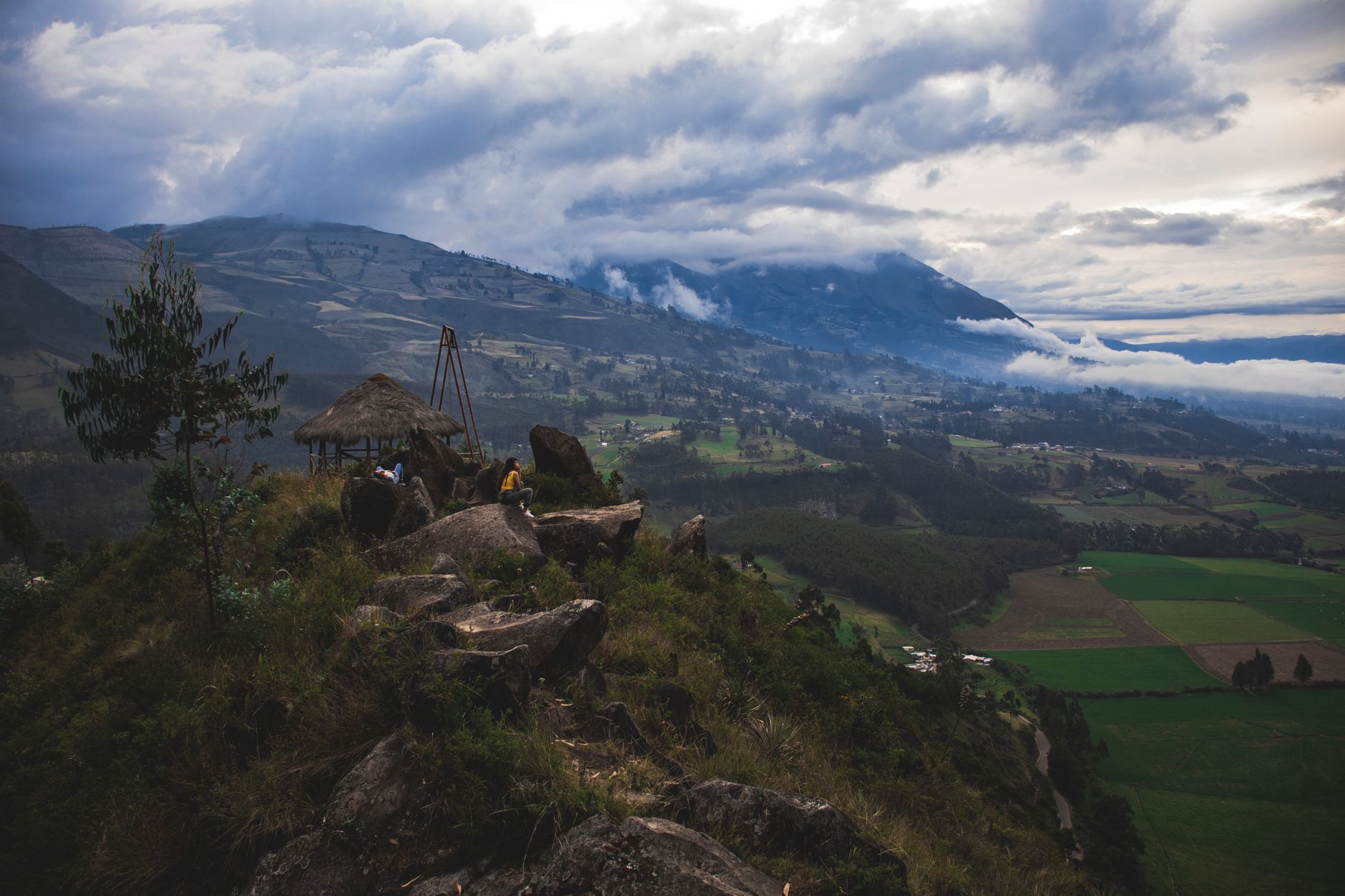
Expansive view of the Imbabura highlands in Ecuador with lush greenery and cloudy skies.
Photo by Bryan Catota on Pexels · Pexels License
Top Monuments in Ecuador
Practical Information
Visa
U.S., Canadian, UK, EU and Australian travelers can usually enter Ecuador visa-free for up to 90 days in any rolling 12-month period. Your passport should be valid for at least 6 months on arrival, and if you enter by land or river from Colombia or Peru, Ecuador currently requires a 5-year criminal record certificate or a border SIMIEC check instead.
Currency
Ecuador uses the U.S. dollar nationwide, which makes cash planning easy if you are arriving from North America and slightly less forgiving if you are used to softer local exchange rates. General IVA is 15%, but properly registered tourist accommodation can bill eligible foreign visitors at 0% IVA for stays under 90 days; in restaurants, check whether a 10% service charge is already on the bill before adding more.
Getting There
Most travelers enter through Quito for the Andes or Guayaquil for the coast and onward flights to the Galápagos Islands. Cuenca is the useful southern-air bridge, especially if you want to skip a long bus haul and move straight into the Azuay-Loja corridor.
Getting Around
Long-distance buses remain the backbone of mainland travel, cheap and frequent enough that you can move between Quito, Baños, Riobamba, Cuenca and Guayaquil without much advance planning. In cities, Quito Metro is fast and simple at US$0.45 for a standard ride, while Cuenca's tram is US$0.35 with card or electronic payment and US$1.00 on a paper ticket.
Climate
Ecuador runs on altitude more than season: Quito, Otavalo and Cuenca can feel cool all year, while Guayaquil, Montañita and Tena stay warm. June to September usually works best for Andean hiking, the coast is less humid from June to November, and the Galápagos Islands shift between a warmer Jan-Apr wildlife-and-snorkeling season and a cooler Jun-Nov season favored by divers.
Connectivity
In Quito, Cuenca, Guayaquil and most established traveler towns, mobile data and hotel Wi-Fi are usually reliable enough for maps, banking and remote work. The weak spots are long bus rides, cloud-forest lodges, Amazon stays around Tena and inter-island or rural stretches in the Galápagos Islands, so download tickets, trail maps and cashless backups before you go offline.
Safety
Safety needs active planning, not hand-waving: current official advisories still flag violent crime, kidnappings and sudden transport disruption in parts of the country. Use registered taxis or ride apps, avoid flashing phones at bus terminals, skip isolated viewpoints after dark in Quito and Guayaquil, and check the latest local guidance before overland travel near the Colombia border or into higher-risk coastal zones.
Taste the Country
restaurantEncebollado
Morning, noon, hangover. Spoon, lime, chifles, broth. Friends talk, then fall silent.
restaurantHornado
Sunday lunch, family table. Pork, mote, llapingacho, agrio. Fork first, fingers later.
restaurantBolón de verde
Breakfast before work or travel. Plantain, cheese or pork, coffee, eggs. Eat slowly, move fast after.
restaurantTigrillo
Zaruma ritual, early hours. Plantain, egg, cheese, onion, café pasado. Conversation starts here.
restaurantMaito
Amazon lunch in Tena or river lodges. Bijao leaf opened at the table. Fish, smoke, hands, patience.
restaurantFanesca
Holy Week, family kitchens, long preparation. One bowl, many grains, salted cod, memory. Nobody cooks it for one person.
restaurantCeviche de camarón
Coast, midday, heat. Spoon, shrimp, lime, tomato, red onion, canguil. Beer or juice beside it.
Tips for Visitors
Budget Split
Keep the mainland and the Galápagos Islands in separate columns when you price the trip. A frugal mainland day can sit around US$35 to US$55, while the islands start climbing fast once you add flights, boats, park fees and island lodging.
Check The Bill
In restaurants, a 10% service charge is often already included, so tipping is usually a rounding-up exercise rather than a second full tip. In hotels, ask whether the quoted rate includes IVA and whether the property applies the foreign-tourist 0% IVA rule.
Use Urban Rail
In Quito, use the Metro to cut across the city instead of bleeding time in traffic. In Cuenca, the tram is the easiest way to move through the historic core corridor without dealing with parking or taxi detours.
Fly Smart South
If your route includes Cuenca, consider flying one leg instead of forcing every transfer by road. A short domestic flight can save most of a day that would otherwise disappear into mountain curves and bus terminals.
Altitude First
Start highland trips gently in Quito or Cuenca, drink water early, and leave the hard hike for day two or three. Quito sits around 2,850 meters, which is enough to make a rushed first day feel foolish.
Download Offline
Buy tickets, save hotel addresses and cache maps before leaving major cities. Coverage drops on mountain roads, in cloud forest around Mindo, in Amazon stretches near Tena and on boat-heavy days in the Galápagos Islands.
Eat By Region
Order for the geography you are standing in. Encebollado, ceviche and bolon de verde make the most sense on the coast; hornado, llapingachos and cuy belong more naturally in the sierra.
Explore Ecuador with a personal guide in your pocket
Your Personal Curator, in Your Pocket.
Audio guides for 1,100+ cities across 96 countries. History, stories, and local insight — offline ready.
Audiala App
Available on iOS & Android
Join 50k+ Curators
Frequently Asked
Do U.S. citizens need a visa for Ecuador? add
Usually no for trips up to 90 days in any rolling 12-month period. You still need a passport with at least 6 months' validity, and border officers can ask for onward travel proof or other supporting documents.
Do I need a yellow fever certificate to enter Ecuador? add
Not for a normal direct arrival from the U.S. or Europe, but yes if you are arriving from or have recently spent qualifying time in countries such as Colombia, Peru, Bolivia or Brazil under Ecuador's current rule. The vaccine must be given at least 10 days before entry, and limited age-based exemptions apply.
Can you travel around Ecuador without speaking much Spanish? add
Yes in Quito, Cuenca, Guayaquil and the Galápagos Islands, where tourism infrastructure is well used to foreign visitors. It gets harder in bus terminals, markets, small-town lodgings and Amazon transport links, where basic Spanish saves time, money and confusion.
Is Ecuador expensive for tourists? add
Mainland Ecuador is manageable by regional standards, but the Galápagos Islands are not cheap. Budget travelers can keep mainland costs modest with buses, set lunches and simple rooms, while island logistics push even independent trips into a much higher bracket.
Is Quito safe for tourists right now? add
Quito can be visited, but you need to travel defensively. Use registered transport, avoid isolated viewpoints and certain nightlife zones after dark, and keep an eye on protest-related road closures because disruption can start with little warning.
What is the best way to get around Ecuador: bus, plane or car? add
For most travelers, buses plus a few strategic flights is the best mix. Buses are cheap and extensive, flights make sense for long jumps such as Quito to Cuenca or mainland to the Galápagos Islands, and driving only pays off if you are comfortable with mountain roads and urban traffic.
How many days do you need for Ecuador and Galápagos? add
Ten to fourteen days is the useful minimum if you want both mainland Ecuador and the Galápagos Islands without turning the trip into airport arithmetic. Seven days can work for one focus only: either a mainland loop such as Quito-Baños-Riobamba-Tena or an island-centered week with little mainland padding.
Should I carry cash in Ecuador or can I use cards? add
Carry both, with smaller U.S. dollar notes if you can get them. Cards work in larger hotels, restaurants and airports, but cash still matters for buses, markets, taxis, rural towns and the kind of lunch counters that often feed you best.
Sources
- verified GOV.UK Ecuador Entry Requirements — Visa-free stay rules, passport validity, land-border criminal record requirement and customs declarations.
- verified U.S. State Department Ecuador Travel Advisory — Current security posture, regional risk framing and yellow fever entry requirement summary.
- verified Servicio de Rentas Internas - Beneficios tributarios para el sector turístico — 0% IVA rule for eligible foreign tourists in registered accommodation and holiday IVA reductions.
- verified Metro de Quito - Contacto / Preguntas Frecuentes — Official Quito Metro fare information, including the US$0.45 standard fare and integrated fare reference.
- verified GAD Municipal de Cuenca - Tarifa del Transporte Masivo Tranviario — Official Cuenca tram fare resolution with US$0.35 electronic fare and US$1.00 paper ticket.
Last reviewed: