Aarhus
Denmark Updated Apr 2026
Salt hangs in the air on Aarhus harbor, and five minutes later you’re under the painted vaults of a cathedral that took shape between 1190 and 1300. Aarhus, Denmark, lives on that sort of jump cut. One minute, cold sea light on glass towers; the next, cobbles, brick, and a bell tower rising 96 meters above the old center.
 Photo: Adriaan Westra / Pexels
- Attractions
- 14
- Trip length
- 2-3 days
- Best season
- Late spring to early autumn (May-September)
Why Aarhus
Built from cited sources · see the method · How we make our guides →
Aarhus feels smaller than a second city should, which is part of its trick. Copenhagen performs capital-city grandeur; Aarhus gets on with things. You notice it in places like DOKK1, where a major waterfront landmark doubles as a library, a meeting point, and a place where locals actually linger instead of merely passing through.
Culture here has range, and not the dutiful kind. ARoS gives you Olafur Eliasson, Bill Viola, and a circular rooftop walk through rainbow glass that changes the whole city by color; Moesgaard gives you the Grauballe Man, his Iron Age face preserved so well it can stop a room cold. Den Gamle By sounds quaint until you realize it carries you past half-timbered streets into Danish life in 1974 and 2014. That shift matters.
The city’s real charm sits in the spaces between headline sights. Morning coffee and a cardamom bun in the Latin Quarter, a long lunch on Jægergårdsgade in Frederiksbjerg, then a walk out to Aarhus Ø where the harbor has been remade into promenades, housing, and public baths designed for people who plan to use them. Aarhus doesn’t ask for awe. It earns affection.
Art With Altitude
ARoS turned a roof walk into the city's calling card: Olafur Eliasson's circular "Your rainbow panorama" washes Aarhus in bands of red, green, and blue. In 2026 the museum's expansion adds James Turrell's "As Seen Below - The Dome," which tells you a lot about this city: even the skyline gets curated.A Time Machine That Keeps Going
Den Gamle By starts with half-timbered Denmark and then refuses to stop, carrying you forward into a 1974 neighborhood and a 2014 apartment block. That shift matters; Aarhus doesn't embalm its past, it keeps asking how ordinary life used to smell, sound, and look.Harbor Reinvented
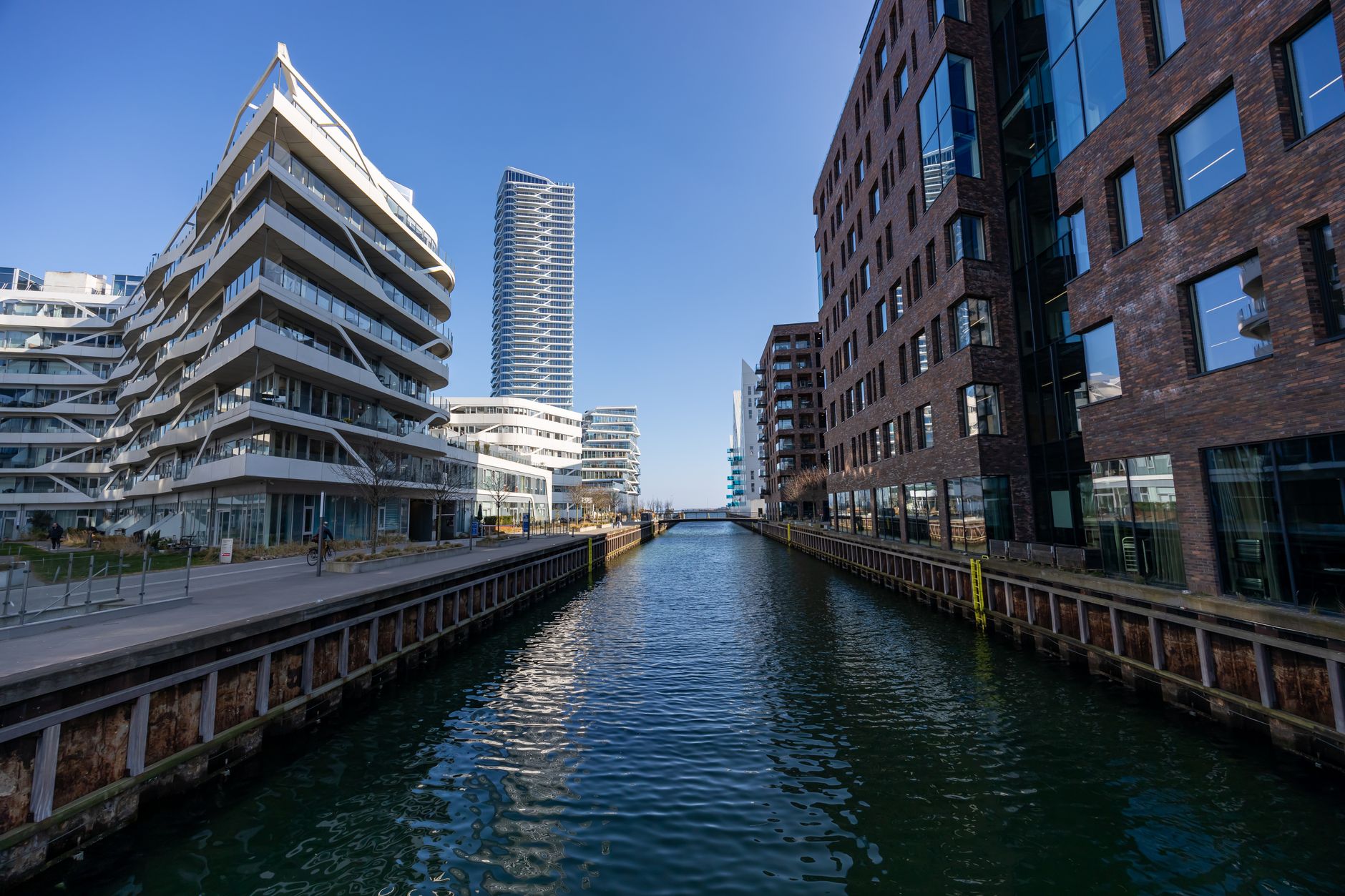
Aarhus O is where the old port became a design argument, with DOKK1 linking downtown to the water, Isbjerget cutting a jagged line over the quay, and the 142-meter Lighthouse pushing the skyline higher. Walk it at dusk when the bay goes silver and the glass starts catching the last light.Forest, Sea, Then Deer
Few small cities switch from cathedral stones to beech forest this fast. Riis Skov, the Infinite Bridge, and Marselisborg Deer Park put salt air and quiet paths within easy reach of the center, which keeps Aarhus from feeling sealed inside its own good taste.
Neighborhoods
Where to wander, by quarter — each with its own rhythm.
Latinerkvarteret
The Latin Quarter is the oldest part of Aarhus, and it still knows how to hold a street. Expect narrow cobbled lanes, crooked facades, small squares, wine bars, independent shops, and coffee places like La Cabra that treat a pastry with proper seriousness. This is where the city feels intimate rather than polished.Midtbyen
Central Aarhus is where the medieval core and the shopping city keep colliding. Aarhus Cathedral anchors the district beside Store Torv and Bispetorv, while nearby you get Salling ROOFTOP, the river bars along Åboulevarden, and the steady pedestrian flow of a place used from morning to late night. Some stretches lean commercial. The cathedral keeps the balance.Frederiksbjerg
Frederiksbjerg is where you go when hunger is setting the agenda. VisitAarhus calls it the city’s larder, and that sounds about right once you hit Jægergårdsgade, M.P. Bruuns Gade, and Ingerslevs Boulevard, where the market turns daily life into something worth detouring for. The mood is local, well-fed, and faintly self-satisfied.Aarhus Ø
Aarhus Ø shows the city in its newest language: water, glass, angular housing blocks, and public space designed with unusual confidence. Isbjerget still catches the eye, the Lighthouse remakes the skyline, and Nicolinehus Market Hall gives the district a social center instead of leaving it as an architecture display. Come for the harbor walk. Stay to see how a former port decided to become a neighborhood.Godsbanen and Institut for (X)
This former freight-yard area has the rougher edges Aarhus needs. Godsbanen packs in workshops, exhibitions, readings, theater, and a climbable roof with broad views toward the west, while neighboring Institut for (X) houses designers, makers, and artists in a district that feels improvised in the best way. Less polished. More alive.Møllestien
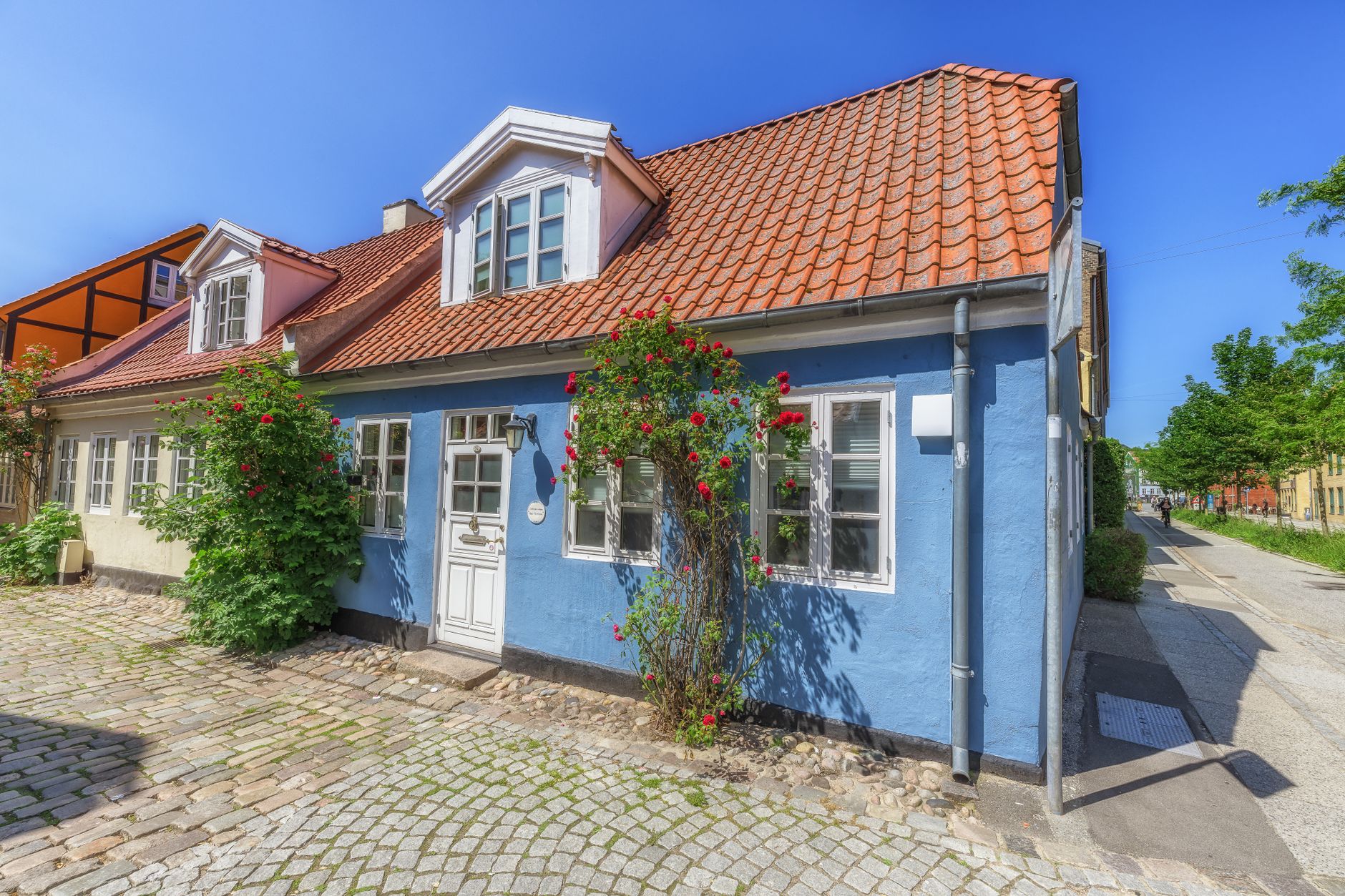
Møllestien is barely a neighborhood in the usual sense, more a short street with the power to stop your walk. Cobbles, low pastel houses, hollyhocks in season, and a hush that feels older than the streets around it make this one of Aarhus’s loveliest small detours. Go early or late. Midday cameras can spoil the spell.Trøjborg
North of the center, Trøjborg has a calmer, residential rhythm and easy access to Riis Skov and the water. Cafes, everyday shops, and the old cinema give it enough character to feel distinct without trying too hard. If central Aarhus starts to feel curated, this is a good place to reset.
Plan your trip
Before you go
- Getting There
- For flights, Aarhus Airport (AAR) is the nearest airport; the 925X Airport Express links AAR with Aarhus H in about 45-50 minutes and cost DKK 128 for adults in 2026. Billund Airport (BLL) is often more useful for international arrivals, with the 912X bus from Aarhus Rutebilstation and Banegardspladsen at DKK 166 adult; by rail, Aarhus H is the main station, and drivers usually arrive via the E45 motorway, with Route 15 feeding in from the west.
- Getting Around
- Aarhus has no metro in 2026; local transport runs on the Letbanen light rail and city buses. Letbanen has two main lines, L1 and L2, while the yellow A-buses 1A through 6A form the urban backbone; for visitors, the Day Ticket Aarhus costs DKK 59 for adults and covers zones 301-313, while Donkey Republic bikes start at DKK 26 for 30 minutes.
- Climate & Best Time
- Spring usually sits around 5-15 C, summer around 18-20 C by day, autumn around 8-17 C, and winter around 0-5 C, with frost and occasional snow between December and March. Rain falls through the year, but September to November tend to feel grayer and wetter; June through August bring the longest days and peak visitor numbers, while late August to September is the sweet spot if you want decent light without full summer pressure.
- Language & Currency
- Danish is the national language, though English works almost everywhere you are likely to go, from museum desks to bakery counters. The currency is the Danish krone (DKK); cards are standard, tipping is optional because service is already included, and some small shops or late-night kiosks may not want cash at all.
- Safety
- Aarhus feels easygoing, but 2026 advice is the usual urban mix: watch your pockets in transport hubs, shopping streets, and busy nightlife areas. The bigger day-to-day risk for many visitors is the bike culture; lanes move fast, one-way rules matter, and stepping into a cycle track without looking is a quick way to get corrected by a bell.
A River Mouth That Learned to Think Big
From Viking harbor to Denmark's second city
- c. 770
Aros Begins at the Water
Most scholars date Aarhus's beginning to around 770, when a trading settlement took shape where the river met the bay. The name was plain and exact: Aros, the river mouth. Boats, wet timber, fish scales, and the sharp smell of tar would have defined the place long before stone towers did.
- c. 900
A Christian Foothold Appears
According to later accounts, the first Christian church stood here by around 900, planted inside a town that was still thoroughly shaped by Viking trade and power. That matters because Aarhus did not become Christian all at once. Faith arrived as wood, ritual, and argument before it arrived as grand masonry.
- 948
Aarhus Enters the Record
A bishop of Aarhus appears at the imperial synod of Ingelheim in 948, the city's first clear appearance in written history. One line in a document can feel thin. Still, that line tells you Aarhus already mattered enough to be counted in the politics of church and kingdom.
- 10th century
Ramparts Ring the Town
Defensive earthworks rose around the settlement in the 10th century, enclosing roughly 6 hectares and using streams and marshy ground as natural protection. You can still feel the logic of the site today. Aarhus was never placed at random; it was chosen by people who understood trade and danger in the same breath.
- 1050
Harald Hardrada Burns Through
Local tradition holds that Harald Hardrada attacked Aarhus in 1050 and burned the early wooden church on the site later occupied by Vor Frue Kirke. Whether every detail survives scrutiny, the story fits the age: kings fought fast, and timber towns paid first. Fire was the great editor of early Scandinavian cities.
- c. 1060
An Episcopal City Takes Shape
Around 1060 Aarhus became an established episcopal seat under Bishop Christian, tying the town more firmly to the Danish crown and the Latin church. That changed the city's gravity. Priests, scribes, builders, and donors followed, and a harbor town began turning into a place of institutional power.
Show the full timeline (26 moments)
- late 11th century
Stone Replaces Timber
Most scholars place the first major stone church here in the late 11th century, dedicated to St. Nicholas, patron saint of sailors. Its crypt survives beneath today's Church of Our Lady, low and cool, with the hush of a room built to outlast weather and politics. Aarhus had started building for permanence.
- 1201
The Cathedral Rises
Construction began on Aarhus Cathedral in 1201, and the project announced the city's ambitions without saying a word. Brick by brick, the bishop's town gave itself a building long enough to dominate the Danish record. Inside, light still slides across vaults that began as a medieval statement of rank.
- 14th century
Plague Cuts the City Down
The Black Death hit Aarhus in the 14th century and did what plague always does: it emptied rooms, workshops, and streets faster than any army. Trade faltered. Bells would have tolled over a city that suddenly sounded too large for the people left in it.
- 1441
Market Town, Crown Approved
Aarhus received market town privileges in 1441, formalizing its right to trade and sharpening its role in eastern Jutland. Legal language can sound dry. In practice, it meant tolls, merchants, warehouses, and a firmer urban identity built on goods moving through the harbor.
- 1536
The Reformation Breaks the Old Order
When Denmark embraced the Lutheran Reformation in 1536, Aarhus lost its Catholic bishopric and the ecclesiastical system that had shaped the city for centuries. Church wealth changed hands. Merchant houses and civic authority gained room to breathe, and the city tilted from clerical rule toward urban commerce.
- 1588
Ole Worm Is Born
Ole Worm was born in Aarhus in 1588, long before he became one of Denmark's great antiquarian minds. His later fascination with runes, natural specimens, and old objects feels perfectly suited to a city layered with buried history. Aarhus gave him the kind of ground that rewards looking twice.
- 1644
Ole Rømer Starts Here
Astronomer Ole Rømer was born in Aarhus in 1644, and his career would later stretch far beyond Jutland. Still, his origin matters. A provincial port produced the man who first measured the speed of light with real mathematical force, which is a fine reminder that big ideas don't wait for capitals.
- mid-18th century
Trade Swells the Harbor City
By the mid-18th century, Aarhus entered a sustained phase of growth as maritime and overland trade expanded. Grain, timber, and imported goods moved through the port with increasing regularity. The city had spent centuries as a regional node; now it began acting like one.
- 1846
Karl Verner's Aarhus Beginning
Linguist Karl Verner was born in Aarhus in 1846, a city that was about to be reshaped by modern infrastructure. His name survives in Verner's Law, one of those fierce little pieces of historical linguistics that changed how scholars heard old languages. Aarhus keeps producing minds with a taste for systems.
- 1862
The Railway Changes Everything
Jutland's first railway reached Aarhus in 1862, and the effect was immediate: faster freight, quicker travel, and a new tempo for business. Ports work differently when steel tracks feed them. Aarhus stopped behaving like a large market town and began becoming an industrial city.
- 1898
Customs House Faces the Harbor
The Customs House rose in 1898, dressed in National Romantic detail and built for a city making serious money from movement and taxation. You can read the confidence in the architecture. Aarhus wanted buildings that looked official, prosperous, and a little self-aware about the fact.
- 1918
Gabriel Axel Is Born
Film director Gabriel Axel was born in Aarhus in 1918, before going on to make work of wit, appetite, and control. His later success, especially in stories where manners hide sharper tensions, suits a city that often looks orderly on the surface and more interesting underneath. Aarhus has that habit.
- 1928
A University City Emerges
Aarhus University was founded in 1928, the decision that may explain modern Aarhus better than any slogan ever could. Students, laboratories, libraries, and lecture halls changed the city's metabolism. From this point on, Aarhus was not just a port and trading center; it was a place that manufactured knowledge.
- 1941
City Hall Makes Modernism Civic
Aarhus City Hall was completed in 1941, designed by Arne Jacobsen and Erik Møller with the clean lines of Danish functionalism. The building feels disciplined rather than grandiose, right down to the careful materials and measured proportions. It gave the city a new public face while Europe was tearing itself apart.
- 1948
Aarhus Becomes Århus
After the Danish spelling reform of 1948, the city officially adopted the form Århus instead of Aarhus. A single letter can carry surprising weight. This one signaled modern national standardization, even if locals and institutions would keep negotiating the city's name for decades.
- 1950
Bjarne Stroustrup's First Address
Bjarne Stroustrup was born in Aarhus in 1950, and his later creation of C++ placed him inside the machinery of the digital age. The link is worth keeping. A city remade by industry and university culture produced one of the people who helped shape how machines now speak.
- 1973
Europe Comes Closer
Denmark joined the European Economic Community in 1973, and Aarhus's port economy gained a wider continental frame. Rules, routes, and markets shifted. For a harbor city, Europe was never an abstraction; it arrived in contracts, cargo, and the daily business of crossing water.
- 2011
The Old Spelling Returns
After a city council decision in 2010, the official name reverted from Århus to Aarhus on 1 January 2011. That was more than branding. The restored double-a tied the city back to older forms while still working neatly in an international alphabet without the Danish Å.
- 2017
Culture Takes the European Stage
As European Capital of Culture in 2017, Aarhus used museums, public spaces, and performance to present itself as more than Denmark's second city. The title gave outside visitors a reason to look harder. Anyone paying attention could see the deeper pattern: trade town, bishop's seat, university city, now cultural laboratory.
- 2026
ARoS Opens the Sky
In 2026 ARoS expands with James Turrell's 'As Seen Below - The Dome,' described by the museum as the largest museum-based Skyspace of its kind. That feels right for Aarhus. The city that began at a river mouth now builds rooms for looking upward, where light itself becomes the exhibit.
Who lived here
-
Astronomer · 1644–1710
Ole Rømer
Born here
Aarhus gave Denmark the boy who later helped prove that light does not travel instantaneously. He'd probably appreciate the city's clean horizons and sharp northern light, even if the rainbow ring on ARoS might strike him as gloriously excessive.
-
Computer scientist · born 1950
Bjarne Stroustrup
Born here
The creator of C++ was born in Aarhus, which feels oddly fitting for a city that likes elegant systems and solid engineering under the surface. He might recognize the same mindset in DOKK1, the harbor rebuild, and the calm Danish habit of making difficult things look almost plain.
-
Film director · 1918–2014
Gabriel Axel
Born here
Gabriel Axel, later the director of "Babette's Feast," was born in Aarhus before taking Danish storytelling onto a larger stage. One suspects he'd still find material here: old brick, harbor weather, and a city that understands appetite without making a speech about it.
-
Singer · born 1946
Gitte Hænning
Born here
Gitte Hænning was born in Aarhus and grew into one of Scandinavia's best-known entertainers. She would probably notice how the city still keeps a little polish and a little mischief in the same frame, especially after dark around the river and theater district.
Insider tips
Small things that change how the city treats you.
Book museum blocks
ARoS, Den Gamle By, and Moesgaard are not quick stops. Give each at least half a day, especially Den Gamle By, which stretches from old timber houses into recreated 1974 and 2014 streets.Use free views
Skip paid viewpoints on your first evening and start with Salling ROOFTOP, DOKK1, and the Botanical Garden Greenhouses, all free. You’ll get the skyline, harbor light, and a feel for the city before spending a krone on ticketed sights.Eat in Frederiksbjerg
For food that feels local rather than polished-for-visitors, walk to Jægergårdsgade and the wider Frederiksbjerg quarter. VisitAarhus calls it the city's larder, and it has the right mix of bakeries, lunch spots, and old-school Danish comfort food.Go south for water
When the weather turns clear, head beyond the center to the Infinite Bridge, Marselisborg Deer Park, or Riis Skov. Aarhus makes more sense once you see how quickly the city slips into forest, beach, and bay.Shoot early light
Møllestien and the Latin Quarter photograph best early, before café tables and day-trippers fill the cobbles. Aarhus Ø works better later, when the glass and water pick up evening light.Use DOKK1 breaks
DOKK1 is more than a library: it's a reliable indoor reset with free entry, family-friendly space, harbor views, and decent shelter on cold or wet days. If you're traveling with children, this place saves the afternoon.
Gallery
The city, as it actually looks.




Frequently asked
Is Aarhus worth visiting?
Yes, especially if you like cities that mix serious museums with everyday livability. Aarhus gives you ARoS, Moesgaard, and Den Gamle By, then turns around and offers harbor walks, forests, and a library where locals actually spend time.
How many days in Aarhus?
Two to three days works well for most travelers. That gives you one museum-heavy day, one day for the old center and waterfront, and enough slack for Riis Skov, the Infinite Bridge, or a long lunch in Frederiksbjerg.
What are the best things to do in Aarhus for first-time visitors?
Start with ARoS, Den Gamle By, Moesgaard Museum, Aarhus Cathedral, the Latin Quarter, and a walk through Aarhus Ø. Add DOKK1 and Salling ROOFTOP if you want the city’s newer face without adding another ticket.
Can you visit Aarhus on a budget?
Yes, if you mix one or two paid headliners with the city's strong free sights. DOKK1, Kunsthal Aarhus, the Botanical Garden Greenhouses, Salling ROOFTOP, Møllestien, and long harbor or forest walks keep costs down.
Is Aarhus expensive?
It can be, especially if you lean into Michelin dining and multiple major museums in one trip. But the city is easier on the wallet than Copenhagen, and many of its best pauses, rooftops, waterfront walks, and green spaces cost nothing.
Is Aarhus safe for tourists?
Yes, Aarhus is generally an easy city to move through, with busy central districts and well-used public spaces. Use normal city habits at night, especially around transport hubs and bar streets, but this is not a place that usually feels tense.
What area should I stay in Aarhus for a first visit?
Stay near the Latin Quarter, around the cathedral, or between ARoS and the river if you want the easiest base. Frederiksbjerg suits travelers who care more about neighborhood food and cafés than postcard streets.
What are the best free things to do in Aarhus?
The strongest free lineup is DOKK1, Salling ROOFTOP, Kunsthal Aarhus, the Botanical Garden Greenhouses, Møllestien, Riis Skov, and the waterfront around Aarhus Ø. Few cities this size give away that much good architecture and fresh air.
Pick up where you left off
Saved and recently read places — kept on this device only.
Photo credits (9)
- Adriaan Westra — Pexels License (https://www.pexels.com/license/) — Source: https://www.pexels.com/photo/36268750/
- Teddy and cushion in Bytteboxen swap station Givebox Aarhus Denmark 07 — Ciara Ní Riain — CC BY-SA 4.0 (https://creativecommons.org/licenses/by-sa/4.0/) — Source: https://commons.wikimedia.org/wiki/File:Teddy_and_cushion_in_Bytteboxen_swap_station_Givebox_Aarhus_Denmark_07.jpg
- Adriaan Westra — Pexels License (https://www.pexels.com/license/) — Source: https://www.pexels.com/photo/36116787/
- Joerg Mangelsen — Pexels License (https://www.pexels.com/license/) — Source: https://www.pexels.com/photo/31455361/
- 1970s B&O Beomaster on a Bytteboxen swap station Givebox shelf Aarhus Denmark 06 — Ciara Ní Riain — CC BY-SA 4.0 (https://creativecommons.org/licenses/by-sa/4.0/) — Source: https://commons.wikimedia.org/wiki/File:1970s_B&O_Beomaster_on_a_Bytteboxen_swap_station_Givebox_shelf_Aarhus_Denmark_06.jpg
- Deyaar Rumi — Pexels License (https://www.pexels.com/license/) — Source: https://www.pexels.com/photo/16375882/
- Karina Husted — Pexels License (https://www.pexels.com/license/) — Source: https://www.pexels.com/photo/30044031/
- Deyaar Rumi — Pexels License (https://www.pexels.com/license/) — Source: https://www.pexels.com/photo/16133010/
- Eddson Lens — Pexels License (https://www.pexels.com/license/) — Source: https://www.pexels.com/photo/18947583/
Photos may have been resized or cropped.