castle
Castles and Crown
Kronborg in Helsingør, royal Copenhagen, and the cathedral tombs of Roskilde tell the story of a kingdom that understood ceremony, shipping lanes, and public spectacle.
Denmark is what happens when a country treats everyday life as a design problem: ferries run on time, lunch matters, and even the old fortresses have clean lines.
 Denmark
EntrySchengen area; many non-EU travelers can stay up to 90 days in 180
DThis Denmark travel guide starts with the country's oddest luxury: you can cross from Viking stones to chalk cliffs in a single week without ever feeling rushed.
Denmark looks small on a map, then keeps changing the closer you get. In Copenhagen, royal palaces, design stores, and harbor baths sit inside a city that moves by bike and metro with almost suspicious ease. West in Roskilde, ship burials and a cathedral full of kings turn the national story into something concrete. North in Helsingør, Kronborg watches the Øresund like it still expects tolls from passing ships. Even the distances help: Odense, Aarhus, and Aalborg are close enough to stitch into one trip, which means you spend less time in transit and more time noticing the shape of the place.
What stays with most travelers is the contrast. Denmark can feel sharply urban in Copenhagen, then turn quiet and elemental on Bornholm, in Ribe, or along the dunes near Skagen. Møns Klint gives you white cliffs and Baltic light; Silkeborg trades sea horizons for lakes, forests, and long canoe days. Food follows the same pattern: meticulous tasting menus exist, but so do rye bread lunches, smoked fish, pork crackling, and bakeries that take butter very seriously. Denmark is not trying to overwhelm you. It wins another way, through order, understatement, and the rare pleasure of a country that has figured out how to make daily life look good.
Bog Kingdoms and First Memory, c. 12000 BCE-800 CE
Morning mist hangs over a Jutland bog, and the ground gives back a face. In 1950, near Silkeborg, workers cutting peat found Tollund Man with his cap still on, the rope still at his neck, as if the Iron Age had closed its eyes only yesterday. Denmark's earliest drama often survives like this: not in marble, not in palaces, but in wet earth that refuses to let go.
Long before kings carved their boasts on stone, people here lived by tide, reed, and fish. Along the coasts, Ertebolle communities left shell middens rather than monuments, great heaps of oyster and mussel that are really archives of appetite. Then farming arrived in the 4th millennium BCE, and the landscape changed from hunting grounds to fields, from seasonal camps to something closer to inheritance.
Ce que l'on ignore souvent, c'est que Denmark begins not as a neat little kingdom but as a patchwork of water, islands, and ritual places. The bog bodies from Jutland, including Grauballe Man with his throat cut, suggest a society that could be tender with craft and brutal with belief in the same breath. One meal of porridge. One rope. One sacrifice. History can be indecently intimate.
That intimacy matters when you walk Denmark now. The calm museum cases in Silkeborg, the low horizons of Jutland, even the sense that land and sea are still negotiating with one another, all belong to this first chapter. Before Copenhagen glittered and before Roskilde rang with royal funerals, Denmark learned to preserve memory in mud, and that taste for survival would shape every age that followed.
Tollund Man is not a king but something rarer in early history: an unknown ordinary body that forces a whole civilization to speak.
When Tollund Man was discovered, the police were called because the face looked so fresh that locals thought they were dealing with a recent murder.
The Viking Court and the Christian Turn, c. 800-1035
A king chooses stone because he wants to outlive rumor. At Jelling, around the 10th century, Harald Bluetooth ordered a runestone that still reads like a piece of royal propaganda: he won Denmark and Norway and made the Danes Christian. It is an astonishing sentence, half prayer, half press release.
The shift was not tidy. Denmark's Viking age was built by ship timber, silver, and violence, but also by calculation. Roskilde became a royal center; rings of power tightened across the islands and Jutland; rulers used burial mounds, churches, and inscriptions to turn force into legitimacy. Ce que l'on ignore souvent, c'est que conversion here was also administration. A cross can travel with tax, law, and obedience.
Then came the family drama that every monarchy knows too well. Sweyn Forkbeard rebelled against Harald, took the crown, and carried Danish ambition across the North Sea. His son Cnut went further still. By 1016, after blood, bargaining, and patience, he ruled England, and for a moment Denmark was not a northern edge at all but the center of a sea empire stretching from Roskilde's fjord world to London.
But empires built on one man's nerve rarely survive his grave. Cnut died in 1035, and the great northern arrangement began to loosen almost at once. Still, the habit remained: Danish kings had learned to think big, to bind faith with power, and to imagine that a small kingdom of islands could speak to Europe as an equal.
Harald Bluetooth emerges less as a saga caricature than as a hard political operator who understood that a carved sentence could rule almost as effectively as a sword.
Bluetooth wireless technology takes its name from Harald Bluetooth, and its logo combines the runic initials for H and B.
Churches, Queens, and the Kalmar Crown, 1035-1536
Candles burn in Roskilde Cathedral, and one can almost hear the rustle of ermine. This is where Denmark's monarchy learned ceremony in stone. Romanesque gave way to Gothic, bishops accumulated weight, and kings discovered that burial itself could become political theater. A dynasty laid properly to rest is a dynasty that expects to continue.
The Middle Ages brought trade, law, and urban life with a new firmness. Towns thickened, the church organized both calendar and conscience, and the crown wrestled constantly with nobles who preferred a weak king to a glorious one. In places like Ribe, whose streets still seem to remember hooves and market mud, you feel how maritime trade tied Denmark to the Baltic, to the Hanseatic world, to arguments carried by wool, grain, and salt.
Then, in the late 14th century, a woman with steel in her velvet sleeve changed everything. Margaret I, widowed young and underestimated at her enemies' peril, assembled Denmark, Norway, and Sweden under the Kalmar Union in 1397. Ce que l'on ignore souvent, c'est that she rarely needed theatrical gestures. She preferred paperwork, negotiation, and the slow humiliation of rivals. The result was one of the most formidable acts of statecraft in northern Europe.
Yet unions are like arranged marriages between proud houses: splendid in portrait, exhausting in practice. Sweden resisted, Danish kings pushed too hard, and the old Catholic order began to crack under new religious winds. By 1536 the Reformation made Lutheran Denmark official, and a kingdom long shaped by bishops and relics stepped into a harsher, more centralized age.
Margaret I ruled without the title of queen regnant in the modern sense, but everybody around her understood perfectly well who was in command.
Margaret chose to call herself 'the rightful heir of Denmark' and 'lady and guardian of the kingdom' rather than rely on a single conventional title.
Kingship on Stage, 1536-1814
Picture a king in black velvet stepping off a ship, impatient, theatrical, convinced that building is a form of ruling. That is Christian IV, the great compulsive builder of Danish history, whose hand still marks Copenhagen through Rosenborg, the old stock exchange, and a cityscape that owes much of its profile to one restless monarch. He loved architecture, war, women, and display. Not always in the right order.
After the Reformation, Denmark became more tightly governed and more visibly royal. The crown took church property, extended its reach, and fought costly wars with Sweden for mastery of the Baltic. Ce que l'on ignore souvent, c'est that grandeur here came with invoices. Court brilliance, fleets, fortifications, and urban redesign were expensive habits, and the kingdom paid in debt, tax, and military exhaustion.
Then came 1660 and the great constitutional pivot: hereditary absolute monarchy. In many countries absolutism announces itself with sunbursts and Versailles mirrors. In Denmark it arrived with legal precision and political opportunity after crisis. The king's power became extraordinary on paper, but court life remained full of pettiness, factions, and sentimental disasters. One thinks of Queen Caroline Mathilde in the 18th century, young, isolated, and fatally entangled with Johann Friedrich Struensee, the reforming royal physician. Their affair shook the court because private longing and public government had become impossible to separate.
By the time Copenhagen burned in 1794 at Christiansborg and then suffered the British bombardment of 1807, the old self-confidence of the composite Danish monarchy had begun to fray. Norway would be lost in 1814. The stage set was still magnificent, yes, but the script had changed. A kingdom of absolute rulers was being pushed, by war and modern politics, toward something much less comfortable and much more democratic.
Christian IV is Denmark's most visible royal ghost: brave in battle, reckless in policy, and incapable of imagining a modest project.
Christian IV personally inspected building sites in Copenhagen and could argue over details like a foreman rather than a distant sovereign.
A Small Kingdom Learns Modernity, 1814-present
Open a schoolbook printed after 1864 and you can feel the bruise. Denmark's defeat to Prussia and Austria that year, and the loss of Schleswig, Holstein, and Lauenburg, shrank the kingdom with brutal clarity. For a country long used to thinking in dynastic and maritime terms, the lesson was severe: grandeur would no longer come from territorial ambition.
And yet this is where modern Denmark becomes unexpectedly moving. The constitution of 1849 had already ended absolute monarchy and created a constitutional order, but the later 19th century forced the country to rebuild from within: schools, cooperatives, agriculture, civic life, and a political culture that preferred competence to imperial fantasy. Ce que l'on ignore souvent, c'est that Danish modernity is not born from triumph. It is born from disciplined disappointment.
The 20th century tested that discipline again. During the German occupation from 1940 to 1945, Denmark collaborated in some respects, resisted in others, and in 1943 carried out one of occupied Europe's most remarkable rescue actions, helping most Danish Jews escape by boat to Sweden across the narrow water from places such as Helsingor. No national legend should be too tidy, but this one contains real courage. Small fishing vessels, October darkness, ordinary people deciding that legality and decency were no longer the same thing.
Postwar Denmark joined NATO in 1949, developed the welfare state, and presented to the world an image of calm competence that can make one forget how much reinvention it required. Walk Copenhagen now, or go west toward Ribe and north to Skagen, and you meet a country that turned losses into institutions and restraint into style. That is the bridge to the Denmark of today: less empire, more equilibrium, but never as simple as its clean lines suggest.
N. F. S. Grundtvig did not build the Danish state with armies but with schools, hymns, and the radical idea that ordinary people deserved intellectual dignity.
In October 1943, many Danish Jews reached safety in Sweden in fishing boats that crossed the Øresund in under an hour, though the wait to find a boat could be far more terrifying than the voyage itself.
Danish sounds like a language spoken with the windows half closed. Words begin in public and finish in private; consonants appear, bow, then disappear behind the teeth. In Copenhagen I kept hearing sentences that seemed to melt before they reached the table, and yet everyone understood everything. That is power.
The famous stød, that tiny catch in the throat, gives the language its pulse. It is less a sound than a secret hesitation, the sort of pause that can separate two meanings and also two temperaments. A country is a table set for strangers; Denmark sets the table with compression.
This economy of speech is not coldness. It is etiquette disguised as acoustics. In Aarhus or Odense, a single "tak" lands with more weight than five compliments elsewhere, and you begin to suspect that verbosity is sometimes only panic wearing jewelry.
Danish food does not flirt. It arrives with rye bread, butter, pickles, pork, herring, cream, and the calm conviction that appetite is a serious matter. Smørrebrød looks decorative only from a distance; up close it is engineering, a strict arrangement of fish, fat, acid, herb, and crumb that expects a knife and fork, not your fingers.
Rugbrød is the dark heart of the country. Tourists call it dense as if density were an accusation; Danes know better. A slice of that sour, seeded loaf with leverpostej, beetroot, and bacon can silence a table faster than philosophy.
Then comes the national talent for preserving what would otherwise vanish: pickled herring, smoked eel on Bornholm, cherries over risalamande, aquavit taken cold enough to sting. The table in Denmark teaches a stern lesson. Restraint can taste obscene.
Danish manners refuse theater. Cashiers do not audition for your affection, waiters do not hover, strangers on trains do not beam at you with the desperate grin of countries addicted to service culture. The first time, you may think: how severe. The second time, you understand the gift. They are leaving you in peace.
Equality here is not an abstract virtue but a daily choreography. Nobody should occupy too much air, too much noise, too much certainty. Janteloven still stalks the room like an old aunt no one admits inviting, and yet her presence explains much: the suspicion of boasting, the fondness for understatement, the quiet horror inspired by self-importance.
That reserve has tenderness inside it. Be punctual in Roskilde, lower your voice in a café in Helsingør, say thank you once and mean it, and doors open. Not literally. Denmark prefers subtler miracles.
Danish design is what happens when a people decide that objects must earn the right to exist. A chair cannot merely stand there; it must hold the back with intelligence, the hand with tact, the eye without vanity. From Arne Jacobsen to Kaare Klint, the national genius has been to remove one line too many and discover that the remaining line was the soul.
The result is often called simple by people who confuse quiet with ease. Nothing easy produced those lamps, those oak tables, those ceramic cups that fit the mouth as if they had interviewed it first. In Copenhagen design shops and old homes alike, you notice the same creed: function, yes, but function with manners.
This reaches beyond furniture. A bicycle lane, a train platform, a harbor bath, the measured light in a room at four in the afternoon: all belong to the same civilization of considered use. Denmark does not decorate life. It edits it.
Danish architecture rarely shouts, which is perhaps why it lingers. The country prefers brick, timber, copper, whitewash, and proportion so exact it begins to feel moral. A church in Ribe, a warehouse front in Copenhagen, a yellow manor on Funen, Kronborg in Helsingør holding its position over the strait like a thought that refuses to move: each building seems to know that weather is the true ruler here.
Light does half the work. Northern light is a strict editor; it forgives nothing, invents nothing, reveals everything. Under that clarity, ornament must justify itself, and Danish buildings often choose discipline over display, with windows placed like measured breaths and courtyards that protect silence as if silence were livestock.
Even when the architecture turns monumental, it keeps a household conscience. Roskilde Cathedral contains kings and queens, tombs and dynastic ambition, yet the brick still speaks the language of labor and earth. Majesty, yes. With mud on its shoes.
Danish literature has the courtesy to smile while handing you a knife. Hans Christian Andersen understood that fairy tales are not nurseries but laboratories of humiliation, longing, vanity, and appetite; Kierkegaard took the same material and moved it into the soul, where the furniture became more expensive. One writes a mermaid who loses her voice, the other writes a self that cannot stop listening to its own abyss. Same country, same weather.
What fascinates me is the scale. Denmark is small enough to make interior life feel architectural. Streets in Copenhagen, childhood in Odense, the flat horizons of Zealand and Jutland: all seem to train the eye inward, toward precision, irony, and the tiny disaster hidden in an ordinary sentence.
Read Danish writers and you meet a national habit of stripping emotion of decoration. The feeling remains. It bites harder that way. Even their melancholy arrives in polished shoes.
Kronborg in Helsingør, royal Copenhagen, and the cathedral tombs of Roskilde tell the story of a kingdom that understood ceremony, shipping lanes, and public spectacle.
Danish food is better understood at lunch than at dinner: smørrebrød, pickled herring, warm pastries, smoked fish, and pork dishes built for weather and appetite.
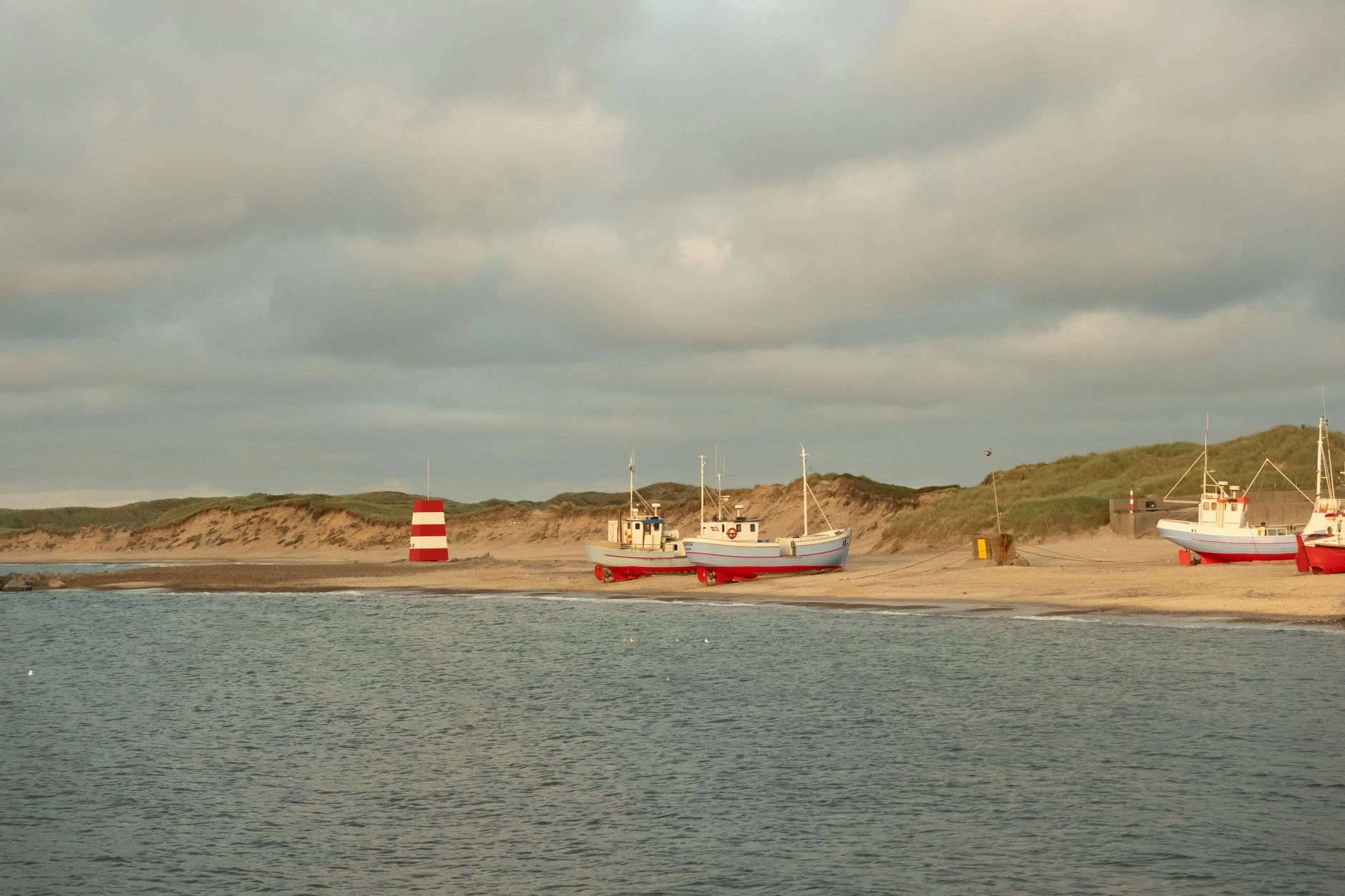
Denmark's drama is horizontal. Walk the chalk edge of Møns Klint, watch two seas meet near Skagen, or follow the wind through dune country and Baltic beaches.
Trains link Copenhagen, Odense, Aarhus, and Aalborg with little friction, while cycling infrastructure makes even short city hops feel smooth and sane.
Few countries jump so cleanly from rune stones and ship burials to furniture, ceramics, and architecture that shaped the modern idea of Scandinavian style.
Bornholm, Silkeborg, Fredericia, and Ribe offer a different Denmark: slower, greener, and often more revealing than the capital if you want room to look around.
3 cities — start with the ones we'd send you to first.
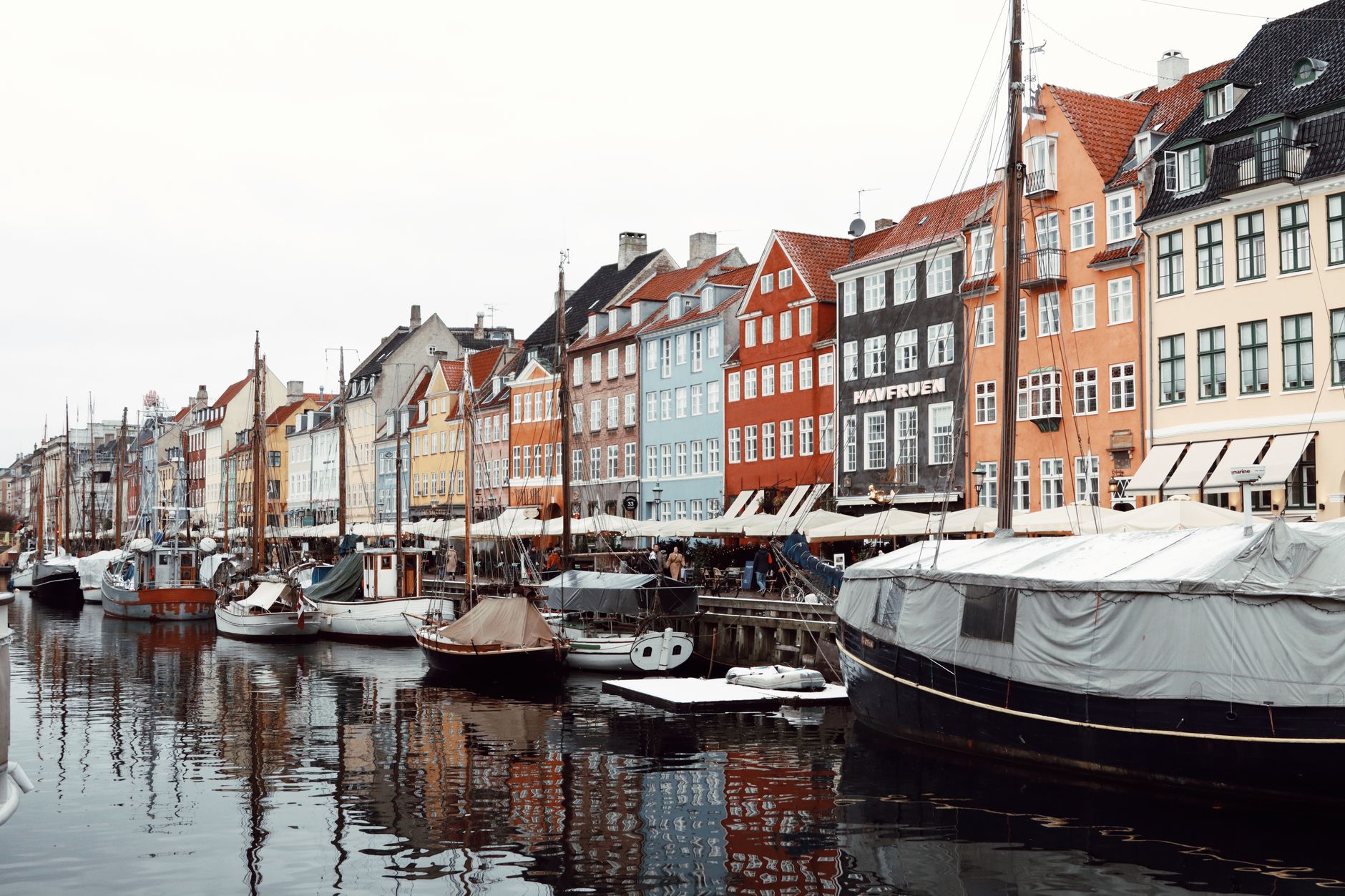
The light hits the coloured houses on Nyhavn at 7 pm in July and you suddenly understand why Danes invented hygge instead of small talk.
Denmark's second city earns its confidence through ARoS's rainbow panorama walkway and a Latin Quarter where the streets are older than the country's current constitution.
Hans Christian Andersen was born here in 1805 in a timber-framed house on Bangs Boder, and the city has spent two centuries deciding whether that is a burden or a gift.
This is Denmark at its most self-aware: royal facades, design shops, bike lanes that actually work, and a capital that knows exactly how much of Europe passes through it. Copenhagen carries the weight, but Roskilde and Helsingør explain the older logic of the region: kings, ships, tolls, and control of the water between Denmark and Sweden.
Funen moves at a calmer pitch than Copenhagen, though the history is no less dense. Odense gives you Andersen, old merchants' houses, and a city center built for walking, while Fredericia shows the military geometry that once mattered because this was the hinge between islands and Jutland.
Aarhus is the Danish city that surprises people who thought everything interesting happened in the capital. Around it, East Jutland mixes university life, serious museums, woodland lakes near Silkeborg, and a coastline that makes short detours feel worthwhile rather than dutiful.
North Jutland is where the landscape opens up and the weather stops pretending to be polite. Aalborg has rebuilt itself with confidence, but the region's real pull is farther north in Skagen, where dunes, yellow houses, and the meeting of the Skagerrak and Kattegat create a finish that feels earned.
Ribe has the kind of age that changes the pace of your footsteps; Denmark's oldest town can still make newer places feel provisional. The broader southwest coast adds marshland, tidal flats, and long historical memory, a region shaped less by grand monuments than by trade, weather, and stubborn survival at the edge of the North Sea.
Bornholm sits apart in both geography and mood, closer to the Baltic world than to the neat national story most visitors bring with them. Granite churches, smokehouses, cycling roads, and hard coastal light give it a sharper profile, while Møns Klint on Zealand's southeastern edge makes a strong mainland counterpoint with white cliffs and fossil-rich chalk.
Opened in 1843 beside Copenhagen Central Station, Tivoli still feels less like a theme park than the city’s glittering living room after dark.
From bog rituals to constitutional calm, Denmark keeps changing scale without losing its nerve.
As the glaciers withdrew, hunter groups moved back into the land that would become Denmark. The first chapter is not royal at all. It begins with mobility, cold light, and a landscape still being made.
The body later called Tollund Man was placed in a bog with such eerie preservation that he would become Denmark's most intimate ancient witness. His death still forces historians to ask whether this was punishment, sacrifice, or both.
Harald's inscription announces that he won Denmark and made the Danes Christian. Few rulers have summarized a national transformation so bluntly, or so successfully, in stone.
Sweyn seized the English throne after years of campaigning across the North Sea. Denmark was no longer a distant raiding power. It had become a kingdom with imperial appetite.
With England in his grasp and Denmark secure, Cnut ruled a political world tied together by ships, silver, and fear. For a brief moment, the center of gravity in northern Europe tilted toward a Danish king.
The murdered king Canute IV became Saint Canute, giving medieval Denmark a royal saint and a potent fusion of monarchy and religion. Kingship acquired a sacred halo, and politics acquired a relic.
Margaret I united Denmark, Norway, and Sweden under one crown at Kalmar. On parchment it looked magnificent. In practice, it would become a long negotiation between ambition and resentment.
Margaret's death removed the single mind most capable of holding the Nordic union together. She left no easy successor, only a political structure that depended on exceptional skill to survive.
Denmark embraced Lutheranism, and the crown absorbed vast church wealth and authority. Religion changed, yes, but so did administration. A more centralized state emerged from the upheaval.
Christian IV would reign for nearly sixty years and leave his mark all over Copenhagen. Few Danish monarchs have been so productive, so charismatic, and so expensive.
After military and political crisis, Denmark turned the elective monarchy into a hereditary absolute one. Royal power expanded dramatically, not through spectacle alone but through legal redesign.
The reforming physician Johann Friedrich Struensee was arrested and executed after his affair with Queen Caroline Mathilde and his bold political program shook the court. Denmark's 18th century briefly looked like enlightened revolution, then snapped back with ferocity.
Britain attacked Copenhagen to seize or destroy the Danish fleet before it could fall under Napoleonic influence. The capital burned, civilians suffered, and Denmark's strategic importance became painfully clear.
The Treaty of Kiel ended a centuries-long union and stripped Denmark of Norway. The kingdom shrank, and with that loss came a forced rethinking of what Denmark could be.
Denmark adopted a constitution and became a constitutional monarchy. Power did not vanish from the crown overnight, but the old absolute order had been broken for good.
Prussia and Austria defeated Denmark, which lost Schleswig, Holstein, and Lauenburg. The trauma was immense. Modern Denmark would be built in the shadow of this reduction.
The constitutional reform of 1915 extended suffrage to women and broadened Danish democracy. A kingdom once governed by dynastic calculation became more fully a civic state.
As Nazi persecution intensified, most Danish Jews were ferried to safety in Sweden. The operation was improvised, dangerous, and morally luminous without needing myth to make it so.
Postwar Denmark chose Atlantic alliance over neutrality. The decision marked a new security posture for a small state that had learned, repeatedly, the cost of standing exposed between great powers.
Joining the European Communities bound Denmark more tightly to continental Europe even as it kept its own currency and political caution. Integration, in the Danish style, came with footnotes.
The bridge-tunnel link between Copenhagen and Malmö turned an old water boundary into a daily corridor. Geography did not disappear. It simply began to cooperate.
When Queen Margrethe II abdicated, her son Frederik X inherited a monarchy that survives by understanding modern restraint. Denmark still keeps its crown, but now it wears it lightly.
Bog Kingdoms and First Memory
Tollund Man is not a king but something rarer in early history: an unknown ordinary body that forces a whole civilization to speak.
Morning mist hangs over a Jutland bog, and the ground gives back a face. In 1950, near Silkeborg, workers cutting peat found Tollund Man with his cap still on, the rope still at his neck, as if the Iron Age had closed its eyes only yesterday. Denmark's earliest drama often survives like this: not in marble, not in palaces, but in wet earth that refuses to let go.
Long before kings carved their boasts on stone, people here lived by tide, reed, and fish. Along the coasts, Ertebolle communities left shell middens rather than monuments, great heaps of oyster and mussel that are really archives of appetite. Then farming arrived in the 4th millennium BCE, and the landscape changed from hunting grounds to fields, from seasonal camps to something closer to inheritance.
Ce que l'on ignore souvent, c'est que Denmark begins not as a neat little kingdom but as a patchwork of water, islands, and ritual places. The bog bodies from Jutland, including Grauballe Man with his throat cut, suggest a society that could be tender with craft and brutal with belief in the same breath. One meal of porridge. One rope. One sacrifice. History can be indecently intimate.
That intimacy matters when you walk Denmark now. The calm museum cases in Silkeborg, the low horizons of Jutland, even the sense that land and sea are still negotiating with one another, all belong to this first chapter. Before Copenhagen glittered and before Roskilde rang with royal funerals, Denmark learned to preserve memory in mud, and that taste for survival would shape every age that followed.
When Tollund Man was discovered, the police were called because the face looked so fresh that locals thought they were dealing with a recent murder.
The Viking Court and the Christian Turn
Harald Bluetooth emerges less as a saga caricature than as a hard political operator who understood that a carved sentence could rule almost as effectively as a sword.
A king chooses stone because he wants to outlive rumor. At Jelling, around the 10th century, Harald Bluetooth ordered a runestone that still reads like a piece of royal propaganda: he won Denmark and Norway and made the Danes Christian. It is an astonishing sentence, half prayer, half press release.
The shift was not tidy. Denmark's Viking age was built by ship timber, silver, and violence, but also by calculation. Roskilde became a royal center; rings of power tightened across the islands and Jutland; rulers used burial mounds, churches, and inscriptions to turn force into legitimacy. Ce que l'on ignore souvent, c'est que conversion here was also administration. A cross can travel with tax, law, and obedience.
Then came the family drama that every monarchy knows too well. Sweyn Forkbeard rebelled against Harald, took the crown, and carried Danish ambition across the North Sea. His son Cnut went further still. By 1016, after blood, bargaining, and patience, he ruled England, and for a moment Denmark was not a northern edge at all but the center of a sea empire stretching from Roskilde's fjord world to London.
But empires built on one man's nerve rarely survive his grave. Cnut died in 1035, and the great northern arrangement began to loosen almost at once. Still, the habit remained: Danish kings had learned to think big, to bind faith with power, and to imagine that a small kingdom of islands could speak to Europe as an equal.
Bluetooth wireless technology takes its name from Harald Bluetooth, and its logo combines the runic initials for H and B.
Churches, Queens, and the Kalmar Crown
Margaret I ruled without the title of queen regnant in the modern sense, but everybody around her understood perfectly well who was in command.
Candles burn in Roskilde Cathedral, and one can almost hear the rustle of ermine. This is where Denmark's monarchy learned ceremony in stone. Romanesque gave way to Gothic, bishops accumulated weight, and kings discovered that burial itself could become political theater. A dynasty laid properly to rest is a dynasty that expects to continue.
The Middle Ages brought trade, law, and urban life with a new firmness. Towns thickened, the church organized both calendar and conscience, and the crown wrestled constantly with nobles who preferred a weak king to a glorious one. In places like Ribe, whose streets still seem to remember hooves and market mud, you feel how maritime trade tied Denmark to the Baltic, to the Hanseatic world, to arguments carried by wool, grain, and salt.
Then, in the late 14th century, a woman with steel in her velvet sleeve changed everything. Margaret I, widowed young and underestimated at her enemies' peril, assembled Denmark, Norway, and Sweden under the Kalmar Union in 1397. Ce que l'on ignore souvent, c'est that she rarely needed theatrical gestures. She preferred paperwork, negotiation, and the slow humiliation of rivals. The result was one of the most formidable acts of statecraft in northern Europe.
Yet unions are like arranged marriages between proud houses: splendid in portrait, exhausting in practice. Sweden resisted, Danish kings pushed too hard, and the old Catholic order began to crack under new religious winds. By 1536 the Reformation made Lutheran Denmark official, and a kingdom long shaped by bishops and relics stepped into a harsher, more centralized age.
Margaret chose to call herself 'the rightful heir of Denmark' and 'lady and guardian of the kingdom' rather than rely on a single conventional title.
Kingship on Stage
Christian IV is Denmark's most visible royal ghost: brave in battle, reckless in policy, and incapable of imagining a modest project.
Picture a king in black velvet stepping off a ship, impatient, theatrical, convinced that building is a form of ruling. That is Christian IV, the great compulsive builder of Danish history, whose hand still marks Copenhagen through Rosenborg, the old stock exchange, and a cityscape that owes much of its profile to one restless monarch. He loved architecture, war, women, and display. Not always in the right order.
After the Reformation, Denmark became more tightly governed and more visibly royal. The crown took church property, extended its reach, and fought costly wars with Sweden for mastery of the Baltic. Ce que l'on ignore souvent, c'est that grandeur here came with invoices. Court brilliance, fleets, fortifications, and urban redesign were expensive habits, and the kingdom paid in debt, tax, and military exhaustion.
Then came 1660 and the great constitutional pivot: hereditary absolute monarchy. In many countries absolutism announces itself with sunbursts and Versailles mirrors. In Denmark it arrived with legal precision and political opportunity after crisis. The king's power became extraordinary on paper, but court life remained full of pettiness, factions, and sentimental disasters. One thinks of Queen Caroline Mathilde in the 18th century, young, isolated, and fatally entangled with Johann Friedrich Struensee, the reforming royal physician. Their affair shook the court because private longing and public government had become impossible to separate.
By the time Copenhagen burned in 1794 at Christiansborg and then suffered the British bombardment of 1807, the old self-confidence of the composite Danish monarchy had begun to fray. Norway would be lost in 1814. The stage set was still magnificent, yes, but the script had changed. A kingdom of absolute rulers was being pushed, by war and modern politics, toward something much less comfortable and much more democratic.
Christian IV personally inspected building sites in Copenhagen and could argue over details like a foreman rather than a distant sovereign.
A Small Kingdom Learns Modernity
N. F. S. Grundtvig did not build the Danish state with armies but with schools, hymns, and the radical idea that ordinary people deserved intellectual dignity.
Open a schoolbook printed after 1864 and you can feel the bruise. Denmark's defeat to Prussia and Austria that year, and the loss of Schleswig, Holstein, and Lauenburg, shrank the kingdom with brutal clarity. For a country long used to thinking in dynastic and maritime terms, the lesson was severe: grandeur would no longer come from territorial ambition.
And yet this is where modern Denmark becomes unexpectedly moving. The constitution of 1849 had already ended absolute monarchy and created a constitutional order, but the later 19th century forced the country to rebuild from within: schools, cooperatives, agriculture, civic life, and a political culture that preferred competence to imperial fantasy. Ce que l'on ignore souvent, c'est that Danish modernity is not born from triumph. It is born from disciplined disappointment.
The 20th century tested that discipline again. During the German occupation from 1940 to 1945, Denmark collaborated in some respects, resisted in others, and in 1943 carried out one of occupied Europe's most remarkable rescue actions, helping most Danish Jews escape by boat to Sweden across the narrow water from places such as Helsingor. No national legend should be too tidy, but this one contains real courage. Small fishing vessels, October darkness, ordinary people deciding that legality and decency were no longer the same thing.
Postwar Denmark joined NATO in 1949, developed the welfare state, and presented to the world an image of calm competence that can make one forget how much reinvention it required. Walk Copenhagen now, or go west toward Ribe and north to Skagen, and you meet a country that turned losses into institutions and restraint into style. That is the bridge to the Denmark of today: less empire, more equilibrium, but never as simple as its clean lines suggest.
In October 1943, many Danish Jews reached safety in Sweden in fishing boats that crossed the Øresund in under an hour, though the wait to find a boat could be far more terrifying than the voyage itself.
Danish sounds like a language spoken with the windows half closed. Words begin in public and finish in private; consonants appear, bow, then disappear behind the teeth. In Copenhagen I kept hearing sentences that seemed to melt before they reached the table, and yet everyone understood everything. That is power.
The famous stød, that tiny catch in the throat, gives the language its pulse. It is less a sound than a secret hesitation, the sort of pause that can separate two meanings and also two temperaments. A country is a table set for strangers; Denmark sets the table with compression.
This economy of speech is not coldness. It is etiquette disguised as acoustics. In Aarhus or Odense, a single "tak" lands with more weight than five compliments elsewhere, and you begin to suspect that verbosity is sometimes only panic wearing jewelry.
Danish food does not flirt. It arrives with rye bread, butter, pickles, pork, herring, cream, and the calm conviction that appetite is a serious matter. Smørrebrød looks decorative only from a distance; up close it is engineering, a strict arrangement of fish, fat, acid, herb, and crumb that expects a knife and fork, not your fingers.
Rugbrød is the dark heart of the country. Tourists call it dense as if density were an accusation; Danes know better. A slice of that sour, seeded loaf with leverpostej, beetroot, and bacon can silence a table faster than philosophy.
Then comes the national talent for preserving what would otherwise vanish: pickled herring, smoked eel on Bornholm, cherries over risalamande, aquavit taken cold enough to sting. The table in Denmark teaches a stern lesson. Restraint can taste obscene.
Danish manners refuse theater. Cashiers do not audition for your affection, waiters do not hover, strangers on trains do not beam at you with the desperate grin of countries addicted to service culture. The first time, you may think: how severe. The second time, you understand the gift. They are leaving you in peace.
Equality here is not an abstract virtue but a daily choreography. Nobody should occupy too much air, too much noise, too much certainty. Janteloven still stalks the room like an old aunt no one admits inviting, and yet her presence explains much: the suspicion of boasting, the fondness for understatement, the quiet horror inspired by self-importance.
That reserve has tenderness inside it. Be punctual in Roskilde, lower your voice in a café in Helsingør, say thank you once and mean it, and doors open. Not literally. Denmark prefers subtler miracles.
Danish design is what happens when a people decide that objects must earn the right to exist. A chair cannot merely stand there; it must hold the back with intelligence, the hand with tact, the eye without vanity. From Arne Jacobsen to Kaare Klint, the national genius has been to remove one line too many and discover that the remaining line was the soul.
The result is often called simple by people who confuse quiet with ease. Nothing easy produced those lamps, those oak tables, those ceramic cups that fit the mouth as if they had interviewed it first. In Copenhagen design shops and old homes alike, you notice the same creed: function, yes, but function with manners.
This reaches beyond furniture. A bicycle lane, a train platform, a harbor bath, the measured light in a room at four in the afternoon: all belong to the same civilization of considered use. Denmark does not decorate life. It edits it.
Danish architecture rarely shouts, which is perhaps why it lingers. The country prefers brick, timber, copper, whitewash, and proportion so exact it begins to feel moral. A church in Ribe, a warehouse front in Copenhagen, a yellow manor on Funen, Kronborg in Helsingør holding its position over the strait like a thought that refuses to move: each building seems to know that weather is the true ruler here.
Light does half the work. Northern light is a strict editor; it forgives nothing, invents nothing, reveals everything. Under that clarity, ornament must justify itself, and Danish buildings often choose discipline over display, with windows placed like measured breaths and courtyards that protect silence as if silence were livestock.
Even when the architecture turns monumental, it keeps a household conscience. Roskilde Cathedral contains kings and queens, tombs and dynastic ambition, yet the brick still speaks the language of labor and earth. Majesty, yes. With mud on its shoes.
Danish literature has the courtesy to smile while handing you a knife. Hans Christian Andersen understood that fairy tales are not nurseries but laboratories of humiliation, longing, vanity, and appetite; Kierkegaard took the same material and moved it into the soul, where the furniture became more expensive. One writes a mermaid who loses her voice, the other writes a self that cannot stop listening to its own abyss. Same country, same weather.
What fascinates me is the scale. Denmark is small enough to make interior life feel architectural. Streets in Copenhagen, childhood in Odense, the flat horizons of Zealand and Jutland: all seem to train the eye inward, toward precision, irony, and the tiny disaster hidden in an ordinary sentence.
Read Danish writers and you meet a national habit of stripping emotion of decoration. The feeling remains. It bites harder that way. Even their melancholy arrives in polished shoes.
Harald Bluetooth understood image before modern politics invented the term. His Jelling stone is a royal message carved for eternity: part boast, part baptismal certificate for the kingdom. Denmark still lives with that mixture of pragmatism and symbolism.
Cnut turned Danish kingship into something oceanic. He was not a local ruler guarding a fjord but a strategist who made the sea behave like a road, tying Roskilde's royal world to England with ships, tribute, and nerve.
Margaret I is one of those women history first underestimates and then cannot avoid. Widowed, patient, and politically unsentimental, she gathered Denmark, Norway, and Sweden into one union and managed proud noblemen with the quiet authority of someone who had already counted their weaknesses.
If you want to see a king's ego in brick and copper, start with Christian IV. He built, fought, borrowed, and loved on a grand scale, leaving Copenhagen richer in monuments and the treasury poorer in almost everything else.
An English princess sent into a cold Danish court, Caroline Mathilde became the human face of 18th-century palace tragedy. Her love affair with the reformer Struensee scandalized Copenhagen because it touched the one thing courts never forgive: the suspicion that private intimacy might redirect the state.
Grundtvig matters because he made education feel national rather than decorative. His folk high school vision treated farmers and workers as minds to be awakened, not subjects to be managed, and that idea runs deep through modern Denmark's sense of itself.
Brandes had the useful social defect of refusing provincial comfort. By demanding that literature address real life, hypocrisy, religion, gender, power, he forced Denmark to stop admiring itself in the mirror and begin arguing with Europe in earnest.
Bohr turned Copenhagen into a laboratory of modern thought. His institute drew the century's brightest physicists, but the man himself remained recognizably Danish in style: understated, exact, and suspicious of grand declarations even while rearranging humanity's understanding of matter.
Karen Blixen wrote like a woman who knew that elegance can sharpen cruelty rather than soften it. Back at Rungstedlund after Africa, she became a grand old presence in Danish culture, half storyteller, half surviving legend, with a gift for turning memory into something scented, dangerous, and beautifully composed.
This is the tight, high-yield Zealand circuit: royal rooms, Viking ships, and the narrow stretch of water that made tolls and empires possible. Base yourself in Copenhagen, then make easy day trips west to Roskilde and north to Helsingør without touching a car.
Start in Odense for Hans Christian Andersen and half-timbered streets, continue through Fredericia's fortress geometry, then finish in Aarhus where design, food, and waterfront modernism sharpen the picture. The route is compact, rail-friendly, and gives you a cleaner sense of daily Denmark than a capital-only trip ever will.
Western and northern Jutland feel like a different country: older towns, wider skies, more weather, fewer polished surfaces. Ribe gives you medieval depth, Aalborg adds urban energy, and Skagen ends the trip where two seas meet and the light turns every painter into a cliché for once with reason.
This route is for travelers who want Denmark away from its obvious center: inland forests around Silkeborg, the chalk drama of Møns Klint, then the Baltic tempo of Bornholm. It works best with a mix of train, car, and ferry or flight, and it gives you a country that feels greener, quieter, and far stranger than the postcard version.
Lunch ritual. Rugbrød, herring or roast beef, knife, fork, beer, snaps, colleagues or family. Fingers never enter the argument.
Evening plate. Pork belly crackles, potatoes absorb, parsley sauce floods. Winter, hunger, long table, little conversation.
Cold lunch or warm supper. Meatballs, pickled cucumber, rye bread, children, office boxes, Sunday leftovers.
First course, never finale. Pickled herring, onion, dill, cold aquavit, eye contact, skål. Noon suits it best.
Christmas Eve suspense. Rice pudding, whipped cream, almonds, hot cherry sauce, one whole almond, one prize, one household conspiracy.
December ritual. Hot pancake spheres, jam, powdered sugar, paper napkins, market stalls, cold fingers.
Summer bowl. Cold buttermilk, lemon, vanilla, crushed biscuits, late light, garden table, zero ceremony.

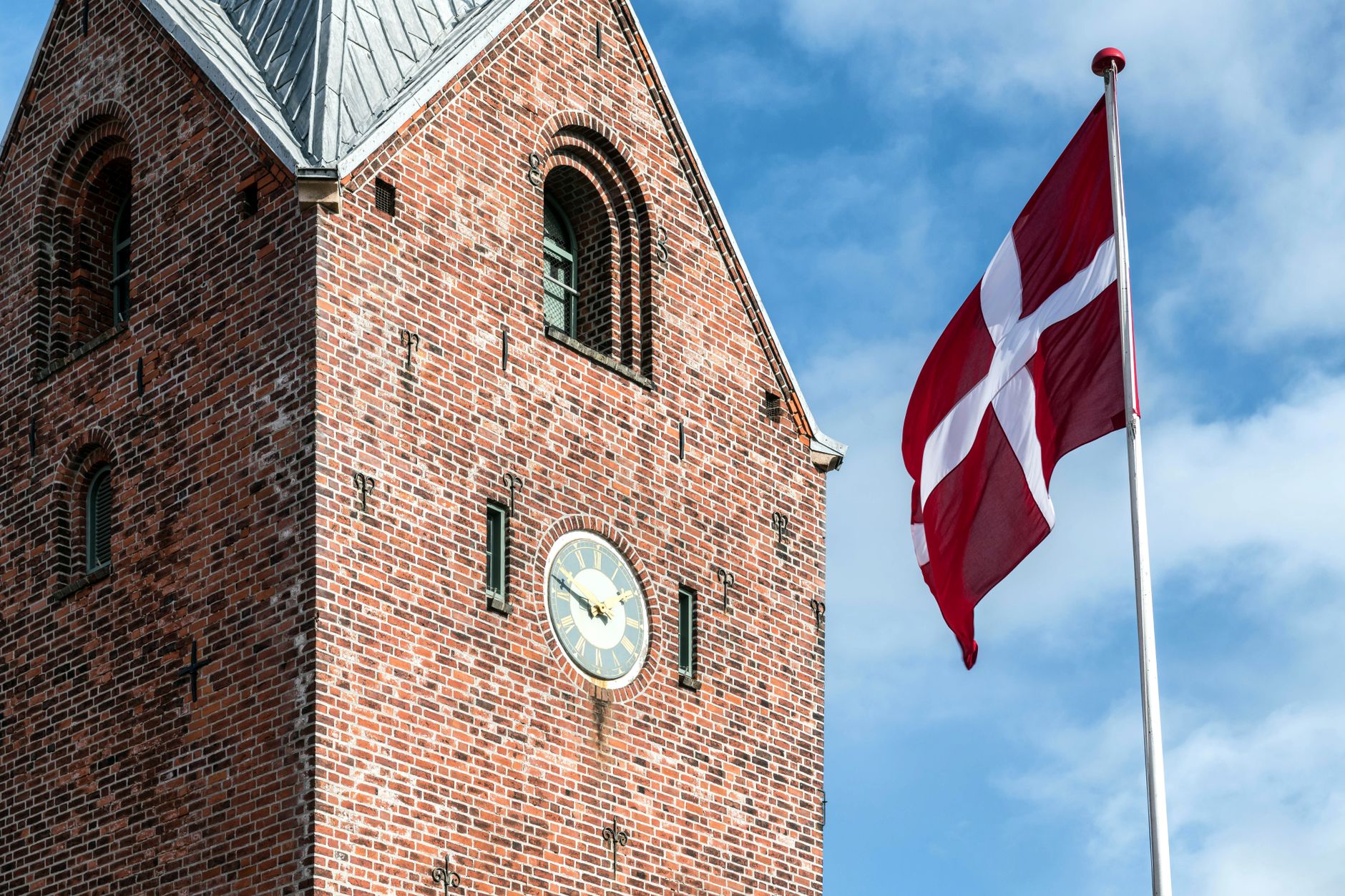
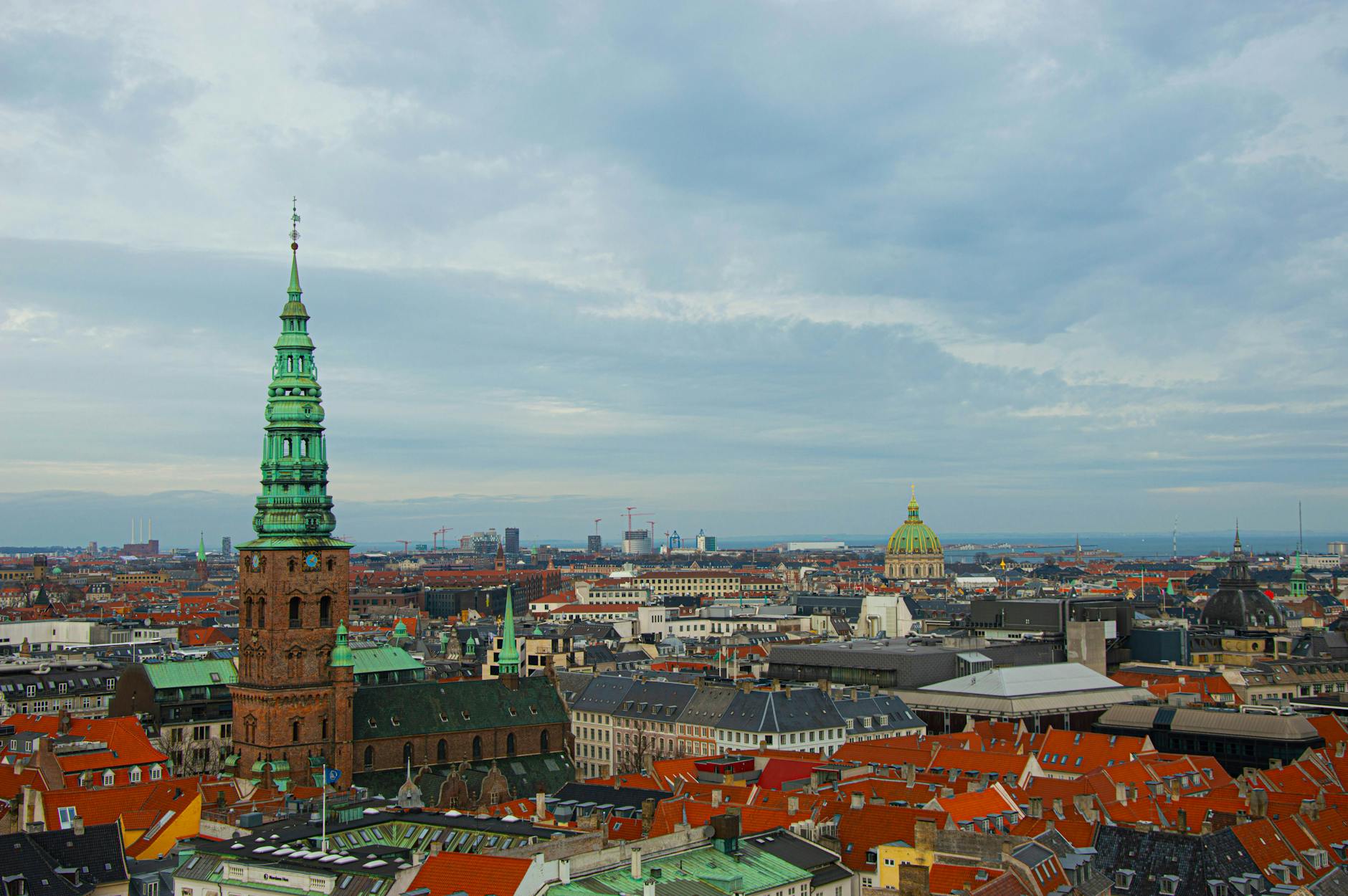
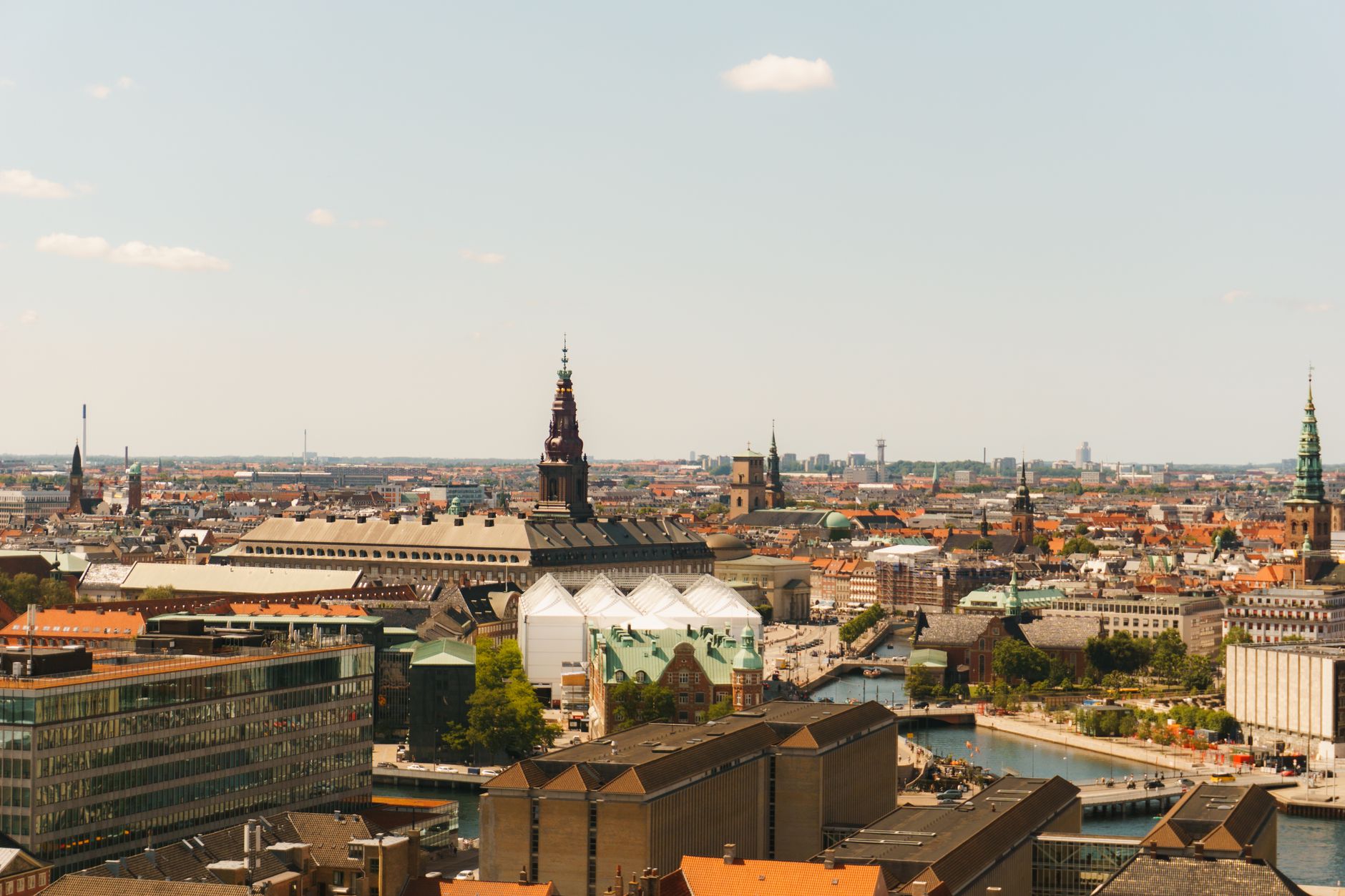

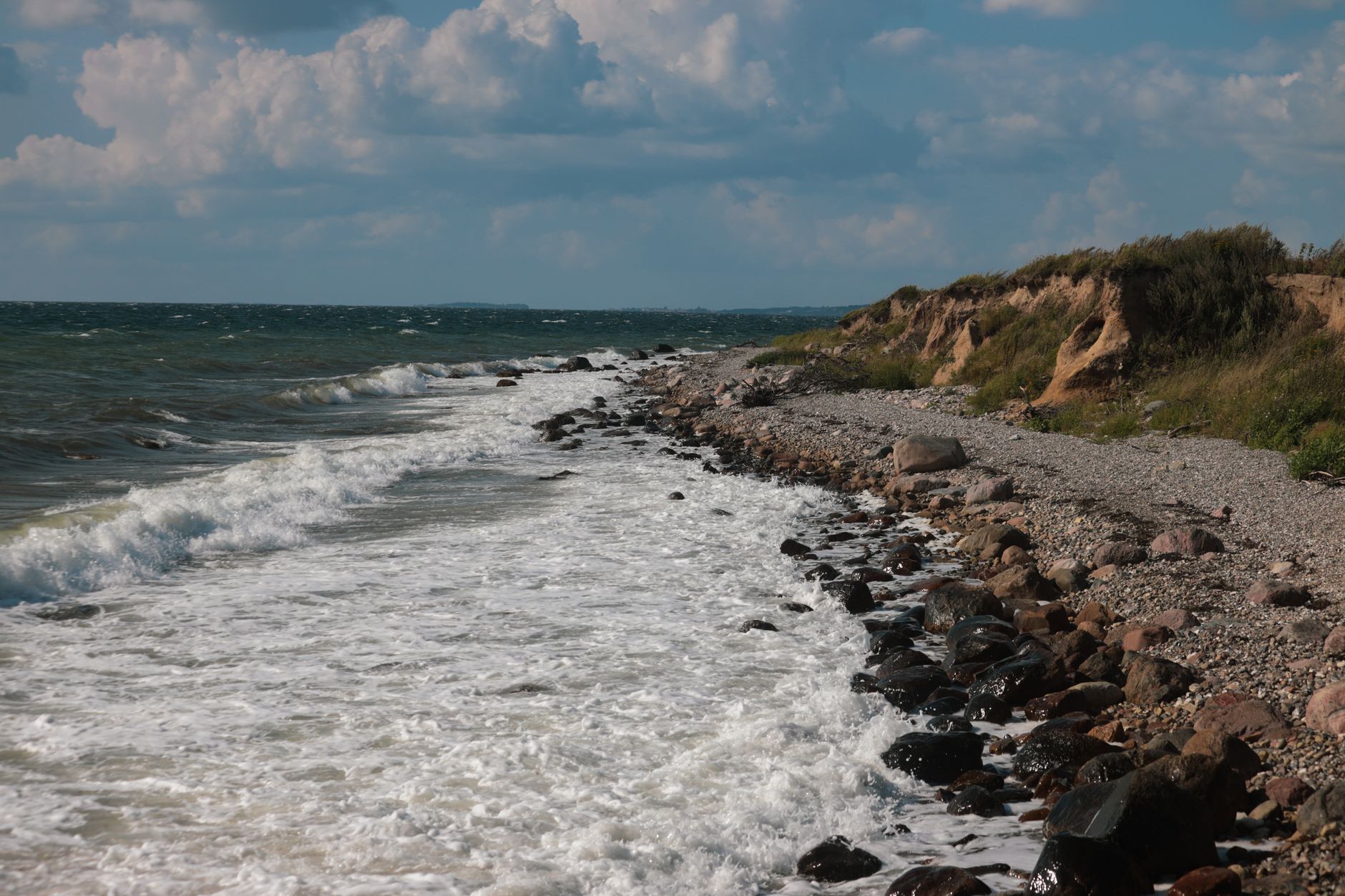




Denmark is in Schengen, so most visitors from the US, Canada, the UK, Australia, and the EU can enter visa-free for up to 90 days within any 180-day period. The Entry/Exit System became mandatory across Schengen on 10 April 2026, which means your first border crossing may take longer because fingerprints and a photo are now recorded digitally.
Denmark uses the Danish krone, not the euro, and paying in DKK usually saves money. Cards are accepted almost everywhere, cash is rarely needed, and tipping is minimal: round up or leave about 10% only when service is genuinely good.
Copenhagen Airport is the main international gateway, with the metro reaching central Copenhagen in about 14 minutes. Billund works well for western Denmark, while trains from Hamburg and Stockholm make sense if you are already moving through northern Europe.
DSB trains make the country easy to cross: Copenhagen to Odense takes about 1 hour 30 minutes, Aarhus about 3 hours, and Aalborg about 4 hours. Rejseplanen is the app to download first, because it pulls together trains, buses, metro, and local connections in one place.
Denmark has a temperate maritime climate: summer is mild rather than hot, winter is damp rather than dramatic, and the wind is a constant character. May, June, and September usually give the best balance of long light, manageable prices, and fewer queues than July.
Mobile coverage is strong, public wifi is common in stations, hotels, and cafes, and intercity trains usually have onboard wifi. Denmark is one of those countries where planning on the move is easy, so an eSIM or EU roaming package is usually enough.
Denmark is one of the safer countries in Europe, with low violent crime and few practical worries beyond normal city pickpocketing. Keep an eye on your bag around Copenhagen Central Station and Strøget, carry travel insurance, and drink the tap water without hesitation.
Always choose DKK when a card terminal offers a currency choice. Dynamic currency conversion is usually the more expensive option, and Denmark gives you plenty of chances to overpay without volunteering for more.
Advance DSB fares are often much cheaper than same-day tickets, especially on longer routes such as Copenhagen to Aarhus or Aalborg. If your dates are fixed, buy early and use Rejseplanen to check platform changes on the day.
July prices rise fast in Copenhagen, Bornholm, and Skagen, and smaller Danish towns can sell out sooner than you expect because room supply is limited. Book early if you are traveling around school holidays or major festival weekends.
A proper lunch, especially smørrebrød, often gives you better value than dinner in Denmark. Many kitchens run cheaper midday menus, and this is one country where the classic lunch table is part of the experience rather than a compromise.
In Copenhagen and Aarhus, bike lanes are traffic, not decoration. Do not drift into them while checking your phone or pulling a suitcase unless you enjoy being corrected at speed.
You can manage most of a Denmark trip from your phone, from train tickets to museum bookings to bike rentals. An eSIM or EU roaming plan is usually simpler than hunting for physical SIM cards after arrival.
Service is built into the price, so big American-style tips look odd rather than generous. Round up, or leave a little extra only when the service clearly earned it.
Explore Denmark with a personal guide in your pocket
Listen to sourced travel stories with local history and practical context — ready offline.
Usually no. Cards are accepted almost everywhere, from trains to bakeries, and many travelers get through an entire trip without touching cash. Keep a small amount of DKK only if you are heading to remote areas, small kiosks, or local markets.
No, unless you only have a weekend. Copenhagen is the obvious start, but adding Roskilde or Helsingør gives you the Viking and maritime story that the capital alone cannot fully tell.
May, June, and September usually give the best balance. You get long daylight and workable weather, but with fewer crowds and lower hotel prices than the July peak.
Expensive by European standards, though not impossible if you plan well. Budget travelers can get by on roughly 500 to 850 DKK a day, while mid-range trips often land between 1,200 and 2,000 DKK once hotels, meals, and museums are counted.
Yes for the main routes, no for some of the best detours. Copenhagen, Odense, Aarhus, Aalborg, Roskilde, and Helsingør are easy by train, but places such as Bornholm's smaller villages or parts of west Jutland are easier with a car.
Yes, Denmark is one of the easier countries in Europe for solo travel. The main nuisance is petty theft in busy urban spots, especially around stations and shopping streets, not the kind of risk that changes your route.
Seven to ten days is a strong first trip. That gives you time for Copenhagen plus one island route or one Jutland route, instead of racing across bridges just to say you covered the map.
Sometimes, but not automatically. Point-to-point tickets bought early can be cheaper than a pass, so the pass makes more sense if you want flexibility or plan to string together several long intercity rides.
Last reviewed