Introduction
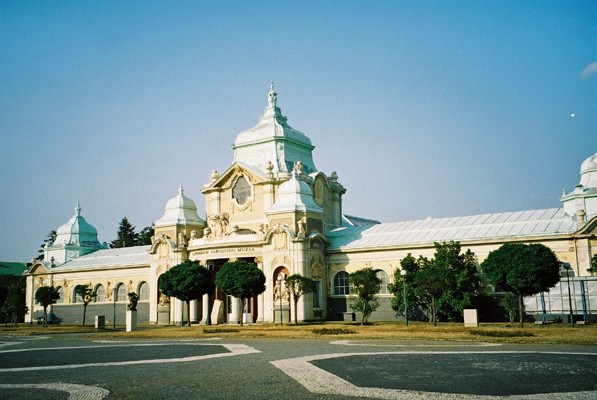
Nestled within Prague’s New Town (Nové Město), Kounic Palace (Kounický palác) is one of the city’s most striking examples of late Baroque architecture, blending Renaissance influences and noble grandeur. While its current role as the Embassy of Serbia restricts regular public access, the palace’s rich history, decorative façade, and central location continue to draw visitors eager to experience Prague’s aristocratic past. This guide provides a detailed overview of Kounic Palace’s history, architecture, visitor information, accessibility, and nearby attractions, helping you plan a memorable exploration of one of Prague’s architectural jewels (prague.eu, tours-prague.eu, czechjournal.cz).
Origins and Construction
Kounic Palace’s origins date to the mid-18th century, when Count Jan Adolf Kounic acquired and combined several adjacent properties. Under architect Anton Schmidt’s direction (circa 1775), the palace was transformed into a late Baroque masterpiece. The Kounic family, prominent within the Habsburg Empire, commissioned the palace as a symbol of their wealth and influence, mirroring a trend among Bohemian nobility to establish grand city residences in the flourishing New Town (tours-prague.eu).
Architectural Features and Evolution
The palace’s exterior is defined by ornate stucco work, balanced Baroque symmetry, and Renaissance sgraffito—a decorative plaster technique revealing intricate geometric and floral motifs. Heraldic elements and allegorical scenes on the façade reflect the family’s lineage and social stature. Inside, original period frescoes, stucco ceilings, and a private chapel—though generally closed to visitors—underscore the aristocratic lifestyle of its original owners (czechjournal.cz).
Subsequent renovations, including a significant update in 1931, preserved the palace’s historical character while adapting it for modern functions. The structure incorporates older medieval buildings, showcasing Prague’s tradition of architectural layering.
Historical Significance in New Town
Situated in New Town, which was founded by Charles IV in 1348 as a visionary urban expansion, Kounic Palace stands alongside other grand residences and civic buildings. The area quickly became a hub for commerce, culture, and politics—an identity Kounic Palace helped reinforce through its architectural grandeur and role as a venue for social and diplomatic gatherings (prague-guide.co.uk).
Role During the Habsburg Era and Modern Times
Throughout the Habsburg period, the palace hosted aristocratic families, imperial dignitaries, and important cultural events. In the 20th century, it adapted to changing times, serving public functions and, since the early 1900s, housing the Embassy of Serbia (embassyofserbia.cz). The palace is now a protected cultural monument, reflecting both national heritage and evolving diplomatic roles.
Renaissance and Baroque Features
Façade and Sgraffito
The palace’s façade is a showcase of Baroque opulence and Renaissance artistry, featuring ornamental stucco, pilasters, and sgraffito patterns. The sgraffito technique, widely used in Bohemia’s Renaissance period, lends the exterior a unique texture and historical resonance. Heraldic motifs and allegorical images further emphasize the noble status of the Kounic family.
Interiors and Artistic Details
While regular interior access is not available, historical records describe grand halls adorned with frescoes and stucco, a chapel with religious sculptures, and elegant salons designed for entertaining Prague’s elite. The palace’s careful use of natural light and decorative detail reflects the architectural ambitions of its time.
Urban Context
Kounic Palace is part of New Town’s architectural mosaic, surrounded by Gothic, Baroque, and Art Nouveau landmarks. Its location near Wenceslas Square and the National Museum places it at the heart of one of Prague’s most vibrant cultural districts.
Cultural Role and Preservation
Kounic Palace has long been a symbol of noble patronage and cultural exchange, hosting social events, exhibitions, and diplomatic functions. As a protected monument, it stands as an example of successful heritage preservation, adapting historic spaces for contemporary use while maintaining their architectural integrity (czechjournal.cz).
Visiting Information
Opening Hours and Tickets
Regular Access:
Kounic Palace is generally closed to the public due to its role as the Embassy of Serbia. There are no regular visiting hours or standard ticket sales for interior tours (embassyofserbia.cz).
Special Events:
Limited public access is occasionally offered during cultural events, such as Prague’s Open House festival or embassy-hosted exhibitions. Participation may require advance registration or tickets. Follow local event calendars and official embassy announcements for these rare opportunities.
Exterior Viewing:
Visitors may freely admire and photograph the palace’s façade from Panská Street at any time.
Facilities and Practical Tips
- Getting There: The palace is centrally located in New Town, within walking distance of Wenceslas Square and accessible via metro lines A, B, and C (stations: Můstek, Muzeum). Tram stops Jindřišská and Václavské náměstí are nearby. Public transport is recommended due to limited parking (dp-praha.cz, mapy.cz).
- Accessibility: The streets surrounding the palace are generally accessible, though the palace itself has limited wheelchair access. For event-specific accessibility, contact organizers or refer to pov.cz.
- Photography: Exterior photography is welcomed. During special events, interior photography may be allowed with restrictions—follow posted guidelines and staff instructions.
- Etiquette: As an active embassy, respect security measures and avoid blocking entrances or photographing security personnel.
Nearby Attractions and Suggested Itineraries
Kounic Palace’s location in New Town makes it ideal for pairing with other top Prague historical sites:
- Wenceslas Square: The bustling commercial and cultural heart of Prague (ricksteves.com).
- National Museum: A Neo-Renaissance landmark with extensive collections.
- Mucha Museum: Dedicated to Art Nouveau master Alphonse Mucha (mapcarta.com).
- Municipal House: An Art Nouveau concert venue and café.
- Franciscan Garden: A tranquil retreat near the palace.
- Charles Square: One of Europe’s largest historic squares (delveintoeurope.com).
Combine your visit with a walking tour of New Town to fully appreciate Prague’s architectural layers and vibrant atmosphere.
Frequently Asked Questions (FAQ)
Q: Can I visit the interior of Kounic Palace?
A: Regular interior access is not available due to its embassy function. Limited access may be offered during special events or festivals.
Q: Are there entrance fees or tickets?
A: No regular tickets are sold. Event access may require registration or a ticket.
Q: What are the opening hours?
A: There are no standard visiting hours. The exterior can be viewed at any time.
Q: Is Kounic Palace wheelchair accessible?
A: The surrounding area is accessible; interior accessibility depends on event-specific arrangements.
Q: Are guided tours available?
A: No regular guided tours are offered inside, but walking tours of New Town often include Kounic Palace as a highlight.
Q: Can I take photos?
A: Exterior photography is permitted. Interior photography may be allowed during special events with permission.
Listen to the full story in the app
Your Personal Curator, in Your Pocket.
Audio guides for 1,100+ cities across 96 countries. History, stories, and local insight — offline ready.
Audiala App
Available on iOS & Android
Join 50k+ Curators
Sources
- verified
- verified
- verified
- verified
- verified
- verified
- verified
- verified
Last reviewed: