Introduction
The most celebrated photographer in Czech history had only one arm, and the tiny Baroque house where Prague now honors his work sits on a street named after a poet who won the Nobel Prize — two men who understood loss as a creative force. The Josef Sudek Gallery, tucked into Úvoz 24 in Prague's Hradčany quarter, occupies barely more floor space than a generous living room, yet it holds rotating exhibitions drawn from the archive of a man who spent decades photographing a single studio window. Come here not for spectacle but for intimacy — the kind of looking that changes how you see light for the rest of the day.
The gallery sits in the house known as "U Luny" (At the Moon), a late-Baroque building wedged into the steep descent of Úvoz street between Prague Castle and the Strahov Monastery. The street itself drops sharply enough that your calves will remind you of it later. Two small rooms on the ground floor serve as exhibition space, managed by the Prague branch of the National Gallery, which has used the house since 2000 to mount temporary shows of Sudek's prints alongside work by other Czech and international photographers.
What makes this place worth the climb isn't scale — it's atmosphere. The rooms are dim by design, the prints lit with the kind of care usually reserved for Old Masters. Sudek's photographs reward slowness: condensation on glass, the grain of aging paper, gardens dissolving into fog. The building's thick walls and low ceilings create the feeling of stepping into one of his pictures.
Expect to spend twenty to forty minutes here, which is exactly the right amount. The gallery rotates exhibitions several times a year, so repeat visits yield different work. And because the house sits on one of Prague's quieter streets — tourists tend to barrel past on their way to the castle — you may find yourself alone with the photographs. That solitude is part of the point.
What to See
The Atelier Itself — Sudek's Studio on Újezd
The gallery occupies a single ground-floor room at Újezd 30, barely larger than a generous living room — roughly 50 square meters, about the footprint of a shipping container and a half. That compression is the point. Josef Sudek spent decades photographing from cramped, intimate spaces, and this former studio preserves the scale at which he thought. Light enters through a tall window facing the courtyard garden, the same window that appeared in Sudek's own photographs of condensation trails and frost patterns during the 1940s and 1950s. The exhibitions rotate every few months, always featuring Sudek's silver gelatin prints, and the low ceilings and quiet mean you can stand close enough to see individual grain in the emulsion. No crowds. No audio guides. Just photographs hung at eye level in a room that still smells faintly of old wood and plaster, where the silence has a physical weight that forces you to slow down and actually look.
The Baroque House "U Luny" and Its Brokoff Stucco
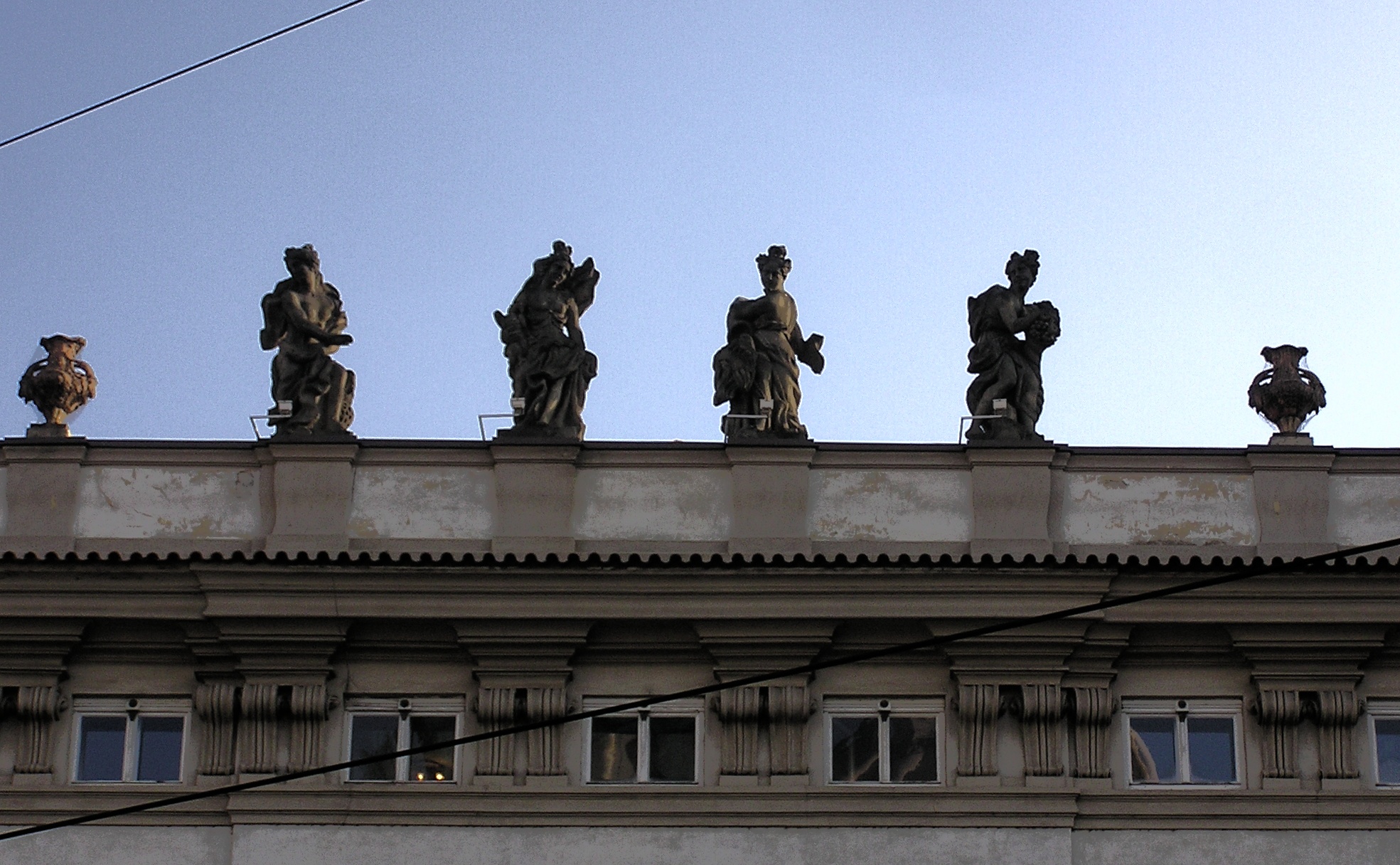
Before you step inside, look up. The building itself dates to the early 18th century and carries the house sign "U Luny" — At the Moon — a name older than the Czech Republic, older than Czechoslovakia, older than the Austro-Hungarian Compromise of 1867. The façade bears stucco reliefs attributed to the workshop of Ferdinand Maxmilián Brokoff, the same sculptor responsible for several of the saints lining the Charles Bridge about 600 meters downhill. His workshop produced the muscular, emotionally charged Baroque figures that define Prague's skyline, and here on Újezd the decorative work is quieter but unmistakable: scrollwork and allegorical motifs pressed into plaster that has survived three centuries of Vltava damp. Legend holds the house is haunted by a white lady — locals will tell you she appears in the courtyard garden on winter evenings. Whether or not you believe that, the garden itself is real, accessible, and startlingly peaceful given that Malá Strana's tourist arteries run just one block east.
A Walk in Sudek's Footsteps: Újezd to Úvoz
Leave the gallery and turn right, heading uphill along Újezd toward Pohořelec. Within five minutes the street becomes Úvoz, a narrow lane that climbs steeply between garden walls toward the Strahov Monastery. Sudek walked this route constantly — his second, larger studio stood on Úvoz from 1959 until his death in 1976, and the street's particular quality of light, filtered through linden branches and bouncing off ochre plaster, shows up again and again in his panoramic prints. The climb is about 400 meters, roughly the length of four football pitches laid end to end, and steep enough to make you breathe harder. But halfway up, a gap in the buildings opens a view of Prague Castle's northern ramparts from an angle that most visitors never find. Finish at the Strahov Monastery library or double back to Neruda Street. Either way, you'll have traced the daily geography of a man who spent fifty years proving that Prague's beauty lives not in its monuments but in its ordinary, rain-streaked surfaces.
Photo Gallery
Explore Josef Sudek Gallery in Pictures

The Josef Sudek Gallery in Prague features a serene, vaulted interior space dedicated to showcasing fine art photography.
svajcr · cc by-sa 3.0

The Josef Sudek Gallery is a charming historic building in Prague, Czech Republic, known for its distinctive pink and yellow Baroque-style facade.
Kirgyt12 · cc by-sa 3.0

The Josef Sudek Gallery in Prague offers an intimate look at photography within a historic space characterized by its unique vaulted architecture.
svajcr · cc by-sa 3.0

A bright, sunny day on the historic streets of Prague, showcasing the entrance to the Josef Sudek Gallery.
Tomáš Fassati · cc by-sa 4.0

The intimate Josef Sudek Gallery in Prague showcases photography within a beautifully preserved space featuring traditional vaulted ceilings.
svajcr · cc by-sa 3.0

A collection of iconic black and white photographs by Josef Sudek displayed within the intimate setting of his gallery in Prague, Czech Republic.
svajcr · public domain

The Josef Sudek Gallery in Prague showcases intimate black-and-white photography within a historic space featuring beautiful vaulted ceilings.
svajcr · cc by-sa 3.0

A minimalist display of black and white photography showcased on the walls of the Josef Sudek Gallery in Prague, Czech Republic.
svajcr · public domain

The Josef Sudek Gallery in Prague showcases a serene interior with historic vaulted ceilings and a curated collection of fine art photography.
Kirgyt12 · cc by-sa 3.0
Inside the Ateliér garden studio, look for the gnarled twisted tree visible through the studio window — it appears in Sudek's most iconic photographs, and standing at the glass you can frame exactly the view he captured across decades.
Visitor Logistics
Getting There
Take tram 22 to Pohořelec (top of the hill), then walk downhill along Úvoz for about 4 minutes — the gallery is at number 24, in the baroque house called "U Luny." Coming from below, ride any tram to Malostranské náměstí and climb Úvoz uphill for roughly 10 steep minutes on cobblestones. No dedicated parking exists; the nearest paid spots are near Pohořelec, but driving into Hradčany is more trouble than it's worth.
Opening Hours
As of 2026, the gallery opens only three days a week: Wednesday, Saturday, and Sunday. Hours shift by season — 12:00–18:00 from April through September, 11:00–17:00 from October through March. Closed Monday, Tuesday, Thursday, and Friday year-round, plus major Czech holidays.
Time Needed
The gallery occupies a single floor of a small baroque house — two or three rooms at most. A focused visit takes 20–30 minutes. If the current exhibition resonates, allow 45 minutes to sit with the photographs in near-silence, which is half the point.
Accessibility
Two steps at the street entrance make wheelchair access impossible without assistance, and the gallery has no elevator or ramp. The approach along Úvoz involves steep cobblestone terrain in either direction — challenging for mobility aids and strollers alike. Contact UPM in advance if you need accommodations.
Cost & Tickets
Entry is 40 CZK full price, 20 CZK reduced (students, seniors) — roughly the price of a tram ticket. No advance booking needed; you pay at the door. The gallery is a branch of UPM (Museum of Decorative Arts), so ask about combined tickets if you're visiting their main building on 17. listopadu street.
Tips for Visitors
Two Sudeks, Don't Confuse
Prague has two separate Josef Sudek venues that even locals mix up. This gallery on Úvoz 24 (Hradčany) was his last apartment; his reconstructed garden studio is at Újezd 30 in Malá Strana, run by a different organization entirely. Visit both — they're a 15-minute walk apart.
Eat on the Same Street
ŪVOZ Restaurant at Úvoz 169/6 serves a two-course modern Czech menu for 850 CZK, Tuesday through Saturday evenings only. For something cheaper, walk downhill to Malostranská Beseda on Malostranské náměstí — tank-poured Pilsner Urquell and proper svíčková in a building that doubles as a live music venue.
Wednesday Is Your Best Bet
With only three open days per week, weekends draw the few visitors who come. Wednesday is the emptiest — you may have the rooms entirely to yourself, which matters in a space smaller than most apartments.
Skip Trdelník, Find Koláče
The cinnamon-sugar chimney cakes sold near Prague Castle are a tourist invention with no Czech heritage. Walk past them. Instead, seek out koláče — the real Czech pastry, filled with poppy seed, plum jam, or tvaroh (fresh cheese) — at any bakery away from the castle tourist corridor.
Combine with Strahov
Strahov Monastery is a 6-minute walk uphill from the gallery, and its on-site brewery pours Sv. Norbert beer with panoramic views across the city. The monastery's baroque library halls alone justify the detour — and the route back down Úvoz past the gallery catches golden afternoon light that Sudek himself photographed.
Photography Inside
Gallery policy on photography varies by exhibition — some shows permit non-flash shots, others prohibit cameras entirely due to loan agreements. Check with staff at the entrance before pulling out your phone. The exterior of the "House at the Moon" is worth a photo regardless.
Where to Eat
Don't Leave Without Trying
Hospůdka U TŘÍ SEKYREK
local favoriteOrder: Order a cold Pilsner and whatever goulash or roasted pork special they're running—this is where locals actually eat, not tourists. The beer is properly poured and the food is honest.
A genuine neighborhood hospoda (pub) with nearly 1,000 reviews and a 4.9 rating—that's not luck, that's consistency. This is where Prague residents go when they want real Czech food and beer without pretense.
ŪVOZ Restaurant
fine diningOrder: Check their seasonal tasting menu—this is a serious kitchen doing thoughtful, ingredient-driven Czech cuisine. The wine pairings are worth considering.
A refined take on Czech food in an intimate setting, with a 4.9 rating from 275 discerning diners. This is where you go when you want to understand contemporary Prague cuisine, not just tourist versions of it.
La Grotta Wine Bar
local favoriteOrder: Wine by the glass paired with their small plates—this is the spot for a sophisticated aperitif or post-gallery wind-down without the formality of a full dinner.
A proper wine bar in a neighborhood that doesn't have many, with 4.9 stars from a curated crowd who know what they're doing. Perfect for a glass and conversation.
Caravana cafebar
cafeOrder: Coffee and whatever pastry or light lunch special they have—this is your best pre- or post-gallery stop, just steps away from the Sudek Atelier.
Perfect 5.0 rating on a small but devoted following. A proper neighborhood café on the same street as the gallery, ideal for a quick coffee and bite without leaving the area.
Dining Tips
- check Lunch (11:30 AM–2:00 PM) is when locals eat and prices are lowest; dinner service starts around 5:00–6:00 PM
- check Many traditional Czech pubs close on Mondays—plan accordingly
- check Tipping: round up the bill or leave 10% for good service; it's customary but not obligatory
- check Czech beer (pivo) is a way of life—order by the half-liter (půllitr) or full liter for the best value and experience
- check Reservations are strongly recommended at fine-dining spots, especially on weekends
Restaurant data powered by Google
Historical Context
The Poet of Prague's Light
Josef Sudek was born on March 17, 1896, in Kolín, a town about 60 kilometers east of Prague — roughly the distance a person could walk in a long day. He would become the most important Czech photographer of the twentieth century, a figure whose influence on art photography in Central Europe is difficult to overstate. But the path from Kolín to that status ran through a World War, an amputation, four decades of near-obsessive solitude, and a refusal to leave Prague even when the city changed regimes around him.
The gallery that bears his name opened in 2000, more than two decades after his death in 1976. The house "U Luny" was chosen not because Sudek lived or worked there, but because its intimate scale and Hradčany location felt consonant with his art — small rooms for a man who found infinity in a windowpane. The National Gallery manages the space as a satellite venue, and the building itself is a protected cultural monument on the Czech heritage registry.
The Arm, the Window, and Four Decades of Looking
In 1917, during World War I, a twenty-one-year-old Josef Sudek was serving on the Italian front when shrapnel tore into his right arm. Military surgeons amputated it. For a young man who had already been apprenticed as a bookbinder — a trade requiring two hands — this was not just a wound but an erasure of his planned future. He spent three years recovering in a veterans' hospital in Prague, and during that convalescence he picked up a camera. The loss of one craft led to the discovery of another.
By the mid-1920s, Sudek had broken with the Czech Photographic Society over its conservatism and co-founded the Czech Photographic Society (Česká fotografická společnost), pushing for photography to be recognized as fine art rather than mere documentation. He began working with a panoramic camera — an unwieldy device that most photographers would struggle to operate with two hands. Sudek managed it with one, producing sweeping views of Prague that revealed the city as a place of mist, shadow, and half-light.
The turning point that defined his mature work came in the 1940s and 1950s, when Sudek retreated into his cluttered studio on Újezd street and began photographing the view through its single window. Condensation, frost, rain — the glass became a filter that transformed the ordinary garden outside into something approaching abstraction. These "Window" series images, made over years with obsessive patience, are now considered among the finest art photographs produced in the twentieth century. Sudek rarely left Prague after that. He died on September 15, 1976, at the age of eighty, having spent nearly sixty years photographing a single city.
Early Life and the Kolín Apprentice
Sudek grew up in modest circumstances — his father died when Josef was young, and the family's resources were limited. He trained as a bookbinder, a skilled trade that demanded precision and manual dexterity. His earliest known photographs date to around 1913, when he was seventeen, but photography was a hobby, not a vocation. The war changed that calculus permanently. During his long hospital recovery between 1917 and 1920, he studied at the School of Graphic Arts in Prague, and by 1924 he had committed fully to the camera. A scholarship allowed him to travel to Italy in 1926, where he photographed veterans' pilgrimages — a subject that carried obvious personal weight for a man who had left part of himself on the Italian front a decade earlier.
Legacy in Two Small Rooms
Sudek's archive is enormous — an estimated 54,000 negatives and prints, now held primarily by the Museum of Decorative Arts in Prague and the Moravian Gallery in Brno. The Josef Sudek Gallery on Úvoz street draws from this collection for its rotating exhibitions, but it also shows contemporary photographers whose work resonates with Sudek's preoccupations: stillness, texture, the behavior of light in enclosed spaces. The gallery's influence is quiet rather than loud, much like Sudek himself, who famously avoided public life, never married, and preferred the company of classical music recordings to most human beings. His nickname among Prague's artistic circles was "the poet of Prague," a title he shared in spirit with his Úvoz street neighbor in name — the Nobel laureate poet Jaroslav Seifert, for whom the adjacent street is named.
Listen to the full story in the app
Your Personal Curator, in Your Pocket.
Audio guides for 1,100+ cities across 96 countries. History, stories, and local insight — offline ready.
Audiala App
Available on iOS & Android
Join 50k+ Curators
Frequently Asked
Is the Josef Sudek Gallery in Prague worth visiting? add
Yes, but only if you care about photography or atmosphere more than spectacle — this is one of the smallest and quietest galleries in Prague, and that's precisely the point. The gallery at Úvoz 24 occupies Sudek's last apartment in a Baroque house called "U Luny" (House at the Moon), with stucco reliefs attributed to the Brokoff workshop. You'll share the rooms with maybe three other visitors, and the light through the windows feels like a Sudek photograph itself.
How long do you need at the Josef Sudek Gallery Prague? add
About 30 to 45 minutes for the Úvoz gallery alone, or a full morning if you combine it with Sudek's reconstructed studio at Újezd 30 across the river. The gallery spaces are small — roughly the footprint of a generous apartment — so the time you spend depends on how long you linger with individual prints. If summer Music Tuesdays are running at the Ateliér, budget an extra hour for that.
How do I get to the Josef Sudek Gallery from Prague city centre? add
Take tram 22 to the Pohořelec stop at the top of the hill, then walk downhill along Úvoz for about five minutes — the gallery is at number 24. The alternative is tram 12 or 22 to Malostranské náměstí, then a steep ten-minute climb uphill through cobblestoned lanes. Be aware the gallery is not wheelchair accessible: two steps from the street block entry.
What is the best time to visit the Josef Sudek Gallery? add
Wednesday or Saturday morning right at opening gives you the emptiest rooms — Sunday draws slightly more visitors. The gallery keeps limited hours: Wednesday, Saturday, and Sunday only, 12:00–18:00 from April through September and 11:00–17:00 from October through March. Afternoon light fills the upper rooms beautifully, which feels appropriate given Sudek's obsession with how light enters windows.
Can you visit the Josef Sudek Gallery for free? add
Not quite free, but close enough that price shouldn't factor into your decision. Admission to the Úvoz gallery is 40 CZK full price (about €1.60) and 20 CZK reduced. Sudek's reconstructed Ateliér at Újezd 30 costs just 10 CZK — less than a cup of coffee anywhere in Prague — and art students enter free.
What should I not miss at the Josef Sudek Gallery Prague? add
Don't leave without looking at the Baroque stucco reliefs on the building's facade — they're attributed to the Brokoff workshop, the same sculptors who carved the saints on Charles Bridge. Inside, pay attention to how the exhibition rooms preserve the proportions of Sudek's actual living quarters. And if you have time, walk twenty minutes downhill to his reconstructed garden studio at Újezd 30, where the twisted tree from his famous photographs still stands in the courtyard.
What is the difference between Josef Sudek Gallery and Josef Sudek Atelier in Prague? add
They're two separate venues that tourists constantly confuse. The Galerie Josefa Sudka at Úvoz 24 is Sudek's last apartment in the Hradčany district, run by Prague's Museum of Decorative Arts (UPM), open only three days a week. The Ateliér Josefa Sudka at Újezd 30 is a replica of his garden studio in Malá Strana, run by the private PPF Art foundation, open Tuesday through Sunday. Both are worth seeing, but they're a twenty-minute walk apart with a hill between them.
Are there good restaurants near the Josef Sudek Gallery Prague? add
ŪVOZ restaurant sits on the same street at Úvoz 169/6, serving modern Czech dishes like confited duck for around 850 CZK for two courses — open Tuesday through Saturday evenings only. If you walk downhill toward the Ateliér instead, Café Savoy on Vítězná 5 has a Neo-Renaissance ceiling from 1893 and serves proper svíčková; book two days ahead for weekend brunch. For cheap beer, Pod Petřínem on Hellichova 5 pours half-litre Kozel drafts for 27 CZK.
Sources
-
verified
Czech Wikipedia — Galerie Josefa Sudka
History of the gallery, its UPM affiliation, building names (U Luny, U Kamenného sloupu), and opening hours
-
verified
Czech Wikipedia — Dům U Kamenného sloupu
Architectural history of the building at Úvoz 24, Brokoff workshop attribution, heritage status
-
verified
Ateliér Josefa Sudka — Official Website
Studio history, Music Tuesdays tradition, Richard Gere visit, PPF Art foundation details, exhibition program
-
verified
Artlist.cz — Ateliér Josefa Sudka
Czech contemporary art database entry with exhibition frequency, guided tour details, gallery description
-
verified
GoOut.net — Ateliér Josefa Sudka
Czech event platform listing with courtyard description and practical visitor details
-
verified
Prague.eu — Josef Sudek Gallery
Official Prague tourism portal with opening hours, admission prices, and current exhibition information
-
verified
Spotted by Locals — Galerie Josefa Sudka
Local perspective on the gallery's quiet character and neighborhood context
-
verified
Martin Fryč Blog — Josef Sudek a hudba hraje
First-person account of navigating to the Ateliér, Music Tuesdays revival details
-
verified
ŪVOZ Restaurant
Menu prices, opening hours, and location details for the nearest restaurant to the gallery
-
verified
Live Young Live Well — Café Savoy Review
Café Savoy menu prices, brunch booking advice, and interior description
-
verified
Firmy.cz — Ateliér Josefa Sudka Reviews
Czech visitor reviews describing the studio as an 'unbelievable experience'
-
verified
Wandertooth — Malá Strana Neighborhood Guide
Neighborhood safety, restaurant recommendations, and transport information for the Újezd area
-
verified
Fotografestival.cz — 14th Fotograf Festival
Annual photography festival using the Ateliér as a venue, October programming details
Last reviewed: