Cesky Krumlov
Czech Republic Updated Apr 2026
The Vltava River doesn't just bend around Český Krumlov. It carves a perfect horseshoe into the Bohemian bedrock, leaving the historic core suspended like a dropped pocket watch. Step inside the Czech Republic and the air smells crisp with wet limestone and coal smoke. Not a film set.
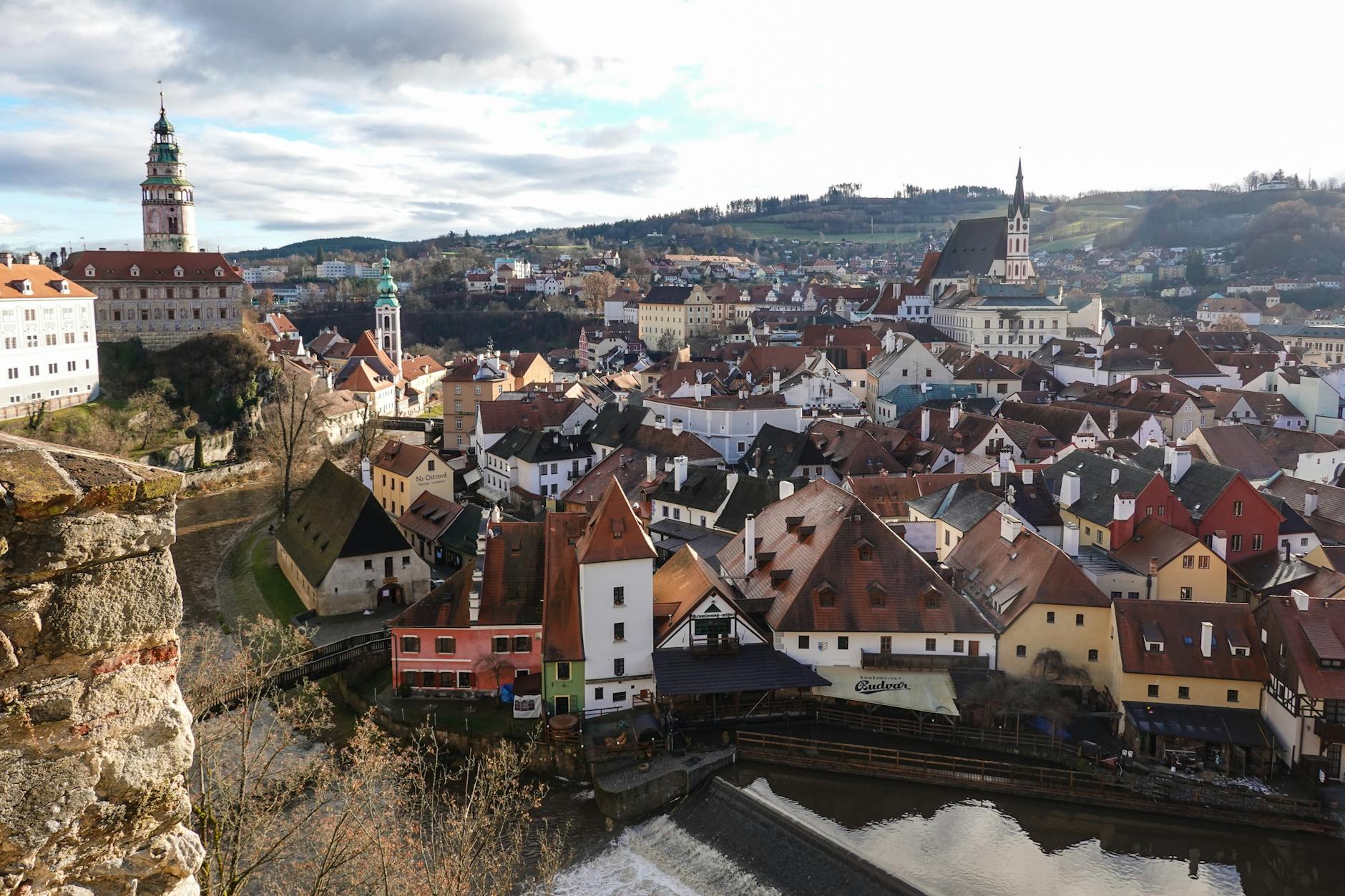 Photo: Magda Ehlers / Pexels
- Attractions
- 12
- Trip length
- 2–3 days
- Best season
- Late Spring & Early Autumn (May–June, Sept–Oct)
Why Cesky Krumlov
Built from cited sources · see the method · How we make our guides →
Preservation here operates with surgical precision. The National Heritage Institute enforces strict lime-plaster mandates on every façade along Horní náměstí, keeping Renaissance sgraffito patterns locked to their 1580 specifications. Modern signage stays strictly banned.
Culture breathes through original timber and stone. The 1766 Baroque Castle Theatre still runs its wooden counterweight rigging for summer operas, though strict audience caps protect the fragile stage floor from modern stress. Walk past the Bear Moat and find the vaulted cellars instead.
A Layered Fortress
The 13th-century castle complex clings to a Vltava river bend, stacking Gothic foundations beneath Baroque theatre wings. You can still watch wooden counterweights lift 18th-century stage flats in the 1766 theatre, one of the few fully operational historical stages left on earth.Schiele’s Shadow
The Egon Schiele Art Centrum occupies a converted brewery on the town’s edge, housing stark charcoal drawings alongside rotating contemporary installations. It bridges Krumlov’s medieval past with the restless modernist vision that chased him through these streets in 1911.The River Meander
The Vltava wraps around the historic center in a tight horseshoe, forcing every viewpoint toward the water. Walk the Latrán embankment at dawn to hear your own footsteps on wet cobblestones before the day-trip buses arrive.The Photographer’s Darkroom
Ateliér Seidel preserves a working 19th-century studio complete with glass plate archives and wet-plate collodion demonstrations. The smell of ether and old varnish lingers long after you leave the dimly lit back rooms.
Neighborhoods
Where to wander, by quarter — each with its own rhythm.
Latrán District
Originally built to house castle servants, this district retains its High Gothic footprint beneath meticulously preserved burgher houses. You will find vaulted cellars sheltering artisan bookbinders. Duck into the side courtyards to spot carved Renaissance ceilings untouched by modern retail.Horní Náměstí (Old Town)
The geometric center anchors a symmetrical square and tightly packed merchant houses. Restorers use traditional lime plasters to lock the exterior sgraffito to its original sixteenth-century specifications. Walk two blocks south to find chalkboard lunch menus that actually feed the locals.Louže Riverside
A quieter stretch along the Vltava bends sharply past the Lazebnický Bridge. The current moves fast, carrying reflections of pastel stucco walls while traditional pubs replace upscale bistros. Order a regional lager. Watch the river drag past.Castle Precincts & Bellaria Gardens
The elevated administrative core dominates the town from a sheer limestone promontory. Visitors navigate stepped courtyards to reach the 1766 Baroque Theatre. Arrive before 09:00 to hear the wooden stage rigging creak before the tour buses depart.Former Mill & Brewery Quarter
Industrial brick warehouses line the southern bank. The Egon Schiele Art Centrum occupies the largest complex, bridging medieval history with contemporary exhibitions. Heavy timber beams and rusted iron fittings remain exposed, leaving the air smelling faintly of old grain and fresh paint.
Plan your trip
Before you go
- Getting There
- Fly into Prague Václav Havel Airport (PRG) or Vienna International Airport (VIE), then book a RegioJet or FlixBus for the 3-hour ride directly to Český Krumlov. Direct regional trains stop in České Budějovice, requiring a 25-minute transfer on IDS JČ bus line 151 or 153. As of 2026, advance fares start around 350 CZK.
- Getting Around
- The historic core is fully pedestrianized, so leave wheeled luggage at your hotel and walk across uneven medieval cobblestones. As of 2026, IDS JČ regional buses run every 30 minutes from peripheral parking zones, while EuroVelo 7 cycling paths hug the riverbank. Avoid driving into the center.
- Climate & Best Time
- Spring and autumn deliver mild days between 14°C and 20°C, keeping foot traffic manageable and café terraces open. July peaks near 25°C with heavy summer crowds, so target late May or early September to secure castle garden access without the midday congestion. Book early.
- Language & Currency
- Czech remains the official tongue, though English and German cover most hotel and restaurant interactions easily. The Czech koruna (CZK) is the only legal tender; contactless cards cover nearly all transactions, but keep 500 CZK in cash for weekend markets. Exchange rates at unofficial kiosks rarely favor travelers.
- Safety
- Violent crime is virtually nonexistent, though pickpockets target the crowded Náměstí Svornosti square during peak season. Wear flat-soled shoes. Sudden rain turns the steep castle stairways and riverbank paths into unexpected slip hazards.
A River Bend That Outlasted Empires
From medieval trading post to preserved Renaissance time capsule
- c. 1240
First Chronicle Names Krumbenowe
Ulrich von Liechtenstein’s tournament epic casually drops the name Krumbenowe into a knightly verse. The settlement clings to a tight S-curve of the Vltava. No one at the court realizes this bend will outlast empires.
- 1274
Vítkovec Lords Charter the Market Town
The merger of Latrán’s service hamlet and a planned eastern commercial quarter births a formal municipality. Mayor Sipota oversees the laying of vaulted cellars and timber-framed merchant stalls. The town’s grid locks into place.
- 1302
Rosenberg Dynasty Claims the South Bohemian Crown
The direct Vítkovec line extinguishes, leaving King Wenceslaus II to hand the sprawling estate to the Rosenberg cousins. They rule for three hundred years, turning the castle into a political command center. South Bohemia’s trade routes funnel directly through these gates.
- 1347
Peter I of Rosenberg Funds a Parish Church
The lord commissions the Church of St. Vitus as a statement of Gothic ambition and civic pride. Scaffolding rises over the riverbank for decades. Masons carve ribbed vaults from local sandstone.
- 1434
Hussite Armies Bypass the Castle Walls
Religious wars tear through Bohemia, but Krumlov survives through careful diplomacy and fortified ridges. The Rosenberg lords negotiate safe passage rather than risk a siege. The untouched streets preserve the original Gothic timberwork.
- 1535
Vilém of Rosenberg Invites Court Artists
The High Burgrave of Bohemia spends a fortune importing Italian masons, Flemish painters, and German musicians. Sgraffito facades spread across the town square like dried parchment, layered with mythological scenes. The castle transforms from a fortress into a Renaissance salon.
Show the full timeline (20 moments)
- 1580
Baltazár Maggi Crowns the Round Tower
The Italian architect caps the medieval core with a soaring Renaissance spire and onion-shaped roof. He calculates the load-bearing capacity to withstand centuries of Alpine winds. The tower’s shadow stretches across the river.
- 1602
Emperor Rudolf II Buys the Entire Estate
The last Rosenberg lord, drowning in debt, sells the domain to the Habsburg crown. German-speaking administrators flood the chancelleries. Krumlov loses its political independence but gains imperial protection.
- 1622
Eggenberg Princes Take the Reins
Ferdinand II rewards the Styrian family with the Krumlov dominion for their loyalty during the Thirty Years' War. They establish a court theatre tradition and commission lavish Baroque interiors. The old Gothic halls gain heavy stucco and gilded mirrors.
- 1719
Schwarzenberg Dynasty Inherits by Marriage
The Eggenberg male line vanishes, transferring the castle to one of Central Europe’s wealthiest noble houses. The Schwarzenbergs shift their primary residence to Hluboká. Neglect becomes the town’s greatest preservation strategy.
- 1805
Adalbert Stifter Born in the District
The future Biedermeier novelist arrives in a nearby village, destined to romanticize the Šumava forests. His early sketches of the Vltava’s fog and cobblestone alleys shape his pastoral realism. The town’s isolation becomes a literary muse.
- 1848
Fire Sweeps Through the Burgher Quarter
Flames consume several wooden merchant houses along the eastern market street. Rebuilding mandates stone and plaster, inadvertently standardizing the historic facades. The town’s medieval silhouette survives the blaze.
- 1880
Railways Bypass the River Bend
Industrial engineers lay tracks through the wider valleys, deliberately avoiding Krumlov’s narrow medieval gorge. The town misses the factory boom and tourist crowds that transform neighboring cities. Its streets remain quiet, paved in worn granite.
- 1910
Egon Schiele Paints the River Meander
The young Austrian Expressionist rents a cramped studio overlooking the water, producing stark, angular canvases. He captures the town’s psychological weight rather than its postcard charm. Local authorities eventually drive him away.
- 1938
Munich Agreement Annexes the Sudetenland
The town’s German-speaking majority falls under Nazi administration, triggering forced Germanization and the deportation of Jewish residents. Swastika banners drape the Renaissance facades. The occupation erases centuries of multicultural coexistence.
- 1945
American Infantry Secures the Valley
The U.S. 5th Infantry Division marches into the town on May 10, meeting minimal resistance and sparing the historic core. Artillery shells miss the castle by mere kilometers. The sudden silence replaces months of radio static.
- 1947
State Confiscates the Schwarzenberg Estate
Post-war decrees strip the noble family of their South Bohemian holdings, transferring the castle to the Czechoslovak government. New tenants occupy the aristocratic apartments, turning palace rooms into communal storage spaces. Decades of state neglect follow.
- 1992
UNESCO Inscribes the Town as World Heritage
International heritage experts recognize the uninterrupted five-century evolution of the medieval street grid. Strict conservation laws ban modern facades and reroute traffic to the periphery. The town becomes a protected time capsule.
- 2002
Vltava River Breaches the Embankments
Catastrophic August floods surge through Latrán, filling ground-floor cellars and warping centuries-old timber beams. Emergency crews pump out millions of liters while conservators scrape mud from Renaissance frescoes. The rebuilt flood defenses blend seamlessly into the historic masonry.
- 2025
Bellaria Pavilion Reopens to the Public
Conservationists finally restore the Rococo summer house, unveiling a hidden dumbwaiter system that once served aristocratic picnics. Visitors trace the original stucco work and artificial grottoes without stepping on fragile terraces. The estate’s final private sanctuary becomes accessible again.
Who lived here
-
Expressionist Painter · 1890–1918
Egon Schiele
Lived here 1910–1911
He traded Vienna’s salons for Krumlov’s narrow alleys, sketching the town’s sharp gables and the Vltava’s cold reflection from a cramped attic studio. He would likely find today’s tourist crowds suffocating, yet still recognize the unbroken silhouette of rooftops that anchored his most angular canvases.
-
Nobleman · 1539–1611
Petr Vok of Rosenberg
Ruled from the castle 1592–1610
He transformed a military fortress into a Renaissance salon, filling the castle library with alchemical manuscripts and funding the town’s first printing presses. Walking the terraced gardens today, he would recognize his own obsession with blending rigid geometry into the wild river valley.
Where to Eat
Where locals actually book dinner — not the tourist menus.
-
Pivovar Eggenberg
Brewing since 1499, this historic operation pours unfiltered South Bohemian lagers straight from traditional brick-lined cellars. Book a guided cellar tour to taste the 12° unfiltered lager while standing beneath centuries-old vaulted arches.
-
Svíčková na smetaně
Marinated beef sirloin swims in a velvety root-vegetable cream sauce, traditionally paired with bread dumplings and a slice of cranberry compote. It’s the regional standard for cold evenings. Order it at any family-run tavern two streets back from the main square.
-
Pstruh na másle
Freshwater trout from upstream Vltava tributaries arrives pan-fried in butter, served alongside boiled potatoes and toasted almond slivers. The preparation stays deliberately simple. Clean river water and high-quality dairy carry the dish.
-
Festival Pětilisté Růže Fare
Held each late June, the Five-Petal Rose festival transforms Latrán Street into an open-air medieval kitchen. Vendors serve spit-roasted meats, honey cakes, and spiced mead poured directly into heavy clay tankards. Reserve seating in advance.
-
Koláče Pastries
While spit-baked trdelník dominates the tourist stalls, seek out traditional koláče from neighborhood bakeries instead. Yeast dough folds around poppy seeds, sweet cheese, or plum jam. It offers a proper Czech breakfast away from the square.
Insider tips
Small things that change how the city treats you.
Pack Light
Medieval cobblestones shatter rolling suitcases, so pack a sturdy backpack to save your luggage and your shoulders.Skip the Train
Český Krumlov lacks a rail connection, so book FlixBus or RegioJet from Prague two weeks early. The direct 3.5-hour route drops you at the station for roughly 350 CZK.Cards Over Cash
Contactless payments work everywhere, from historic pubs to small bakeries. Keep a few koruna for tips, but euros will earn you poor exchange rates.Chase the Lunch Menu
Order a polední menu between 11:30 and 14:00 for half the dinner price. Kitchens serve authentic South Bohemian roasts and dumplings to locals and workers.Book Theatre Early
The 1766 Baroque Castle Theatre limits audiences to protect original 18th-century rigging. Tickets vanish months ahead for the summer season.
Gallery
The city, as it actually looks.


Frequently asked
Is Český Krumlov worth visiting?
Yes, but plan around day-trip crowds. The intact 13th-century layout and UNESCO-preserved architecture create a rare time capsule. Stay overnight to experience the quiet morning mist over the Vltava and secure tables at vaulted cellar pubs.
How many days in Český Krumlov?
Two full days cover the essentials without rushing. Spend the first exploring the castle complex, Latrán district, and Egon Schiele Art Centrum. Use the second for riverside trails, Bellaria Pavilion, or a day trip to Holašovice village.
How do I get to Český Krumlov from Prague Airport?
Take the Airport Express or Bus 119 to Prague’s Florenc terminal, then transfer to a direct FlixBus or RegioJet. The entire journey takes 3.5 hours and costs around 350 CZK when booked early.
Is Český Krumlov safe for tourists?
Violent crime is virtually nonexistent. Watch your wallet in crowded areas around Náměstí Svornosti and avoid unofficial currency exchange kiosks advertising zero commission.
How much does it cost to eat in Český Krumlov?
Expect 450 CZK for dinner on the main square, but drop to 180 CZK in Latrán or local pubs. A daily lunch menu runs 90 to 150 CZK and typically includes soup, a main course, and a drink.
Pick up where you left off
Saved and recently read places — kept on this device only.
Photo credits (6)
- Magda Ehlers — Pexels License (https://www.pexels.com/license/) — Source: https://www.pexels.com/photo/15259724/
- Český Krumlov, historické jádro — Xth-Floor — CC BY-SA 4.0 (https://creativecommons.org/licenses/by-sa/4.0/) — Source: https://commons.wikimedia.org/wiki/File:Český_Krumlov,_historické_jádro.jpg
- Cyklisto sesedni z kola — JAn Dudík — CC BY-SA 4.0 (https://creativecommons.org/licenses/by-sa/4.0/) — Source: https://commons.wikimedia.org/wiki/File:Cyklisto_sesedni_z_kola.jpg
- Sluneční hodiny v Českém Krumlově 02 — Anuraj50 — CC BY-SA 4.0 (https://creativecommons.org/licenses/by-sa/4.0/) — Source: https://commons.wikimedia.org/wiki/File:Sluneční_hodiny_v_Českém_Krumlově_02.jpg
- Sluneční hodiny v Českém Krumlově 01 — Anuraj50 — CC BY-SA 4.0 (https://creativecommons.org/licenses/by-sa/4.0/) — Source: https://commons.wikimedia.org/wiki/File:Sluneční_hodiny_v_Českém_Krumlově_01.jpg
- Paraplíčko Vyšehrad Český Krumlov 2026 — DominikCK1999 — CC BY 4.0 (https://creativecommons.org/licenses/by/4.0/) — Source: https://commons.wikimedia.org/wiki/File:Paraplíčko_Vyšehrad_Český_Krumlov_2026.jpg
Photos may have been resized or cropped.