Introduction
Kamenný Mlýn, meaning "Stone Mill," is a site of remarkable historical and cultural significance on the western edge of Brno, Czech Republic. Originating in the medieval period, it has evolved from a deserted mill into an industrial settlement, and today stands as a preserved archaeological and recreational landmark. Most of the original buildings were lost to urban development in the 20th century, but the Chapel of St. Anthony of Padua remains as a symbol of the area’s enduring heritage.
This guide presents a detailed overview of Kamenný Mlýn’s history, practical visitor information (including hours, tickets, and accessibility), and tips for exploring nearby attractions. It also highlights recent restoration and archaeological efforts, ensuring visitors can fully appreciate both the tangible and intangible heritage of this unique Brno site.
Medieval Origins
Kamenný Mlýn’s earliest recorded mention dates to 1366, when it was described as a "deserted" mill. Its strategic location along the Svratka River, connecting the villages of Žabovřesky and Staré Brno, positioned it as an important site for agriculture and trade (vodnimlyny.cz). In 1468, the Carthusian Monastery in Královo Pole acquired the mill, integrating it into the common monastic landholdings of the time.
18th–19th Century Growth
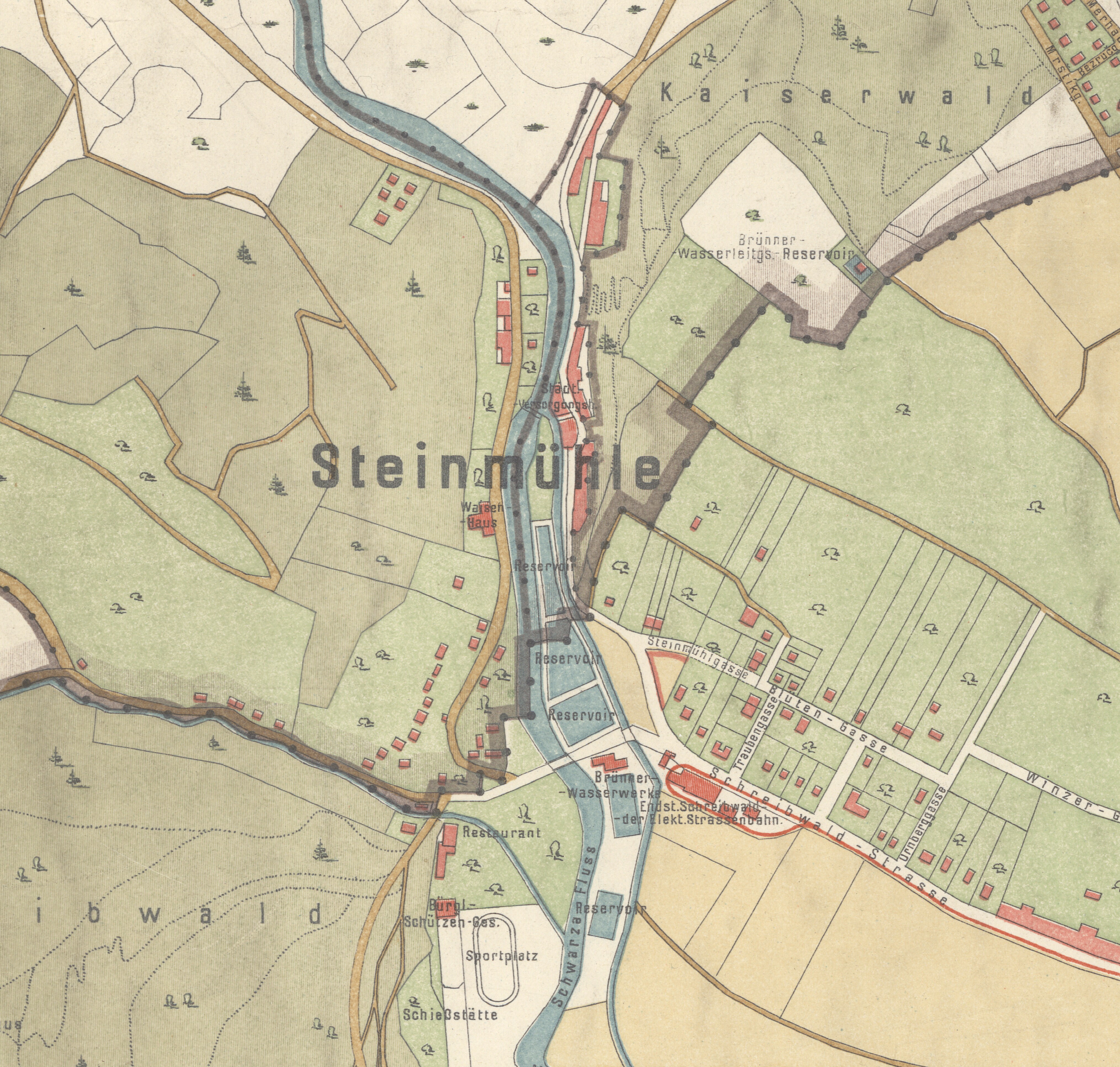
By 1785, the area was sparsely settled, with just two cottages. The 19th century saw significant development: in 1834, nine houses were recorded, and the settlement became a hub for milling, social life, and later, industry. Kamenný Mlýn gained local recognition for its tavern and inn, serving travelers and residents alike.
Industrialization and Urban Changes
Industrialization in the mid-19th century transformed Kamenný Mlýn. In 1851, Arstide Doret attempted to establish a wool finishing plant, and by 1857, A. F. Schwab & Sons opened a textile factory, signifying the area’s shift from rural milling to industrial manufacture. The settlement became part of Brno in 1919, briefly reverted to Žabovřesky in 1927, and was finally absorbed into Brno’s urban fabric (vodnimlyny.cz).
20th Century Transformations
Following World War II, industrial sites were nationalized, and the area included additional facilities, such as a paper mill and vocational school. The 1970s brought major changes: almost all original structures were demolished to make way for a new road connecting Pisárky, Komín, and Bystrc, leaving only the Chapel of St. Anthony of Padua intact (vodnimlyny.cz).
Archaeological Discoveries
Recent urban infrastructure projects have enabled new archaeological research. Excavations by Archaia Brno have revealed original walls, cellars, courtyard paving, and remnants of the 19th-century settlement (Archaia Brno). These findings deepen our understanding of daily life and architectural evolution at Kamenný Mlýn.
Visiting Kamenný Mlýn
Hours & Tickets
- General Access: Kamenný Mlýn is an open public area accessible year-round, 24/7.
- Chapel of St. Anthony of Padua: Open daily, typically from 9:00 AM to 6:00 PM.
- Admission: Free; no ticket required. Special guided tours or events may have a small fee.
Accessibility
- The site is reachable via public transport (trams 1, 2, and 6; Pisárky and Žabovřeská stops).
- Newly constructed walking and cycling paths, footbridges, and staircases provide barrier-free access to most areas, though the chapel itself is reached via a footpath with stairs (brnodaily.com).
- Paths are stroller- and wheelchair-friendly except the final approach to the chapel.
Directions
- By Tram: Take lines 1, 2, or 6 to Pisárky or Žabovřeská. The site is a short walk from each stop.
- By Car: Limited parking is available near Žabovřeská Street. Public transport is recommended due to traffic and parking constraints.
Facilities
- Restrooms: Available at the Pisárky tram terminus.
- Refreshments: Limited on-site; nearby neighborhoods (Jundrov, Pisárky) offer cafés and grocery stores.
- Seating & Picnic Areas: Green spaces and benches along trails.
Guided Tours & Special Events
- Local heritage organizations and TIC Brno offer seasonal guided tours, often linked to broader historical or architectural walks (gotobrno.cz).
- Community and cultural events, including blessings and historical walks, are occasionally held at the chapel.
Nearby Attractions
- Wilson’s Forest (Wilsonův les): Urban woodland with scenic walking trails and picnic spots.
- Brno Reservoir: Popular for swimming, boating, and cycling (tourspilot.com).
- Anthropos Pavilion: Museum of human prehistory, accessible by new cycling paths.
- Vila Stiassni: Functionalist villa renowned for guided tours and exhibitions (tourismato.cz).
Practical Travel Tips
- Best Visiting Times: Spring and autumn (8:00 AM–7:00 PM) for mild weather and scenic views.
- Attire: Wear sturdy footwear; terrain can be uneven near the chapel.
- Cash: Some local cafés prefer cash payments.
- Language: Czech is the official language; English is widely spoken in the city but less so in outlying areas.
- Safety: Brno is one of the safest cities in Europe (hellojetlag.com). Standard precautions apply.
- Pets: Welcome, but must be leashed.
- Accessibility: Most of the main trails are stroller- and wheelchair-friendly.
Frequently Asked Questions (FAQ)
Q: Are tickets required to visit Kamenný Mlýn or the chapel?
A: No, both are free to visit.
Q: What are the best visiting hours?
A: The area is open all day, but daylight hours (8:00 AM–7:00 PM) are safest and most enjoyable.
Q: Are guided tours available?
A: Yes, check local tourism sites for schedules.
Q: Is Kamenný Mlýn suitable for families and pets?
A: Yes, the area is family-friendly and pet-friendly.
Q: Are there on-site restroom facilities?
A: No, use nearby facilities in Pisárky or Jundrov.
Q: Is the site accessible for people with limited mobility?
A: Main paths are accessible, but the final approach to the chapel involves stairs.
Visuals and Media

The restored chapel is the last surviving monument of the original settlement.
Explore Kamenný Mlýn with this Interactive Map
Virtual Tour of Kamenný Mlýn
Listen to the full story in the app
Your Personal Curator, in Your Pocket.
Audio guides for 1,100+ cities across 96 countries. History, stories, and local insight — offline ready.
Audiala App
Available on iOS & Android
Join 50k+ Curators
Sources
- verified
- verified
- verified
- verified
- verified
- verified
- verified
Last reviewed: