


Underground Cathedrals
Descend into the Žlutý kopec Water Tanks—19th-century brick reservoirs the size of basilicas, now echoing with drips and your own footsteps. Locals compare the experience to Istanbul’s Basilica Cistern, minus the crowds.
The cathedral bells of Brno strike eleven at noon, a civic prank so old it’s become law. In the Czech Republic’s second city, that single off-beat chime tells you everything: medieval legends still run the clocks, but the students pouring out of 27 nearby universities set the tempo. Between the Moravian vineyards to the south and the forests that lap the city’s northern edge, Brno hides underground reservoirs like flooded basilicas, Europe’s second-largest ossuary, and a functionalist villa so modern it still looks like tomorrow.
Curated from places in this city. Same price as official sites.
Prices shown are indicative — final pricing and availability are confirmed at checkout. Audiala may receive a commission from bookings made via these links.
BThe cathedral bells of Brno strike eleven at noon, a civic prank so old it’s become law. In the Czech Republic’s second city, that single off-beat chime tells you everything: medieval legends still run the clocks, but the students pouring out of 27 nearby universities set the tempo. Between the Moravian vineyards to the south and the forests that lap the city’s northern edge, Brno hides underground reservoirs like flooded basilicas, Europe’s second-largest ossuary, and a functionalist villa so modern it still looks like tomorrow.
Compact enough to cross on foot in twenty minutes, Brno still manages to stack Gothic spires, inter-war avant-garde villas, and atomic-age bunkers into the same skyline. Locals treat the main square as an open-air living room: chess players slam clocks outside the 13th-century town hall while burčák, the young, half-fermented wine, appears in plastic jugs every September and vanishes just as quickly.
What keeps the city from feeling like an outdoor museum is the sheer density of everyday life. Trams rattle through the center until 1 a.m.; basement jazz clubs occupy former civil-defense shelters; and the smell of roasted coffee drifts out of 60-odd cafés—evidence of a tradition that began in 1702 when a Jesuit brought the first beans over the border from Vienna. Add a wine culture older than Bordeaux and ticket prices that hover around Prague’s 1990s levels, and Brno begins to look like the continent’s best-kept urban secret.
What makes this place worth slowing down for.
Descend into the Žlutý kopec Water Tanks—19th-century brick reservoirs the size of basilicas, now echoing with drips and your own footsteps. Locals compare the experience to Istanbul’s Basilica Cistern, minus the crowds.
Villa Tugendhat (1929) is the only UNESCO villa in Central Europe—its onyx wall glows amber at sunset and the chrome frames slide open like a Bauhaus train window. Book at least 10 weeks ahead; only 12 visitors are let in per slot.
Gregor Mendel’s greenhouse has been rebuilt on its original footprint in the garden where he counted 28,000 pea plants; the attached museum lets you cross-breed virtual peas and watch recessive traits appear in real time.
From April to October the Brno Reservoir ferries run every 30 minutes to Veveří Castle—bring a bottle of Pálava from the on-board kiosk and watch pine cliffs drop straight into the water like a Scandinavian fjord with Moravian sun.
Not every monument, just the ones we'd walk you past ourselves.

Nestled in the heart of Brno, Czechia, the Moravian Museum (Moravské zemské muzeum) stands as a beacon of cultural heritage and scientific discovery, making…

Nestled in the historic heart of Brno, the Moravian Gallery stands as a beacon of Central European art and culture, inviting visitors into a world where…
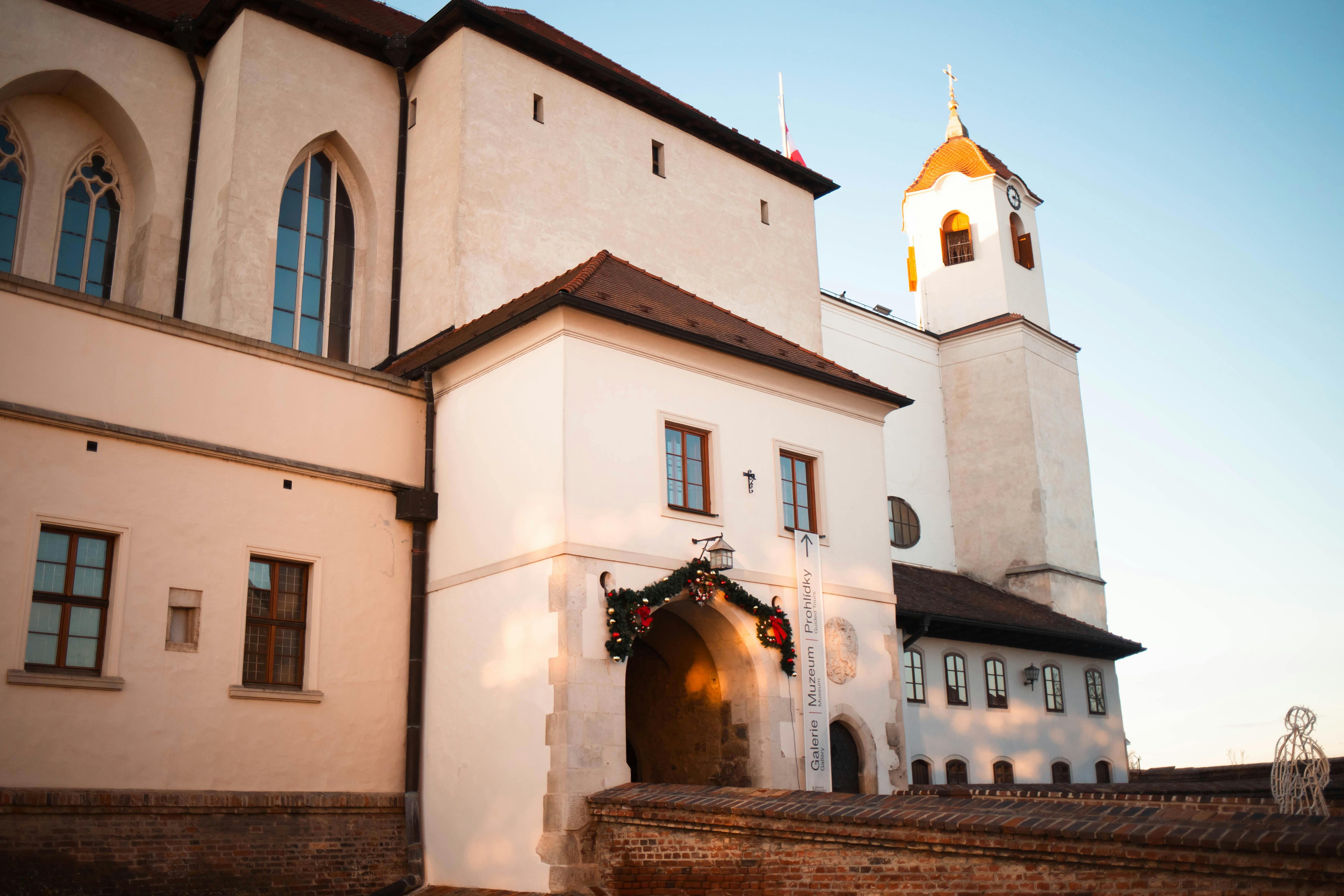
Brno's former prison fortress now works as a hilltop park, museum, and summer stage, with city views that matter as much as the cells below today still.
Welcome to Brno, the second-largest city in the Czech Republic, renowned for its rich cultural heritage and historical significance.

Brno City Theatre (Městské divadlo Brno, MdB) stands as one of the Czech Republic’s most distinguished cultural landmarks, nestled in the heart of Brno on…

Brno Central Cemetery (Czech: Ústřední hřbitov města Brna) stands as one of the largest and most historically significant cemeteries in the Czech Republic and…
The Cathedral of St. Peter and Paul in Brno, Czechia, stands as a monumental testament to centuries of architectural evolution, religious devotion, and…
Where to wander, by quarter — each with its own rhythm.
A maze of cobbled lanes anchored by Zelný trh market and the dragon-hung Old Town Hall; cafés spill onto medieval cellars that double as underground labyrinths. The district shrinks after dark into Jakubské náměstí, where pavement drinkers turn the square into an alfresco pub.
Leafy, student-heavy quarter west of the center. Grand bourgeois apartments hide wine bars and basement clubs; Lužánky park hosts open-air cinema and weekend picnics under 200-year-old chestnuts.
Castle-topped hill and twin-towered cathedral form the city’s visual shorthand. Climb the fortress ramparts for rust-red roofs, then descend into casemates that once held Austrian political prisoners.
Inter-war villa quarter where Tugendhat, Löw-Beer and Stiassni villas line quiet plane-tree avenues. Functionalist flat roofs and curved chrome railings feel oddly Californian until a tram clangs past.
Working-class artery nicknamed the ‘Brno Bronx’; graffiti, hip-hop venues and Europe’s only Museum of Romani Culture. Gentrification creeps in via natural-wine bars and studio galleries carved from tenements.
Denisovy sady gardens give postcard panoramas; beneath them, 10-Z bunker hosts Cold-War exhibitions and midnight jazz. By day, Alfa Passage hides art-nouveau cafés inside a former department store.
Local summer playground 20 min by tram: sail to the ruin of Veveří Castle, cycle birch-lined paths, or drink chilled Müller-Thurgau on pontoon bars as the sun drops behind the dam.
University district north of the tracks; cheap pubs, indie venues and the enormous Sono Centrum warehouse club. Morning farmers’ markets sell fresh strudel and experimental natural wines from nearby Velké Pavlovice.
Sieges, factories, and a villa that changed architecture forever
Bell-Beaker folk plant wheat on the gravel terraces above the Svratka. Their flint sickles and copper awls surface each time modern tram lines are dug up, reminding commuters that the ground beneath is older than the pyramids.
Oak palisades go up at Staré Zámky. The ramparts enclose a stone church and craftsmen casting Slavic belt fittings; inside, Greek-liturgy mass is sung 150 years before Prague gets its first bishop.
Cosmas writes that King Vratislaus II besieges his brother’s ‘Brno castle’. The ink is still wet on the first written mention of a place that will eclipse Olomouc and Znojmo.
Václav I signs a charter giving Brno self-government and a 24-member council. Overnight the settlement becomes a royal town with its own seal, market tolls, and the right to hang thieves from the new stone bridge.
Masons finish the Měnín Gate, the southeastern throat of town. Wagons rumble under its arch toward Vienna; the same route will later rattle with Napoleon’s supply carts and, in 1945, Soviet T-34s.
Elizabeth Richeza, Polish princess and widow of Wenceslaus II, endows a Cistercian abbey at Old Brno. The nuns’ basilica becomes the stage where, six centuries later, Leoš Janáček will debut operas that split the musical world open.
Twenty-eight thousand Swedes camp outside the walls. Inside, 1,400 townsfolk and Jesuits hold the line for 112 days. When the siege collapses, Torstensson’s march on Vienna stalls—Brno earns a place in European memory and the cathedral bells ring at 11 a.m. forever after.
Joseph II shutters the fortress and reopens it as a prison. Iron shackles replace cannonballs; soon Italian revolutionaries, Hungarian liberals and Serbian insurgents share cells with Moravian poachers, all within earshot of the town’s new cafés.
The sickly son of a peasant family will enter St Thomas’s Abbey in Old Brno, plant 28,000 pea plants in its garden, and discover the math of heredity—while the city outside fills with the clatter of the first mechanised looms.
A shoemaker’s son from Hukvaldy steps off a mail coach at the Dominican Square. Fifty years later he will give the world Jenůfa and a soundscape built from Brno street chatter, prison choruses, and the creak of the Špilberk drawbridge.
Thomas Edison’s dynamos hum in the cellar of the Mahen Theatre. When the curtain rises on 18 November, gaslight gives way to carbon filaments—Prague, Vienna and Budapest still flicker in the dark.
Löw-Beer & Co. fire up a steam engine on Cejl Street. Within a decade 20,000 spindles rattle day and night, cotton fluff settles on cathedral spires, and Brno’s population doubles as Czech, German and Jewish workers crowd into red-brick tenements.
Act 50/1919 signs into law the second Czech university. Lectures begin in confiscated German barracks; within months 3,000 students pack anatomy theatres and law halls, giving Brno the youngest blood it has ever tasted.
Mies van der Rohe hands over the keys to a steel-and-onyx house on Černopolní. The glass walls slide away like train compartments, and the living room floats above Moravian hills—modern architecture has just moved to Brno.
In a bourgeois apartment on Zelený trh, the child who will prove the limits of mathematics takes his first breath. The bells of St James ring at 11 a.m.; nobody yet knows the universe itself is partly unknowable.
After three air-raids and a pincer assault, the 2nd Ukrainian Front secures Brno. Shattered façades still smell of cordite when Czech partisans hoist the tricolour from the Old Town Hall tower—only to be quietly replaced by Soviet red within hours.
The looms that once wove cotton for the Habsburg army now answer to five-year plans. Löw-Beer and Tugendhat names vanish from letterheads; villas become Soviet trade-union sanatoriums, and the scent of scorched starch drifts over Cejl again.
A brutalist wedge of white concrete lands on the Svratka embankment. Inside, 1,100 velvet seats face a stage built for Slavonic epics; the premiere—Janáček’s Excursions of Mr Brouček—echoes through copper loudspeakers shaped like Moravian helmets.
With velvet-revolution ballots still warm, the federal map is redrawn. Brno awakens as a republican capital-in-waiting: student cafés replace party committees, and the first post-communist mayor promises to ‘give the city back to its river.’
After a decade of restitution wrangles, the glass house is scrubbed free of socialist grime and inscribed as World Heritage. Tourists now queue to see the retractable onyx wall that once hid Greta Tugendhat’s Christmas tree from Nazi inspectors.
From basement jazz clubs to the Janáček Academy’s atonal ensembles, the city that once rang with siege bells now vibrates with 400 concerts a month. The citation praises a place ‘where experimental sound is simply daily life.’
Where locals actually book dinner — not the tourist menus.
Small things that change how the city treats you.
The Villa Tugendhat tour sells out 2-3 months ahead; reserve at gotobrno.cz the moment you know your dates.
Set your watch for 11 a.m. when Petrov’s cathedral bells ring—locals will tell you they mark the 1645 Swedish siege trick.
The yellow RegioJet coaches run Prague–Brno in 2 h 30 min for about €8; Wi-Fi and an espresso are included.
In early autumn head to Jakubské náměstí for fresh, fizzy burčák—half-fermented young wine sold by the plastic litre.
Buy the Moravian Karst combined cave pass at Brno’s main station; it covers rail, entry and boat ride through the Punkva caverns.
The city, as it actually looks.

The illuminated skyline of Brno, Czech Republic, glows at night with a mix of modern high-rise architecture and traditional residential buildings.
Gabriel Mihalcea on Pexels

A striking black and white view of the Justiční škola building in Brno, Czech Republic, featuring a prominent bronze statue in the foreground.
Jiří Dočkal on Pexels
Yes—Brno is smaller, cheaper, and feels lived-in. You get medieval alleys, UNESCO modernism (Villa Tugendhat), underground labyrinths and South-Moravian wine culture within a 15-minute walk.
Two full days cover the city’s core; add a third if you want Moravian Karst caves or Lednice chateau as easy day trips.
Cards are accepted almost everywhere, but carry a few hundred CZK for market stalls, public toilets and rural wineries on day trips.
Very. Violent crime is rare; the only nuisance is late-night noise around Jakubské náměstí in summer, where students spill onto the cobbles.
Absolutely—the same reservoirs that feed the famous Žlutý kopec underground tanks supply the city.
Ready to book?
Curated from places in this city. Same price as official sites.
Prices shown are indicative — final pricing and availability are confirmed at checkout. Audiala may receive a commission from bookings made via these links.
Brno–Tuřany Airport (BRQ) handles Ryanair flights from London-Stansted, Malaga and Milan-Bergamo; Bus E76 reaches the main station in 20 min. Prague Airport (PRG) is 2 h 30 min away by direct railjet from Praha hlavní nádraží. Road: D1 motorway from Prague, D2 from Bratislava.
No metro—Brno runs on 11 tram lines, 14 trolleybus and 45 bus routes. Contactless tap-on “Pípni a jeď” caps at 90 CZK/day. Tourist tickets: 24 h Brno 90 CZK, 5-day 250 CZK. Shared bikes (Rekola/Nextbike) free 2×30 min Mar–Nov; 380 designated parking zones.
May and September hover 15–22 °C with 50 mm rain—vineyard hills glow green-gold. July peaks at 28 °C but brings afternoon storms (87 mm); winter dips to –1 °C and short daylight. Book May–June or early September for open-cellars and open-air concerts without the summer crush.
Czech is the official language; English works in cafés and theatres, less so on village trains. Currency is Czech crown (CZK) only—1 EUR = 24.5 CZK as of April 2026. Tap-to-pay everywhere; tip 10 % by rounding up on the card terminal.
110 places, one continuous walking route. Free with your first city.
110 places to discover


Showing 48 of 110 — search any place to jump straight there.