history_edu
Layered History
From Old Havana to the sugar fortunes of Trinidad and the rebel memory of Santiago de Cuba, Cuba makes its history visible in stone, street plans, and public squares.
Cuba is not one mood but a chain of distinct worlds: fortress cities, tobacco valleys, Afro-Caribbean streets, and a daily life shaped as much by wit and shortage as by beauty.
 Cuba
Cuba
EntryeVisa plus DViajeros form
CA Cuba travel guide starts with a correction: the island is not frozen in time. It is fast-moving, funny, musical, and far more varied than the vintage-car postcard suggests.
Cuba rewards travelers who want more than a beach and a bar tab. In Havana, Spanish walls, Art Deco towers, and Soviet-era improvisation share the same streets, while Trinidad still carries the wealth and violence of the sugar trade in its cobbles and courtyards. Head west to Viñales and the mood shifts again: red soil, tobacco barns, and limestone mogotes rising from the valley floor like stranded ships. This is a country where geography changes the tempo every few hours, and where history never stays inside museums.
The most useful way to read Cuba is through its cities. Cienfuegos feels measured and French-inflected, built on broad avenues and 19th-century confidence; Camagüey turns the opposite way, all bends, alleys, and deliberate confusion. Santiago de Cuba is louder, darker, more Afro-Caribbean in rhythm and memory, with the fortress of San Pedro de la Roca guarding the coast like a clenched fist. Baracoa, isolated for centuries by mountains and bad roads, still feels slightly apart from the national script. Each place gives you a different Cuba, not a smaller version of the same one.
Indigenous Cuba and First Contact, c. 500-1511
A canoe cuts across green water, a cassava cake dries near the fire, and tobacco smoke curls into the air long before any Spanish chronicler thinks to describe it. That is where Cuba begins for a traveler with any patience at all: not with cannon, not with rum, but with villages, cultivated plots, and a world that already had its own routes, ceremonies, and hierarchies.
Most of the island the Spaniards encountered was Taíno, though western Cuba kept older, different traditions that later writers flattened into neat labels. Ce que l'on ignore souvent, c'est que Cuba was never one simple pre-Columbian stage set waiting for Europe to stride in. It was layered, regional, and already old.
Then came 28 October 1492. Christopher Columbus reached Cuba and, in that familiar imperial reflex, tried to force what he saw into the map he wanted. He sent men inland expecting courts and princes in the Asian style; instead they found tobacco, hammocks, village life, and a political order that obeyed no European fantasy.
That first misunderstanding matters. It set the tone for four centuries. The island that would later produce Havana, Trinidad, and Santiago de Cuba entered European writing not as itself, but as a place someone else insisted on misreading.
Columbus appears here less as a conquering genius than as a stubborn man squinting at Cuba and refusing to believe what stood before him.
One of the first things Europeans remarked on in Cuba was rolled tobacco being inhaled or smoked, which means the cigar entered the written record before the colony fully did.
Conquest, Fortresses, and the Key to the Indies, 1511-1790s
Picture the scene in 1512: a captive leader, a pyre, a friar offering salvation at the edge of death. Hatuey, a Taíno refugee from Hispaniola who had crossed by canoe to warn Cuba what the Spaniards were bringing, asked whether Spaniards also went to heaven. Told that they did, he is said to have answered that he preferred somewhere else. Few last words in Caribbean history cut so cleanly.
The conquest that followed was brutally efficient. Diego Velázquez founded the first Spanish towns, including Baracoa, Bayamo, Trinidad, and Havana, and the island's indigenous population collapsed under violence, forced labor, and disease. Cuba became colonial very quickly, but never quietly.
Havana changed everything. Moved to its present site in 1519, the city grew into the convoy port of empire, the place where treasure fleets gathered before crossing the Atlantic under guard. Ce que l'on ignore souvent, c'est que the grandeur visitors admire in Old Havana was born from fear as much as wealth: fear of corsairs, rival empires, and the sea itself.
By the time the British seized Havana in 1762 after a three-month siege, Cuba was no longer a peripheral island. It was the lock on Spain's American door. And once that lock had been cracked, even briefly, the island's future as a plantation powerhouse and strategic obsession was assured.
Hatuey endures in Cuban memory because he was not merely a victim but the first man to tell the truth about conquest before the island had fully seen it.
The British occupation of Havana lasted less than a year, yet in those months they opened trade and imported enslaved Africans at a pace that showed just how profitable Cuba could become.
Sugar, Slavery, and the Long War for Independence, 1791-1898
A sugar mill whistles before dawn in the Valley de los Ingenios near Trinidad; cane carts creak, boilers rage, and wealth accumulates in a few hands with indecent speed. This was the Cuba of the 19th century, magnificent in facade and pitiless underneath. The island became one of the richest sugar colonies in the world because slavery was pushed to industrial scale.
The Haitian Revolution frightened Cuba's planter class and enriched it at the same time. Refugees, capital, and know-how moved across the Caribbean, and Cuban sugar surged just as Saint-Domingue burned. In places like Matanzas and Cienfuegos, fortunes rose behind columns and ballrooms while enslaved men and women paid the bill with their bodies.
Then came rebellion. Carlos Manuel de Céspedes freed his slaves at La Demajagua in October 1868 and launched the Ten Years' War, beginning Cuba's drawn-out struggle against Spain. It did not win independence at once, but it changed the moral weather forever.
José Martí gave that struggle its finest language and, in 1895, his life. He was a poet who understood politics, an exile who understood theater, and he knew that nations are built as much from sentences as from rifles. His death at Dos Ríos turned him into something larger than a leader: the conscience every later regime would try to claim.
When the USS Maine exploded in Havana harbor in February 1898, Cuba's war became an international crisis and then a Spanish-American war. Spain fell, but freedom arrived with an American shadow attached. That unresolved tension would define the republic to come.
Martí remains moving because behind the bronze busts stood a restless, overworked man writing letters, borrowing money, and trying to hold a divided exile movement together.
The tower of Manaca Iznaga near Trinidad, now photographed for its elegance, was built as a bell tower to control enslaved labor with sound.
Republic, Dictators, and the Revolution, 1902-1959
A roulette wheel turns in Havana, a band begins after midnight, and on another table someone is discussing a coup as if it were an investment tip. That was republican Cuba at its most seductive and its most compromised: formally independent from 1902, yet repeatedly bent by foreign influence, oligarchy, corruption, and military force.
The island dazzled visitors and exhausted many of its own citizens. Havana became a capital of nightlife, vice, money, and glamour, while much of the countryside remained poor and badly served. Ce que l'on ignore souvent, c'est que the republic's crisis was not only political. It was social theater with a very sharp bill at the end.
Fulgencio Batista, soldier first and strongman later, understood power better than legitimacy. His 1952 coup shut the constitutional door and made armed opposition far more plausible than reform. What followed is one of those episodes that history keeps polishing into myth, though it was messier at the time.
In 1956 Fidel Castro, Raúl Castro, Che Guevara, and their companions landed from the yacht Granma and were nearly annihilated. The survivors reached the Sierra Maestra, built alliances, made propaganda out of scarcity, and by January 1959 entered Santiago de Cuba and then Havana as victors. The old republic ended not with a vote, but with a column of rebels descending from the mountains.
Batista fascinates because he rose from sergeant to ruler with a gambler's instinct for timing, then lost the country by mistaking fear for loyalty.
When the Granma expedition landed in December 1956, the operation went so badly that the revolution nearly died in the mangroves before it became legend.
Socialist Cuba After 1959, 1959-present
A microphone on a vast square, a beard under the floodlights, and a speech that seems it may never end: revolutionary Cuba announced itself not in whispers but in marathon performance. Fidel Castro and his comrades nationalized property, crushed rivals, aligned with the Soviet Union, and turned the island into one of the Cold War's most charged stages. Havana became both capital and backdrop, monumental and rationed at once.
Then came October 1962. The missile crisis lasted thirteen days, but it fixed Cuba in the global imagination for generations. Ce que l'on ignore souvent, c'est how often Cuba's leaders were managing not just ideology, but humiliation, dependence, pride, and the permanent risk of becoming a symbol for other people's wars.
The Soviet collapse in 1991 brought the so-called Special Period, a phrase far too tidy for what people actually lived through. Power cuts, hunger, improvised transport, bicycles, exodus, ingenuity: the state endured, but daily life shrank to essentials. In Havana, in Camagüey, in Santiago de Cuba, people learned the difficult art of making scarcity look almost graceful.
The 21st century has been a sequence of openings and closures. Raúl Castro loosened parts of the economy, relations with the United States thawed briefly in 2014, and then hardened again. The July 2021 protests showed public frustration in the streets with unusual force, while the shortages and blackouts of 2024 and 2025 reminded everyone that history in Cuba is never past; it still arrives with tonight's electricity schedule.
And yet the island keeps producing music, argument, jokes, and stubborn elegance under pressure. That may be Cuba's most royal secret of all: not grandeur, but endurance.
Fidel Castro mastered the monarchy of republican anti-monarchists, ruling through charisma, ritual, and presence as if the revolution itself had a court.
During the worst years after the Soviet collapse, Havana's streets filled with Chinese Flying Pigeon bicycles because fuel had become too scarce to sustain ordinary transport.
Cuban Spanish does not wait politely for grammar to finish dressing. It clips the ends off words, turns "para" into "pa", lets an "s" vanish in the heat, and still lands with perfect precision. In Havana, a greeting can travel from a balcony to the pavement and return as a joke before you have found the right tense.
The tenderness of it is almost tactical. "Mi amor," "corazón," "mi vida" arrive from cashiers, grandmothers, men selling peanuts, women guarding doorways. Europe trains you to mistrust such language. Cuba teaches you that warmth can be public, quick, and exact, a form of civic lubrication rather than confession.
Then come the words that refuse export. "Asere" is friend, witness, accomplice. "¿Qué bolá?" is a whole shoulder movement disguised as a question. And "tumbao" may be the most useful noun on the island: style, rhythm, command, the art of taking up space without asking permission. A country is sometimes a syntax before it becomes a map.
Cuban food does not perform. It insists. Rice, beans, pork, cassava, plantain: the same nouns return with the authority of liturgy, and repetition here is not poverty of imagination but proof that someone, generations ago, found the correct arrangement and saw no reason to apologize.
Take the plate everyone thinks they understand. Ropa vieja is shredded beef, yes, but also onion, pepper, garlic, tomato, cumin, bay, the long patience of a pot, and white rice waiting beside it like a faithful translator. Congrí does not decorate the meal. It gives the meal a spine.
In Trinidad, lunch can arrive on a table with sweet fried plantain, black beans, pork, and a glass bottle of vinegar with green chilies floating inside like a threat. In Baracoa, coconut slips into sauces and sweets with almost indecent ease, because the town lives under rain and palms and sees no virtue in restraint. Food in Cuba is rarely theatrical. It is more serious than that. It tells you how to remain human when the shelves cannot always be trusted.
Music in Cuba is not an accessory to the evening. It is one of the ways the evening becomes legible. A clave pattern begins, two sticks making a small wooden law, and suddenly bodies, voices, glasses, chairs, and doorframes all understand what is expected of them.
Santiago de Cuba carries son as if it were family silver that still gets used on weekdays. Havana can move from bolero to timba in the span of one block, with the bass arriving before the band is visible. In Matanzas, rumba keeps its old muscular intelligence: drum, call, reply, flirtation, challenge. Nothing here asks to be consumed passively. Even listening feels like a physical task.
What strikes me most is the discipline hidden inside apparent ease. Syncopation sounds loose only to the untrained ear. Every pause has ancestry. Every chorus has social function. Cuba’s music smiles often, but it is not innocent; it remembers barracks, patios, processions, radio studios, black Atlantic crossings, and the stubborn miracle by which grief learns to dance without becoming smaller.
Cuba prays in more than one language at once. Catholic saints stand in chapels with their candles and plaster calm; Yoruba orishas move through the same rooms under other names, carrying thunder, river water, iron, honey, crossroads. The elegant term is syncretism. The lived fact is that people know how to speak to several heavens.
You see it in details before anyone explains it. White clothes on initiates. Beaded necklaces coded by deity. A glass of water left out with the gravity of a document. The word "aché" appears quietly, then everywhere: force, blessing, charge, permission from the invisible. Once you hear it properly, secular life begins to look less secular.
In Havana and Matanzas, Regla de Ocha is part ritual system, part family archive, part technology of survival. Drumming ceremonies do not resemble the chilled piety northern Europeans expect from religion, which is one reason they feel so alive. The sacred here is not embarrassed by the body. It arrives through sweat, rhythm, food, feathers, tobacco smoke, and the old human wish to bargain with fate while remaining polite.
Cuba writes as if prose were too narrow a container. José Martí made politics sound like lyric conviction, which is why he still survives on walls, in classrooms, in arguments, in memory itself. Alejo Carpentier took the Caribbean baroque and gave it architecture: history piled on history until the sentence began to feel carved rather than written.
Then Havana grows stranger. José Lezama Lima turns the city into a dense edible substance, all excess and gleam and metaphysical appetite. Leonardo Padura gives it back its fatigue, its skepticism, its worn staircases and unheroic truths. Between them lies a whole library of Cuban self-interrogation: Nicolás Guillén with son in his line, Reinaldo Arenas with fury in his lungs, a literature that never quite accepts official simplification.
This matters when you walk through Havana, Cienfuegos, or Camagüey. The island does not present itself as one story. It edits itself in public, then disputes the edit. Cuban literature teaches the useful habit of distrusting any account that sounds too complete. That may be the most national lesson of all.
Cuban architecture has one great advantage over ideology: it ages honestly. Salt air, heat, diesel, rain, neglect, repair, improvisation, all leave their handwriting on the facade. In Old Havana, arcades and balconies hold colonial power, 19th-century money, tropical mildew, and laundry on the same vertical plane. Nothing has been purified for your moral comfort.
Trinidad keeps its cobbles, iron grilles, and pastel houses with a severity that sugar once paid for. Cienfuegos, founded in 1819 with French ambitions, feels more geometric, more composed, a city that believes in straight lines and civic dignity. Camagüey distrusts the straight line altogether; its lanes bend and double back like an argument designed to confuse pirates and strangers, often the same category.
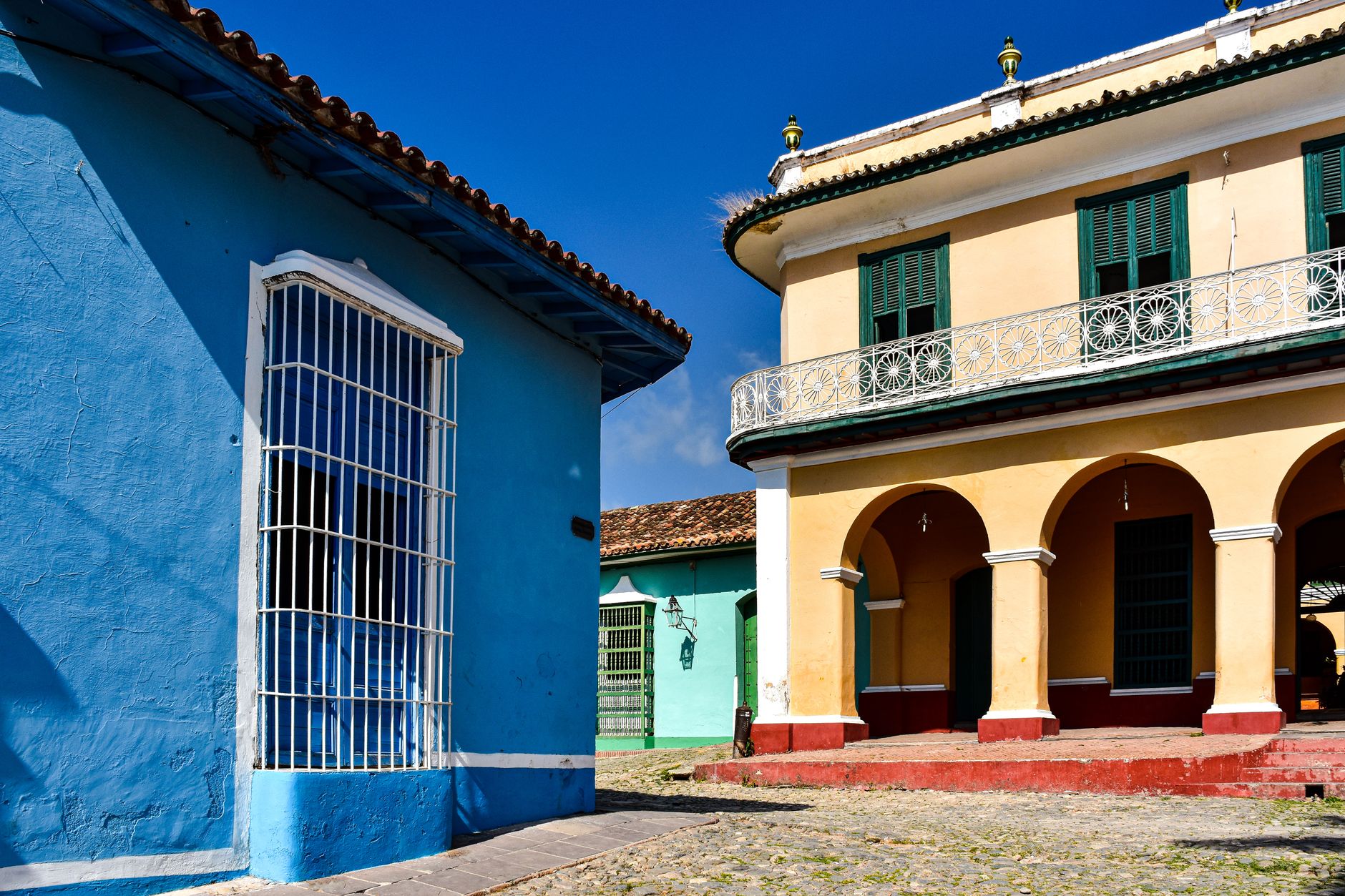
What I admire is the refusal of neatness. A mansion becomes apartments. A grand staircase survives under flaking paint. A courtyard collects plants, bicycles, gossip, and a television humming somewhere out of sight. Buildings in Cuba do not merely stand. They negotiate. They carry memory like humidity: invisible until the light catches it.
From Old Havana to the sugar fortunes of Trinidad and the rebel memory of Santiago de Cuba, Cuba makes its history visible in stone, street plans, and public squares.
Viñales brings sheer limestone mogotes and tobacco country; the island beyond offers wetlands, coral cays, mountain ranges, and nearly 5,700 kilometers of coastline.
In Cuba, music rarely stays on a stage. Son, rumba, salsa, and street percussion shape evenings in Havana, Santiago de Cuba, and countless bars, patios, and sidewalks.
Travel here through the table: ropa vieja, congrí, yuca con mojo, tiny sweet coffee, and rum traditions refined over generations. Viñales and Pinar del Río add the tobacco story.
Cuba has nine UNESCO World Heritage sites, including Havana, Trinidad, Viñales, Cienfuegos, Camagüey, and the castle above Santiago de Cuba. Few Caribbean countries match that density.
Baracoa, Gibara, Holguín, and the far east show a less packaged Cuba, with heavier rain, stronger Afro-Caribbean currents, and landscapes that feel wilder than the resort corridor.
12 cities — start with the ones we'd send you to first.
Baroque churches and crumbling Vedado mansions share the same block, and the Malecón seawall at dusk draws half the city out to sit, smoke, and watch the Atlantic turn copper.
Cobblestoned and pastel-painted, this 16th-century sugar town froze when the mills died, leaving intact a Plaza Mayor where the wealth of 75 ingenios is still readable in the ironwork and tilework of every façade.
Red-earthed tobacco fields spread between mogote limestone monoliths in a valley so geologically strange that the UNESCO citation reads like a geology lecture interrupted by beauty.
Cuba's second city runs hotter, louder, and more African than Havana — this is where son and conga were codified, where Fidel declared victory on January 1, 1959, and where the Castillo de San Pedro de la Roca still aims
French Creole settlers platted this 19th-century port with Neoclassical precision, producing the only city in Cuba where the grid, the proportions, and the bay all feel like a single architectural argument.
Deliberately labyrinthine streets — laid out to confuse pirates — still disorient visitors today, while the city's signature oversized tinajones clay jars squat in courtyards as if daring you to ask why.
Cuba's oldest Spanish settlement sits at the rain-soaked eastern tip of the island, cut off by mountains until 1965, which is why it still eats differently — chocolate, coconut, and polymita snail shells everywhere — fro
One of Cuba's nine original colonial villas, Remedios is small enough to walk in an afternoon yet hosts Las Parrandas, a December fireworks war between two rival neighborhoods that has been escalating in volume and ambit
The city where Che Guevara's guerrillas derailed an armored troop train on December 29, 1958 — the locomotive still lies jackknifed beside the tracks as a monument — and where his mausoleum draws a quieter, more ideologi
Western Cuba is where most first trips begin, but it is not just an introduction. Havana carries the political theater, the sea wall, the grand facades held together by habit and ingenuity, while the road west opens toward tobacco country, karst hills, and a version of rural Cuba that still feels close to the island's working spine.
This is the Cuba of red earth, limestone walls, and tobacco sheds that look temporary until you realize they have outlasted governments. Viñales is the obvious base, but the point is the landscape itself: a UNESCO-listed valley where farming, geology, and weather still dictate the day more than the clock does.
Cienfuegos and Trinidad sit close enough to pair and different enough to justify it. Cienfuegos is orderly, maritime, and unusually French in its urban feel; Trinidad is tighter, older, and built from sugar money, with the Valley de los Ingenios just outside town as the hard historical counterweight to all that beauty.
Central inland Cuba is where routes get slower and the island's scale starts to show. Camagüey has one of the country's great historic centers, designed as a maze after pirate raids, while Santa Clara and Remedios add revolutionary memory, colonial churches, and festival traditions that make this belt more than a stop between coasts.
Southeastern Cuba has more heat, more percussion, and less patience for the polished image foreigners often bring with them. Santiago de Cuba is the anchor, with the San Pedro de la Roca fortress above the sea and the island's deepest musical roots in the streets; farther east, the mountains and coast begin to crowd each other in ways western Cuba never does.
Baracoa feels cut off even when the road is open, and that is part of its hold. Rain falls harder here, cocoa and coconut shape the kitchen, and the coast bends toward rivers and mountains rather than neat resort logic; Holguín and Gibara make strong companion stops if you want the east without committing every day to long transfers.
From Taíno villages to the republic of blackouts and endurance
Agricultural communities linked to the wider Arawakan world become dominant across most of the island. Cassava, cotton, ritual life, and village leadership structures shape the Cuba the Spaniards will later encounter, though western regions remain culturally distinct.
Christopher Columbus lands on 28 October 1492 and immediately tries to fit the island into his Asian fantasy. He finds no emperor, no oriental court, only a reality that refuses his map.
Diego Velázquez de Cuéllar launches the conquest of Cuba from the east. The process will bring settlement, forced labor, disease, and the near-destruction of indigenous life.
Hatuey, who had warned the island about the Spaniards, is burned alive after resisting conquest. His reported refusal of a heaven shared with Spaniards becomes one of the fiercest last lines in the history of the Americas.
The settlement that becomes Havana is moved to its excellent harbor on the northwest coast. From this point the city begins its ascent toward strategic magnificence.
After a three-month siege, British forces capture Havana in August 1762. Their occupation lasts less than a year, but it reveals Cuba's military and commercial value with brutal clarity.
As Saint-Domingue erupts, Cuban planters and merchants seize the opportunity. Sugar production expands dramatically, and with it the importation of enslaved Africans on a massive scale.
Carlos Manuel de Céspedes issues the Grito de Yara and frees his slaves at La Demajagua. Cuba's long struggle for independence from Spain enters its decisive modern phase.
The Pact of Zanjón closes the first great war against Spain, but not the question that caused it. Many Cubans see compromise where they had hoped for nationhood.
José Martí returns to Cuba to join the renewed war and is killed in action on 19 May 1895. His death seals his transformation from political thinker into national conscience.
The explosion helps trigger the Spanish-American War and changes the scale of Cuba's conflict overnight. Spain loses the island, but Cuban independence will arrive mediated by American power.
Cuba becomes formally independent on 20 May 1902. The new republic is real, yet constrained from the start by the Platt Amendment and repeated US intervention.
A revolt led by noncommissioned officers reshapes the state and elevates Fulgencio Batista. From backstage fixer to front-stage ruler, he will dominate Cuban politics for years.
Batista returns to power by force, cancelling elections and closing off constitutional politics. For many opponents, armed struggle now seems less romantic than logical.
Fidel Castro and his followers attack the Moncada Barracks in Santiago de Cuba on 26 July. The operation fails militarily, but the date becomes the revolution's founding myth.
Fidel Castro, Che Guevara, and their companions arrive aboard the yacht Granma in December 1956. The landing is chaotic and nearly fatal, but the survivors reach the Sierra Maestra and begin the guerrilla war in earnest.
Batista flees on 1 January 1959, and rebel forces move through Santiago de Cuba toward Havana. The republic collapses, and a new revolutionary state begins to take shape with extraordinary speed.
Exiles backed by the United States land at Bahía de Cochinos and are defeated within days. The failed invasion strengthens Castro at home and deepens Cuba's alignment with the Soviet Union.
For thirteen days in October 1962, Cuba stands at the center of a nuclear confrontation between the United States and the Soviet Union. The world remembers the superpowers; Cubans remember being the ground beneath the argument.
The collapse of the Soviet Union strips Cuba of its main patron and plunges the island into severe economic crisis. Food shortages, blackouts, bicycles, improvisation, and departure redefine daily life.
The United States and Cuba begin restoring diplomatic relations after decades of hostility. For a brief moment, the island seems poised between continuity and something more open.
On 11 July 2021, demonstrations break out in multiple Cuban cities amid shortages, blackouts, and anger over everyday conditions. The protests mark the most visible challenge to the state in decades.
Fuel scarcity, fragile transport, food shortages, and repeated blackouts shape travel and daily life across the island. Cuba remains intensely alive, but no serious observer can mistake resilience for ease.
Indigenous Cuba and First Contact
Columbus appears here less as a conquering genius than as a stubborn man squinting at Cuba and refusing to believe what stood before him.
A canoe cuts across green water, a cassava cake dries near the fire, and tobacco smoke curls into the air long before any Spanish chronicler thinks to describe it. That is where Cuba begins for a traveler with any patience at all: not with cannon, not with rum, but with villages, cultivated plots, and a world that already had its own routes, ceremonies, and hierarchies.
Most of the island the Spaniards encountered was Taíno, though western Cuba kept older, different traditions that later writers flattened into neat labels. Ce que l'on ignore souvent, c'est que Cuba was never one simple pre-Columbian stage set waiting for Europe to stride in. It was layered, regional, and already old.
Then came 28 October 1492. Christopher Columbus reached Cuba and, in that familiar imperial reflex, tried to force what he saw into the map he wanted. He sent men inland expecting courts and princes in the Asian style; instead they found tobacco, hammocks, village life, and a political order that obeyed no European fantasy.
That first misunderstanding matters. It set the tone for four centuries. The island that would later produce Havana, Trinidad, and Santiago de Cuba entered European writing not as itself, but as a place someone else insisted on misreading.
One of the first things Europeans remarked on in Cuba was rolled tobacco being inhaled or smoked, which means the cigar entered the written record before the colony fully did.
Conquest, Fortresses, and the Key to the Indies
Hatuey endures in Cuban memory because he was not merely a victim but the first man to tell the truth about conquest before the island had fully seen it.
Picture the scene in 1512: a captive leader, a pyre, a friar offering salvation at the edge of death. Hatuey, a Taíno refugee from Hispaniola who had crossed by canoe to warn Cuba what the Spaniards were bringing, asked whether Spaniards also went to heaven. Told that they did, he is said to have answered that he preferred somewhere else. Few last words in Caribbean history cut so cleanly.
The conquest that followed was brutally efficient. Diego Velázquez founded the first Spanish towns, including Baracoa, Bayamo, Trinidad, and Havana, and the island's indigenous population collapsed under violence, forced labor, and disease. Cuba became colonial very quickly, but never quietly.
Havana changed everything. Moved to its present site in 1519, the city grew into the convoy port of empire, the place where treasure fleets gathered before crossing the Atlantic under guard. Ce que l'on ignore souvent, c'est que the grandeur visitors admire in Old Havana was born from fear as much as wealth: fear of corsairs, rival empires, and the sea itself.
By the time the British seized Havana in 1762 after a three-month siege, Cuba was no longer a peripheral island. It was the lock on Spain's American door. And once that lock had been cracked, even briefly, the island's future as a plantation powerhouse and strategic obsession was assured.
The British occupation of Havana lasted less than a year, yet in those months they opened trade and imported enslaved Africans at a pace that showed just how profitable Cuba could become.
Sugar, Slavery, and the Long War for Independence
Martí remains moving because behind the bronze busts stood a restless, overworked man writing letters, borrowing money, and trying to hold a divided exile movement together.
A sugar mill whistles before dawn in the Valley de los Ingenios near Trinidad; cane carts creak, boilers rage, and wealth accumulates in a few hands with indecent speed. This was the Cuba of the 19th century, magnificent in facade and pitiless underneath. The island became one of the richest sugar colonies in the world because slavery was pushed to industrial scale.
The Haitian Revolution frightened Cuba's planter class and enriched it at the same time. Refugees, capital, and know-how moved across the Caribbean, and Cuban sugar surged just as Saint-Domingue burned. In places like Matanzas and Cienfuegos, fortunes rose behind columns and ballrooms while enslaved men and women paid the bill with their bodies.
Then came rebellion. Carlos Manuel de Céspedes freed his slaves at La Demajagua in October 1868 and launched the Ten Years' War, beginning Cuba's drawn-out struggle against Spain. It did not win independence at once, but it changed the moral weather forever.
José Martí gave that struggle its finest language and, in 1895, his life. He was a poet who understood politics, an exile who understood theater, and he knew that nations are built as much from sentences as from rifles. His death at Dos Ríos turned him into something larger than a leader: the conscience every later regime would try to claim.
When the USS Maine exploded in Havana harbor in February 1898, Cuba's war became an international crisis and then a Spanish-American war. Spain fell, but freedom arrived with an American shadow attached. That unresolved tension would define the republic to come.
The tower of Manaca Iznaga near Trinidad, now photographed for its elegance, was built as a bell tower to control enslaved labor with sound.
Republic, Dictators, and the Revolution
Batista fascinates because he rose from sergeant to ruler with a gambler's instinct for timing, then lost the country by mistaking fear for loyalty.
A roulette wheel turns in Havana, a band begins after midnight, and on another table someone is discussing a coup as if it were an investment tip. That was republican Cuba at its most seductive and its most compromised: formally independent from 1902, yet repeatedly bent by foreign influence, oligarchy, corruption, and military force.
The island dazzled visitors and exhausted many of its own citizens. Havana became a capital of nightlife, vice, money, and glamour, while much of the countryside remained poor and badly served. Ce que l'on ignore souvent, c'est que the republic's crisis was not only political. It was social theater with a very sharp bill at the end.
Fulgencio Batista, soldier first and strongman later, understood power better than legitimacy. His 1952 coup shut the constitutional door and made armed opposition far more plausible than reform. What followed is one of those episodes that history keeps polishing into myth, though it was messier at the time.
In 1956 Fidel Castro, Raúl Castro, Che Guevara, and their companions landed from the yacht Granma and were nearly annihilated. The survivors reached the Sierra Maestra, built alliances, made propaganda out of scarcity, and by January 1959 entered Santiago de Cuba and then Havana as victors. The old republic ended not with a vote, but with a column of rebels descending from the mountains.
When the Granma expedition landed in December 1956, the operation went so badly that the revolution nearly died in the mangroves before it became legend.
Socialist Cuba After 1959
Fidel Castro mastered the monarchy of republican anti-monarchists, ruling through charisma, ritual, and presence as if the revolution itself had a court.
A microphone on a vast square, a beard under the floodlights, and a speech that seems it may never end: revolutionary Cuba announced itself not in whispers but in marathon performance. Fidel Castro and his comrades nationalized property, crushed rivals, aligned with the Soviet Union, and turned the island into one of the Cold War's most charged stages. Havana became both capital and backdrop, monumental and rationed at once.
Then came October 1962. The missile crisis lasted thirteen days, but it fixed Cuba in the global imagination for generations. Ce que l'on ignore souvent, c'est how often Cuba's leaders were managing not just ideology, but humiliation, dependence, pride, and the permanent risk of becoming a symbol for other people's wars.
The Soviet collapse in 1991 brought the so-called Special Period, a phrase far too tidy for what people actually lived through. Power cuts, hunger, improvised transport, bicycles, exodus, ingenuity: the state endured, but daily life shrank to essentials. In Havana, in Camagüey, in Santiago de Cuba, people learned the difficult art of making scarcity look almost graceful.
The 21st century has been a sequence of openings and closures. Raúl Castro loosened parts of the economy, relations with the United States thawed briefly in 2014, and then hardened again. The July 2021 protests showed public frustration in the streets with unusual force, while the shortages and blackouts of 2024 and 2025 reminded everyone that history in Cuba is never past; it still arrives with tonight's electricity schedule.
And yet the island keeps producing music, argument, jokes, and stubborn elegance under pressure. That may be Cuba's most royal secret of all: not grandeur, but endurance.
During the worst years after the Soviet collapse, Havana's streets filled with Chinese Flying Pigeon bicycles because fuel had become too scarce to sustain ordinary transport.
Cuban Spanish does not wait politely for grammar to finish dressing. It clips the ends off words, turns "para" into "pa", lets an "s" vanish in the heat, and still lands with perfect precision. In Havana, a greeting can travel from a balcony to the pavement and return as a joke before you have found the right tense.
The tenderness of it is almost tactical. "Mi amor," "corazón," "mi vida" arrive from cashiers, grandmothers, men selling peanuts, women guarding doorways. Europe trains you to mistrust such language. Cuba teaches you that warmth can be public, quick, and exact, a form of civic lubrication rather than confession.
Then come the words that refuse export. "Asere" is friend, witness, accomplice. "¿Qué bolá?" is a whole shoulder movement disguised as a question. And "tumbao" may be the most useful noun on the island: style, rhythm, command, the art of taking up space without asking permission. A country is sometimes a syntax before it becomes a map.
Cuban food does not perform. It insists. Rice, beans, pork, cassava, plantain: the same nouns return with the authority of liturgy, and repetition here is not poverty of imagination but proof that someone, generations ago, found the correct arrangement and saw no reason to apologize.
Take the plate everyone thinks they understand. Ropa vieja is shredded beef, yes, but also onion, pepper, garlic, tomato, cumin, bay, the long patience of a pot, and white rice waiting beside it like a faithful translator. Congrí does not decorate the meal. It gives the meal a spine.
In Trinidad, lunch can arrive on a table with sweet fried plantain, black beans, pork, and a glass bottle of vinegar with green chilies floating inside like a threat. In Baracoa, coconut slips into sauces and sweets with almost indecent ease, because the town lives under rain and palms and sees no virtue in restraint. Food in Cuba is rarely theatrical. It is more serious than that. It tells you how to remain human when the shelves cannot always be trusted.
Music in Cuba is not an accessory to the evening. It is one of the ways the evening becomes legible. A clave pattern begins, two sticks making a small wooden law, and suddenly bodies, voices, glasses, chairs, and doorframes all understand what is expected of them.
Santiago de Cuba carries son as if it were family silver that still gets used on weekdays. Havana can move from bolero to timba in the span of one block, with the bass arriving before the band is visible. In Matanzas, rumba keeps its old muscular intelligence: drum, call, reply, flirtation, challenge. Nothing here asks to be consumed passively. Even listening feels like a physical task.
What strikes me most is the discipline hidden inside apparent ease. Syncopation sounds loose only to the untrained ear. Every pause has ancestry. Every chorus has social function. Cuba’s music smiles often, but it is not innocent; it remembers barracks, patios, processions, radio studios, black Atlantic crossings, and the stubborn miracle by which grief learns to dance without becoming smaller.
Cuba prays in more than one language at once. Catholic saints stand in chapels with their candles and plaster calm; Yoruba orishas move through the same rooms under other names, carrying thunder, river water, iron, honey, crossroads. The elegant term is syncretism. The lived fact is that people know how to speak to several heavens.
You see it in details before anyone explains it. White clothes on initiates. Beaded necklaces coded by deity. A glass of water left out with the gravity of a document. The word "aché" appears quietly, then everywhere: force, blessing, charge, permission from the invisible. Once you hear it properly, secular life begins to look less secular.
In Havana and Matanzas, Regla de Ocha is part ritual system, part family archive, part technology of survival. Drumming ceremonies do not resemble the chilled piety northern Europeans expect from religion, which is one reason they feel so alive. The sacred here is not embarrassed by the body. It arrives through sweat, rhythm, food, feathers, tobacco smoke, and the old human wish to bargain with fate while remaining polite.
Cuba writes as if prose were too narrow a container. José Martí made politics sound like lyric conviction, which is why he still survives on walls, in classrooms, in arguments, in memory itself. Alejo Carpentier took the Caribbean baroque and gave it architecture: history piled on history until the sentence began to feel carved rather than written.
Then Havana grows stranger. José Lezama Lima turns the city into a dense edible substance, all excess and gleam and metaphysical appetite. Leonardo Padura gives it back its fatigue, its skepticism, its worn staircases and unheroic truths. Between them lies a whole library of Cuban self-interrogation: Nicolás Guillén with son in his line, Reinaldo Arenas with fury in his lungs, a literature that never quite accepts official simplification.
This matters when you walk through Havana, Cienfuegos, or Camagüey. The island does not present itself as one story. It edits itself in public, then disputes the edit. Cuban literature teaches the useful habit of distrusting any account that sounds too complete. That may be the most national lesson of all.
Cuban architecture has one great advantage over ideology: it ages honestly. Salt air, heat, diesel, rain, neglect, repair, improvisation, all leave their handwriting on the facade. In Old Havana, arcades and balconies hold colonial power, 19th-century money, tropical mildew, and laundry on the same vertical plane. Nothing has been purified for your moral comfort.
Trinidad keeps its cobbles, iron grilles, and pastel houses with a severity that sugar once paid for. Cienfuegos, founded in 1819 with French ambitions, feels more geometric, more composed, a city that believes in straight lines and civic dignity. Camagüey distrusts the straight line altogether; its lanes bend and double back like an argument designed to confuse pirates and strangers, often the same category.
What I admire is the refusal of neatness. A mansion becomes apartments. A grand staircase survives under flaking paint. A courtyard collects plants, bicycles, gossip, and a television humming somewhere out of sight. Buildings in Cuba do not merely stand. They negotiate. They carry memory like humidity: invisible until the light catches it.
Hatuey arrived from Hispaniola to warn Cuba what Spanish rule would mean, which already gives his story the force of prophecy. Burned alive in 1512, he became the island's first rebel martyr and, perhaps more movingly, the first man remembered for refusing to confuse baptism with justice.
Velázquez stamped Spanish power onto Cuba with unnerving speed, founding settlements that still shape the map: Baracoa, Trinidad, and Havana among them. He is one of those men whose administrative efficiency hides a trail of ruin.
On his estate at La Demajagua, Céspedes freed his slaves and called for independence, an act at once noble, strategic, and long overdue. Cubans remember him as the Father of the Nation, but what gives him life is the risk of that moment: a landowner stepping into revolt with no guarantee that history would reward him.
Martí wrote Cuba into existence before he could help win it. He spent years in exile, lecturing, organizing, begging for funds, and trying to keep vanity from destroying the cause, then died in battle so quickly in 1895 that his martyrdom almost eclipsed the ferocious intelligence of the man.
Dominican by birth, Gómez became indispensable to Cuba's wars of independence, which tells you something important about the Caribbean's intertwined destinies. He brought military discipline, the devastating machete charge, and the weary authority of a man who knew wars are won by endurance more often than glory.
Maceo, the Bronze Titan, turned physical courage into political force. Wounded again and again, fierce in debate as well as battle, he embodied a Cuba that was Black, martial, and unwilling to accept either Spanish rule or timid compromise.
Batista rose from sergeant to kingmaker to ruler, which already sounds like a novel with poor moral supervision. His final period in power made Havana glitter for foreign money while leaving enough resentment underneath to feed the revolution that drove him into exile.
Castro understood spectacle, patience, and power better than almost anyone in 20th-century Latin America. He turned a guerrilla victory into a state, then into a global symbol, and spent decades speaking as if Cuba's destiny were something he could personally narrate into being.
Celia Sánchez is often placed just off center in the revolutionary story, which is precisely why she deserves a second look. She organized landings, logistics, safe houses, archives, and access to Fidel, doing the intimate statecraft without which the heroic photographs would have remained only photographs.
This is the shortest Cuba trip that still gives you more than one note to listen to. Start in Havana for the architecture, music, and late-night street life, then continue to Matanzas for river city texture, Afro-Cuban cultural history, and a quieter rhythm before you fly out or return west.
This central Cuba route makes sense on the map and in the bloodstream. Cienfuegos gives you French-influenced order and a proper bay, Trinidad brings cobbles and sugar wealth turned into stone, and Santa Clara adds revolutionary history plus a practical onward hub; Remedios works as a final smaller-scale stop if transport behaves.
Eastern Cuba feels like a different country in the best way: hotter, rougher around the edges, more musically charged, and less shaped by package tourism. Begin in Santiago de Cuba for fortresses and son, push on to rain-soaked Baracoa, then swing back through Holguín and end in Gibara, whose seafront and faded elegance reward anyone who likes cities with a little salt on them.
Two weeks gives you time to see Cuba's changes from limestone valley to capital to provincial grandness without pretending the island moves quickly. Viñales brings mogotes and tobacco country, Havana supplies the historical weight, Cienfuegos resets the pace, and Camagüey finishes with twisting streets that were built to confuse raiders and still confuse visitors.
Lunch, family table, metal spoon. Beef shreds, rice mound, black beans nearby, plantain after salt.
Sunday plate, pork company, loud room. Rice and beans cook together, then hold the meal in place.
Cassava, garlic, sour orange, onion. Christmas, New Year, roast pork, many hands, no ceremony.
Bread, roast pork, mojo, onion. Street corner, bus wait, late hour, quick bite, greasy fingers.
Corn dough, pork, husk, spoon if collapse comes. Family kitchen, market lunch, patient eating.
Cassava bread, dry snap, old memory. Baracoa table, fish stew, coffee, talk.
Tiny cups, shared pour, much sugar. Morning counter, office break, neighbor circle, quick gossip.



Most visitors need a tourist eVisa, a passport valid for 6 months, medical travel insurance, a return or onward ticket, and the D'Viajeros QR code. Cuba's official tourism portal says the eVisa replaced the old tourist card from June 30, 2025; UK guidance says you should complete D'Viajeros within 72 hours before arrival, while Cuban reporting says the form can open 7 days before travel, so do both tasks shortly before departure and keep the QR offline.
Cuba uses the Cuban peso, or CUP, but tourist prices still drift between CUP, euros, and sometimes U.S. dollars. Cards are unreliable, U.S.-issued cards generally do not work, and even non-U.S. Visa or Mastercard should be treated as a backup; bring cash in euros or Canadian dollars and keep small CUP notes for taxis, snacks, and tips.
You reach Cuba by air or sea, not by rail. Havana is the main gateway for Havana and Viñales, Santa Clara works for the Trinidad and Cienfuegos corridor when flights line up, Holguín is practical for Gibara and Baracoa connections, and Santiago de Cuba is the cleanest entry point for the southeast.
Viazul remains the main tourist bus network, but treat schedules as aspirational rather than fixed. Cuba's official transport page says bookings can be made online with international cards and are not paid in cash at terminals; shortages and route changes mean private transfers, shared taxis, and flexible buffer days are often the real transport plan.
Dry season runs from November to April, with the easiest weather for moving around and the highest prices from December to March. May to October is hotter, wetter, and more fragile logistically, with hurricane risk peaking from August to October; Baracoa stays wetter than almost anywhere else on the island.
Internet works, then doesn't, then returns when you stop expecting it. Cuba's tourism portal says tourist SIMs are sold through CubacelTur and Wi-Fi exists in hotels, some airports, and public hotspots, but power cuts and overloaded networks make offline maps, downloaded tickets, and printed confirmations a smarter bet than constant data.
Cuba is usually manageable for street-level travel, but 2025-2026 conditions are rougher than older guidebooks suggest: power outages, medicine shortages, fuel problems, and patchy transport can turn a simple transfer into an all-day exercise. Petty theft exists, especially in crowded urban areas, and U.S. travelers need to remember that pure tourism is still not legal under U.S. rules.
Carry enough euros or Canadian dollars to cover several days, not just your first night. ATMs, card terminals, and exchange options can all fail at the same time, which is a bad joke until it happens to you.
Never plan a same-day long transfer and a booked activity you care about. Buses sell out, private cars get repriced, fuel shortages bite, and what looks like a four-hour move can steal the whole day.
Download maps, visas, D'Viajeros QR codes, boarding passes, and hotel addresses before leaving your last good connection. Cuba is one of those places where paper still wins arguments.
Good casas particulares fill first in Havana, Trinidad, Viñales, and Baracoa, especially in dry season. Reserve the first nights of each leg before arrival, then leave room to adjust once you see how transport is behaving.
Keep low-denomination CUP for city taxis, snacks, and tips. Breaking a large note can turn into a 20-minute negotiation, usually at the moment you most want to move.
Bring painkillers, rehydration salts, sunscreen, insect repellent, and any prescription medicine you need for the full trip. Basic supplies can be hard to replace once you are outside the larger hotel zones.
Open with a polite 'buenos días' and use 'usted' with older people, officials, and hosts you have just met. Cuba is warm, but warmth is not the same thing as skipping manners.
Explore Cuba with a personal guide in your pocket
Audio guides for 1,100+ cities across 96 countries. History, stories, and local insight — offline ready.

Yes, most travelers need a tourist eVisa before arrival. You also need a passport valid for 6 months, medical insurance, and the D'Viajeros QR code, which airlines may check before boarding.
No, pure tourism is still not legal for people under U.S. jurisdiction. U.S. travelers need to fit one of the 12 authorized OFAC categories, keep records of the trip, and also comply with Cuba's own visa and entry rules.
It can be, especially when shortages force you into private cars, better-stocked restaurants, or last-minute room changes. A careful budget traveler can still manage on roughly US$45-70 per person per day, but Havana and transport disruptions can push costs much higher.
Sometimes, but not well enough to rely on them. U.S.-issued cards generally do not work, non-U.S. cards are accepted unevenly, and cash remains the thing that solves problems fastest.
January, February, and March usually give you the easiest weather and the smoothest overland travel. November, April, and early May are often the better-value compromise if you want lower prices without stepping into peak hurricane season.
Seven to ten days is the useful minimum if you want more than Havana and one second stop. Two weeks is better if you want to combine western Cuba with places like Camagüey, Santiago de Cuba, or Baracoa without turning the trip into a relay race.
Usually yes at street level, but the bigger issue in 2026 is not violent danger so much as infrastructure strain. Solo travelers need backup cash, offline documents, patience with outages, and enough flexibility to absorb a missed bus or a neighborhood blackout.
No, not normally by European or North American standards. Roaming can be expensive, local tourist SIMs help, and hotel or public Wi-Fi works often enough to be useful but not often enough to trust with anything time-sensitive.
Yes, it can. If you are from a Visa Waiver country and have traveled to Cuba since January 2021, you will generally no longer qualify for ESTA and will need a full U.S. visa instead.
Last reviewed