account_balance
Roman To Republic
Split, Trogir, and Dubrovnik carry 2,000 years of argument in stone. You move from Diocletian's imperial palace to a merchant republic that survived by diplomatic nerve.
Croatia's real advantage is compression: Roman walls, island crossings, national parks, and serious food all fit into one trip without turning every travel day into a campaign.
EntrySchengen rules apply
CCroatia compresses Roman palaces, island ferries, and swim stops into one small map. This Croatia travel guide shows where Dubrovnik, Split, and Plitvice Lakes earn your time.
Croatia makes sense fast. You can land in Zagreb for Austro-Hungarian facades, trams, and baked štrukli, then reach Split and walk into Diocletian's Palace, a 30,000-square-meter Roman retirement scheme that still functions as a neighborhood. South of there, Dubrovnik turns statecraft into stone: walls, monasteries, and the residue of a republic that survived by flattering stronger powers. None of this sits far apart. That is the country's trick. Distances stay manageable, while the shifts in architecture, dialect, and lunch feel larger than the map suggests.
The coast gets the headlines, but Croatia works because the interior keeps changing the script. Plitvice Lakes is not just a park but a chain of mineral-rich water and timber walkways where color seems slightly overcommitted to the job. In Istria, Rovinj trades Venetian campaniles and sardine-town memory for polished waterfront ease. Trogir and Šibenik condense Dalmatian stonework into compact old centers you can read in an afternoon. Then the islands fracture the journey again: Hvar for polished harbor life, Korčula for fortified grace, Vis for the kind of remove that still feels earned rather than staged.
Illyrian Shores and Roman Dalmatia, 229 BCE-476 CE
A queen stood on the Adriatic shore and answered Rome with insolence. Around 229 BCE, Queen Teuta of the Illyrians treated piracy as business, not sin, and Roman ambassadors went home furious. Ce que l'on ignore souvent, c'est que Croatia enters written history not as a victim at the edge of empire, but as a place troublesome enough to force the empire's hand.
Then came the Greeks, practical and sea-minded, founding Tragurion on the little island that is now Trogir. The outline still makes sense when you arrive today: a defensible patch of stone, close to trade routes, close to trouble. Rome followed with roads, forums, baths, and above all Salona, the great Roman city near modern Split, where the empire planted administration, ceremony, and ambition in Dalmatian soil.
One man changed the country's historical silhouette forever: Diocletian, born near Salona around 244. After ruling the Roman world, he did something no emperor was meant to do. He abdicated in 305 and withdrew to a vast palace by the sea at Split, 30,000 square meters of walls, temples, courtyards, and apartments, half villa, half fortress, built for a sovereign who wanted rest without ever quite trusting the world to leave him alone.
Legend gives him the finest retirement line in antiquity. When urged to seize power again, he is said to have replied that if his old colleague could see the cabbages he was growing at Salona, he would stop tempting him. Charming, yes. But the melancholy is never far away: the political system he designed collapsed almost at once, and the old emperor watched from the Dalmatian coast as his life's work came apart.
Diocletian turns up here not as a marble tyrant but as an exhausted ruler trying, rather touchingly, to trade the empire for a kitchen garden at Split.
Around 3,000 people still live within the walls of Diocletian's Palace in Split, which means one of Rome's grandest imperial compounds became, in time, an ordinary neighborhood.
The Medieval Croatian Kingdom, 7th century-1527
The early Croatian rulers appear in the record with the wary intelligence of borderland princes. Duke Borna, named in Frankish chronicles in the early 9th century, was already balancing Franks and Byzantines, east against west, survival against pride. Croatia's medieval story begins in negotiation before it hardens into glory.
That glory is attached, above all, to King Tomislav. Around 925, he united Dalmatian and Pannonian Croats, and a papal letter addressed him as rex Chroatorum. One should be honest: the sources are thin, the aura is large, and that is often how founding monarchs are made. Yet Tomislav mattered because later generations needed a first king around whom a kingdom could remember itself.
The next turn was less splendid and more enduring. In 1102, Croatia entered personal union with Hungary, whether or not the Pacta Conventa survives as later memory dressed as medieval parchment. Ce que l'on ignore souvent, c'est que Croatia did not vanish into another crown: it kept its sabor, its ban, its nobles, its habits of political self-assertion. The arrangement was unequal. It was not empty.
Then came one of those afternoons that alter a nation's imagination for centuries. On September 9, 1493, at Krbava Field, the Croatian nobility rode against an Ottoman raiding force, charged into a trap, and were cut down in appalling numbers. The phrase that followed, reliquiae reliquiarum, the remnants of the remnants, is not rhetoric one forgets. It sounds like mourning written into statecraft.
King Tomislav remains half document, half legend, which is precisely why he still reigns so powerfully in the Croatian imagination.
The famous Pacta Conventa shaped political thought for centuries even though historians still argue over whether the text itself is authentic in its surviving form.
Frontier Heroism and the Republic of Ragusa, 1527-1808
Dubrovnik, then Ragusa, mastered the difficult art of small-state survival. Venice watched from one side, the Ottoman Empire from the other, and the republic answered both with politeness, tribute, and a steel trap mind for commerce. Its patricians paid the sultan, wrote to Rome, traded across the Mediterranean, and kept their own counsel behind closed doors where loose tongues could cost a life.
One detail says almost everything about the place. The Council of State met in secrecy, and revealing deliberations could bring the death penalty. This was not theatrical republican liberty. It was oligarchic discipline, a city of silk merchants and diplomats who understood that information, in the Adriatic, could be more valuable than ships.
Elsewhere, the Ottoman pressure forged a harsher kind of grandeur. In 1566, Nikola Sublic Zrinski held Szigetvar against Suleiman the Magnificent's final campaign. When the fortress was doomed, he dressed in his finest clothes, pocketed the keys, opened the gates, and led a last charge with his surviving men. Bern would linger over the costume, naturellement, because clothes matter at the end: one dies as one wishes to be remembered.
Ragusa had its own scandal. Marin Drzic, the republic's finest Renaissance playwright, secretly wrote to Cosimo I de' Medici in 1566 proposing outside help to overthrow Dubrovnik's ruling class. The letters survive. Ce que l'on ignore souvent, c'est that one of the sharpest comic minds in Croatian literature was also a failed conspirator, bitter enough to gamble his city on Florentine intervention.
Then nature intervened more brutally than any senate. The earthquake of 1667 killed thousands in Dubrovnik and shattered much of the city. What rose afterward was Baroque, disciplined, elegant, and a little severe, the architecture of a republic rebuilding itself while pretending not to tremble.
Nikola Sublic Zrinski is remembered as a hero, but one glimpses the man in the final gesture: dressing carefully for death because honor, to him, was a form of order.
The word 'cravat' comes from Croatian soldiers in 17th-century Europe, whose knotted neckwear amused and impressed the French court enough to become fashion.
Empires, Yugoslavia, and the Return of the Croatian State, 1808-1991
Napoleon ended the Republic of Ragusa in 1808, and with that one of the Adriatic's cleverest little states disappeared into the age of empires. The 19th century that followed brought Habsburg administration, railway modernity, national revivals, and a new politics of language. In Zagreb, among clerks, poets, bishops, and patriots, the Croatian national idea learned to dress itself in grammar, newspapers, and carefully staged memory.
This was the century of Bishop Josip Juraj Strossmayer, who collected paintings, funded institutions, and argued that culture could do political work when armies could not. It was also the century of Ban Josip Jelacic, cavalry cloak and all, whose image still rides through Zagreb because symbols, when chosen well, can outlast constitutions. Ce que l'on ignore souvent, c'est how much of modern Croatia was first built on paper: dictionaries, schools, academies, rail timetables, legal formulas.
The 20th century was less patient. After 1918, Croats entered the Kingdom of Serbs, Croats and Slovenes, later Yugoslavia, an arrangement full of hopes, resentments, and arguments over who would rule whom. Then war, occupation, fascism, civil conflict, and communist victory tore through the country with the full cruelty of European history. One cannot tell this story honestly with court gossip alone. Peasants, workers, Jews, Serbs, Croats, partisans, prisoners: all paid.
Under socialist Yugoslavia after 1945, Croatia industrialized, urbanized, and opened itself to Adriatic tourism while remaining under one-party rule. Split grew, Zagreb broadened, and places like Rovinj, Hvar, Korcula, Sibenik, and Dubrovnik became part of a shared Mediterranean dream marketed to foreign visitors with cocktails and sunshine, though politics remained tightly kept elsewhere. The beautiful coast and the disciplined state lived side by side.
In 1991, the federation broke apart and war returned. The siege of Vukovar, the shelling of Dubrovnik, the long anxiety of a country fighting for independence marked the end of one era and the harsh birth of another. Croatia emerged sovereign, wounded, and determined. That resolve carries directly into its European chapter.
Strossmayer understood that galleries, universities, and patronage could serve a nation as effectively as cavalry, and with fewer funerals.
The shelling of Dubrovnik in 1991 struck a city long admired as a jewel of diplomacy and stone, proving with cruel efficiency that UNESCO status does not stop artillery.
Independent Croatia in Europe, 1991-present
Independence did not arrive as a clean sunrise. It came with sirens, refugees, broken facades, and the slow work of counting the dead. Yet the state that emerged after the 1990s war moved with notable persistence toward European institutions, rebuilding roads, ports, and confidence while also arguing, as all living democracies do, over memory, corruption, identity, and who gets to narrate sacrifice.
The geography helped. Croatia could offer what many countries would envy: Zagreb for administration and culture, Split for Roman grandeur still in daily use, Dubrovnik for stone theater above the sea, Plitvice Lakes for almost indecent natural beauty, and islands such as Hvar, Vis, and Korcula that made the Adriatic feel both civilized and half-wild. Trogir, Sibenik, Varaždin, Osijek, and Rovinj added depth, each with its own accent and historical texture.
Joining the European Union on July 1, 2013, was more than a bureaucratic step. It was a declaration that Croatia wished to be read not merely through war reporting, but through law, mobility, trade, and the older European story to which it had always belonged in fragments. Schengen and the euro followed on January 1, 2023, knitting the country more tightly into the continent while making movement across its borders easier for visitors and businesses alike.
And yet the old layers never disappear. Roman emperors linger in Split, Venetian shadows fall across Rovinj and Korcula, Habsburg order still shapes Zagreb and Varaždin, and the memory of siege remains alive in Dubrovnik and across the east. Ce que l'on ignore souvent, c'est that Croatia's modern identity is not one story but several, held together by language, stubbornness, and a coast so dazzling it can make outsiders miss the harder inland truths.
Franjo Tudjman stands at the center of the independence era as founder, strategist, and deeply contested father of the state, which is usually how founders end up in real history.
Croatia entered both the Schengen Area and the eurozone on the same day, January 1, 2023, a rare double symbol of arrival after a century marked by repeated changes of borders and political systems.
Croatian sounds as if the mouth has signed a pact with rock. You hear it in Zagreb first: consonants aligned like tram rails, vowels clean, no fog anywhere, each word arriving with the moral seriousness of a stamped document and then, in the café, dissolving into laughter over a macchiato that lasts longer than some governments.
Then Dalmatia changes the temperature of the same language. In Split and Hvar, speech loosens at the edges, slides toward the sea, and one small word begins to explain the country better than any museum label: pomalo. Slowly, yes, but also not yet, calm down, the world will not improve because you rushed it.
The national miracle is that a people who can pronounce Krk without a vowel have also invented fjaka, that exquisite state of sun-struck surrender in which ambition melts before lunch. A country is sometimes revealed by its impossible syllables. Croatia keeps a few in reserve.
Listen for hvala, thank you, that brief scrape in the throat, almost austere, and for the formal Vi that still matters in shops, hotels, and first meetings. Respect comes first here. Warmth follows fast, but it likes ceremony.
Croatia eats according to geography with an honesty bordering on arrogance. The coast offers fish, octopus, Swiss chard, figs, and olive oil that tastes of cut grass and metal; the interior answers with pork fat, paprika, poppy seed, cream, and sausages that seem designed to make winter submit.
On the Adriatic, lunch begins with proof. A grilled sardine in Rovinj, black risotto in Korčula, gregada in Hvar, brudet with polenta in a harbor where the boats knock softly against stone: each dish insists that the sea is not scenery but grammar.
Then Zagreb puts štrukli on the table and the whole southern mythology of purity and restraint collapses under cheese, dough, and heat. I admire this. Civilizations reveal themselves by how they treat appetite, and Croatia has the good sense to distrust anyone who claims not to be hungry.
The grand rite is peka, ordered a day ahead because desire must be taught patience. Lamb or octopus goes under the iron bell with potatoes, rosemary, and oil, then disappears into embers for hours; when the lid lifts, conversation pauses in exactly the way prayer and greed pause the body.
Croatian literature has the temperament of a survivor who remembers the exact insult. Miroslav Krleža wrote with the force of a man arguing with a century and expecting the century to lose, while Dubravka Ugrešić dissected exile, nationalism, and bad taste with such precision that one almost feels sorry for the victims. Almost.
Read them in Zagreb, where Austro-Hungarian façades still cultivate the illusion that order can save a soul, and the irony lands harder. This is a literature suspicious of slogans, allergic to innocence, intimate with fracture; empires pass through, borders move, names change, but the sentence remains, sharp as wire.
Dubrovnik contributes a more theatrical cunning. Marin Držić, playwright and conspirator, wrote comedies and then tried to enlist Florence in a plot against the republic's oligarchs, which is one of those episodes that makes literature look less like a decorative art than like a side door into treason.
Even the canon has salt on it. The Adriatic appears not as postcard backdrop but as a medium of escape, trade, vanity, longing, and delay, and that may be why Croatian writing feels so alive to me: it knows beauty can coexist with pettiness, and it refuses to lie about either.
Croatian etiquette is not ornate. It is exact. You greet properly, you do not barrel in with instant intimacy, you take coffee seriously, and you understand that a table is a small constitution in which rank, affection, appetite, and timing all become visible at once.
In Zagreb, reserve has polish. In Split, familiarity may come sooner, but only after the first measure has been taken, the brief scan that asks whether you are capable of behaving like an adult and not a summer nuisance in sandals. Fair enough.
The coffee ritual deserves state protection. One espresso can occupy an hour, two cigarettes, three subjects, and a weather change, and anyone who treats this as inefficiency has misunderstood half the Balkans and all of the Mediterranean.
Then comes hospitality, which is generous without becoming servile. Someone pours rakija, someone insists you eat more, someone waves away your refusal because refusal is part of the choreography; the trick is to resist once, accept on the second offer, and never confuse politeness with coldness. They are not cousins.
Croatia's architecture behaves as if every conqueror left a note in the margin. Roman stone in Split becomes laundry line and café wall inside Diocletian's Palace, Venetian elegance in Rovinj turns practical under sea wind, Austro-Hungarian discipline in Zagreb straightens the back, and Dubrovnik, after earthquake and republic and siege, still rises in that pale limestone tone that makes sunlight look edited.
Trogir is the kind of place that shames urban planners. A Greek settlement, Roman traces, a medieval street plan, a cathedral portal by Radovan in 1240, all compressed onto an island so compact that one almost expects history to apologize for taking up space. It does not.
Šibenik offers another lesson with the Cathedral of St. James, built in stone without brick or timber in its vaulting system, a feat so stubbornly intelligent that it borders on insult. Croatia likes structures that prove a point.
What moves me most is the lack of embalming. People still live inside these inherited forms, hang washing over Roman thresholds, order beer beside Gothic walls, and turn palaces into ordinary addresses. A building is never more touching than when daily life refuses to kneel before it.
Catholicism in Croatia is visible before it is declared. Bell towers punctuate islands and inland towns alike, saints occupy niches with professional calm, feast days order village time, and even those who mistrust institutions often keep the gestures: the candle, the sign of the cross before a road trip, the grave visit with flowers and exact memory.
Yet this is not a country of simple piety. Centuries of Venetian pressure, Ottoman threat, Habsburg administration, socialist Yugoslavia, and postwar nationalism have made belief here dense with history, pride, resistance, and performance, all braided together so tightly that outsiders who demand purity of motive will learn nothing.
Walk into a church in Korčula at noon or in Zagreb just before evening mass and the sensory truth arrives first. Cold stone, wax, old wood, a grandmother's coat carrying a trace of perfume, the tiny metallic percussion of someone dropping coins into a box for candles.
I distrust any religion that forgets the body. Croatia does not make that mistake. Its sacred spaces smell, echo, glitter, and kneel; whatever one believes, one leaves understanding that faith here was never merely an opinion.
Split, Trogir, and Dubrovnik carry 2,000 years of argument in stone. You move from Diocletian's imperial palace to a merchant republic that survived by diplomatic nerve.
With more than 1,000 islands, Croatia turns ferries into part of the trip rather than dead time. Hvar, Korčula, and Vis each change the mood, the food, and the pace.
Plitvice Lakes is the headline, but the larger story is karst: limestone ridges, sinkholes, rivers, and abrupt sea-to-mountain shifts. Few countries change altitude and atmosphere this quickly.
Croatian food follows geography with unusual honesty. Expect black risotto and gregada on the coast, štrukli in Zagreb, kulen in Slavonia, and olive oil that deserves your attention.
Morning stone in Šibenik, late sun on Rovinj's waterfront, and Dubrovnik walls before the cruise crowds arrive all reward anyone carrying a camera. Even bad weather tends to add texture rather than ruin the scene.
This is a country where one trip can hold a capital, a UNESCO old town, a ferry, and a national park without absurd transfers. Croatia suits travelers who want range without logistical punishment.
12 cities — start with the ones we'd send you to first.
A medieval limestone city sealed inside walls so intact that the 1991-92 siege damage has been almost entirely erased, leaving travelers to argue with themselves about whether perfection this concentrated is still real.
Three thousand people live inside a Roman emperor's retirement palace, their laundry strung between columns Diocletian commissioned in 295 AD.
A Central European capital of covered arcades, art nouveau facades, and a Museum of Broken Relationships that draws longer queues than the cathedral.
Sixteen terraced lakes connected by travertine waterfalls in colors — turquoise, jade, slate — that look digitally enhanced until you are standing in front of them.
An Istrian fishing town whose old quarter occupies a peninsula so narrow that the houses on the outer edge have their foundations in the sea.
The island that replaced Ibiza in the European party circuit without entirely losing the lavender fields and Renaissance loggia that were there first.
A UNESCO town on a tidal island the size of a city block, where a Greek colonial grid from the 3rd century BC sits directly beneath a Venetian loggia and a Croatian cafe.
Home to the Cathedral of St. James — built entirely of stone with no brick or mortar, assembled like a three-dimensional puzzle by a Dalmatian master between 1431 and 1535.
A walled island town that claims Marco Polo as a native son, a claim historians dispute and locals decline to abandon.
Zagreb is where Croatia stops performing for the beach crowd and starts showing its daily habits: cafe terraces, trams, Austro-Hungarian facades, and a museum culture that does not need sea views to get your attention. This region works well in spring, autumn, and December, and it pairs easily with short moves north to Varaždin or south toward Plitvice Lakes.
Istria faces Italy without pretending to be Italy. Rovinj gives you Venetian outlines, polished stone, and seafood menus that make better sense with Malvazija on the table, while inland villages and truffle country sit close enough for lunch detours rather than full relocations.
North Dalmatia has harder edges than the postcard version of the coast, and that is part of the appeal. Šibenik feels older and less posed than its bigger rivals, Trogir still carries its island-town footprint from Greek foundations onward, and the region is practical for travelers moving between Zadar, Krka, and Split.
Split is not a museum piece; people live inside the Roman bones of Diocletian's Palace, and the city moves with that friction between antiquity and daily life. From here the sea opens quickly toward Hvar and Vis, so this is the best base if you want urban energy first and island time second.
Dubrovnik is the formal entrance to South Dalmatia, but the region gets more interesting once you move beyond the walls and out along the island chain. Korčula brings a quieter stone-town scale, the ferry geography becomes part of the day, and the whole area rewards travelers who book ahead and travel light.
Slavonia is flatter, meatier, and less hurried than the coast, with river landscapes replacing coves and marina views. Osijek makes the best base here: broad avenues, Habsburg planning, easier prices, and access to the east of the country that most summer visitors never bother to see.
From Illyrian resistance to a modern European state
Illyrian queen Teuta's support for Adriatic piracy pushed Rome into the First Illyrian War. Croatia enters the written Mediterranean story with a female ruler bold enough to irritate the superpower of the age.
Greek settlers establish Tragurion, today's Trogir, on a tiny island ideal for trade and defense. The urban outline survives so well that the ancient logic is still legible when you cross the bridge.
The emperor starts building an immense fortified residence on the Dalmatian coast, close to his native Salona. It was meant as a retirement palace; history turned it into one of the strangest living Roman ensembles on earth.
Diocletian gives up power and retreats to Split, the only Roman emperor to abdicate voluntarily. The act feels almost modern, then and now: the ruler who had everything chooses walls, sea air, and cabbages.
The destruction of Salona during the great upheavals of late antiquity sends people toward the safety of Diocletian's old palace. Split, in a sense, grows from refugees moving into imperial leftovers.
Borna is the first Croatian ruler clearly named in contemporary written sources. Even at this early stage, Croatia is already practicing the art it will need for centuries: surviving between larger powers.
A papal letter refers to Tomislav as king of the Croats, giving later generations the monarch they needed at the beginning of the national story. Sparse sources did not prevent a rich memory.
Croatia enters personal union with the Hungarian crown. The kingdom keeps its own institutions, including the sabor and the office of ban, but the balance of power shifts for centuries.
Croatian nobles charge an Ottoman force and are destroyed in a trap on Krbava Field. The trauma is so deep that later political language speaks of Croatia as the 'remnants of the remnants' of a once-renowned kingdom.
After dynastic crisis and Ottoman pressure, Croatian nobles elect Ferdinand of Habsburg as king at Cetin. Croatia's fate becomes tied more firmly to Vienna and the military frontier world.
At Szigetvar, Zrinski leads a final sortie against overwhelming Ottoman forces after weeks of siege. The episode becomes one of the great heroic legends shared by Croatian and Hungarian memory.
The playwright secretly writes to Cosimo I de' Medici, asking for help to overthrow Dubrovnik's government. The letters expose a republic whose polished manners concealed sharp internal hatreds.
A devastating earthquake kills thousands and wrecks much of Dubrovnik. The Baroque city visitors see today is, in large part, the result of that catastrophe and the disciplined rebuilding that followed.
French rule abolishes the old republic, closing the history of one of the Adriatic's most skillful city-states. A diplomatic masterpiece disappears into the age of modern empires.
The 19th-century national revival gathers force around language, publishing, and cultural institutions, especially in Zagreb. Modern Croatian political identity begins to harden in print before it takes firmer constitutional form.
Jelacic becomes the political and military symbol of Croatian autonomy during the revolutions of 1848. His afterlife in Zagreb's main square says much about how nations choose their public ancestors.
With the collapse of Austria-Hungary, Croatian lands become part of the Kingdom of Serbs, Croats and Slovenes, later Yugoslavia. The old imperial frame vanishes; new tensions quickly replace it.
After war, occupation, genocide, resistance, and civil conflict, Croatia becomes a republic within socialist Yugoslavia. The postwar decades bring modernization, tourism, and silence in equal measure.
Croatia declares independence as Yugoslavia breaks apart, and war follows. The siege of Vukovar and shelling of Dubrovnik mark the founding trauma of the modern state.
EU membership marks Croatia's formal return to the central institutions of the continent after a century of violent political rearrangements. It is a legal step with heavy symbolic weight.
On January 1, 2023, Croatia joins both the Schengen Area and the eurozone. Borders grow easier, the currency changes, and the country closes another long chapter of postwar normalization.
Illyrian Shores and Roman Dalmatia
Diocletian turns up here not as a marble tyrant but as an exhausted ruler trying, rather touchingly, to trade the empire for a kitchen garden at Split.
A queen stood on the Adriatic shore and answered Rome with insolence. Around 229 BCE, Queen Teuta of the Illyrians treated piracy as business, not sin, and Roman ambassadors went home furious. Ce que l'on ignore souvent, c'est que Croatia enters written history not as a victim at the edge of empire, but as a place troublesome enough to force the empire's hand.
Then came the Greeks, practical and sea-minded, founding Tragurion on the little island that is now Trogir. The outline still makes sense when you arrive today: a defensible patch of stone, close to trade routes, close to trouble. Rome followed with roads, forums, baths, and above all Salona, the great Roman city near modern Split, where the empire planted administration, ceremony, and ambition in Dalmatian soil.
One man changed the country's historical silhouette forever: Diocletian, born near Salona around 244. After ruling the Roman world, he did something no emperor was meant to do. He abdicated in 305 and withdrew to a vast palace by the sea at Split, 30,000 square meters of walls, temples, courtyards, and apartments, half villa, half fortress, built for a sovereign who wanted rest without ever quite trusting the world to leave him alone.
Legend gives him the finest retirement line in antiquity. When urged to seize power again, he is said to have replied that if his old colleague could see the cabbages he was growing at Salona, he would stop tempting him. Charming, yes. But the melancholy is never far away: the political system he designed collapsed almost at once, and the old emperor watched from the Dalmatian coast as his life's work came apart.
Around 3,000 people still live within the walls of Diocletian's Palace in Split, which means one of Rome's grandest imperial compounds became, in time, an ordinary neighborhood.
The Medieval Croatian Kingdom
King Tomislav remains half document, half legend, which is precisely why he still reigns so powerfully in the Croatian imagination.
The early Croatian rulers appear in the record with the wary intelligence of borderland princes. Duke Borna, named in Frankish chronicles in the early 9th century, was already balancing Franks and Byzantines, east against west, survival against pride. Croatia's medieval story begins in negotiation before it hardens into glory.
That glory is attached, above all, to King Tomislav. Around 925, he united Dalmatian and Pannonian Croats, and a papal letter addressed him as rex Chroatorum. One should be honest: the sources are thin, the aura is large, and that is often how founding monarchs are made. Yet Tomislav mattered because later generations needed a first king around whom a kingdom could remember itself.
The next turn was less splendid and more enduring. In 1102, Croatia entered personal union with Hungary, whether or not the Pacta Conventa survives as later memory dressed as medieval parchment. Ce que l'on ignore souvent, c'est que Croatia did not vanish into another crown: it kept its sabor, its ban, its nobles, its habits of political self-assertion. The arrangement was unequal. It was not empty.
Then came one of those afternoons that alter a nation's imagination for centuries. On September 9, 1493, at Krbava Field, the Croatian nobility rode against an Ottoman raiding force, charged into a trap, and were cut down in appalling numbers. The phrase that followed, reliquiae reliquiarum, the remnants of the remnants, is not rhetoric one forgets. It sounds like mourning written into statecraft.
The famous Pacta Conventa shaped political thought for centuries even though historians still argue over whether the text itself is authentic in its surviving form.
Frontier Heroism and the Republic of Ragusa
Nikola Sublic Zrinski is remembered as a hero, but one glimpses the man in the final gesture: dressing carefully for death because honor, to him, was a form of order.
Dubrovnik, then Ragusa, mastered the difficult art of small-state survival. Venice watched from one side, the Ottoman Empire from the other, and the republic answered both with politeness, tribute, and a steel trap mind for commerce. Its patricians paid the sultan, wrote to Rome, traded across the Mediterranean, and kept their own counsel behind closed doors where loose tongues could cost a life.
One detail says almost everything about the place. The Council of State met in secrecy, and revealing deliberations could bring the death penalty. This was not theatrical republican liberty. It was oligarchic discipline, a city of silk merchants and diplomats who understood that information, in the Adriatic, could be more valuable than ships.
Elsewhere, the Ottoman pressure forged a harsher kind of grandeur. In 1566, Nikola Sublic Zrinski held Szigetvar against Suleiman the Magnificent's final campaign. When the fortress was doomed, he dressed in his finest clothes, pocketed the keys, opened the gates, and led a last charge with his surviving men. Bern would linger over the costume, naturellement, because clothes matter at the end: one dies as one wishes to be remembered.
Ragusa had its own scandal. Marin Drzic, the republic's finest Renaissance playwright, secretly wrote to Cosimo I de' Medici in 1566 proposing outside help to overthrow Dubrovnik's ruling class. The letters survive. Ce que l'on ignore souvent, c'est that one of the sharpest comic minds in Croatian literature was also a failed conspirator, bitter enough to gamble his city on Florentine intervention.
Then nature intervened more brutally than any senate. The earthquake of 1667 killed thousands in Dubrovnik and shattered much of the city. What rose afterward was Baroque, disciplined, elegant, and a little severe, the architecture of a republic rebuilding itself while pretending not to tremble.
The word 'cravat' comes from Croatian soldiers in 17th-century Europe, whose knotted neckwear amused and impressed the French court enough to become fashion.
Empires, Yugoslavia, and the Return of the Croatian State
Strossmayer understood that galleries, universities, and patronage could serve a nation as effectively as cavalry, and with fewer funerals.
Napoleon ended the Republic of Ragusa in 1808, and with that one of the Adriatic's cleverest little states disappeared into the age of empires. The 19th century that followed brought Habsburg administration, railway modernity, national revivals, and a new politics of language. In Zagreb, among clerks, poets, bishops, and patriots, the Croatian national idea learned to dress itself in grammar, newspapers, and carefully staged memory.
This was the century of Bishop Josip Juraj Strossmayer, who collected paintings, funded institutions, and argued that culture could do political work when armies could not. It was also the century of Ban Josip Jelacic, cavalry cloak and all, whose image still rides through Zagreb because symbols, when chosen well, can outlast constitutions. Ce que l'on ignore souvent, c'est how much of modern Croatia was first built on paper: dictionaries, schools, academies, rail timetables, legal formulas.
The 20th century was less patient. After 1918, Croats entered the Kingdom of Serbs, Croats and Slovenes, later Yugoslavia, an arrangement full of hopes, resentments, and arguments over who would rule whom. Then war, occupation, fascism, civil conflict, and communist victory tore through the country with the full cruelty of European history. One cannot tell this story honestly with court gossip alone. Peasants, workers, Jews, Serbs, Croats, partisans, prisoners: all paid.
Under socialist Yugoslavia after 1945, Croatia industrialized, urbanized, and opened itself to Adriatic tourism while remaining under one-party rule. Split grew, Zagreb broadened, and places like Rovinj, Hvar, Korcula, Sibenik, and Dubrovnik became part of a shared Mediterranean dream marketed to foreign visitors with cocktails and sunshine, though politics remained tightly kept elsewhere. The beautiful coast and the disciplined state lived side by side.
In 1991, the federation broke apart and war returned. The siege of Vukovar, the shelling of Dubrovnik, the long anxiety of a country fighting for independence marked the end of one era and the harsh birth of another. Croatia emerged sovereign, wounded, and determined. That resolve carries directly into its European chapter.
The shelling of Dubrovnik in 1991 struck a city long admired as a jewel of diplomacy and stone, proving with cruel efficiency that UNESCO status does not stop artillery.
Independent Croatia in Europe
Franjo Tudjman stands at the center of the independence era as founder, strategist, and deeply contested father of the state, which is usually how founders end up in real history.
Independence did not arrive as a clean sunrise. It came with sirens, refugees, broken facades, and the slow work of counting the dead. Yet the state that emerged after the 1990s war moved with notable persistence toward European institutions, rebuilding roads, ports, and confidence while also arguing, as all living democracies do, over memory, corruption, identity, and who gets to narrate sacrifice.
The geography helped. Croatia could offer what many countries would envy: Zagreb for administration and culture, Split for Roman grandeur still in daily use, Dubrovnik for stone theater above the sea, Plitvice Lakes for almost indecent natural beauty, and islands such as Hvar, Vis, and Korcula that made the Adriatic feel both civilized and half-wild. Trogir, Sibenik, Varaždin, Osijek, and Rovinj added depth, each with its own accent and historical texture.
Joining the European Union on July 1, 2013, was more than a bureaucratic step. It was a declaration that Croatia wished to be read not merely through war reporting, but through law, mobility, trade, and the older European story to which it had always belonged in fragments. Schengen and the euro followed on January 1, 2023, knitting the country more tightly into the continent while making movement across its borders easier for visitors and businesses alike.
And yet the old layers never disappear. Roman emperors linger in Split, Venetian shadows fall across Rovinj and Korcula, Habsburg order still shapes Zagreb and Varaždin, and the memory of siege remains alive in Dubrovnik and across the east. Ce que l'on ignore souvent, c'est that Croatia's modern identity is not one story but several, held together by language, stubbornness, and a coast so dazzling it can make outsiders miss the harder inland truths.
Croatia entered both the Schengen Area and the eurozone on the same day, January 1, 2023, a rare double symbol of arrival after a century marked by repeated changes of borders and political systems.
Croatian sounds as if the mouth has signed a pact with rock. You hear it in Zagreb first: consonants aligned like tram rails, vowels clean, no fog anywhere, each word arriving with the moral seriousness of a stamped document and then, in the café, dissolving into laughter over a macchiato that lasts longer than some governments.
Then Dalmatia changes the temperature of the same language. In Split and Hvar, speech loosens at the edges, slides toward the sea, and one small word begins to explain the country better than any museum label: pomalo. Slowly, yes, but also not yet, calm down, the world will not improve because you rushed it.
The national miracle is that a people who can pronounce Krk without a vowel have also invented fjaka, that exquisite state of sun-struck surrender in which ambition melts before lunch. A country is sometimes revealed by its impossible syllables. Croatia keeps a few in reserve.
Listen for hvala, thank you, that brief scrape in the throat, almost austere, and for the formal Vi that still matters in shops, hotels, and first meetings. Respect comes first here. Warmth follows fast, but it likes ceremony.
Croatia eats according to geography with an honesty bordering on arrogance. The coast offers fish, octopus, Swiss chard, figs, and olive oil that tastes of cut grass and metal; the interior answers with pork fat, paprika, poppy seed, cream, and sausages that seem designed to make winter submit.
On the Adriatic, lunch begins with proof. A grilled sardine in Rovinj, black risotto in Korčula, gregada in Hvar, brudet with polenta in a harbor where the boats knock softly against stone: each dish insists that the sea is not scenery but grammar.
Then Zagreb puts štrukli on the table and the whole southern mythology of purity and restraint collapses under cheese, dough, and heat. I admire this. Civilizations reveal themselves by how they treat appetite, and Croatia has the good sense to distrust anyone who claims not to be hungry.
The grand rite is peka, ordered a day ahead because desire must be taught patience. Lamb or octopus goes under the iron bell with potatoes, rosemary, and oil, then disappears into embers for hours; when the lid lifts, conversation pauses in exactly the way prayer and greed pause the body.
Croatian literature has the temperament of a survivor who remembers the exact insult. Miroslav Krleža wrote with the force of a man arguing with a century and expecting the century to lose, while Dubravka Ugrešić dissected exile, nationalism, and bad taste with such precision that one almost feels sorry for the victims. Almost.
Read them in Zagreb, where Austro-Hungarian façades still cultivate the illusion that order can save a soul, and the irony lands harder. This is a literature suspicious of slogans, allergic to innocence, intimate with fracture; empires pass through, borders move, names change, but the sentence remains, sharp as wire.
Dubrovnik contributes a more theatrical cunning. Marin Držić, playwright and conspirator, wrote comedies and then tried to enlist Florence in a plot against the republic's oligarchs, which is one of those episodes that makes literature look less like a decorative art than like a side door into treason.
Even the canon has salt on it. The Adriatic appears not as postcard backdrop but as a medium of escape, trade, vanity, longing, and delay, and that may be why Croatian writing feels so alive to me: it knows beauty can coexist with pettiness, and it refuses to lie about either.
Croatian etiquette is not ornate. It is exact. You greet properly, you do not barrel in with instant intimacy, you take coffee seriously, and you understand that a table is a small constitution in which rank, affection, appetite, and timing all become visible at once.
In Zagreb, reserve has polish. In Split, familiarity may come sooner, but only after the first measure has been taken, the brief scan that asks whether you are capable of behaving like an adult and not a summer nuisance in sandals. Fair enough.
The coffee ritual deserves state protection. One espresso can occupy an hour, two cigarettes, three subjects, and a weather change, and anyone who treats this as inefficiency has misunderstood half the Balkans and all of the Mediterranean.
Then comes hospitality, which is generous without becoming servile. Someone pours rakija, someone insists you eat more, someone waves away your refusal because refusal is part of the choreography; the trick is to resist once, accept on the second offer, and never confuse politeness with coldness. They are not cousins.
Croatia's architecture behaves as if every conqueror left a note in the margin. Roman stone in Split becomes laundry line and café wall inside Diocletian's Palace, Venetian elegance in Rovinj turns practical under sea wind, Austro-Hungarian discipline in Zagreb straightens the back, and Dubrovnik, after earthquake and republic and siege, still rises in that pale limestone tone that makes sunlight look edited.
Trogir is the kind of place that shames urban planners. A Greek settlement, Roman traces, a medieval street plan, a cathedral portal by Radovan in 1240, all compressed onto an island so compact that one almost expects history to apologize for taking up space. It does not.
Šibenik offers another lesson with the Cathedral of St. James, built in stone without brick or timber in its vaulting system, a feat so stubbornly intelligent that it borders on insult. Croatia likes structures that prove a point.
What moves me most is the lack of embalming. People still live inside these inherited forms, hang washing over Roman thresholds, order beer beside Gothic walls, and turn palaces into ordinary addresses. A building is never more touching than when daily life refuses to kneel before it.
Catholicism in Croatia is visible before it is declared. Bell towers punctuate islands and inland towns alike, saints occupy niches with professional calm, feast days order village time, and even those who mistrust institutions often keep the gestures: the candle, the sign of the cross before a road trip, the grave visit with flowers and exact memory.
Yet this is not a country of simple piety. Centuries of Venetian pressure, Ottoman threat, Habsburg administration, socialist Yugoslavia, and postwar nationalism have made belief here dense with history, pride, resistance, and performance, all braided together so tightly that outsiders who demand purity of motive will learn nothing.
Walk into a church in Korčula at noon or in Zagreb just before evening mass and the sensory truth arrives first. Cold stone, wax, old wood, a grandmother's coat carrying a trace of perfume, the tiny metallic percussion of someone dropping coins into a box for candles.
I distrust any religion that forgets the body. Croatia does not make that mistake. Its sacred spaces smell, echo, glitter, and kneel; whatever one believes, one leaves understanding that faith here was never merely an opinion.
He ruled the Roman world, then retired to the Adriatic like a man fleeing his own creation. Split still lives inside the walls he built for old age, which means Croatia keeps one emperor not in a museum case but in the rhythm of daily life.
Tomislav is the sort of ruler history half proves and nations wholly keep. A papal letter gives him just enough documentary weight, and the rest has been supplied by centuries of Croatian longing for a sovereign beginning.
At Szigetvar he turned defeat into legend by leading a final charge in ceremonial dress. That gesture mattered because Croatia remembers courage not as abstraction, but as a man choosing how he will be seen in the last minutes of his life.
Dubrovnik gave him a stage, and he returned the favor by mocking its vanities with exquisite malice. Then he tried to conspire against the republic's ruling elite by writing secretly to the Medici, which is a wonderfully Ragusan mixture of wit, grievance, and dangerous ambition.
This Jesuit from Dubrovnik moved through Rome, Paris, and London with the ease of a man whose mind opened doors everywhere. Croatia claims him with justice: he proves that Ragusa was not only a merchant republic, but also a producer of first-rate intelligence in the literal sense.
Strossmayer spent money on paintings, academies, and education because he understood that culture can prepare a nation for politics. He is one of those 19th-century builders who left behind no battlefield charge, only institutions, which is often the more durable form of patriotism.
He rides across Zagreb on horseback because the 19th century liked its politics visible and upright. Behind the statue stands a more complicated man, navigating Habsburg loyalty, Hungarian pressure, and Croatian claims in an age when every compromise came with a bill.
Krleza wrote with the impatience of a man allergic to cant, provincial vanity, and official lies. If you want the psychological weather of modern Croatia, not only its monuments, he is the guide who refuses to flatter you.
He is impossible to omit and impossible to discuss innocently. Tudjman presided over the founding of the modern state, and his legacy still divides opinion because the birth of nations is rarely clean, rarely gentle, and never free of argument.
This is the compact inland break: coffee and museums in Zagreb, then a clean shift into the baroque streets of Varaždin. It suits travelers who want city texture, good train or road links, and a Croatia that feels more Habsburg than Adriatic.
Start in Rovinj for Istrian harbors and a slower food-first rhythm, then cut inland to Plitvice Lakes before dropping to the stone cities of Šibenik and Trogir. The route works if you want a lot of contrast in one week without spending half your trip packing and unpacking.
Dubrovnik gives you the walls and the weight of history, then the route loosens into island time on Korčula, Hvar, and Vis. Ferries do the work here, not cars, and the reward is a trip built around sea crossings, long lunches, and nights that do not begin early.
This is the long cross-country version, beginning in Osijek, pausing in Zagreb, then finishing with Roman stone and sea light in Split. You see how sharply Croatia changes from east to west: river plains, capital city, then the coast where Diocletian built himself a retirement palace the size of a small town.
Order one day ahead. Family table, Sunday, konoba, waiting, bread, wine, potatoes, octopus, silence.
Harbor lunch, shared bowl, many fish, no haste. Spoon, bread, polenta, talk, sea.
Bakery morning or late café lunch in Zagreb. Fork, cheese, cream, gossip, newspapers.
Night meal by the water in Split or Korčula. White wine, black lips, laughter, stains.
Wedding, feast day, grandmother command. Beef, sweet wine, prunes, long cooking, longer sitting.
Kitchen table in Slavonia, winter, friends arriving without warning. Knife, bread, cheese, rakija, stories.
Boat arrival on Hvar, lunch before anything else. White fish, potatoes, garlic, quiet, another glass.
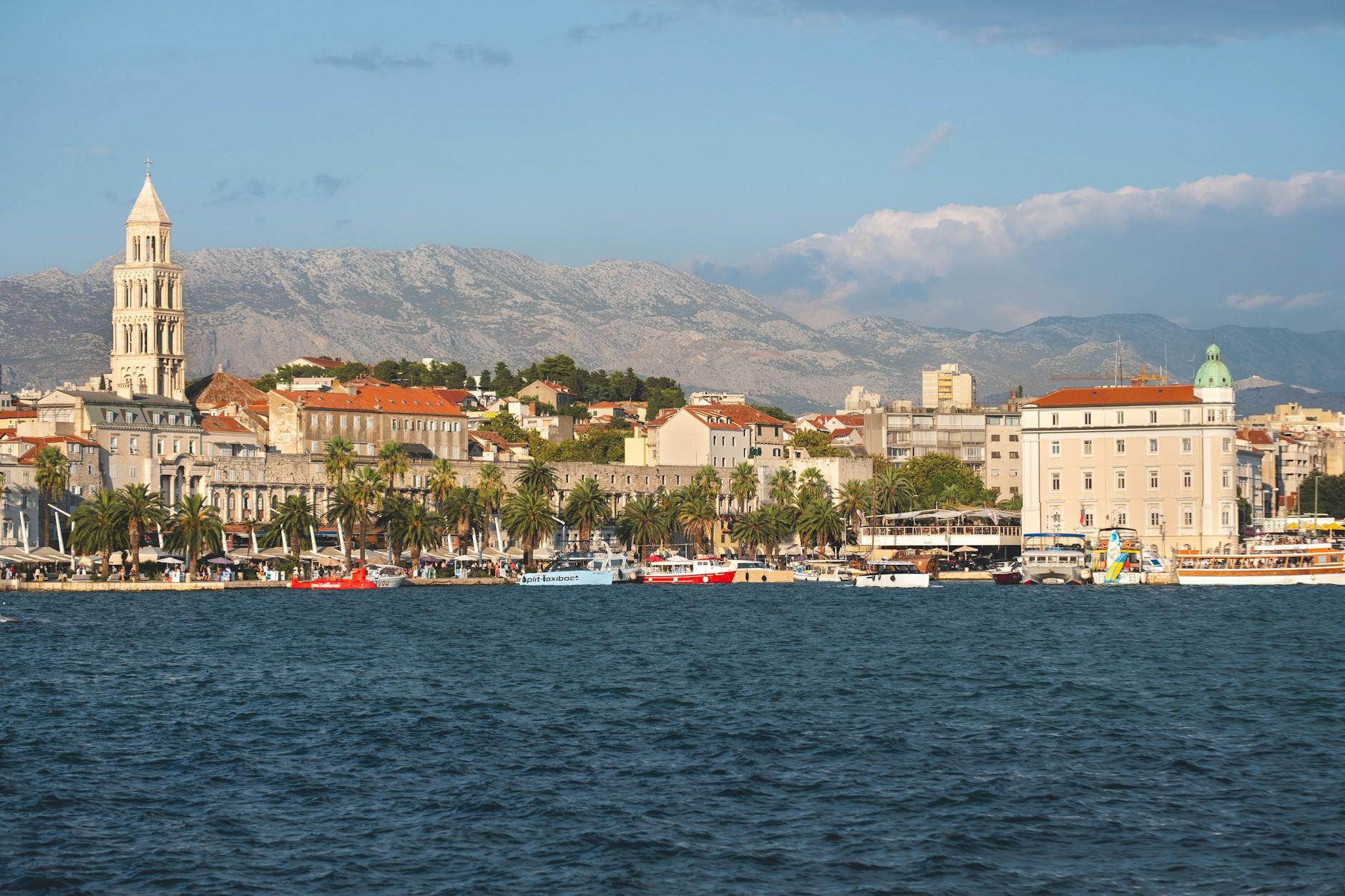
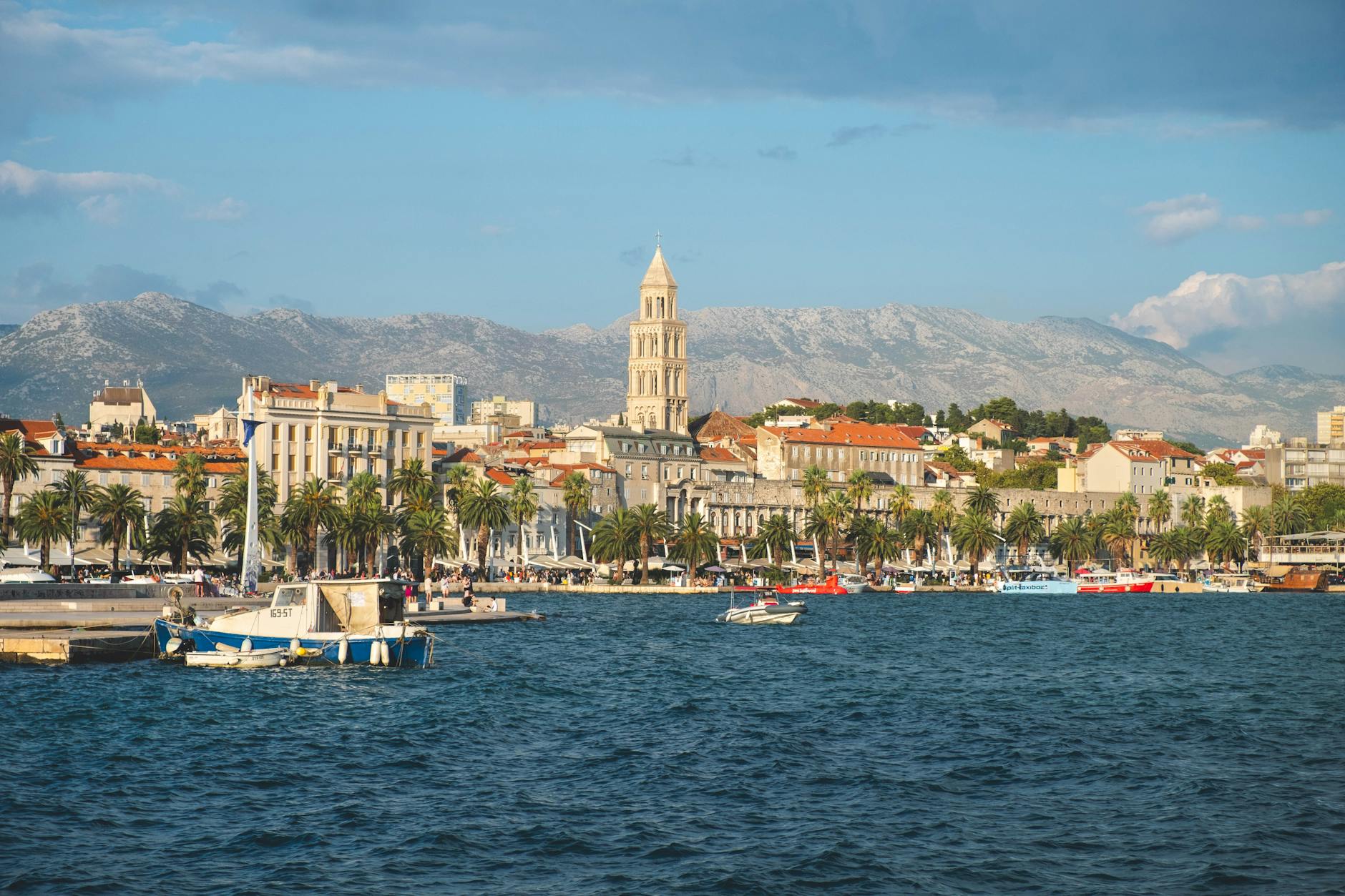


Croatia is in Schengen, so the 90-days-in-180 rule applies to most non-EU visitors, including travelers from the US, UK, Canada, and Australia. Your passport should usually be valid for at least 3 months beyond your Schengen departure date, and UK passports also need to be less than 10 years old on entry.
Croatia uses the euro, and cards work well in Zagreb, Split, Dubrovnik, airports, and most ferry ports. Carry some cash for market stalls, rural konobas, bakery runs, and the odd bus ticket; if an ATM offers conversion, decline it unless your card provider is worse.
Zagreb is the best year-round gateway, while Split, Dubrovnik, Zadar, and Pula make more sense for coast-first trips. Train links exist from Slovenia and Hungary, but for most travelers the faster plan is to fly in and then use buses or ferries.
Buses do most of the heavy lifting inside Croatia, especially on the coast and between places like Šibenik, Trogir, Split, and Dubrovnik. Ferries and catamarans are essential for Hvar, Korčula, and Vis, while trains are more useful around Zagreb, Varaždin, and Osijek than anywhere in Dalmatia.
Croatia has three travel seasons in one country: continental inland weather around Zagreb and Osijek, mountain weather around Lika and the Velebit zone, and Mediterranean heat on the Adriatic. July and August are hottest and busiest; May, June, and September usually give you better prices, easier parking, and water still warm enough to swim.
Mobile coverage is strong in cities, along the main coast, and on major islands, and free Wi-Fi is standard in most hotels, apartments, and many cafes. Buy an eSIM or local SIM if you need steady data for ferry changes, road apps, or apartment check-ins, because old stone lanes in Dubrovnik and hill roads inland can still produce dead spots.
Croatia is generally an easy, low-drama country for travelers, with the main risks being summer heat, slippery waterfront stones, and road fatigue on long coastal drives. Keep an eye on bags in crowded ferry terminals and old towns, use official taxis or apps in the cities, and check HAK before driving if wind or storms are forecast.
Dubrovnik, Hvar, and many sea-view rooms on the coast jump sharply in July and August. If you know your dates, locking in ferries and beds 6 to 10 weeks ahead usually saves more than hunting for last-minute deals.
Trains make sense around Zagreb, Varaždin, and Osijek, but they are not the backbone of a Dalmatia trip. For Split, Šibenik, Dubrovnik, and Plitvice Lakes, buses are usually the faster and more realistic choice.
Island ferries are not a scenic extra; they are how the route works. Book key catamarans to Hvar, Korčula, or Vis ahead in summer, and leave margin for wind delays if you have a same-day flight connection.
If a konoba offers peka, ask when you book, not when you sit down. The proper versions need hours under the bell, and the kitchen will not improvise one because you suddenly felt inspired at 8 pm.
Croatia is not the US. Round up in bars, leave 5 to 10 percent in restaurants if service was good, and do not assume every screen asking for a tip reflects local custom.
Apartments inside Dubrovnik, Split, and Korčula often involve steps, polished stone, and no parking at the door. Pack smaller than you think you need; one wheeled suitcase can turn into an argument with gravity.
Midday heat on the coast in July and August is real, especially on exposed walls, ferry decks, and lake trails. Sightsee early, swim or lunch in the middle of the day, and keep more water with you than feels necessary.
Explore Croatia with a personal guide in your pocket
Audio guides for 1,100+ cities across 96 countries. History, stories, and local insight — offline ready.

Probably not for a short tourist trip if you hold an EU, US, UK, Canadian, or Australian passport. Croatia is in Schengen, so most non-EU visitors follow the same 90-days-in-180 rule used across much of Europe, and your passport usually needs at least 3 months of validity beyond departure.
Usually a bit cheaper than Italy's best-known Adriatic and island destinations, but not cheap everywhere. Dubrovnik, Hvar, and peak-season coastal stays can feel close to Italian prices, while Zagreb, Osijek, and inland routes are easier on the budget.
Buses and ferries are the practical answer for most travelers. Use buses for the coast and places like Plitvice Lakes, use ferries for Hvar, Korčula, and Vis, and think of trains as a northern and eastern Croatia tool rather than a national one.
No, not directly, and in practice not at all. There is no rail line to Dubrovnik, so the normal options are bus, car, private transfer, or seasonal sea connections.
Yes, September is one of the smartest months to go. Sea temperatures are still good for swimming, crowds ease after late August, and you often get lower room rates plus a more adult, less school-holiday mood.
Seven to ten days is the useful middle ground for a first trip. That gives you enough time to combine one inland stop such as Zagreb or Plitvice Lakes with a coast or island section instead of spending the whole trip in transit.
Yes, generally very safe, including for solo travelers. The problems are usually ordinary travel ones rather than country-specific ones: heat, overconfident driving on coastal roads, and keeping an eye on bags in crowded ports or buses.
Carry both. Cards work in most hotels, restaurants, and transport hubs, but cash still helps in small cafes, markets, family-run konobas, and occasional rural or island situations where the card machine suddenly becomes a philosophical question.
Yes, but timing decides everything. Go in April, May, late September, or October, sleep inside or just outside the old town, and use early morning or evening for the walls; midday in high summer can feel like a queue with sea views.
Last reviewed