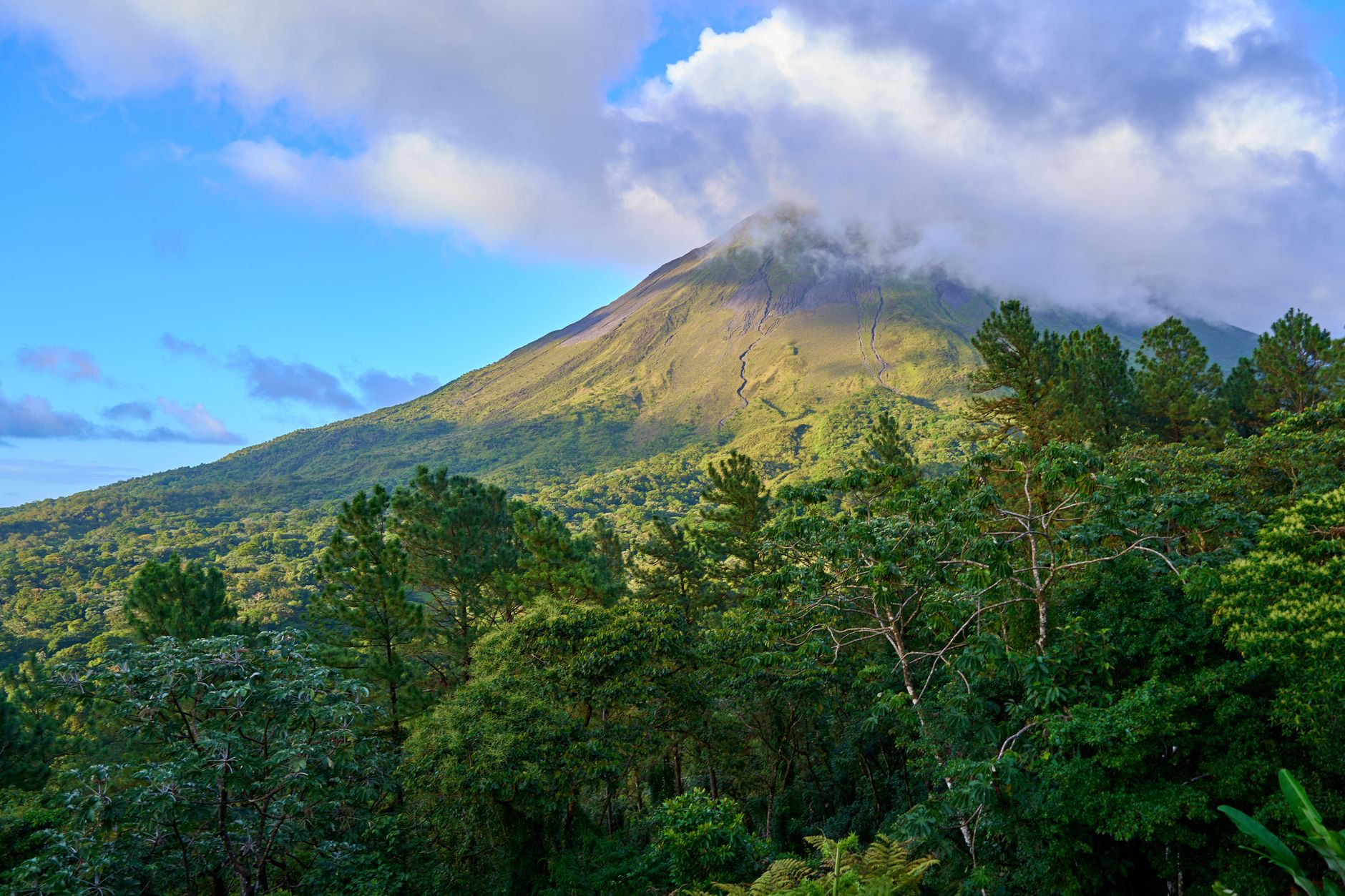
Costa Rica

Costa Rica feels bigger than it is because each region runs on its own climate, cuisine, and rhythm. Few countries let you move this quickly between volcano, cloud forest, Caribbean canal, and Pacific beach without losing the thread.

Capital
San José
Cities
3
Best season
December-April for most regions; September-October on the Caribbean coast
Trip length
10-14 days

Cities in Costa Rica

A Costa Rica travel guide starts with a paradox: this small country fits volcanoes, cloud forest, surf beaches, and turtle canals into one compact map.

Regions

  • San José

    Central Valley

    The Central Valley is where Costa Rica sounds most urban and most self-aware. San José can feel scrappy rather than pretty, but it makes sense once you use it as a base for Cartago's religious history and Sarchí's craft tradition, with coffee slopes and commuter towns filling the gaps between them.
  • La Fortuna

    Northern Highlands and Volcano Belt

    This is the Costa Rica of lava silhouettes, suspension bridges, and weather that changes by the hour. La Fortuna does volcano drama without making you suffer for logistics, while Monteverde trades heat for cloud, wind, and a forest canopy that feels closer to science fiction than to a postcard.
  • Liberia

    Guanacaste and the Northwest

    Northwest Costa Rica is drier, dustier, and more cattle-country than many travelers expect. Liberia is the practical hub, but the real character lies in broad ranchland, heat-shimmer afternoons, and access to Rincón de la Vieja, where steam vents and dry forest replace the country's better-known rainforest mood.
  • Puerto Viejo de Talamanca

    Caribbean Lowlands

    The Caribbean side moves to a different beat, shaped by Afro-Caribbean cooking, heavier humidity, and a softer relationship with the clock. Puerto Viejo de Talamanca is the obvious base, but Tortuguero shows the region's other face: canal villages, nesting turtles, and transport that starts with a boat schedule rather than a road map.
  • Puerto Jiménez

    Central Pacific and Osa

    This region splits cleanly in two. Jacó and Manuel Antonio are easy to reach and built for short beach escapes, but farther south the Osa Peninsula turns rougher, greener, and more serious, with Puerto Jiménez as the launch point for Corcovado and some of the country's best wildlife watching.
  • Turrialba

    Turrialba and the Eastern Highlands

    East of the capital, the country opens into river valleys, dairy country, and volcanic ridges that feel more agricultural than touristic. Turrialba is the anchor for whitewater on the Pacuare, access to its active volcano, and a calmer version of mountain Costa Rica than the busier Arenal-Monteverde circuit.

Suggested Itineraries

  1. 3 days

    3 Days: Central Valley at Close Range

    This short route stays near the capital and works when you want markets, church squares, coffee-country craft towns, and one solid look at how daily Costa Rica actually moves. San José gives you the urban pulse, Sarchí brings painted ox-cart heritage, and Cartago adds pilgrimage history and cooler air under Irazú's shadow.

  2. 7 days

    7 Days: Volcanoes, Forest, and the Northwest

    Start in Liberia, where the dry heat and ranching mood of Guanacaste feel different from the capital almost at once. Then move to La Fortuna for volcano views and hot springs, and finish in Monteverde for cloud forest, hanging bridges, and the kind of mist that gets into your backpack by noon.

  3. 10 days

    10 Days: Caribbean Coast and Canal Country

    This route shows a looser, rainier, more musically layered Costa Rica. Puerto Viejo de Talamanca gives you Afro-Caribbean food and beach life, Turrialba brings rivers and volcano country, and Tortuguero ends the trip in canals where boats replace roads and dawn starts with birds rather than engines.

  4. 14 days

    14 Days: Pacific Surf to the Osa Wilds

    Begin in Jacó for easy surf access and practical transport links, then slow down in Manuel Antonio where rainforest and beach share the same hillside. Finish in Puerto Jiménez, gateway to the Osa Peninsula, where Costa Rica stops feeling polished and starts feeling vast, muddy, and properly alive.

Top Monuments in Costa Rica

Plan your trip

Before you go

Visa
U.S., Canadian, and UK passport holders can usually enter Costa Rica visa-free for tourist stays of up to 180 days, though the immigration officer sets the exact number of days on arrival. You need a passport valid for your stay, proof of onward travel, and you may be asked to show funds of at least US$100 per month or partial month.
Currency
The local currency is the Costa Rican colón (CRC), but U.S. dollars are accepted almost everywhere in tourist areas from San José to Manuel Antonio. Card payments are common, yet buses, sodas, village shops, and some park-town businesses still work better with cash; VAT is 13%, and restaurant and hotel bills already include a 10% service charge.
Getting There
Most travelers arrive through SJO near San José or LIR near Liberia. SJO makes more sense for San José, La Fortuna, Tortuguero, Cartago, and the Central Pacific; LIR is the cleaner choice for Guanacaste beaches and the northwest.
Getting Around
Buses are the cheapest way across the country, but San José does not have one grand central terminal, so routes often start from different private stations. Rental cars save time on multi-stop trips, while domestic flights and shared shuttles are worth the extra money for Puerto Jiménez, Tortuguero connections, and long Pacific or Nicoya transfers.
Climate
Costa Rica runs on microclimates, not one tidy forecast. The Pacific side is driest from December to April, the Caribbean side is often better in September and October, and highland places like Monteverde stay cool, windy, and wet enough to justify a light jacket all year.
Connectivity
Wi-Fi is standard in hotels, guesthouses, and most cafes in San José, La Fortuna, Monteverde, and Puerto Viejo de Talamanca. Coverage weakens in mountain roads, national parks, and parts of the Osa Peninsula, so download maps before heading toward Tortuguero or Puerto Jiménez.
Safety
Costa Rica is one of the easier countries in the region for independent travel, but petty theft is common in cities, beaches, buses, and rental cars. Do not leave bags visible, use licensed taxis or arranged transfers from airports, and take river levels, surf conditions, and volcanic closures more seriously than the crime statistics.

Tips for visitors

  • Pay in colones

    Use colones for buses, sodas, market snacks, and small purchases. Dollars are accepted, but the exchange rate on the spot is rarely generous and your change often comes back in CRC anyway.
  • Trains are local

    Costa Rica's trains are commuter tools around the Central Valley, not a countrywide travel network. Use them for short hops near San José, Heredia, and Alajuela, then switch to buses, shuttles, flights, or a car.
  • Book peak season early

    Reserve rooms and rental cars well ahead for January, February, Easter week, and much of July. The best small lodges around Manuel Antonio, Monteverde, Tortuguero, and Puerto Jiménez do not wait for last-minute planners.
  • Pad your drive times

    A 120-kilometer drive can easily take three or four hours once rain, trucks, one-lane bridges, and mountain curves join the conversation. Avoid planning more than one major transfer on the same day if you want to arrive sane.
  • Eat in sodas

    For value, start with family-run sodas rather than polished tourist menus. A casado or gallo pinto lunch there often costs a fraction of what you will pay near national-park gates or beachfront strips.
  • Guard the car

    Nothing advertises a rental car break-in like bags left on seats at a trailhead or beach car park. Keep passports, electronics, and cameras out of sight, or better, keep them on you.
  • Ask softly

    Politeness gets better results than volume. A calm greeting, a quick 'buenas,' and a patient follow-up usually work better than pushing for a hard yes on the first try.
  • Download before remote stops

    Signal drops fast once you head toward Tortuguero boat docks, Corcovado access points, or back roads around Monteverde. Save offline maps, tickets, and lodge directions before leaving the last reliable town.

The story of Costa Rica

Costa Rica rewards travelers who want range, not just rest. You can wake to coffee in San José, watch mist drag across the ridges of Monteverde by lunch, and end the day in the hot-spring country around La Fortuna, where Arenal still shapes the horizon even in silence. The distances look easy on a map, but the real story is altitude: 1,500-meter cloud forest, wet Caribbean lowlands, and Pacific beaches with entirely different weather patterns. That is why first-time trips work best when you choose a few regions and let each one breathe.

Wildlife is not an optional extra here. Manuel Antonio puts monkeys, sloths, and white-sand coves in one manageable day, while Tortuguero trades roads for canals and turns the journey itself into part of the point. Farther south, Puerto Jiménez opens the door to the Osa Peninsula, where the rainforest feels less curated and more absolute. Then the mood changes again on the Caribbean side in Puerto Viejo de Talamanca, where Afro-Caribbean cooking, surf breaks, and humid streets give Costa Rica a different voice. Same country. Different tempo.

Culture often gets overshadowed by zip lines and jungle lodges, which is a mistake. Cartago still carries the weight of colonial faith and earthquakes, Sarchí keeps the painted ox-cart tradition alive without embalming it, and Turrialba sits close to both fertile farmland and one of the country's most restless volcanoes. In Jacó and Liberia, you see the practical side of travel logistics: beach access, transport hubs, road-trip staging points. Costa Rica works because nature is only half the story; the other half is how people built a country around weather, coffee, migration, and the quiet discipline behind pura vida.

c. 400-1500

Granite Spheres in the Wet Heat of the Diquis

Morning mist hangs over the Diquis Delta, and out of the grass rises a stone sphere so precise it still looks like a provocation. Between about 400 and 1500, the chiefdoms of Costa Rica's southern Pacific produced these granite forms in sizes ranging from a fist to nearly 3 meters across, some weighing up to 16 tonnes. No metal tools. No wheel. And yet the surface curves with an assurance that still unsettles archaeologists.

Ce que l'on ignore often is that these were not decorative curiosities scattered by chance through the jungle. UNESCO's research points to ranked settlements, ceremonial spaces, and political centers where spheres marked authority. This was not an empty tropical frontier before the Spaniards. It was a world of chiefs, controlled routes, prestige objects, and power made visible in stone.

Then came the indignity of the 1940s. As the United Fruit Company cleared land for banana plantations, workers unearthed sphere after sphere and rumors spread that gold lay hidden inside. Some were drilled, some blasted, some dragged away to gardens and gateposts. Doris Stone, the archaeologist who first documented them in 1943, worked with the odd sorrow of someone studying ruins while the bulldozers were still warm.

That wound matters because it tells you something essential about Costa Rica. The country often presents itself through rainforest and civility, yet one of its deepest stories begins with an unresolved mystery and a modern act of destruction. The stone people were not erased in one blow. They were first weakened by conquest, then nearly forgotten by commerce, and that forgetting would shape everything that followed.

1502-1821

The Rich Coast That Turned Out to Be Poor

In 1502 Christopher Columbus dropped anchor off the Caribbean coast on his fourth voyage and saw Indigenous people wearing gold ornaments. The phrase Costa Rica, the Rich Coast, clung to the map with almost comic confidence. The trouble was simple: the gold was real, but not abundant enough to make this corner of Central America useful to the Spanish Empire in the way Peru or Mexico would be.

What followed was not imperial splendor but neglect. Cartago, founded inland in 1563, became the colonial capital, though capital is almost too grand a word for a poor provincial town ringed by mud, fields, and recurrent anxiety. Governors complained, settlers farmed their own plots because large Indigenous labor systems had collapsed under disease and violence, and the colony acquired a reputation as the assignment no one wanted.

One man stands out in this harsh opening act. Juan Vazquez de Coronado, governor in the 1560s, tried to impose order with less bloodshed than most conquistadors managed or cared to manage; his letters to the Spanish crown describe the land with a curiosity that feels startlingly human beside the usual brutality of the age. He died in a shipwreck near the Azores in 1565, only forty-two years old. A life cut short. Almost operatic.

The colony's poverty later fed a national legend: that Costa Rica grew into a land of smallholders rather than vast aristocratic estates. The legend smooths away plenty of inequality, but it contains a hard kernel of truth. By the time independence arrived from Guatemala City in 1821, not with cannon but with paperwork and delay, Costa Rica had already learned to live with distance, improvisation, and a certain suspicion of grand imperial promises.

1821-1948

From Cartago's Ruins to the Coffee Fortune of San Jose

A republic can begin with a road, a ledger, and a bag of coffee. During the 19th century, Costa Rica shifted power from old Cartago toward San Jose, where merchants, officials, and exporters built a new political center on the profits of coffee grown in the Central Valley. The bean changed everything: land values, class ambition, architecture, and the country's sense of itself. By the late 1800s, coffee was not just a crop. It was a social order.

Ce que l'on ignore often is how theatrical this supposedly modest republic could be. Juan Mora Fernandez, the first head of state, pushed the young country toward schools and administration, but later presidents wanted display as well as discipline. Under Tomas Guardia and the liberal reformers, Costa Rica built railways, secularized institutions, and tied its economy to Atlantic export routes. Foreign capital arrived with force, above all through Minor C. Keith and the railroad to the Caribbean, and bananas soon joined coffee in the national drama.

The age had its saints and its stagecraft. In 1856, when William Walker's filibusters threatened Central America, the campaign against them produced Costa Rica's most famous popular hero, Juan Santamaria, the humble drummer boy from Alajuela said to have set fire to the enemy stronghold at Rivas before dying of his wounds. Legend and documentation do not fit together perfectly here, but that is often how nations choose their martyrs. They select the figure who gives courage a face.

Then nature reminded the republic who still held the last word. The earthquake of 4 May 1910 shattered Cartago, toppling buildings and leaving the old capital marked forever by absence. Today, when you stand in Cartago among the Ruinas de Santiago Apostol and then walk toward the Basilica of Our Lady of the Angels, you feel the peculiar Costa Rican braid of faith, fragility, and persistence. A coffee republic had grown up. It had also learned how quickly stone can fall.

1948-Present

The Civil War, the Missing Army, and the Invention of Pura Vida

In 1948, Costa Rica entered one of the few truly violent passages in its modern history. A disputed election triggered a brief civil war that lasted 44 days and killed around 2,000 people, a terrible number in a small country. Jose Figueres Ferrer, the rebel leader with the farmer's practicality and the reformer's ego, emerged victorious and then did something so startling it still defines the nation: he abolished the army in 1948.

The gesture was not pure innocence. It was politics, calculation, and vision all at once. Money that might have gone to barracks could now be steered toward schools, health care, and state-building, and the 1949 constitution fixed that new order into law. In Latin America, where generals so often stride back onto the stage, Costa Rica quietly removed the costume rack.

This did not produce paradise. Banana enclaves had already scarred the Caribbean lowlands, inequality never vanished, and ecological virtue came later than the national mythology likes to admit. Yet from the late 20th century onward Costa Rica did build something unusual: a stable democracy, strong protected areas, and an international image tied less to force than to forests, science, and a cultivated civic decency. Monteverde became a byword for cloud forest wonder, Tortuguero for turtles and canals, La Fortuna for volcanic theater, Manuel Antonio for a park where monkeys behave as if they own the concession, and Puerto Jimenez for the wild threshold of the Osa Peninsula.

That reinvention still has a human scale. In San Jose, amid traffic and government facades, the country's self-image remains half serious and half sly; in Sarchi, the painted ox cart survived long enough to become a national emblem; in Turrialba and Cartago, volcanoes continue to remind everyone that geology is the oldest minister of state. Pura vida sounds casual on the surface. Underneath it sits a republic built after war, kept alive by compromise, and always one election away from having to prove itself again.

Costa Rica From Stone Chiefdoms to the Second Republic

A small country with a long memory of survival, improvisation, and reinvention

  1. c. 400

    Diquis chiefdoms begin shaping stone spheres

    In the southern Pacific delta, complex chiefdoms begin producing the granite spheres that remain Costa Rica's most haunting pre-Columbian objects. Their precision suggests organized labor, skilled planning, and political authority made visible in stone.

  2. c. 800-1500

    Ranked settlements spread across the Diquis region

    Archaeological evidence points to ceremonial centers and subordinate villages tied into a clear hierarchy. Long before conquest, this was a landscape of local power, not an empty green backdrop.

  3. 1502

    Columbus reaches the Caribbean coast

    On his fourth voyage, Christopher Columbus anchors off the coast of present-day Costa Rica and reports seeing gold ornaments. The name Costa Rica, the Rich Coast, outlives the actual quantity of riches the Spanish hoped to find.

  4. 1563

    Cartago is founded

    The inland city of Cartago becomes the colony's administrative center, though colonial grandeur never quite arrives with it. Mud, distance, and scarcity shape the province more than imperial luxury ever does.

  5. 1565

    Juan Vazquez de Coronado dies at sea

    The governor most associated with the early consolidation of Spanish rule dies in a shipwreck near the Azores while returning to Spain. His letters remain among the most vivid early descriptions of the territory.

  6. 1635

    Tradition dates the discovery of La Negrita

    According to devotion in Cartago, Juana Pereira finds the small dark image of the Virgin that becomes Nuestra Senora de los Angeles. The story turns a local apparition into one of the country's enduring centers of pilgrimage.

Show the full timeline (21 moments)
  1. 1666

    Cartago suffers a major pirate-era attack

    The old capital, already poor and vulnerable, is hit during the violent Caribbean struggles that entangle pirates, local raiders, and imperial weakness. Costa Rica's colonial story is less about treasure fleets than about exposure and neglect.

  2. 1821

    Independence arrives from Guatemala

    Central America declares independence from Spain on 15 September 1821, and the news eventually reaches Costa Rica by messenger rather than battlefield thunder. The republic begins almost quietly, with delay instead of drama.

  3. 1824

    San Jose rises in the new republic

    After early struggles between cities, San Jose emerges as the political center of independent Costa Rica. The shift marks the start of a new axis of power away from colonial Cartago.

  4. 1824-1833

    Juan Mora Fernandez shapes the young state

    As the first head of state, Mora Fernandez pushes education and civil administration in a country with few resources and little imperial inheritance to lean on. His style helps fix moderation into the republic's self-image.

  5. 1856

    War against William Walker and the legend of Juan Santamaria

    Costa Rican forces join the regional struggle against the filibuster William Walker. Out of the fighting at Rivas comes the martyr story of Juan Santamaria, the humble soldier who gives courage a national face.

  6. 1871

    Liberal state-building accelerates

    The constitution of 1871 anchors a more centralized liberal order, while coffee wealth and export ambition keep remaking the country. Reform, railways, and secularizing impulses begin to travel together.

  7. 1890

    The National Theatre opens in San Jose

    Financed largely by coffee wealth, the Teatro Nacional gives the capital a polished European mask and a statement of elite ambition. Behind the velvet and marble stands the hard arithmetic of export agriculture.

  8. 1910

    The Cartago earthquake devastates the old capital

    A massive earthquake destroys much of Cartago on 4 May 1910, leaving ruins that still shape the city's memory. Sacred devotion and seismic fragility become inseparable in the landscape.

  9. 1943

    Doris Stone publishes on the stone spheres

    Her early documentation helps draw scholarly attention to the Diquis spheres just as agricultural expansion is damaging many sites. Study and destruction proceed side by side, which gives the episode its bitterness.

  10. 1948

    Civil war redraws the republic

    A disputed election triggers a short but bloody civil war. The conflict lasts only 44 days, yet it becomes the hinge between the old republic and the constitutional order that follows.

  11. 1948

    Jose Figueres Ferrer abolishes the army

    After victory in the civil war, Figueres eliminates the military institution that had shadowed so much of regional politics. It is one of the most consequential gestures in modern Latin American statecraft.

  12. 1949

    A new constitution founds the Second Republic

    The constitution of 1949 formalizes the postwar settlement and helps lock in a state centered on elections, education, and civilian institutions. Costa Rica begins building the reputation it still trades on today.

  13. 1979

    Lake Arenal expands with the hydroelectric project

    The enlarged reservoir transforms the region around Arenal and becomes a major source of electricity. Modern Costa Rica's environmental and energy story is never purely natural; it is engineered as well.

  14. 1987

    Oscar Arias wins the Nobel Peace Prize

    The prize recognizes Arias's role in Central American peace efforts at a time when neighboring countries are torn by war. Costa Rica's image as a diplomatic outlier gains international force.

  15. 2014

    Stone spheres of the Diquis enter the UNESCO list

    The Precolumbian Chiefdom Settlements with Stone Spheres of the Diquis are inscribed as World Heritage. A mystery long neglected, damaged, and displaced returns to the center of the national story.

Culture & food

  • language

    A Country Spoken in the Formal Intimate

    Costa Rican Spanish performs a trick that would fail anywhere else. It calls you usted and puts its hand on your shoulder at the same time. In San José, a fruit seller can ask what you need with the grammar of diplomacy and the warmth of an aunt who has already decided you look underfed.

    That is the first seduction. Formality here does not freeze the air; it sweetens it. Vos circulates among friends, mae pops up like a pebble in the mouth, diay does the work of an entire raised eyebrow, and pura vida dissolves inconvenience with the efficiency of salt in hot water. A country is a table set for strangers.

    Listen closely and the country splits into climates of speech. The Central Valley rounds its phrases differently from the Caribbean coast, where Puerto Viejo de Talamanca carries the music of Limonese Creole in the street, in kitchens, in jokes, in the easy code-switching that tells you Costa Rica was never one single voice. Even the silences have dialects.

    Foreigners often mistake this softness for vagueness. They are wrong. The language avoids blunt collision, then achieves its point anyway, which is a more refined form of power. You are not pushed. You are rearranged.

  • etiquette

    The Art of Not Cornering Anyone

    Costa Rican politeness has no taste for spectacle. People greet the room, lower the temperature of requests, and leave enough space around every interaction for dignity to breathe. Ask for something too loudly, too fast, too sure of your own rightness, and you will hear the social fabric tighten like a violin string.

    This is not timidity. It is choreography. A waiter in Cartago may answer with perfect courtesy and still decline to bend the world around your impatience; a shopkeeper in Liberia may smile, agree in principle, and allow your absurd plan to die naturally by never helping it happen. Rejection here prefers silk gloves.

    The genius lies in the refusal to humiliate. Conflict is often wrapped in humor, delayed by tact, or redirected into a softer shape, which makes daily life feel lighter than it is. Sandals, yes. Also steel.

    Travelers who understand this have an easier time everywhere from Sarchí to Turrialba. Say good morning before business. Ask instead of demand. Leave one beat of silence after the answer. In Costa Rica, manners are not decoration. They are engineering.

  • cuisine

    Rice, Beans, and the Secret Life of Precision

    The national cuisine hides behind modest nouns. Rice. Beans. Plantain. Corn. Broth. Then you taste it and discover that modesty was camouflage. A gallo pinto at breakfast in San José is not the same creature as one on the Caribbean side; the grains separate differently, the seasoning changes its accent, the spoon remembers another coast.

    Costa Rica cooks with repetition the way a composer uses a bass line. Rice and beans return at dawn, noon, and night, yet never as lazy habit. Casado is the republic arranged on a plate: rice, beans, salad, plantain, picadillo, some meat or fish, each item keeping its border and still entering the same sentence. Order has flavor.

    Then come the dishes that reveal the country’s deeper pulse. Olla de carne tastes of a patient household and a pot that began its labor before noon. In Limón, patí and rondón announce that the Caribbean did not ask permission to alter the national palate; it arrived with coconut milk, chile, thyme, and memory, and changed the grammar of lunch.

    The right place to understand this is not a polished dining room. It is a soda with six plastic tables, a coffee thermos, and a cook who knows exactly how much Lizano belongs in the pan and would never tell you the number. Technique dislikes boasting.

  • religion

    Black Madonna, White Socks, Asphalt Pilgrimage

    Costa Rica can look secular until August proves otherwise. Then the road to Cartago fills with bodies moving toward the Basílica de Nuestra Señora de los Ángeles, and piety becomes visible in knees, shoulders, plastic ponchos, and the peculiar solemnity of people who have decided that walking all night is a reasonable answer to suffering.

    At the center waits La Negrita, the small dark stone Virgin discovered, according to tradition, in 1635 by Juana Pereira. She is tiny. That is part of her force. Nations often attach themselves to large monuments because scale flatters power; Costa Rica chose a figure you could almost hide in your hand.

    The basilica itself is less interesting than the movement around it. Families arrive carrying petitions, gratitude, medical reports, babies, impossible hopes. Some enter in sneakers. Some on their knees. Devotion, like cuisine, prefers repetition.

    Even for those with no faith, the ritual teaches something about the country. Religion here is less thunder than persistence. It returns annually, walks the highway, drinks sweet coffee at dawn, and places its trust in a stone small enough to embarrass empires.

  • architecture

    Tin Roofs, Painted Wheels, and Concrete with Moss

    Costa Rican architecture does not seduce by monumentality. It seduces by adaptation. The house learns the rain before it learns style; the roof extends, the veranda widens, the bars on the window become both caution and ornament, and the building enters into an argument with humidity that will never be fully won.

    In San José, fragments of earlier ambition survive between practical structures and hard traffic. One façade remembers Europe, another remembers an earthquake, a third remembers budget limits, and the whole city produces a nervous charm born from improvisation rather than master planning. Perfection would feel suspicious here.

    Elsewhere, the country preserves different signatures. In Sarchí, the painted ox cart turns design into national memory: geometry on wood, color as inheritance, labor made ceremonial. In Cartago, the ruins of the old parish church after the 1910 earthquake stand as a lesson in the vanity of stone and the persistence of gardens. Moss is an architect too.

    What matters most is the way buildings accept climate as a co-author. Open corridors, tiled floors, high ceilings, shade used as material. Costa Rica rarely builds against nature with total confidence. It negotiates. That modesty may be its finest line.

  • philosophy

    Pura Vida, Misunderstood on Purpose

    Foreigners treat pura vida like a slogan and therefore miss the point. It is not optimism. It is not laziness. It is not even happiness, at least not in the glossy sense. It is a compact philosophy of proportion: keep the inconvenience in scale, keep the pleasure near at hand, keep the ego from becoming the loudest object in the room.

    This sounds simple. It is not. To live that way in a country of rain, bureaucracy, road washouts, active volcanoes, and tropical abundance requires a disciplined talent for refusing melodrama. When a Costa Rican says pura vida, the phrase can mean delight, resignation, irony, tenderness, or simple social glue. Its genius is its elasticity.

    You feel the philosophy most clearly outside the postcard scenes. On a bus delayed three times. In La Fortuna, when the volcano remains hidden in cloud and nobody bothers to stage outrage. In Monteverde, where mist erases the famous view and the cloud forest still asks for attention at the distance of a leaf.

    Aphorisms usually annoy me. This one earns its keep. Pura vida is what happens when a nation chooses survivable grace over theatrical control.

Taste the Country

  • Gallo pinto

    Breakfast. Eggs, natilla, plantain, coffee. Forkfuls built, not sampled.

  • Casado

    Lunch in a soda. Rice, beans, salad, plantain, protein. Coworkers, drivers, grandmothers, everyone.

  • Olla de carne

    Midday or rainy afternoon. Broth first, solids after. Family table, tortillas, patient silence.

  • Tamal de cerdo

    December mornings. Plantain leaf opened like a letter. Coffee, cousins, judgments about whose batch won.

  • Patí

    Hot from a bakery or counter in Puerto Viejo de Talamanca. Handheld, flaky, fiery. Bus stop food, beach food, no cutlery.

  • Rondón

    Coastal meal in Limón country. Coconut broth, fish, tubers, chile. Bowls, spoons, heat, conversation.

  • Chorreadas

    Fresh corn ground and griddled. Natilla or white cheese on top. Late breakfast, market stop, fast happiness.

Notable Figures

  • Doris Stone

    Archaeologist · 1909-1994

    She began publishing on the stone spheres in 1943, just as plantation expansion was damaging the sites that made her career. Her link to Costa Rica carries a sharp irony: she was studying a past that the banana economy around her was busy disfiguring.

  • Juan Vazquez de Coronado

    Conquistador and governor · 1523-1565

    He is remembered in Costa Rican history with more complexity than most conquistadors because he tried, at least by the standards of his century, to limit indiscriminate violence. His surviving letters from the 1560s read like dispatches from a man who saw both territory and human reality, then died before he could turn either into a long career.

  • Juana Pereira

    Figure of popular devotion · 17th century

    The story says a young girl of mixed ancestry found a small dark stone image of the Virgin on a rock near Cartago, carried it away, and saw it return miraculously to the same spot. Whether one reads it as faith, folklore, or social allegory, the tale still shapes the great pilgrimage to the Basilica de Nuestra Senora de los Angeles every 2 August.

  • Juan Mora Fernandez

    First head of state · 1784-1854

    He helped pull the new state away from colonial drift and toward schools, administration, and a functioning public life. Costa Rica likes to imagine itself born moderate and sensible; Mora Fernandez is one reason that fantasy has some evidence behind it.

  • Juan Santamaria

    National hero · 1831-1856

    The young drummer from Alajuela became the republic's martyr after the battle of Rivas, where tradition says he burned the enemy stronghold at the cost of his own life. Historians still argue over details, but nations are often revealed by the stories they choose to keep polishing.

  • Tomas Guardia Gutierrez

    President and military strongman · 1831-1882

    Guardia ruled with authority that could be heavy-handed, yet under his watch the country advanced rail construction, legal reform, and state modernization. Costa Rica's civility was not assembled only by gentle schoolmasters; men with uniforms also helped build the frame.

  • Minor C. Keith

    Railroad entrepreneur and banana magnate · 1848-1929

    He arrived to build tracks and ended by reorganizing whole landscapes around export logic, debt, and labor. If coffee gave Costa Rica its self-image, Keith helped give it the harsher modern lesson that infrastructure is never just infrastructure.

  • Carmen Lyra

    Writer and educator · 1887-1949

    Best known abroad for Cuentos de mi tia Panchita, she mattered at home because she used writing and teaching to expose class hypocrisy and defend workers. Behind the schoolbook aura stood a woman with political bite, eventually driven into exile after the 1948 conflict.

  • Jose Figueres Ferrer

    Statesman and founder of the Second Republic · 1906-1990

    Few leaders leave behind a single act that changes a country's international image for generations. Figueres did: he dismantled the military institution that had shaped so much of Latin American politics, then recast Costa Rica as a republic of ballots, schools, and argument.

  • Franklin Chang-Diaz

    Astronaut and physicist · born 1950

    His story begins in San Jose and arcs all the way to NASA, which is not the route most tropical republics advertise in their national mythology. He matters because he gives Costa Rica a modern heroic register beyond coffee, volcanoes, and civic virtue: science, ambition, and orbital scale.

Frequently asked

Do U.S. citizens need a visa for Costa Rica?

Usually no, for tourist stays under 180 days. The exact number of days is decided on arrival, and you should carry proof of onward travel plus a passport valid for your stay.

Is Costa Rica expensive compared with the rest of Central America?

Yes, usually the most expensive mainstream destination in mainland Central America. Budget travelers can still manage on roughly US$45-70 a day, but beach towns, guided wildlife trips, and rental cars push costs up quickly.

Is it better to fly into San José or Liberia for Costa Rica?

Fly into San José for the Central Valley, La Fortuna, Tortuguero, Manuel Antonio, and most trips that start inland. Fly into Liberia if your plan is mainly Guanacaste or the northwest Pacific coast.

Can you use U.S. dollars in Costa Rica?

Yes, especially in tourist areas, hotels, tour agencies, and many restaurants. You will still want colones for buses, local eateries, tips, small shops, and cleaner day-to-day pricing.

Do I need a car in Costa Rica or can I use buses?

You can absolutely use buses, especially for major routes and if you are watching costs. A car becomes worth it when you want flexibility, dawn wildlife starts, remote lodges, or a multi-stop trip through Guanacaste or the South Pacific.

What is the best month to visit Costa Rica?

For the Pacific side, February and March are the safest all-round bet for sun and easier road conditions. For the Caribbean side, September and October often work better, which is why one national 'best month' is the wrong way to think about Costa Rica.

Is Costa Rica safe for solo travelers?

Yes, broadly speaking, especially compared with much of the region. The real nuisance is theft rather than violent crime, so watch bags on buses, beaches, in San José, and anywhere a parked rental car sits too long.

How many days do you need in Costa Rica?

Seven to ten days is enough for one region plus one contrast, such as La Fortuna and Monteverde or Puerto Viejo de Talamanca and Tortuguero. Two weeks gives you room for a Pacific route down to Manuel Antonio or Puerto Jiménez without turning the trip into a transfer marathon.

Do restaurants in Costa Rica expect a tip?

Not in the American sense, because a 10% service charge is usually already built into the bill, along with 13% VAT. Leave extra only when the service was genuinely better than routine.

Sources & attribution5
Photo credits (3)
  1. Koen Swiers — Pexels License (https://www.pexels.com/license/) — Source: https://www.pexels.com/photo/12832297/
  2. Lachcim Kejarko — Pexels License (https://www.pexels.com/license/) — Source: https://www.pexels.com/photo/5819273/
  3. Gotta Be Worth It — Pexels License (https://www.pexels.com/license/) — Source: https://www.pexels.com/photo/29943338/

Photos may have been resized or cropped.