mountain_flag
Altitude Shapes Everything
Colombia sits on the equator, yet temperature changes with elevation, not month. Bogotá stays cool at 2,640 meters, Medellín lands in springlike air, and Cartagena runs hot by the sea.
Colombia makes sense once you stop treating it as a single mood. Altitude, coast, and history change the country every few hundred kilometers, which is exactly why one trip here feels so large.
 Colombia
EntryUS, UK, EU, CA and AU travelers usually get 90 days visa-free
CA Colombia travel guide starts with one fact most travelers miss: this country runs on altitude, not seasons, so Bogotá, Cartagena, and Medellín can feel like three different trips.
Colombia packs an unusual amount of geography into one itinerary. In a single week, you can wake at 2,640 meters in Bogotá, where mornings call for a jacket and a bowl of ajiaco, then end the same trip in Cartagena under Caribbean heat with coconut rice and sea salt still on your hands. That shift is the country’s real trick. The Andes split into three ranges, the Magdalena River cuts through the middle, and both the Caribbean and Pacific coasts pull the culture in different directions. You don’t visit one Colombia. You move between Colombias, each with its own weather, table, accent, and pace.
The headline attractions earn their reputation, but the country’s depth sits in the transitions. Medellín’s cable cars and valley light explain one version of modern Colombia; Salento and Manizales show another, where coffee grows on steep green folds and the wax palm rises absurdly high above the Quindío valley. On the Caribbean side, Santa Marta opens the road to the Sierra Nevada, while Mompox slows the Magdalena story to a near whisper of churches, river trade, and colonial facades left far from the cruise-ship script. Even the capitals of mood keep changing. Cali moves to salsa time. Popayán turns white stone and measured ritual into an entire streetscape.
Sacred Gold and Stone Kingdoms, c. 1000 BCE-1537
A cold lake at dawn, high in the hills above present-day Bogotá: that is where one of Colombia's founding misunderstandings began. Muisca ritual placed a newly invested ruler on a raft, his skin coated in resin and dusted with gold, while emeralds and votive offerings disappeared into the black water of Guatavita. The Spaniards heard the story and made the usual error of conquerors. They turned a ceremony into a map.
Ce que l'on ignore souvent, c'est que Colombia before the conquest was not one empire waiting for a crown. It was a mosaic of powers, languages, and landscapes: the Muisca on the cool plateau around Bogotá, the Quimbaya in the coffee-bearing hills near present-day Manizales and Salento, the Tairona in the Sierra Nevada above Santa Marta, and older ceremonial cultures farther south at San Agustín and Tierradentro. Stone, salt, cotton, coca, feathers, and gold moved across mountain roads long before a European horse set hoof here.
The most haunting monuments are not always the best known. In Tierradentro, spiral staircases sink into painted underground tombs, red and black geometry intact after centuries of damp silence. At San Agustín, in the upper Magdalena, great stone figures with feline teeth still stare into the rain as if the priests have only just stepped away. And in the jungle above Santa Marta, Ciudad Perdida, founded around the 8th century, rose terrace by terrace from the mountain long before Machu Picchu existed.
Then came the glittering trap. Goldwork so refined that modern visitors in Bogotá still stop short before the Muisca raft was never merely decoration; it was diplomacy, sacrifice, status, theology made visible. The tragedy is simple. A civilization offering treasure to the gods found itself pursued by men who preferred to melt the gods down.
Tisquesusa, the last independent Zipa of Bacatá, did not die in a grand battle but, according to colonial accounts, bled to death in the reeds after a night ambush near what became Bogotá.
The legend of El Dorado began not with a city, but with a ruler covered in gold dust standing on a raft in Lake Guatavita.
Conquest, Fortresses, and the Empire of Fear, 1537-1810
The conquest of the Colombian highlands has the air of a mad race staged by men who had misread both geography and Providence. Gonzalo Jiménez de Quesada came up the Magdalena from the Caribbean, losing hundreds of men to hunger, disease, and the river itself. Sebastián de Belalcázar marched north from Quito. Nikolaus Federmann arrived from Venezuela. By 1539, all three had reached the same plateau around Bogotá within months of one another. After such slaughter, the ending was almost comic: rather than settle the matter with swords, they sailed to Spain to ask the king who deserved the credit.
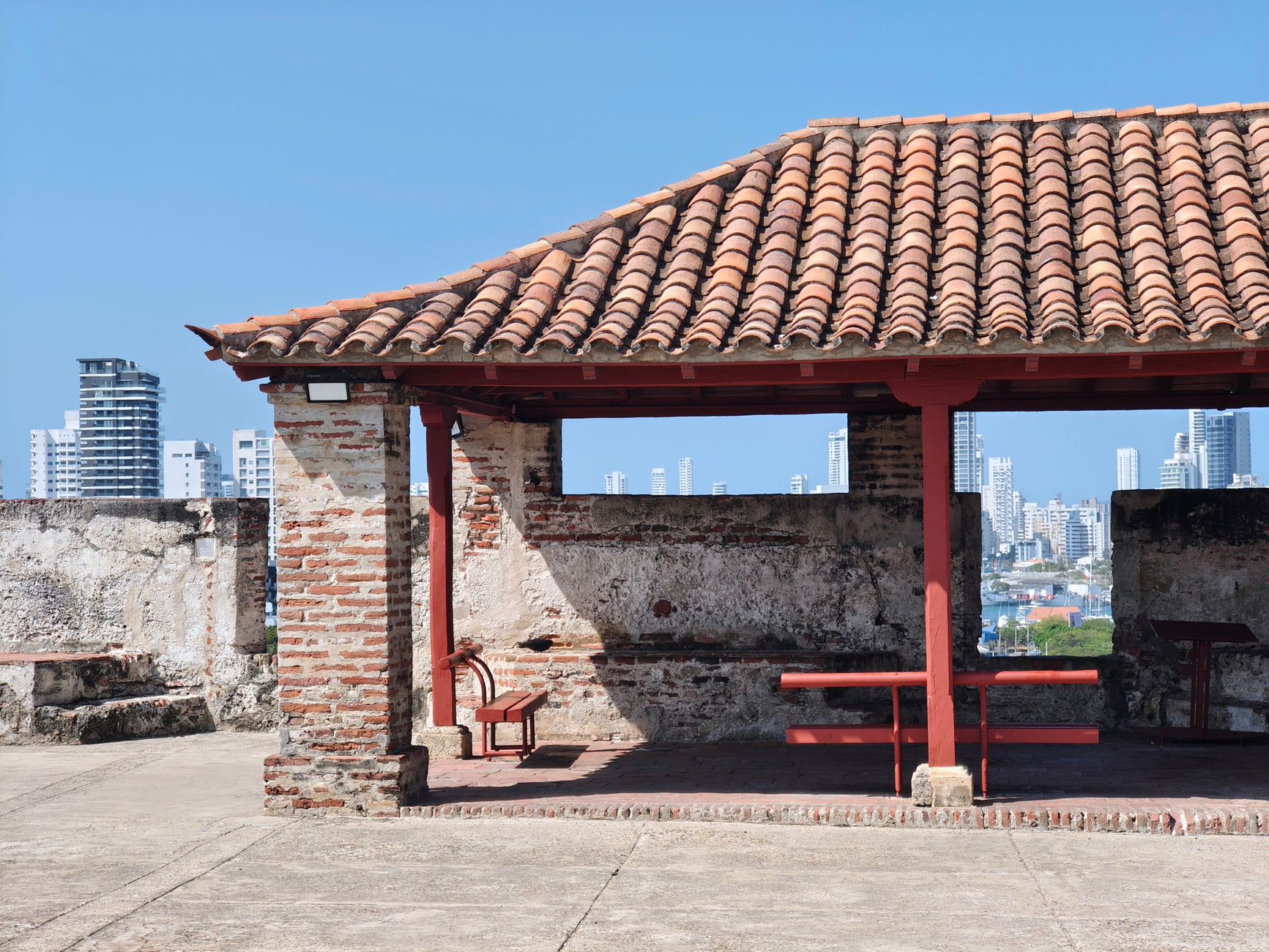
On the coast, Cartagena became the jeweled lock on Spain's American treasury, and therefore an irresistible target. Francis Drake attacked in 1586 and held the city to ransom, destroying buildings methodically until payment came. The answer was masonry on an imperial scale: bastions, curtains, batteries, and walls that still define Cartagena today. You can walk them at sunset now, but they were built from dread, calculation, and slave labor. Fear leaves handsome architecture behind.
Cartagena also staged another, less photographed drama. In 1610 the Holy Office established one of the main tribunals of the Inquisition in Spanish America here, and suspicion became a kind of civic climate. Healers, converts, alleged sorcerers, and inconvenient minds could all be dragged into its machinery. The city sold spices, souls, and certainties with equal seriousness.
Yet empire never held the whole stage. In the forests inland from Cartagena, Benkos Biohó, an enslaved man of West African origin, escaped and founded San Basilio de Palenque, the first enduring free Black town in the Americas. He negotiated like a statesman, dressed like one too, and the Spanish killed him for that dignity in 1621. His town survived. That is the important part. The colony built walls around Cartagena, but freedom learned to grow in the thickets beyond them.
Benkos Biohó stands at the heart of colonial Colombia not as a victim, but as the founder of a free polity the empire could not erase.
After Drake's 1586 attack on Cartagena, the ransom was paid, but he had already burned so much of the city that the payment bought only an end to further humiliation.
Republics, Civil Wars, and the Price of Freedom, 1810-1903
A proclamation in Bogotá in July 1810, a borrowed flower vase, an argument sharpened into revolt: Colombia's break with Spain began, famously, with theater as much as with principle. The so-called Florero de Llorente incident was less spontaneous than patriotic legend later pretended, but that hardly makes it less revealing. Independence in Spanish America often opened with a salon quarrel and ended with cavalry in the mud.
Simón Bolívar entered the story like a man convinced history had personally appointed him. He crossed the Andes in 1819 under conditions that still sound implausible, then defeated royalist forces at Boyacá and opened the road to Bogotá. But ce que l'on ignore souvent, c'est que liberation immediately produced another struggle, quieter and in some ways more enduring: who would govern, and how. Bolívar preferred the grandeur of central power. Francisco de Paula Santander trusted constitutions, decrees, tax systems, and schools. One made thunder. The other made a state.
Gran Colombia, that magnificent and short-lived experiment uniting present-day Colombia, Venezuela, Ecuador, and Panama, cracked under its own ambition. Regional interests pulled apart what victory had stitched together, and by 1831 the union was gone. The 19th century that followed was an exhausting procession of civil wars, constitutions, church-state feuds, and partisan vendettas. Popayán and Mompox produced jurists and dreamers in abundance; the countryside produced widows.
The darkest coda came with the Thousand Days' War between 1899 and 1902, a conflict so ruinous that it left the republic nearly bankrupt and socially shattered. Panama then broke away in 1903 with decisive support from the United States. A century that had begun with promises of emancipation ended with amputated territory and a nation forced to reckon with a simple fact: winning independence is not the same thing as learning peace.
Francisco de Paula Santander, often cast as Bolívar's colder counterpart, was the man who tried to turn liberation into paperwork, schools, and durable institutions.
The uprising remembered as the Florero de Llorente began with a dispute over a flower vase, proof that history often enters by the side door rather than the palace gate.
Violence, Reinvention, and an Uneasy Modern Colombia, 1903-present
The 20th century opened with loss and did not quickly improve. In April 1948, the murder of the liberal leader Jorge Eliécer Gaitán set Bogotá ablaze in the Bogotazo, a riot so fierce that the city center became an inferno of smashed shopfronts, looted offices, and trams in flames. This was not just an urban convulsion. It helped trigger La Violencia, a decade of partisan bloodshed in which hundreds of thousands died, many far from the capital, in villages where ideology arrived carrying machetes.
Then the map of fear changed shape. Guerrilla insurgencies took root in rural zones, the state answered unevenly, paramilitary violence spread, and cocaine money entered public life like acid through stone. Pablo Escobar turned Medellín into a global synonym for terror in the 1980s and early 1990s, but even that shorthand obscures the human scale of the damage: judges murdered, journalists hunted, candidates assassinated, neighborhoods trapped between seduction and coercion. Colombia was not one war. It was many wars, layered atop one another.
And yet the country kept producing acts of stubborn civic imagination. The 1991 Constitution tried to widen the republic's moral vocabulary, recognizing Indigenous and Afro-Colombian rights more clearly and rewriting the terms of citizenship. Medellín, after burying too many sons, began one of Latin America's most watched urban transformations, linking hillside districts by metro cable and public libraries rather than merely by police raids. Cartagena remained theatrically beautiful; Bogotá grew harder, smarter, more restless; Cali danced through its own crises; Leticia looked toward the river and the forest, reminding the nation that the Amazon was not an afterthought.
The 2016 peace agreement with the FARC did not close Colombia's wounds. That would have been too simple, and Colombia is never simple. But it changed the argument. The country now lives in a tense space between memory and reinvention, between mourning and appetite, between the old reflex for violence and the stubborn desire to make ordinary life possible. That may be its most moving achievement: not innocence regained, but endurance made visible.
Gabriel García Márquez understood modern Colombia better than many politicians did, because he knew that in this country the absurd and the documentary often share the same address.
The 1991 Constitution was adopted while parts of the country were still in open conflict, a reminder that Colombians often rewrite the rules in the middle of the storm rather than after it.
Colombia does not speak Spanish in the singular. It speaks in gradients of closeness, little verbal bows, tactical tenderness. In Bogotá, a shopkeeper may call you "señor" with such gravity that buying a bottle of water feels like signing a treaty. In Medellín, "vos" arrives with music in it, not rebellion. On the Caribbean coast, Cartagena and Santa Marta let the sentence loosen its collar.
The marvel is "usted." Elsewhere it can sound like starch. Here it often sounds like affection wearing gloves. Lovers use it. Grandmothers use it. Teenagers use it while laughing. Grammar becomes etiquette, and etiquette becomes a form of caress so discreet that you almost miss it, which is why it works.
Then come the elastic words. "Vaina" can mean object, nuisance, affair, miracle, problem, cosmic shrug. A people who can run half a conversation on one noun has understood something about life. "Berraco" is better still: brave, furious, gifted, difficult. It refuses translation because Colombia refuses reduction. Good for the language. Good for the traveler.
Listen for the titles too: "doctor," "doctora," handed out not as academic fact but as social choreography. Respect here has stagecraft. Small daily theater. A country reveals itself by the way it addresses strangers, and Colombia addresses them as if words still had ceremonial weight.
Colombian manners are generous, but generosity here should never be mistaken for innocence. Someone offers you a tinto, and yes, it is coffee, black and sweet and small enough to disappear in three sips. It is also an opening move. A pause made visible. In Bogotá offices, on Medellín sidewalks, in bus terminals, in village kitchens, the cup says: sit down, speak, become briefly legible.
Greetings matter. You say good morning before the question, good afternoon before the transaction, good evening before the request. Skip that, and your efficiency begins to smell like arrogance. Colombia still grants ritual its due. This is one of its charms and one of its tests.
Another rule hides behind a joke: do not "dar papaya." Do not display the phone on the wrong corner, the wallet in the wrong taxi, the confusion on the wrong street. The phrase sounds fruity. The meaning is merciless. Why offer temptation and then act surprised when temptation behaves consistently?
And yet the country refuses grimness. Colombians "mamar gallo." They tease, stall, make play out of solemnity. Even advice can arrive laughing. This mixture of warmth, vigilance, and irony feels exact to the place. A country is a table set for strangers, but someone still counts the silverware afterward.
To ask for "Colombian food" is to ask a mountain range for one opinion. The table changes with altitude, rainfall, cattle, memory. In Bogotá, ajiaco arrives with three potatoes, chicken, corn on the cob, capers, cream, avocado, and guascas, that herb with the strange talent of tasting like the memory of itself. In Antioquia, bandeja paisa lands with beans, rice, chicharrón, egg, avocado, plantain, and an arepa, as if lunch expected quarry work afterward.
The nation understands soup at a level some countries reserve for religion. Sancocho appears in versions as different as cousins at a funeral: fish on one coast, hen inland, three meats where abundance wants proof. Changua at breakfast in Bogotá still startles foreigners with milk, egg, scallion, and bread, which is their loss. Dawn deserves tenderness too.
Corn is not garnish here. Corn is grammar. Arepas change shape and allegiance from region to region: plain, stuffed, grilled, fried, used as vehicle, shield, pause. On the Caribbean side, the arepa de huevo submits to one frying, then another, because excess is sometimes the shortest route to truth. In Cartagena, posta negra cartagenera turns sweetness into authority with beef darkened by panela until the sauce looks almost ecclesiastical.
And the fruit. Lulo, guanábana, maracuyá, curuba, guava, mango with salt and lime sold on the street. Colombia does not treat fruit as dessert. It treats it as daily revelation. A market stall in Cali can look like a vocabulary lesson invented by a feverish botanist, and the correct response is not restraint.
Colombia hears itself in percussion before it hears itself in borders. The Caribbean coast gave cumbia its courtship circle of drums, gaitas, maracas, and skirts that answer the beat like weather. Vallenato came from accordion, box drum, guacharaca, and the old habit of carrying news in song across hot distances. A nation of mountains and rivers needed melody to travel where roads did not.
Then Cali enters, and the body loses the argument. Cali does not merely dance salsa; it organizes time around it. The step is fast, almost insolent, full of footwork that seems to challenge gravity on principle. You can sit in a club and watch people move with such technical ferocity that your drink begins to feel underqualified.
The Pacific coast changes the pulse altogether. In places linked to Buenaventura and the Chocó, marimba de chonta, drums, and call-and-response singing build music that sounds older than the republic and less interested in pleasing it. This is not background. It is architecture made of rhythm.
What I admire most is the absence of embarrassment. Colombians will sing badly, dance brilliantly, clap correctly, improvise loudly, and let a bus, a patio, or a family lunch become a venue without formal permission. Music is not a separate cultural department. It is how the country ventilates itself.
Colombia builds according to climate, fear, and vanity, which is to say like everyone else, only with more drama between sea level and 2,640 meters. Cartagena still wears its colonial stone, shaded balconies, convent walls, and fortifications with a face so composed that you might forget Francis Drake once extorted the city into masonry. The old center is beautiful, yes, but beauty here has artillery behind it.
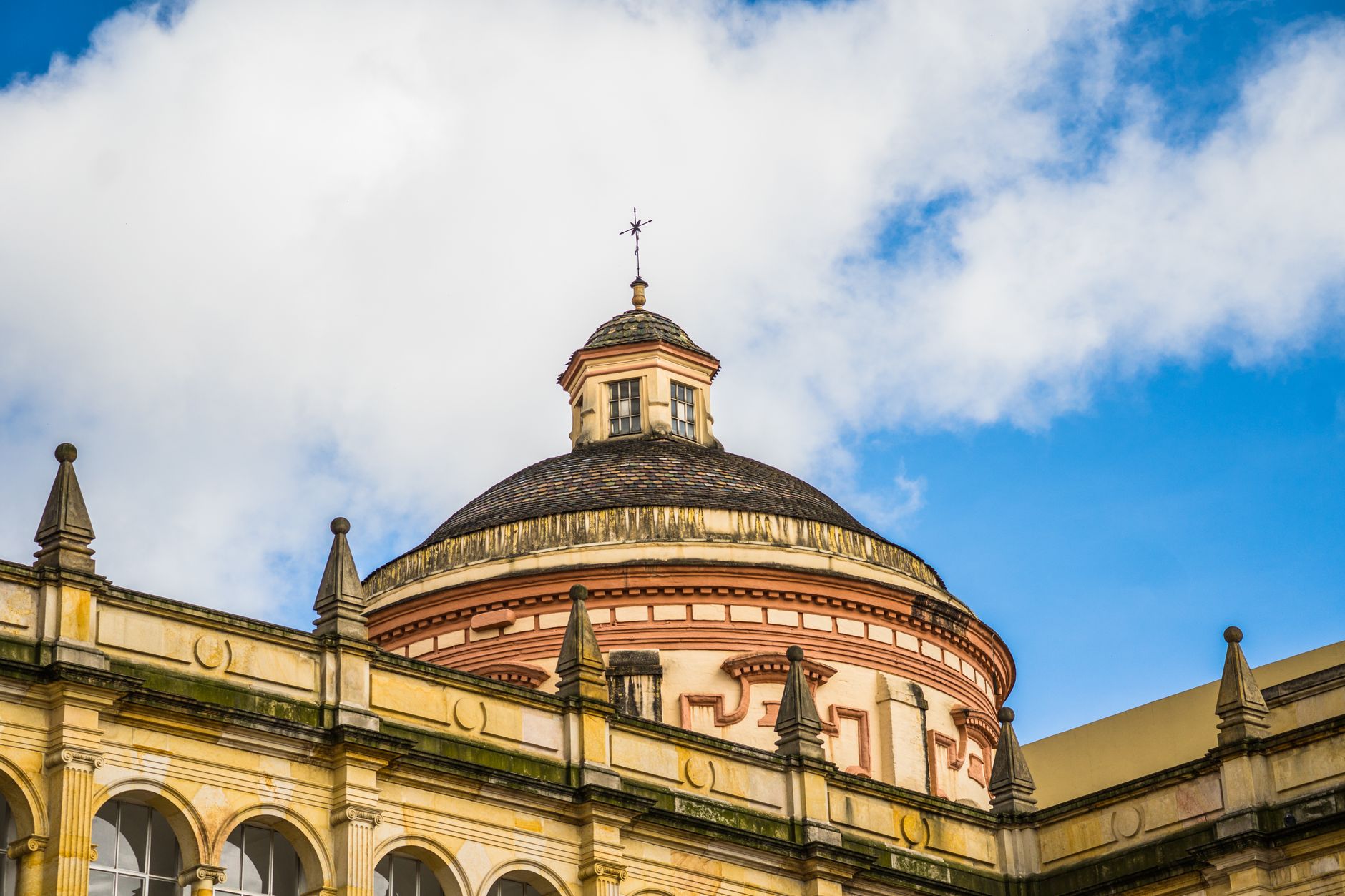
Bogotá prefers brick. It rises on a cold plateau with church towers, republican facades, modern office blocks, libraries, social housing experiments, and the mountain of Monserrate watching the whole performance from above. Brick in this light looks serious, almost edible, especially after rain. The capital understands that austerity can be seductive when handled with conviction.
Medellín tells a different story. The city climbed the valley sides, then answered its own topography with Metro lines, Metrocables, outdoor escalators in Comuna 13, libraries placed like declarations. Urbanism here became a public sentence: the poor live on the hills, therefore the hills must be connected to dignity. Rare for concrete to make a moral argument. Medellín sometimes manages it.
Elsewhere the country keeps changing masks. Popayán remains whitewashed and severe. Mompox stretches its colonial quiet along the Magdalena as if time had missed a ferry. Barichara turns stone and dust into a kind of discipline. Colombia does not offer one architectural face. It offers an anthology of climates learning to stand up.
Colombia sits on the equator, yet temperature changes with elevation, not month. Bogotá stays cool at 2,640 meters, Medellín lands in springlike air, and Cartagena runs hot by the sea.
Few countries let you pair Caribbean forts with Pacific rainforest in one itinerary. The Caribbean gives you Cartagena and Santa Marta; the Pacific adds whale routes and some of the wettest landscapes on earth.
Coffee country is not a slogan here but a working landscape of steep farms, mill towns, and mountain roads. Salento and Manizales place you inside the UNESCO-listed Coffee Cultural Landscape, where harvests shape daily life.
Colombia’s past resists tidy summaries. Indigenous ritual, Spanish conquest, fortified ports, free Black settlements, and republican ambition all leave visible marks from Bogotá to Cartagena to Mompox.
The food changes block by block and region by region. Try ajiaco in Bogotá, bandeja paisa around Medellín, arepa de huevo on the Caribbean coast, and salsa-hour street snacks in Cali.
Colombia ranks first in bird species and spans páramo, cloud forest, savanna, reef, and Amazon basin. Leticia opens the rainforest, while the Andes and Caribbean edge keep the wildlife list moving fast.
13 cities — start with the ones we'd send you to first.
A city of 2,640 metres and perpetual drizzle where a street-art kilometre on Carrera 7 sits three blocks from the Gold Museum's 55,000 pre-Columbian pieces.
On San Andrés, the sea arrives in seven shades of blue and leaves speaking three languages—Spanish, English, and a lilt of salt.
The city that built cable cars over its own hillside comunas now runs the best metro in Colombia and throws a flower festival every August that shuts down the Eje Cafetero for a week.
Walled, colonial, and Caribbean, where the 11-kilometre rampart the Spanish finished in 1796 still holds the old city together like a stone belt.
The salsa capital where the dance style is footwork-first and the barrio Juanchito fills its dance floors every Thursday night before the weekend has technically started.
Colombia's oldest surviving Spanish city, founded 1525, used today mostly as the jumping-off point for Tayrona National Park's jungle-backed beaches and the six-day trek to Ciudad Perdida.
A single cobblestoned street of balconied bahareque houses gives way to the Valle de Cocora, where wax palms — Colombia's national tree — stand 60 metres tall in the mist.
Perched on a knife-edge Andean ridge at 2,153 metres, it keeps Nevado del Ruiz's snow cone in permanent view and hosts a January theatre festival that draws companies from across Latin America.
Declared a National Monument in 1978, this Santander stone village of whitewashed walls and terracotta roofs sits above a canyon where the 9-kilometre Camino Real to Guane was paved by the Guane people before the Spanish
Bogotá sits at 2,640 meters, and the region around it feels built for layers, long lunches and serious museums. Move north and the plateau loosens into market towns, canyons and stone villages where the old route of El Dorado still shapes the storytelling.
The Caribbean coast runs on heat, salt and timing: early starts, long middays, later dinners. Cartagena gives you walls and balconies, Santa Marta opens the door to the Sierra Nevada, and Saint Andrew swaps colonial stone for reef water and Creole island culture.
This is one of Colombia's easiest regions to travel: good roads by local standards, a dense network of towns, and a culture that prizes order without becoming dull. Medellín is the urban anchor, while Manizales and Salento show the greener, steeper side of the same world.
Southwestern Colombia feels older and rougher-edged than the polished coffee loop. Cali is all rhythm and appetite, Popayán keeps a stricter colonial face, and Tierradentro rewards the extra effort with one of the country's strangest archaeological sites: painted tombs dug into volcanic earth.
Leticia is less a city than a river outpost where Colombia meets Brazil and Peru in one humid, shifting borderland. Days here are set by boat schedules, rain and river level, and the payoff is access to pink dolphins, flooded forest and Indigenous communities that still define the region's pace.
Mompox sits on a branch of the Magdalena and feels detached from the main current of Colombian travel, which is part of its appeal. Churches, ironwork and crumbling facades matter here, but the deeper story is the river itself, once the country's commercial spine and still the key to understanding how inland Colombia was built.
Bogotá's small-plane airport sits beside wetlands, gated compounds, and truck roads, where pilot training and private aviation meet the city's raw northern edge.
San Andrés reef turns seven colors over living coral.
A Colombian chronology of gold, empire, republics, and reinvention
Elite funerary chambers begin to appear in the Cauca highlands, cut into volcanic ground and painted in red, black, and white. Their makers remain uncertain, which only deepens the mystery when you descend those spiral stairs today.
Monumental carved figures spread through the upper Magdalena region, guarding tombs and sacred sites. Jaguars, birds, and human-animal beings suggest a ritual world far more complex than the conquistadors later understood.
The Tairona build an urban and ceremonial center deep in the Sierra Nevada de Santa Marta. Its terraces and stone stairways make a sharp point: sophisticated mountain societies were thriving here centuries before the Spanish arrived.
On the high plateau around present-day Bogotá, Muisca polities grow wealthy through salt, trade, and goldwork. Their ceremonial world will later give the Spanish the fatal fantasy of El Dorado.
Alonso de Ojeda and other early expeditions begin charting the Caribbean shore. Contact starts at the waterline, but conquest inland will prove slower, deadlier, and far more confused than imperial maps imply.
After an appalling march up the Magdalena, Gonzalo Jiménez de Quesada reaches the interior and moves against Muisca rulers. The road to Bogotá opens through hunger, disease, and opportunism rather than any clean military triumph.
The Spanish establish Santa Fe as their seat in the Andean interior. A sacred indigenous landscape becomes an imperial capital, and the administrative heart of New Granada begins to take shape.
Drake sacks Cartagena and extorts a vast ransom, burning and demolishing buildings along the way. Spain responds with fortifications so massive that they still define the city's silhouette.
The maroon settlement associated with Benkos Biohó establishes itself as a durable free Black community near Cartagena. It becomes one of the boldest refusals of colonial slavery anywhere in the Americas.
The Holy Office sets up one of Spanish America's main inquisitorial tribunals in Cartagena. Commerce, piety, and paranoia now share the same port, with consequences for healers, converts, and anyone deemed suspect.
Bolívar is born in Caracas, but his destiny will be inseparable from New Granada. His campaigns across the Andes will eventually change the political future of Bogotá and the wider region.
A quarrel in Bogotá over a flower vase becomes the symbolic trigger for local uprising against Spanish authority. Patriotic legend simplified the scene; its theatrical edge is precisely what made it memorable.
The young independence spy known as La Pola is shot by royalist authorities in Bogotá. Her death hardens resistance and gives the patriot cause one of its most enduring female martyrs.
Bolívar's forces defeat the royalists on 7 August, opening the road to Bogotá. It is the decisive military turn that makes political separation from Spain real rather than merely declared.
The new republic unites territories that are now Colombia, Venezuela, Ecuador, and Panama. It is a grand vision, brilliant on paper and deeply unstable in practice.
Bolívar dies disillusioned near Santa Marta, watching his continental project unravel. Few endings are more Colombian: the liberator exits in melancholy while the republic argues over inheritance.
Regional rivalries and political fractures break apart Bolívar's union. New Granada survives, but the dream of a single great northern South American republic is gone.
Liberals and Conservatives plunge the country into a devastating civil war that lasts until 1902. The social and financial damage is so severe that the republic staggers into the new century half-broken.
With decisive backing from the United States, Panama separates from Colombia. For Colombians, the loss is not merely territorial; it is a bitter humiliation at the dawn of the modern age.
Jorge Eliécer Gaitán is assassinated in Bogotá, and the capital explodes in fire and rage. The riot becomes the gateway to La Violencia, a decade of partisan slaughter across the countryside.
In the context of rural conflict and state weakness, the Revolutionary Armed Forces of Colombia emerge as a Marxist guerrilla movement. One armed conflict now joins several older fractures already running through the republic.
Drug-trafficking power reaches a murderous crescendo, especially around Medellín, with bombings, assassinations, and open attacks on the state. Colombia's image abroad narrows to terror, though the reality on the ground is far more layered.
Colombia adopts a new constitution that broadens democratic rights and formally recognizes ethnic and cultural diversity more fully. It is an act of political imagination carried out in the middle of conflict, not after it.
The government signs a peace accord with the country's largest guerrilla movement after years of negotiation. It does not end all violence, but it changes the national horizon and the terms of public memory.
Sacred Gold and Stone Kingdoms
Tisquesusa, the last independent Zipa of Bacatá, did not die in a grand battle but, according to colonial accounts, bled to death in the reeds after a night ambush near what became Bogotá.
A cold lake at dawn, high in the hills above present-day Bogotá: that is where one of Colombia's founding misunderstandings began. Muisca ritual placed a newly invested ruler on a raft, his skin coated in resin and dusted with gold, while emeralds and votive offerings disappeared into the black water of Guatavita. The Spaniards heard the story and made the usual error of conquerors. They turned a ceremony into a map.
Ce que l'on ignore souvent, c'est que Colombia before the conquest was not one empire waiting for a crown. It was a mosaic of powers, languages, and landscapes: the Muisca on the cool plateau around Bogotá, the Quimbaya in the coffee-bearing hills near present-day Manizales and Salento, the Tairona in the Sierra Nevada above Santa Marta, and older ceremonial cultures farther south at San Agustín and Tierradentro. Stone, salt, cotton, coca, feathers, and gold moved across mountain roads long before a European horse set hoof here.
The most haunting monuments are not always the best known. In Tierradentro, spiral staircases sink into painted underground tombs, red and black geometry intact after centuries of damp silence. At San Agustín, in the upper Magdalena, great stone figures with feline teeth still stare into the rain as if the priests have only just stepped away. And in the jungle above Santa Marta, Ciudad Perdida, founded around the 8th century, rose terrace by terrace from the mountain long before Machu Picchu existed.
Then came the glittering trap. Goldwork so refined that modern visitors in Bogotá still stop short before the Muisca raft was never merely decoration; it was diplomacy, sacrifice, status, theology made visible. The tragedy is simple. A civilization offering treasure to the gods found itself pursued by men who preferred to melt the gods down.
The legend of El Dorado began not with a city, but with a ruler covered in gold dust standing on a raft in Lake Guatavita.
Conquest, Fortresses, and the Empire of Fear
Benkos Biohó stands at the heart of colonial Colombia not as a victim, but as the founder of a free polity the empire could not erase.
The conquest of the Colombian highlands has the air of a mad race staged by men who had misread both geography and Providence. Gonzalo Jiménez de Quesada came up the Magdalena from the Caribbean, losing hundreds of men to hunger, disease, and the river itself. Sebastián de Belalcázar marched north from Quito. Nikolaus Federmann arrived from Venezuela. By 1539, all three had reached the same plateau around Bogotá within months of one another. After such slaughter, the ending was almost comic: rather than settle the matter with swords, they sailed to Spain to ask the king who deserved the credit.
On the coast, Cartagena became the jeweled lock on Spain's American treasury, and therefore an irresistible target. Francis Drake attacked in 1586 and held the city to ransom, destroying buildings methodically until payment came. The answer was masonry on an imperial scale: bastions, curtains, batteries, and walls that still define Cartagena today. You can walk them at sunset now, but they were built from dread, calculation, and slave labor. Fear leaves handsome architecture behind.
Cartagena also staged another, less photographed drama. In 1610 the Holy Office established one of the main tribunals of the Inquisition in Spanish America here, and suspicion became a kind of civic climate. Healers, converts, alleged sorcerers, and inconvenient minds could all be dragged into its machinery. The city sold spices, souls, and certainties with equal seriousness.
Yet empire never held the whole stage. In the forests inland from Cartagena, Benkos Biohó, an enslaved man of West African origin, escaped and founded San Basilio de Palenque, the first enduring free Black town in the Americas. He negotiated like a statesman, dressed like one too, and the Spanish killed him for that dignity in 1621. His town survived. That is the important part. The colony built walls around Cartagena, but freedom learned to grow in the thickets beyond them.
After Drake's 1586 attack on Cartagena, the ransom was paid, but he had already burned so much of the city that the payment bought only an end to further humiliation.
Republics, Civil Wars, and the Price of Freedom
Francisco de Paula Santander, often cast as Bolívar's colder counterpart, was the man who tried to turn liberation into paperwork, schools, and durable institutions.
A proclamation in Bogotá in July 1810, a borrowed flower vase, an argument sharpened into revolt: Colombia's break with Spain began, famously, with theater as much as with principle. The so-called Florero de Llorente incident was less spontaneous than patriotic legend later pretended, but that hardly makes it less revealing. Independence in Spanish America often opened with a salon quarrel and ended with cavalry in the mud.
Simón Bolívar entered the story like a man convinced history had personally appointed him. He crossed the Andes in 1819 under conditions that still sound implausible, then defeated royalist forces at Boyacá and opened the road to Bogotá. But ce que l'on ignore souvent, c'est que liberation immediately produced another struggle, quieter and in some ways more enduring: who would govern, and how. Bolívar preferred the grandeur of central power. Francisco de Paula Santander trusted constitutions, decrees, tax systems, and schools. One made thunder. The other made a state.
Gran Colombia, that magnificent and short-lived experiment uniting present-day Colombia, Venezuela, Ecuador, and Panama, cracked under its own ambition. Regional interests pulled apart what victory had stitched together, and by 1831 the union was gone. The 19th century that followed was an exhausting procession of civil wars, constitutions, church-state feuds, and partisan vendettas. Popayán and Mompox produced jurists and dreamers in abundance; the countryside produced widows.
The darkest coda came with the Thousand Days' War between 1899 and 1902, a conflict so ruinous that it left the republic nearly bankrupt and socially shattered. Panama then broke away in 1903 with decisive support from the United States. A century that had begun with promises of emancipation ended with amputated territory and a nation forced to reckon with a simple fact: winning independence is not the same thing as learning peace.
The uprising remembered as the Florero de Llorente began with a dispute over a flower vase, proof that history often enters by the side door rather than the palace gate.
Violence, Reinvention, and an Uneasy Modern Colombia
Gabriel García Márquez understood modern Colombia better than many politicians did, because he knew that in this country the absurd and the documentary often share the same address.
The 20th century opened with loss and did not quickly improve. In April 1948, the murder of the liberal leader Jorge Eliécer Gaitán set Bogotá ablaze in the Bogotazo, a riot so fierce that the city center became an inferno of smashed shopfronts, looted offices, and trams in flames. This was not just an urban convulsion. It helped trigger La Violencia, a decade of partisan bloodshed in which hundreds of thousands died, many far from the capital, in villages where ideology arrived carrying machetes.
Then the map of fear changed shape. Guerrilla insurgencies took root in rural zones, the state answered unevenly, paramilitary violence spread, and cocaine money entered public life like acid through stone. Pablo Escobar turned Medellín into a global synonym for terror in the 1980s and early 1990s, but even that shorthand obscures the human scale of the damage: judges murdered, journalists hunted, candidates assassinated, neighborhoods trapped between seduction and coercion. Colombia was not one war. It was many wars, layered atop one another.
And yet the country kept producing acts of stubborn civic imagination. The 1991 Constitution tried to widen the republic's moral vocabulary, recognizing Indigenous and Afro-Colombian rights more clearly and rewriting the terms of citizenship. Medellín, after burying too many sons, began one of Latin America's most watched urban transformations, linking hillside districts by metro cable and public libraries rather than merely by police raids. Cartagena remained theatrically beautiful; Bogotá grew harder, smarter, more restless; Cali danced through its own crises; Leticia looked toward the river and the forest, reminding the nation that the Amazon was not an afterthought.
The 2016 peace agreement with the FARC did not close Colombia's wounds. That would have been too simple, and Colombia is never simple. But it changed the argument. The country now lives in a tense space between memory and reinvention, between mourning and appetite, between the old reflex for violence and the stubborn desire to make ordinary life possible. That may be its most moving achievement: not innocence regained, but endurance made visible.
The 1991 Constitution was adopted while parts of the country were still in open conflict, a reminder that Colombians often rewrite the rules in the middle of the storm rather than after it.
Colombia does not speak Spanish in the singular. It speaks in gradients of closeness, little verbal bows, tactical tenderness. In Bogotá, a shopkeeper may call you "señor" with such gravity that buying a bottle of water feels like signing a treaty. In Medellín, "vos" arrives with music in it, not rebellion. On the Caribbean coast, Cartagena and Santa Marta let the sentence loosen its collar.
The marvel is "usted." Elsewhere it can sound like starch. Here it often sounds like affection wearing gloves. Lovers use it. Grandmothers use it. Teenagers use it while laughing. Grammar becomes etiquette, and etiquette becomes a form of caress so discreet that you almost miss it, which is why it works.
Then come the elastic words. "Vaina" can mean object, nuisance, affair, miracle, problem, cosmic shrug. A people who can run half a conversation on one noun has understood something about life. "Berraco" is better still: brave, furious, gifted, difficult. It refuses translation because Colombia refuses reduction. Good for the language. Good for the traveler.
Listen for the titles too: "doctor," "doctora," handed out not as academic fact but as social choreography. Respect here has stagecraft. Small daily theater. A country reveals itself by the way it addresses strangers, and Colombia addresses them as if words still had ceremonial weight.
Colombian manners are generous, but generosity here should never be mistaken for innocence. Someone offers you a tinto, and yes, it is coffee, black and sweet and small enough to disappear in three sips. It is also an opening move. A pause made visible. In Bogotá offices, on Medellín sidewalks, in bus terminals, in village kitchens, the cup says: sit down, speak, become briefly legible.
Greetings matter. You say good morning before the question, good afternoon before the transaction, good evening before the request. Skip that, and your efficiency begins to smell like arrogance. Colombia still grants ritual its due. This is one of its charms and one of its tests.
Another rule hides behind a joke: do not "dar papaya." Do not display the phone on the wrong corner, the wallet in the wrong taxi, the confusion on the wrong street. The phrase sounds fruity. The meaning is merciless. Why offer temptation and then act surprised when temptation behaves consistently?
And yet the country refuses grimness. Colombians "mamar gallo." They tease, stall, make play out of solemnity. Even advice can arrive laughing. This mixture of warmth, vigilance, and irony feels exact to the place. A country is a table set for strangers, but someone still counts the silverware afterward.
To ask for "Colombian food" is to ask a mountain range for one opinion. The table changes with altitude, rainfall, cattle, memory. In Bogotá, ajiaco arrives with three potatoes, chicken, corn on the cob, capers, cream, avocado, and guascas, that herb with the strange talent of tasting like the memory of itself. In Antioquia, bandeja paisa lands with beans, rice, chicharrón, egg, avocado, plantain, and an arepa, as if lunch expected quarry work afterward.
The nation understands soup at a level some countries reserve for religion. Sancocho appears in versions as different as cousins at a funeral: fish on one coast, hen inland, three meats where abundance wants proof. Changua at breakfast in Bogotá still startles foreigners with milk, egg, scallion, and bread, which is their loss. Dawn deserves tenderness too.
Corn is not garnish here. Corn is grammar. Arepas change shape and allegiance from region to region: plain, stuffed, grilled, fried, used as vehicle, shield, pause. On the Caribbean side, the arepa de huevo submits to one frying, then another, because excess is sometimes the shortest route to truth. In Cartagena, posta negra cartagenera turns sweetness into authority with beef darkened by panela until the sauce looks almost ecclesiastical.
And the fruit. Lulo, guanábana, maracuyá, curuba, guava, mango with salt and lime sold on the street. Colombia does not treat fruit as dessert. It treats it as daily revelation. A market stall in Cali can look like a vocabulary lesson invented by a feverish botanist, and the correct response is not restraint.
Colombia hears itself in percussion before it hears itself in borders. The Caribbean coast gave cumbia its courtship circle of drums, gaitas, maracas, and skirts that answer the beat like weather. Vallenato came from accordion, box drum, guacharaca, and the old habit of carrying news in song across hot distances. A nation of mountains and rivers needed melody to travel where roads did not.
Then Cali enters, and the body loses the argument. Cali does not merely dance salsa; it organizes time around it. The step is fast, almost insolent, full of footwork that seems to challenge gravity on principle. You can sit in a club and watch people move with such technical ferocity that your drink begins to feel underqualified.
The Pacific coast changes the pulse altogether. In places linked to Buenaventura and the Chocó, marimba de chonta, drums, and call-and-response singing build music that sounds older than the republic and less interested in pleasing it. This is not background. It is architecture made of rhythm.
What I admire most is the absence of embarrassment. Colombians will sing badly, dance brilliantly, clap correctly, improvise loudly, and let a bus, a patio, or a family lunch become a venue without formal permission. Music is not a separate cultural department. It is how the country ventilates itself.
Colombia builds according to climate, fear, and vanity, which is to say like everyone else, only with more drama between sea level and 2,640 meters. Cartagena still wears its colonial stone, shaded balconies, convent walls, and fortifications with a face so composed that you might forget Francis Drake once extorted the city into masonry. The old center is beautiful, yes, but beauty here has artillery behind it.
Bogotá prefers brick. It rises on a cold plateau with church towers, republican facades, modern office blocks, libraries, social housing experiments, and the mountain of Monserrate watching the whole performance from above. Brick in this light looks serious, almost edible, especially after rain. The capital understands that austerity can be seductive when handled with conviction.
Medellín tells a different story. The city climbed the valley sides, then answered its own topography with Metro lines, Metrocables, outdoor escalators in Comuna 13, libraries placed like declarations. Urbanism here became a public sentence: the poor live on the hills, therefore the hills must be connected to dignity. Rare for concrete to make a moral argument. Medellín sometimes manages it.
Elsewhere the country keeps changing masks. Popayán remains whitewashed and severe. Mompox stretches its colonial quiet along the Magdalena as if time had missed a ferry. Barichara turns stone and dust into a kind of discipline. Colombia does not offer one architectural face. It offers an anthology of climates learning to stand up.
Bolívar matters in Colombia not as a marble hero on horseback, but as the man who turned the Andes into a military gamble and won. He dreamed bigger than the map could bear, then watched Gran Colombia slip through his fingers almost as soon as it was born.
Santander is the reason Colombian independence did not remain pure cavalry romance. While Bolívar supplied the lightning, Santander supplied the decrees, the schools, the courts, and the slightly severe conviction that republics run on paperwork as much as glory.
La Pola carried messages, gathered intelligence, and moved through Bogotá with the outward calm of a seamstress and the inward resolve of a conspirator. When the Spanish executed her at 22, they created a martyr; what they could not do was make her small.
Biohó escaped slavery, built a free settlement in the forests behind Cartagena, and negotiated with Spanish authorities as if liberty were already his by right. The crown killed him, but Palenque endured, and that endurance is his real monument.
Gaitán spoke to urban workers and the poor with a force that made Colombia's elite uneasy. When he was shot on 9 April 1948, Bogotá erupted, and the country entered one of the most violent passages in its modern history.
García Márquez carried the heat, gossip, mourning, and political absurdity of the Caribbean coast into world literature. Read him before going to Cartagena or Santa Marta and half the country seems to acquire a second, more dangerous layer of meaning.
Arango painted politicians, prostitutes, nuns, and naked women with a frankness that polite society in Medellín found intolerable. She spent decades being dismissed precisely because she saw too clearly what the republic preferred to hide.
Juan Valdez is invented, which is exactly why he belongs here. Created by the National Federation of Coffee Growers, he turned the labor of thousands of farmers around Manizales, Salento, and the wider coffee region into one of the most recognizable national faces on earth.
This is the fast Caribbean version of Colombia: fortified streets in Cartagena, then a bus east to Santa Marta for sea air and an older, rougher port-city rhythm. It works for a long weekend because the route is simple, the weather is warm, and you spend more time outside than in transit.
Start high in Bogotá with museums and cold morning light, then move north into the slower interior where Barichara's stone streets and Mompox's riverfront houses feel cut off from the century. This route suits travelers who care more about history and atmosphere than beaches.
This route ties together the Paisa heartland, the coffee hills and Colombia's salsa capital without forcing a giant backtrack. Medellín gives you urban energy, Manizales and Salento bring mountain roads and finca country, and Cali finishes with late nights and a more muscular rhythm.
Begin in Leticia for the Amazon, then fly west and work south through whitewashed Popayán to the underground tombs of Tierradentro. It is a stronger route for travelers who want archaeology, river forest and a part of Colombia that still feels less packaged than the Medellín-Cartagena circuit.
Lunch in Bogotá. Family table, Sunday table, cold-rain table. Spoon, capers, cream, avocado, silence, then talk.
Midday in Medellín or Antioquia. Plate, appetite, companions, no haste. Beans first, chicharrón later, avocado for mercy.
Morning or late afternoon in Cartagena and the Caribbean. Street stall, hot oil, paper napkin, ají, standing crowd. Bite fast, then wait for the burn.
Sunday pot, riverbank pot, family pot. Chicken or fish or three meats, cassava, plantain, corn, rice, avocado. Ladle, plastic chair, cousins, hours.
Office pause, bus-terminal pause, doorway pause. Small black coffee, sugar, paper cup or tiny glass. Invitation before conversation.
Celebration food in Tolima and beyond. Pork, rice, peas, crackling skin, shared table. Feast logic, not snack logic.
Lunch in Cartagena, often with coconut rice and plantain. Knife, fork, slow sauce, long table. Sweetness and meat in open conspiracy.




US, Canadian, UK, EU and Australian passport holders usually get up to 90 days on arrival for tourism or business, but the border officer can shorten that stay. Extensions are possible with Migración Colombia, and the usual ceiling is 180 days in a 12-month period. Bring proof of onward travel and check yellow fever rules if you are arriving from or heading into risk zones.
Colombia uses the Colombian peso (COP). In April 2026, USD 1 buys roughly COP 4,100 to 4,200, so meals and buses can feel cheap, but ATM fees of COP 14,000 to 20,000 add up fast. Cards work in Bogotá, Medellín, Cartagena and larger hotels, while smaller towns still run on cash.
Most long-haul arrivals land in Bogotá at El Dorado, with smaller international gateways in Medellín, Cartagena and Cali. If you are flying to Saint Andrew, budget for the tourist card charged before departure. Colombia has no international passenger rail links, so every overland arrival is by road or bus.
Domestic flights save huge amounts of time on long hops such as Bogotá to Cartagena or Leticia to Cali. Intercity buses are extensive and often comfortable on Andean routes, but mountain roads make journeys slower than the map suggests. In cities, use Metro in Medellín, TransMilenio in Bogotá, and app-based rides instead of street-hailed taxis.
Weather here is set by altitude more than by month. Bogotá sits cool at 2,640 meters, Medellín stays springlike around 1,500 meters, and Cartagena is hot and humid almost every day of the year. December to March is the easiest all-round window for the Andes and Caribbean, while the Pacific whale season runs from June to October.
4G is strong in the main travel corridor from Bogotá to Medellín, Cartagena, Cali and the coffee region, and 5G is now live in the larger cities. Buy a local SIM from Claro, Movistar or Tigo if you will be booking rides and buses on the move. Coverage drops sharply in the Amazon, parts of the Pacific coast and high mountain roads, so download tickets and maps before leaving town.
The standard risk in Colombia is petty theft and phone snatching, not dramatic cartel scenes, though some border and rural conflict zones remain off-limits. Stick to known neighborhoods, use rideshare at night, and do not accept drinks from strangers. Check current advisories before planning overland travel near the Venezuelan border, parts of Nariño or remote Pacific stretches.
Withdraw larger amounts in cities instead of making repeated small withdrawals in rural towns. Bancolombia and Davivienda are common, but many machines cap each transaction at COP 800,000 to 1,000,000.
A menú del día at COP 12,000 to 18,000 is still the best-value meal in the country. You usually get soup, a main plate, juice and sometimes dessert for less than one cocktail in Cartagena.
Passenger trains are not part of normal travel in Colombia. For long distances, compare low-cost flights first, then buses, because a route that looks short on the map can still take eight or ten hours by road.
Prices jump hard during December holidays, Semana Santa, Medellín's Feria de las Flores and big weekends in Cartagena. If your dates fall in early August or late December, lock in hotels before flights.
A local SIM makes app rides, banking texts and bus bookings far easier than relying on hotel Wi-Fi. Set it up in Bogotá, Medellín, Cali or Cartagena before heading to Salento, Mompox or Leticia.
Use your phone indoors, in rides, or with your back to a wall rather than while standing at the curb. The local phrase dar papaya means making yourself an easy target, and Colombians mean it literally.
Many restaurants add a voluntary service charge of around 10 percent. If it appears, you can accept it, lower it or refuse it, but you should know it is not an automatic legal obligation.
Explore Colombia with a personal guide in your pocket
Audio guides for 1,100+ cities across 96 countries. History, stories, and local insight — offline ready.

Usually no, for stays of up to 90 days. US, Canadian, UK, EU and Australian travelers are commonly admitted visa-free for tourism, but the final decision sits with the immigration officer, and you may be asked for proof of onward travel. If you want to stay longer, apply for an extension with Migración Colombia before the first 90 days expires.
Yes, in the main travel corridor if you use ordinary city sense. Bogotá, Medellín, Cartagena, Santa Marta and the coffee region are manageable for independent travelers, but petty theft, phone snatching and drug-facilitated robbery remain real risks. Border zones and some rural departments still need current advisory checks before you go.
January is the easiest all-round pick. The Andes and Caribbean are usually drier from December to March, which helps with city walking, bus travel and beach time, while June to August is strong for coffee country and Pacific whale trips. November and April can be cheaper, but you need to plan around rain.
Budget travelers can get by on about USD 30 to 45 a day, mid-range travelers on USD 70 to 100, and comfortable trips often start around USD 150. The big variables are flights, Cartagena hotel prices and how often you use private transport. Set lunches, city buses and local coffee keep daily costs down.
Uber works in most big cities, even though the legal framework has stayed murky. Travelers still use Uber, InDrive and Cabify widely because they reduce the risk of overcharging and street-taxi scams. In Bogotá or Cali at night, app-based rides are the better call.
You need both, but cash still matters. Cards are common in Bogotá, Medellín, Cartagena and airport hotels, while smaller restaurants, buses, markets and towns like Barichara or Mompox often prefer pesos. Carry small notes because many drivers and kiosks will not break a COP 100,000 bill.
Ten to fourteen days is the sweet spot for a first trip. That gives you time for one Andean city, one Caribbean stop and either coffee country or the Amazon without spending the whole trip in airports and bus terminals. In one week, stay in a single region and resist the urge to cross the whole country.
You should treat it as part of the trip preparation, because the official Check-Mig platform is active and some airlines still ask about it. Migración Colombia says it speeds the entry process and allows submission from 72 hours to 1 hour before travel. Even when officers do not insist on it, having it done avoids useless friction at the airport.
Last reviewed