
Emperor Qinshihuang's Mausoleum Site Museum
Xi'anChina 34° N · 108° E Updated Aug 2026
Qin Shi Huang started his tomb at 13. The clay army guards it — but the burial mound itself, rivers of mercury and all, is still unexcavated.
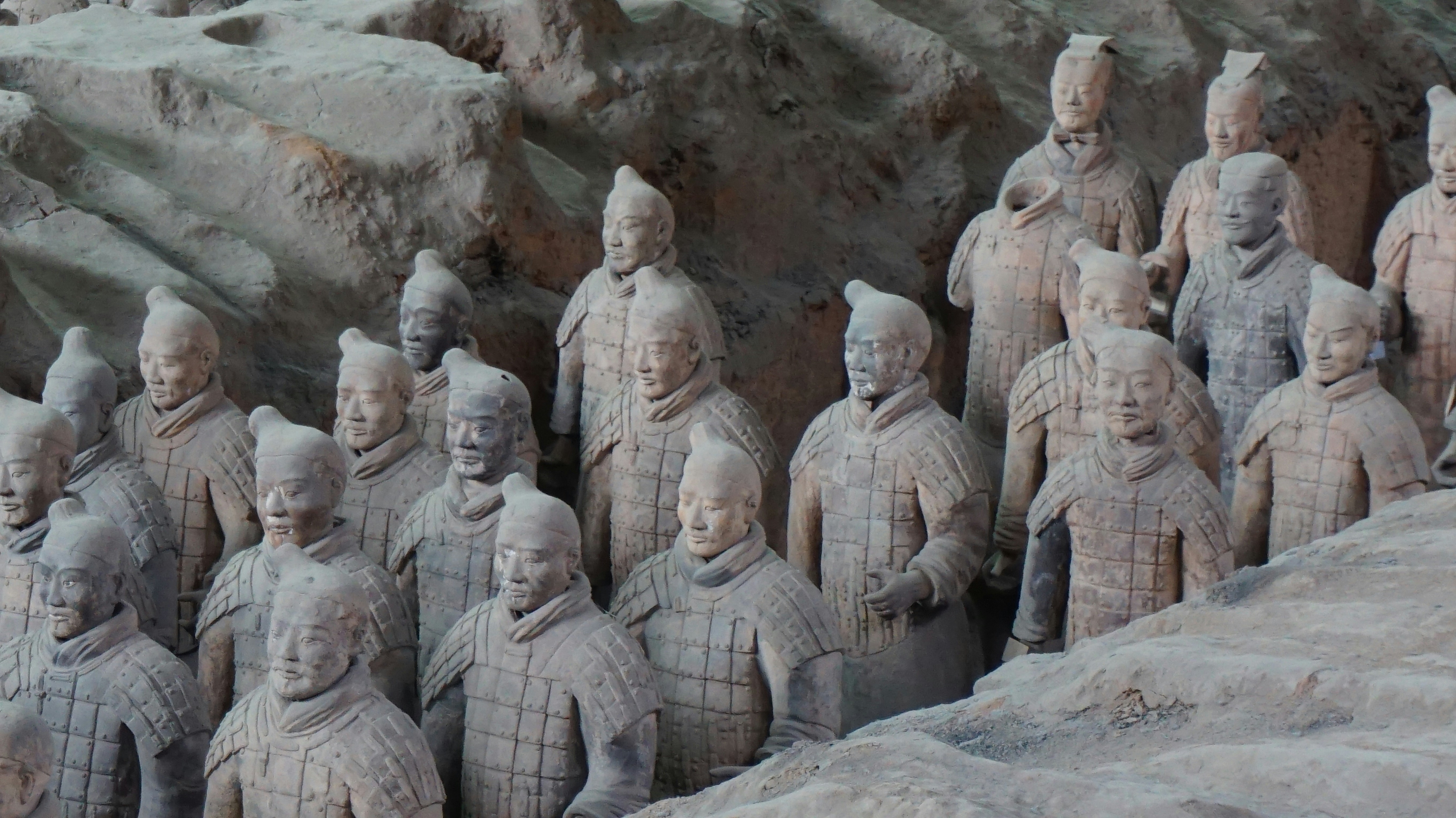 Photo: denis pan / Unsplash
- Time needed
- Half day (3-4 hours, both sites)
- Entry
- One ticket covers the pits and Lishan Garden; shuttle between them is free
- Access
- Ramped viewing galleries and accessibility programs; heavy crowds are the real obstacle
- Best season
- Autumn (September-November) — fewer crowds, Lintong pomegranate and persimmon season
The most famous army on earth never fought a battle, and when the first soldiers came out of the ground in 1974 they still had pink skin, black hair and red lips — pigment that curled off within minutes of meeting the air. Emperor Qinshihuang's Mausoleum Site Museum, in the Lintong district of Xi'an, China, is where those ranks still stand in their earthen trenches, weapons gone, faces turned east. Go for the pits. Stay for the thing nobody has opened, because the First Emperor's actual burial chamber sits about 1.5 km west under a grassy hill, sealed, unexcavated, and still argued over.
First correction, and it changes how you plan your day: the terracotta warriors are not the tomb. They're one outward-facing garrison in a funerary city that UNESCO describes as mirroring the street plan of the Qin capital at Xianyang — walls, gates, stables, workshops, laborers' graveyards, hundreds of subsidiary pits. One ticket covers two areas linked by a free shuttle: the Warriors and Horses Museum with Pits 1, 2 and 3, and Lishan Garden out at the mound itself, where the acrobats' pit K9901, the civil officials' pit K0006, and the bronze chariots museum sit.
The numbers behind it are hard to hold in your head. Records place the start of construction at 246 BCE, the year a thirteen-year-old named Ying Zheng took the Qin throne and began building the place he'd be buried in. He unified the six warring states in 221 BCE and died in 210 BCE, which means the digging ran roughly thirty-eight years — most of a working life, spent on one hole in the ground.
The labor figure everyone quotes, 700,000 conscripts, comes from the historian Sima Qian writing a century later; treat it as tradition rather than a headcount. What's not in doubt is the irony. The dynasty this tomb was built to make eternal collapsed by 206 BCE, inside a single generation, while the tomb is still here twenty-two centuries later, outliving the empire that paid for it.
What to see
-
Pit 1: the army you already think you know
You walk in expecting the postcard and get something closer to vertigo. Pit 1 runs 230 metres east to west and 62 wide — roughly two football pitches laid end to end under one arched steel roof — with an estimated 6,000 figures and horses standing in the earth corridors below. The ranks recede until faces blur into repetition, and that repetition is the point: this is a war machine rendered in fired clay, buried around 210 BCE and forgotten until March 1974, when farmers digging a well hit a head.
Most people stop at the first railing by the entrance and photograph the backs of other people's phones. Don't. Walk the perimeter to the flanks, where the crowd thins and you can get close enough to read individual faces — the moustaches, the topknots tied off-centre, the shifts in ear shape that make each figure someone rather than something. The sound helps too: the hall swallows voices into a low collective hum, and you notice it most when you finally shut up and look.
-
The Bronze Chariots Museum, buried under its own hill
The best-designed building on the site is the one you can barely see. Opened in trial form on 18 May 2021 at the southwest corner of the tomb mound, the Bronze Chariots Museum is earth-covered and planted over, its entrance tucked among trees so it doesn't compete with the mausoleum. Inside it's fair-faced concrete, cool and dim, and the entry ramp turns twice — screening out the car parks, the noodle stalls, the century — before framing Lishan Mountain in a single cut.
Then the chariots. Excavated in 1980 west of the mound and built at half scale from thousands of separately cast parts with gold and silver fittings, they are the most technically absurd objects the Qin left behind. Look past the silhouette everyone photographs: on Chariot No. 1, the inner rails and the underside of the canopy still carry painted cloud and geometric motifs on a pale ground. Two thousand years, and the decorator's brushwork survives where nobody was meant to look.
The exit path does one last thing on purpose. It opens onto the mound.
-
The Lishan Garden loop most visitors skip
Your ticket covers a second site, a free shuttle runs there, and most people go home without using either. That second site — Lishan Garden — is where the place stops being a spectacle and turns strange. Open sky, long paths, a fraction of the crowd, and at the centre the unexcavated tomb mound itself: a tree-covered landform that reads less like a monument than like something deliberately sealed.
Give it ninety minutes and do it in this order. Pit K9901 first, discovered in March 1999, holds life-size acrobats and entertainers with bare torsos and twisted, mid-performance poses — bodies, not soldiers; find the tiny incised characters 咸阳亲 on one figure's right arm. Then K0006, the civil officials' pit, which escaped the burning that gutted the others and so preserved its roof beams, floor boards and sealing timbers, plus flecks of red, green and pink pigment clinging mostly to faces. Finish at the chariots museum and walk back out toward the mound.
Spring and autumn suit this half best — you're outdoors and on foot. In August the walk is punishing by ten in the morning.
Plan your visit
- Getting There
- The site sits in Lintong District, about 40 km northeast of central Xi'an — a half-day excursion, not a downtown stop. Cheapest reliable route as of 2026: Metro Line 1 to Fangzhicheng, change to Line 9, ride to Huaqing Pool station Exit C, walk 200 m northeast to Huaqing Pool bus station, then Lintong bus 602 or tourist bus 613 to the gate (about 1.5 hours, CNY 10–15 total). Direct tourist coaches leave every 30 minutes from the east gate of Yisushe Grand Theater near the Bell Tower and from the Dayanta Vienna Hotel near the Big Wild Goose Pagoda for CNY 30 — board only buses whose staff wear red vests. A DiDi or taxi from the city wall runs roughly CNY 120–140 plus tolls and takes about an hour.
- Opening Hours
- Gates open at 08:30 daily, seven days a week — no Monday closure. From 16 March to 15 November the site closes around 18:30 with last admission near 17:00; from 16 November to 15 March it closes around 18:00 with last admission near 16:30. A summer-holiday extension (roughly July–August, opening 08:00 and closing 19:30) has been advertised for 2026 but changes year to year, so confirm on bmy.com.cn. One quirk worth knowing: the hours seasons flip on 16 March and 16 November, while ticket-price seasons flip on 1 March and 1 December. Entry is timed — arrive 30 minutes before your booked slot.
- Time Needed
- The museum's own ticketing system says 1.5 hours for each of its two halves, and that's honest. Pits 1, 2 and 3 plus the bronze chariots take 1.5–2 hours at a march; add the free shuttle and Lishan Garden and you're at 3–3.5 hours. History-minded visitors should budget 4–5 hours. Then add three hours of round-trip transit from downtown — a realistic day is out at 09:00, back by 15:00.
- Tickets
- One ticket covers both the warrior pits and Lishan Garden, plus the free shuttle between them. Expect around CNY 120 as of 2026; the older peak-season rate of CNY 150 (1 March–30 November) may still apply, so check bmy.albatrip.cn or the 秦始皇帝陵博物院 WeChat account before you go. Book roughly a week ahead — sooner for summer and Golden Week — and bring the passport you booked under, since ticketing is name-registered and your document gets checked at the door. Your ticket is scanned three times across the visit, so don't bin it after the first gate. Audio guide costs CNY 40 at the warriors; at Lishan Garden it's CNY 10 with a CNY 90 refundable deposit, and live docent talks there are free.
- Accessibility
- The main pit halls have ramps and lifts, and restrooms are wheelchair-accessible, but this is not a step-free site — there are steps inside the exhibition buildings and the distances are punishing. Lishan Garden alone covers 2.26 km², bigger than Monaco, and a standard visit walks well over 2 km on paved but sloping ground. The CNY 15 electric cart inside Lishan Garden is close to essential for wheelchair users and anyone with limited stamina. Call ahead on +86-29-81399127 to confirm current arrangements — the museum publishes no detailed access statement.
History
Thirty-Eight Years, and Then a Well
For most of two thousand years this was a hill with a story attached. Sima Qian's account described rivers and seas of mercury pumped mechanically through a scale model of the empire, a ceiling set with pearls as constellations, crossbows rigged to fire at intruders. Nobody could check. The mound was listed for national protection on 4 March 1961, and it stayed exactly that: a protected hill.
Then came a drought year, a village called Xiyang, and a group of farmers who needed water badly enough to dig four or five metres down through packed earth — deeper than a two-storey house is tall. In March 1974 they hit fired clay, bronze arrowheads and brick flooring. They did not know what they had. Some called the fragments 瓦盆爷, roughly 'clay pot grandfather'; according to accounts collected later, a few burned incense to them and others read them as a bad omen.
The turning point
The Man Who Glued the First Soldier Back Together
Zhao Kangmin was not a famous archaeologist. He was a cultural relics worker for Lintong county, the kind of local official whose job is mostly paperwork and mostly ignored. Xinhua reports he got the call on 25 April 1974 and found the fragments had already been lying around for twenty-eight days — kicked about, moved, some pieces reportedly taken away as curiosities.
What was at stake for him was not scholarship. It was whether the find survived the month. He had the pieces carted back to the county cultural centre and started fitting them together by hand, and out of that pile of broken clay he assembled the first complete warriors anyone had seen since the Qin. That's the turning point: not the shovel hitting the pit, but one provincial official deciding the debris was worth reassembling.
The state moved fast once the figures could be seen standing. In August 1975 the State Council approved a museum on the site; a preparatory office opened that November. Pit 2 turned up in April 1976 during construction work around Pit 1, Pit 3 the following month, and on 1 October 1979 the doors opened to the public. UNESCO inscribed the mausoleum on 11 December 1987.
Somebody Burned This Place
The destruction is not legend — it's stratigraphy. Excavation reports record charred and collapsed wooden roofing in Pit 1 and parts of Pit 2, figures smashed before the fire rather than by it, and weapons stripped out. A 2022 report on the outer east gate found red-burned earth and charcoal, then water damage layered on top. Popular retellings hand the blame to the warlord Xiang Yu, following the ancient texts. Museum archaeologists are more careful: the evidence shows late-Qin violence, not a signature. The case is open.
Eight Years and Three Thousand Fragments
In 1980, west of the mound, excavators found two half-scale bronze chariot teams — crushed flat, still painted. Restoration under Wu Yongqi took eight years and involved reassembling more than 3,000 bronze pieces, an object-level version of what Zhao Kangmin did by hand in 1974. They now have their own building at Lishan Garden, opened in 2021, and they're the reason to make the shuttle trip. Umbrella struts thin as a pencil, knotted bronze reins, a driver's sleeve. Nothing else on site shows Qin craft this close up.
Tips for visitors
Arrive After 15:30
Tour coaches empty out mid-afternoon, and the last 90 minutes before closing are the quietest hours of the day. Second-best window is 11:30–13:00, when groups break for lunch; in summer, queues at other times run 30 minutes to an hour.Only One Official Seller
The museum issued a formal warning in February 2025 about vendors misusing its name and logo online, and in March 2026 Lintong authorities confirmed complaints about private XR/VR "Qin underground palace" attractions hard-selling themselves as official projects. Buy tickets only through bmy.com.cn or the museum's WeChat account, and treat any guide or driver steering you toward a paid "special exhibit" as a commission play.No Flash, No Drones
Personal photography is fine in the main halls, but flash is off-limits and posted no-photo zones are enforced. Flying devices are banned outright at security screening and the luggage desk refuses them — the site runs an anti-drone defence system, so don't test it.Don't Skip Lishan Garden
Most guidebooks let you treat the pits as the whole museum, which is how visitors miss the bronze chariots — two half-scale carriages of astonishing craftsmanship, housed in their own hall since 2021. The shuttle is free and included in your ticket, though the road transfer takes 20–30 minutes each way despite the sites being only 1.5 km apart.Walk Past the First Restaurants
The exit corridor is a souvenir-and-fast-food strip — KFC at 331 m, Dicos at 356 m, McDonald's at 415 m. Better options nearby: 清真·回坊大牌档 for quick Shaanxi staples around ¥30 a head, 同盛祥牛羊肉泡馍 for classic paomo around ¥37, or 大秦礼宴 on Fenghuang Avenue at ¥180+ if you want the theatrical Qin banquet.Eat Lintong's Own Fruit
Lintong has grown pomegranates for more than 2,000 years and the district markets them hard — fresh-pressed juice from roadside stalls in late summer and autumn is genuinely good. In autumn and winter, look for 火晶柿子, the tiny orange Huojing persimmons that are a protected local product.Get a Guide or an Audio Guide
The local joke is that without narration you're just looking at dirt pits and mud figures — the pits themselves carry almost no interpretive signage. The CNY 40 audio guide is the cheap fix; freelance guides swarm the ticket office, so settle on price and language before you start walking.Spring and Autumn Beat Summer
March–May and September–November give you mild weather and manageable crowds. Winter drops to 0–5°C and the halls are unheated caverns, but you'll have Pit 1 nearly to yourself; avoid Golden Week (1–7 October), Spring Festival and Labour Day entirely, when daily capacity caps and traffic control kick in.
Watch & Explore Emperor Qinshihuang's Mausoleum Site Museum.

Frequently asked
Is the Terracotta Army worth visiting?
Yes, though the reason isn't the one most people arrive with. Pit 1 is 230m by 62m with an estimated 6,000 figures inside — a hall long enough to park two football pitches end to end, packed with ranks of men who each have a different face. The catch is that without a guide or audio guide, a common local verdict applies: you're looking at dirt pits and clay men. Pay the 40 RMB for the audio guide.
How long do you need at the Terracotta Army?
Budget 3–3.5 hours for both halves of the site, plus roughly 3 hours of round-trip transit from central Xi'an. The museum's own ticketing system says about 1.5 hours each for the Terracotta Warriors pits and Lishan Garden, connected by a free shuttle. History-minded visitors regularly stretch it to 4–5 hours.
How do I get to the Terracotta Army from Xi'an?
Metro Line 1 to Fangzhicheng, transfer to Line 9, ride to Huaqing Pool station, exit C, then walk 200m northeast to the bus station and take Lintong bus 602 or tourist bus 613. Around 1.5 hours and CNY 10–15 total — Line 9 changed this route completely, so ignore guides written before it opened. Direct tourist buses also run from the Yisushe Grand Theater east gate near the Bell Tower for CNY 30, but only board buses whose staff wear red vests.
What is the best time to visit the Terracotta Army?
Arrive after 15:30, when the tour-group coaches have left and the railings at Pit 1 finally open up. Second-best window is 11:30–13:00, when groups break for lunch. Spring and autumn beat summer for the outdoor walking between halls, and winter empties the place out at 0–5°C. Avoid Golden Week (1–7 October) and Spring Festival entirely.
Can you visit the Terracotta Army for free?
No — entry runs around 120 RMB, historically up to 150 RMB in peak season, and one ticket covers both the warrior pits and Lishan Garden. Book online through the museum's official system or its WeChat account, roughly a week ahead, and bring the passport you booked under: Chinese museum tickets are name-registered and checked against your document. The free shuttle between the two sites is included, and guiding at Lishan Garden is free.
What should I not miss at the Terracotta Army?
Lishan Garden, which most visitors skip after the pits and which sits on the same ticket. It holds the actual unexcavated tomb mound, the K9901 acrobats pit with its bare-torsoed performers, the K0006 civil officials pit — the rare one that never burned, so the wooden roof and floor beams survived — and the Bronze Chariots Museum, half-buried under a planted roof, where the exit ramp deliberately frames the mound as you resurface.
Is the Terracotta Army the tomb of Qin Shi Huang?
No, and this is the single most common misunderstanding. The army pits sit about 1.5km east of the burial mound and are one sector of a much larger funerary city built to mirror the Qin capital at Xianyang. The central chamber under the mound has never been opened — Chinese authorities keep postponing excavation because conservation technology can't yet guarantee that what's inside would survive exposure.
Were the Terracotta Warriors originally painted?
Yes, in bright pigment — villagers at the 1974 discovery reportedly saw black hair and red lips before the color went. Lab work cited by the museum found lacquer layers curling after roughly one minute in low humidity, which is why excavation slowed down until a 1997 conservation breakthrough. Traces of red, green, black, pink and white still cling to faces in the K0006 officials pit.
Sources & attribution 20
- UNESCO World Heritage Centre — Mausoleum of the First Qin Emperor (ref. 441) — Inscription details, 246 BCE construction start, 221 BCE unification, 210 BCE death, and the statement that the complex mirrors the urban plan of the Qin capital Xianyang.
- Emperor Qinshihuang's Mausoleum Site Museum — official site — Official institutional homepage; umbrella museum covering both the Terracotta Warriors pits and Lishan Garden.
- Emperor Qinshihuang's Mausoleum Site Museum — visitor guide — Opening seasons (16 Mar–15 Nov peak, 16 Nov–15 Mar low), timed entry, daily capacity cap, guide service phone lines, and confirmation that both areas share one ticket.
- Emperor Qinshihuang's Mausoleum Site Museum — Pit 1 — Pit 1 dimensions (230m x 62m, ~14,260 sq m), estimated 6,000 figures, and the March 1974 well-digging discovery.
- Emperor Qinshihuang's Mausoleum Site Museum — K0006 civil officials pit — The unburned pit: surviving wooden roof, side-board, floor and sealing-door traces, 12 official figures, and surviving red/green/black/pink/white pigment on faces.
- Emperor Qinshihuang's Mausoleum Site Museum — K9901 acrobats pit — Life-size terracotta entertainers with bare torsos and varied poses, plus bronze ding vessels.
- Emperor Qinshihuang's Mausoleum Site Museum — Bronze Chariots Museum announcement — The 2021 move of the bronze chariots to the new earth-covered underground museum at Lishan Garden, and the layout of the Lishan Garden visitor areas.
- Emperor Qinshihuang's Mausoleum Site Museum — 50-year retrospective — Conservation history including the 1997 painted-terracotta protection breakthrough and the lab finding that lacquer layers curl after about one minute in lower humidity.
- Official museum ticketing system (albatrip) — Ticket rules: valid same day only, checked three times, free shuttle included, and the recommendation of ~1.5 hours at each of the two visitor areas.
- China Highlights — How to Visit the Terracotta Army — Crowd-avoidance windows (after 15:30, 11:30–13:00), 3.5-hour visit budget, booking lead times, pit visiting order, and seasonal weather advice.
- TravelChinaGuide — How to Visit the Terracotta Army — Metro Line 1 → Line 9 → Huaqing Pool → bus 602/613 route, direct tourist bus from Yisushe Grand Theater at CNY 30, red-vest anti-scam rule, and distances from Xi'an transport hubs.
- Xian Private Tour — Travel Tips for Visiting the Terracotta Warriors — Ticket prices by season, 40 RMB audio guide, passport/ID name-registration requirement, and taxi costs from central Xi'an.
- Trip.com HK — Lishan Garden — Free docent talks at Lishan Garden, 10 RMB audio-guide rental with 90 RMB deposit, and the 15 RMB internal electric cart.
- The China Guide — Terracotta Warriors — Crowd contrast between Pit 1 and Lishan Garden, the commercial strip on the walk back, and the fact that most visitors skip the mausoleum park.
- Xinhua — Zhao Kangmin and the 1974 discovery — March 1974 well-digging by Xiyang villagers and Zhao Kangmin's recovery and restoration of the first warriors.
- People's Daily Shaanxi — villagers' account of the discovery — Villagers' reports of painted skin, black hair and red lips fading rapidly on first exposure, and the folk names given to the figures.
- ArchDaily — Bronze Chariots Museum, Qin Shi Huang Mausoleum Site Museum — Half-buried design, fair-faced concrete, planted roof, and the choreographed entry and exit sequence that frames Mount Li and the tomb mound.
- Shaanxi Provincial Cultural Heritage Bureau — mausoleum overview — Layout of the double-walled funerary complex and the eastward orientation of the army pits relative to the tomb mound.
- The Paper — XR/VR attraction hard-sell complaints near the museum — Lintong authorities' response to complaints about private attractions marketed as official projects around the site.
- Shaanxi Local Chronicles — postponement of central chamber excavation — Why excavation of the sealed burial chamber remains postponed on conservation grounds.
Built from cited sources · see the method · How we make our guides →
More in Xi'an.
67 places to discover — a few worth pairing.

Pick up where you left off
Saved and recently read places — kept on this device only.
Photo credits (5)
- Aaron Greenwood — Unsplash License (https://unsplash.com/license) — Source: https://images.unsplash.com/photo-1528163186890-de9b86b54b51
- Qin bronze chariot two — Jmhullot — CC BY 3.0 (https://creativecommons.org/licenses/by/3.0/) — Source: https://commons.wikimedia.org/wiki/File:Qin_bronze_chariot_two.jpg
- 秦始皇帝陵·秦始皇陵·西安臨潼·(封土正北側) — Legolas1024 — CC BY-SA 4.0 (https://creativecommons.org/licenses/by-sa/4.0/) — Source: https://commons.wikimedia.org/wiki/File:秦始皇帝陵·秦始皇陵·西安臨潼·(封土正北側).jpg
- Xian China Terracotta-Army-Museum-01 — CEphoto, Uwe Aranas — CC BY-SA 3.0 (https://creativecommons.org/licenses/by-sa/3.0/) — Source: https://commons.wikimedia.org/wiki/File:Xian_China_Terracotta-Army-Museum-01.jpg
- denis pan — Unsplash License (https://unsplash.com/license) — Source: https://images.unsplash.com/photo-1523946963389-207478f6cb2e
Photos may have been resized or cropped.