Historical Background
Origins and Development
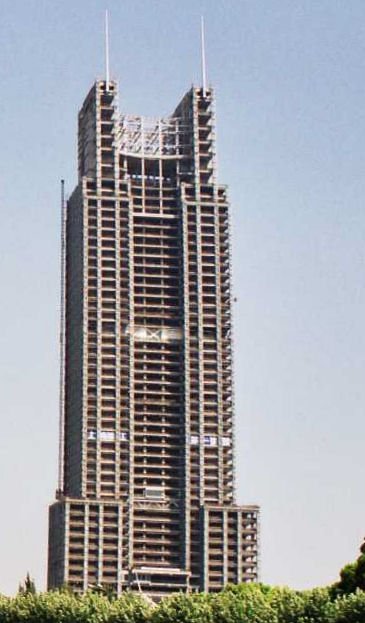
The Bocom Financial Towers were constructed during Shanghai’s skyscraper boom of the late 1990s and early 2000s, marking a pivotal moment in the city’s urban and economic development (Wikipedia; WorldAtlas). Commissioned by the Bank of Communications, which was founded in 1908, the towers reflect the institution’s ambition and Shanghai’s emergence as a financial capital. The South Tower was completed in 1999, followed by the North Tower in 2002.
Role in Shanghai’s Urban Evolution
Located in Lujiazui—once undeveloped but now Shanghai’s premier financial hub—the towers symbolize the city’s shift from its historic Bund waterfront to a modern skyline filled with international skyscrapers. Their completion paralleled Shanghai’s broader integration into the global economy and urban modernization (Wikipedia).
Architectural Significance
Design and Structure
The Bocom Financial Towers were designed by ABB Architekten and the East China Architectural Design & Research Institute, with engineering by KHP Konig und Heunisch Planungsgesellschaft and Obermeyer Planen & Beraten (SkyscraperCenter). Their conjoined-twin design features a soaring atrium (163.4 meters high) that connects the two towers and enhances natural lighting and spatial flow.
- North Tower 265 meters tall (52 floors)
- South Tower 197 meters tall (42 floors)
- Both towers are constructed with reinforced concrete, designed to withstand earthquakes and typhoons, and feature sleek modernist facades.
Aesthetic and Functional Features
- Headquarters for Bank of Communications and other financial firms
- The atrium, with its impressive height, serves as a communal space and improves building ventilation and light
- A private swimming pool on the 48th floor of the North Tower offers panoramic city views
- The towers’ unique angled roofs were featured in the film “Mission: Impossible III” (Wikipedia)
Innovation and Sustainability
The towers integrate advanced engineering for seismic and wind resistance, and utilize energy-efficient materials and systems that align with Shanghai’s sustainability goals (SkyscraperCenter).
Visitor Information
Visiting Hours
- Public Areas Open Monday to Friday, 9:00 AM–6:00 PM. Access on weekends and holidays is limited and dependent on the operating hours of individual retail or dining establishments.
Tickets and Entry
- Public Access Free entry to the atrium, podium retail areas, and ground-level lobbies. No observation deck is available.
- Office Floors & Amenities Access beyond public zones (including the swimming pool) is reserved for tenants and invited guests.
Accessibility
- Elevators, ramps, and accessible restrooms are available.
- Both Chinese and English signage is present; English-speaking staff are usually available in reception and retail areas.
Guided Tours
- No regular public tours are offered.
- Some local tour operators may include the towers as part of an external walking tour of the Lujiazui district (Trip.com Shanghai Guide; KKday Shanghai Guide).
Location and Transportation
- Address 188 Yincheng Middle Road, Lujiazui, Pudong, Shanghai, China
- Metro Lujiazui Station (Line 2), approximately a 5-minute walk to the towers (Virtual Globetrotting)
- Bus Multiple local routes serve the area.
- Taxi/Ride-Hailing Widely available; allow extra time during rush hour.
- Parking Underground parking is available for a fee.
Features and Amenities
- Atrium A spectacular, light-filled space open to the public.
- Retail & Dining Cafés, restaurants, and shops are located in the podium and lobby areas, suitable for business lunches or casual visits.
- Conference Facilities Modern meeting rooms are available by prior arrangement for business events.
- Banking Services Full-service banking and ATMs available in the complex.
Nearby Attractions
The Bocom Financial Towers are centrally located amidst some of Shanghai’s most notable attractions:
- Shanghai Tower China’s tallest building with a world-class observation deck (Chinadiscovery).
- Jin Mao Tower Known for its pagoda-inspired design.
- Shanghai World Financial Center Offers glass-floor observation decks.
- Oriental Pearl TV Tower Iconic for its futuristic spheres and panoramic views.
- Bund Waterfront Rich in historical architecture, easily reachable for a contrast to Pudong’s modern skyline.
The nearby Huangpu riverside promenade is ideal for photography—especially in the evening when the towers and skyline are illuminated (Travel of China).
Visitor Tips
- Best Time to Visit Weekday business hours offer the most complete access; evenings are best for skyline photography.
- Dress Code Smart casual attire is recommended, especially for business or conference visits.
- Payments Mobile payments (WeChat Pay, Alipay) are widely accepted; some shops accept international credit cards (KKday Shanghai Guide).
- Weather Check ahead for fog or rain, which can affect visibility.
- Language English is widely used in the financial district, but learning simple Mandarin phrases is helpful.
- Safety The area is safe and well-patrolled, but be cautious of traffic and electric scooters.
FAQs
Q: Can I visit an observation deck at the Bocom Financial Towers?
A: No, there is no public observation deck. For skyline views, visit nearby Shanghai Tower or Jin Mao Tower.
Q: Are tickets required to enter the Bocom Financial Towers?
A: No, public areas such as the atrium and retail podium are free to enter.
Q: What are the opening hours for visitors?
A: Public areas are open Monday to Friday, 9:00 AM–6:00 PM.
Q: Are there guided tours available?
A: No official guided tours are offered, but some external tours of the financial district may include the towers.
Q: How do I get to the Bocom Financial Towers?
A: The towers are easily accessible via Lujiazui Metro Station (Line 2).
Q: Are the towers accessible for disabled visitors?
A: Yes, the buildings have ramps, elevators, and accessible restrooms.