


Place
China Updated Apr 2026
Most people arrive in Macau expecting Las Vegas with better food. They're half right about the food. What they don't expect is the 1488 temple tucked against a hillside, the UNESCO-listed Portuguese facades crumbling in tropical heat, or the fact that this 33-square-kilometer peninsula inside China has been absorbing outside worlds for over five centuries and quietly making them its own.
 Photo: Jeffrey Lau / Pexels
Built from cited sources · see the method · How we make our guides →
The name itself is a misunderstanding. When Portuguese sailors arrived in the 16th century and asked locals what this place was called, the locals pointed toward the A-Ma Temple — dedicated to the sea goddess Mazu — and said its name. The Portuguese transcribed what they heard, named their colony accordingly, and spent the next 442 years building something that belongs to neither Asia nor Europe. A Jesuit church burned down in 1835 and they kept the front wall standing. It's now the most photographed structure in Macau: the Ruins of St. Paul's, a complete church compressed into a single elaborate facade, sermon in stone with no building behind it.
Four and a half centuries of Portuguese administration layered over a Chinese fishing community produced Macanese cuisine — a category that exists nowhere else on earth. African chicken arrives grilled in a coconut-peanut sauce that traveled here via Portugal's colonial routes through Mozambique and Angola. Minchi is ground pork, soy, potatoes: the kind of dish that emerges when two food cultures share a kitchen long enough to stop noticing. The egg tarts look Portuguese. They taste like Macau — flakier shell, slightly charred top, custard that's less sweet and somehow more serious than the Hong Kong version. Lord Stow's Bakery in Coloane and Margaret's Café on the peninsula have been disputing priority since 1989.
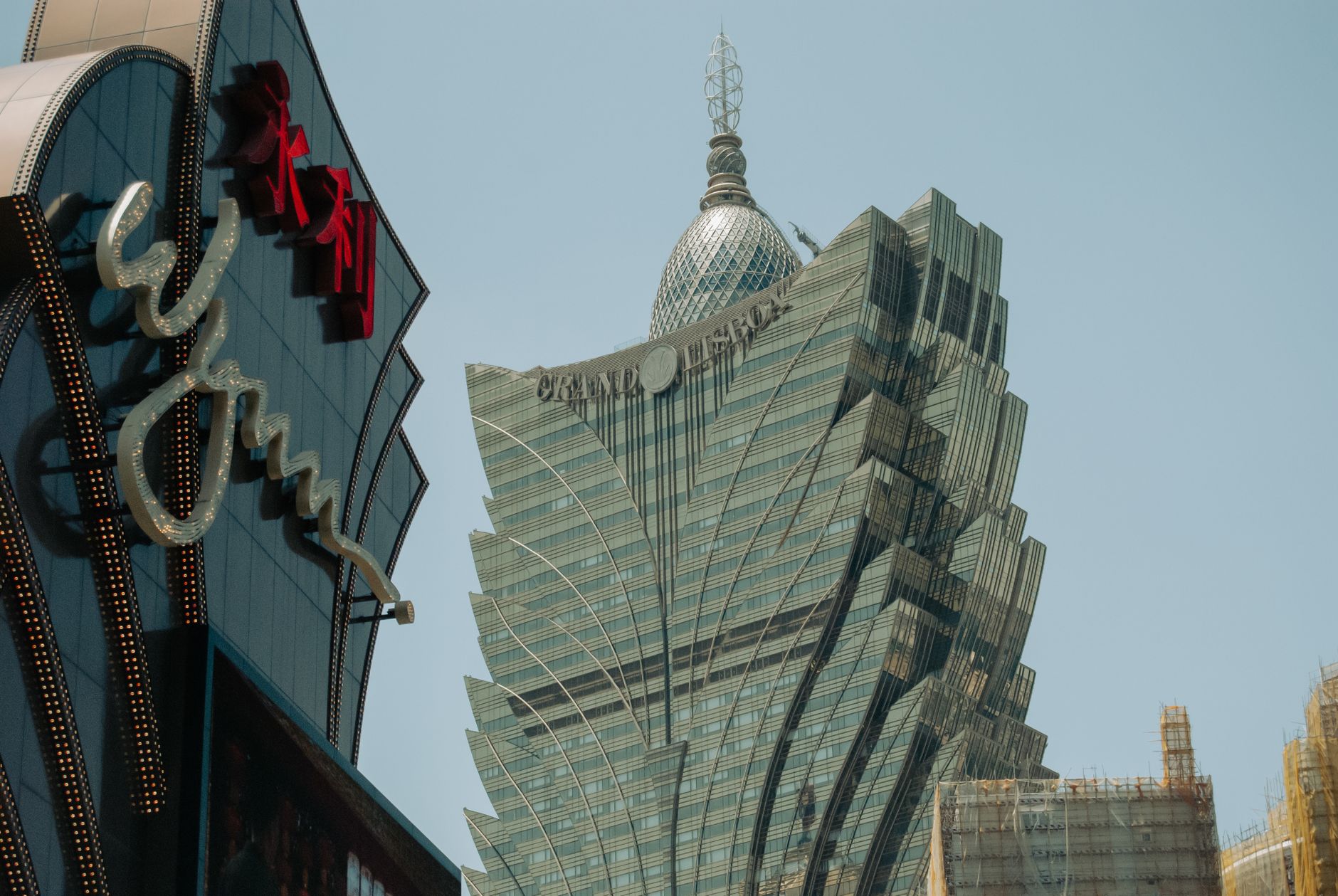
The casinos are enormous and real. Macau's gaming revenue has historically outpaced Las Vegas, and the Cotai Strip — built on land reclaimed between two original islands — looks like someone gave an architecture student unlimited money and no deadline. But the old UNESCO city sits on the original peninsula and mostly ignores all of it. Senado Square's wave-pattern cobblestones, Monte Fort's cannons still trained on the harbor, the A-Ma Temple's incense smoke drifting up a hillside that's been there since 1488 — these are 15 minutes by taxi from the Venetian. Both Macaos exist simultaneously. Which one you end up in depends entirely on when you leave your hotel.
Not every monument, just the ones we'd walk you past ourselves.
Where to wander, by quarter — each with its own rhythm.
Before you go
From fishing harbor to the world's most profitable square mile
Archaeological digs on Coloane Island have turned up evidence of human presence going back four to six thousand years — shellfish middens, stone tools, the quiet record of people who fished and moved on. The peninsula itself was barely larger than a neighborhood, jutting into the Pearl River Delta on a thin isthmus that would later make it both defensible and vulnerable. Nobody named it yet.
When Mongol armies swept south through China, roughly fifty thousand people fled to the coastal fringe around Macau — one of the largest sudden population surges the region had ever seen. They came by junk and on foot, crammed onto a peninsula with no harbor infrastructure and no formal city. Most eventually moved on. Some stayed, and their descendants would be the ones greeting Portuguese sailors two and a half centuries later.
Fishermen from Guangdong and Fujian built the A-Ma Temple into a hillside above the Inner Harbour sixty-five years before any Portuguese sailor set foot on the peninsula. Dedicated to Mazu, goddess of those at sea, its six pavilions climb the rock face in an arrangement that makes structural sense only when you understand feng shui. When Portuguese ships arrived and asked the locals what this place was called, the answer — something like 'Ama-gao,' the bay of A-Ma — became, through mispronunciation and Atlantic distance, 'Macau.'
Jorge Álvares sailed into the Pearl River Delta in 1513, planted a stone marker for King Manuel I on Lintin Island, and reported back that China was enormous, rich, and thoroughly uninterested in Portuguese overtures. That same year, Rafael Perestrello — a cousin of Christopher Columbus, in a detail that history refuses to make less strange — traded successfully in Guangzhou. Two early visits, two very different lessons about what China would and would not allow.
Tomé Pires led Portugal's first formal diplomatic mission to China, reaching Beijing in 1520 with gifts and trade proposals. The Ming court arrested him. The Sultan of Malacca — whose city the Portuguese had seized six years earlier — had already poisoned the relationship at the highest levels, lodging his complaint directly with the Emperor. Pires died in Chinese captivity, and Portugal spent the next four decades trying to find a back door into the trade it needed.
After a conveniently vague shipwreck incident, Macau's harbors were opened to Portuguese vessels for shelter and trade. Not to settle. Not to build. Just to anchor and dry things out, officially. They built stone houses near Nam Van almost immediately. The Ming court noticed and, for reasons historians still argue about, decided the arrangement was tolerable enough to leave alone.
The Ming court formally consented to a permanent Portuguese presence in 1557, in exchange for an annual rent of 500 taels of silver — roughly 20 kilograms. Portugal built a walled village; China retained sovereignty; Portuguese residents paid Chinese taxes; Chinese residents answered to Chinese law. It was a dual-jurisdiction arrangement that worked reasonably well for three centuries, which is more than can be said for most colonial agreements.
The Jesuit priest Alessandro Valignano landed in Macau in September 1578 and immediately understood what the city could become: not just a trading post, but the nerve center of Catholic Asia. Born in Chieti, trained in Rome, he spent the next 28 years here — founding St. Paul's College in 1594, the first Western-style university in East Asia, and coordinating Jesuit missions from Japan to India. He died in Macau on January 20, 1606, and his tomb remains in the crypt beneath the ruins of his greatest project.
St. Paul's College was where Japanese converts learned Latin, where Chinese scholars encountered Galileo's astronomy, and where priests trained before heading into a China that would, more often than not, execute them for their trouble. The College became one of the most ambitious educational experiments the 16th century attempted anywhere. When the church attached to it burned down in 1835, only the stone facade survived — and that facade is still, by a wide margin, the most visited structure in Macau.
Construction began on the Church of Mater Dei — what would become, at its peak, the largest Catholic church on the continent. Jesuit lay brothers, Japanese Christian refugees, and local laborers worked together on a facade that later scholars called a 'sermon in stone': the Virgin, the instruments of the Passion, a Japanese demon crushed beneath a woman's heel. By 1637, the trade route that made all of this possible — Chinese silk to Japan, Japanese silver back to Macau — had already started to collapse.
A Dutch fleet put 800 men ashore in June 1622 with the intention of taking Macau for the VOC. The defense that pushed them back was improvised and desperate, and included Jesuit priests firing cannons from Monte Fort — which was not, until that afternoon, finished. The attack failed, the Dutch withdrew, and the first formal Portuguese Governor arrived the following year to build the fortifications that should have existed already.
When Japan's Tokugawa shogunate expelled Catholic missionaries and severed contact with Portugal, it ended the most profitable trade route Macau had ever operated: Chinese silk north to Nagasaki, Japanese silver south through Macau. The Dutch kept their small foothold at Dejima — the shogunate having decided that Protestant merchants were less of a spiritual threat than Jesuit ones. Macau had no equivalent arrangement. The city's golden age ended not with a battle but with a policy decision made in Edo.
News arrived in 1642 that Portugal's House of Braganza had reclaimed the crown from Spain — an event that had actually occurred two years earlier, but word traveled slowly through blockades and ocean storms. Macau celebrated for ten weeks despite being broke and cut off from most of its trading partners. King João IV rewarded the loyalty with a new honorific: 'There is None More Loyal.' The full title — 'City of the Name of God in China, There is None More Loyal' — is still displayed inside the Leal Senado today.
On the night of January 26, 1835, fire swept through the Church of Mater Dei for the third time in its history. This time it took everything: the nave, the roof, the library of St. Paul's College, the interior that had taken generations to assemble. What survived was the stone facade — four stories of carved granite that had been designed to stand against nothing in particular, and have been standing against weather and tourist cameras ever since. The ruins are more visited today than the intact building ever was.
Governor João Maria Ferreira do Amaral had spent his tenure bulldozing ancestral graves to build roads and expelling Qing customs officials from territory he'd declared Portuguese land. In August 1849, while bird hunting near the Barrier Gate, he was ambushed by villagers from Longtian led by Shen Zhiliang. His right shoulder and head were severed. Shen Zhiliang surrendered himself to Qing authorities to protect his village from reprisals and was executed under Portuguese pressure. The gate where it happened is now called Portas do Cerco.
The Sino-Portuguese Treaty of Peking finally gave Portugal what it had sought since 1842: Chinese recognition that Macau was Portuguese territory. China had refused every earlier attempt, insisting on sovereignty. The treaty's wording left the question deliberately ambiguous in Chinese, which meant the underlying dispute about what 'perpetual occupation and governance' actually transferred never fully resolved. It simply went quiet for 112 years.
The composer Xian Xinghai was reportedly born on a boat in Macau harbor in 1905, his parents migrants from Panyu on the mainland. He left as a young child and spent his adult life in Shanghai and Paris, studying at the Conservatoire and returning to China to write the Yellow River Cantata in 1939 — four movements that became the sonic signature of a nation's resistance to Japanese occupation. He died in 1945, aged 40, in a Soviet hospital. Macau claims him as its most significant cultural export, though the city barely had time to shape him.
When Japan invaded China in 1937, Macau's neutrality — Portugal was staying out of Europe's war too — made it a shelter of last resort. The population rose from 164,528 in 1937 to 245,194 by 1939: eighty thousand people crammed onto a peninsula barely 11 square kilometers in size. By December 1941, Japanese forces surrounded Macau on every side without ever formally invading it. The city spent three years and eight months as what residents later called an 'isolated island' — technically free, practically trapped.
Ho Yin arrived in Macau during the war years and built Tai Fung Bank into the financial backbone of the Portuguese colony while simultaneously serving as Beijing's most trusted interlocutor with Lisbon. For three decades he was the person both sides needed in the room — a Chinese businessman with genuine influence over Portuguese administrators and credibility with Communist Party officials who distrusted almost everyone carrying that kind of Portuguese association. The avenues and parks named after him are one measure of how singular that position was.
China and Portugal signed the Sino-Portuguese Joint Declaration: Macau would return to Chinese sovereignty on December 20, 1999, and would retain its legal system, currency, and political arrangements for fifty years after that — until 2049. China had actually been offered Macau back in 1974, after Portugal's Carnation Revolution ended its colonial ambitions, and had declined; the timing wasn't right. Thirteen years later, the terms had been worked out, and the countdown clock started.
At midnight on December 20, 1999, Portugal's flag came down over Macau for the last time, ending 442 years of Portuguese presence and the last European colonial foothold on the Asian mainland. The handover ceremony was measured, dignified, and slightly anticlimactic — which was probably intentional on all sides. Macau became China's second Special Administrative Region, with Edmund Ho as its first Chief Executive. The pataca stayed, Portuguese remained an official language, and most things continued exactly as before.
Twenty-two buildings and public spaces spread across the peninsula — from A-Ma Temple to the Ruins of St. Paul's to Senado Square — were inscribed on the UNESCO World Heritage List. The inscription recognized something residents had taken for granted for years: that Macau's layered Portuguese-Chinese urban fabric was genuinely rare, the product of a cohabitation that was often tense and occasionally violent but had produced, over four centuries, an architectural register that looked nothing like either of its parent cultures.
Sometime around 2006, Macau's casino revenues passed those of Las Vegas — a fact that surprised almost nobody who had watched the Cotai Strip being reclaimed from the sea between Taipa and Coloane. The land-reclamation project turned a shallow strait into the densest concentration of casino floor space on earth: the Venetian Macao alone covers more floor area than the original Venice. Macau's GDP per capita reached US$65,040 in 2023, among the highest in the world, generated almost entirely by an industry that employs three-quarters of the workforce.
Jesuit Missionary · 1539–1606
Lived and died in Macau
Valignano arrived in Macau in September 1578 and saw it as the gateway through which Christianity would reach China and Japan — a calculation that made the city the center of the largest Jesuit operation in Asia. He founded St. Paul's College in 1594, the first Western-style university in East Asia, which gave rise to the church whose stone facade is now Macau's most-photographed landmark. He died here on January 20, 1606, and is buried in the Museum of Sacred Art behind the ruins of his own creation.
Composer · 1905–1945
Born in Macau (reportedly)
Xian Xinghai was reportedly born on a boat in Macau harbor — a provisional beginning for a man who would become China's most celebrated modern composer. He went on to study at the Paris Conservatoire and returned to write the Yellow River Cantata in 1939, a work so embedded in Chinese cultural identity that it was performed throughout the Cultural Revolution. He never came back to Macau.
Missionary and Scholar · 1782–1834
Lived and died in Macau
Morrison arrived in Macau in 1807 as the first Protestant missionary to attempt China — working undercover as a clerk for the East India Company while spending years translating the entire Bible into Chinese. It was painstaking, largely thankless work conducted in a city where the Catholic Church dominated and the Qing Empire tolerated foreign religion only at arm's length. He is buried in the Old Protestant Cemetery, where his grave still draws scholars interested in the collision of Western faith and Chinese civilization.
Painter · 1774–1852
Lived in Macau from 1825 until death
Chinnery fled to Macau from debts in India and found, quite by accident, the subject that would define his career. For 27 years he painted the Portuguese merchants, Cantonese fishermen, and layered street life of 19th-century Macau with an eye sharp enough to make historians grateful. His portraits are among the only detailed visual records of what the city looked like before the casino era remade its waterfront.
Businessman · 1894–1983
Lived in Macau, founded the gaming industry
Fu Tak Yam arrived from Foshan and proceeded to invent modern Macau's defining industry. He co-founded the Tai Heng Company gambling monopoly in 1937 and introduced baccarat to the territory — a card game that would eventually generate more annual revenue here than in Las Vegas. The casino towers that now dominate Cotai's skyline trace a direct line back to his table.
Banker and Community Leader · 1908–1983
Lived in Macau from World War II
Ho Yin arrived in Macau during the Japanese occupation and built Tai Fung Bank into the territory's most important financial institution. For decades he functioned as the essential intermediary between the Portuguese colonial government and Beijing — a politically delicate role that meant steering between the Salazar era, the Cultural Revolution, and the 1966 Macau riots without committing fatally to the wrong side. Streets, parks, and an asteroid bear his name; his son Edmund became Macau's first Chief Executive after the 1999 handover.
Actress · born 1963
Born in Macau
Ming-Na Wen was born in Macau before her family emigrated to the United States, where she became the voice of Disney's Mulan — one of the few Hollywood lead roles drawn from Chinese mythology. She later appeared in The Mandalorian and Agents of S.H.I.E.L.D., building a career that spans animation, prestige television, and science fiction across four decades. Macau produces few internationally recognized film names; she is by some distance the most prominent.
Where locals actually book dinner — not the tourist menus.
The Portuguese custard tart arrived with missionaries in the 16th century and never left. Macau's version has a flakier, crispier shell than the Hong Kong variant and a richer, slightly less sweet custard. Lord Stow's Bakery in Coloane Village is the reference point — the queue is reliable evidence.
Don't expect it to taste African — this is a Macanese invention, grilled chicken in a coconut and peri-peri sauce that passed through Mozambique and Goa before landing here. The name is the history. Henri's Galley near the Outer Harbour has served it for decades and remains the most direct way to understand what 400 years of Portuguese maritime trade tasted like.
Ground pork or beef fried with diced potatoes, soy sauce, and a fried egg on top. This is the closest thing Macau has to a national dish — simple, specific to here, and on every local lunch menu. Order it anywhere that isn't a hotel buffet.
A bone-in pork chop, marinated overnight, fried hard, and pressed into a Portuguese bread roll that absorbs the fat as it cools. Sold at stalls around Senado Square for roughly MOP 30. The bread-to-meat ratio is intentional and correct.
A Portuguese-Macanese dessert: alternating layers of whipped cream and crushed Marie biscuits, served cold in a cup. The name means 'sawdust' — for obvious visual reasons. Deceptively good, and found at most local cafés and pastelerias.
Sandy, crumbly, and aggressively almond-forward. Every souvenir shop sells the packaged version. Seek out the handmade ones from older bakeries in the historic quarter — the texture is completely different, closer to shortbread than to biscuit.
Prepared in the Portuguese tradition — baked with potatoes and olive oil, or served as fritters — bacalhau is the one dish that connects Macau directly to Lisbon without the Cantonese detour. Portuguese-style restaurants near the historic centre serve it properly; the casino buffet versions do not.
Not specific to Macau, but the concentration of high-quality dim sum houses here — serving both local Cantonese residents and mainland visitors with serious expectations — keeps the standard unusually high for the price. Go to a teahouse in the peninsula, not the casino floor.
Small things that change how the city treats you.
The city, as it actually looks.




Yes — but for reasons most visitors miss. The casino strip is one answer; the UNESCO Historic Centre is a completely different city within the same 32 square kilometers. A-Ma Temple was built in 1488, sixty-five years before the Portuguese arrived, and the Ruins of St. Paul's survived three fires to become one of Asia's most photographed monuments. Two days rewards you; three lets you breathe.
Two full days covers the Historic Peninsula and Cotai Strip without rushing. A third reaches Coloane Island's quieter beaches and villages. Macau is often done as a day trip from Hong Kong, but an overnight stay changes things — the casino towers light up at dusk and the historic lanes empty out by evening.
The TurboJET or Cotai Water Jet ferry takes roughly 55 minutes from central Hong Kong or Hong Kong Airport's SkyPier, with 150+ daily departures. If you're connecting from HKG without entering Hong Kong, cross-boundary coaches run directly via the HKZM Bridge. Sky Shuttle helicopter does the crossing in 15 minutes if you want to skip the queues entirely.
Generally very safe — violent crime is rare and casino areas are heavily secured. The documented risk is taxi scams at ferry terminals: inflated fixed fares, or in extreme cases, luggage left in the trunk driven away at a red light. Use hotel shuttles, casino buses, or public buses where possible. If you take a taxi, agree on the meter before entering.
Flag fall is MOP 21 for the first 1,600 meters, then MOP 2 per 220 meters. From the airport to city center, expect roughly MOP 110 (around €12) including the MOP 8 airport surcharge. Each piece of luggage in the boot costs MOP 3.
The official currency is the Macanese Pataca (MOP), but Hong Kong Dollars are accepted almost universally at roughly 1:1 and change comes back in Patacas. Cash dominates in local markets and street food stalls; major hotels, casinos, and restaurants take credit cards. Alipay and WeChat Pay are increasingly common, catering to mainland Chinese visitors.
The entire Historic Centre — Ruins of St. Paul's, A-Ma Temple, Senado Square, Monte Fort, Church of St. Dominic — charges no entry. The Macau Museum inside Monte Fort has a small admission; the fort grounds don't. Casino shuttle buses are free even without gambling, and the walk between the peninsula's UNESCO sites takes under 30 minutes.
Cantonese is the dominant everyday language; Mandarin is widely understood given heavy mainland tourist traffic. Portuguese is official and appears on all street signs and bus stops — useful for navigation even without speaking it. English works in hotels, casinos, and major tourist areas but less reliably in local markets. Screenshot key addresses in Chinese characters before hailing a taxi.
Saved and recently read places — kept on this device only.
Photos may have been resized or cropped.