
Shaolin Monastery
DengfengPeople's Republic of China 34° N · 112° E Updated May 2026
Founded in 495 for an Indian monk, Shaolin is where Zen legend, martial-arts theater, and a still-working monastery share one mountain slope.
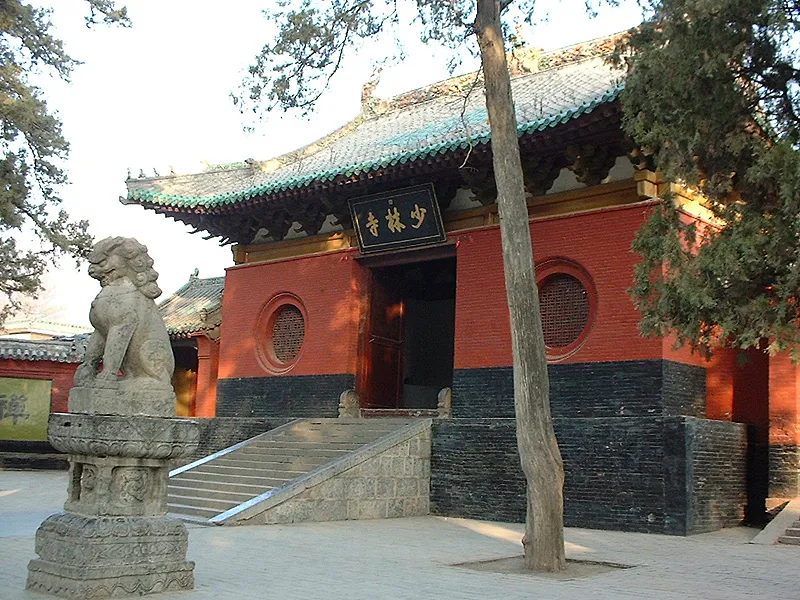 Photo: User:Yaoleilei · CC BY-SA 3.0
Why does the world's most famous kung fu monastery feel, at first, almost quiet enough to miss its own legend? Shaolin Monastery in Dengfeng, People's Republic of China, rewards a visit because the real shock is not the martial spectacle but the survival of a working Buddhist house where bells, incense, and disciplined bodies still share the same mountain air. Today you step through gates below Shaoshi Mountain, hear wooden clappers and shouted training counts ricochet off old courtyards, and catch the smell of pine smoke and cold stone before the tour groups fully close in.
Most visitors arrive carrying a film in their heads. Flying kicks, warrior monks, Bodhidharma glaring at a cave wall for nine years. Then the place corrects you: saffron robes move past souvenir stalls, sutras are still chanted, and the mountain keeps its own counsel.
Records show Shaolin was founded in 495 under Northern Wei patronage for the Indian monk Batuo, which means the monastery began as a political-religious bet before it became a martial symbol. That early purpose still matters. You come here to see how a temple can survive fire, warlords, dynastic favor, revolution, cinema, and commerce without fully giving up the rhythm that made it worth building in the first place.
Walk on to the Pagoda Forest and the scale lands properly. More than 240 brick-and-stone funerary pagodas rise from the earth like a crowded skyline in miniature, each one a grave marker, each one proof that Shaolin was never just a story about fighting.
What to see
-
The Main Temple Compound
Shaolin's first surprise is its order. Founded in 495 under Northern Wei patronage for the Indian monk Batuo, the monastery draws you along a central axis of gates, courtyards, Bell and Drum towers, and red timber halls that feel measured almost to the breath; then a doorway opens, incense thickens, the light drops, and the place stops performing for the crowd. Look for the ancient ginkgo in front of Mahavira Hall, said by the temple to be more than 1,500 years old, its trunk thicker than a dining table for ten, because that tree changes the whole reading of the site: this isn't a movie set for kung fu fantasies, but a monastic world that has kept its own time for fifteen centuries. -
The Pagoda Forest
West of the main compound, Shaolin becomes quieter and far stranger. More than 200 brick and stone memorial pagodas stand among the trees like a congregation that never left, each one built for an eminent monk, their clustered roofs and weathered inscriptions turning a graveyard into a skyline no taller than a two-storey house. Stay longer than most people do, especially when the mountain light starts to thin, and you'll hear wind in the pines instead of tour groups; the effect is less grand than the temple halls and more moving, because memory here comes in repeated forms, one tower after another, as if grief had learned architecture. -
Walk to Chuzu Temple and Bodhidharma Cave
Take the route most rushed visitors skip: from the main monastery toward Chuzu Temple, reported as built in 1125, and then higher to the cave linked by tradition to Bodhidharma's nine years of meditation. Chuzu is the real detour worth making, with carved stone columns crowded by musicians, dragons, peonies, and mythical beasts, while the path beyond grows cooler and rougher until the monastery noise falls away and Mount Song takes over. Legend holds that Bodhidharma's presence marked the rock itself; documented or not, the climb still does what good pilgrimage routes do, which is strip Shaolin of its brand-name swagger and return it to mountain, stone, and discipline.
Plan your visit
- Getting There
- Shaolin sits on the Shaoshi Mountain side of the Songshan scenic area, about 15 km northwest of Dengfeng. From Zhengzhou, the least awkward public route is the direct scenic bus from Zhengzhou Center Station by the railway station East Square, about 90 minutes, after either reaching the city by train or taking Airport Bus Line 3 from Xinzheng Airport to the station area in about 40 minutes; from Dengfeng West Bus Station, local shuttles to Shaolin run roughly every 20 minutes, take about 40 minutes, and cost around CNY 5.
- Opening Hours
- As of 2026, published hours do not match perfectly, which tells you something about how this place runs. The safest working window is 07:00 or 08:00 opening, last reliable entry around 16:00 to 16:30, and an effective close between 17:00 and 17:30; arrive by 09:00 if you want the temple, Pagoda Forest, and a kung fu show without clock-watching.
- Time Needed
- Give the core visit 2.5 to 4 hours if you want the Resident Temple, Pagoda Forest, and one kung fu performance without rushing from gate to gate. A fuller day takes 6 to 8 hours if you add Sanhuangzhai or mountain sections, while an in-depth visit can stretch to 1 or 2 days once you fold in Damo Cave, Chuzu An, and the wider Dengfeng heritage circuit.
- Accessibility
- The core temple zone is the manageable part: paved sections, visitor facilities, and in-park transport make the main visit more realistic than the mountain add-ons. Sanhuangzhai, Damo Cave, and the steeper Songshan trails involve stairs, uneven stone, and longer climbs, and I found no evidence of public visitor elevators in the historic core.
- Cost and Tickets
- As of 2026, the official Shaolin Temple Scenic Area ticket is CNY 80, covering the Resident Temple, Pagoda Forest, Sanhuangzhai, Chuzu An, Erzu An, and the kung fu performance. Since the real-name reservation system took effect on July 31, 2025, the smart move is to book 2 to 7 days ahead through the official WeChat channels; foreign visitors should reserve online first, then bring a passport to the service window for verification and ticket exchange.
History
The Bell Kept Ringing
Shaolin's oddest achievement is not that monks learned to fight. Records show the stranger feat is continuity: a monastery founded in 495 under Emperor Xiaowen, burned, rebuilt, courted by emperors, battered by soldiers, then folded into modern heritage management still functions as a Buddhist monastery rather than a dead shell.
That continuity has a sound. Dawn chanting, meditation, funerary memorials, and the teacher-to-disciple discipline of body and mind have carried across fifteen centuries, even when the buildings did not. Look past the stage-managed kung fu image and you start seeing a place organized, stubbornly, around repetition.
The turning point
Before the Fists, the Vows
At first glance, Shaolin seems to tell a simple story: monks trained, legends grew, and kung fu made the temple famous. The courtyards encourage that reading. Staff forms crack through the air, tour guides point toward Bodhidharma, and the whole place can look like a martial origin myth made stone.
But one detail spoils the neat version. Near the bell tower, the 728 Shaolin Monastery Stele preserves documents tied to Li Shimin, the future Tang emperor Taizong, and records show the monastery's early standing came from imperial patronage, land grants, and Buddhist authority before later martial fame hardened into legend.
The deeper truth begins with Emperor Xiaowen. What was at stake for him was personal as well as imperial: a Xianbei ruler remaking himself as a Chinese emperor needed legitimacy at Mount Song, long treated as one of the symbolic centers of the realm, and the turning point came in 495 when he ordered a monastery built for Batuo. Shaolin started as a house of scripture, ritual, and statecraft; martial practice grew within that world, then later publicity made it look like the original purpose.
Knowing that changes your gaze completely. The training yard stops being the whole story, and the chant hall becomes the key. Even the kicks read differently: less as spectacle, more as one branch of a discipline that survived because the monastery kept returning, again and again, to prayer, memory, and rule.
What Changed
Almost everything material changed. Scholars date major surviving structures across multiple dynasties, the monastery was badly damaged in March 1928 when Shi Yousan's forces burned large sections of the complex, and later reconstruction followed the post-1978 religious thaw and the tourist boom triggered by the 1982 film Shaolin Temple. UNESCO inscription in 2010 fixed the site inside a global heritage frame, which helped preservation but also froze part of the place into performance.
What Endured
The core function endured with surprising stubbornness. Records show Shaolin remained a Buddhist monastery dedicated to Chan practice, ritual observance, teaching, and memorial care for generations of monks, and the Pagoda Forest makes that continuity visible in brick: dated funerary towers span more than a millennium, from the Tang period onward, like a stone archive of uninterrupted remembrance. Even when buildings fell, the pattern returned.
Tips for visitors
Temple Manners
This is still a working Buddhist site under the souvenir varnish, so dress modestly: covered shoulders and knees is the safest choice if you plan to enter halls. Keep your voice down in worship spaces, don't treat monks or trainees like props, and leave altars and ritual objects alone.Photos, Carefully
Courtyards and exterior paths are usually fine for casual photography, but some halls ban pictures and posted rules matter more than your camera roll. Drones are not allowed in the scenic area, and a tripod or commercial-looking setup is more likely to get stopped than admired.Go Early
Morning light catches the temple roofs before the tour groups thicken, and the site feels less like a martial-arts theme park when the stone still holds the night's cool. Kung fu shows are scheduled at 09:30, 10:30, 11:30, 14:00, 15:00, and 16:00, subject to on-site notice, so build your route around one instead of drifting into a dead hour.Eat Nearby
For a temple-side meal, 少林欢喜地素斋馆 is the obvious pick: vegetarian, easy, and usually budget to mid-range. If you want something heartier, 中原农家乐 on G207 near the Shaolin Police Station does big farmhouse plates on a budget, while 子晋雷家 is the better sit-down option for richer homestyle dishes.Pair It Properly
Shaolin makes more sense once you stop treating it as a lone monument and read it as part of Dengfeng's bigger argument about Buddhism, Confucian learning, and mountain sacred geography. Pair it with Songyang Academy or Zhongyue Temple if you have a second half-day; pair it with Sanhuangzhai if you want cliffs, wind, and less bus-group theater.Ignore Fixers
Buy through the official scenic-area channels and be suspicious of anyone offering shortcut tickets, special access, or a helpful detour from parking areas and approach roads. Shaolin attracts hustle along with pilgrims, and the oldest trick here is still the simplest one: someone tries to stand between you and the real ticket office.
Watch & Explore Shaolin Monastery.

Frequently asked
Is Shaolin Monastery worth visiting?
Yes, if you want more than a kung fu stage set. Founded in 495 under the Northern Wei, Shaolin lands hardest when you slow down: incense in the halls, the Pagoda Forest with well over 200 memorial towers standing like a stone skyline, and Mount Song rising behind it all. Go for the monastery and the graves first, then treat the performance as the loud side dish.
How long do you need at Shaolin Monastery?
You need about 3 to 4 hours for the core visit, and a full day if you add the mountain sections. That shorter visit covers the Resident Temple, the kung fu show, and the Pagoda Forest without rushing like you're catching a train. Add 6 to 8 hours if you want Sanhuangzhai or the Bodhidharma cave route, where the climb changes the mood completely.
How do I get to Shaolin Monastery from Dengfeng?
The simplest way is the Dengfeng-to-Shaolin shuttle from Dengfeng West Bus Station. The monastery sits about 15 kilometers from central Dengfeng, roughly the length of a long airport approach road, and recent travel sources put the ride at around 40 minutes for about CNY 5. A taxi is faster, but the shuttle is the low-friction local move.
What is the best time to visit Shaolin Monastery?
Autumn is the best time, with spring close behind. Autumn brings the old ginkgo near Mahavira Hall into gold and throws red leaves across the Songshan slopes; spring softens the whole compound with greener courtyards and easier walking weather. Whatever the season, arrive by 9:00 a.m. because late-afternoon entry gets shaky and the site winds down around 5:00 to 5:30 p.m.
Can you visit Shaolin Monastery for free?
No, regular admission is not free. The official scenic-area ticket is CNY 80 and covers the Shaolin Resident Temple, Pagoda Forest, Sanhuangzhai, Chuzu An, Erzu An, and the standard kung fu performance; I found no recurring free-admission day in the current visitor material. Since July 31, 2025, most visitors also need to reserve in advance through the official system rather than count on buying a full-price ticket on the spot.
What should I not miss at Shaolin Monastery?
Do not miss the Pagoda Forest, the main temple axis, and one quieter stop such as Chuzu Temple or the 728 stele. The Pagoda Forest is the part that stays with you: hundreds of brick and stone memorial towers, each like a bookmark left by a monk, under mountain light that makes the place feel more elegy than spectacle. Also look down in the Thousand Buddhas Hall if accessible, where temple tradition links the worn floor depressions to long martial practice.
Sources & attribution 14
- Encyclopaedia Britannica — Founding date, historical background, main temple layout, Pagoda Forest scale, and overall significance of the monastery.
- UNESCO World Heritage Centre — UNESCO status, Dengfeng sacred-landscape context, and the monastery's setting within the Historic Monuments of Dengfeng.
- Songshan Scenic Area Official Service Page — Official base ticket price for the Shaolin Temple Scenic Area.
- Songshan Scenic Area Official FAQ — What the ticket includes and the standard kung fu performance schedule.
- Songshan Scenic Area Official Ticket Page — Official reservation channel and current online ticketing system context.
- Songshan Scenic Area Official Traffic Page — Official transport details, including bus access patterns and practical arrival information.
- Dengfeng Government — Official note that visitors can take the Dengfeng-to-Shaolin shuttle from Dengfeng West Bus Station.
- China Discovery — Practical visit length estimates and the standard core sightseeing route.
- China Discovery — What to see inside the temple complex, visitor route highlights, and experiential details such as Chuzu Temple and the main halls.
- LoongWander — Recent practical guidance on opening-hour patterns, seasonal conditions, and approximate Dengfeng shuttle timing and fare.
- The China Journey — Full-day timing estimates and practical seasonal cautions for mountain sections.
- Shaolin Official English Site — Seasonal atmosphere, especially the ancient ginkgo near Mahavira Hall and the temple's visual character in autumn and snow.
- China.org.cn — Additional detail on the Pagoda Forest and its role as a cemetery of memorial pagodas.
- CTDSB — Reported implementation of the real-name online reservation system from July 31, 2025.
Built from cited sources · see the method · How we make our guides →
Pick up where you left off
Saved and recently read places — kept on this device only.
Photo credits (6)
- 20241103 Bell Tower of Shaolin Temple with Ginkgo Tree — Windmemories — CC BY-SA 4.0 (https://creativecommons.org/licenses/by-sa/4.0/) — Source: https://commons.wikimedia.org/wiki/File:20241103_Bell_Tower_of_Shaolin_Temple_with_Ginkgo_Tree.jpg
- Pagoda Forest, Shaolin Temple — kevinmcgill from Den Bosch, Netherlands — CC BY-SA 2.0 (https://creativecommons.org/licenses/by-sa/2.0/) — Source: https://commons.wikimedia.org/wiki/File:Pagoda_Forest,_Shaolin_Temple.jpg
- 20241103 Shaolin Martial Art Performance 01 — Windmemories — CC BY-SA 4.0 (https://creativecommons.org/licenses/by-sa/4.0/) — Source: https://commons.wikimedia.org/wiki/File:20241103_Shaolin_Martial_Art_Performance_01.jpg
- Bodhidharma Shaolinsi — Jiulongtang — CC BY-SA 3.0 (https://creativecommons.org/licenses/by-sa/3.0/) — Source: https://commons.wikimedia.org/wiki/File:Bodhidharma_Shaolinsi.JPG
- 20241103 Chuzu Temple 11 — Windmemories — CC BY-SA 4.0 (https://creativecommons.org/licenses/by-sa/4.0/) — Source: https://commons.wikimedia.org/wiki/File:20241103_Chuzu_Temple_11.jpg
- Shaolinsi — User:Yaoleilei — CC BY-SA 3.0 (https://creativecommons.org/licenses/by-sa/3.0/) — Source: https://commons.wikimedia.org/wiki/File:Shaolinsi.JPG
Photos may have been resized or cropped.