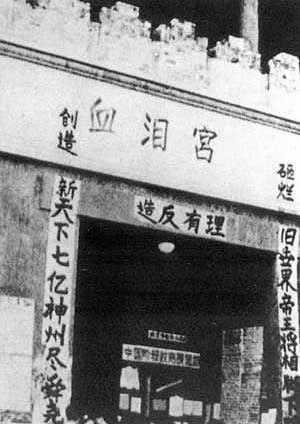
Historical Background
Origins and Establishment
The Italian Legation was established after the Second Opium War (1856–1860), when treaties such as the Treaty of Tientsin (1858) and the Convention of Peking (1860) opened Beijing to permanent diplomatic missions by Western powers (Beijing Tourism Official Site, Italian Embassy in Beijing). Italy, unified in 1861, joined other nations in setting up its legation in the Legation Quarter, known locally as Dongjiaominxiang (东交民巷), just east of Tiananmen Square.
This quarter rapidly transformed into a distinct diplomatic enclave, hosting embassies, clubs, banks, and churches. The Legation Quarter became a catalyst for urban modernization and symbolized Beijing’s expanding international connections.
Architectural and Urban Context
The Italian Legation was designed in a neoclassical style with Renaissance revival details, standing out against traditional Chinese hutongs that surrounded it. The structure included residential quarters, offices, and gardens, and contributed to the cosmopolitan atmosphere of the Legation Quarter (Chinatripedia). The area was characterized by stately European façades, wrought ironwork, and leafy boulevards, reflecting the aspirations and identities of the foreign communities who lived and worked there.
The Boxer Rebellion and the 1900 Siege
The Legation Quarter was the stage for one of the most dramatic episodes in Beijing’s history: the 1900 Boxer Rebellion. Between June and August, besieged by Boxer militants and Qing imperial troops, around 900 foreigners and nearly 3,000 Chinese Christians sought refuge behind the fortified walls of the Quarter (Morrison Collection, State Library of NSW, Everything Explained Today). The Italian Legation, along with other embassies, played a crucial role in the multinational defense and survival efforts.
Post-Boxer Rebellion and Later Developments
Following the Boxer Protocol (1901), the Legation Quarter was further fortified, and foreign powers enjoyed extraterritorial rights. The area thrived as a diplomatic hub until the mid-20th century, after which embassies relocated and the Quarter gradually reintegrated into the city. Today, the former Italian Legation building serves as part of the Beijing Municipal Government and is not regularly open to the public.
Visiting the Italian Legation: Practical Information
Visiting Hours
- Exteriors The Italian Legation’s façade and surrounding streets can be viewed at any time, 24/7 (Deep China Travel).
- Interiors The interior is not open to the public as the building is used for government purposes.
Tickets and Guided Tours
- Tickets No tickets are required to explore the exterior or walk the Legation Quarter (Chinatripedia).
- Guided Tours Several local operators offer historical walking tours of the Legation Quarter. These tours provide context, stories, and access to preserved sites. Advance booking is recommended, especially in peak seasons (Rachel Meets China).
Accessibility
- The area is generally accessible and pedestrian-friendly, though some buildings have steps or uneven pavements. Wheelchair users may need assistance in certain areas (Deep China Travel).
Photography Tips
- The Legation Quarter’s tree-lined boulevards and European façades are best photographed in early morning or late afternoon when the light is soft.
- Please respect restricted areas and avoid intrusive photography of official buildings.
Travel Tips
- How to Get There Take Beijing Subway Line 2 or 5 to Chongwenmen Station, or Line 2/8 to Qianmen Station. Bus routes 41 and 60 also serve the area (Chinatripedia).
- What to Bring Comfortable shoes, a camera, sunscreen in summer, and a translation app for signage and navigation.
- Amenities The Quarter itself is not commercialized; restrooms and cafés are available in adjacent districts like Wangfujing or near Tiananmen Square.
Nearby Attractions
- St. Michael’s Church A neo-Gothic Catholic church within the Legation Quarter (Deep China Travel).
- Former French Post Office An early 20th-century Western-style building.
- Beijing Museum of Diplomatic History Located in the former American Legation, this museum covers China’s diplomatic history (Chinatripedia).
- Tiananmen Square and the Forbidden City The Legation Quarter is a short walk from these iconic Beijing sites (Nomadasaurus).
Preservation and Legacy
The Legation Quarter is protected as a historic district. Many buildings have been restored and repurposed as government offices, cultural venues, boutique hotels, and restaurants. The Italian Legation’s neoclassical façade remains a striking reminder of Beijing’s international past, and the area’s blend of architectural heritage and modern urban life is unique in the city (Beijing Tourism Official Site).
Frequently Asked Questions (FAQ)
Q: Can I enter the Italian Legation building?
A: No. The building is currently used for government purposes and is not open to the public.
Q: What are the visiting hours for the Legation Quarter?
A: The street is open for walking and exterior viewing at any time.
Q: Are guided tours available?
A: Yes, several local operators offer historical walking tours in English and Chinese.
Q: Is photography allowed?
A: Exterior photography is allowed and encouraged, but be respectful of offices and restricted areas.
Q: Is the area wheelchair accessible?
A: The streets are generally accessible, though some historic surfaces may be uneven.
Q: How do I get there?
A: Subway (Chongwenmen or Qianmen stations) and bus routes 41 and 60 provide easy access.