
Origins and Construction
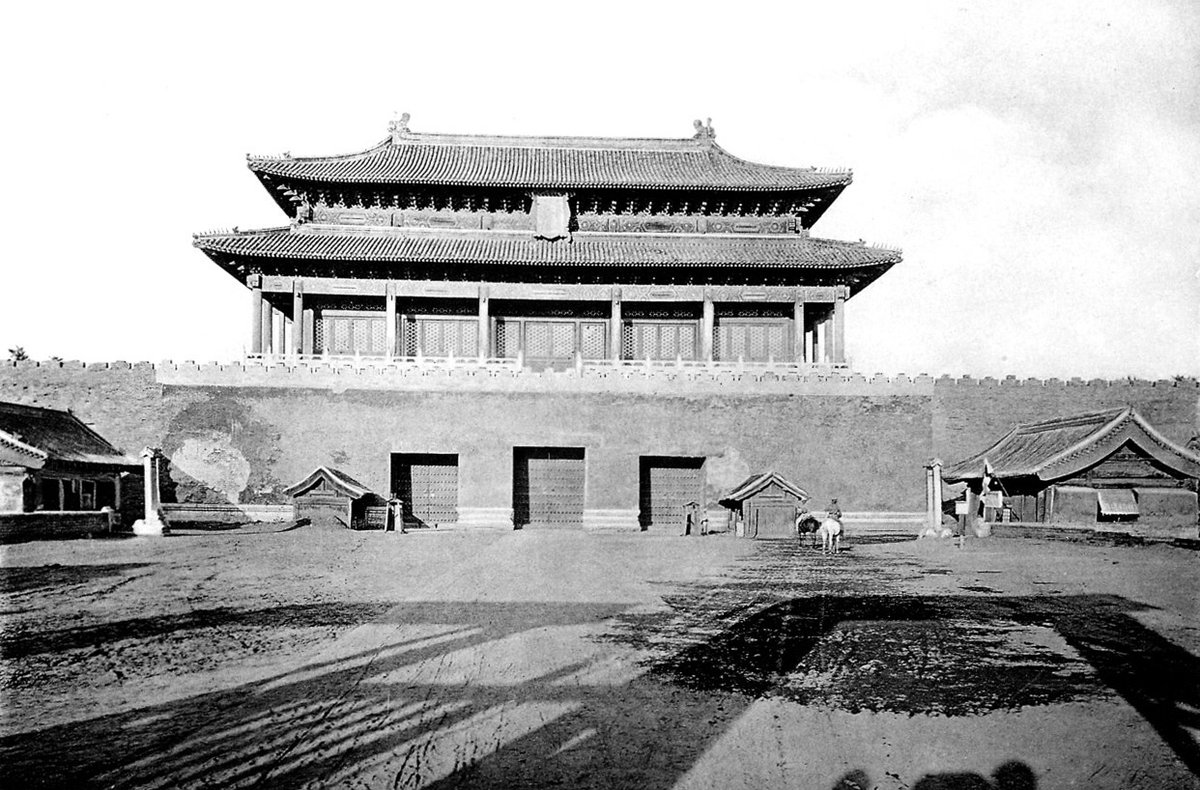
Erected during the Ming dynasty under the Yongle Emperor between 1406 and 1420, the Gate of Divine Might was originally named Xuanwu Gate (玄武门) after the Black Tortoise, a mythological guardian representing the north (Britannica). In 1420, the gate was renamed to reflect auspicious imperial symbolism and avoid taboos linked to the emperor’s personal name. Its position aligns with feng shui principles, emphasizing the emperor’s central place in the cosmic order and the palace’s strict north-south axis (Wikipedia; Top China Travel).
Architectural Features and Symbolism
The Gate of Divine Might exemplifies traditional Chinese imperial architecture:
- Structure A two-story construction atop 10-meter-high red walls.
- Roof Double-eaved hip roof with yellow glazed tiles, symbolizing supreme authority.
- Decorative Elements Blue and gilt plaque with “Shenwumen,” ornate wooden beams, painted brackets with dragons and phoenixes, and stone guardian lions (fu lions) flanking the entrance (Top China Travel; Kinhtenguoc).
- Ground and Details Gold brick paving, marble platform, and intricate ceiling motifs.
- Symbolism The gate’s northern orientation and name invoke the Black Tortoise, symbolizing protection and endurance, while its placement reinforces the Forbidden City’s cosmological design (ChinaTravel.com; TravelChinaGuide).
Historical and Ceremonial Functions
Throughout the Ming and Qing dynasties, the gate served as the palace’s main northern exit, primarily used by palace staff and for certain imperial ceremonies, including the entry of women selected for the imperial harem and the emperor’s departures for ancestral rites (TravelChinaGuide). Its role underscores the hierarchical and ritualistic order of the imperial court and the gate’s importance as a threshold between imperial privacy and the outside world.
Visiting the Gate of Divine Might
Location and Access
The Gate of Divine Might is at the northernmost point of the Forbidden City, directly facing Jingshan Park across the moat. Visitors must enter the Forbidden City through the southern Meridian Gate and exit via the Gate of Divine Might or the East Prosperity Gate (TravelChinaGuide; Trevallog). Direct entry through the Gate of Divine Might is not permitted.
- Nearest Subway Tiananmen East or Tiananmen West (Line 1) for entrance; after your visit, the north gate is a 15–20 minute walk from the closest metro (Trevallog).
- Jingshan Park Easily accessible after exiting via the Gate of Divine Might—cross the road via the underground tunnel to reach the park (Trevallog).
Visiting Hours and Ticket Information
- Operating Hours The Forbidden City is open from 8:30 AM to 5:00 PM (April–October, last entry at 4:00 PM), and 8:30 AM to 4:30 PM (November–March, last entry at 3:30 PM).
- Closed Days Closed every Monday, except national holidays (TravelChinaGuide).
- Tickets Purchase online in advance using your passport; on-site sales are not available. Foreign visitors must bring their passports for verification (Trevallog).
- Visitor Limit 80,000 per day—book early, especially during peak seasons (TravelChinaGuide).
Facilities and Services
- Luggage Storage Free deposit available at the Visitor Service Center near Duanmen Square. Deposit and claim hours correspond with opening times (TravelChinaGuide).
- Restrooms Located throughout the palace, including near the Gate of Divine Might.
- Food & Drink Onsite restaurants and snack bars, but re-entry is not permitted once you exit (Trevallog).
- Audio Guides Available at major gates, including the Gate of Supreme Harmony, supporting multiple languages (China Highlights).
- Guided Tours Enhance your experience with in-depth historical insights (Trevallog).
Accessibility and Safety
- Wheelchair Access Main routes are largely accessible; wheelchair rentals available. Some side buildings have steps (China Highlights).
- Security Bag checks and mandatory security screenings at entrances. Large bags must be stored at the luggage center (TravelChinaGuide).
- Safety Measures Strict closing times ensure the safety of visitors and preservation of artifacts.
Best Times to Visit
- Avoid Crowds Visit early mornings or late afternoons, especially mid-October to late November for pleasant weather and fewer crowds (China Highlights).
- Peak Times Weekends and public holidays (National Day, Labor Day) see the highest traffic.
Photography and Souvenirs
- Photography Allowed outdoors and in courtyards; no flash or tripods inside exhibition halls (China Highlights).
- Souvenirs Shops near exits offer imperial-themed gifts, postcards, and books.
Highlights and Nearby Attractions
- Jingshan Park Climb over 300 steps for panoramic views of the Forbidden City; a perfect photo spot (Trevallog).
- Imperial Garden Just inside the gate, tranquil gardens with ancient trees and pavilions.
- Beihai Park West of the Forbidden City, famous for its scenic lake and Nine-Dragon Wall.
- Corner Towers The four turrets around the moat are architectural marvels popular among photographers (Beijing Deep Tour).
- Corner Tower Coffee Nearby café with themed drinks and souvenirs.
Tips for a Memorable Visit
- Plan Ahead Book tickets in advance, bring your passport, and allow 2–4 hours for a thorough visit.
- Route Start at the Meridian Gate, walk north along the central axis, and exit via the Gate of Divine Might.
- Amenities Utilize luggage storage and restrooms as needed.
- Etiquette Respect preservation rules—no climbing, no littering, and follow photography guidelines.
Frequently Asked Questions (FAQ)
Q: What are the Gate of Divine Might visiting hours?
A: The Forbidden City is open 8:30 AM–5:00 PM (April–October) and 8:30 AM–4:30 PM (November–March), with last entry one hour before closing.
Q: Can I enter the Forbidden City through the Gate of Divine Might?
A: No, entry is via the Meridian Gate (south); the Gate of Divine Might is the main exit.
Q: How do I buy tickets?
A: Tickets must be purchased online in advance using your passport number.
Q: Is the Forbidden City open every day?
A: It is closed on Mondays except for national public holidays.
Q: Are there facilities near the Gate of Divine Might?
A: Yes, restrooms, luggage storage, and a nearby café.
Q: Is the gate area accessible for those with mobility issues?
A: The area is mostly flat, but the walk to nearby metro stations can be lengthy.
Preservation and Cultural Legacy
As a UNESCO World Heritage site, the Gate of Divine Might benefits from continuous conservation efforts to preserve its historical and architectural value (TravelChinaGuide). The gate stands not only as a functional exit but as a profound symbol of China’s imperial legacy, marking the boundary between the ancient imperial world and modern Beijing.


