Type 2+ letters to search all countries, cities, and places
/Ctrl KEsc
travel_explore
Type 2+ letters to search all countries, cities, and places
Press Enter to open the top result
Sanctuary on San Cristóbal Hill
Santiago·Chile·33° S · 70° W·Updated Apr 2026
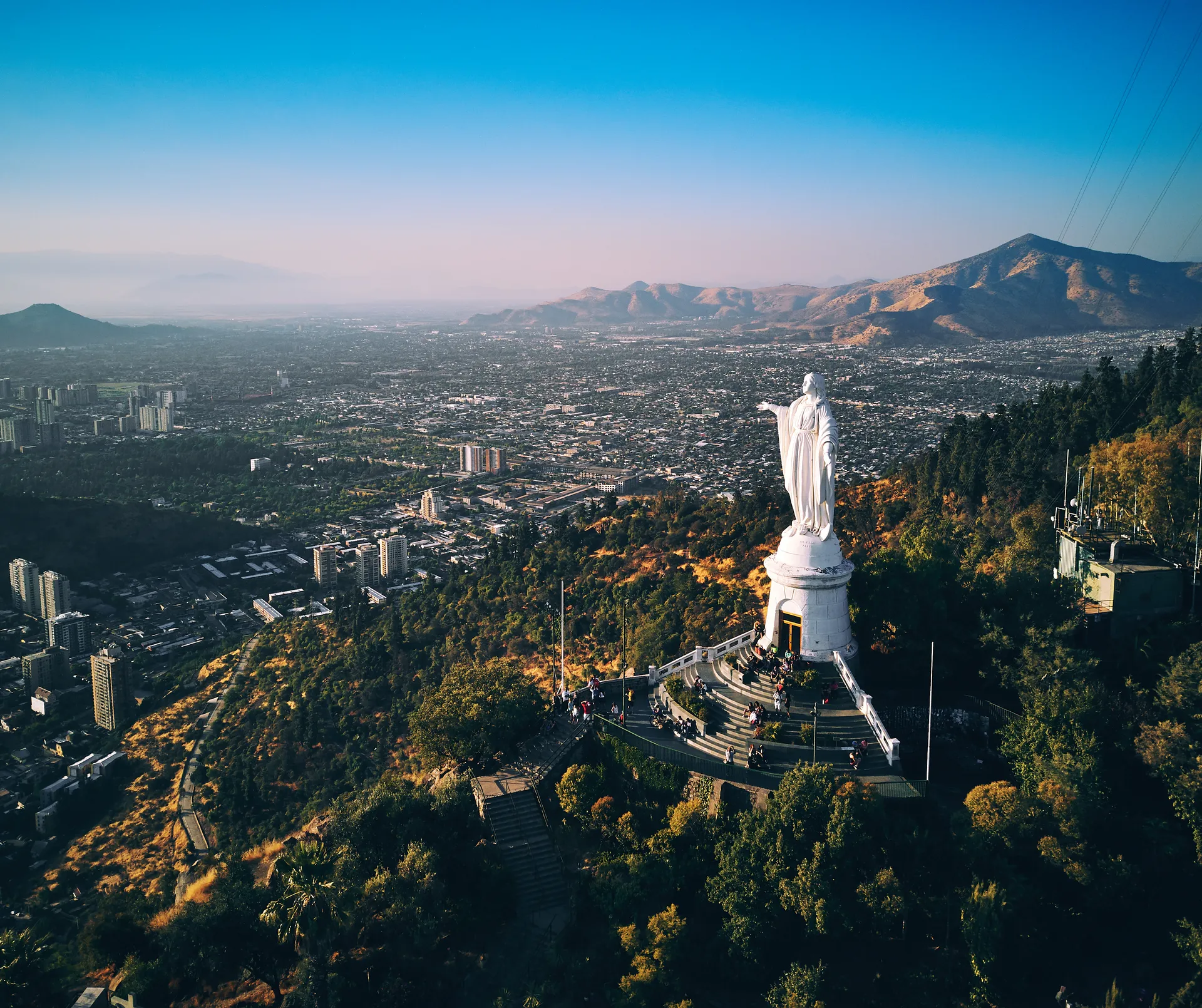
A white Virgin watches over Santiago from Cerro San Cristóbal, where pilgrimage, skyline views, and a cold mote con huesillos still share the same ritual up top.
A white Virgin watches over Santiago from a hill that once supplied stone for the city below. Santuario Inmaculada Concepción, in Santiago, Chile, is worth the climb for more than the view: this is where faith, politics, and urban memory meet in one hard-to-forget silhouette. You come for the skyline icon. You stay because the place has a stranger story than the postcard admits.
From the streets of Bellavista or Providencia, the sanctuary looks simple enough: a brilliant figure on Cerro San Cristóbal, bright against smog, cloud, or the sharp blue winter sky. Up close, the site feels less like a single monument than a sequence of pauses: the wind on the summit, the murmur of prayer, candle wax and sun-warmed stone, the whole bowl of the city spread out below like a map someone forgot to fold.
Most visitors assume the shrine has always belonged to a green urban park. Documented history says otherwise. Before Parque Metropolitano took shape, this hill was drier, rougher, and worked for quarry stone that helped build Santiago itself, including major civic works below.
That change matters. The sanctuary is not just a religious stop above the city; it marks the moment when a raw hill became a public symbol, and when Chilean Catholicism chose to place its most visible Marian image where everyone, believer or not, would have to reckon with it.
Researched by the Audiala editorial team from historical records, architectural archives, and local expertise.
What to see
The Virgin and the Pedestal Oratory
The surprise is scale: the white Virgin rises 14 meters from crown to hem, then stands on an 8.3-meter pedestal, so the whole monument lifts more than 22 meters above the summit, roughly the height of a seven-story apartment block. Records show the first stone was blessed on 8 December 1904 and the monument was inaugurated on 26 April 1908; cast in iron at Val d'Osne in France and shipped uphill in pieces, it looks distant from half of Santiago until you step inside the base and find the opposite, a compact oratory where the city noise drops, candle wax hangs in the air, and the giant skyline emblem turns human-sized again.
Capilla de la Maternidad de María and Plaza Vasca
A few steps from the exposed summit, the Capilla de la Maternidad de María changes the mood completely: cooler air, dimmer light, Peter Hörn's frescoes and sculpture work close to the eye, and the faint smell of wax instead of hot stone. Then slip out to Plaza Vasca, where the traffic of day-trippers thins and the sanctuary shows its quieter face; the Basque coats of arms carved into marble benches and the oak tied to Gernika make this corner feel less like a viewpoint and more like a small act of memory hidden beside the famous view.
Take the Summit as a Sequence
Don't treat this place as one statue and a photo stop. Start at Terraza Bellavista with the binoculars and mote con huesillo stalls, then walk the Camino de las Siete Palabras, where seven concrete crosses painted by Chilean artists slow your pace just enough for the wind to matter, before ending at the chapel and the monument; that order reveals the sanctuary's real trick, which is how a recreational hilltop with cable cars and snack kiosks turns, almost abruptly, into an open-air church.
Plan your visit
Getting There
The easiest approach is from Bellavista: take Metro Baquedano, walk about 10 minutes north along Pío Nono to the Funicular station at Pío Nono 450, then ride 8-15 minutes to Cumbre. For a calmer approach, start at Teleférico Oasis, Av. El Cerro 750 in Pedro de Valdivia Norte, about 15-17 minutes on foot from Metro Pedro de Valdivia or roughly 15 minutes from Costanera Center. Driving is possible on some days, but summit vehicle access is controlled enough that you should not count on parking without checking locally first.
Opening Hours
As of 2026, the shrine is usually visited through Parquemet and the hill transport systems rather than a separate tourist gate. Funicular hours are Monday 13:00-18:45 and Tuesday-Sunday 10:00-18:45, with the first Monday of each month closed for maintenance; Teleférico currently shows Tuesday-Sunday 10:00-19:45 on the operator site. Masses are Tuesday-Saturday at 12:00 and Sunday at 10:30 and 12:00, while the museum runs Tuesday-Sunday 11:00-17:00.
Time Needed
Give it 30-45 minutes if you only want the statue, chapel, and that wide Santiago basin view, a city spread below you like a map thrown over the Andes. Most visitors need 1.5-2 hours once you factor in the ride up, the esplanade, and a pause for photos or prayer. A fuller hilltop visit with Café Tudor, the terrace, and a ride up one way and down the other lands closer to 2-3 hours.
Accessibility
Teleférico is the best accessible route: Oasis and Zoológico stations have elevators, staff assist with boarding, and the panoramic buses are set up for wheelchairs as well. The summit area is manageable if you arrive that way, but it is still an outdoor hilltop with open paths and some slope. Hiking up is a different matter entirely, especially in summer heat that can feel like walking into an oven door.
Cost & Tickets
The sanctuary itself appears to be free; you pay for the ride, not the Virgin. As of 2026, Funicular Pío Nono-Cumbre costs CLP 1,600 one way or CLP 2,250 round trip, while Teleférico Oasis-Cumbre starts around CLP 3,150 one way or CLP 4,050 round trip. Online booking secures a timed slot, and the all-day 'Vive el Parque' pass is currently listed from CLP 11,500.
Photo Gallery
A close-up view of the bronze bells housed in a modern metal structure at the Santuario Inmaculada Concepción in Santiago, Chile. · RjcastilloA scenic elevated view of the Santuario Inmaculada Concepción in Santiago, Chile, showcasing its modern altar structure and terraced seating overlooking the city. · Dario AlpernA solemn interior view of the Santuario Inmaculada Concepción in Santiago, Chile, featuring a crucifix and a memorial display for Pope John Paul II. · José Joaquín CortesThe candle shrine at the Santuario Inmaculada Concepción in Santiago, Chile, features rows of votive racks set against a historic stone wall adorned with plaques. · David Berkowitz from New York, NY, USAA collection of memorial plaques and a wax-covered candle rack at the Santuario Inmaculada Concepción in Santiago, Chile. · David Berkowitz from New York, NY, USAA beautifully crafted wooden nativity display set beneath a rustic wooden canopy at the Santuario Inmaculada Concepción in Santiago, Chile. · David Berkowitz from New York, NY, USALit candles flicker in front of votive plaques at the Santuario Inmaculada Concepción, a peaceful place of prayer in Santiago, Chile. · David Berkowitz from New York, NY, USA
History
The Virgin Who Claimed the Skyline
Santuario Inmaculada Concepción did not rise on neutral ground. According to tradition, a large cross already stood on Cerro San Cristóbal after the Spanish founding of Santiago, so the summit had long been treated as a place of religious visibility before the Virgin arrived.
Documented records show the sanctuary belongs to the early 20th century, when Church leaders in Santiago wanted to mark the 50th anniversary of the dogma of the Immaculate Conception, proclaimed by Pius IX on 8 December 1854. What they built was not a discreet chapel. It was a skyline statement.
The turning point
José Alejo Infante and the Hill That Became an Argument
The key figure here is José Alejo Infante Concha, the priest who pushed the idea of placing a colossal Marian image on the summit. For him, this was personal as well as devotional. He had already lived through the bruising Church-State struggles of late 19th-century Chile, when questions of who held moral authority in public life were anything but abstract.
According to sanctuary accounts, Archbishop Mariano Casanova asked Infante on 20 October 1903 to organize the jubilee celebrations for the dogma's 50th anniversary. The turning point came on 8 December 1904, when the first stone was blessed and carried uphill in pilgrimage from the cathedral. After that, the project stopped being a pious proposal and became a fact in the city's body: stone, slope, sweat, public commitment.
Documented records show the monument was inaugurated on 26 April 1908, not in 1904 as many visitors assume when they read the pedestal inscription. Casanova died on 16 May 1908, only weeks later. That timing gives the sanctuary a sharp, almost final edge, as if one of Santiago's most visible religious symbols was also the archbishop's last word to the city.
A Hill Before the Park
Cerro San Cristóbal was not always the leafy refuge people imagine from the funicular. Documented sources describe a drier hill used for quarrying, with stone taken for works such as Puente de Cal y Canto, La Moneda, and city paving. The sanctuary stands above Santiago on a summit that helped build the capital in a literal sense, which gives the view an added charge: you are looking out from the material bones of the city itself.
The Pope on the Summit
If one date changed the sanctuary from a local shrine into a national stage, it was 1 April 1987. Documented records show Pope John Paul II came here during his Chile visit and blessed Santiago and the country from beneath the Virgin. In a nation still under dictatorship, the moment carried more weight than a routine devotional stop. The hill became a platform from which a religious gesture could not help sounding political.
Tips for visitors
Dress For Worship
No formal tourist dress code is posted, but this is an active Catholic sanctuary with mass, confession, and adoration. Normal city clothes are fine; beachwear, drunken Bellavista energy, and loud posing inside the prayer spaces are not.
Photos With Tact
Casual photography around the summit is normal, and the light late in the day can turn Santiago silver and pink in a matter of minutes. Inside services, keep the camera discreet, and for drones or organized shoots, assume permission is required under Parquemet and Chilean aviation rules.
Watch Bellavista
The real petty-crime risk is not the sanctuary by day but Bellavista after dark, where recent reports still mention phone snatching and assaults. Keep your phone in a zipped pocket or front pocket, and if you stay for dinner, leave by Uber or Cabify rather than wandering aimlessly after midnight.
Eat Like Santiago
Start with a mote con huesillos at the summit; that sweet peach drink with wheat berries is more local than any polished tasting menu. For a proper meal, Galindo in Bellavista is the old-school Chilean option at mid-range prices, Fuente Alemana on Pedro de Valdivia is the sandwich move at budget-to-mid-range, and Peumayén is the splurge if you want indigenous ingredients handled with some intelligence.
Go By Day
Morning gives you softer air and fewer crowds, while late afternoon gives the skyline its theatrical light. December 8, the feast of the Immaculate Conception, draws thousands and changes transport and mass schedules, so check the official sites that same morning if you are visiting near religious holidays.
Save On Transport
The cheapest version is to enter Parquemet for free and pay only for one transport leg, then walk or ride a different system down. A good-value route is Funicular up from Pío Nono and Teleférico down toward Oasis, which lets you see the hill from two angles instead of paying twice for the same view.
Where to Eat
local_dining
Don't Leave Without Trying
Pastel de choclo — sweet corn topping over pino, chicken, egg, and olives; a core Chilean dishEmpanada de pino — baked empanada with beef, onion, olive, and eggCazuela — clear broth with meat, potato, squash, corn, and riceCaldillo de congrio — conger eel stew, a coastal classicCompleto or lomito italiano — massive Chilean sandwich with avocado, tomato, and mayoSopaipillas — fried pumpkin dough, often eaten as a snack or light mealMote con huesillo — wheat grain with peach juice, a refreshing summer drink
Kiosko Plaza Mexico
cafe
Cafe€star4.5(78)
Order: Coffee and pastries — this is your best bet for a quick, honest cafe stop near the base of San Cristóbal with consistently high marks from locals.
Highest-rated spot in the verified data with solid review volume. A no-fuss neighborhood cafe where you can grab a real coffee and recharge after the sanctuary visit without tourist markup.
Order: Coffee and light brunch — this cafe sits on the hill itself, so order something simple and enjoy it with a view.
Located directly on Cerro San Cristóbal, this is your only option to eat without descending the hill. The highest review count in the dataset means steady foot traffic and reliable service for a quick rest.
Order: Fresh pastries and bread — a proper bakery stop for something warm and local before or after the sanctuary.
This is the only dedicated bakery in the verified list, making it a solid choice if you want real baked goods rather than cafe fare. Located on Pedro Bannen, one of the main access routes to the hill.
Order: Coffee and snacks — a casual mobile cafe option on the hill itself for a quick caffeine fix.
A food cart (carros) on Cerro San Cristóbal itself, so you can grab something without hiking back down. Best for a very quick bite between sanctuary visits.
checkThe sanctuary sits atop Cerro San Cristóbal; most good restaurants are at the base in Bellavista, Pedro de Valdivia, or near Parque Forestal — plan to descend via funicular or cable car to eat properly.
checkMercado Tirso de Molina (upstairs casual stalls) and Mercado Central offer cheap, informal Chilean plates like ceviche, completos, and mote con huesillo if you want market-level authenticity.
checkLa Vega Central is the biggest produce and food market in Recoleta, but exercise caution later in the day due to recent security concerns in the surrounding area.
checkCafes near the sanctuary tend to open mid-morning (10:30 AM or later); plan accordingly if you visit early.
checkThe verified restaurants near the sanctuary are mostly cafes and quick bites — for a proper sit-down meal, you'll need to walk into Bellavista or Pedro de Valdivia proper.
Food districts:Bellavista — historic bohemian quarter with traditional Chilean restaurants and bars, accessible from the base of San CristóbalPedro de Valdivia — main avenue with sandwich shops and casual dining, another popular entry/exit for the hillParque Forestal — tree-lined park with upscale cafes and restaurants, good for a post-sanctuary strollRecoleta — home to Mercado Tirso de Molina and La Vega Central, the real commercial food heart of Santiago
Restaurant data powered by Google
Frequently asked
Is Santuario Inmaculada Concepción worth visiting?
Yes, especially if you want more than a lookout. The white Virgin on Cerro San Cristóbal stands 14 meters high, about a four-story building, and the site carries more history than the postcard version suggests: a 1904 foundation, a 1908 inauguration, and a remembered papal blessing in 1987 during one of Chile's tense political decades. Go for the view, but stay for the smaller things people miss: the chapel, the museum, the artist-painted crosses, and the feeling of wind and prayer sharing the same hilltop.
How long do you need at Santuario Inmaculada Concepción?
Give it 90 minutes to 2 hours, about the length of a long lunch and coffee, if you ride up and actually look around. A quick stop at the summit can take 30 to 45 minutes, but that turns the sanctuary into a photo platform and misses the chapel, the museum, and the slower walk between the terrace and the statue. If you mix the funicular and cable car, or linger over a mote con huesillos, half a day goes easily.
How do I get to Santuario Inmaculada Concepción from Santiago?
The easiest route from central Santiago is Metro Baquedano, then a short walk to the Pío Nono entrance, about 10 minutes on foot, roughly the time it takes to cross a few city blocks with traffic lights. From there, take the funicular to Cumbre, or use the Teleférico from Oasis on the Pedro de Valdivia Norte side if you want the smoother, more accessible approach. Walking up is possible, but on a dry Santiago day the hill feels much bigger than it looks from below.
What is the best time to visit Santuario Inmaculada Concepción?
Late afternoon is the sweet spot. The white statue reads better against softer light, the city haze often eases, and the summit feels less punishing than at midday when the sun hits the concrete and open sky hard. If you want the sanctuary at its most alive as a religious place, go around 8 December for the Feast of the Immaculate Conception, but expect crowds measured in the thousands, more like a public gathering than a quiet hilltop stop.
Can you visit Santuario Inmaculada Concepción for free?
Yes, the sanctuary itself appears to be free to enter. What usually costs money is the transport up the hill: the funicular from Pío Nono and the Teleférico from Oasis or Zoológico, with current fares checked in April 2026 starting in the low thousands of Chilean pesos. If you're watching your budget, walk into Parquemet for free and pay only for the ride you actually want.
What should I not miss at Santuario Inmaculada Concepción?
Don't stop at the terrace photo and leave. The detail worth hunting is the sanctuary's second scale: the chapel beside the giant statue, the small oratory in the base, the Camino de las Siete Palabras with its seven artist-worked crosses, and the modest museum near the central stair, which explains how a cast-iron monument shipped from France ended up on this summit. And read the pedestal date, 8.XII.1904, because that small inscription quietly tells you the place began four years before the monument was actually inaugurated.
Sources & attribution116
Researched and written by the Audiala editorial team from historical records, architectural archives, and local expertise. Last updated April 2026.
Santuario de la Inmaculada Concepción, Cerro San Cristóbal (25059260397) — Deensel — CC BY 2.0 (https://creativecommons.org/licenses/by/2.0/) — Source: https://commons.wikimedia.org/wiki/File:Santuario_de_la_Inmaculada_Concepción,_Cerro_San_Cristóbal_(25059260397).jpg
Campanas del Santuario Cerro San Cristobal A74134820240121 — Rjcastillo — CC BY 4.0 (https://creativecommons.org/licenses/by/4.0/) — Source: https://commons.wikimedia.org/wiki/File:Campanas_del_Santuario_Cerro_San_Cristobal_A74134820240121.jpg
Anfiteatro del Santuario del Cerro San Cristóbal — Dario Alpern — CC BY-SA 3.0 (https://creativecommons.org/licenses/by-sa/3.0/) — Source: https://commons.wikimedia.org/wiki/File:Anfiteatro_del_Santuario_del_Cerro_San_Cristóbal.jpg
Cerro San Cristóbal - Santuario - 01 — José Joaquín Cortes — CC BY-SA 4.0 (https://creativecommons.org/licenses/by-sa/4.0/) — Source: https://commons.wikimedia.org/wiki/File:Cerro_San_Cristóbal_-_Santuario_-_01.jpg
Cerro San Cristobal - Santiago, Chile (5277496217) — David Berkowitz from New York, NY, USA — CC BY 2.0 (https://creativecommons.org/licenses/by/2.0/) — Source: https://commons.wikimedia.org/wiki/File:Cerro_San_Cristobal_-_Santiago,_Chile_(5277496217).jpg
Cerro San Cristobal - Santiago, Chile (5277495289) — David Berkowitz from New York, NY, USA — CC BY 2.0 (https://creativecommons.org/licenses/by/2.0/) — Source: https://commons.wikimedia.org/wiki/File:Cerro_San_Cristobal_-_Santiago,_Chile_(5277495289).jpg
Cerro San Cristobal - Santiago, Chile (5277491355) — David Berkowitz from New York, NY, USA — CC BY 2.0 (https://creativecommons.org/licenses/by/2.0/) — Source: https://commons.wikimedia.org/wiki/File:Cerro_San_Cristobal_-_Santiago,_Chile_(5277491355).jpg
Cerro San Cristobal - Santiago, Chile (5277496771) — David Berkowitz from New York, NY, USA — CC BY 2.0 (https://creativecommons.org/licenses/by/2.0/) — Source: https://commons.wikimedia.org/wiki/File:Cerro_San_Cristobal_-_Santiago,_Chile_(5277496771).jpg
Cerro San Cristobal - Santiago, Chile (5278102748) — David Berkowitz from New York, NY, USA — CC BY 2.0 (https://creativecommons.org/licenses/by/2.0/) — Source: https://commons.wikimedia.org/wiki/File:Cerro_San_Cristobal_-_Santiago,_Chile_(5278102748).jpg
Chile - Santiago 36 - devotion candles at on Cerro San Crisóbal (6977803597) — McKay Savage from London, UK — CC BY 2.0 (https://creativecommons.org/licenses/by/2.0/) — Source: https://commons.wikimedia.org/wiki/File:Chile_-_Santiago_36_-_devotion_candles_at_on_Cerro_San_Crisóbal_(6977803597).jpg
Cerro San Cristobal - Santiago, Chile (5278104854) — David Berkowitz from New York, NY, USA — CC BY 2.0 (https://creativecommons.org/licenses/by/2.0/) — Source: https://commons.wikimedia.org/wiki/File:Cerro_San_Cristobal_-_Santiago,_Chile_(5278104854).jpg
Chile - Santiago 27 - view from Cerro San Cristóbal (6977793789) — McKay Savage from London, UK — CC BY 2.0 (https://creativecommons.org/licenses/by/2.0/) — Source: https://commons.wikimedia.org/wiki/File:Chile_-_Santiago_27_-_view_from_Cerro_San_Cristóbal_(6977793789).jpg
Cerro San Cristóbal - Santuario - 02 — José Joaquín Cortes — CC BY-SA 4.0 (https://creativecommons.org/licenses/by-sa/4.0/) — Source: https://commons.wikimedia.org/wiki/File:Cerro_San_Cristóbal_-_Santuario_-_02.jpg
Strictly necessary cookies keep the site working. Analytics (PostHog, Google Analytics) measures how each visitor uses our pages. Marketing loads YouTube videos and walking-route maps without a tap and lets Google Analytics set advertising cookies. We never sell your data. You can change this any time from the footer.
Privacy
Cookie preferences
Pick what you're okay with. You can change this any time from the footer.
Strictly necessary
Always on
Sign-in, language, navigation. Always on.
Product analytics
PostHog (EU) and Google Analytics record which pages you view and how you use them, under a random identifier stored in your browser. Helps us see which pages work and which need fixing. Google's ad personalisation stays off. No selling.
Marketing
Loads YouTube videos and the walking-route maps (OpenFreeMap) without a tap; without it, they load only when you tap them. If analytics is also on, Google Analytics may set advertising cookies. Ad personalisation stays off.