An introduction.
Researched by the Audiala editorial team from historical records, architectural archives, and local expertise.
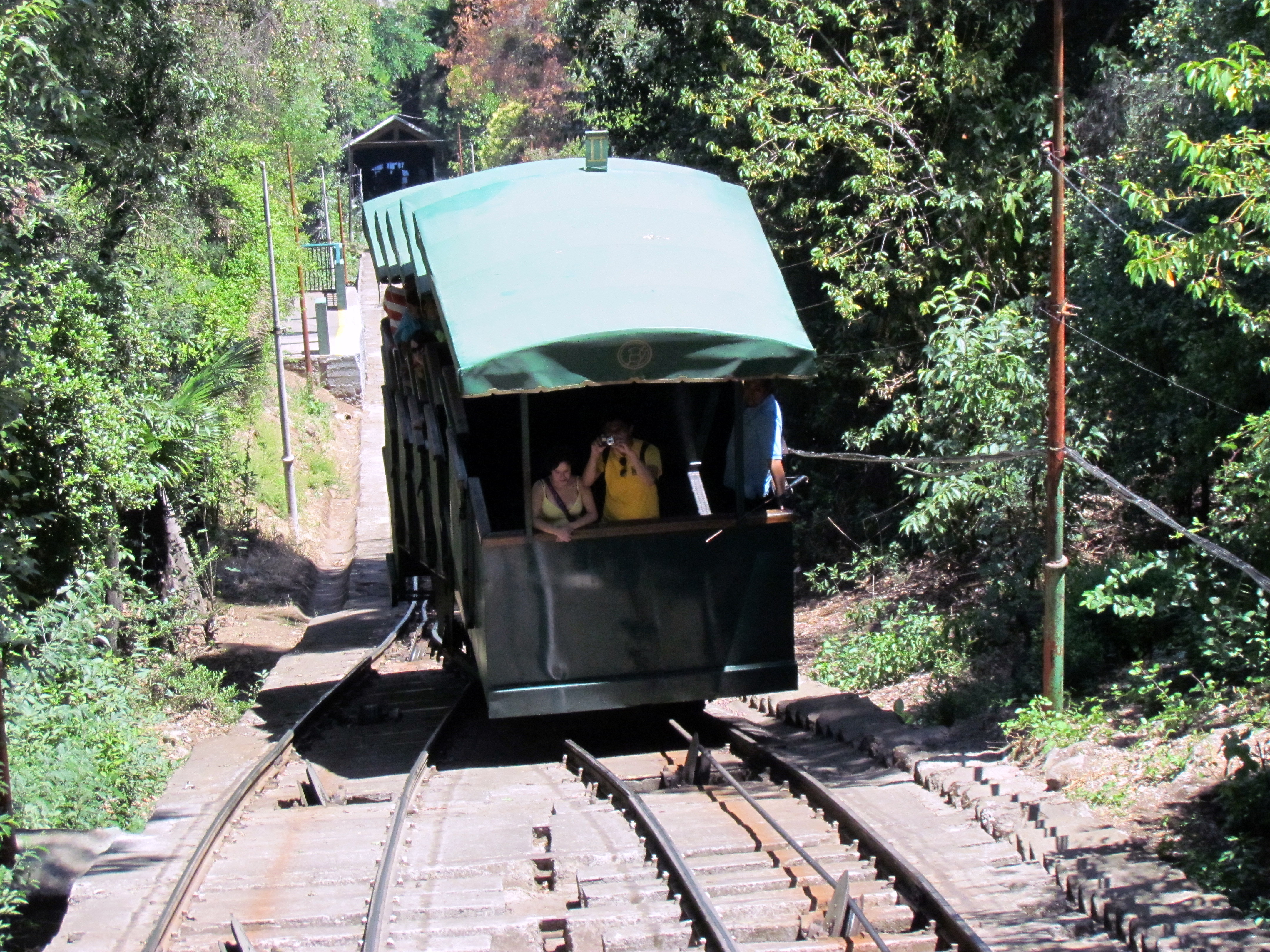
TThree fare classes once climbed the same hill in one machine, with curtains for the well-off in the middle and open standing sections at the ends. The Funicular de Santiago in Santiago de Chile, Chile, is worth visiting because it turns a quick ride into a sharp little lesson about the city: class, faith, engineering, and ambition all pulled on the same cable. You come for the view over the smog bowl and the Andes beyond. You stay because the station at Pío Nono looks like a stone fairy-tale tower that knows better.
The ride begins at Plaza Caupolicán, where Luciano Kulczewski's base station rises from Cerro San Cristóbal stone itself, cut from the same hill that builders once quarried for Santiago. That detail matters. The funicular is made from the wound it helped tame.
As the cars climb toward the old Zoo station and the summit, the city drops away in layers of concrete, jacarandas, church domes, and traffic haze. Then the air changes. You smell dust, hot metal, eucalyptus, and, on cooler mornings, the damp mineral breath of the hillside.
Most visitors treat it as a scenic shortcut to the Virgin sanctuary or the cable car. Fair enough. But this line, inaugurated in 1925, is really a moving balcony onto the moment when Santiago decided a scarred hill should become public theater.
01 What to see.
Pío Nono Station
The Ride to Cumbre
Cumbre Station, Café Tudor, and the Walk to the Virgin
02 In pictures.


Plan and listen to Funicular De Santiago with Audiala.
Audio guide in your pocket, itinerary in your browser. Built for the way you actually visit.
03 Visitor logistics.
The practical scaffolding for a good visit — kept short.
Getting There
The base station sits at Pío Nono 450 in Bellavista, beside Plaza Caupolicán. As of 2026, the easiest public route is Metro Baquedano on Lines 1 or 5, then a 7-10 minute walk, about the length of six to eight city blocks; buses stop nearby at Purísima / Santa Filomena, Bellavista / Bombero Núñez, Puente Purísima, and Facultad de Derecho. Driving is less tidy: no dedicated official parking is clearly listed at Pío Nono, so if you need easier car access, use the Teleférico Oasis side at Av. El Cerro 750 and connect across the hill.
Opening Hours
As of 2026, the funicular runs Monday from 13:00 to 18:45, and Tuesday to Sunday from 10:00 to 18:45; the last descent is at 18:45. The first Monday of every month is closed for maintenance, a small reminder that this 1925 machine still needs care.
Time Needed
Give it 45-60 minutes if you only want the ride and the summit view. Allow 1.5-2.5 hours for the better version: funicular up, a walk around the cumbre, the Virgin sanctuary, a coffee, then back down. If you add the Teleférico and wait in line at peak times, the visit easily stretches to 2-4 hours, closer to half a lazy afternoon than a quick stop.
Accessibility
As of 2026, the operator promises preferential assistance for visitors with reduced mobility and free entry for people presenting a disability credential, but I did not find a clear official statement confirming step-free boarding onto the funicular car itself. If wheelchair access matters, the safer documented route is Oasis station on the Teleférico side, which has an elevator, then a connection across the hill; at the summit, expect some sloped walking.
Cost & Tickets
As of 2026, a Pío Nono-Cumbre ticket costs CLP 1,600 one way or CLP 2,250 round trip; Zoológico-Cumbre is CLP 1,050 one way. Combined funicular and Teleférico tickets start at CLP 4,750, while the day-pass pages show conflicting prices, including CLP 9,250 and CLP 11,500, so check the purchase page before paying. Buying online saves the ticket-office line, though not always the boarding wait.
05 Tips for visitors.
Small things that change the day.
Beat The Queue
Go early or late. Midday and winter-holiday periods draw the longest waits, while the summit light is softer near the end of the day and the city haze often loosens its grip.
Drone Rule
Regular photos are fine, but drones are banned unless you have prior authorization and the required aeronautical permits. Pack the camera, leave the flying machine behind.
Eat Smart
For a quick stop, use Delicatto inside the Pío Nono station or Café Tudor at the summit, reopened in 2023 in the old Tudor Hall above the machinery. If you want a real meal after the ride, Bellavista has stronger options: Peumayen Ancestral Food for a mid-range dinner, Krossbar Bellavista for beer and casual plates, or Zacarias Cocina Chilena for a more classic Chilean table.
Car Rules
Don't carry snacks or drinks into the car; the operator bans both inside the funicular. Strollers must be folded before boarding, which matters more here than at flatter city sights because the platform turnover is quick.
Combo Savings
If you already plan to cross Cerro San Cristóbal, buy a combined funicular and Teleférico ticket instead of two separate rides. The route from Pío Nono up to Cumbre and across to Pedro de Valdivia turns a simple ascent into a full hill traverse for only a modest jump in price.
Pair It Well
The natural pairing is Bellavista first, funicular second: Patio Bellavista sits about five minutes away on foot, close enough to feel like the hill's front porch. From the summit, keep going to the Virgin sanctuary and Terraza Bellavista for mote con huesillo, the peach-and-wheat drink Santiago refuses to outgrow.
Where to Eat
Don't Leave Without Trying
Dining Tips
- check The Pío Nono strip near the funicular is where locals actually eat — skip the tourist-facing spots and head to the smaller venues tucked into the side streets.
- check Casual food near Cerro San Cristóbal leans toward coffee, sandwiches, and quick bites — plan accordingly if you want a full sit-down meal.
- check Many neighborhood restaurants close on Mondays and have limited Tuesday–Wednesday hours; call or check Instagram before you go.
- check The funicular area is part of the Recoleta/Providencia circuit, so combining a meal with a neighborhood walk is the local move.
Restaurant data powered by Google
04 A history of reinvention.
The Hill That Learned to Perform
Cerro San Cristóbal was not born picturesque. Records show the hill spent decades being quarried for stone, its slopes cut and worked long before anyone imagined a public park draped across them.
The funicular arrived as part of a bigger civic wager. After Law No. 3295 authorized the park in 1917 and officials took formal possession in 1918, Santiago began remaking the hill into a place for promenades, devotion, spectacle, and a view large enough to flatter the capital.
Ernesto Bozo Pezza's Risk on the Slope
Documented sources identify the Italian engineer Ernesto Bozo Pezza, sometimes spelled Bosso or Bozzo in later retellings, as the man who executed the project with Juan Nelly. For Bozo, this was more than a contract. His name was tied to a machine that had to haul Santiago's public up a steep former quarry face without turning modern engineering into public embarrassment.
The turning point came on 25 April 1925, when President Arturo Alessandri attended the inauguration and invited guests rode to the summit under Chilean and Italian flags. Ceremony was one thing. Proof was another. Archivo Nacional records indicate the general public had to wait until 10 May 1925 while resistance tests were completed, a small delay that says everything about what was at stake: if the brakes failed, so would the entire promise of the hill as a modern public park.
You can still feel that tension in the machinery. The line sells romance now, but it was born in anxiety, steel cable, and inspection.
A Public Park With Curtains
From Papal Stage to Heritage Patient
Listen to the full story in the app
The whole Funicular De Santiago,
told well.
Audio guides for 1,100+ cities across 96 countries. History, stories, and local insight — offline ready.

06 Frequently asked.
The questions travellers send us most about Funicular De Santiago.
Is Funicular De Santiago worth visiting?
Yes, if you want more than a view. The ride opened on 25 April 1925, climbs Cerro San Cristóbal from the stone Pío Nono station by Luciano Kulczewski, and still feels like a piece of working city theater rather than a mere shuttle. The secret is upstairs: at Cumbre, the old Tudor Hall now serves coffee above the machine room, so the hilltop smells faintly of metal, grease, and espresso instead of pure postcard romance.
How long do you need at Funicular De Santiago?
Plan on 1.5 to 2.5 hours if you want the ride, the summit, and a slow look around. The ascent itself takes about 8 to 15 minutes, which is shorter than a crosstown taxi ride, but the real time goes into walking to the Virgin sanctuary, lingering at Terraza Bellavista, or stopping at Café Tudor. If you're only riding up and back, 45 to 60 minutes is enough.
How do I get to Funicular De Santiago from Santiago De Chile?
The easiest route is Metro to Baquedano, then a 7 to 10 minute walk to Pío Nono 450 by Plaza Caupolicán. That walk is short, about the time it takes to finish a takeaway coffee, and it drops you straight into the Bellavista edge of the hill. If you need easier parking or step-free planning, the better-documented alternative is to enter from Oasis on Avenida El Cerro 750 and connect by Teleférico.
What is the best time to visit Funicular De Santiago?
Late morning on a clear weekday is the sweet spot. You'll usually get better city views before afternoon haze softens the Andes, and you'll dodge some of the heavier midday boarding lines that build when Bellavista and the hill fill up. Monday starts later at 13:00, Tuesday to Sunday runs from 10:00 to 18:45, and the first Monday of each month is closed for maintenance.
Can you visit Funicular De Santiago for free?
Usually no, the funicular is ticketed. Current official fares start at CLP 1,050 for Zoológico to Cumbre and CLP 1,600 one way from Pío Nono to Cumbre, which is less than the price of a casual lunch in Bellavista. One clear exception exists: visitors with a disability credential are admitted free according to the operator's regulations.
What should I not miss at Funicular De Santiago?
Don't miss the Pío Nono station itself, the papal plaque in the cabin, and the summit sequence from Café Tudor to the Virgin sanctuary. Most people stare outward at the skyline and miss the better confession: the base station was built from stone cut from the same hill, so the mountain is literally holding up the ticket hall. At the top, look for how the funicular ends in a strange stack of uses, part pilgrimage site, part machine house, part cafe with Santiago spread below like a map left open on a table.
Verified, and shown.
Researched and written by the Audiala editorial team from historical records, architectural archives, and local expertise.
Official heritage page with history, architects, builders, 1925 inauguration, 1968 roof change, 2000 Historic Monument status, and 2022 reopening.
Used to confirm Chile's World Heritage properties and that the funicular is not inscribed.
Used to confirm the funicular is not on Chile's Tentative List.
Provided restoration details and context for the recovery works begun during the pandemic period.
Background on the hill, zoo sector, and early public-park transformation tied to the funicular.
Used for the legal and political remaking of Cerro San Cristóbal into a public park.
Secondary history on financing, Ernesto Bozo Pezza, and the funicular's role in turning the hill into Santiago's viewpoint.
Used for engineering history, originality debates, the 1998 accident, and restoration context.
Historical material used for company formation, chronology, and centenary context.
Confirmed Pope John Paul II's 1 April 1987 ascent and blessing from the hill.
Used for centenary coverage, 1968 roof change, papal plaque, and the 2023 reopening of Café Tudor.
Provided background on Vicuña Mackenna, Alberto Mackenna, expropriation, and the public-park campaign.
Used as a secondary source on the 80th anniversary, attribution history, and hill transformation.
Used for the sanctuary chronology at the summit, including foundation and inauguration dates.
Official legal text confirming Law No. 3295 of 28 September 1917 authorizing the public park.
Used for formal possession of the hill in 1918 and early park records.
Secondary source for forestation works and general hill history.
Used for Café Tudor and summit visitor context.
Official notice confirming July-August 1949 suspension for repairs.
Official notice confirming July 1950 temporary closures for repairs.
Official decree page for Historic Monument designation on 16 November 2000.
Used for restoration progress during the pandemic-era closure.
Official update on restoration works.
Official reopening notice from 22 July 2022.
Used for the 2023 public opening of Café Tudor.
Used for summit café details and reopening timing.
Official source for the 25 April 2025 centenary celebration.
Official operator site with current hours, base access, services, and heritage overview.
Official ticket page with current fares, route options, and ride details.
Official cable car site used for network connections and access planning.
Used for current operator offerings and ride combinations.
Operator regulations used for refunds, closures, ages, stroller rules, and onboard restrictions.
Official page for combined funicular and cable car tickets and timing rules.
Used for the Pío Nono station address, base services, and combo planning.
Used for current unlimited-ride day pass pricing context.
Used for disability access, free entry with credential, drone rules, and lost-property policy.
Used cautiously for recent queue behavior and visitor timing impressions.
Used to note third-party bundled tours marketed with skip-the-line language.
Used for walk time from Baquedano and ride-duration guidance.
Transit routing, walking times, metro lines, and nearby bus stops.
Spanish transit page used to cross-check nearby lines and stop names.
Used for practical walking context from Patio Bellavista.
Used in parking and access comparison around the Oasis side of the hill.
Used for operator social-media references to bathrooms and nearby free parking.
Used for Oasis station accessibility, elevator, and rest-area information.
Used for wheelchair-accessible panoramic bus information.
Used for summit station features, nearby sights, and current visitor experience.
Used cautiously for overall hill visit timing.
Used for nearby dining options around the base station.
Used for Café Tudor details and summit amenities.
Used for the Zoológico station and family-visit context.
Official summit services page used for viewpoints and connections.
Historic imagery and material used for the Pío Nono station and façade interpretation.
Used to identify the commemorative plaque for Pope John Paul II in the cabin.
Used for visual confirmation of the funicular and station image history.
Used for broader atmospheric description of Cerro San Cristóbal.
Used for summer seasonal products tied to the hill circuit.
Used for Tupahue pool information in seasonal planning.
Used for winter seasonal offers tied to the funicular.
Used for spring products and to note an operational contradiction about intermediate stops.
Used to note third-party audio-guide style products for the hill.
Used for unlimited-ride and bundled hill experiences.
Used cautiously as a secondary aid for the 1998 accident month and general cross-checking.
Used cautiously for hill-name variations and general background.
Used cautiously for sanctuary background and hill-name retellings.
Last reviewed
Researched from Wikidata, Wikipedia & official sources · fact-checked · How we make our guides →


