hiking
Desert To Ice
Chile runs from the Atacama Desert to the glaciers of Patagonia, so one itinerary can cover salt flats, vineyards, volcanoes, fjords, and granite towers without crossing a border.
Chile is what happens when a country stretches for 4,300 kilometers and never settles on one mood: desert observatories, port-city hills, rain-soaked archipelagos, and Patagonia at the edge of the ice.
EntryVisa-free for many travelers up to 90 days
CChile travel guide: few countries change this fast. In one trip you can wake in Santiago, stargaze in San Pedro de Atacama, and end beneath Patagonian granite.
Chile works because its extremes are not marketing copy. North of Santiago, the Atacama is so dry that some weather stations have recorded years with almost no rain at all; south of Puerto Natales, wind hits the plains hard enough to tilt your walk. That range gives travelers real choices, not minor variations on the same city break. You can spend a morning inside the markets and museums of Santiago, ride hillside funiculars in Valparaíso, then trade traffic for salt flats, observatories, and cold desert nights in San Pedro de Atacama.
The country is long enough to reward a route, not just a stop. Wine valleys and Pacific ports make sense on a first trip, but Chile gets more interesting when you keep going: wooden churches and stormy coasts in Chiloé, riverfront beer culture and wet forests in Valdivia, and the ship-and-frontier mood of Punta Arenas at the far end of the continent. Easter Island sits 3,700 kilometers offshore, which tells you something about Chilean geography before you even land. Few places let you move this far between landscapes without leaving one country.
Origins and First Peoples, c. 14500 BCE-1541
A strip of wet timber and chewed seaweed changed the history of the Americas. At Monte Verde, near present-day Puerto Montt, archaeologists uncovered traces of a camp roughly 14,500 years old: hearths, medicinal plants, worked wood, the remains of mastodon meat. Ce que l'on ignore souvent, c'est que this quiet southern site spent years being mocked before it forced scholars to admit that the old Clovis-first story had collapsed.
Far to the north, on the coast near Arica, the Chinchorro were preparing their dead around 5000 BCE with a tenderness that still startles. They did not reserve mummification for rulers. Children, fishermen, even infants were wrapped, reconstructed, painted black or red, as if eternity were not a privilege but a common right.
Then came the long Mapuche resistance, and with it one of the decisive facts of Chilean history: this land was never easily absorbed. When the Inca advanced south toward the Maule River in the late 15th century, they met fighters who would not yield. The empire stopped there.
That refusal shaped everything that followed. Before Santiago had a plaza, before Valparaíso had a port worth naming, Chile already contained a frontier spirit, wary of distant masters and very attached to its own ground.
Lautaro would become the great name of resistance later, but long before him the anonymous Mapuche leaders at the Maule River had already done something extraordinary: they taught an empire where its limits lay.
The Chinchorro began mummifying their dead about two millennia before the Egyptians, and they did it without pharaohs, pyramids, or a priestly court.
Conquest and Colonial Chile, 1541-1808
On 12 February 1541, Pedro de Valdivia founded Santiago with a handful of Spaniards, a plan for a grid of streets, and an ambition far larger than his resources. Beside him stood Inés de Suárez, his companion, technically another man's wife, and one of the least comfortably respectable heroines in South American history. She was not decorative. She was indispensable.
Seven months later, the infant city burned. While Valdivia was away, Mapuche forces attacked Santiago in September 1541, and chroniclers claimed that Inés urged the execution of captive chiefs, their severed heads thrown from the fortifications to break the assault. One shudders. One also remembers that without that brutality, the Spanish settlement might well have vanished before its first anniversary.
The deeper drama unfolded south of the Biobío, where the Arauco War became a centuries-long wound. Lautaro, once Valdivia's page, learned Spanish cavalry methods from the inside, escaped, and turned that knowledge against his captors. At Tucapel in 1553 he destroyed Valdivia's force and captured the governor himself, a reversal so sharp that it still feels theatrical.
Colonial society then acquired its own monsters. None is more vivid than Catalina de los Ríos y Lisperguer, known as La Quintrala, red-haired heiress, alleged poisoner, and terror of her estates near Santiago. Ce que l'on ignore souvent, c'est que Chile's colonial legend is not only priests, governors, and silver ledgers; it is also a noblewoman accused of murder after murder, protected for decades by money, lineage, and the useful softness of justice toward the powerful.
By the late 18th century, Chile was a distant captaincy with rich estates, resentful creoles, and a capital that had learned to survive earthquake, fire, and siege. The Bourbon reforms tightened control. They also trained a local elite to imagine power in its own hands.
Inés de Suárez remains the human shock at the center of Chile's founding story: pious, practical, and capable of terrifying violence when the city walls shook.
La Quintrala was accused of so many killings that later legend gave her a private chest of torture instruments, yet she died peacefully in bed in 1665.
Independence and the Unquiet Republic, 1808-1891
Independence in Chile did not begin with trumpets. It began with a vacancy. Napoleon invaded Spain in 1808, the Bourbon throne wavered, and in Santiago the local elite formed a junta in 1810 while claiming loyalty to the captive king. That polite fiction lasted only so long.
Bernardo O'Higgins, the illegitimate son of Ambrosio O'Higgins, moved into history with the permanent ache of a child half acknowledged by power. He had English schooling, revolutionary company, and a surname that did not sound like the rest of the colonial aristocracy. After the disaster of Rancagua in 1814, patriots fled across the Andes, and Chile's cause looked finished.
It was not. In 1817 José de San Martín and O'Higgins crossed back over the mountains, defeated royalist forces at Chacabuco, and entered Santiago as liberators. The image is almost operatic: uniforms stiff with cold, horses spent, the Andes behind them like a wall of judgment.
Yet republics are rarely grateful to their founders for long. O'Higgins abolished noble titles and tried to modernize the country, but centralism, military expense, and elite hostility drove him into exile in Peru in 1823. Chile gained a state and lost the man who had helped make it.
What followed was not calm but construction. A conservative order hardened after 1830, Valparaíso became the Pacific's great commercial port, and victory in the War of the Pacific gave Chile nitrate riches and the northern territories of Antofagasta and Tarapacá. Money flooded in. So did arrogance, and by 1891 civil war had pitted president against Congress in a struggle over who truly owned the republic.
Bernardo O'Higgins freed Chile, then discovered the oldest lesson of politics: nations adore founders most safely when they are gone.
O'Higgins abolished hereditary titles in Chile even though his own life had been marked by the pain of birth, legitimacy, and the social obsession with bloodlines.
Crisis, Dictatorship, and Democratic Return, 1891-1990
At the turn of the 20th century, Chile looked rich and felt unequal. Nitrate wealth from the north funded grand facades and parliamentary habits, while workers in the desert camps lived under company discipline so hard that protest often ended in blood. In 1907, at the Santa María School in Iquique, troops massacred striking workers and their families. The republic had shown its steel teeth.
Then the 20th century accelerated. Middle-class politics grew, women pushed into public life, and the state became more ambitious. Valdivia was shattered by the earthquake of 1960, the strongest instrumentally recorded on earth, while the far south around Punta Arenas reminded Santiago that Chile was not one country in scale or rhythm but several stitched together by law, road, and imagination.
Salvador Allende's election in 1970 brought the Chilean left to power through the ballot box, something the world watched with fascination and dread. Shortages, polarization, and foreign pressure followed. On 11 September 1973, fighter jets attacked La Moneda in Santiago, and the presidential palace filled with smoke.
General Augusto Pinochet built a dictatorship that mixed market reform with censorship, torture, disappearances, and fear administered through paperwork as much as through guns. Ce que l'on ignore souvent, c'est how domestic the terror could feel: a knock at night, a name not spoken at the table, an address in Santiago or Concepción suddenly avoided. Chile modernized and bled at the same time.
The plebiscite of 1988 changed the script. Pinochet expected confirmation; the country voted No. Democracy returned in 1990, carrying memory like a family silver chest no one quite agreed where to place, and modern Chile entered the next era with prosperity, grievance, and an unfinished argument about justice.
Salvador Allende remains one of Chile's most intimate ghosts, a president who chose to stay inside a burning palace rather than leave office by force.
The campaign that helped defeat Pinochet in the 1988 plebiscite used bright television spots and the slogan 'La alegría ya viene,' an almost insolent optimism after years of fear.
Democracy, Memory, and a Country That Keeps Rewriting Itself, 1990-present
Democratic Chile did not arrive as a clean break. The constitution, the army's shadow, and the economic model of the dictatorship all survived into the new order. Presidents governed, coalitions alternated, poverty fell, and yet many Chileans felt that the polite republic had been built on a bargain too carefully arranged.
Memory kept returning in physical form. In Santiago, former detention sites became places of mourning and instruction. In Valparaíso, Congress sat in a city of hills and patched facades while students, dockworkers, and activists reminded the nation that institutions are never the whole story.
The social explosion of October 2019 began with a metro fare increase and turned into something much larger: rage over pensions, debt, inequality, and a public life that seemed tidy only from a minister's office. Streets filled. Eyes were lost to rubber bullets. The old consensus cracked in full view.
Then came the constitutional process, twice attempted, twice rejected, which tells you something essential about Chile. This is a country capable of immense civic seriousness and immense distrust, often in the same week. Even its failures are eloquent.
What comes next remains unwritten. But from the Mapuche frontier to the plebiscite, from Chiloé to Easter Island, Chile's history has never really been the story of obedience; it is the story of a long, narrow country arguing, again and again, over who gets to define it.
Michelle Bachelet, physician, torture survivor's daughter, exile, president, embodies Chile's democratic paradox: wounded by history yet repeatedly called upon to steady it.
Chile attempted to replace the Pinochet-era constitution twice in the 2020s, and voters rejected both drafts, first from the left and then from the right.
Chilean Spanish does not arrive; it pounces. In Santiago, the sentence begins in one register and ends in another, with consonants swallowed on the way as if speech had somewhere urgent to be before nightfall. You hear "po," "cachai," "al tiro," and understand that grammar here is less a skeleton than a weather system.
The marvel is not speed. It is tact. A shopkeeper gives you "usted" with grave courtesy, then a friend leans over the table and says "tú cachái" with a complicity so quick it feels like being adopted. One syllable can hold impatience, tenderness, irony, and boredom at once. "Weón" performs all four before lunch.
Foreign ears first mistake this for chaos. It is the opposite. Chile has turned speech into social choreography, exact as cutlery placement, and the pleasure lies in watching the shifts: the respectful distance, the joke, the tease, the softening. A country is audible in the way it permits familiarity.
Chile reveals itself at the table with almost embarrassing frankness. The nation eats bread as if bread were a civic duty, and the marraqueta on a Chilean table deserves the respect one gives a cathedral object: four crisp lobes, a shattering crust, an interior built for butter, palta, or both. At la once, somewhere between tea and supper, the kettle hisses, cups knock against saucers, and conversation stops briefly for the first bite. Wisdom.
Then come the dishes that refuse decorative behavior. Pastel de choclo arrives in its clay bowl like a domestic drama, sweet corn crust above, pino below, the olive and hard-boiled egg waiting in ambush. Curanto in Chiloé is not a recipe so much as an edible excavation of shellfish, sausage, pork, potatoes, milcao, smoke, and damp earth. You do not sample it. You surrender.
Even the street food has doctrine. A completo in Santiago or Valparaíso teaches abundance with indecent clarity: sausage, tomato, avocado, mayonnaise in quantities that would make a Swiss banker weep. Mote con huesillo, sold from glass containers in summer, asks a stranger to drink syrup, then chew wheat, then fish out a peach with a spoon. Dessert masquerading as hydration. Chile enjoys these disguises.
Chile produced poets the way certain climates produce storms. Gabriela Mistral writes with the dry severity of the Elqui Valley, where tenderness never arrives without bone. Pablo Neruda can be immense, yes, but his real seduction lies in the odes, where an onion or a pair of socks receives the full ceremony of attention and comes out ennobled. One learns a grave lesson: the object on the table is never just an object.
Then Nicanor Parra enters with a match and sets solemnity on fire. His antipoetry performs a distinctly Chilean operation, which is to distrust the grand gesture while mastering it perfectly. Chile admires eloquence and suspects it in the same breath. That tension explains half the country.
In Santiago, literature still feels public, almost infrastructural. In Valparaíso, it acquires stairs, graffiti, sea fog, and a slight hangover. And on Easter Island, words meet silence and lose a little of their arrogance. That is healthy. A nation of poets should know when language fails.
Chileans do not fling intimacy at strangers. They place it on the table carefully, beside the bread, and wait to see whether you deserve it. The first exchange is often measured, formal, almost shy; then the room warms by increments, and once it warms, it is generous in a way that feels earned rather than automatic.
This has consequences for the traveler. You greet people. You thank bus drivers. You do not barge into a bakery and fire your question like a pistol shot. The little rituals matter because they make social life habitable in a country where reserve is not coldness but discipline. Manners are a form of elegance available to everyone.
Meals expose the code best. You pour tea for the others first at la once. You pass the pebre. You do not rush. In Chile, affection often arrives disguised as insistence: eat more, take another sopaipilla, here, try this, no really. Refusal can be read as poor judgment, which, to be fair, it sometimes is.
Chilean architecture has the grave intelligence of a body that knows the ground may betray it at any moment. Earthquakes do not permit vanity for long. Adobe cracked, timber flexed, concrete learned hard lessons, and the cities developed an aesthetic of adaptation that tells the truth about living here: beauty matters, but survival gets the final vote.
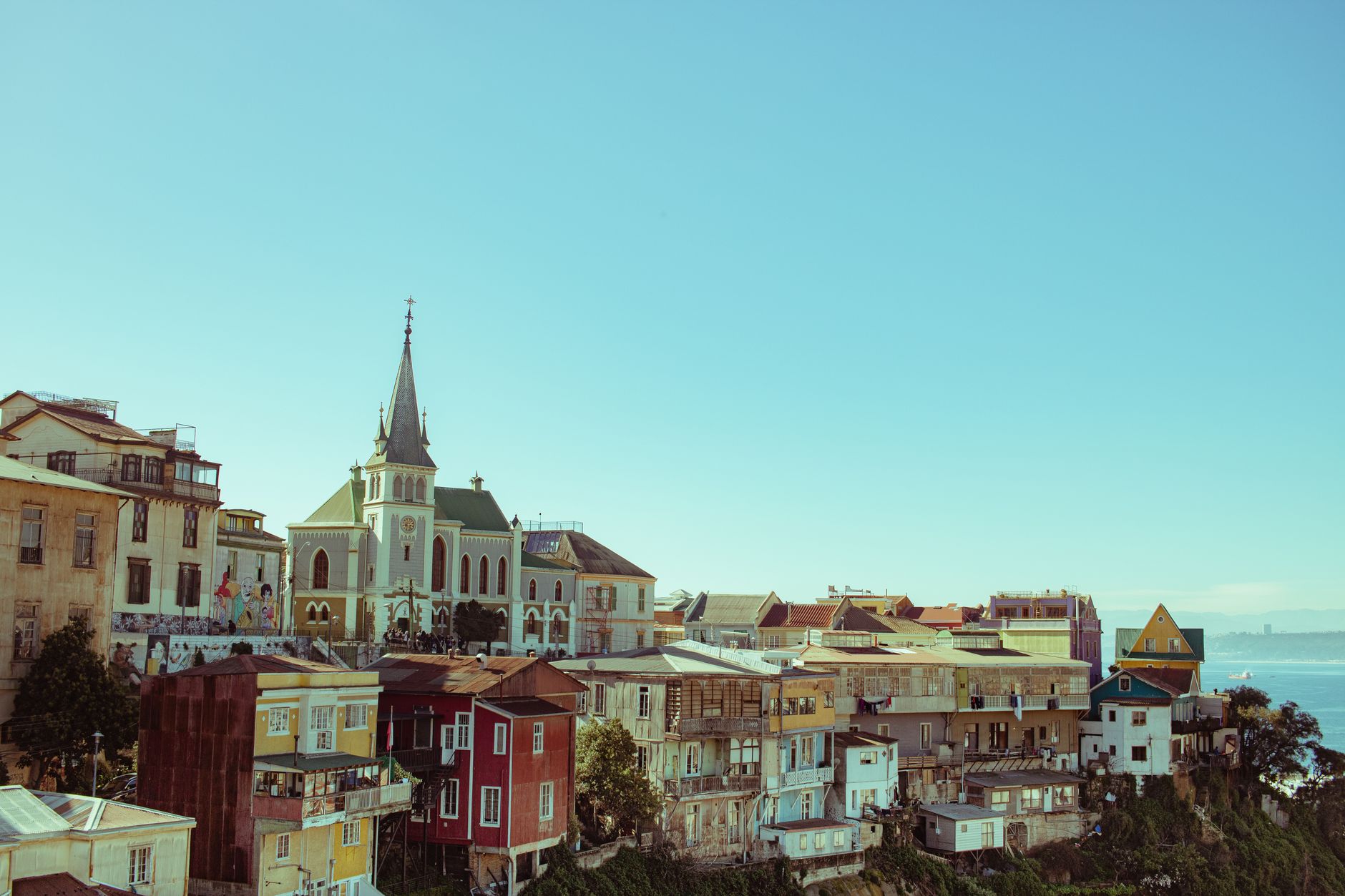
In Valparaíso, the hills solve hardship with color, corrugated metal, funiculars, and houses that seem to cling to the slope by force of opinion. The city looks improvised until you notice how exact its improvisation is. Port wealth, fires, earthquakes, reinvention: every facade has had at least two lives.
Elsewhere, the country changes material like a mood. The wooden churches of Chiloé turn rain, labor, and Catholic ritual into a maritime carpentry of astonishing delicacy. In Santiago, glass towers rise under the Andes with corporate confidence, while old neighborhoods keep their patios, wrought iron, and stubborn shade. Chile builds as if permanence were a negotiation, not a promise.
Chile runs from the Atacama Desert to the glaciers of Patagonia, so one itinerary can cover salt flats, vineyards, volcanoes, fjords, and granite towers without crossing a border.
Santiago gives you museums, markets, and a serious food scene; Valparaíso answers with staircases, murals, old funiculars, and a port-city roughness that still feels lived-in.
Northern Chile has some of the clearest skies on Earth. Around San Pedro de Atacama, high altitude, dry air, and little light pollution make stargazing feel almost theatrical.
Chile's food gets good fast once you stop ordering safely. Think marraqueta with avocado in the capital, chorrillana in Valparaíso, and curanto in Chiloé, where shellfish, potatoes, and smoke do the talking.
This is not a museum-piece country. Indigenous resistance, dictatorship memory, port wealth, migration, and literary ambition all sit close to the surface, from central plazas to the far south.
Torres del Paine and Easter Island earn their fame for different reasons: one for raw scale and weather, the other for distance, Polynesian history, and nearly 900 moai facing a very empty ocean.
12 cities — start with the ones we'd send you to first.
Santiago lives under the Andes like a kept secret — a city of political ghosts and foraging tasting menus, where a Nobel laureate's house hides in a bohemian neighborhood and the national hot dog is treated with the seri…
Forty-two hills of peeling Victorian paint, outdoor murals that outclass most gallery shows, and funicular elevators (ascensores) that have been hauling residents since 1883.
A mud-brick village at 2,400 metres surrounded by salt flats, geysers erupting at dawn, and a sky so unpolluted that the European Southern Observatory planted its telescopes nearby.
Three granite towers rising 2,800 metres from the Patagonian steppe — the kind of landscape that makes experienced trekkers go quiet mid-sentence.
Rapa Nui sits 3,700 kilometres off the Chilean coast, and its 900 moai were carved, transported, and erected by a civilization that did all of it without metal tools or wheels.
An island where the Catholic missionaries couldn't build in stone so built in wood instead, producing 16 UNESCO-listed palafito churches and a cuisine — curanto cooked in a pit — that has no equivalent on the mainland.
The last town before the ice fields, where every hostel drying room smells of wet Gore-Tex and the conversation at dinner is always about tomorrow's weather on the W Trek.
A river city that 19th-century German settlers rebuilt after an 1820 fire, leaving behind breweries, Kunstmann lager, and a fish market where sea lions haul themselves onto the wooden platforms to steal the catch.
The southernmost city of any real size on Earth, where the wind bends every tree permanently northward and the Strait of Magellan is a 20-minute walk from the central plaza.
Central Chile is where the country feels most compressed: finance towers, old markets, vineyard valleys, and the Pacific all within day-trip range. santiago gives you the practical backbone, but the region works because city life, wine country, and the coast sit close enough to combine without wasting days in transit.
The north runs on dryness, altitude, and distance. La Serena gives you a softer entry with beaches and observatories, then San Pedro de Atacama strips the country down to salt, rock, and sky so clean it feels edited.
This is the Chile of river cities, volcanic cones, German-settler baking, and forests that smell wet even when the rain has stopped. Valdivia and Villarrica anchor the region well, but the mood comes from constant shifts between lake, market, ferry, brewery, and dark green woodland.
Southern Chile is less about monuments than exposure: wind, distance, ferries, empty roads, and weather that rewrites a day's plan in ten minutes. Puerto Natales is the working base, Punta Arenas handles the long-haul logistics, and Torres del Paine is the place people think they came for until the whole region gets under their skin.
Easter Island sits 3,700 kilometers west of mainland Chile, which is why it feels culturally separate as much as geographically remote. Go for the moai, yes, but stay long enough to understand the volcanic landscape, the ceremonial platforms, and the hard fact that every practical detail here depends on limited flights and limited supply.
Opened in 1925 with separate first- and second-class sections, Santiago's funicular still climbs Cerro San Cristóbal after its careful 2022 restoration.
A white Virgin watches over Santiago from Cerro San Cristóbal, where pilgrimage, skyline views, and a cold mote con huesillos still share the same ritual up top.
South America's largest club-owned stadium holds 47,000 fans and a renovation plan inspired by Mapuche culture.
From Monte Verde to the constitutional battles of the 21st century
Near present-day Puerto Montt, people left hearths, wooden structures, and plant remains that forced scholars to rethink the peopling of the Americas. Chile entered world history through an archaeological argument, not a royal chronicle.
On the northern coast near Arica, the Chinchorro began preserving their dead with striking technical care. They mummified ordinary people as well as children, making mortality look strangely democratic.
At or near the Maule River, Mapuche forces checked the southern expansion of the Inca Empire. That resistance created a political boundary long before the Spanish imagined Chile as a colony.
Almagro's expedition crossed the Atacama and the Andes in brutal conditions, leaving many Indigenous porters dead from cold and exhaustion. He found little gold and even less reason to stay.
Pedro de Valdivia established Santiago on 12 February 1541 as the Spanish foothold in central Chile. Months later the city was nearly destroyed in a Mapuche attack, with Inés de Suárez at the center of its desperate defense.
Lautaro, once Valdivia's servant, led a Mapuche force that annihilated the governor's troops and captured him. The conquest stopped being a triumphal march and became a bitter frontier war.
Alonso de Ercilla's epic poem transformed the war in Chile into literature and made Mapuche leaders into tragic heroes. Madrid expected obedience; it received admiration for the enemy.
Catalina de los Ríos y Lisperguer was born into wealth and would become colonial Chile's most notorious noblewoman. Her legend fused gender, cruelty, and impunity in a society obsessed with rank.
Chile's creole elite formed a junta on 18 September 1810, claiming to govern in the name of the captive Spanish king. The language was cautious. The consequences were not.
Royalist forces crushed patriot resistance at Rancagua, sending independence leaders into exile across the Andes. Chile's revolution looked finished for a moment that lasted three hard years.
San Martín and Bernardo O'Higgins crossed the Andes and defeated royalist troops at Chacabuco. Santiago reopened to the independence cause under the shadow of snowy passes and exhausted horses.
Chile formally declared independence in 1818, turning a rebellion into a state. O'Higgins became Supreme Director and began the hard, unglamorous work of building institutions.
Political opposition forced Bernardo O'Higgins from power, and he left for Peru. Founders rarely get serene endings; Chile's liberator discovered that truth early.
The 1833 constitution gave Chile a durable but highly centralized political order. Stability arrived with hierarchy attached, and that bargain shaped the century.
Chile entered war against Peru and Bolivia over nitrate-rich territories in the north. Victory would expand Chilean territory and wealth while leaving wounds still visible on the map.
At the naval battle of Iquique, Captain Arturo Prat boarded the Huáscar and was killed. The act lasted minutes and produced a national cult of sacrifice that outlived the war itself.
A showdown between President José Manuel Balmaceda and Congress erupted into civil war. The parliamentary era that followed promised constitutional order but carried the bitterness of armed settlement.
In Iquique, troops fired on striking nitrate workers and their families gathered at a school. The massacre exposed the violence hidden beneath export wealth and parliamentary manners.
The strongest instrumentally recorded earthquake in history struck southern Chile, devastating Valdivia and triggering tsunamis across the Pacific. Nature reminded the republic who still held ultimate power.
Allende became president through democratic election, offering a socialist path by constitutional means. The world watched Chile as if it were a laboratory and a warning at once.
On 11 September 1973, the armed forces overthrew Allende and bombed the presidential palace in Santiago. The dictatorship that followed would reshape the economy and scar families for decades.
In a plebiscite designed to legitimize continued rule, Chileans voted against Pinochet. Ballot papers accomplished what fear had long delayed.
Civilian rule returned, though many institutions of the dictatorship remained in place. Chile entered democracy carrying both relief and unfinished business.
A Santiago metro fare increase sparked nationwide protests over inequality, pensions, debt, and political distance. Streets from Santiago to Valparaíso became the stage for a deeper reckoning with the post-dictatorship model.
After a massive participatory process, voters rejected a proposed new constitution. Chile showed the world something rare: profound appetite for change, matched by profound caution about what shape that change should take.
A second attempt, this time shaped by a very different political balance, was also voted down. The result confirmed that Chile's argument about itself remains open, alive, and stubbornly democratic.
Origins and First Peoples
Lautaro would become the great name of resistance later, but long before him the anonymous Mapuche leaders at the Maule River had already done something extraordinary: they taught an empire where its limits lay.
A strip of wet timber and chewed seaweed changed the history of the Americas. At Monte Verde, near present-day Puerto Montt, archaeologists uncovered traces of a camp roughly 14,500 years old: hearths, medicinal plants, worked wood, the remains of mastodon meat. Ce que l'on ignore souvent, c'est que this quiet southern site spent years being mocked before it forced scholars to admit that the old Clovis-first story had collapsed.
Far to the north, on the coast near Arica, the Chinchorro were preparing their dead around 5000 BCE with a tenderness that still startles. They did not reserve mummification for rulers. Children, fishermen, even infants were wrapped, reconstructed, painted black or red, as if eternity were not a privilege but a common right.
Then came the long Mapuche resistance, and with it one of the decisive facts of Chilean history: this land was never easily absorbed. When the Inca advanced south toward the Maule River in the late 15th century, they met fighters who would not yield. The empire stopped there.
That refusal shaped everything that followed. Before Santiago had a plaza, before Valparaíso had a port worth naming, Chile already contained a frontier spirit, wary of distant masters and very attached to its own ground.
The Chinchorro began mummifying their dead about two millennia before the Egyptians, and they did it without pharaohs, pyramids, or a priestly court.
Conquest and Colonial Chile
Inés de Suárez remains the human shock at the center of Chile's founding story: pious, practical, and capable of terrifying violence when the city walls shook.
On 12 February 1541, Pedro de Valdivia founded Santiago with a handful of Spaniards, a plan for a grid of streets, and an ambition far larger than his resources. Beside him stood Inés de Suárez, his companion, technically another man's wife, and one of the least comfortably respectable heroines in South American history. She was not decorative. She was indispensable.
Seven months later, the infant city burned. While Valdivia was away, Mapuche forces attacked Santiago in September 1541, and chroniclers claimed that Inés urged the execution of captive chiefs, their severed heads thrown from the fortifications to break the assault. One shudders. One also remembers that without that brutality, the Spanish settlement might well have vanished before its first anniversary.
The deeper drama unfolded south of the Biobío, where the Arauco War became a centuries-long wound. Lautaro, once Valdivia's page, learned Spanish cavalry methods from the inside, escaped, and turned that knowledge against his captors. At Tucapel in 1553 he destroyed Valdivia's force and captured the governor himself, a reversal so sharp that it still feels theatrical.
Colonial society then acquired its own monsters. None is more vivid than Catalina de los Ríos y Lisperguer, known as La Quintrala, red-haired heiress, alleged poisoner, and terror of her estates near Santiago. Ce que l'on ignore souvent, c'est que Chile's colonial legend is not only priests, governors, and silver ledgers; it is also a noblewoman accused of murder after murder, protected for decades by money, lineage, and the useful softness of justice toward the powerful.
By the late 18th century, Chile was a distant captaincy with rich estates, resentful creoles, and a capital that had learned to survive earthquake, fire, and siege. The Bourbon reforms tightened control. They also trained a local elite to imagine power in its own hands.
La Quintrala was accused of so many killings that later legend gave her a private chest of torture instruments, yet she died peacefully in bed in 1665.
Independence and the Unquiet Republic
Bernardo O'Higgins freed Chile, then discovered the oldest lesson of politics: nations adore founders most safely when they are gone.
Independence in Chile did not begin with trumpets. It began with a vacancy. Napoleon invaded Spain in 1808, the Bourbon throne wavered, and in Santiago the local elite formed a junta in 1810 while claiming loyalty to the captive king. That polite fiction lasted only so long.
Bernardo O'Higgins, the illegitimate son of Ambrosio O'Higgins, moved into history with the permanent ache of a child half acknowledged by power. He had English schooling, revolutionary company, and a surname that did not sound like the rest of the colonial aristocracy. After the disaster of Rancagua in 1814, patriots fled across the Andes, and Chile's cause looked finished.
It was not. In 1817 José de San Martín and O'Higgins crossed back over the mountains, defeated royalist forces at Chacabuco, and entered Santiago as liberators. The image is almost operatic: uniforms stiff with cold, horses spent, the Andes behind them like a wall of judgment.
Yet republics are rarely grateful to their founders for long. O'Higgins abolished noble titles and tried to modernize the country, but centralism, military expense, and elite hostility drove him into exile in Peru in 1823. Chile gained a state and lost the man who had helped make it.
What followed was not calm but construction. A conservative order hardened after 1830, Valparaíso became the Pacific's great commercial port, and victory in the War of the Pacific gave Chile nitrate riches and the northern territories of Antofagasta and Tarapacá. Money flooded in. So did arrogance, and by 1891 civil war had pitted president against Congress in a struggle over who truly owned the republic.
O'Higgins abolished hereditary titles in Chile even though his own life had been marked by the pain of birth, legitimacy, and the social obsession with bloodlines.
Crisis, Dictatorship, and Democratic Return
Salvador Allende remains one of Chile's most intimate ghosts, a president who chose to stay inside a burning palace rather than leave office by force.
At the turn of the 20th century, Chile looked rich and felt unequal. Nitrate wealth from the north funded grand facades and parliamentary habits, while workers in the desert camps lived under company discipline so hard that protest often ended in blood. In 1907, at the Santa María School in Iquique, troops massacred striking workers and their families. The republic had shown its steel teeth.
Then the 20th century accelerated. Middle-class politics grew, women pushed into public life, and the state became more ambitious. Valdivia was shattered by the earthquake of 1960, the strongest instrumentally recorded on earth, while the far south around Punta Arenas reminded Santiago that Chile was not one country in scale or rhythm but several stitched together by law, road, and imagination.
Salvador Allende's election in 1970 brought the Chilean left to power through the ballot box, something the world watched with fascination and dread. Shortages, polarization, and foreign pressure followed. On 11 September 1973, fighter jets attacked La Moneda in Santiago, and the presidential palace filled with smoke.
General Augusto Pinochet built a dictatorship that mixed market reform with censorship, torture, disappearances, and fear administered through paperwork as much as through guns. Ce que l'on ignore souvent, c'est how domestic the terror could feel: a knock at night, a name not spoken at the table, an address in Santiago or Concepción suddenly avoided. Chile modernized and bled at the same time.
The plebiscite of 1988 changed the script. Pinochet expected confirmation; the country voted No. Democracy returned in 1990, carrying memory like a family silver chest no one quite agreed where to place, and modern Chile entered the next era with prosperity, grievance, and an unfinished argument about justice.
The campaign that helped defeat Pinochet in the 1988 plebiscite used bright television spots and the slogan 'La alegría ya viene,' an almost insolent optimism after years of fear.
Democracy, Memory, and a Country That Keeps Rewriting Itself
Michelle Bachelet, physician, torture survivor's daughter, exile, president, embodies Chile's democratic paradox: wounded by history yet repeatedly called upon to steady it.
Democratic Chile did not arrive as a clean break. The constitution, the army's shadow, and the economic model of the dictatorship all survived into the new order. Presidents governed, coalitions alternated, poverty fell, and yet many Chileans felt that the polite republic had been built on a bargain too carefully arranged.
Memory kept returning in physical form. In Santiago, former detention sites became places of mourning and instruction. In Valparaíso, Congress sat in a city of hills and patched facades while students, dockworkers, and activists reminded the nation that institutions are never the whole story.
The social explosion of October 2019 began with a metro fare increase and turned into something much larger: rage over pensions, debt, inequality, and a public life that seemed tidy only from a minister's office. Streets filled. Eyes were lost to rubber bullets. The old consensus cracked in full view.
Then came the constitutional process, twice attempted, twice rejected, which tells you something essential about Chile. This is a country capable of immense civic seriousness and immense distrust, often in the same week. Even its failures are eloquent.
What comes next remains unwritten. But from the Mapuche frontier to the plebiscite, from Chiloé to Easter Island, Chile's history has never really been the story of obedience; it is the story of a long, narrow country arguing, again and again, over who gets to define it.
Chile attempted to replace the Pinochet-era constitution twice in the 2020s, and voters rejected both drafts, first from the left and then from the right.
Chilean Spanish does not arrive; it pounces. In Santiago, the sentence begins in one register and ends in another, with consonants swallowed on the way as if speech had somewhere urgent to be before nightfall. You hear "po," "cachai," "al tiro," and understand that grammar here is less a skeleton than a weather system.
The marvel is not speed. It is tact. A shopkeeper gives you "usted" with grave courtesy, then a friend leans over the table and says "tú cachái" with a complicity so quick it feels like being adopted. One syllable can hold impatience, tenderness, irony, and boredom at once. "Weón" performs all four before lunch.
Foreign ears first mistake this for chaos. It is the opposite. Chile has turned speech into social choreography, exact as cutlery placement, and the pleasure lies in watching the shifts: the respectful distance, the joke, the tease, the softening. A country is audible in the way it permits familiarity.
Chile reveals itself at the table with almost embarrassing frankness. The nation eats bread as if bread were a civic duty, and the marraqueta on a Chilean table deserves the respect one gives a cathedral object: four crisp lobes, a shattering crust, an interior built for butter, palta, or both. At la once, somewhere between tea and supper, the kettle hisses, cups knock against saucers, and conversation stops briefly for the first bite. Wisdom.
Then come the dishes that refuse decorative behavior. Pastel de choclo arrives in its clay bowl like a domestic drama, sweet corn crust above, pino below, the olive and hard-boiled egg waiting in ambush. Curanto in Chiloé is not a recipe so much as an edible excavation of shellfish, sausage, pork, potatoes, milcao, smoke, and damp earth. You do not sample it. You surrender.
Even the street food has doctrine. A completo in Santiago or Valparaíso teaches abundance with indecent clarity: sausage, tomato, avocado, mayonnaise in quantities that would make a Swiss banker weep. Mote con huesillo, sold from glass containers in summer, asks a stranger to drink syrup, then chew wheat, then fish out a peach with a spoon. Dessert masquerading as hydration. Chile enjoys these disguises.
Chile produced poets the way certain climates produce storms. Gabriela Mistral writes with the dry severity of the Elqui Valley, where tenderness never arrives without bone. Pablo Neruda can be immense, yes, but his real seduction lies in the odes, where an onion or a pair of socks receives the full ceremony of attention and comes out ennobled. One learns a grave lesson: the object on the table is never just an object.
Then Nicanor Parra enters with a match and sets solemnity on fire. His antipoetry performs a distinctly Chilean operation, which is to distrust the grand gesture while mastering it perfectly. Chile admires eloquence and suspects it in the same breath. That tension explains half the country.
In Santiago, literature still feels public, almost infrastructural. In Valparaíso, it acquires stairs, graffiti, sea fog, and a slight hangover. And on Easter Island, words meet silence and lose a little of their arrogance. That is healthy. A nation of poets should know when language fails.
Chileans do not fling intimacy at strangers. They place it on the table carefully, beside the bread, and wait to see whether you deserve it. The first exchange is often measured, formal, almost shy; then the room warms by increments, and once it warms, it is generous in a way that feels earned rather than automatic.
This has consequences for the traveler. You greet people. You thank bus drivers. You do not barge into a bakery and fire your question like a pistol shot. The little rituals matter because they make social life habitable in a country where reserve is not coldness but discipline. Manners are a form of elegance available to everyone.
Meals expose the code best. You pour tea for the others first at la once. You pass the pebre. You do not rush. In Chile, affection often arrives disguised as insistence: eat more, take another sopaipilla, here, try this, no really. Refusal can be read as poor judgment, which, to be fair, it sometimes is.
Chilean architecture has the grave intelligence of a body that knows the ground may betray it at any moment. Earthquakes do not permit vanity for long. Adobe cracked, timber flexed, concrete learned hard lessons, and the cities developed an aesthetic of adaptation that tells the truth about living here: beauty matters, but survival gets the final vote.
In Valparaíso, the hills solve hardship with color, corrugated metal, funiculars, and houses that seem to cling to the slope by force of opinion. The city looks improvised until you notice how exact its improvisation is. Port wealth, fires, earthquakes, reinvention: every facade has had at least two lives.
Elsewhere, the country changes material like a mood. The wooden churches of Chiloé turn rain, labor, and Catholic ritual into a maritime carpentry of astonishing delicacy. In Santiago, glass towers rise under the Andes with corporate confidence, while old neighborhoods keep their patios, wrought iron, and stubborn shade. Chile builds as if permanence were a negotiation, not a promise.
She arrived in Chile as Pedro de Valdivia's companion and became central to the survival of Santiago in 1541. Chroniclers cast her in a scene almost too savage for polite retelling: urging the execution of Mapuche prisoners during the attack on the newborn settlement, then disappearing from many schoolbook versions because female ferocity sits badly in heroic founding myths.
Captured as a child and forced to serve Valdivia, Lautaro learned cavalry tactics from the man he would later destroy. He returned to his people, reorganized resistance, and turned the conquest into a war that Spain never truly won; Chile still speaks his name with the force reserved for the very young dead.
La Quintrala moved through 17th-century Chile like a scandal with red hair. Accused of poisonings, beatings, and killings on her estates, she survived every denunciation that should have ruined her, which tells you as much about colonial power as it does about her own violence.
Chile's founding father carried a private wound into public life: he was the unacknowledged son of one of the empire's most powerful officials. He helped secure independence, abolished noble titles, and then went into exile, which gives his career the melancholy shape of a man who won a country and lost its affection.
If O'Higgins became the official father of Chile, Carrera remained the brilliant, combustible sibling history never quite tamed. He pushed radical change early, loved uniforms and gesture, feuded bitterly with rivals, and left behind a dynasty so politically charged that Chilean memory still sorts itself around his name.
Prat became immortal in a matter of minutes at the naval battle of Iquique, when he boarded the Peruvian ironclad Huáscar knowing perfectly well how slim his chances were. Chile turned that leap into civic scripture: schoolchildren, war memorials, and an entire republican ethic of duty built around one doomed act of courage.
Lucila Godoy Alcayaga took the name Gabriela Mistral and carried Chile's dry valleys, schoolrooms, griefs, and stern tenderness into world literature. Behind the monument stood a woman marked by loss, public service, and a fierce moral seriousness that never softened into decoration.
Neruda gave Chile a public voice grand enough for politics and intimate enough for onions, socks, and the sea. His houses, especially in Valparaíso, feel like self-portraits in wood and glass, while his death days after the 1973 coup left a final chapter still surrounded by suspicion and argument.
Allende tried to transform Chile through democratic mandate rather than insurrection, which made him a global symbol long before the bombers reached the palace. His last radio address, delivered while La Moneda burned, remains one of those rare moments when a statesman sounds both defeated and unbroken.
The daughter of an air force general tortured by Pinochet's regime, Bachelet returned from exile to lead the country that had broken her family. Her authority came less from theatrical force than from composure, which in Chile can be a more durable kind of power.
This is the compact first trip: one capital, one port, two very different versions of Chile within easy reach of each other. Start in santiago for markets, museums, and practical city rhythm, then shift to Valparaíso for hills, murals, old funiculars, and the Pacific air that changes the mood at once.
Northern Chile works best as a dry, high-contrast route: colonial streets and observatory skies in La Serena, then the salt flats, geysers, and sharp-edged light of San Pedro de Atacama. It is a good week for travelers who want landscapes to do the heavy lifting and do not mind a domestic flight to save time.
Southern Chile rewards people who like weather, woodsmoke, rivers, and food that tastes of rain and coast. This route moves from Concepción into Valdivia and Villarrica, then finishes in Chiloé, where churches, fishing coves, and curanto give the trip its own logic.
Patagonia needs time because the distances are real, the wind has opinions, and missed weather windows are part of the deal. Use Punta Arenas for arrival and logistics, base yourself in Puerto Natales, and give Torres del Paine enough days for hikes, boat legs, and the kind of clear morning that makes the whole trip make sense.
Tea. Marraqueta. Butter. Palta. Family table. Late afternoon. Long talk.
Hands. Napkins. Beef, onion, olive, egg. September. Office lunch. Family gathering.
Clay bowl. Spoon. Corn crust. Pino below. Summer noon. Grandmother authority.
Pit heat. Shellfish, pork, sausage, potatoes, milcao. Chiloé table. Group appetite. Slow dismantling.
Counter meal. Bread, sausage, tomato, palta, mayonnaise. Standing posture. Midnight hunger.
Street cart. Cold syrup. Wheat kernels. Dried peach. Summer walk. Bench pause.
Broth first. Solids after. Chicken or beef, corn, squash, potato. Sunday lunch. Sick day cure.


US, UK, EU, Canadian, and Australian passport holders can usually enter Chile visa-free for up to 90 days. Keep the tourist card you receive on entry, complete the mandatory SAG customs declaration for food and plant products, and note that Easter Island has a separate 30-day cap with extra proof-of-stay requirements.
Chile uses the Chilean peso (CLP). Cards work well in santiago, Valparaíso, and bigger hotel or restaurant settings, but cash still matters for markets, rural buses, small cafes, and parts of Patagonia or the Atacama.
Most international arrivals come through Santiago Arturo Merino Benítez Airport, known as SCL. International flights use Terminal 2, domestic flights use Terminal 1, and there is no rail link from the airport, so most travelers use Centropuerto or TurBus Aeropuerto buses, taxis, or pre-booked transfers.
Chile is too long to treat as one overland trip unless you have serious time. Intercity buses are the practical backbone for central Chile, domestic flights save days on long jumps to San Pedro de Atacama, Punta Arenas, or Easter Island, and a rental car makes the most sense in the Lake District, Chiloé, and parts of the Carretera Austral.
Chile runs from hyper-arid desert to sub-Antarctic wind in one country, so season matters more than averages. December to February is the busiest and most expensive period, March to April and September to November usually give the best balance, and January to February can bring altiplano rains that disrupt northern routes around San Pedro de Atacama.
Mobile coverage is good in cities and on main highways, but it drops fast in national parks, mountain roads, and parts of Patagonia. Download offline maps before heading to Torres del Paine, Chiloé, or long desert stretches, and do not assume hotel Wi-Fi will handle video calls outside major urban areas.
Chile is one of the easier countries in South America for independent travel, but petty theft is real in transport hubs, busy plazas, and on overnight buses. In santiago and Valparaíso, keep phones out of your back pocket, use ride-hailing at night with luggage, and take official weather and park warnings seriously in the desert and Patagonia.
Your money goes furthest in central Chile and least far in Patagonia and on Easter Island. Book Torres del Paine lodging, park transport, and Rapa Nui flights early, then save on food by using lunch menus and bakery breakfasts in cities.
Restaurants often suggest a 10% tip, and that is standard for sit-down service, but it is still voluntary. Check the bill before paying because some places ask directly at the card machine.
Chile has useful train pockets, but it is not a national rail country in the way many European travelers expect. For most long trips, the real choice is bus versus flight, not train versus bus.
January and February fill first in Puerto Natales and Torres del Paine, especially for park-facing hotels, refugios, and bus seats at convenient times. If you are traveling in summer, lock those pieces first and build the rest around them.
Offline maps, bus tickets, and reservation screenshots matter in Chile because signal can disappear outside urban corridors. This is especially true in San Pedro de Atacama, Chiloé, and on routes south of Puerto Natales.
Chile takes agricultural controls seriously. Declare fruit, seeds, meat, dairy, and other restricted items on arrival instead of guessing, because fines for false declarations are not theoretical.
Some registered hotels can exempt eligible foreign tourists from the 19% VAT if payment is processed correctly in foreign currency. Ask before checkout, because the exemption does not apply automatically everywhere and it does not cover car rentals.
Explore Chile with a personal guide in your pocket
Audio guides for 1,100+ cities across 96 countries. History, stories, and local insight — offline ready.

Usually no, for stays up to 90 days. You still need a valid passport, you should keep your tourist card until departure, and you must complete the SAG declaration for agricultural goods on entry.
Chile is mid-range by South American standards, and the price swings hard by region. A careful traveler can manage on roughly CLP 45,000 to 75,000 per day, while Patagonia, Easter Island, and last-minute domestic flights can push costs far higher.
Ten to fourteen days is a sensible minimum if you want more than one region. With a week, pick one clear arc such as santiago and Valparaíso or La Serena and San Pedro de Atacama instead of trying to jump from desert to Patagonia.
Use buses for shorter and medium-distance routes in central and southern Chile, and fly for the big jumps. A bus makes sense between santiago and Valparaíso or around the south, but San Pedro de Atacama, Punta Arenas, and Easter Island usually reward anyone who values time.
March to April and September to November are usually the smartest months for price, weather, and manageable crowds. December to February is summer and works well for Patagonia, but it is also the busiest period, while January and February can bring rain to the altiplano in the far north.
Yes, broadly, but with the normal urban precautions. Petty theft is the main issue in big cities and transport hubs, while the serious non-urban risks come from weather, altitude, and distance in places like San Pedro de Atacama and Torres del Paine.
No, not everywhere. Cards are routine in santiago, Valparaíso, and most established hotels or restaurants, but you should still carry pesos for markets, small-town buses, remote fuel stops, and smaller businesses in Chiloé or Patagonia.
Yes, in high season you should book well ahead. Accommodation in Puerto Natales, park-area lodging, refugios, and key bus departures can sell out weeks or months in advance between December and February.
Last reviewed