castle
Atlantic History, Unedited
Cidade Velha does not soften what happened here. The pillory, the fortress, and the ruined cathedral put the early Atlantic slave trade in plain view.
Cape Verde is where a vacant Atlantic archipelago became a Creole country of volcanoes, trade winds, slave-route history, and music that sounds like distance itself.
EntryEU/UK/US/CA: visa-free up to 30 days with EASE pre-registration and TSA fee
CThis Cape Verde travel guide starts with the island chain's strangest fact: nobody lived here before the Portuguese arrived. Then history got loud.
Cape Verde sits 620 kilometers west of Senegal, but it never settles into one mood. In Praia, government buildings and market streets face an Atlantic that keeps blowing dust and salt through the capital. In Cidade Velha, the stone pillory and ruined cathedral mark one of the earliest brutal chapters of the transatlantic slave trade. Then you land in Mindelo and the tone shifts again: music spills into harbor bars, Cesaria Evora still hangs over the city, and the whole place feels built for late light and dry wit. Ten islands, nine inhabited, and each one argues with the others.
Travelers usually come for beaches, then realize the country's real hook is contrast. Santa Maria gives you long sand, trade winds, and water clear enough to turn an ordinary swim into a plan-changing afternoon. Sao Filipe stands under Fogo's volcano with colonial facades painted against black lava country. Ponta do Sol and Ribeira Grande open onto Santo Antao's knife-edge roads and green ravines, where terraces cling to cliffs and every turn looks drawn by someone who distrusted straight lines. Even the flatter islands have their own logic: Sal's salinas, Boa Vista's dunes, Maio's emptier shores.
Atlantic Founding, 1456-1492
A beach of black lava, a strip of white surf, not a soul in sight: that is how these islands entered written history. When Portuguese navigators reached the archipelago between 1456 and 1462, they found no kingdom to conquer and no town to rename, only volcanic ridges, dry ravines and anchorages exposed to the Atlantic. Cape Verde begins with a silence that is almost unsettling.
Records give the first chapter a quarrel worthy of a Renaissance court. The Venetian Alvise Cadamosto claimed the sighting, the Genoese captain António de Noli claimed the settlement, and the Portuguese crown, with its usual sense for useful loyalty, favored de Noli and handed him Santiago. In 1462, Ribeira Grande, today Cidade Velha, was founded on that island, the first durable European town in the tropics.
What people often miss is darker. The first laborers brought to these supposedly empty islands were enslaved Africans sent to clear land, raise walls and make settlement possible before many colonists wanted to stay themselves. The colony was born upside down: coercion first, comfort later.
And from that violence came something new. Portuguese settlers, African captives, traders from the Upper Guinea coast and mixed families created the first Cape Verdean creole society, along with Kriolu, a language shaped not in a court or monastery but in kitchens, docks and slave yards. That mixture would make the islands useful to empire, and impossible to keep simple.
António de Noli is usually presented as the founder, but behind the title stands a displaced Genoese adventurer who ended his life far from home on land he governed for a crown that was not his own.
One of the archipelago's first human stories is that enslaved Africans arrived before many free settlers did.
Ribeira Grande and the Atlantic Trade, 1492-1712
Picture the square at Cidade Velha in the 16th century: the church bell rings, mule hooves strike the stone, a clerk scratches names into a ledger while the heat settles over the bay like fabric. Ships from the Guinea coast anchor below the cliff, and the town lives from what it dares not name too plainly. This was one of the Atlantic world's earliest great entrepots for the slave trade.
The pelourinho still tells the truth. That stone pillory, standing in the open air, was the place where enslaved people were displayed, punished and sold, with no tasteful euphemism to soften the fact. Records show clergy, merchants and royal officials working within the same small town, each claiming a moral vocabulary, each profiting from the same machinery.
Ce que l'on ignore souvent, c'est que the trade depended on intermediaries who lived between worlds. The lançados, Portuguese or Luso-African traders who settled along the West African coast, married into local families, learned African languages and negotiated captives, became founders of a creole Atlantic. Their children linked Cidade Velha to a far larger human map of kinship, money and betrayal.
Wealth drew predators. In November 1585 Sir Francis Drake entered the bay with 25 ships and about 2,300 men, found the town poorly defended, looted it and burned much of it in a matter of days. The Portuguese answered by fortifying the heights above the port with what is now the Fortaleza Real de São Filipe, but the wound had already done its work: fear, decline and the slow drift of trade elsewhere.
Sir Francis Drake appears in English legend as a hero of empire, but in Cape Verde he is the man who proved that Atlantic wealth without defense was little more than bait.
The ruins of the old cathedral at Cidade Velha are among the earliest cathedral remains in sub-Saharan Africa.
Drought, Neglect and Departure, 1712-1951
By the 18th century the center of gravity had shifted away from Cidade Velha, and the old capital began to wear its new name like a sentence. Trade moved, raiders kept coming, and imperial attention wandered whenever profit did. The islands remained strategic on a map, yet often abandoned in practice.
The real sovereign was drought. Between 1773 and 1775 famine on Santiago killed tens of thousands; later crises in the 19th century, especially in 1831 and 1863, did the same with a cruelty that official correspondence records in cold lines and late responses. Cape Verdean history is full of governors, bishops and decrees, but it is famine that shaped family memory.
What people often miss is how directly neglect fed emigration. Men left as sailors, laborers and contract workers; women held households together with remittances, prayer and fierce accounting; children grew up with letters from abroad as part of domestic life. Sodade was not born as a poetic pose. It was an administrative fact felt at the dinner table.
Yet this was not only a history of hunger. In the late 19th and early 20th centuries Mindelo, on São Vicente, became a coal and cable port where steamships paused, musicians listened, newspapers circulated and new political ideas landed with the mail. One island was starving, another was singing, and modern Cape Verde was being assembled between those two truths.
Eugénio Tavares gave Brava's longing a public voice, turning private exile and island distance into poems people could hum.
In famine years, colonial authorities were often accused of watching grain leave the islands while local people starved.
National Awakening and Independence, 1951-1975
A sheet of paper can be more dangerous than a cannon. In the mid-20th century, while Portugal tried to relabel its African possessions as overseas provinces, Cape Verdean students, teachers and dockworkers were reading, debating and measuring the gap between imperial language and daily life. In Praia and Mindelo, nationalism did not arrive as theater; it arrived as argument.
The central figure is Amílcar Cabral, born in Bafatá in Portuguese Guinea to Cape Verdean parents, educated as an agronomist, precise in thought and unsparing in judgment. He understood that soil surveys and liberation strategy required the same thing: seeing what was actually there, not what propaganda wished to see. His PAIGC movement linked Guinea-Bissau and Cape Verde in a shared anti-colonial project, though the war itself was fought on the mainland.
Ce que l'on ignore souvent, c'est que Cabral was not a romantic of violence. He spoke constantly about culture, dignity, discipline and the danger of replacing one empty elite with another. Then, in January 1973, he was assassinated in Conakry before he could see the flag rise.
Independence came on 5 July 1975. Aristides Pereira became the first president, and the new state inherited little besides drought, migration, thin resources and a population used to improvising survival. But that fragility also forced a political seriousness that would matter later: Cape Verde could not afford grand illusions, only institutions that worked.
Amílcar Cabral remains the moral giant of Cape Verdean independence, not because he promised paradise, but because he despised slogans that hid reality.
Cabral trained as an agronomist, and his close knowledge of land, crops and drought shaped the hard practicality of his politics.
Democracy, Diaspora and Cultural Prestige, 1975-Present
At independence Cape Verde was poor, dry and frighteningly exposed to every failed harvest. Yet the post-1975 story is not one of heroic miracle so much as careful statecraft: schools expanded, public health improved, coups never became the national habit, and in 1991 a peaceful transition to multi-party democracy set the country apart in the region. On islands where rain could not be trusted, procedure became a form of protection.
The country also learned to live through departure without surrendering itself to it. The diaspora in Lisbon, Rotterdam, Boston, Brockton and beyond sent money, styles, records and expectations back home, so that Cape Verdean identity came to exist in two places at once. You hear that double life in the music before you see it in statistics.
No one embodied it more completely than Cesária Évora of Mindelo. Barefoot on stage, cigarette in hand, singing of ships, lovers and distances that never quite close, she turned sodade into one of the late 20th century's unmistakable voices without prettifying the hardship underneath it. She made the archipelago audible to the world.
Today the country moves on several tempos at once. Praia grows as an administrative capital, Santa Maria sells sun and salt on Sal, São Filipe lives under the shadow of Fogo, and Cidade Velha asks the nation to remember what built it. The bridge to the next era is already visible: climate pressure, tourism, migration and memory now meet on the same narrow ground.
Cesária Évora sang like someone opening a window at dusk, and through that window the world finally heard Cape Verde on its own terms.
Cape Verde's peaceful alternation of power in 1991 was rare enough in the region to become part of the country's quiet political pride.
Portuguese keeps the ledgers, the court files, the schoolroom blackboards. Kriolu keeps the pulse. You hear the difference within ten minutes in Praia: Portuguese for the office counter, Kriolu for the joke, the reprimand, the price negotiated with eyebrows, the sentence that matters.
A language born from ship holds and market stalls should have turned brutal forever. Instead it learned suppleness. Santiago gives you Badiu vowels with more gravel in them; Mindelo answers with a lighter music, almost a tease. People will tell you these are variants. They are also biographies.
Then comes a word like morabeza and the entire country steps forward. Hospitality is too thin a translation. Morabeza means that the chair was waiting for you before you knew you were tired, that the coffee appears, that refusal becomes a small social crime. A country is a table set for strangers.
Cape Verde made exile singable. That may be its greatest invention. In Mindelo, especially after dark, music does not entertain so much as confess in public with excellent timing.
Morna moves at the pace of memory that has stopped pretending to heal. Cesária Évora gave that tempo a face the world could recognize, but the feeling belongs to rooms smaller than fame: a bar near Avenida Marginal, a guitar, a violin, one voice carrying sodade as if distance were a physical object one could place on the table between two glasses. You listen and understand that islands produce mathematicians of absence.
Coladeira arrives to save everyone from drowning in their own soul. Thank heaven. The hips intervene, irony returns, the night acquires elbows. In Praia the batuque does something even older and sharper: women build percussion with hands and cloth and insist, with impeccable authority, that rhythm began before any empire and will outlive the next one too.
Cape Verdean cooking begins with scarcity and ends with ceremony. Corn, beans, fish, pork, cassava: ingredients that sound austere until cachupa enters the room and fills it with steam, garlic, bay leaf, and the serene arrogance of a dish that has survived drought, colonial neglect, migration, and fashion. A pot of cachupa is never just lunch. It is household policy.
The first spoonful explains the country better than a lecture could. On Santiago the broth often runs deeper and darker; on Fogo, near São Filipe, fish versions carry a different brightness, lemon and coriander pushing through the starch like light through shutters. Families debate whose recipe is right with the gravity other nations reserve for constitutional law.
Morning brings the superior trick. Yesterday's cachupa becomes cachupa refogada, fried with onion and often an egg, the edges caramelized, the center still tender, the whole thing proving that leftovers are one of civilization's finer ideas. Real elegance often comes second.
You do not enter a shop in Cape Verde and go straight to business unless you enjoy being classified, correctly, as ill-brought-up. First the greeting. Bon dia. Boa tarde. A question about health, weather, family, or at least the shape of the day. Only then may money appear without vulgarity.
This is not decorative politeness. It is a hierarchy of reality. The person comes first, the exchange after. In Cidade Velha, in Assomada, in the side streets of Praia, you feel how quickly a room measures whether you understand this rule. The judgment is swift. So is the forgiveness, if you learn.
Food obeys the same code. Someone offers coffee, grogue, a plate, a spoonful, a second spoonful, and your refusal lands harder than you intended. Accepting binds you for a moment into the household's grammar. Etiquette here is not stiffness. It is warmth with an exact syntax.
Architecture in Cape Verde has had to negotiate with salt, drought, trade, and the Atlantic's bad temper. In Cidade Velha the old street lines still carry the moral shock of the place: churches, a pillory, warehouses, the first European tropical city arranged with bureaucratic confidence over an inhuman trade. The Pelourinho does not let anyone sentimentalize the setting. Good. Some stones should refuse charm.
Elsewhere the buildings become more evasive and more intimate. In Mindelo, pastel facades and iron balconies remember maritime trade and nineteenth-century aspiration; the city still knows how to hold a corner with style. In São Filipe, the sobrados along the black volcanic slope look as though Lisbon and lava had a difficult but fruitful marriage.
Then you climb into Santo Antão, toward Ponta do Sol or Ribeira Grande, and architecture shrinks to what weather permits: thick walls, shade, courtyards, roofs that understand sun as an adversary. Beauty here rarely announces itself. It persists.
Cape Verde thinks with the sea, and the sea is not a comforting philosopher. Nearly every family has someone abroad: Rotterdam, Lisbon, Boston, Paris. Departure is so ordinary that it stops posing as drama and becomes structure. The result is not despair. It is a disciplined tenderness.
Sodade is the word outsiders memorize first, usually with self-congratulation. They shouldn't rush. Sodade here is not romantic fog. It is the knowledge that love often lives on another shore, that remittances pay school fees, that airport goodbyes can become a family routine, that music and cooking and jokes must carry more than their usual share because bodies are absent.
And yet the country does not grow solemn from this. It grows precise. People celebrate with force because time together has arithmetic. A meal in Praia, a song in Mindelo, a glass in São Filipe: each can feel slightly ceremonial without becoming pompous. Islands teach economy. Emotion included.
Cidade Velha does not soften what happened here. The pillory, the fortress, and the ruined cathedral put the early Atlantic slave trade in plain view.
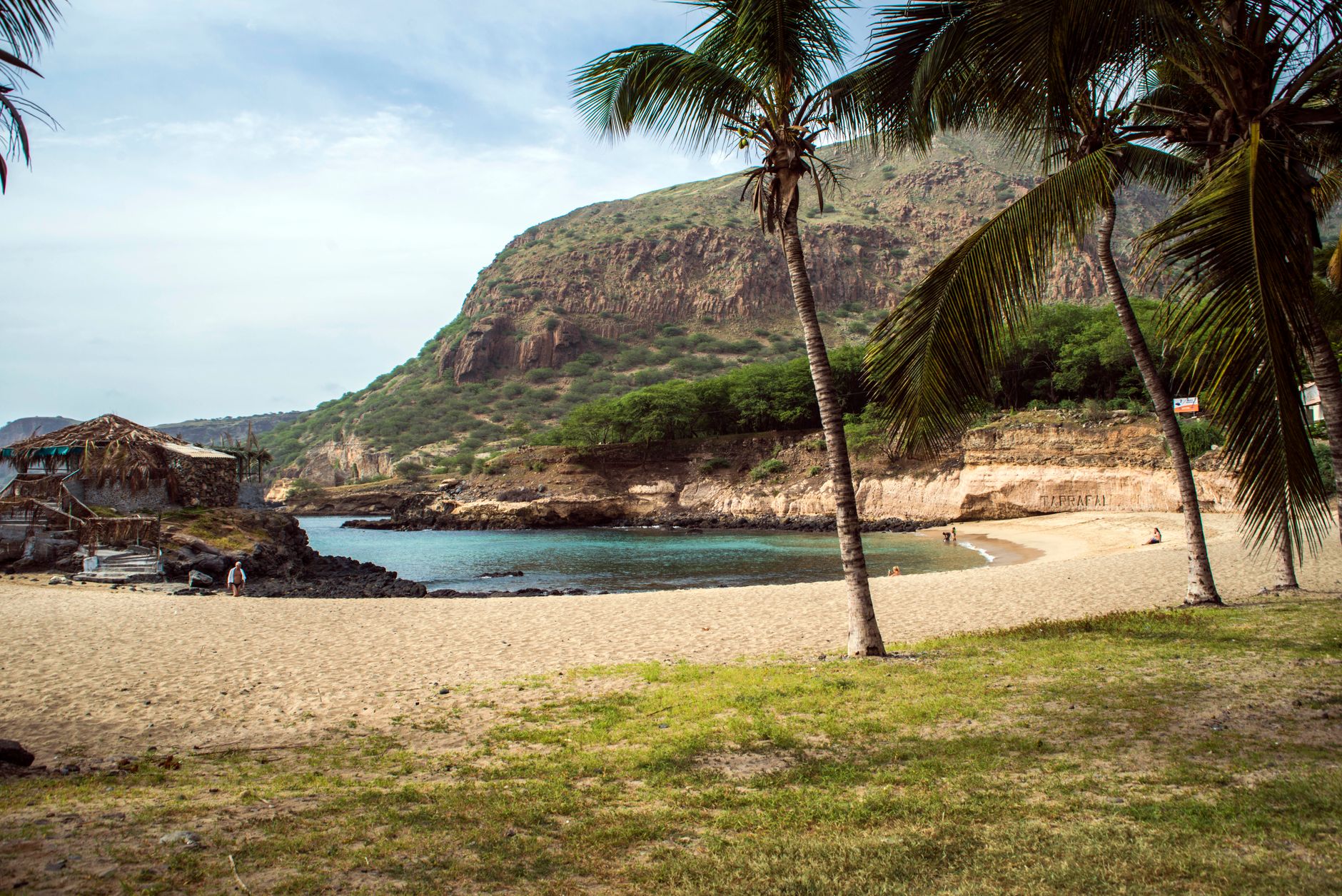
Santa Maria and Sal Rei deliver the beach version of Cape Verde: long pale sand, strong breeze, and water sports that actually justify the flight.
Pico do Fogo rises to 2,829 meters above vineyards, lava fields, and stark black slopes. Sao Filipe is the right base if you want ash under your shoes, not just a postcard.
Santo Antao is the island hikers remember. From Ponta do Sol to Ribeira Grande, old mule paths, ridges, and terraced valleys turn walking into the main event.
Mindelo remains the country's cultural pressure point. Morna, coladeira, harbor nights, and Cesaria Evora's legacy give the city a rhythm no resort can fake.
Cape Verdean cooking turns scarcity into depth: cachupa simmered for hours, grilled tuna cut dark red, grogue poured strong, and papaya jam next to salty cheese.
12 cities — start with the ones we'd send you to first.
The capital sprawls across a clifftop plateau above a working harbour where fishing boats unload tuna at dawn and the Platô neighbourhood's colonial facades peel in the salt wind.
A UNESCO-listed ghost of the Atlantic slave trade — the 16th-century pillory still stands in the square where enslaved Africans were branded before being shipped to Brazil.
São Vicente's port city is the archipelago's cultural nerve centre, where Art Deco buildings face a deep-water bay and Cesária Évora's morna still drifts out of open doorways on weekend nights.
Sal's southern tip delivers a mile of white sand, a main street of painted wooden houses, and a kite-surfing scene that turns the turquoise shallows into a permanent aerial circus.
Perched on a cliff above Fogo's black-sand coast, this colonial town of sobrado mansions looks directly at the active volcano that last erupted in 2014 and buried two villages in lava.
Santiago's highland market town, where farmers from the interior valleys sell dried beans and sugarcane grog on Wednesdays and Saturdays in one of the archipelago's most unfiltered local markets.
Sal's administrative capital is the unglamorous inland counterweight to Santa Maria — a grid of low buildings where Cape Verdeans actually live, eat cachupa for lunch, and ignore the resort economy entirely.
Santo Antão's northwest tip is a cluster of pastel houses wedged between a black cliff and the Atlantic, reachable by a coastal road so dramatic the Portuguese government nearly never finished building it.
Santo Antão's main town sits at the mouth of a volcanic valley where sugarcane fields climb impossible gradients and the local grogue distilleries operate with no tourism infrastructure whatsoever.
Santiago is the political center and the island that explains how Cape Verde actually works when the beach brochure gets out of the way. Praia is busy, practical and occasionally rough-edged; Cidade Velha carries the first colonial port and its slave-market past, while Assomada opens the road into the island's cooler interior and market towns.
Sal is the easiest island to enter and the easiest to underestimate. Santa Maria has the country's strongest tourism machine, but the real shape of the island appears when you drive north through Espargos, old salt pans and wind-flattened terrain that looks closer to desert than tropics.
This is the Cape Verde of live music, mountain roads and serious walking days. Mindelo still feels like a port city first and a resort never, while Ribeira Grande and Ponta do Sol on Santo Antão sit at the edge of some of the most dramatic landscapes in the archipelago.
The southern volcanic islands feel more inward-looking and more dramatic. São Filipe has a handsome colonial core and the road toward Pico do Fogo, while Nova Sintra on Brava trades beaches for cool air, flowers and a sense that the Atlantic has finally lowered its voice.
These eastern islands are flatter, sandier and more exposed to wind than the greener west. Sal Rei is the easier base, with broad beaches and dune excursions, while Vila do Maio suits travelers who want fishing boats, empty stretches of coast and fewer people telling them what to do.
Cape Verde's history is short in chronology, immense in consequence: an uninhabited archipelago became a slave port, a famine frontier, a nation of emigrants and one of Africa's most durable democracies.
Voyagers in Portuguese service, including the Venetian Alvise Cadamosto in later accounts, report the islands to Europe. The striking fact is not conquest but absence: they appear to have been uninhabited when the newcomers arrived.
António de Noli is linked to the formal settlement of Santiago and the founding of Ribeira Grande, today's Cidade Velha. A port town rises quickly because the Atlantic world is already learning how useful this position will be.
By the late 15th century, the islands are already serving ships, merchants and imperial administrators moving between Europe, West Africa and the Americas. Geography becomes destiny, and destiny turns grim.
Royal and commercial documentation from the early 16th century shows the archipelago's growing role in trafficking enslaved Africans. The paper trail hardens what the stones at Cidade Velha still imply.
The Church formalizes its presence with a diocese, giving the town added prestige. Mass, trade and coercion now live side by side in one small Atlantic capital.
Drake's fleet storms the port, loots it and sets much of it ablaze. The raid is dramatic, but its deeper effect is psychological: Cape Verde's wealth has advertised its weakness to every rival power at sea.
Portugal responds to repeated attacks by building a cliff-top fortress over Ribeira Grande. The guns face the Atlantic, but the town below is already entering a slower chapter of decline.
The old capital is formally renamed 'Old City,' a title that sounds almost cruel in its clarity. It marks the transfer of importance away from the once-dominant port.
Drought and official indifference bring mass death, especially on Santiago. The catastrophe imprints itself on family history far more deeply than many governors' names ever will.
Cape Verde's vulnerability to rain failure is exposed again. The cycle of hunger and emigration tightens, making departure part of ordinary life.
Tavares, born on Brava, will become one of the great poetic voices of island longing. His work helps give emotional form to exile, memory and the ache of separation.
Steam navigation gives São Vicente fresh importance. Mindelo becomes a cosmopolitan stopover where sailors, merchants, musicians and political ideas all come ashore.
Born in Bafatá to Cape Verdean parents, Cabral will become the intellectual architect of liberation. Few anti-colonial leaders thought more clearly about culture, land and political honesty.
She will later sing the islands into world consciousness without sanding down their sadness. In her voice, Cape Verde sounds intimate and oceanic at once.
The legal relabeling is meant to preserve empire by changing the vocabulary. Cape Verdeans hear the new formula and understand that names can be instruments of denial.
Amílcar Cabral and his comrades create the party that will fight for the liberation of Guinea-Bissau and Cape Verde. The movement joins theory, discipline and anti-colonial struggle in unusually rigorous fashion.
Cabral is killed in Conakry before seeing independence. His death gives the liberation cause a martyr, but also deprives Cape Verde and Guinea-Bissau of one of the era's sharpest political minds.
The new republic is born with Aristides Pereira as its first president. It inherits drought, emigration and scarcity, but also a disciplined political class forged by hard realities.
Cape Verde holds elections that bring an orderly change of power. In a region where coups and constitutional ruptures were hardly rare, this becomes one of the republic's defining strengths.
The old slave port receives global recognition, but the honor carries a moral burden. Preservation here is not only about architecture; it is about forcing the Atlantic past to remain visible.
When Cesária dies, Cape Verde loses its most famous voice, but not the repertoire of feeling she gave the world. Mindelo keeps singing; it simply sounds lonelier for a while.
The name preference is diplomatic, but also symbolic. A country once named from outside insists, gently and firmly, on how it wishes to be called.
Atlantic Founding
António de Noli is usually presented as the founder, but behind the title stands a displaced Genoese adventurer who ended his life far from home on land he governed for a crown that was not his own.
A beach of black lava, a strip of white surf, not a soul in sight: that is how these islands entered written history. When Portuguese navigators reached the archipelago between 1456 and 1462, they found no kingdom to conquer and no town to rename, only volcanic ridges, dry ravines and anchorages exposed to the Atlantic. Cape Verde begins with a silence that is almost unsettling.
Records give the first chapter a quarrel worthy of a Renaissance court. The Venetian Alvise Cadamosto claimed the sighting, the Genoese captain António de Noli claimed the settlement, and the Portuguese crown, with its usual sense for useful loyalty, favored de Noli and handed him Santiago. In 1462, Ribeira Grande, today Cidade Velha, was founded on that island, the first durable European town in the tropics.
What people often miss is darker. The first laborers brought to these supposedly empty islands were enslaved Africans sent to clear land, raise walls and make settlement possible before many colonists wanted to stay themselves. The colony was born upside down: coercion first, comfort later.
And from that violence came something new. Portuguese settlers, African captives, traders from the Upper Guinea coast and mixed families created the first Cape Verdean creole society, along with Kriolu, a language shaped not in a court or monastery but in kitchens, docks and slave yards. That mixture would make the islands useful to empire, and impossible to keep simple.
One of the archipelago's first human stories is that enslaved Africans arrived before many free settlers did.
Ribeira Grande and the Atlantic Trade
Sir Francis Drake appears in English legend as a hero of empire, but in Cape Verde he is the man who proved that Atlantic wealth without defense was little more than bait.
Picture the square at Cidade Velha in the 16th century: the church bell rings, mule hooves strike the stone, a clerk scratches names into a ledger while the heat settles over the bay like fabric. Ships from the Guinea coast anchor below the cliff, and the town lives from what it dares not name too plainly. This was one of the Atlantic world's earliest great entrepots for the slave trade.
The pelourinho still tells the truth. That stone pillory, standing in the open air, was the place where enslaved people were displayed, punished and sold, with no tasteful euphemism to soften the fact. Records show clergy, merchants and royal officials working within the same small town, each claiming a moral vocabulary, each profiting from the same machinery.
Ce que l'on ignore souvent, c'est que the trade depended on intermediaries who lived between worlds. The lançados, Portuguese or Luso-African traders who settled along the West African coast, married into local families, learned African languages and negotiated captives, became founders of a creole Atlantic. Their children linked Cidade Velha to a far larger human map of kinship, money and betrayal.
Wealth drew predators. In November 1585 Sir Francis Drake entered the bay with 25 ships and about 2,300 men, found the town poorly defended, looted it and burned much of it in a matter of days. The Portuguese answered by fortifying the heights above the port with what is now the Fortaleza Real de São Filipe, but the wound had already done its work: fear, decline and the slow drift of trade elsewhere.
The ruins of the old cathedral at Cidade Velha are among the earliest cathedral remains in sub-Saharan Africa.
Drought, Neglect and Departure
Eugénio Tavares gave Brava's longing a public voice, turning private exile and island distance into poems people could hum.
By the 18th century the center of gravity had shifted away from Cidade Velha, and the old capital began to wear its new name like a sentence. Trade moved, raiders kept coming, and imperial attention wandered whenever profit did. The islands remained strategic on a map, yet often abandoned in practice.
The real sovereign was drought. Between 1773 and 1775 famine on Santiago killed tens of thousands; later crises in the 19th century, especially in 1831 and 1863, did the same with a cruelty that official correspondence records in cold lines and late responses. Cape Verdean history is full of governors, bishops and decrees, but it is famine that shaped family memory.
What people often miss is how directly neglect fed emigration. Men left as sailors, laborers and contract workers; women held households together with remittances, prayer and fierce accounting; children grew up with letters from abroad as part of domestic life. Sodade was not born as a poetic pose. It was an administrative fact felt at the dinner table.
Yet this was not only a history of hunger. In the late 19th and early 20th centuries Mindelo, on São Vicente, became a coal and cable port where steamships paused, musicians listened, newspapers circulated and new political ideas landed with the mail. One island was starving, another was singing, and modern Cape Verde was being assembled between those two truths.
In famine years, colonial authorities were often accused of watching grain leave the islands while local people starved.
National Awakening and Independence
Amílcar Cabral remains the moral giant of Cape Verdean independence, not because he promised paradise, but because he despised slogans that hid reality.
A sheet of paper can be more dangerous than a cannon. In the mid-20th century, while Portugal tried to relabel its African possessions as overseas provinces, Cape Verdean students, teachers and dockworkers were reading, debating and measuring the gap between imperial language and daily life. In Praia and Mindelo, nationalism did not arrive as theater; it arrived as argument.
The central figure is Amílcar Cabral, born in Bafatá in Portuguese Guinea to Cape Verdean parents, educated as an agronomist, precise in thought and unsparing in judgment. He understood that soil surveys and liberation strategy required the same thing: seeing what was actually there, not what propaganda wished to see. His PAIGC movement linked Guinea-Bissau and Cape Verde in a shared anti-colonial project, though the war itself was fought on the mainland.
Ce que l'on ignore souvent, c'est que Cabral was not a romantic of violence. He spoke constantly about culture, dignity, discipline and the danger of replacing one empty elite with another. Then, in January 1973, he was assassinated in Conakry before he could see the flag rise.
Independence came on 5 July 1975. Aristides Pereira became the first president, and the new state inherited little besides drought, migration, thin resources and a population used to improvising survival. But that fragility also forced a political seriousness that would matter later: Cape Verde could not afford grand illusions, only institutions that worked.
Cabral trained as an agronomist, and his close knowledge of land, crops and drought shaped the hard practicality of his politics.
Democracy, Diaspora and Cultural Prestige
Cesária Évora sang like someone opening a window at dusk, and through that window the world finally heard Cape Verde on its own terms.
At independence Cape Verde was poor, dry and frighteningly exposed to every failed harvest. Yet the post-1975 story is not one of heroic miracle so much as careful statecraft: schools expanded, public health improved, coups never became the national habit, and in 1991 a peaceful transition to multi-party democracy set the country apart in the region. On islands where rain could not be trusted, procedure became a form of protection.
The country also learned to live through departure without surrendering itself to it. The diaspora in Lisbon, Rotterdam, Boston, Brockton and beyond sent money, styles, records and expectations back home, so that Cape Verdean identity came to exist in two places at once. You hear that double life in the music before you see it in statistics.
No one embodied it more completely than Cesária Évora of Mindelo. Barefoot on stage, cigarette in hand, singing of ships, lovers and distances that never quite close, she turned sodade into one of the late 20th century's unmistakable voices without prettifying the hardship underneath it. She made the archipelago audible to the world.
Today the country moves on several tempos at once. Praia grows as an administrative capital, Santa Maria sells sun and salt on Sal, São Filipe lives under the shadow of Fogo, and Cidade Velha asks the nation to remember what built it. The bridge to the next era is already visible: climate pressure, tourism, migration and memory now meet on the same narrow ground.
Cape Verde's peaceful alternation of power in 1991 was rare enough in the region to become part of the country's quiet political pride.
Portuguese keeps the ledgers, the court files, the schoolroom blackboards. Kriolu keeps the pulse. You hear the difference within ten minutes in Praia: Portuguese for the office counter, Kriolu for the joke, the reprimand, the price negotiated with eyebrows, the sentence that matters.
A language born from ship holds and market stalls should have turned brutal forever. Instead it learned suppleness. Santiago gives you Badiu vowels with more gravel in them; Mindelo answers with a lighter music, almost a tease. People will tell you these are variants. They are also biographies.
Then comes a word like morabeza and the entire country steps forward. Hospitality is too thin a translation. Morabeza means that the chair was waiting for you before you knew you were tired, that the coffee appears, that refusal becomes a small social crime. A country is a table set for strangers.
Cape Verde made exile singable. That may be its greatest invention. In Mindelo, especially after dark, music does not entertain so much as confess in public with excellent timing.
Morna moves at the pace of memory that has stopped pretending to heal. Cesária Évora gave that tempo a face the world could recognize, but the feeling belongs to rooms smaller than fame: a bar near Avenida Marginal, a guitar, a violin, one voice carrying sodade as if distance were a physical object one could place on the table between two glasses. You listen and understand that islands produce mathematicians of absence.
Coladeira arrives to save everyone from drowning in their own soul. Thank heaven. The hips intervene, irony returns, the night acquires elbows. In Praia the batuque does something even older and sharper: women build percussion with hands and cloth and insist, with impeccable authority, that rhythm began before any empire and will outlive the next one too.
Cape Verdean cooking begins with scarcity and ends with ceremony. Corn, beans, fish, pork, cassava: ingredients that sound austere until cachupa enters the room and fills it with steam, garlic, bay leaf, and the serene arrogance of a dish that has survived drought, colonial neglect, migration, and fashion. A pot of cachupa is never just lunch. It is household policy.
The first spoonful explains the country better than a lecture could. On Santiago the broth often runs deeper and darker; on Fogo, near São Filipe, fish versions carry a different brightness, lemon and coriander pushing through the starch like light through shutters. Families debate whose recipe is right with the gravity other nations reserve for constitutional law.
Morning brings the superior trick. Yesterday's cachupa becomes cachupa refogada, fried with onion and often an egg, the edges caramelized, the center still tender, the whole thing proving that leftovers are one of civilization's finer ideas. Real elegance often comes second.
You do not enter a shop in Cape Verde and go straight to business unless you enjoy being classified, correctly, as ill-brought-up. First the greeting. Bon dia. Boa tarde. A question about health, weather, family, or at least the shape of the day. Only then may money appear without vulgarity.
This is not decorative politeness. It is a hierarchy of reality. The person comes first, the exchange after. In Cidade Velha, in Assomada, in the side streets of Praia, you feel how quickly a room measures whether you understand this rule. The judgment is swift. So is the forgiveness, if you learn.
Food obeys the same code. Someone offers coffee, grogue, a plate, a spoonful, a second spoonful, and your refusal lands harder than you intended. Accepting binds you for a moment into the household's grammar. Etiquette here is not stiffness. It is warmth with an exact syntax.
Architecture in Cape Verde has had to negotiate with salt, drought, trade, and the Atlantic's bad temper. In Cidade Velha the old street lines still carry the moral shock of the place: churches, a pillory, warehouses, the first European tropical city arranged with bureaucratic confidence over an inhuman trade. The Pelourinho does not let anyone sentimentalize the setting. Good. Some stones should refuse charm.
Elsewhere the buildings become more evasive and more intimate. In Mindelo, pastel facades and iron balconies remember maritime trade and nineteenth-century aspiration; the city still knows how to hold a corner with style. In São Filipe, the sobrados along the black volcanic slope look as though Lisbon and lava had a difficult but fruitful marriage.
Then you climb into Santo Antão, toward Ponta do Sol or Ribeira Grande, and architecture shrinks to what weather permits: thick walls, shade, courtyards, roofs that understand sun as an adversary. Beauty here rarely announces itself. It persists.
Cape Verde thinks with the sea, and the sea is not a comforting philosopher. Nearly every family has someone abroad: Rotterdam, Lisbon, Boston, Paris. Departure is so ordinary that it stops posing as drama and becomes structure. The result is not despair. It is a disciplined tenderness.
Sodade is the word outsiders memorize first, usually with self-congratulation. They shouldn't rush. Sodade here is not romantic fog. It is the knowledge that love often lives on another shore, that remittances pay school fees, that airport goodbyes can become a family routine, that music and cooking and jokes must carry more than their usual share because bodies are absent.
And yet the country does not grow solemn from this. It grows precise. People celebrate with force because time together has arithmetic. A meal in Praia, a song in Mindelo, a glass in São Filipe: each can feel slightly ceremonial without becoming pompous. Islands teach economy. Emotion included.
He was a Genoese outsider who won a Portuguese crown's favor and, with it, a place in Cape Verde's founding myth. The irony is perfect: one of the archipelago's first official fathers was neither Portuguese by birth nor rooted in the islands he helped organize.
Cadamosto left behind the sort of travel writing that kings and courts loved because it turned navigation into prestige. His rivalry with de Noli over who truly found the islands reminds you that discovery stories are often property disputes written as glory.
English schoolbooks cast him in bronze. Cape Verde remembers the smoke. When Drake attacked Ribeira Grande, he exposed how rich and how vulnerable the Atlantic slave port had become.
He gave island longing a voice that people recognized as their own, not as an imported Portuguese sadness with local scenery attached. In his hands, the ache of departure became part of Cape Verde's moral vocabulary.
Cabral is the rare nationalist leader whose prose is as important as his legend. He distrusted easy rhetoric, studied agriculture with scientific rigor, and insisted that freedom meant more than changing flags over the same old hunger.
He inherited a state with few resources and no margin for vanity. Pereira's years in office helped set the sober tone of Cape Verdean government: cautious, disciplined and acutely aware that a small republic survives by not lying to itself for long.
Pires belongs to that generation who had to move from liberation politics to the less glamorous work of administration. His importance lies not in theatrical gestures but in helping turn a fragile postcolonial state into one of Africa's steadier democracies.
She did not sell Cape Verde as paradise. She sang it as distance, fatigue, elegance and memory, often barefoot, with a voice that carried the weather of the islands inside it. Through her, Mindelo became one of the Atlantic's great musical capitals.
Fortes wrote with volcanic force, giving the young republic a language large enough for drought, sea wind and political awakening. If Cesária made the islands audible, he helped make them legible to themselves.
This is the shortest route that still explains the country. Start in Praia for the capital's everyday rhythm, drop into Cidade Velha for the blunt Atlantic history, then head inland to Assomada where the market tells you more than any museum label could.
Base this week around the flatter eastern islands, where the landscape shifts from crater salinas to long Atlantic beaches. Espargos gives you the practical side of Sal, Santa Maria handles the swimming and wind sports, and Sal Rei adds a slower, dune-backed finish on Boa Vista.
Begin in Mindelo, where bars, harbor light and Cesária Évora's afterimage still shape the nights, then cross to Santo Antão for roads cut into basalt and valleys built for long walks. Ribeira Grande works as the practical base, while Ponta do Sol gives you the cliff-edge ending.
This longer route moves south through the islands that feel most self-contained. São Filipe gives you Fogo's colonial façades and volcano access, Nova Sintra brings Brava's cooler hilltop calm, and Vila do Maio finishes with flat roads, quiet beaches and a pace that strips the week clean.
Lunch. Family table. Deep bowl, bread, argument, second serving.
Morning. Frying pan, onion, egg, yesterday's stew, black coffee.
Street corner. Hot oil, tuna, chili, fingers, paper napkin, standing lunch.
Weekday meal. Rice, beans, linguica, spoon, shared pot.
Sunday table. Conch stew, hands, bread, silence, then praise.
Farmer's table. Small glass, eye contact, one toast, one swallow.
Breakfast or late afternoon. Sweet papaya, salty cheese, knife, bread, conversation.



EU, UK, US and Canadian passport holders can enter Cape Verde visa-free for up to 30 days, but air arrivals still need EASE pre-registration and the airport security fee before travel. Australian travelers should check with a Cape Verde consulate before booking, because current exemption lists are not consistent enough to trust older advice.
Cape Verde uses the Cabo Verdean escudo (CVE), pegged to the euro, and cash still matters outside bigger hotels and airport corridors. Cards work well in Santa Maria, Praia and many resort businesses, but taxis, small guesthouses, beach bars and rural stops often expect escudos.
Most visitors arrive through Sal for beach holidays, Praia for Santiago, or Mindelo for São Vicente and Santo Antão. Lisbon remains the cleanest hub from Europe and the usual one-stop link from North America, while direct options change too often to build a trip around wishful thinking.
Inter-island flights save time, but schedules can shift, so leave a buffer day before your international departure if a domestic leg matters. Ferries are essential for routes to Santo Antão and useful elsewhere, while shared aluguers and minibuses handle short hops within islands more cheaply than taxis.
Cape Verde stays warm all year, with the driest and most reliable beach weather usually from November to June. December to April is windier, which suits kitesurfers in Santa Maria and Sal Rei, while July to October can bring brief heavy rain, greener valleys and rougher sea conditions.
Mobile coverage is solid in towns and the main tourism zones, and hotels in Praia, Mindelo and Santa Maria usually offer workable Wi-Fi. Speeds drop fast on ferries, in mountain valleys and in smaller settlements, so download maps and tickets before you leave your room.
Cape Verde is one of the calmer countries in the region, but petty theft happens in city centers, on beaches after dark and around transport hubs. The bigger day-to-day risk is the Atlantic: exposed beaches can have strong currents, so local advice matters more than your confidence.
Withdraw CVE when you land and keep small notes for taxis, aluguers, cafés and ferry days. Paying in euros is possible in tourist zones, but the exchange is rarely generous.
Do not schedule a domestic flight on the same day as your international departure if missing it would hurt. One buffer night in Praia, Mindelo or Santa Maria buys more peace than any apology email later.
Ferries matter on routes involving Santo Antão and can fill around holidays and weekends. Buy ahead, arrive about an hour early and keep paper or offline copies of your booking.
Say hello before asking for a table, a taxi fare or a bottle of water. A simple 'bom dia' or 'boa tarde' lands better than rushing straight to the transaction.
Cape Verde has no rail network, so country planning is all flights, ferries, shared vans and taxis. Distances look short on a map; sea conditions and schedules are what decide your day.
Santa Maria and Sal Rei fill fastest in the winter wind months and around European school breaks. Lock in rooms and airport transfers early if you are traveling between December and April.
Mobile data is good in the main towns, but mountain roads, ferry crossings and smaller villages can turn unreliable fast. Save boarding passes, maps and hotel contacts before you head out.
Explore Cape Verde with a personal guide in your pocket
Audio guides for 1,100+ cities across 96 countries. History, stories, and local insight — offline ready.

If you hold an EU, UK, US or Canadian passport, usually no for stays up to 30 days. You still need EASE pre-registration and the airport security fee for air arrivals, and travelers with Australian passports should verify the current rule directly before booking.
No, Cape Verde is outside Schengen and outside the EU. Time spent there does not count against the Schengen 90-in-180-day limit.
You can use euros in some tourist-heavy areas, especially around Santa Maria and Sal Rei, but escudos work better almost everywhere. Local cash is the safer choice for taxis, markets, ferries and small restaurants.
Seven days is enough for one island or a simple two-island trip; ten to fourteen days gives the country room to make sense. Island-hopping looks easy on paper, but flights and ferries can eat more time than first-time visitors expect.
Sal is the easiest answer for classic beach time, especially around Santa Maria. Boa Vista, with Sal Rei as the main base, is quieter and feels less built up, which some travelers prefer immediately.
It can be moderate or expensive depending on the island and your habits. Local lunches, guesthouses and shared transport keep costs reasonable, while resorts on Sal and Boa Vista push prices much closer to southern Europe.
It is possible, but not frictionless. Domestic flights save time, ferries are essential on some routes, and smart itineraries keep one buffer day before the flight home.
Generally yes, especially compared with many destinations in the region, but basic city precautions still apply. Watch your bag in Praia and Mindelo, avoid isolated beaches after dark and take local warnings about currents seriously.
Last reviewed