train
Cities by Corridor
The Toronto-montreal-Ottawa-Quebec City corridor packs Canada’s easiest first trip into one route: politics, food, museums, and neighborhoods that change language as fast as the road signs.
Canada is not one destination but a chain of regions held together by distance, weather, and a talent for turning survival into culture.
EntryVisa-exempt for many visitors; eTA usually required for air arrivals
CCanada travel guide starts with one hard truth: this country is too large to “do” in one trip. Think in regions, not checklists.
Canada rewards travelers who stop treating it like a neat national package. You can eat smoked meat in montreal at lunch, stand in the political theater of Ottawa the next day, then reach Toronto, where the skyline rises above Lake Ontario like a financial bet that happened to work. Head west and the mood shifts again: Vancouver runs on ocean light and mountain weather, while Calgary feels closer to the Prairies than the postcards admit. Distance changes the country as much as history does.
The best first trip usually follows one strong line. Maybe that means cities and rail stations through Quebec City, montreal, Ottawa, Toronto, and Niagara Falls. Maybe it means a western arc from Vancouver to Victoria, then inland toward Calgary and Banff. Each route gives you a different Canada: bilingual and argumentative in Quebec, glass-and-water urban on the Pacific, bigger-skied and more weather-beaten once the mountains give way. Pick one. The country will still outgrow your plans, which is part of the appeal.
First Peoples and First Contacts, before 1000-1600
A canoe of white stone glides over Lake Ontario. That is how Haudenosaunee tradition remembers the Peacemaker, the visionary who ended cycles of revenge and bound nations together under the Great Law of Peace, with Hiawatha beside him, a man broken by grief and remade by diplomacy.
Ce que l'on ignore souvent, c'est that this political order gave clan mothers the power to remove chiefs and demanded long debate before war. Long before Ottawa had a parliament, the woodlands between today's Montreal and Niagara Falls held a federation built on persuasion, ceremony, and memory.
Then another apparition arrived. Around the year 1000, Norse sailors put up turf-walled houses at L'Anse aux Meadows, near today's St. John's, and for a brief moment Europe touched North America without conquest, without maps that lasted, almost without witnesses.
The human detail is brutal. Freydis Eiriksdottir, if the sagas are to be believed, came west not as a decorative heroine but as a woman capable of business, fury, and murder with an axe when her companions hesitated; one already sees, at the very edge of the continent, that Canada will never be a story of mild manners alone.
The Norse left. Indigenous nations did not. That matters, because every later empire would behave as if history began with its own flag, while the real beginning lay in older laws, older trade routes, and older names carried by river and drum into the age of New France.
Shanawdithit, the last known Beothuk, spent her final years in St. John's drawing from memory so that a vanished people would leave at least one witness behind.
At L'Anse aux Meadows, a spindle whorl and evidence of ironworking suggest women were present in the Norse camp; this was not just a raid, but a fragile attempt at settlement.
New France, 1534-1763
Winter bites first. In 1535, Jacques Cartier's men on the St. Lawrence were too weak from scurvy to bury their dead until an Indigenous remedy, annedda, a cedar infusion, brought them back from the edge; Cartier wrote down the cure, but not with the generosity one might hope for.
He had another obsession. Gold. Donnacona, the Stadaconan leader whose sons Cartier had already carried off to France, told him of the Kingdom of Saguenay, glittering somewhere inland; perhaps it was diplomacy, perhaps mockery, perhaps a desperate attempt to direct the French elsewhere, but King Francois I paid attention.
Quebec begins in a more sober register. In 1608 Samuel de Champlain founded his settlement below Cap Diamant, on a narrowing of the river perfect for control and vulnerable to everything else: hunger, cold, loneliness, and the need for alliances with nations who understood the country far better than he did.
Ce que l'on ignore souvent, c'est that New France was shaped as much by women with ledgers and letters as by men with arquebuses. Marie de l'Incarnation reached Quebec in 1639, left an eleven-year-old son in Tours, and then wrote some of the most extraordinary pages in North American history while building a convent, a school, and a moral order in a place that still smelled of timber, mud, and fear.
By the time British forces closed in during the Seven Years' War, the colony had created seigneuries, missions, trading networks, and a French-speaking world that conquest would not erase. The flag would change in 1763. The language would stay.
Samuel de Champlain is often shown as an impassive founder, but the man himself spent years improvising alliances and watching carefully, because certainty was a luxury the St. Lawrence never granted.
Champlain died in Quebec on Christmas Day 1635, and his grave has never been identified with complete certainty.
Conquest, Rebellion, Confederation, 1763-1914
One September morning in 1759, the cliffs above Quebec City filled with soldiers who should not have been there. The Battle of the Plains of Abraham lasted less than an hour, and both commanding generals, Montcalm and Wolfe, would be dead within days; empires changed hands with astonishing speed, while the civilians below kept baking bread, praying, trading, and burying sons.
British rule did not flatten the French fact of the country. The Quebec Act of 1774 preserved French civil law and Catholic practice, not out of romance but calculation; London had learned that governing Canada meant bargaining with what already existed.
Then came the century of unfinished arguments. Loyalists arrived after the American Revolution, canals and timber fortunes altered the economy, and the rebellions of 1837-38 showed that colonial deference had limits; Louis-Joseph Papineau in Lower Canada and William Lyon Mackenzie in Upper Canada gave the empire a headache it could not dismiss as local noise.
Confederation in 1867 was presented as tidy constitutional architecture. It was anything but. A vast country had to be imagined into existence with railways, treaties, land surveys, and a language of compromise, while the people who already lived across the prairies and woodlands were being pushed, promised to, and ignored in unequal measure.
No figure exposes the cost more clearly than Louis Riel. In Red River and later Saskatchewan, he insisted that the new dominion could not be built as if the Metis were a clerical inconvenience; his execution in 1885 helped make modern Canada and nearly broke it at the same time, because Quebec and English Canada read the scaffold in entirely different ways.
Louis Riel was not a footnote to Confederation but its inconvenient conscience, a man who understood before most that maps drawn in Ottawa could ruin lives far to the west.
When the Fathers of Confederation met in Charlottetown in 1864, one practical reason they attracted attention was that their champagne supply outshone the original conference agenda.
War, Welfare, and Restless Identity, 1914-1982
The First World War dragged Canada onto a larger stage by way of mud. At Vimy Ridge in April 1917, troops from all four divisions fought together and took the position at terrible cost; legend later wrapped the battle in national grandeur, but the letters home speak just as clearly of exhaustion, shellfire, and boys aging in a week.
Peace did not make the country calm. Women pressed for full political rights, workers filled Winnipeg in 1919 during a general strike that frightened elites, and the Depression revealed how thin the safety net really was when prairie dust, unemployment, and hunger entered ordinary kitchens.
The middle decades produced one of Canada's defining contradictions. The state grew more protective through pensions, unemployment insurance, and then medicare, yet public life still carried exclusions that were intimate and humiliating, like the night in 1946 when Viola Desmond sat on the main floor of a New Glasgow cinema in Nova Scotia and was arrested over a one-cent tax difference that disguised a color line.
Ce que l'on ignore souvent, c'est how long Canada hesitated to look like itself. The Maple Leaf flag arrived only in 1965, after bitter debate, and the patriation of the Constitution in 1982, with its Charter of Rights and Freedoms, gave the country a new legal language for the self it had been circling for decades.
Between those dates lay Expo 67 in Montreal, Quiet Revolution, bilingualism, Pierre Trudeau's theatrical federalism, and the long argument over Quebec's place in the federation. Canada had money, highways, universities, and television by then. It still had not settled the question of what kind of country it wished to be.
Viola Desmond entered Canadian history because she refused to move seats, turning one evening in a Nova Scotia movie house into a national lesson in quiet courage.
When the new Canadian flag was inaugurated in 1965, some veterans and traditionalists mourned the loss of the Red Ensign as if a family portrait had been taken off the wall.
Charter Canada, 1982-present
A runner on an artificial leg moves along the roadside, lean, determined, almost unbearably young. In 1980 Terry Fox began his Marathon of Hope in St. John's by dipping his prosthetic leg into the Atlantic, and though cancer stopped him near Thunder Bay, the image remains one of modern Canada at its best: stoic, public-minded, and unwilling to confuse sentiment with surrender.
Yet this later Canada is not a tale of uncomplicated virtue. Constitutional battles, the failed Meech Lake and Charlottetown accords, and the 1995 Quebec referendum showed how narrow the seams of the federation could become; one point here, one concession there, and the whole garment seemed ready to split.
At the same time, cities changed their face. Toronto became one of the world's great immigrant metropolises, Vancouver turned toward the Pacific with fresh intensity, Calgary sold energy and ambition, and Montreal kept staging its old argument between memory and reinvention with unmatched style.
The deepest shift came from truths that had long been pushed into drawers. The Truth and Reconciliation Commission, the confirmation of unmarked graves at former residential school sites, and renewed Indigenous legal and political activism forced the country to look again at the price of its own building.
So Canada now lives in a double inheritance: pride in a rights-based, plural society, and the knowledge that many of its foundations were laid through dispossession. The story is not finished. One suspects it never will be, and perhaps that is the most Canadian thing of all.
Terry Fox became a secular saint of the country not because he won, but because he made endurance look like a public duty anyone might share.
The 1995 Quebec referendum was decided by less than 55,000 votes, a margin so thin that families, neighborhoods, and dinner tables carried the tension for years.
Canada reveals itself first by the mouth. In Toronto, the streetcar doors sigh open, someone says "sorry" because your sleeve brushed theirs, and the word means five things at once: apology, warning, courtesy, retreat, small social incense. Then you arrive in Montreal, where French and English circle each other like two cats that have agreed, for tonight, not to fight.
This is not bilingualism as a schoolbook virtue. It is daily theater. A cashier begins with "bonjour-hi," not from indecision but from exquisite tactical intelligence, and that little hyphen contains a federation, two empires, several grudges, and the desire to sell you a sandwich without incident.
Certain nouns are tiny national museums. A washroom is not a restroom. A toque is not a beanie. A depanneur in Montreal is not merely a convenience store; it is the corner oracle for beer, aspirin, lottery tickets, and late remorse. Language here does not decorate reality. It sorts the cold from the survivable.
Canadian cuisine begins where climate stops being picturesque. In Quebec City, a spoon sinks into split pea soup thick with ham, and one understands that thrift can become tenderness if repeated for two centuries. In Halifax, a donair arrives wrapped in foil like a dangerous secret, sweet sauce running down the wrist before dignity can intervene.
The national table is a parliament of migrations. Montreal gives you smoked meat on rye, the knife-work of Jewish delis meeting North American appetite. Toronto answers with Tamil curries in Scarborough, Jamaican patties under glass, Cantonese seafood tanks, and peameal bacon at St. Lawrence Market as if Ontario had decided breakfast should taste of salt, cornmeal, and commerce.
Then comes poutine, which foreigners often treat as a stunt. They are wrong. Good poutine is an argument about temperature and timing: fries still resisting, gravy hot enough to soften but not drown, curds squeaking against the teeth like fresh snow under boots. A country is a table set against the weather.
Canadian politeness has been slandered by postcards. People imagine warmth. What they encounter is form: doors held, voices lowered, queues obeyed with the gravity of liturgy. In Ottawa, the bus stop can feel like a small constitutional monarchy in which everyone has accepted invisible rules and no one wishes to draft amendments before coffee.
This restraint has elegance. It also has teeth. A Canadian can refuse you with such grace that you may thank them for the refusal, and only later, in your hotel room, understand that the conversation ended three minutes earlier. The country dislikes spectacle. Even anger is expected to arrive properly dressed.
Do not mistake this for emptiness. It is a technique of coexistence in a place where winter is long, apartments are shared by overheated radiators, and the social fabric would fray quickly if every annoyance became theater. The code is simple: make room, do not corner, keep the peace unless the matter deserves war.
Canadian architecture is what happens when empire, money, and weather are forced to share a coat. Quebec City keeps its stone walls and steep roofs because snow is not a metaphor there. Montreal layers convent masonry, triplex staircases, and bank buildings with the grave self-belief of the nineteenth century. Then Toronto rises in glass, steel, and condominium multiplication, as if modernity were a crop with quarterly targets.
Yet the most Canadian detail may be underground. In Montreal, the RESO tunnels let the city continue beneath the city, a second circulatory system built for January. In Toronto, the PATH performs a related miracle with less romance and more fluorescent lighting. Civilization, in this country, often means staying indoors without admitting defeat.
Even the grand gestures carry climate in their bones. Parliament Hill in Ottawa borrows Gothic language from Europe, but the drama lands differently under a white sky and a wind that cuts across the Ottawa River as if sharpening itself. Buildings here do not simply aspire upward. They brace.
Canadian literature distrusts grand declarations. It prefers the side door, the withheld confession, the domestic object left on a table after the argument. Alice Munro could turn a kitchen into a moral abyss. Margaret Atwood understands that power rarely enters wearing a crown; it arrives as policy, household habit, one more instruction spoken calmly.
In Quebec, the sentence does something else. It bites its lip, then laughs. Michel Tremblay gave Montreal's spoken French the dignity of print and, with that single act, made literature answer to the street. Anne Hebert wrote with the chill exactitude of a blade laid on linen. One feels, reading her, that innocence is a costume rented by the hour.
This is a country that writes from edges: prairie towns, northern distances, immigrant apartments, Atlantic harbors, reservations, suburban kitchens, motel rooms near highways that seem to cross half the planet. Perhaps that is why the prose often feels intimate even when the land is monstrous. Faced with so much space, the sentence learns precision or dies.
Canadian design seldom begs for admiration. It prefers to work first. A Hudson's Bay point blanket, striped and heavy, looks almost absurdly simple until you remember it once functioned as warmth, trade good, status object, and historical evidence all at once. The classic canoe does the same trick: beauty arriving disguised as necessity.
The country likes clean lines, but not for ideological reasons. Snow teaches editing. So does low winter light, which is merciless to clutter. In Vancouver and Victoria, wood, glass, and water enter into civil conversation; the Pacific edge asks for houses that notice rain. In the Prairies, grain elevators and train stations once provided a harsher school: shape follows weather, distance, storage, departure.
Even the graphic symbols are disciplined. The maple leaf on the flag is not lyrical. It is surgical. Red, white, eleven points, no embroidery. Canada understands that an object can become beloved precisely because it declines to chatter.
The Toronto-montreal-Ottawa-Quebec City corridor packs Canada’s easiest first trip into one route: politics, food, museums, and neighborhoods that change language as fast as the road signs.
From Calgary to Banff, the scale gets absurd fast: glacier lakes, sudden snow, wildlife warnings, and highways that make your rental car feel very small.
Few countries let you choose between Pacific rainforests, Atlantic fishing towns, and the Arctic imagination in a single national border. Canada does, and each coast tells a different story.
Canada’s best dishes come from climate, migration, and thrift. Think poutine in Quebec, smoked meat in montreal, donair in Halifax, and maple taffy when winter is almost done with you.
September and October bring the sharpest colors in Ontario, Quebec, and the Maritimes, while winter turns places like Quebec City and Ottawa into cities that finally make sense in snow.
English and French are not background decoration here. In montreal and Ottawa especially, language shapes menus, humor, politics, and the texture of an ordinary conversation.
9 cities — start with the ones we'd send you to first.
A city of 200 languages where Kensington Market's Portuguese fish shops sit three blocks from a Cantonese dim sum hall that's been open since 1901.
Montreal smells like espresso at 8 a.m. and river wind at midnight, with church bells and bass lines sharing the same blocks. Here, old stone and neon feel less like contrast and more like conversation.
The morning light hits the copper roofs on Parliament Hill and suddenly the whole country feels smaller than the canal running beneath your feet.
The city feels like it was carved out of rainforest and saltwater in the same week. One moment you’re between glass towers, the next you’re under thousand-year cedar trees listening to the ocean.
The city still wears its cowboy boots under a business suit. One minute you’re standing on a glass floor 191 metres above the Bow River, the next you’re watching mounted police in full red serge ride past wooden storefro…
Stand at the railing at 6 a.m. and the roar feels like it’s coming from inside your ribs. Everything else here is just noise.
Sitting at the geographic centre of Canada, it holds the world's largest collection of Inuit art at the Winnipeg Art Gallery's Qaumajuq vault and temperatures that swing 70 degrees between July and January.
The only walled city north of Mexico, where the 17th-century stone of the Vieux-Québec's Rue Saint-Louis makes you forget the continent you're standing on.
A Victorian railway town marooned inside a UNESCO World Heritage mountain wilderness, where elk graze the main street and the turquoise of Lake Louise is an impossible geological accident.
This is Canada's busiest urban belt, where finance towers, lakefront parks, and federal institutions sit within a few hours of each other. Toronto moves fast, Ottawa keeps its ceremonial calm, and Niagara Falls reminds you that the neatness of southern Ontario ends where the river drops off a cliff.
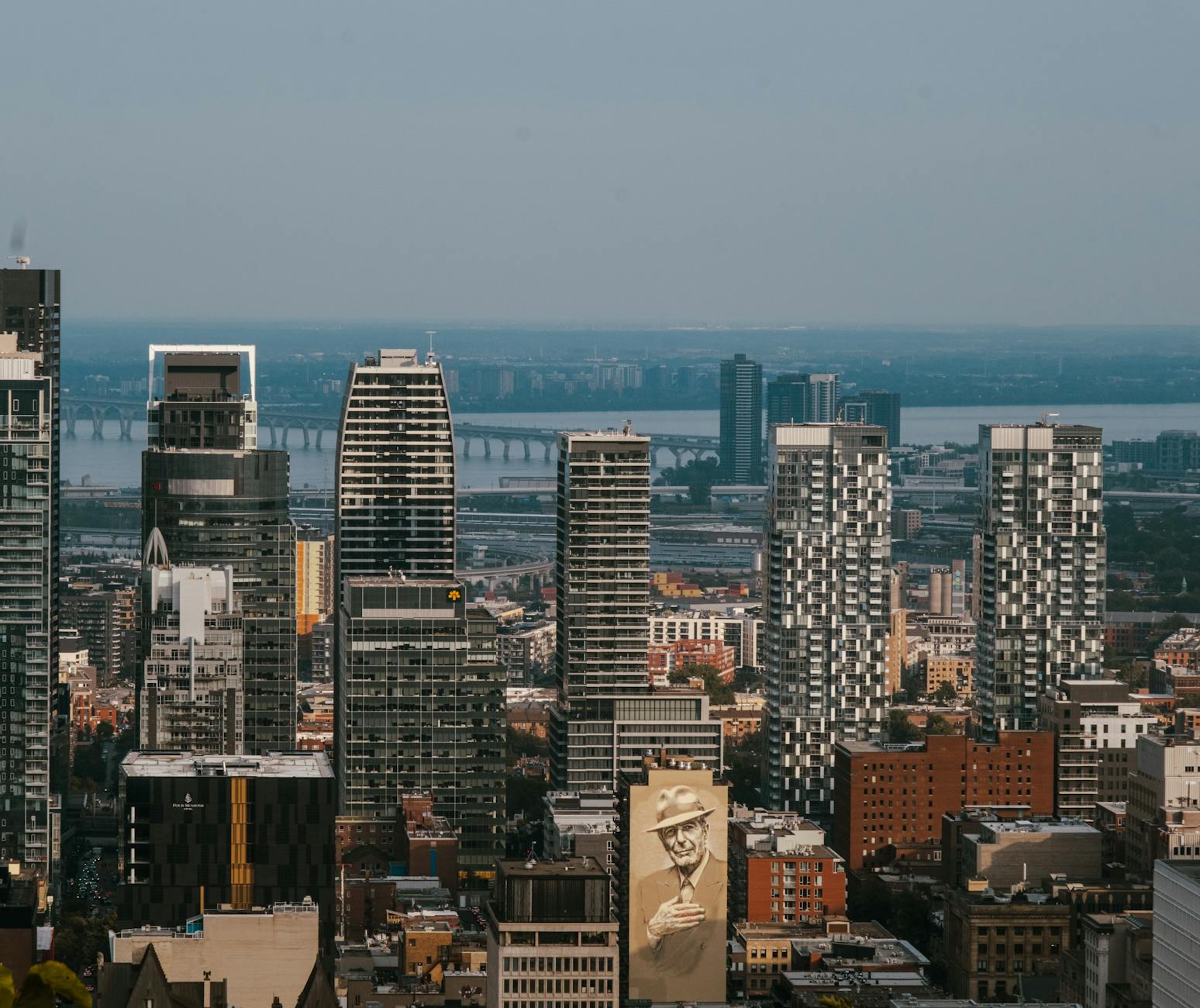
The St. Lawrence corridor is where Canada feels most argument-driven and most alive. Quebec City gives you walls, church spires, and a street plan older than the country; montreal answers with bagels, late dinners, and a bilingual edge that turns ordinary errands into small acts of translation.
The Atlantic provinces run on weather, harbors, and distance from the rest of the country. Halifax is the practical anchor, but St. John's carries the sharper personality: bright row houses, hard wind, and the sense that Europe is still just over the water, even when the map says otherwise.
The Prairies are not empty; they are spacious, agricultural, and often underestimated by people who only count mountains. Winnipeg sits at the meeting point of rail lines, rivers, and Indigenous histories, and it makes more sense the longer you stay, especially once you understand how much of Canada was organized through this inland corridor.
Western Alberta changes fast: glass towers in Calgary, then foothills, then a wall of rock as you drive toward Banff. This region is built around altitude, weather windows, and the blunt fact that famous scenery still behaves like wilderness, no matter how many souvenir shops sit near the trailhead.
The Pacific side is milder, wetter, and more ocean-shaped than the rest of the country. Vancouver folds glass towers into mountains and port traffic; Victoria slows the tempo, with ferries, gardens, and a harbor that feels deliberately staged until the wind comes up and reminds you it is still the Pacific.
A Japanese garden at UBC stands on a site shaped by wartime vandalism and repair; today, maple shade, moss, and water slow Vancouver to a whisper for an hour.
One woman rode a barrel over a 167-foot drop here in 1901.
A country assembled by diplomacy, conquest, migration, and unfinished arguments
Haudenosaunee tradition places the Peacemaker and Hiawatha in an era before European arrival, binding nations into a confederacy whose political sophistication still surprises readers raised on imperial timelines. The emphasis was on debate, condolence, and balance, not on a crown.
On the northern tip of Newfoundland, Norse visitors built turf-walled houses and worked iron, leaving the earliest confirmed European site in North America. They came, traded, fought, and vanished within a short span.
Cartier entered the Gulf of St. Lawrence and began the French imperial story in what would become Canada. The gesture looked ceremonial in Europe; on the ground, it opened centuries of bargaining, violence, and alliance.
Scurvy ravaged Cartier's wintering party until local knowledge, likely a cedar infusion called annedda, restored them. European survival in Canada often depended on knowledge Europeans later pretended was their own.
Samuel de Champlain established a permanent French foothold at Quebec, controlling a strategic narrowing of the river. From this precarious post grew the political and cultural core of New France.
The Ursulines reached Quebec to found a convent and school, bringing disciplined learning into a rough colonial settlement. Marie de l'Incarnation's letters would become one of the great written records of early Canada.
At 14, Madeleine helped hold Fort Vercheres during an Iroquois attack by rallying defenders and projecting strength beyond her years. New France loved heroines who could handle a musket and a legend.
British forces scaled the heights outside Quebec City and defeated the French in a battle astonishingly short and historically enormous. Montcalm and Wolfe both died, and the fate of New France turned with them.
France ceded most of its North American possessions, and Canada entered a British imperial framework. The handover changed sovereignty, not the presence of French-speaking communities or Indigenous nations.
Britain, wary of unrest, recognized Catholic worship and French civil law in Quebec. It was a pragmatic decision with lasting consequences, one reason French Canada remained distinct after conquest.
Reformers challenged colonial power in both Canadas, demanding more accountable government. The uprisings failed militarily but exposed how unstable the old order had become.
Ontario, Quebec, Nova Scotia, and New Brunswick formed a new federation under the British North America Act. It was a constitutional birth, though the country itself still had to be negotiated across vast distances.
Riel and the Metis provisional government forced Ottawa to bargain, leading to Manitoba's creation. Confederation expanded westward, but not without revealing whose voices the new dominion preferred to hear.
The Canadian Pacific Railway tied the country together in steel, while Louis Riel's execution in the same year tore at its political conscience. Nation-building and national trauma arrived almost hand in hand.
Canadian divisions fought together at Vimy Ridge in the First World War, a victory later treated as a coming-of-age moment for the nation. The mythology is real, but so were the mud, terror, and loss.
For six weeks, labor unrest transformed Winnipeg into the center of a national struggle over wages, rights, and fear of radicalism. Canada discovered that order could not be taken for granted in peacetime either.
Desmond's arrest in a New Glasgow theater exposed racial discrimination that many Canadians preferred to imagine belonged elsewhere. A one-cent tax charge tried, unsuccessfully, to disguise the truth.
Canada replaced older imperial symbols with the red-and-white flag now treated as timeless. In reality, the choice was bitterly contested, which is often how national icons are born.
Starting in St. John's, Terry Fox set out to run across Canada on a prosthetic leg to raise money for cancer research. He stopped before reaching the Pacific, but the country did not stop running with him.
Canada brought its Constitution home from Westminster and entrenched the Charter of Rights and Freedoms. The legal language of the country changed, and with it the way Canadians argued about liberty, equality, and the state.
The sovereignty referendum was defeated by the slimmest of margins, revealing how fragile the federation could feel from one counting table to the next. The result settled nothing permanently, but it changed the temperature of Canadian politics.
After hearing testimony from survivors of residential schools, the commission laid out a moral and political challenge the country could no longer plausibly sidestep. Modern Canada was asked to examine the violence buried beneath its civics lessons.
First Peoples and First Contacts
Shanawdithit, the last known Beothuk, spent her final years in St. John's drawing from memory so that a vanished people would leave at least one witness behind.
A canoe of white stone glides over Lake Ontario. That is how Haudenosaunee tradition remembers the Peacemaker, the visionary who ended cycles of revenge and bound nations together under the Great Law of Peace, with Hiawatha beside him, a man broken by grief and remade by diplomacy.
Ce que l'on ignore souvent, c'est that this political order gave clan mothers the power to remove chiefs and demanded long debate before war. Long before Ottawa had a parliament, the woodlands between today's Montreal and Niagara Falls held a federation built on persuasion, ceremony, and memory.
Then another apparition arrived. Around the year 1000, Norse sailors put up turf-walled houses at L'Anse aux Meadows, near today's St. John's, and for a brief moment Europe touched North America without conquest, without maps that lasted, almost without witnesses.
The human detail is brutal. Freydis Eiriksdottir, if the sagas are to be believed, came west not as a decorative heroine but as a woman capable of business, fury, and murder with an axe when her companions hesitated; one already sees, at the very edge of the continent, that Canada will never be a story of mild manners alone.
The Norse left. Indigenous nations did not. That matters, because every later empire would behave as if history began with its own flag, while the real beginning lay in older laws, older trade routes, and older names carried by river and drum into the age of New France.
At L'Anse aux Meadows, a spindle whorl and evidence of ironworking suggest women were present in the Norse camp; this was not just a raid, but a fragile attempt at settlement.
New France
Samuel de Champlain is often shown as an impassive founder, but the man himself spent years improvising alliances and watching carefully, because certainty was a luxury the St. Lawrence never granted.
Winter bites first. In 1535, Jacques Cartier's men on the St. Lawrence were too weak from scurvy to bury their dead until an Indigenous remedy, annedda, a cedar infusion, brought them back from the edge; Cartier wrote down the cure, but not with the generosity one might hope for.
He had another obsession. Gold. Donnacona, the Stadaconan leader whose sons Cartier had already carried off to France, told him of the Kingdom of Saguenay, glittering somewhere inland; perhaps it was diplomacy, perhaps mockery, perhaps a desperate attempt to direct the French elsewhere, but King Francois I paid attention.
Quebec begins in a more sober register. In 1608 Samuel de Champlain founded his settlement below Cap Diamant, on a narrowing of the river perfect for control and vulnerable to everything else: hunger, cold, loneliness, and the need for alliances with nations who understood the country far better than he did.
Ce que l'on ignore souvent, c'est that New France was shaped as much by women with ledgers and letters as by men with arquebuses. Marie de l'Incarnation reached Quebec in 1639, left an eleven-year-old son in Tours, and then wrote some of the most extraordinary pages in North American history while building a convent, a school, and a moral order in a place that still smelled of timber, mud, and fear.
By the time British forces closed in during the Seven Years' War, the colony had created seigneuries, missions, trading networks, and a French-speaking world that conquest would not erase. The flag would change in 1763. The language would stay.
Champlain died in Quebec on Christmas Day 1635, and his grave has never been identified with complete certainty.
Conquest, Rebellion, Confederation
Louis Riel was not a footnote to Confederation but its inconvenient conscience, a man who understood before most that maps drawn in Ottawa could ruin lives far to the west.
One September morning in 1759, the cliffs above Quebec City filled with soldiers who should not have been there. The Battle of the Plains of Abraham lasted less than an hour, and both commanding generals, Montcalm and Wolfe, would be dead within days; empires changed hands with astonishing speed, while the civilians below kept baking bread, praying, trading, and burying sons.
British rule did not flatten the French fact of the country. The Quebec Act of 1774 preserved French civil law and Catholic practice, not out of romance but calculation; London had learned that governing Canada meant bargaining with what already existed.
Then came the century of unfinished arguments. Loyalists arrived after the American Revolution, canals and timber fortunes altered the economy, and the rebellions of 1837-38 showed that colonial deference had limits; Louis-Joseph Papineau in Lower Canada and William Lyon Mackenzie in Upper Canada gave the empire a headache it could not dismiss as local noise.
Confederation in 1867 was presented as tidy constitutional architecture. It was anything but. A vast country had to be imagined into existence with railways, treaties, land surveys, and a language of compromise, while the people who already lived across the prairies and woodlands were being pushed, promised to, and ignored in unequal measure.
No figure exposes the cost more clearly than Louis Riel. In Red River and later Saskatchewan, he insisted that the new dominion could not be built as if the Metis were a clerical inconvenience; his execution in 1885 helped make modern Canada and nearly broke it at the same time, because Quebec and English Canada read the scaffold in entirely different ways.
When the Fathers of Confederation met in Charlottetown in 1864, one practical reason they attracted attention was that their champagne supply outshone the original conference agenda.
War, Welfare, and Restless Identity
Viola Desmond entered Canadian history because she refused to move seats, turning one evening in a Nova Scotia movie house into a national lesson in quiet courage.
The First World War dragged Canada onto a larger stage by way of mud. At Vimy Ridge in April 1917, troops from all four divisions fought together and took the position at terrible cost; legend later wrapped the battle in national grandeur, but the letters home speak just as clearly of exhaustion, shellfire, and boys aging in a week.
Peace did not make the country calm. Women pressed for full political rights, workers filled Winnipeg in 1919 during a general strike that frightened elites, and the Depression revealed how thin the safety net really was when prairie dust, unemployment, and hunger entered ordinary kitchens.
The middle decades produced one of Canada's defining contradictions. The state grew more protective through pensions, unemployment insurance, and then medicare, yet public life still carried exclusions that were intimate and humiliating, like the night in 1946 when Viola Desmond sat on the main floor of a New Glasgow cinema in Nova Scotia and was arrested over a one-cent tax difference that disguised a color line.
Ce que l'on ignore souvent, c'est how long Canada hesitated to look like itself. The Maple Leaf flag arrived only in 1965, after bitter debate, and the patriation of the Constitution in 1982, with its Charter of Rights and Freedoms, gave the country a new legal language for the self it had been circling for decades.
Between those dates lay Expo 67 in Montreal, Quiet Revolution, bilingualism, Pierre Trudeau's theatrical federalism, and the long argument over Quebec's place in the federation. Canada had money, highways, universities, and television by then. It still had not settled the question of what kind of country it wished to be.
When the new Canadian flag was inaugurated in 1965, some veterans and traditionalists mourned the loss of the Red Ensign as if a family portrait had been taken off the wall.
Charter Canada
Terry Fox became a secular saint of the country not because he won, but because he made endurance look like a public duty anyone might share.
A runner on an artificial leg moves along the roadside, lean, determined, almost unbearably young. In 1980 Terry Fox began his Marathon of Hope in St. John's by dipping his prosthetic leg into the Atlantic, and though cancer stopped him near Thunder Bay, the image remains one of modern Canada at its best: stoic, public-minded, and unwilling to confuse sentiment with surrender.
Yet this later Canada is not a tale of uncomplicated virtue. Constitutional battles, the failed Meech Lake and Charlottetown accords, and the 1995 Quebec referendum showed how narrow the seams of the federation could become; one point here, one concession there, and the whole garment seemed ready to split.
At the same time, cities changed their face. Toronto became one of the world's great immigrant metropolises, Vancouver turned toward the Pacific with fresh intensity, Calgary sold energy and ambition, and Montreal kept staging its old argument between memory and reinvention with unmatched style.
The deepest shift came from truths that had long been pushed into drawers. The Truth and Reconciliation Commission, the confirmation of unmarked graves at former residential school sites, and renewed Indigenous legal and political activism forced the country to look again at the price of its own building.
So Canada now lives in a double inheritance: pride in a rights-based, plural society, and the knowledge that many of its foundations were laid through dispossession. The story is not finished. One suspects it never will be, and perhaps that is the most Canadian thing of all.
The 1995 Quebec referendum was decided by less than 55,000 votes, a margin so thin that families, neighborhoods, and dinner tables carried the tension for years.
Canada reveals itself first by the mouth. In Toronto, the streetcar doors sigh open, someone says "sorry" because your sleeve brushed theirs, and the word means five things at once: apology, warning, courtesy, retreat, small social incense. Then you arrive in Montreal, where French and English circle each other like two cats that have agreed, for tonight, not to fight.
This is not bilingualism as a schoolbook virtue. It is daily theater. A cashier begins with "bonjour-hi," not from indecision but from exquisite tactical intelligence, and that little hyphen contains a federation, two empires, several grudges, and the desire to sell you a sandwich without incident.
Certain nouns are tiny national museums. A washroom is not a restroom. A toque is not a beanie. A depanneur in Montreal is not merely a convenience store; it is the corner oracle for beer, aspirin, lottery tickets, and late remorse. Language here does not decorate reality. It sorts the cold from the survivable.
Canadian cuisine begins where climate stops being picturesque. In Quebec City, a spoon sinks into split pea soup thick with ham, and one understands that thrift can become tenderness if repeated for two centuries. In Halifax, a donair arrives wrapped in foil like a dangerous secret, sweet sauce running down the wrist before dignity can intervene.
The national table is a parliament of migrations. Montreal gives you smoked meat on rye, the knife-work of Jewish delis meeting North American appetite. Toronto answers with Tamil curries in Scarborough, Jamaican patties under glass, Cantonese seafood tanks, and peameal bacon at St. Lawrence Market as if Ontario had decided breakfast should taste of salt, cornmeal, and commerce.
Then comes poutine, which foreigners often treat as a stunt. They are wrong. Good poutine is an argument about temperature and timing: fries still resisting, gravy hot enough to soften but not drown, curds squeaking against the teeth like fresh snow under boots. A country is a table set against the weather.
Canadian politeness has been slandered by postcards. People imagine warmth. What they encounter is form: doors held, voices lowered, queues obeyed with the gravity of liturgy. In Ottawa, the bus stop can feel like a small constitutional monarchy in which everyone has accepted invisible rules and no one wishes to draft amendments before coffee.
This restraint has elegance. It also has teeth. A Canadian can refuse you with such grace that you may thank them for the refusal, and only later, in your hotel room, understand that the conversation ended three minutes earlier. The country dislikes spectacle. Even anger is expected to arrive properly dressed.
Do not mistake this for emptiness. It is a technique of coexistence in a place where winter is long, apartments are shared by overheated radiators, and the social fabric would fray quickly if every annoyance became theater. The code is simple: make room, do not corner, keep the peace unless the matter deserves war.
Canadian architecture is what happens when empire, money, and weather are forced to share a coat. Quebec City keeps its stone walls and steep roofs because snow is not a metaphor there. Montreal layers convent masonry, triplex staircases, and bank buildings with the grave self-belief of the nineteenth century. Then Toronto rises in glass, steel, and condominium multiplication, as if modernity were a crop with quarterly targets.
Yet the most Canadian detail may be underground. In Montreal, the RESO tunnels let the city continue beneath the city, a second circulatory system built for January. In Toronto, the PATH performs a related miracle with less romance and more fluorescent lighting. Civilization, in this country, often means staying indoors without admitting defeat.
Even the grand gestures carry climate in their bones. Parliament Hill in Ottawa borrows Gothic language from Europe, but the drama lands differently under a white sky and a wind that cuts across the Ottawa River as if sharpening itself. Buildings here do not simply aspire upward. They brace.
Canadian literature distrusts grand declarations. It prefers the side door, the withheld confession, the domestic object left on a table after the argument. Alice Munro could turn a kitchen into a moral abyss. Margaret Atwood understands that power rarely enters wearing a crown; it arrives as policy, household habit, one more instruction spoken calmly.
In Quebec, the sentence does something else. It bites its lip, then laughs. Michel Tremblay gave Montreal's spoken French the dignity of print and, with that single act, made literature answer to the street. Anne Hebert wrote with the chill exactitude of a blade laid on linen. One feels, reading her, that innocence is a costume rented by the hour.
This is a country that writes from edges: prairie towns, northern distances, immigrant apartments, Atlantic harbors, reservations, suburban kitchens, motel rooms near highways that seem to cross half the planet. Perhaps that is why the prose often feels intimate even when the land is monstrous. Faced with so much space, the sentence learns precision or dies.
Canadian design seldom begs for admiration. It prefers to work first. A Hudson's Bay point blanket, striped and heavy, looks almost absurdly simple until you remember it once functioned as warmth, trade good, status object, and historical evidence all at once. The classic canoe does the same trick: beauty arriving disguised as necessity.
The country likes clean lines, but not for ideological reasons. Snow teaches editing. So does low winter light, which is merciless to clutter. In Vancouver and Victoria, wood, glass, and water enter into civil conversation; the Pacific edge asks for houses that notice rain. In the Prairies, grain elevators and train stations once provided a harsher school: shape follows weather, distance, storage, departure.
Even the graphic symbols are disciplined. The maple leaf on the flag is not lyrical. It is surgical. Red, white, eleven points, no embroidery. Canada understands that an object can become beloved precisely because it declines to chatter.
She was the last known Beothuk, and that bare sentence does not begin to cover the tragedy. Before dying of tuberculosis, she drew maps, tools, and ceremonies from memory, leaving Canada one of its most haunting archives: a people's afterimage in the hand of a young woman who knew nobody was coming to save the language.
Champlain did not simply plant a flag and stroll away. He spent years negotiating with Indigenous allies, enduring shortages, sketching coasts and rivers, and trying to make a settlement hold in a climate that punished vanity very quickly.
She crossed the Atlantic in 1639 and helped shape the intellectual and spiritual life of New France. The sharper detail is personal: she left her son behind in Tours, then wrote with such force and clarity that her letters remain among the finest windows into the fears, labors, and convictions of early Canada.
At 14, during an Iroquois attack in 1692, she helped hold Fort Vercheres by bluffing strength where little existed. Canada remembers the heroine with a musket; the more interesting truth is that she survived by nerve, theater, and a perfect understanding that fear can sometimes be managed if one looks busy enough.
Riel stood at the point where Canada expanded and where that expansion became morally dangerous. He defended Metis political rights, forced Ottawa to take Red River seriously, and then died on the gallows in Regina, leaving behind a country that could not decide whether it had executed a traitor or one of its founders.
In 1921 she became the first woman elected to the House of Commons, and she did not arrive to decorate the chamber. She pressed prison reform, labor rights, and social policy with a farmer's bluntness that made many male colleagues look ornamental by comparison.
She entered a segregated movie theater in New Glasgow in 1946 and refused to accept the humiliation assigned to Black patrons. Officials tried to reduce the whole matter to a one-cent tax offense, which tells you almost everything about how polite injustice likes to dress itself.
A Baptist preacher with a gift for argument, he helped make public health care a defining Canadian commitment. What matters is not the slogan but the setting: prairie politics, cooperative habits, and the conviction that illness should not become a family's financial ruin.
He set out from St. John's in 1980 with one artificial leg and a plan so audacious that it still disarms cynicism. Fox did not finish the run, but he changed the moral weather of the country; millions saw, in real time, what resolve looks like when stripped of spectacle.
This is the cleanest first taste of southern Ontario: big-city museums, neighborhoods, and lakefront time in Toronto, then the short push to Niagara Falls for the mist, the noise, and the full absurd scale of the water. It works well by train and day tour, and it suits travelers who want maximum payoff without changing hotels every night.
This route follows the St. Lawrence and the political fault lines that made modern Canada. Start in Quebec City for stone walls and old streets, move on to montreal for the country's sharpest food and language mix, then finish in Ottawa with museums and federal architecture that explain the nation in concrete terms.
Begin on the Pacific in Vancouver, cross to Victoria for harbor views and island pace, then fly north to Whitehorse where the landscape stops behaving like scenery and starts feeling geological. The route makes sense for travelers who want coast, ferry, and northern light without trying to cover the whole west in one go.
This trip starts with the prairie skyline of Calgary, climbs fast into Banff for alpine roads and glacier-fed lakes, then swings east to Winnipeg for a very different Canada: grain routes, Indigenous history, and a city that rewards people who stay longer than one night. It is a good choice if you want mountains and plains in the same trip without defaulting to the busiest east-coast corridor.
Late evening, plastic fork, shared table, steam on the glasses. Fries, curds, gravy, vinegar. Eat fast before the truce collapses.
Early morning in Montreal, still warm from the wood oven, torn by hand on the sidewalk. Sesame on the coat, honey in the crust, no ceremony required.
Lunch with mustard, rye, pickle, and a paper napkin already defeated. Friends talk less once the brisket arrives.
Breakfast at St. Lawrence Market in Toronto, standing if necessary. Hot bun, mustard, pork, grease, commerce.
After midnight, with one loyal companion and no vanity. Sweet garlic sauce on the fingers is part of the contract.
Late winter in Quebec, outdoors, coat open despite the cold because sugar insists on optimism. Children and adults behave with the same lack of restraint.
Christmas table, family noise, pickles within reach. Cut in thick wedges and eat slowly; the pepper and meat do the talking.


Canada is visa-exempt for many travelers, but the rule that matters is how you arrive. EU, UK, and Australian passport holders usually need an eTA for flights; the official fee is C$7, it is linked to your passport, and it is often approved within minutes. US citizens usually enter with a valid US passport and do not need an eTA.
Canada uses the Canadian dollar (CAD). Count on C$90-150 a day for a budget trip, C$220-350 for a comfortable mid-range trip, and much more in Banff, Vancouver, and downtown Toronto in summer. Restaurant tips start at 15%, and posted prices often exclude sales tax, which runs from 5% in Alberta to 14.975% in Quebec.
Most international arrivals come through Toronto Pearson, Vancouver, Montréal-Trudeau, Calgary, or Halifax. Pearson reaches downtown Toronto on the UP Express in about 25 minutes, while Vancouver airport reaches downtown Vancouver on the Canada Line in under 30. If you are combining Canada with the US, the New York to Toronto, New York to montreal, and Seattle to Vancouver train routes are practical border crossings.
Canada looks manageable on a map until you notice the scale: Toronto to Vancouver is more than 4,300 km by rail. Use trains for the Windsor-Quebec corridor, ferries for Victoria and Atlantic islands, and domestic flights when you jump between regions like Quebec City, Calgary, and St. John's. For the Rockies, a car gives you the most freedom once you leave Calgary for Banff.
This is a country of hard contrasts, not one tidy forecast. Vancouver can sit in rain at 8C while Winnipeg drops below -20C and Toronto sweats through 30C humidity in July. September and early October are often the sweet spot for Quebec City, Ottawa, Toronto, and Halifax; July and August bring the best hiking weather in Banff and the highest hotel prices.
Mobile coverage is strong in cities and along major highways, but it thins fast in northern routes, mountain parks, and parts of Newfoundland and Labrador. Free Wi-Fi is standard in most hotels, cafes, airports, and libraries, though airport and train Wi-Fi can be patchy. If you are crossing from the US, check roaming before you land because Canadian mobile rates are rarely cheap.
Canada is broadly safe for travelers, with the usual big-city precautions around nightlife districts, transit hubs, and unattended bags. Weather is the real risk: winter ice, summer wildfire smoke in the west, and long driving distances that turn a small planning mistake into a serious delay. In parks around Banff and western Canada, respect wildlife rules, carry water, and never treat a bear warning like local color.
The menu price is often not the final price. Add sales tax and a 15% restaurant tip before you decide whether that C$24 brunch in Toronto or montreal is actually a cheap meal.
Reserve Banff, Vancouver, Niagara Falls, and Quebec City as early as you can for July through September. Rooms that look overpriced in January can look like a bargain by June.
Train travel works best between Toronto, Ottawa, montreal, and Quebec City. Outside that corridor, flights usually save a full day, and in western parks a rental car is often the difference between seeing the place and seeing the parking lot.
September often buys you the best trade: warm enough for city walking, lower hotel pressure, and early fall color in Ontario and Quebec. By mid-October, Banff can see snow and shorter trail access.
Order the dish that belongs to the place instead of the generic safe option. That means poutine in Quebec, smoked meat in montreal, peameal bacon in Toronto, donair in Halifax, and toutons in St. John's.
Offline maps and boarding passes matter more here than in compact countries. Coverage drops quickly outside cities, and a long drive from Calgary to Banff or a ferry day to Victoria is not where you want to discover a dead signal.
Canadians plan around weather because they have learned to. If locals mention wildfire smoke, freezing rain, or a highway closure, change your schedule instead of trying to power through it.
Explore Canada with a personal guide in your pocket
Listen to sourced travel stories with local history and practical context — ready offline.

If you are visa-exempt and flying in, probably yes. EU, UK, and Australian passport holders usually need an eTA for air travel, while US citizens generally do not; the official fee is C$7 and the authorization is tied to your passport.
Yes, especially once you add hotel costs, tax, and tips. A realistic budget starts around C$90-150 a day for hostel-and-transit travel, while a comfortable private-room trip usually lands closer to C$220-350 a day.
Use trains in the Toronto-montreal-Ottawa-Quebec City corridor, then switch to flights or a car for bigger jumps. Canada is too large for one mode to do everything well, and western trips around Calgary, Banff, Vancouver, or Whitehorse often work best with a mix of air and road.
September is the safest all-round answer for most travelers. You get lower pressure on hotels than in mid-summer, good city weather in Toronto, Ottawa, montreal, and Quebec City, and decent access to the Rockies before winter starts closing things down.
Yes, but your trip will be narrower. Buses and shuttles can get you from Calgary to Banff and cover some headline sights, but a car makes it far easier to reach trailheads, lakes, and sunrise spots on your own schedule.
Three to four days is enough for a strong first trip. Give Toronto two full days for neighborhoods and museums, then one day for Niagara Falls, or stay overnight there if you want the quieter early morning and evening hours.
montreal is better for food, nightlife, and range; Quebec City is better for compact beauty and older architecture. If you have a week, do both by train and let the contrast explain French Canada better than any museum label could.
Usually no. In many provinces the posted price is pre-tax, so a bill in Vancouver, Toronto, Halifax, or Quebec City will come in higher than the number you first saw on the shelf or menu.
Yes, in general, and especially in the major tourist cities. The bigger problems are practical rather than criminal: winter weather, long distances, fatigue on rural drives, and underestimating how quickly conditions change in places like Banff or northern routes.
Last reviewed