forest
Rainforest and rare wildlife
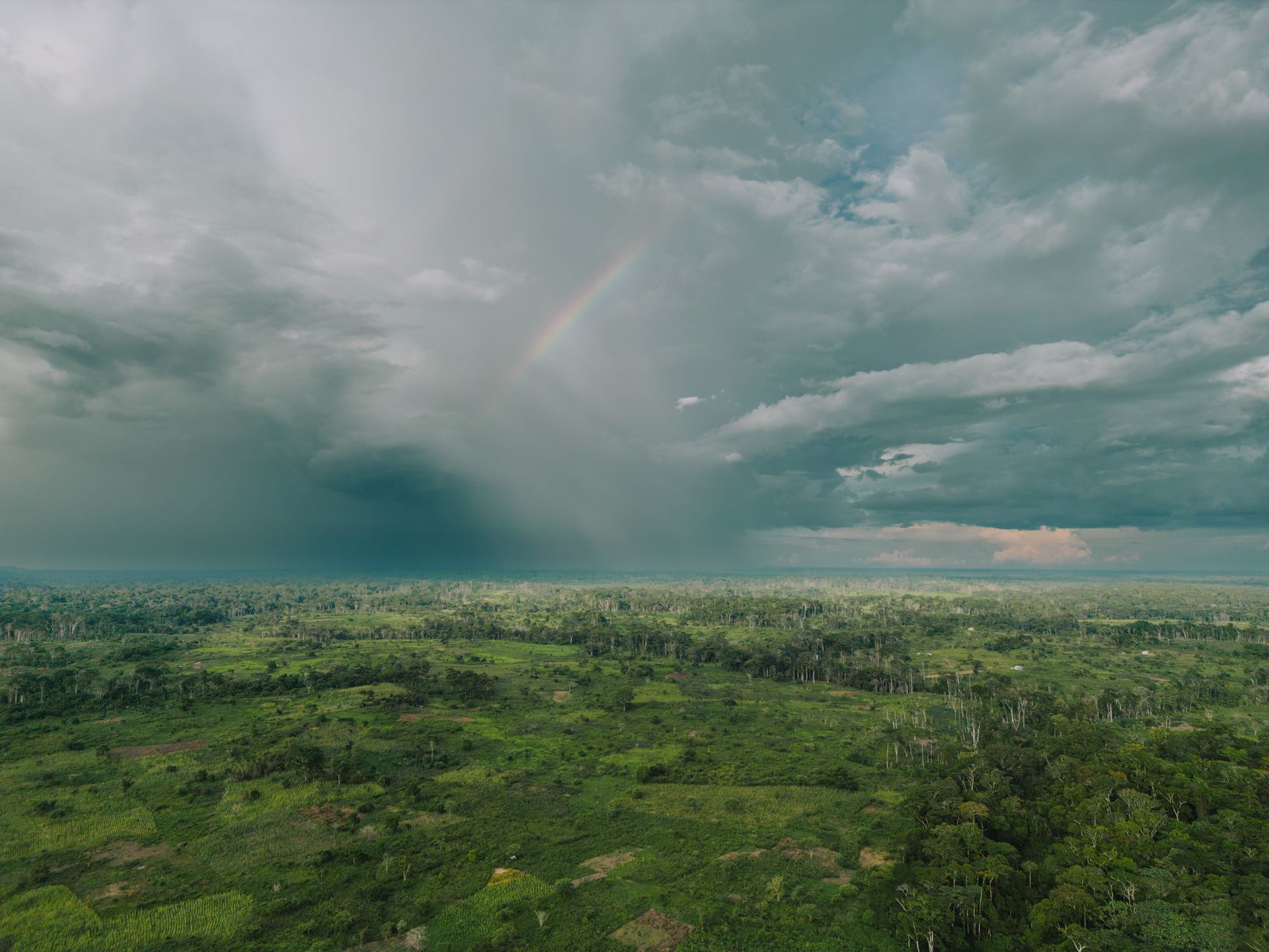
Dja Faunal Reserve and Lobéké protect vast tracts of Congo Basin forest where western lowland gorillas, forest elephants, and chimpanzees still move through intact habitat.
Cameroon makes sense once you stop treating it as one destination and start reading it as five climates, hundreds of languages, and a chain of cities that each tell a different story.
 Cameroon
EntryVisa required; e-visa via evisacam.cm
CA Cameroon travel guide starts with a fact most countries can't match: rainforest, volcano, palace courtyards, and Sahel all fit inside one border.
Cameroon gets called "Africa in miniature," but the phrase only makes sense once you move through it. In Douala, the air smells of diesel, brine, and grilled fish at the Wouri estuary. Three hours inland, Yaoundé climbs over seven hills and runs on ministries, traffic, and long market afternoons. Head west to Bafoussam, Bamenda, Bafut, and Foumban and the country shifts again: cooler air, volcanic soil, royal compounds, carved masks, and court histories that never quite became museum pieces. These are not small variations. They feel like separate countries pressed together.
The southern forests hold some of Central Africa's richest wildlife country, including Dja Faunal Reserve and the Sangha-linked forests around Lobéké. The coast gives you Kribi, where the Lobé Falls drop straight into the Atlantic, a geographical trick rare enough to sound invented. Around Limbe and Buea, Mount Cameroon rises to 4,095 meters, still active, still shaping the weather, still forcing clouds to empty themselves on one of the wettest corners of earth. Then the road turns north through Ngaoundéré toward Maroua, where grassland gives way to dry plains, Fulani lamidos, rock outcrops, and a harder light.
Before Kingdoms, pre-1500
At the Wouri estuary, where the water turns brown with tide and mangrove silt, Portuguese sailors dropped anchor in 1472 and hauled up baskets writhing with prawns. They called it Rio dos Camarões, the River of Shrimps, and a future country kept the joke. A nation named by men thinking about supper: history can be grand, but it also has a sense of humor.
Long before Douala carried that name, the far north around Lake Chad belonged to the Sao world, half archaeology and half whispered memory. Their terracotta heads, with scarified cheeks and watchful eyes, still look less like relics than portraits interrupted. Arab chroniclers and later local traditions described the Sao as giants. That tells you less about their height than about the shock they left behind.
In the Mandara Mountains, people built because the plains had become dangerous. Dry-stone terraces climbed volcanic slopes; storage towers and ritual enclosures turned fear into architecture. Ce que l'on ignore souvent, c'est que these hill settlements were not picturesque retreats. They were defenses, pressed into shape by raids, slave-taking, and the hard arithmetic of survival.
So the first chapter of Cameroon is not a blank prelude before Europeans arrive. It is already crowded with engineers, potters, farmers, and fugitives. And when later kingdoms rise in the Grassfields and the north, they inherit not emptiness but old ground, old routes, and older anxieties.
The emblematic figures of this era have no surviving names, only terracotta faces whose expression still resists explanation.
Cameroon's modern name comes from Portuguese sailors astonished by the sheer abundance of prawns in the Wouri estuary.
Grassfields and Emirates, 1500-1884
In the western highlands, a palace was never just a residence. At Bafut, near present-day Bamenda, the fon's compound gathered courtyards, carved posts, ancestral shrines, and the slow ceremonial choreography of power. Skulls displayed in audience spaces were not decoration in the European sense. They were lineage made visible, a reminder that the dead still attended politics.
Further west and south, kingdoms and chiefdoms multiplied across the Grassfields with astonishing density. Foumban emerged as the seat of the Bamum dynasty, founded by Nchare Yen after conquest, negotiation, and dynastic marriage in the 17th century. That is how states often begin: not with a flag, but with a spear, a bride, and a genealogy polished afterward.
Then came the Fulani advance from the north, strengthened by the wider Islamic reform movements that shook the region in the early 19th century. Cavalry changed the map. Courts adapted, fled, converted, fortified, or paid tribute. Whole communities carried the memory of displacement into new settlements, new titles, new ritual obligations.
What survives from this period is not one Cameroon, because no such political unit existed yet, but a dense mosaic of authority. Royal compounds in Bafut and Foumban, Muslim lamidats in the north around Ngaoundéré and Maroua, market routes crossing language frontiers, and prestige measured as much in wives, retainers, and sacred objects as in land. That plural inheritance would later make colonial borders look neat on paper and false on the ground.
Nchare Yen, founder of the Bamum kingdom, lives in court memory less as a marble hero than as a conqueror who welded clans together through war and marriage.
In Bafut, ancestral skulls traditionally watched over political discussions, because legitimacy was supposed to answer to the dead as well as the living.
Sultans and Empires, 1884-1916
Picture a young ruler in Foumban at the end of the 19th century, inheriting a throne shaken by war and humiliation. Sultan Ibrahim Njoya had watched his father's death cast a shadow over the Bamum court, and he answered it not only with military recovery but with something far stranger. He decided that memory should no longer depend on what a courtier could recite.
Around 1896, Njoya began creating a script for the Bamum language. Not borrowing one. Creating one. The system changed over several revisions, moving from hundreds of signs toward a leaner syllabary now known as Shümom. He founded schools, ordered records kept, wrote history, legal texts, and medicinal knowledge, and made literacy a royal project. Very few sovereigns anywhere can claim to have invented an alphabetic future for their court.
German rule, declared over Kamerun in 1884, arrived with treaties, coercion, plantations, military expeditions, and a taste for order that often concealed brutality. Douala became a colonial port. Railways and roads followed the logic of extraction. Chiefs were used, punished, decorated, displaced. Rudolf Duala Manga Bell, prince of the Bell lineage in Douala, first tried legal argument. When the Germans planned to seize and segregate Douala land, he appealed all the way to Berlin. It did not save him.
In 1914, the Germans hanged Manga Bell for high treason. His crime, in plain language, was insisting that a treaty should bind both sides. Ce que l'on ignore souvent, c'est that this moment contains the whole colonial drama in miniature: African rulers were expected to understand European law when it served empire and forget it when it did not. Two years later, during the First World War, German Kamerun collapsed under Allied attack, and the country entered a new partition with old wounds intact.
Ibrahim Njoya was not simply a king with literary tastes; he was a reformer who treated writing as an instrument of sovereignty.
Njoya is one of the rare rulers in recorded history to personally oversee the evolution of a script from pictograms toward an efficient syllabary within his own lifetime.
Mandates, Reunification, and the Long Republic, 1916-present
After Germany's defeat, Cameroon was divided between French and British administration, a diplomatic solution that planted a domestic problem. French Cameroun took the larger share, administered from Yaoundé; British Cameroons were attached in practice to Nigeria. The line looked tidy on maps. Lives along it did not. Schools, courts, language, and political habits began to diverge.
Independence came first to French Cameroun in 1960 under Ahmadou Ahidjo. The next year, after a United Nations plebiscite, Southern Cameroons chose to join the new republic while Northern Cameroons joined Nigeria. The resulting federation promised balance between two colonial legacies, French and British, central and regional, legal code and common law. But federations, like marriages, reveal their weaknesses in daily life, not on the wedding day.
Ahidjo built a disciplined one-party state, then in 1982 handed power to Paul Biya, who still dominates Cameroonian politics decades later. The country has known oil booms, austerity, football ecstasies, urban growth in Douala and Yaoundé, and the stubborn endurance of royal courts in places such as Foumban and Bafut. Cameroon often looks immovable from afar. Up close, it is full of negotiation.
The deepest fault line of the present lies in the Anglophone regions, where grievances over language, law, representation, and state violence hardened into open conflict from 2016 onward. That crisis cannot be treated as a footnote. It is the afterlife of partition, still writing itself into classrooms, courtrooms, roadblocks, and exile. And so the modern history of Cameroon ends where earlier chapters began: with the tension between imposed borders and local loyalties, between what the state declares and what people will actually accept.
Ahmadou Ahidjo shaped the first republic with austere authority, while Paul Biya turned longevity itself into a political style.
The 1961 reunification joined territories that had spent decades learning different administrative habits, school systems, and legal cultures under separate colonial rulers.
Cameroon speaks the way a market changes smell when you cross one aisle. French at the ministry desk in Yaoundé. English in a schoolyard in Buea. Pidgin in the taxi when the driver decides efficiency matters more than grammar, which is often. Then Camfranglais arrives, that urban acrobat, and the sentence begins in one language, swerves for mischief, and lands somewhere only insiders fully own.
This is not confusion. It is precision of another order. A person chooses code the way a chef chooses heat: French for administration, Pidgin for quick trust, a mother tongue for tenderness or warning, and sometimes all three before the plantains reach the table.
Listen in Douala and you hear commerce make its own music. Listen in Bamenda and the tempo shifts; English stands straighter, Pidgin grins wider. A country with more than 250 languages cannot pretend the world fits inside one mouth. It refuses politely.
Language here is never only language. It is rank, flirtation, camouflage, family, and theatre. A country is a table set for strangers; Cameroon changes the cutlery between courses.
In Cameroon, the greeting is not a preface. It is the ceremony itself. You do not rush toward your question as if information were prey. You greet. You ask after the night, the health, the family, the road. Only then do you arrive at the matter that brought you there.
A European may mistake this for delay. It is the opposite. The greeting establishes whether you know how to exist among other humans. Without it, your efficiency looks like frost.
Titles drift beautifully beyond kinship. Maman. Papa. Grand. Aunty. Uncle. These are not mistakes of vocabulary. They are social architecture, a way of placing respect in the room before anyone sits down.
Watch the slight lowering of the body before an elder. Hear the softened tone. Notice how impatience makes a person suddenly smaller. Cameroon has little interest in the cult of casualness. It prefers manners with consequence.
The national argument could be settled with one pot of ndolé in Douala. Bitterleaf, ground peanuts, onions, shrimp or beef, miondo on the side, fingers doing the final work the spoon cannot do with dignity. A proper mouthful contains starch, bitterness, oil, and smoke; it explains more about the country than a stack of policy papers.
Food here does not sit politely beside life. It occupies the center and makes demands. Eru with water fufu in the southwest. Achu and yellow soup in the grassfields near Bafoussam and Bamenda. Kondrè in Bamileke country, where green plantains and goat spend enough time together to become intimate.
Cameroon likes density. Not heaviness for its own sake, but concentration. Cassava ferments. Leaves darken in palm oil. Fish smokes. Pepper insists. The sauces cling because they mean to stay with you.
And then the coast makes its own seduction. In Kribi, fish meets charcoal and sea air. In Limbe, pepper soup can humble vanity in three spoonfuls. Cuisine here behaves like grammar: structure first, then style, then a final clause of fire.
Cameroonian music has the insolence of somebody arriving late and being instantly forgiven. Makossa came out of Douala with bass lines that understand hips better than most governments understand citizens. The great names still hover over the city like patron saints with electric guitars: Manu Dibango above all, turning the saxophone into a border-crossing device.
Bikutsi from the center, especially around Yaoundé, does something different. It strikes. The rhythms are percussive, tensile, almost argumentative. You do not merely hear bikutsi. You are corrected by it.
Then the map opens wider. Fulani musical traditions in Ngaoundéré carry other textures, other silences, and the Far North near Maroua bends the ear toward lutes, hand drums, and praise forms that belong to courts, ceremonies, and memory rather than the nightclub. The country does not have one soundtrack. It has a relay of urgencies.
Music here rarely behaves as decoration. It summons, mocks, courts, praises, remembers. Even the dance can look like a legal argument. Especially the dance.
If Cameroon has a capital of memory, it is Foumban. The Bamum palace and its museums hold royal art that never learned modesty: beadwork, carved thrones, masks, pipes, bronzes, doors that seem to have listened to dynasties pass by. Sultan Ibrahim Njoya still dominates the imagination, not only because he ruled, but because he wrote, invented, archived, and understood that power without record becomes rumor.
His Shümom script remains one of the most astonishing acts of cultural self-possession anywhere. A ruler in the late 19th century deciding that his kingdom needed its own writing system is the sort of gesture that makes lesser national histories seem underdressed.
Elsewhere, art keeps closer to ritual. In Bafut, palace objects are not mere exhibits; they belong to a living court world of masks, stools, carved posts, leopard imagery, and ancestral authority. The object is beautiful, yes. It is also busy governing the invisible.
Cameroon does not separate art neatly from use. A mask judges. A textile ranks. A palace door teaches. Beauty here has work to do.
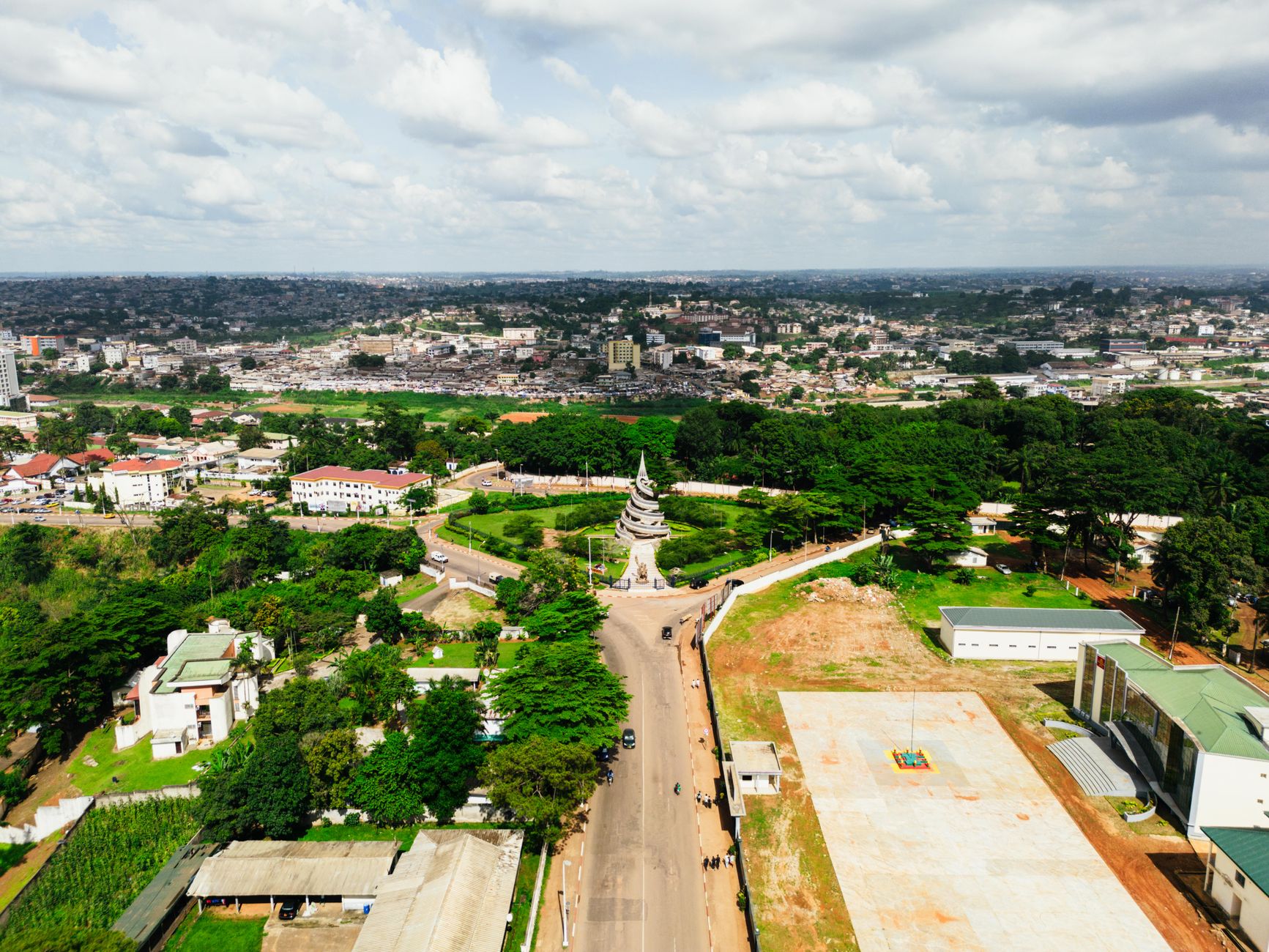
Cameroon builds according to altitude, rain, ritual, and available stubbornness. In Douala, the city sweats under concrete, port traffic, and corrugated roofs that rattle under rain with the authority of percussion. In Yaoundé, seven hills produce long views, administrative compounds, church spires, and neighborhoods that seem to negotiate with slope rather than conquer it.
Go west and architecture changes temperament. The palaces and compounds of the grassfields near Bafut and Foumban organize space around courtyards, thresholds, lineage, and controlled revelation. You are not meant to see everything at once. Power dislikes immediate legibility.
Then Mount Cameroon enters the discussion near Buea and Limbe. A volcano 4,095 meters high has opinions about settlement. Houses crouch under weather, roads curve around lava history, and the coastal plain near Limbe lives with the mountain the way one lives with an unpredictable aristocrat: respect first, jokes later.
In the north, around Maroua and toward the Mandara Mountains, earth architecture answers heat with intelligence that air-conditioning can only envy. Thick walls, shade, courtyards, granaries, compounds built by people who knew climate is not an inconvenience. It is the first architect.
Dja Faunal Reserve and Lobéké protect vast tracts of Congo Basin forest where western lowland gorillas, forest elephants, and chimpanzees still move through intact habitat.
Around Buea and Limbe, West and Central Africa's highest peak rises from the coast to 4,095 meters. Few places let you pair black volcanic slopes with Atlantic beaches in the same day.
Foumban, Bafut, Bamenda, and Bafoussam open a route into the Grassfields kingdoms, where palaces, masked societies, and dynastic rituals still shape public life rather than sitting behind glass.
At Kribi, the Lobé Falls crash directly into the Atlantic. The scene is strange even by tropical standards: brown river water, white surf, fishing canoes, and dense forest at the edge of the sand.
Cameroon cooks with starch, smoke, palm oil, pepper, and patience. Ndolé, eru, achu, koki, kondrè, and mbongo tchobi are not variations on a theme; each comes from a different cultural world.
A single trip can run from humid Douala and administrative Yaoundé to the ranch country around Ngaoundéré and the dry plains near Maroua. Few African itineraries change this much without crossing a border.
12 cities — start with the ones we'd send you to first.
Cameroon's engine room — container cranes over the Wouri estuary, Akwa district bars still loud at 2 a.m., and the best ndolé you'll eat anywhere served from a pot that never fully cools.
A civil-service capital built on seven hills where French bureaucracy, Catholic cathedrals, and Beti village logic coexist inside the same afternoon.
The commercial heartbeat of the Bamileke plateau, where njangi networks move serious money and the weekly market trades everything from kola nuts to Chinese motorbikes.
Gateway to the Ring Road circuit, a highland town of cool mist and Pidgin English where grassfield kingdoms begin just beyond the last roundabout.
The Bamum sultanate's living capital — the palace museum holds Sultan Njoya's invented script, bronze thrones, and a royal archive that rewrote what outsiders thought possible in precolonial Africa.
White-sand Atlantic coast where the Lobé River drops directly into the sea in a curtain of brown water and the catch comes off wooden pirogues onto beachside grills by noon.
A colonial hill station at the foot of Mount Cameroon where German-era stone buildings survive the altitude and the active volcano above them is not a metaphor.
The northern railhead where the Transcamerounais train terminates, a Fulani emirate town of mosques and cattle markets perched on the Adamawa plateau at 1,100 metres.
The Far North's main city, ringed by Mandara Mountain inselbergs, where Kanuri embroiderers, Fulani leather workers, and the Monday market make the Sahel feel like a civilization rather than an edge.
Douala is where Cameroon announces itself in diesel, containers, grilled fish, and hurried cash payments. Follow the coast south to Kribi for white sand and the Lobé Falls, or west to Limbe and Buea where Mount Cameroon changes the weather and the pace in the same afternoon.
Yaoundé feels more official than Douala, but it is also the country's practical hinge: embassies, ministries, train departures, and long-haul bus yards all sit within reach. Push east to Bertoua and the landscape opens toward forest routes and the UNESCO-listed reserves farther beyond, where logistics get slower and planning matters more.
The western highlands are cooler, denser, and politically layered, with chiefdoms and sultanates that still shape public life. Bafoussam is the transport spine, while Foumban carries the grander story: Sultan Ibrahim Njoya, the Bamum court, and one of the most intellectually ambitious royal histories in Africa.
Bamenda sits in a folded green landscape where roads climb, weather shifts fast, and old compounds still hold more authority than they first appear to. Nearby Bafut is the anchor stop, not because it is polished, but because the palace complex still carries the weight of dynastic memory rather than museum staging.
Ngaoundéré is the country changing gears. The air dries, the architecture loosens, and the rail line from Yaoundé finally gives way to a more spacious northern rhythm shaped by Fulani influence, cattle trade, and long overland distances.
Maroua belongs to the Sahel, not the forested south, and it pays to think like it: early starts, shade at noon, water always. This is the gateway to the Mandara Mountains and the Diy-Gid-Biy cultural landscape, where settlement patterns were shaped by defense, scarcity, and altitude rather than convenience.
A compressed history of Cameroon through kingdoms, empire, partition, and unfinished reunification
Navigators entering the estuary found waters thick with prawns and called it Rio dos Camarões. A future country inherited the name from a moment of maritime appetite.
Traditions place the rise of the Bamum kingdom around this period, with Nchare Yen remembered as the founder who fused conquest and dynastic marriage. Foumban would become one of Cameroon's great royal capitals.
The wider Islamic reform movement associated with Usman dan Fodio transformed political life across the region. Emirate and lamidat structures spread, and older polities were defeated, absorbed, or forced to adapt.
European missionaries expanded their foothold along the coast, bringing schools, churches, and a new moral vocabulary. Conversion and commerce began to travel together.
Treaties with coastal rulers opened the door to German imperial control. What followed was not mere flag-planting but military conquest, plantation economies, and administrative redesign.
At Foumban, Sultan Ibrahim Njoya launched one of the most extraordinary intellectual projects in African history. His evolving script would turn royal memory, law, and knowledge into written form.
German infrastructure projects linked coast and interior along lines useful to extraction. Roads and railways were modern tools with a hard purpose: moving labor, troops, and goods.
The king of the Bell lineage protested German expropriation in Douala through legal argument and petition. He was hanged for treason, turning him into one of Cameroon's enduring martyrs of colonial rule.
Allied forces defeated Germany in Kamerun, ending three decades of imperial rule. The territory then moved toward partition under French and British administration.
The postwar settlement divided the territory into French Cameroun and British Cameroons. A line drawn by imperial powers would later become a domestic crisis.
French authorities had curtailed his power and removed him from Foumban. His death marked the end of a reign that had tried, with astonishing originality, to keep African sovereignty intellectually alive under empire.
The Union des Populations du Cameroun emerged as a major anti-colonial force, demanding independence and reunification. French authorities treated it as a threat rather than a negotiating partner.
Repression pushed the anti-colonial struggle into a violent phase, especially in parts of French Cameroun. The war for independence became both political and brutally intimate.
Ahmadou Ahidjo led the new Republic of Cameroon into sovereignty. Independence arrived with ceremony, but also with insurgency, centralization, and the unresolved question of reunification.
After a UN plebiscite, Southern Cameroons joined the republic while Northern Cameroons joined Nigeria. Reunification was celebrated as a solution and would later be remembered as an argument.
A national referendum ended the federation and strengthened central authority. The move simplified the map of power while sharpening Anglophone fears of absorption.
Biya inherited the presidency and would go on to dominate Cameroonian politics for decades. Few transitions in modern African history have lasted so long in their consequences.
The change from United Republic of Cameroon back to Republic of Cameroon looked administrative. For many Anglophones, it symbolized the erosion of the 1961 compact.
A limnic eruption released a dense cloud of carbon dioxide that suffocated villages around the crater lake. It was one of the deadliest natural disasters in modern Cameroonian history and almost impossible to imagine until it happened.
Cameroon's football team stunned Argentina in the opening match and carried African football into new territory. For a few weeks, the country seemed to stride onto the world stage with a grin and a tackle.
The constitution offered a language of regions, local government, and shared power. As so often in Cameroon, the distance between constitutional promise and administrative habit remained large.
Teachers and lawyers in the English-speaking regions protested marginalization in education and the legal system. The state's response radicalized a crisis rooted in the partition settlement a century earlier.
What began as protest hardened into war in parts of the Northwest and Southwest. Schools, villages, and roads became battlegrounds in a conflict that remains one of Cameroon's defining contemporary wounds.
The government offered regional status and institutional reforms, but distrust ran deeper than administrative wording. The conflict showed again that Cameroon cannot govern its plural history by decree alone.
Before Kingdoms
The emblematic figures of this era have no surviving names, only terracotta faces whose expression still resists explanation.
At the Wouri estuary, where the water turns brown with tide and mangrove silt, Portuguese sailors dropped anchor in 1472 and hauled up baskets writhing with prawns. They called it Rio dos Camarões, the River of Shrimps, and a future country kept the joke. A nation named by men thinking about supper: history can be grand, but it also has a sense of humor.
Long before Douala carried that name, the far north around Lake Chad belonged to the Sao world, half archaeology and half whispered memory. Their terracotta heads, with scarified cheeks and watchful eyes, still look less like relics than portraits interrupted. Arab chroniclers and later local traditions described the Sao as giants. That tells you less about their height than about the shock they left behind.
In the Mandara Mountains, people built because the plains had become dangerous. Dry-stone terraces climbed volcanic slopes; storage towers and ritual enclosures turned fear into architecture. Ce que l'on ignore souvent, c'est que these hill settlements were not picturesque retreats. They were defenses, pressed into shape by raids, slave-taking, and the hard arithmetic of survival.
So the first chapter of Cameroon is not a blank prelude before Europeans arrive. It is already crowded with engineers, potters, farmers, and fugitives. And when later kingdoms rise in the Grassfields and the north, they inherit not emptiness but old ground, old routes, and older anxieties.
Cameroon's modern name comes from Portuguese sailors astonished by the sheer abundance of prawns in the Wouri estuary.
Grassfields and Emirates
Nchare Yen, founder of the Bamum kingdom, lives in court memory less as a marble hero than as a conqueror who welded clans together through war and marriage.
In the western highlands, a palace was never just a residence. At Bafut, near present-day Bamenda, the fon's compound gathered courtyards, carved posts, ancestral shrines, and the slow ceremonial choreography of power. Skulls displayed in audience spaces were not decoration in the European sense. They were lineage made visible, a reminder that the dead still attended politics.
Further west and south, kingdoms and chiefdoms multiplied across the Grassfields with astonishing density. Foumban emerged as the seat of the Bamum dynasty, founded by Nchare Yen after conquest, negotiation, and dynastic marriage in the 17th century. That is how states often begin: not with a flag, but with a spear, a bride, and a genealogy polished afterward.
Then came the Fulani advance from the north, strengthened by the wider Islamic reform movements that shook the region in the early 19th century. Cavalry changed the map. Courts adapted, fled, converted, fortified, or paid tribute. Whole communities carried the memory of displacement into new settlements, new titles, new ritual obligations.
What survives from this period is not one Cameroon, because no such political unit existed yet, but a dense mosaic of authority. Royal compounds in Bafut and Foumban, Muslim lamidats in the north around Ngaoundéré and Maroua, market routes crossing language frontiers, and prestige measured as much in wives, retainers, and sacred objects as in land. That plural inheritance would later make colonial borders look neat on paper and false on the ground.
In Bafut, ancestral skulls traditionally watched over political discussions, because legitimacy was supposed to answer to the dead as well as the living.
Sultans and Empires
Ibrahim Njoya was not simply a king with literary tastes; he was a reformer who treated writing as an instrument of sovereignty.
Picture a young ruler in Foumban at the end of the 19th century, inheriting a throne shaken by war and humiliation. Sultan Ibrahim Njoya had watched his father's death cast a shadow over the Bamum court, and he answered it not only with military recovery but with something far stranger. He decided that memory should no longer depend on what a courtier could recite.
Around 1896, Njoya began creating a script for the Bamum language. Not borrowing one. Creating one. The system changed over several revisions, moving from hundreds of signs toward a leaner syllabary now known as Shümom. He founded schools, ordered records kept, wrote history, legal texts, and medicinal knowledge, and made literacy a royal project. Very few sovereigns anywhere can claim to have invented an alphabetic future for their court.
German rule, declared over Kamerun in 1884, arrived with treaties, coercion, plantations, military expeditions, and a taste for order that often concealed brutality. Douala became a colonial port. Railways and roads followed the logic of extraction. Chiefs were used, punished, decorated, displaced. Rudolf Duala Manga Bell, prince of the Bell lineage in Douala, first tried legal argument. When the Germans planned to seize and segregate Douala land, he appealed all the way to Berlin. It did not save him.
In 1914, the Germans hanged Manga Bell for high treason. His crime, in plain language, was insisting that a treaty should bind both sides. Ce que l'on ignore souvent, c'est that this moment contains the whole colonial drama in miniature: African rulers were expected to understand European law when it served empire and forget it when it did not. Two years later, during the First World War, German Kamerun collapsed under Allied attack, and the country entered a new partition with old wounds intact.
Njoya is one of the rare rulers in recorded history to personally oversee the evolution of a script from pictograms toward an efficient syllabary within his own lifetime.
Mandates, Reunification, and the Long Republic
Ahmadou Ahidjo shaped the first republic with austere authority, while Paul Biya turned longevity itself into a political style.
After Germany's defeat, Cameroon was divided between French and British administration, a diplomatic solution that planted a domestic problem. French Cameroun took the larger share, administered from Yaoundé; British Cameroons were attached in practice to Nigeria. The line looked tidy on maps. Lives along it did not. Schools, courts, language, and political habits began to diverge.
Independence came first to French Cameroun in 1960 under Ahmadou Ahidjo. The next year, after a United Nations plebiscite, Southern Cameroons chose to join the new republic while Northern Cameroons joined Nigeria. The resulting federation promised balance between two colonial legacies, French and British, central and regional, legal code and common law. But federations, like marriages, reveal their weaknesses in daily life, not on the wedding day.
Ahidjo built a disciplined one-party state, then in 1982 handed power to Paul Biya, who still dominates Cameroonian politics decades later. The country has known oil booms, austerity, football ecstasies, urban growth in Douala and Yaoundé, and the stubborn endurance of royal courts in places such as Foumban and Bafut. Cameroon often looks immovable from afar. Up close, it is full of negotiation.
The deepest fault line of the present lies in the Anglophone regions, where grievances over language, law, representation, and state violence hardened into open conflict from 2016 onward. That crisis cannot be treated as a footnote. It is the afterlife of partition, still writing itself into classrooms, courtrooms, roadblocks, and exile. And so the modern history of Cameroon ends where earlier chapters began: with the tension between imposed borders and local loyalties, between what the state declares and what people will actually accept.
The 1961 reunification joined territories that had spent decades learning different administrative habits, school systems, and legal cultures under separate colonial rulers.
Cameroon speaks the way a market changes smell when you cross one aisle. French at the ministry desk in Yaoundé. English in a schoolyard in Buea. Pidgin in the taxi when the driver decides efficiency matters more than grammar, which is often. Then Camfranglais arrives, that urban acrobat, and the sentence begins in one language, swerves for mischief, and lands somewhere only insiders fully own.
This is not confusion. It is precision of another order. A person chooses code the way a chef chooses heat: French for administration, Pidgin for quick trust, a mother tongue for tenderness or warning, and sometimes all three before the plantains reach the table.
Listen in Douala and you hear commerce make its own music. Listen in Bamenda and the tempo shifts; English stands straighter, Pidgin grins wider. A country with more than 250 languages cannot pretend the world fits inside one mouth. It refuses politely.
Language here is never only language. It is rank, flirtation, camouflage, family, and theatre. A country is a table set for strangers; Cameroon changes the cutlery between courses.
In Cameroon, the greeting is not a preface. It is the ceremony itself. You do not rush toward your question as if information were prey. You greet. You ask after the night, the health, the family, the road. Only then do you arrive at the matter that brought you there.
A European may mistake this for delay. It is the opposite. The greeting establishes whether you know how to exist among other humans. Without it, your efficiency looks like frost.
Titles drift beautifully beyond kinship. Maman. Papa. Grand. Aunty. Uncle. These are not mistakes of vocabulary. They are social architecture, a way of placing respect in the room before anyone sits down.
Watch the slight lowering of the body before an elder. Hear the softened tone. Notice how impatience makes a person suddenly smaller. Cameroon has little interest in the cult of casualness. It prefers manners with consequence.
The national argument could be settled with one pot of ndolé in Douala. Bitterleaf, ground peanuts, onions, shrimp or beef, miondo on the side, fingers doing the final work the spoon cannot do with dignity. A proper mouthful contains starch, bitterness, oil, and smoke; it explains more about the country than a stack of policy papers.
Food here does not sit politely beside life. It occupies the center and makes demands. Eru with water fufu in the southwest. Achu and yellow soup in the grassfields near Bafoussam and Bamenda. Kondrè in Bamileke country, where green plantains and goat spend enough time together to become intimate.
Cameroon likes density. Not heaviness for its own sake, but concentration. Cassava ferments. Leaves darken in palm oil. Fish smokes. Pepper insists. The sauces cling because they mean to stay with you.
And then the coast makes its own seduction. In Kribi, fish meets charcoal and sea air. In Limbe, pepper soup can humble vanity in three spoonfuls. Cuisine here behaves like grammar: structure first, then style, then a final clause of fire.
Cameroonian music has the insolence of somebody arriving late and being instantly forgiven. Makossa came out of Douala with bass lines that understand hips better than most governments understand citizens. The great names still hover over the city like patron saints with electric guitars: Manu Dibango above all, turning the saxophone into a border-crossing device.
Bikutsi from the center, especially around Yaoundé, does something different. It strikes. The rhythms are percussive, tensile, almost argumentative. You do not merely hear bikutsi. You are corrected by it.
Then the map opens wider. Fulani musical traditions in Ngaoundéré carry other textures, other silences, and the Far North near Maroua bends the ear toward lutes, hand drums, and praise forms that belong to courts, ceremonies, and memory rather than the nightclub. The country does not have one soundtrack. It has a relay of urgencies.
Music here rarely behaves as decoration. It summons, mocks, courts, praises, remembers. Even the dance can look like a legal argument. Especially the dance.
If Cameroon has a capital of memory, it is Foumban. The Bamum palace and its museums hold royal art that never learned modesty: beadwork, carved thrones, masks, pipes, bronzes, doors that seem to have listened to dynasties pass by. Sultan Ibrahim Njoya still dominates the imagination, not only because he ruled, but because he wrote, invented, archived, and understood that power without record becomes rumor.
His Shümom script remains one of the most astonishing acts of cultural self-possession anywhere. A ruler in the late 19th century deciding that his kingdom needed its own writing system is the sort of gesture that makes lesser national histories seem underdressed.
Elsewhere, art keeps closer to ritual. In Bafut, palace objects are not mere exhibits; they belong to a living court world of masks, stools, carved posts, leopard imagery, and ancestral authority. The object is beautiful, yes. It is also busy governing the invisible.
Cameroon does not separate art neatly from use. A mask judges. A textile ranks. A palace door teaches. Beauty here has work to do.
Cameroon builds according to altitude, rain, ritual, and available stubbornness. In Douala, the city sweats under concrete, port traffic, and corrugated roofs that rattle under rain with the authority of percussion. In Yaoundé, seven hills produce long views, administrative compounds, church spires, and neighborhoods that seem to negotiate with slope rather than conquer it.
Go west and architecture changes temperament. The palaces and compounds of the grassfields near Bafut and Foumban organize space around courtyards, thresholds, lineage, and controlled revelation. You are not meant to see everything at once. Power dislikes immediate legibility.
Then Mount Cameroon enters the discussion near Buea and Limbe. A volcano 4,095 meters high has opinions about settlement. Houses crouch under weather, roads curve around lava history, and the coastal plain near Limbe lives with the mountain the way one lives with an unpredictable aristocrat: respect first, jokes later.
In the north, around Maroua and toward the Mandara Mountains, earth architecture answers heat with intelligence that air-conditioning can only envy. Thick walls, shade, courtyards, granaries, compounds built by people who knew climate is not an inconvenience. It is the first architect.
In Foumban, Ibrahim Njoya turned a royal court into a laboratory of statecraft. He created the Bamum script, opened schools, and wrote history because he understood that a kingdom able to write itself cannot be narrated entirely by others.
Manga Bell fought German land seizures in Douala with petitions, legal arguments, and a belief that treaties should mean what they say. The empire answered with a gallows in 1914, which is one way of admitting that his argument had struck home.
Ahidjo was the quiet, disciplined architect of the first republic, less theatrical than many liberation leaders and often more effective. He stitched together a fragile state, then left office voluntarily in 1982, a rare act in postcolonial politics and one whose consequences still echo.
Paul Biya governs Cameroon with the strange force of duration: decades in office have made him seem less a president than a climate system. To understand modern Yaoundé, you have to understand how bureaucracy, distance, and permanence became his political language.
The young Sultan of Foumban inherited not a museum piece but a living court where dynastic memory still matters. His presence is a reminder that in Cameroon, royalty did not vanish into folklore; it adapted, negotiated, and remained visible.
Atangana mastered the dangerous art of surviving empire by working with it. Around Yaoundé, he helped shape the colonial order while also consolidating Ewondo influence, which makes him one of those figures history never lets remain innocent.
Mongo Beti used fiction like a blade, cutting through colonial hypocrisy and postcolonial complacency with equal pleasure. He gave Cameroon one of its sharpest consciences, the sort that embarrasses power simply by describing it accurately.
Francis Bebey carried Douala into literature and music without reducing it to postcard material. He could write with wit about modern African life because he noticed the comedy in technology, manners, and ambition before most people did.
Eto'o did not found a kingdom or write a constitution, but he gave Cameroon one of its most recognizable faces abroad. The Indomitable Lions had heroes before him; he turned that tradition into a global brand with the ego, goals, and discipline such a role requires.
Start in Douala for the economic pulse, then trade traffic and port haze for the Atlantic at Kribi before finishing under Mount Cameroon in Limbe. It is short, practical, and easy to price: city arrival, beach reset, then a greener coastal finish with better air and easier walking.
This route runs through the western highlands where palaces, markets, and royal memory still shape daily life. Bafoussam gives you the transport hub, Foumban brings Bamum court culture, then Bamenda and Bafut shift the mood toward cooler hills and one of the country's great palace compounds.
Begin in Yaoundé, then use the rail spine to climb toward Ngaoundéré before pushing on to Maroua and the far north. The country changes fast on this run: humid capital, high plateau, then open Sahel where distances widen, temperatures rise, and the architecture turns defensive and spare.
This two-week loop links the administrative calm of Yaoundé with the eastern gateway at Bertoua, then swings west to the mountain flank around Buea. It works best for travelers who want more than beaches and palaces: rail or road planning, forest-edge travel, and a finish in cooler highland air.
Family table. Fingers pinch cassava. Sauce coats greens, peanuts, shrimp. Conversation slows.
Sunday gathering. One finger dips, turns, lifts. Elders watch technique.
Shared bowl. Hands pull, fold, swallow. Palm oil, crayfish, smoke remain.
Celebration meal. Plantain absorbs broth. Guests arrive, sit, eat, linger.
Lunch plate. Black sauce stains fingers. Bobolo follows. Silence for a minute.
Street corner. Skewers turn, pepper falls, smoke rises. Friends stand, eat, argue.
Beach evening. Fish lands on charcoal. Onion, chili, bière, sea air.

For US, UK, EU, Canadian, and Australian passports, treat Cameroon as visa required and apply before departure through the official e-visa portal at evisacam.cm. Standard processing is commonly quoted at around 72 hours after payment, with faster handling available in some cases; carry a passport valid for 6 months, at least one blank page, and your yellow-fever certificate.
Cameroon uses the Central African CFA franc, written as XAF, FCFA, or simply CFA, with a fixed peg to the euro at EUR 1 = XAF 655.957. Cash still runs the country outside better hotels and airline counters, so arrive with small notes and do not count on cards working reliably beyond Douala and Yaoundé.
Most international arrivals come through Douala or Yaoundé, usually on one-stop routes via Paris, Brussels, Istanbul, Addis Ababa, or Casablanca. Douala works best for the coast and the southwest; Yaoundé is the cleaner entry point if you are heading north, east, or straight onto the rail line.
Camrail is the most useful long-distance transport link inside the country, especially on Douala-Yaoundé and the overnight Yaoundé-Ngaoundéré run. For everything else, expect buses, shared taxis, and domestic flights that can shift at short notice; daytime travel is the safer bet on the roads.
November to February is the easiest window for most trips: drier roads, clearer logistics, and less punishing heat in the north. Douala and the coast stay wet much of the year, the western highlands are cooler, and the far north turns brutally hot before the rains arrive around June.
4G is common in the main cities, but coverage thins out fast once you leave the main corridors or head into the mountains and forest zones. Buy a local SIM in Douala or Yaoundé, keep cash for data top-ups, and download maps before heading to places like Bafut, Bertoua, or Maroua.
Cameroon rewards planning and punishes improvisation. Petty theft and scams are the routine urban problems, while some border and conflict-affected areas carry more serious risks; check current government advice, avoid night drives, use known drivers, and keep yellow-fever proof with your passport rather than buried in a bag.
ATMs and card terminals are useful in Douala and Yaoundé, then much less reliable after that. Keep low-denomination CFA notes for taxis, market food, station fees, and mobile data top-ups.
If your route includes Yaoundé, Douala, or Ngaoundéré, check Camrail before committing to a long road journey. The train is often slower on paper and less exhausting in real life.
Reserve your first and last nights before arrival, plus any stop tied to a flight, train, or late arrival. Elsewhere you can stay flexible, but do not improvise in smaller cities after dark.
Plan intercity road trips for morning departures and daylight arrivals. Road conditions, breakdown response, and night visibility are all worse than the map suggests.
Sort your local SIM in Douala or Yaoundé where registration is easier and staff are used to foreign passports. Download offline maps and your hotel details before heading toward the coast, the highlands, or the north.
In shops, homes, and offices, a quick greeting before business goes further than a rushed question. It costs ten seconds and usually gets you better help.
Order the dish that belongs to the place you are standing in. Ndolé makes sense in Douala, achu in the west, and grilled fish on the coast; the country's food map is sharper than many restaurant menus admit.
Explore Cameroon with a personal guide in your pocket
Audio guides for 1,100+ cities across 96 countries. History, stories, and local insight — offline ready.

Yes. US and UK travelers should apply before departure through the official e-visa system rather than expecting visa-free entry or visa on arrival. Keep your approval, passport, and yellow-fever certificate together because border formalities are document-heavy.
Parts of Cameroon are manageable with careful planning, but safety conditions are uneven and some areas are a poor idea without up-to-date advice. Stick to current government advisories, avoid night travel, use known transport operators, and treat border zones and conflict-affected regions with extra caution.
December is the easiest single month for most travelers, but the broader sweet spot is November through February. Roads are drier, the north is less punishing, and you are less likely to lose days to rain on the coast or in the forest belt.
Sometimes, but do not build your trip around them. Better hotels, a few restaurants, and some airline counters in Douala and Yaoundé take cards, while much of the country still runs on cash and card fraud remains a real concern.
Use trains where the rail line exists, then switch to buses, shared taxis, or prearranged drivers. The most useful backbone is Douala-Yaoundé-Ngaoundéré; beyond that, transport gets more regional, slower, and less predictable.
Douala is better for the coast and southwest, while Yaoundé is better for the capital region, the train north, and eastern routes. Choose the airport based on your first overland move, not just the cheapest fare.
A practical range is about XAF 25,000 to 40,000 for budget travel, XAF 55,000 to 95,000 for mid-range, and XAF 130,000 or more if you want comfort and private transport. Douala and beach areas can push prices up quickly, especially for air-conditioned hotels and seafood restaurants.
Yes, in most cases you should expect to show yellow-fever proof on entry. Even when checks are inconsistent, the requirement appears often enough in official guidance that traveling without the certificate is bad arithmetic.
Last reviewed