
Place
Cambodia Verified Apr 2026
At 5:30 AM, the reflecting pools at Angkor Wat hold the temple's towers upside-down in still water while two hundred strangers stand silent on the stone banks watching the sky go orange. Siem Reap, Cambodia, grew a city around 1,000 years of Khmer civilization — and what surprises most visitors isn't the scale of Angkor, which covers some 400 square kilometers of jungle, moats, and reservoir, but how much of it you can have entirely to yourself.
 Photo: BabijaPhoto JB / Pexels
Built from cited sources · see the method · How we make our guides →
The city that grew up around the temples makes its own quiet case. Pokambor Avenue runs through a French Quarter of yellow facades and wooden shutters; Wat Bo Road has an 18th-century pagoda whose interior walls show 19th-century murals mixing Hindu mythology with scenes of ordinary Cambodian life.
Cuisine Wat Damnak, a converted wooden house in Wat Bo Village, became the first Cambodian restaurant in Asia's 50 Best list in 2016, building a tasting menu from herbs grown in the chef's own garden and fish from Tonlé Sap Lake. Five kilometers from that table, Road 60 Night Market opens around 4 PM and draws Cambodian families from across the province; grilled pork with pickled vegetables costs about $1. The distance between those two dinners tells you most of what you need to know about the city.
This is also a country that lost between 25 and 33 percent of its population between 1975 and 1979. Siem Reap doesn't pretend otherwise. The Cambodia Landmine Museum, founded by a former child soldier named Aki Ra who still leads active demining operations, sits 25 kilometers north of the city center; Phare, the nightly circus school performance, trains students from difficult backgrounds and tells stories from that period using acrobatics and original music.
Not every monument, just the ones we'd walk you past ourselves.
Where to wander, by quarter — each with its own rhythm.
Before you go
A thousand years of ambition carved in stone, then six decades of catastrophe
The Tonlé Sap flood pulse — the lake swelling to five times its dry-season size each monsoon — made this floodplain one of Southeast Asia's most productive fishing grounds a full millennium before the first temple stone was cut. Communities here harvested rice and freshwater fish in quantities that would eventually sustain an empire. The hydraulic genius of later Khmer kings wasn't invention; it was inheritance, refining what these unnamed farmers already understood about water and abundance.
On the plateau of Phnom Kulen, 30 miles north of present-day Siem Reap, a prince named Jayavarman II performed a ritual that no Khmer ruler had attempted before — declaring himself a universal monarch, a chakravartin, independent of any foreign power. The ceremony severed Cambodia's ties to the Javanese kingdom that had dominated the region for generations. Everything that would eventually stand at Angkor flows from this single act of political audacity on a mountain plateau.
Indravarman I broke with brick. At Bakong, 9 miles southeast of modern Siem Reap, he raised a temple-mountain in sandstone — the first major Khmer monument built primarily in stone rather than laterite or brick. He also dug the Indratataka, a reservoir stretching nearly 4 kilometers, feeding the rice paddies that would sustain Angkor's eventual population of perhaps one million people. Water first, then temples: the Khmer hierarchy of priorities was never entirely spiritual.
Yasovarman I planted his capital at Phnom Bakheng, a small hill overlooking what would become the world's largest pre-industrial city. He named it Yasodharapura and dug the East Baray — a reservoir 7 kilometers long and nearly 2 kilometers wide, holding enough water to irrigate the entire surrounding plain. Angkor would shift locations and expand over the centuries, but this hilltop remained its symbolic center. The tower still stands, though now crowds arrive every evening to take the same photograph of the same sunset.
A minister named Yajnyavahara built Banteay Srei 38 kilometers north of Angkor's center and used pink sandstone so fine that carvers could work it almost like wood. The apsaras and devatas covering every surface have expressions — individual faces, not the generic divine attendants of a hundred other temples. The French scholar Philippe Stern, examining these carvings in the 1920s, called them the jewel of Khmer art. He was not wrong.
When Suryavarman II turned his attention to a new state temple, he conceived something the world had never built: a religious complex covering 200 hectares, surrounded by a moat 190 meters wide and 5 kilometers in circumference. Construction took roughly 37 years and produced bas-relief galleries stretching 700 meters — depicting the Mahabharata, the Ramayana, and his own military campaigns in the same carved breath. He built it facing west, toward death, leading scholars to conclude it functioned simultaneously as temple and mausoleum. They haven't settled that argument yet.
Cham warships sailed up the Mekong in 1177, then into the Tonlé Sap, and sacked Angkor — burning, looting, killing the king, dismantling two centuries of accumulated imperial confidence in a matter of weeks. The defeat was catastrophic enough that it appears carved into the Bayon's bas-reliefs, commissioned by the king who eventually avenged it. Angkor had never been sacked before. It took years to recover anything resembling nerve.
Jayavarman VII was already nearly 60 when he drove the Cham from Angkor and launched the most ambitious building program in Cambodian history. He conquered Champa itself by 1203, stretching the empire across most of mainland Southeast Asia, then turned to construction: Angkor Thom's walled city, the Bayon's 54 towers and 200-odd stone faces, Ta Prohm for his mother, Preah Khan for his father, and 102 hospitals connected by paved roads across the realm. No other Khmer king built more, fought harder, or — the Buddhist steles say — worried more about the suffering of his people. He converted the empire from Hinduism to Mahayana Buddhism along the way, which changed everything that came after.
The Bayon sits at the exact center of Angkor Thom's walled city, and its 54 towers — each carved with four enormous faces gazing serenely in every cardinal direction — produce an effect unlike anything else in religious architecture. Scholars remain divided on whose face it is: Jayavarman VII himself, a bodhisattva, some synthesis of the two. Walking among those towers at dawn, when mist sits low and the stone is still cold, the ambiguity feels deliberate. The faces aren't asking to be identified. They're watching you decide.
The Ayutthaya Kingdom of Siam besieged Angkor for seven months in 1431. When the walls finally fell, King Ponhea Yat gathered his court and fled south; the capital relocated first to Basan, then permanently to Chaktomuk — what is now Phnom Penh. Angkor was not fully abandoned: monks continued maintaining Angkor Wat, and some population remained. But the hydraulic infrastructure that had sustained a million people slowly silted, cracked, and surrendered to forest. The jungle did the rest over the next four centuries.
Local tradition credits King Ang Chan's forces with repulsing a Siamese invasion around 1549, and holds that the town was named Siem Reap — "Defeat of Siam" — to mark the moment. The scholar Michael Vickery contested the etymology, but the name stuck regardless, embedding a geopolitical grudge into every map and road sign in the country for the next five centuries. Cambodia and Siam fought repeatedly across this era; by 1795, the entire province was under Bangkok's administration. The name endured as reminder more than boast.
French explorer Henri Mouhot arrived at Angkor in 1860 and published accounts in 1863 that electrified European audiences — though the temples had never been lost. Monks had worshipped continuously at Angkor Wat for four centuries, and Chinese and Cambodian merchants had documented the ruins in writing generations before Mouhot was born. What he actually discovered was the Western appetite for a narrative about lost civilizations, which served France's colonial ambitions in the region rather conveniently. His death from fever in Laos the following year only made the story more useful.
The Franco-Siamese Treaty of 1907 returned Siem Reap, Battambang, and Sisophon provinces to French Indochina after 112 years under Bangkok's administration. The École française d'Extrême-Orient immediately took charge of Angkor and established a permanent conservation office the following year, beginning systematic clearance, documentation, and anastylosis restoration — decades of painstaking work reassembling fallen towers, stone by carved stone. The Grand Hotel d'Angkor opened in 1932, catering to wealthy Europeans arriving by boat and ox-cart. International tourism to Angkor was invented here, with all the complications that would eventually entail.
On November 9, 1953, Cambodia achieved independence from France under King Norodom Sihanouk, ending 90 years of protectorate rule. Angkor immediately became the symbol of national identity — the temple's silhouette printed on the new flag, stamped on the currency, painted on walls across the country. Sihanouk pursued strict neutrality through the 1950s and 1960s, balancing China, North Vietnam, and the West with remarkable agility. In Siem Reap, conservator Bernard Philippe Groslier led the most ambitious restoration program the temples had ever seen, racing to complete work before a war he could see coming.
General Lon Nol seized power on March 18, 1970, while Sihanouk was abroad; the American bombing campaigns already covertly underway since 1969 expanded dramatically. More than 2.7 million tons of bombs fell on Cambodian soil between 1969 and 1973, displacing two million people and driving rural survivors toward whichever armed group promised to stop it. The Khmer Rouge, a fringe movement when the decade began, recruited from that fury. Groslier was expelled from Angkor in 1972, the conservation offices shuttered. By 1975, everything had changed.
Khmer Rouge forces entered Siem Reap on April 17, 1975, and held a victory celebration inside Angkor Wat's first enclosure — as if claiming the empire's symbolic weight for themselves. Cities were evacuated within days. Approximately two million people died over the next four years from execution, forced labor, starvation, and disease — roughly one in four Cambodians. The temples that had survived seven centuries of war and monsoon survived this too. The people had less luck.
Vietnamese forces captured Phnom Penh on January 7, 1979, ending the Khmer Rouge regime after three years, eight months, and twenty days. In Siem Reap, as across Cambodia, the immediate task was counting the dead and finding enough rice for whoever remained. Some 180,000 Vietnamese troops occupied the country for the next decade under the People's Republic of Kampuchea, while the international community — still recognizing the Khmer Rouge as Cambodia's legitimate government — imposed sanctions that made reconstruction nearly impossible. The temples sat unrestored, mined, and quietly looted.
On December 14, 1992, Angkor was placed on UNESCO's World Heritage List and simultaneously on the List of World Heritage in Danger. Both designations were accurate: the complex had been systematically pillaged for years, landmines were buried among Ta Prohm's roots, and looted statues were appearing in auction houses in New York and London. The dual inscription triggered international funding and the International Coordinating Committee, eventually bringing 28 countries into the most expensive ongoing archaeological preservation effort in Southeast Asia.
Between May 23 and 28, 1993, more than 90 percent of registered Cambodians voted in elections administered by UNTAC — the UN Transitional Authority that had deployed 22,000 personnel from 46 countries, the first time the United Nations had directly administered an independent state. FUNCINPEC won, but Hun Sen's CPP refused to accept the result; the compromise produced two prime ministers governing simultaneously. Sihanouk returned as king. The Khmer Rouge boycotted everything and continued fighting from the northwest, and peace was real but incomplete — which turned out to be Cambodia's default condition for another decade.
By 2019, Angkor Wat alone was receiving 2.2 million international visitors per year; Cambodia as a whole saw 6.61 million international arrivals. The management problems were visible everywhere: dawn crowds at the reflecting pools numbered in the thousands, Ta Prohm's famous tree roots were fenced and roped and photographed until the bark wore smooth, and Phnom Bakheng's hilltop sunset slot required advance timed entry. Mass tourism had transformed Siem Reap from a provincial town into a city of hostels, cocktail bars, and night markets almost overnight. Whether that transformation was good for Siem Reap depended entirely on who you asked.
Cambodia closed its borders to international tourists in April 2020; annual arrivals collapsed from 6.61 million to 1.31 million for the year, with most of those arriving before the shutters came down. In Siem Reap, 62 percent of tourism businesses closed or suspended operations. Angkor Wat stood quiet — no tour groups at dawn, no lines at Ta Prohm — for the first time in living memory. Photographs of the deserted temples circulated globally and people called them beautiful. The people who had depended on those crowds found them devastating.
The Siem Reap–Angkor International Airport opened commercially in 2024, with 17 airlines transferring operations from the old city-center terminal. The new airport sits 40 kilometers from the temples — the old runway's vibrations had been quietly threatening Angkor Wat's foundations for years, which was reason enough to move. Built under an $880 million, 55-year concession to a Chinese developer, it is designed to eventually handle 20 million passengers annually. Arriving passengers now drive past miles of rice paddies before they see anything at all — a different kind of arrival for a place that once announced itself with stone towers visible from the runway.
Khmer King · r. 1113–c. 1150
Commissioned Angkor Wat (begun 1113)
He ordered the construction of the world's largest religious monument over roughly 37 years — a temple aligned with the spring equinox, wrapped in bas-reliefs depicting the Mahabharata, the Ramayana, and his own military campaigns across nearly a kilometer of carved stone. What makes the story strange is that we have no record of his death; he simply vanishes from inscriptions around 1150, before his temple was finished. The stone he set in motion outlasted his name.
Khmer King · c. 1122–c. 1220
Built Bayon, Ta Prohm, Preah Khan and Angkor Thom (reigned 1181–1219)
He reconquered Angkor after the Cham sacked it in 1177, then built more than any king before or after — Bayon's 216 carved faces, Ta Prohm for his mother, Preah Khan for his father, and 102 hospitals across the empire. The Bayon faces are believed to be portraits of Jayavarman himself, which means every photograph taken at the temple is, in some sense, a portrait. He converted the empire to Buddhism, and the temples he left behind feel different from Angkor Wat's Hindu geometry — quieter, somehow more human.
Founder of the Khmer Empire · r. 802–835
Declared the Khmer Empire on Phnom Kulen, 50 km north of Siem Reap (802 AD)
In 802 AD, he climbed Phnom Kulen — a sandstone plateau 50 km north of modern Siem Reap — and declared himself chakravartin, universal ruler, founding the Khmer Empire on the spot. The mountain is now a national park where Cambodians make weekend pilgrimages to a giant reclining Buddha and a riverbed carved with hundreds of lingam reliefs. Without that declaration on a hilltop outside this small city, Angkor Wat would not exist.
Sculptor · born 1971
Exhibited in Siem Reap, 2004–2005
Born in Battambang, he survived the Khmer Rouge years as a child before studying in the United States and returning to Cambodia to build large-scale sculptures from bamboo, rattan, and beeswax — materials that echo traditional Khmer craftsmanship while making something entirely contemporary. His Siem Reap exhibitions at Hotel de la Paix and Amansara in 2004–2005 made a quiet argument: that Khmer artistic identity didn't fossilize at Angkor. He has since shown internationally, but the work still reads as unmistakably from here.
Where locals actually book dinner — not the tourist menus.
Cambodia's traditional breakfast: cold rice noodles under a green fish-based curry sauce, finished with raw banana blossom, bean sprouts, and a pile of fresh herbs. Every market opens with it, and it's the dish most Cambodians will steer you toward first.
White fish steamed in coconut-lemongrass curry inside a banana leaf cup — the texture sits somewhere between custard and soufflé, fragrant with kaffir lime and galangal. Widely available from street level up; chef Luu Meng's version at Malis on Pokambor Avenue is the benchmark.
Short rice noodles stir-fried at high heat with pork, egg, and aromatics — a market dish cooked well at Phsar Leu on National Route 6, where the woks are loudest early morning and late afternoon. Expect to pay around $2.
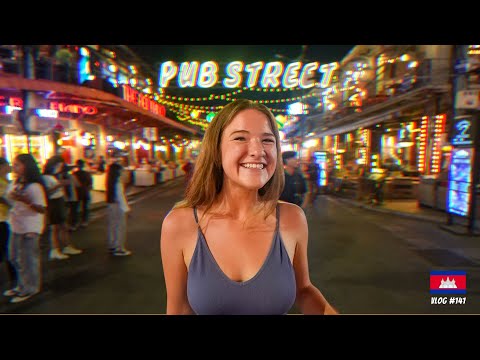
A restored traditional wooden house with lotus pond seating, where certain dishes are finished tableside on volcanic stone heated to 400°C — the stone arrives still smoking. The deliberate pace and the setting make it the structural opposite of Pub Street.
Chef Luu Meng's restaurant on Pokambor Avenue, five minutes from Old Market, in an interior designed around Angkor temple proportions. The Kep flower crab fried rice and chicken curry in lotus leaf are the dishes worth ordering; the fish amok here is the reference version for first-timers.
Siem Reap's main local market on National Route 6, with no tourist infrastructure and most stalls at $1–3. Arrive early morning for nom kachai — chive rice flour cakes, Chinese-influenced — or late afternoon when the grills and woks run at full heat.
Changkran Khmer runs morning classes in a riverside wooden longhouse from 9 AM, with an optional market visit before cooking — Chef Mongkol spent 20 years in international hotel kitchens before returning to teach traditional technique. Khmer Gourmet on Alley West Street is the more central option for those who'd rather skip the commute.
Small things that change how the city treats you.
The city, as it actually looks.
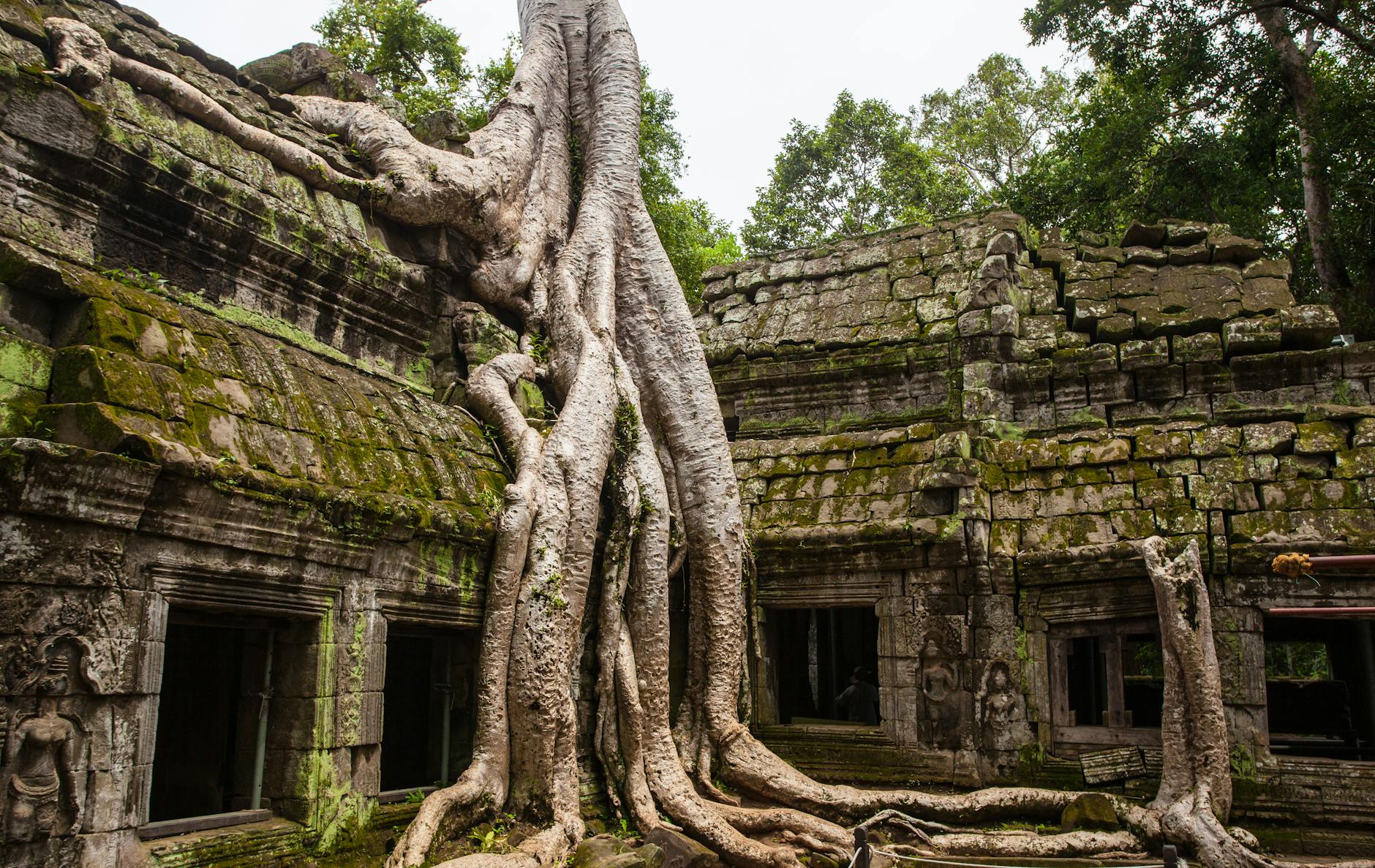


Yes — and the case is stronger than temples alone. Angkor's 400 km² archaeological park spans 600 years of Khmer civilization across hundreds of structures, from Angkor Wat's precise Hindu geometry to Bayon's 200+ carved stone faces to Ta Prohm's strangler figs swallowing gallery walls. Beyond the park, Siem Reap has a genuinely interesting food scene, a nightly circus that doubles as a social enterprise, and floating villages on Tonlé Sap that few visitors bother to reach.
Three days covers the essential circuit without fatigue. Day one: Angkor Wat at sunrise, Bayon, Ta Prohm. Day two: the outer temples, especially Banteay Srei — 38 km north, small, and carved in pink sandstone with a precision that the larger complexes can't match. Day three: Tonlé Sap lake, a city market, and Phare Circus in the evening. A fourth day earns you Beng Mealea — a jungle-buried temple 40 km east that feels genuinely unvisited.
Siem Reap–Angkor International Airport (SAI) opened in 2024 and sits 45 km from the city — roughly 60 minutes. A tuk-tuk costs $20–25, a taxi $35 for up to three passengers, and a shuttle bus $8 (departures from 9:30 AM to 10 PM). Agree the fare before you get in anything; Grab and PassApp work from the airport too and show fixed prices.
Safer than Phnom Penh by most measures — violent crime targeting tourists is rare. The real risks are low-level scams: tuk-tuk drivers demanding more mid-ride, men posing as monks near temple gates, and businesses rejecting your dollar bills because they're creased or pre-2006. Use ride apps for fixed fares, buy Angkor tickets only at the official booth, and carry clean, new banknotes.
November through February: dry, 22–31°C, and the moats hold the previous rainy season's water. March is warm but manageable; April climbs to 39°C with oppressive humidity. The wet season (May–October) cuts crowds and accommodation costs — September brings 254 mm of rain, but most mornings are clear enough for temples before noon, and the jungle around Ta Prohm turns genuinely lush.
A 1-day pass is $37; a 3-day pass is $62 (any 3 of 10 days); a 7-day pass is $72 (any 7 of 30 days). Children under 12 enter free with a passport. Buy at the official Angkor Enterprise booth on Charles de Gaulle Road or online to skip the queue — hotel concierges sell them at a small markup.
US dollars work for everything tourist-facing — hotels, restaurants, tuk-tuks, Angkor tickets. Change under $1 comes back in Cambodian Riel at roughly 4,000 KHR per dollar. The catch: businesses reject pre-2006, creased, torn, or marked bills without warning. Bring new, clean notes from home; $20s and $50s are easier to break than the $100s that ATMs here dispense.
Start with fish amok — fish steamed in a banana leaf with coconut milk and spiced kroeung paste, somewhere between a curry and a custard. Nom banh chok (rice noodles with fish curry sauce) is the local breakfast before 8 AM at Old Market stalls for $1–2. For one serious dinner, Cuisine Wat Damnak runs a weekly tasting menu built around whatever's in the chef's garden — it was the first Cambodian restaurant to make Asia's 50 Best.
Saved and recently read places — kept on this device only.
Photos may have been resized or cropped.