An introduction.
Researched by the Audiala editorial team from historical records, architectural archives, and local expertise.
WWhy does a school in Phnom Penh, Cambodia, echo with the sound of chains rather than children? Tuol Sleng Torture Center—once Chao Ponhea Yat High School—now holds 14 white graves beside a peeling classroom block, and you should walk through its balconies to understand what happens when a state turns its own people into paperwork.
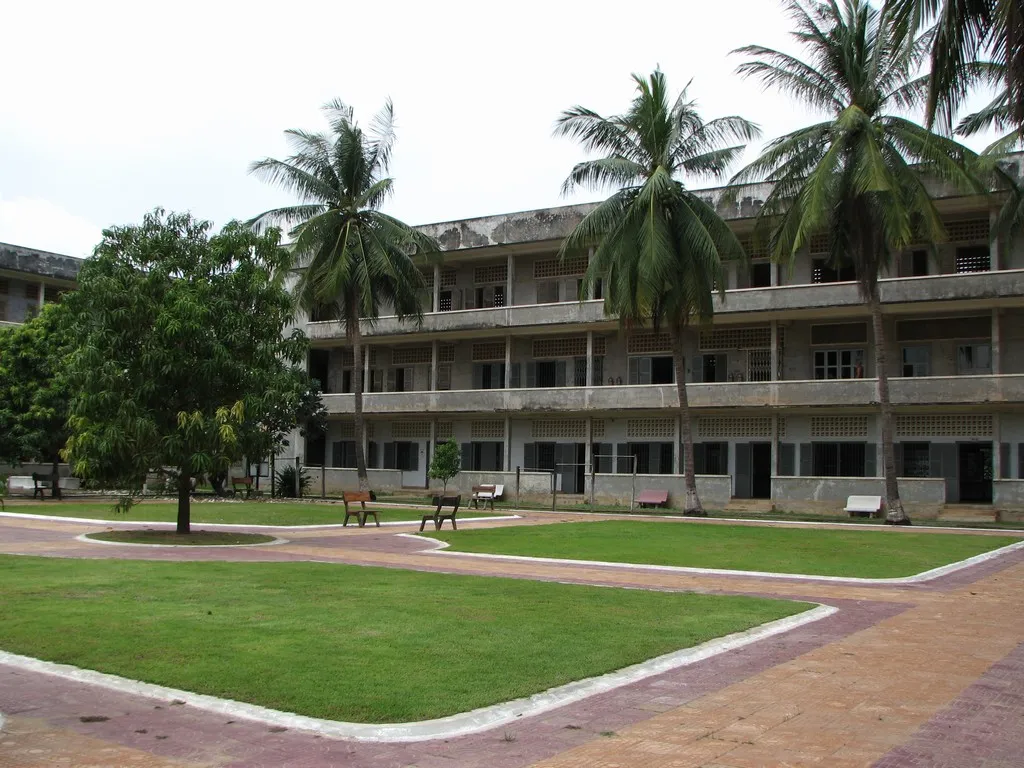
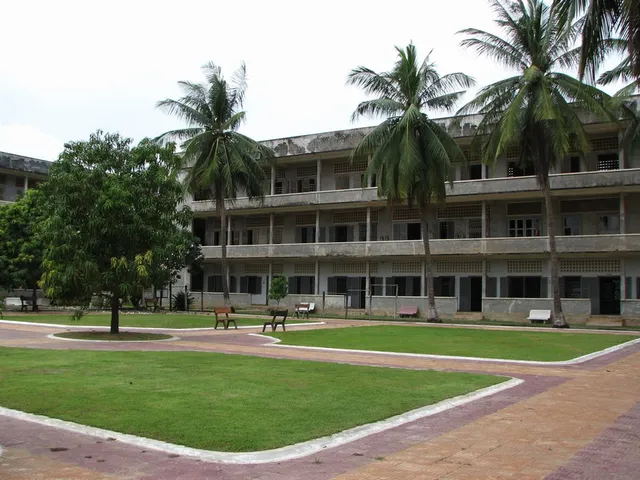
Cambodian workers completed this campus in 1962 as Chao Ponhea Yat High School, four concrete three-story blocks around a grassy courtyard. Khmer Rouge cadres converted it into Security Office 21 in August 1975, four months after soldiers emptied Phnom Penh at gunpoint. The classrooms still smelled of chalk.
Rusted wire wraps the corridors where visitors move. Black-and-white intake portraits cover the walls, and blood stains bloom through yellow-and-white floor tiles in Building A. Guards killed the last 14 prisoners on 8 January 1979; their white graves now sit in the courtyard directly below the balcony.
Survivors like Chum Mey sometimes sit inside the courtyard, telling visitors how he fixed typewriters and engines to stay alive. You come to hear memory in the rooms where Duch's interrogators tried to erase it.
We LOVE it here in PHNOM PENH, CAMBODIA! 🇰🇭 [Best Things We Did for Cheap]
The Detour Duo01 What to see.
Building B: The Admission Portraits
Building C: The Cells and the Barbed-Wire Balcony
The Courtyard as Witness
02 In pictures.


Watch & Explore Tuol Sleng Torture Center.
Plan and listen to Tuol Sleng Torture Center with Audiala.
Audio guide in your pocket, itinerary in your browser. Built for the way you actually visit.
Tickets & tours.
These are guided options from our partners — same price as booking direct.
Prices are indicative — final pricing and availability are confirmed at checkout. Audiala may earn a commission from bookings made through these links.
Also on GetYourGuide
More tours for Tuol Sleng Torture Center
Curated from GetYourGuide. Same price as official, free cancellation on most.
 GetYourGuide
Phnom Penh: The Killing Fields & Tuol Sleng Genocide Museum
from
€17
 GetYourGuide
Phnom Penh: killing field & Toul Sleng genocide museum Tour
from
€16
 GetYourGuide
Five Top Killing Field, Toul Sleng, Royal Palace, Wat Phnom
from
€47
 GetYourGuide
Phnom Penh Tour Killing Field Toul Sleng Dinner Sunset Boat
from
€17
Prices shown are indicative — final pricing and availability are confirmed at checkout. Audiala may receive a commission from bookings made via these links.
03 Visitor logistics.
The practical scaffolding for a good visit — kept short.
Getting There
Grab or PassApp tuk-tuk from the riverfront costs $2.00–$3.50 and takes 10–20 minutes. City Bus Line 01 stops along Monivong Boulevard, a 10-minute walk east; fare is 1,500 KHR. Walking from BKK1 takes 10–15 minutes via Street 320 or 350.
Opening Hours
Open daily 08:00–17:00 as of 2026; the ticket counter closes around 16:30. Hours stay the same year-round, including weekends. Khmer New Year and Pchum Ben bring local visitors and slower movement.
Time Needed
A focused visit takes 1–1.5 hours: central courtyard, Building A interrogation rooms, memorial stupa. Budget 2.5–3.5 hours for the multilingual audio guide plus the documentary in Building D. Pairing with Choeung Ek same day is common—about 45 minutes south.
Accessibility
Ground-floor courtyards and paths are wheelchair accessible, but upper detention floors have no elevators—only steep concrete staircases. Uneven flagstones and high door sills require care. Disabled visitors enter free as of 2026.
Cost & Tickets
Foreign adults pay $5 entry; adding the multilingual audio guide brings it to $10 as of 2026. Students aged 10–18 pay $3, or $5 with audio; under-10s enter free. The audio guide covers 30+ stops with survivor testimony—worth the extra cost.
04 Tips for visitors.
Small things that change the day.
Cover Shoulders, Knees
Security turns visitors away for sleeveless tops, crop tops, or short shorts. Carry a light scarf or long-sleeve shirt for the gate, even in April heat.
Camera Limits
Photograph open courtyards, but never rooms holding victim photos or torture equipment. Flash, selfie poses inside memorial rooms, and drones are all banned.
Exit Tuk-Tuk Quotes
Drivers at the exit quote $25–$40 for Choeung Ek; Grab or PassApp locks the same ride at $5–$8. Stand back from the street edge along Street 113—motorbike bag-snatchers work that curb.
Eat Like Neighbors
Shophouses right outside serve kuy teav or nom banh chok for $1.50–$3. Walk 600m south to Eleven One Kitchen for MSG-free fish amok and fresh juice around $4–$9.
Arrive at Opening
At 08:00 you'll have rooms nearly to yourself before tour buses and midday heat arrive. Frangipani-shaded benches in the central courtyard are where you'll want to sit between buildings.
Pair With Killing Fields
Do Tuol Sleng first, then Choeung Ek after lunch—the forensic and memorial arc lands harder in that order. Leave by 13:00 to miss afternoon traffic south.
05 Chalk Dust and Confession Files
Tuol Sleng began as a school, and in a disturbing way it still teaches. The same four concrete blocks frame the same courtyard, the same stairwells carry footsteps, and the same hard tropical light cuts through the same slatted windows. What changed is the curriculum.
On 20 May and during the two weeks of Pchum Ben, monks chant at the central stupa while families offer rice and incense. Students arrive daily to study the archives of the disappeared. The museum's function has shifted from state violence to public testimony, but the physical routine of opening rooms each morning continues the site's old rhythm.
The Math Teacher Who Counted the Dead
From the outside, Kaing Guek Eav—called Duch—looked like the revolution's most rational servant. A former mathematics teacher, he took command of S-21 in May 1976 and built a regime of intake photographs, numbered dossiers, and cross-referenced confessions. The surface story says this was security: catch spies, verify facts, execute with certainty.
But the evidence doesn't add up. Prisoners confessed to working for the CIA in 1952, the KGB in 1967, and Vietnam in 1970—sometimes in the same week. A mathematics teacher would know these timelines cannot all be true. So why did Duch keep filing impossible confessions?
Because the confessions were not meant to be true. Prison records and Duch's later testimony at the ECCC show guards beating, waterboarding, and electrocuting prisoners until they produced whatever story the party needed to justify another purge. What was at stake for Duch was his own survival: any hesitation could land him in one of the brick cells he ordered his men to build. The turning point came in early January 1979, when Vietnamese soldiers reached Phnom Penh. He ordered the last prisoners killed, walked out, and left his files behind.
When you stand in front of those black-and-white intake photos now, you see them differently. The prisoner's face is not a suspect's record; it is proof of a system that named people guilty before they arrived. And the filing cabinets, once a sign of bureaucratic control, read as what they were: a countdown to Choeung Ek.
What Changed
What Endured
Listen to the full story in the app
The whole Tuol Sleng Torture Center,
told well.
Audio guides for 1,100+ cities across 96 countries. History, stories, and local insight — offline ready.
06 Frequently asked.
The questions travellers send us most about Tuol Sleng Torture Center.
Is Tuol Sleng worth visiting?
Yes — but it will sit with you for days. This is not an easy stop. A 1960s high school in southern Phnom Penh became Security Office 21, where the Khmer Rouge tortured and documented roughly 18,000 people between 1975 and 1979. Fewer than a dozen adults walked out alive. You go because the place forces you to look at what humans do to each other, and because survivors like Chum Mey still show up to tell you what happened.
How long do you need at Tuol Sleng?
Budget 2 to 3 hours, especially with the audio guide. A rushed hour covers the courtyard and Building A's interrogation rooms, but you'd miss the mugshot galleries and Vann Nath's paintings in Building B. The audio guide has roughly 30 stops with survivor testimony — plan to pause, sit on a bench under the frangipani trees, and breathe.
How do I get to Tuol Sleng from Phnom Penh city center?
Grab or PassApp tuk-tuk from the riverside costs about $2 to $3.50 and takes 10 to 20 minutes. The museum sits at the corner of Street 113 and Street 350 in Boeung Keng Kang 3. City Bus Line 01 stops about a 10-minute walk east on Monivong Boulevard if you want to spend 1,500 riel instead. Avoid the tuk-tuk drivers waiting at the exit who quote $25 to $40 for a Killing Fields run — use the app.
Is Tuol Sleng the same as the Killing Fields?
No — Tuol Sleng was the interrogation prison; Choeung Ek is where guards executed most prisoners. S-21 held people for weeks or months while interrogators extracted confessions under torture. Once prisoners signed, guards trucked them 15 kilometers south to Choeung Ek at night for execution. The two sites pair naturally in one day, but they are different places with different horrors.
Who survived Tuol Sleng?
Only 7 to 12 adults survived out of roughly 18,000 prisoners. The Khmer Rouge spared people with useful skills — Vann Nath painted portraits of Pol Pot, Bou Meng painted Pol Pot and Mao, Chum Mey repaired typewriters and sewing machines. Bou Meng died in 2024 at age 85. Chum Mey still visits the museum and signs copies of his memoir.
What should I not miss at Tuol Sleng?
Get the audio guide, then spend time with Vann Nath's paintings and the mugshot galleries in Building B. The audio guide includes survivor testimony that transforms the empty rooms. Vann Nath's oil paintings show exactly what he witnessed — waterboarding, hanging from the pull-up bar, electrocution. The mugshot walls hold thousands of faces, including children and infants, each with a serial number pinned to their clothing. Building A's ground floor still has the iron bed frames where soldiers found the last 14 victims chained on January 7, 1979.
What is the best time to visit Tuol Sleng?
Go at 8 a.m. when the museum opens, before the heat and the tour groups arrive. The dry season from November to April pushes temperatures past 35°C, and the brick isolation cells hold that heat like ovens. Morning light through the balcony wire mesh is also the most bearable way to see the courtyard. If you visit during the May-to-October monsoon, the rain on the corrugated roofing echoes through the corridors — heavier, but somehow fitting.
Can you visit Tuol Sleng for free?
Only if you're Cambodian — foreigners pay $5, or $10 with the audio guide. Cambodian nationals, people with disabilities, and children under 10 enter free. Students aged 10 to 18 pay $3. The $5 entry fee is modest for what the museum preserves, and the extra $5 for the audio guide is the best money you'll spend in Phnom Penh.
Verified, and shown.
Researched and written by the Audiala editorial team from historical records, architectural archives, and local expertise.
Official museum history covering the school's 1962 construction, conversion to S-21 in 1975, survivor names, admission fees, and building-by-building layout.
Operational dates (1975–1979), prisoner estimates of 14,000–18,000, the January 7, 1979 liberation, and the discovery of the last 14 victims.
Profiles of survivors Vann Nath, Bou Meng, and Chum Mey, including their arrest dates and the skills that kept them alive.
UNESCO serial inscription covering S-21, Choeung Ek, and M-13; official Khmer nomenclature and site significance.
Accessibility details confirming ground-floor wheelchair access, free admission for people with disabilities, and lack of elevators to upper floors.
Dress code requirements (shoulders and knees covered), photography prohibitions inside memorial rooms, and behavior expectations.
Architectural details including the gymnastic pull-up bar repurposed for torture, the 2002 skull map dismantling, and scratched-out portrait eyes.
Booking options and combo tour availability pairing Tuol Sleng with Choeung Ek.
Combo tour bookings for Tuol Sleng and the Killing Fields, including transport and guide options.
Researched from Wikidata, Wikipedia & official sources · fact-checked · How we make our guides →