temple_buddhist
Angkor and beyond
Angkor Wat is the headline, but Cambodia’s temple story starts earlier and runs wider, from the pre-Angkor brick sanctuaries of Sambor Prei Kuk to hilltop ruins near Takéo.
Cambodia is not just Angkor Wat. It is a country where water reverses course, empires linger in brick and stone, and everyday life still feels tied to the river, the rice field, and the monastery bell.
EntryVisa required for most Western passports
CThis Cambodia travel guide starts with the country’s central trick: a lake that changes direction, temples that outlived empires, and coastlines still quieter than Thailand’s.
Cambodia rewards travelers who want more than an Angkor checklist. In Siem Reap, dawn at Angkor Wat still earns its reputation, but the country makes more sense when you keep moving: south to Phnom Penh for riverfront palaces and 20th-century history that still feels close, west to Battambang for art deco facades and bamboo-train absurdity, then out to Kampot and Kep where pepper vines, crab shacks, and salt air replace temple stone. The distances look manageable on a map. The heat will remind you they are real.
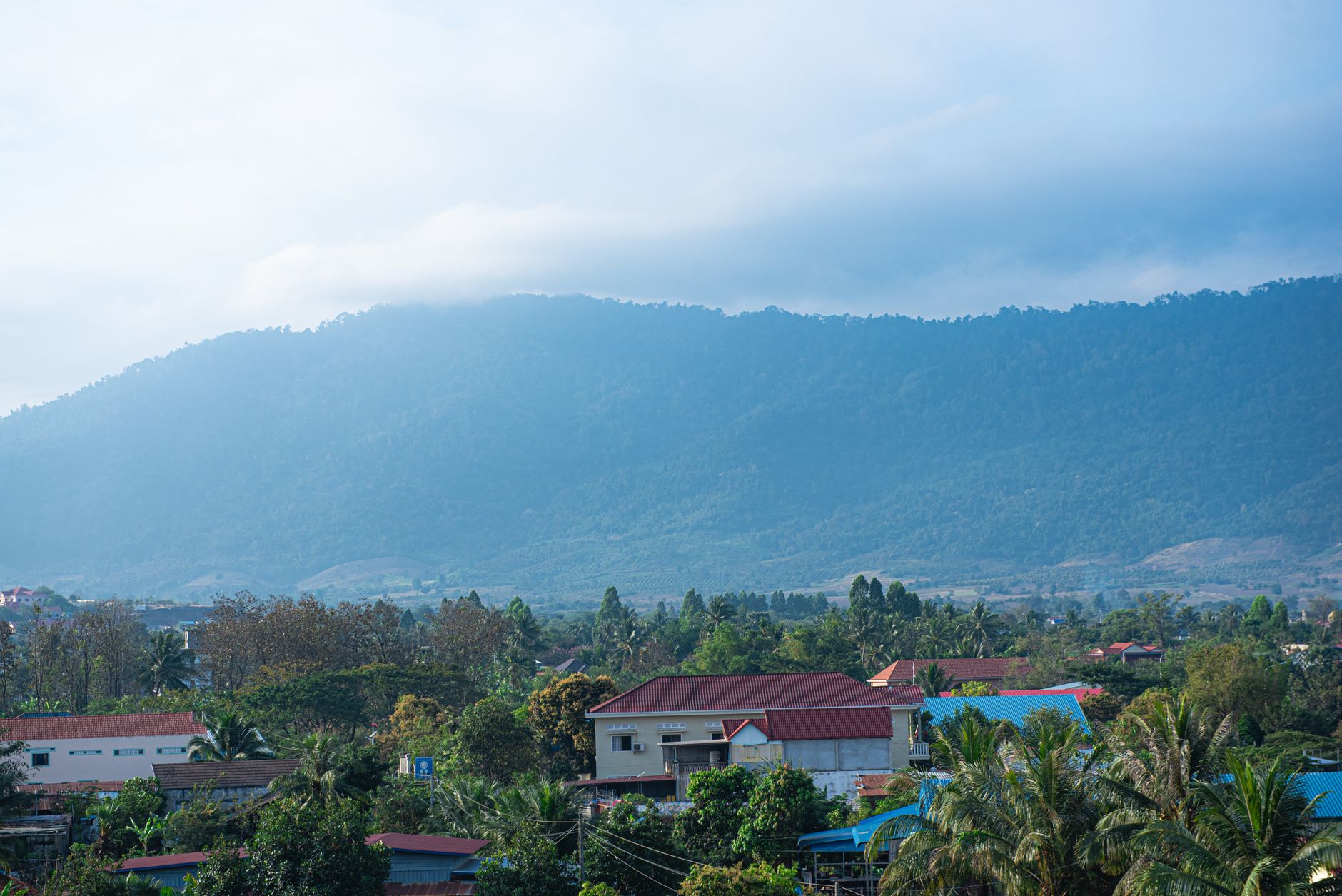
The landscape keeps changing shape. Tonle Sap swells from roughly 2,500 to 16,000 square kilometers between dry and wet season, the Mekong cuts north to south, and the coast opens into ferries bound for Sihanoukville and Koh Rong. Head east and the country rises into the red-soil plateaus of Mondulkiri and Ratanakiri, where waterfalls, forest roads, and indigenous villages replace the lowland rice plain. Even Cambodia’s quieter corners have pedigree: Sambor Prei Kuk holds some of Southeast Asia’s most unusual early brick temples, centuries older than the monuments most visitors came for.
Origins, Funan and Chenla, c. 4000 BCE-802 CE
A burial at Prohear gives the game away. Under the earth lay gold, silver, beads, and the remains of a woman who had been sent into death dressed as someone important, sometime between 150 BCE and 50 CE. Long before the first towers rose over the plain, the lower Mekong already knew rank, ceremony, trade, and violence.
Then the Chinese began writing down what they saw or thought they saw. They called the early kingdom Funan, a riverine power tied to the sea, to India, to China, and, by way of astonishing trade routes, even to the Roman world. Roman medallions from the age of Antoninus Pius and Marcus Aurelius turned up at Oc Eo. One can picture them passing from hand to hand in damp delta heat, far from the Mediterranean that minted them.
Ce que l'on ignore souvent, c'est que Cambodia's founding legend begins not with conquest alone but with a marriage. The Brahman Kaundinya arrives, the naga princess Soma resists, then the two are joined, and a kingdom is imagined into being. Legend, yes. But revealing legend. Power here had to marry the land before it could rule it.
By the 6th and 7th centuries, Chenla had absorbed Funan and pushed authority inland. At Sambor Prei Kuk, the old Isanapura, brick sanctuaries appeared among the trees, some of them octagonal, as if Khmer architecture were still trying out its future signatures. An inscription dated 13 September 627, under Isanavarman I, brings us suddenly close to named power. A date. A king. A capital. The stage is set for Angkor.
Isanavarman I feels less like a shadow than many early rulers because his reign leaves us something precious in Southeast Asian history: a date you can almost touch.
Some graves at Phum Snay contained the left limbs of domestic animals as offerings, a small and eerie sign that ritual precision mattered thousands of years before Angkor.
The Angkorian Empire, 802-1431
On a mountain sanctuary in 802, Jayavarman II performed a ceremony that later generations remembered as the birth of a united Khmer kingship. It was theater, of course, but the sort of theater that changes history. A ruler declares himself more than a local strongman, cuts symbolic ties with foreign domination, and suddenly the landscape begins to answer in reservoirs, embankments, and temples.
The kings who followed thought on a gigantic scale. Yashovarman I shifted the center toward the Angkor plain; engineers drew water across the land with a confidence bordering on insolence; then, in 1113, Suryavarman II seized power and began Angkor Wat, that vast sandstone statement whose galleries still carry the chill of dawn and the dust of empire. He built a funerary temple, a political manifesto, and a cosmic diagram all at once. Not bad for one reign.
Then came catastrophe. In 1177, Cham forces advanced by water and sacked Angkor, one of those national humiliations that burn for centuries. Reliefs later carved at Bayon still seem to vibrate with the memory of battle boats and panic. Ce que l'on ignore souvent, c'est that the empire's most serene faces were carved after one of its worst traumas.
The avenger was Jayavarman VII, already an older man when he took power after 1181. He reconquered the realm, embraced Mahayana Buddhism, raised Angkor Thom, covered the roads with rest houses and hospitals, and ruled with the fervor of someone who had looked directly at disaster. Beside him stood women too often reduced to footnotes: Queen Jayarajadevi, intensely devout, and later her sister Indradevi, an intellectual of unusual clarity, placed at the head of a Buddhist monastery.
But building on this scale extracts a price. By the 13th and 14th centuries, the empire was changing from within as Theravada Buddhism spread, court ideologies shifted, and external pressure mounted. In 1431, after Siamese attacks, the old Angkorian center lost its primacy. The stones remained. The court moved on.
Jayavarman VII was no marble saint: he appears instead as an aging victor, grief-stricken, devout, relentless, and perhaps a little intoxicated by the idea of remaking the world in stone.
Chinese envoy Zhou Daguan, who visited Angkor in 1296, noted that elite women handled trade in the markets while noble men moved through a court soaked in rank and ritual.
Post-Angkor Kingdoms, 1431-1863
After Angkor, the kingdom did not vanish; it became precarious. Courts shifted southward, power gravitated toward the river world around Phnom Penh and later Oudong, and Cambodian kings learned the exhausting art of survival between stronger neighbors. Siam pressed from the west, Vietnam from the east. A coronation could depend as much on foreign backing as on local legitimacy.
The setting changed with the politics. Instead of imperial capitals on a monumental plain, one thinks of river ports, lacquered halls, barges on the Mekong, and royal households carrying their archives, regalia, and anxieties from one seat to another. This is less famous than Angkor. It is also more human.
Ce que l'on ignore souvent, c'est how often Cambodia's sovereigns were trapped in family quarrels sharpened by outside powers. Princes appealed to Bangkok or Huế; rivals returned with foreign troops; whole reigns were spent negotiating tribute, hostages, and the humiliating arithmetic of dependency. The kingdom survived not because it was strong, but because it was stubborn.
In the 19th century the pressure became almost unbearable. Vietnamese influence deepened under Emperor Minh Mang, Siam contested every advantage, and Cambodian sovereignty looked dangerously theoretical. When King Norodom accepted French protection in 1863, it was not a romantic embrace of Europe. It was a wager that one master might keep the others at bay.
King Ang Duong, scholar and restorer, spent much of his reign trying to preserve dignity in a kingdom whose neighbors treated it like disputed inheritance.
During the long post-Angkor centuries, royal capitals shifted often enough that legitimacy in Cambodia came to depend not on one fixed city but on the moving body of the court itself.
French Protectorate and Independence, 1863-1970
The French arrived with paperwork, gunboats, and a familiar promise: protection. King Norodom signed the protectorate treaty in 1863, hoping to save the kingdom from being swallowed whole by Siam and Vietnam. Paris, naturally, had its own ideas. By the 1880s the protectorate had thickened into direct control, and in Phnom Penh the colonial city took shape with quays, ministries, villas, and the bureaucratic confidence of empire.
Yet Cambodia was never simply a passive set. Royal ritual remained potent, monks remained central, and the court still mattered as spectacle and symbol. One can imagine the rustle of silk in the palace compound, the heat held under tiled roofs, the mingling of incense and river air, while French officials convinced themselves they were the true authors of order. They rarely are.
Ce que l'on ignore souvent, c'est that the French also helped repackage Angkor as both archaeological treasure and imperial advertisement. The ruins near Siem Reap became proof of a glorious Khmer past and, conveniently, of the colonial mission that claimed to rescue it. Restoration was real. So was the self-congratulation.
Independence came in 1953 under King Norodom Sihanouk, and with him Cambodia entered politics as performance. Charming, mercurial, brilliant at self-invention, Sihanouk abdicated in 1955 so he could govern more freely, made films, wrote songs, denounced enemies, courted non-alignment, and turned the young kingdom into a personal stage. For a time it worked. But beneath the choreography lay rural discontent, Cold War pressure, and a state more fragile than it looked.
Norodom Sihanouk could be prince, king, filmmaker, diplomat, populist, and autocrat in the span of a decade, which is precisely why he still dominates Cambodia's 20th century memory.
Sihanouk directed and starred in his own films, a sovereign who quite literally cast himself in the national story.
Republic, Revolution, and Reconstruction, 1970-present
In 1970, while Sihanouk was abroad, General Lon Nol deposed him and proclaimed the Khmer Republic. War widened at once. American bombing tore through parts of the countryside, the monarchy's spell broke, and Cambodia became one more front in a regional catastrophe. By April 1975 the Khmer Rouge entered Phnom Penh, and the city emptied in a matter of hours.
What followed remains almost unbearable to write plainly. Under Pol Pot's Democratic Kampuchea, money was abolished, religion attacked, families split apart, and prisons like S-21 turned administrative terror into daily routine. Children denounced parents. Monks were defrocked. Glasses could mark you as suspect. Nearly two million people died between execution, starvation, disease, and exhaustion.
Ce que l'on ignore souvent, c'est how banal some of the machinery looked. School buildings became torture centers. Rice fields became killing grounds. Bureaucratic notes, photographs, and confessions were filed with chilling neatness, as if neat handwriting could wash blood from policy. Cambodia's deepest scandal is not only the scale of the crime, but the paperwork of it.
Vietnamese forces overthrew the Khmer Rouge in January 1979, but peace did not spring back to life. Occupation, guerrilla war, famine, refugees, and diplomatic absurdities followed, with the Khmer Rouge retaining international recognition at the United Nations for years. Only in the 1990s, through the Paris Peace Agreements, UNTAC, elections, and the monarchy's restoration, did a new chapter begin, uneven and incomplete.
Today's Cambodia carries all of these layers at once. Phnom Penh remembers through memorials and traffic, Angkor endures near Siem Reap, and the old pre-Angkorian world still breathes at Sambor Prei Kuk. The country rebuilt, yes. But it did not forget, and that memory still shapes the kingdom's future.
King Norodom Sihamoni, reserved where his father was theatrical, reigns over a country that restored the monarchy after surviving one of the 20th century's most methodical collapses.
At S-21, thousands of prisoners were photographed on arrival; the regime that tried to erase human beings also created one of the most haunting visual archives in modern history.
Khmer treats speech as a social act before it becomes a transfer of information. You hear it in the soft landing of sentences, in the refusal to bruise the air, in the way a simple greeting like "soksabay" asks whether peace still lives inside the body. That is a better question than "how are you." It assumes life is an arrangement of inner weather.
The script looks embroidered rather than written, all loops and curls, as if each consonant had been taught to dance by a patient aunt. On a shop sign in Phnom Penh, on a noodle stall tarp in Siem Reap, on a hand-painted bus board heading toward Battambang, Khmer turns language into ornament without losing precision. A page of it resembles jewelry that has somehow learned grammar.
Then come the pronouns, and the foreigner discovers humiliation in its purest educational form. There is no innocent "I." Age, intimacy, rank, tenderness: all must be chosen before the sentence may proceed. "Bong" and "aun" mean older and younger sibling, yet they also map flirtation, politeness, commerce, family, and the little negotiations of daily life. A country reveals itself by the words it forces you to earn.
Cambodians often decline by bending rather than blocking. "Pi bak" means difficult, and sometimes difficult means no, sometimes later, sometimes you have asked the wrong question in the wrong shape. This is not evasiveness. It is manners with a moral core. Language here does not exist to win. It exists to let everyone leave the exchange with their face intact.
Cambodian food begins where many neighboring cuisines become timid. Prahok arrives first as a smell, then as a doctrine. Fermented fish paste does not seek approval; it seeks conversion, and it usually gets it. The first spoonful can feel like an argument, the second like memory, the third like evidence that civilization depends on controlled rot more than etiquette allows us to admit.
Rice is the axis. The Khmer phrase for eating, "sii bay," says as much with admirable economy: to eat is to eat rice. Everything else circles it in varying degrees of splendor and necessity. At dawn in Phnom Penh, bai sach chrouk appears with grilled pork, pickles, broth, and broken grains that hold the meat juices like small ceramic bowls. By midmorning, nom banh chok has already vanished from the pavement because breakfast here keeps banker’s hours and no sentimentality.
Amok trey, when it is made for Cambodians rather than for cameras, has the grave softness of a steamed custard and the intelligence of kreung paste working in the dark: lemongrass, galangal, turmeric, kaffir lime leaf. Samlor korko tastes of fields, ponds, and persistence. Lok lak is often introduced as beef with pepper and lime, which is accurate in the way saying opera is singing is accurate. The point is Kampot pepper, that floral black sting from the south, and the shock of salt and acid against flesh.
Cuisine in Cambodia is often explained through comparison to Thailand or Vietnam, which is lazy and faintly rude. Better to say this: Cambodia cooks with old memory. It likes smoke, sourness, herbs, pond fish, green mango, morning broth, roadside charcoal, and the complicated glamour of things preserved in jars. In Kampot and Kep, pepper and crab finish each other’s sentences. In every market, the nose understands before the mind does.
Cambodia believes that the body can speak before the mouth commits itself. The sampeah, palms pressed and head inclined, is not decorative courtesy. It is syntax. The height of the hands changes with age, status, reverence; a child, a vendor, a monk, a grandparent do not receive the same architecture of respect. A handshake feels blunt by comparison, like eating soup with a hammer.
Shoes come off. Voices stay low. Feet, those unpoetic instruments, should not point at people or sacred images. Heads should not be touched, not even in what foreigners imagine is affection, because the head carries a moral charge the hand has no right to invade. Much of this can sound ceremonial on paper. In life it feels practical, almost tender. A society has every right to decide which parts of the body may behave badly.
You notice another rule after a few days in Phnom Penh or on a slower afternoon in Battambang: public composure counts as a form of generosity. Anger embarrasses the room, not just the angry person. Refusal softens itself. Requests arrive with cushioning. The result is not falseness. It is choreography. People make space for one another by lowering the temperature of every exchange.
Foreigners often imagine politeness as a thin glaze over desire. Cambodia suggests the opposite. Etiquette here is a serious art, one that turns ordinary transactions into little acts of social protection. A market, a family table, a pagoda courtyard: all run on the same delicate premise. Do not make another person lose face if you can help it. Civilization may be nothing more noble than that.
Theravada Buddhism in Cambodia does not sit behind glass. It breathes in traffic fumes, in market steam, in the gold flicker of neighborhood shrines where incense sticks lean at doubtful angles and still manage their work. Monks in saffron robes pass a phone shop, a lottery stall, a Lexus dealership, and nothing clashes. The sacred here has better manners than the secular. It does not demand a stage.
Merit is a daily economy. People offer food to monks at sunrise, leave flowers, light candles, sponsor repairs, finance funerary rites, and speak of bap, karmic fault, with the ease other societies reserve for bad luck. Religion is not confined to the pagoda; it informs the weather of decisions. Why do this? Why avoid that? Because the visible world is porous, and every act stains or clarifies the next.
The dead remain close. Cambodia’s 20th century made sure of that. Ancestor rites carry grief that has not finished its sentence, and Pchum Ben, the festival for the dead, has an intensity that foreigners feel even when they miss half the meaning. Rice offerings, chants before dawn, names spoken into ritual time: the ceremony does not erase history. It gives grief a table and tells it to sit properly.
At great temple sites like Angkor near Siem Reap or the older brick sanctuaries of Sambor Prei Kuk, Hindu past and Buddhist present share stone with surprising civility. A lintel remembers Vishnu. A modern prayer asks the Buddha for protection. Cambodia has never had much interest in pure categories. It prefers continuities, overlays, survivals. Faith here behaves like roots under a courtyard wall: invisible until they move the stones.
Cambodian architecture has a habit of making the visitor feel physically smaller and historically less certain. Angkor Wat is the famous example, of course, but fame obscures method. The temples were built to control distance, shadow, ascent, and revelation with almost indecent intelligence. Causeways slow the body. Galleries cool it. Towers with lotus-bud profiles draw the eye upward until devotion becomes a muscular event.
But Cambodia’s architectural genius did not begin and end at Angkor. Sambor Prei Kuk, older by centuries, keeps its brick towers among the trees with the discretion of someone who knows pedigree needs no advertisement. Their octagonal forms look experimental even now, as if the builders had the confidence to sketch in masonry. Then the later empire arrives and scales everything into theology: reservoirs like inland seas, barays that turn water into statecraft, temple mountains that claim the cosmos in tiers of sandstone.
The urban fabric tells another story. In Phnom Penh, French colonial villas, Chinese shophouses, New Khmer Architecture from the 1950s and 1960s, and improvised contemporary additions coexist with the stubbornness of relatives trapped at the same wedding. Vann Molyvann’s work matters because he understood that concrete in the tropics must negotiate heat, rain, airflow, ceremony, and national ambition all at once. Architecture can be political without becoming boring. That is rarer than architects admit.
Cambodia builds for climate with a directness that deserves respect. Stilt houses answer floodwater. Deep eaves answer rain. Ventilation answers the fact that air, when trapped, becomes an enemy. Beauty follows function here more often than the reverse, though no one says so that crudely. A house lifted above the ground is already a philosophy.
Cambodian art distrusts emptiness. Even when a surface appears calm, some patient intelligence has passed over it and left a pattern, a polish, a pressure of fingers. Silk weaving carries river light inside it. Silverwork for ritual bowls and ceremonial objects knows how to catch shadow as well as shine. Lacquer, carving, painted temple ceilings, apsara gestures in dance costumes: the hand remains visible, which is another way of saying the human presence has not been edited out.
The apsara is the country’s most misread image. Foreigners see grace and stop there. Grace is the least interesting part. The hand positions are exact. The torso holds composure under strain. Every bend of the fingers suggests that elegance is a discipline before it becomes pleasure. In classical dance, art is not self-expression. It is codified emotion so refined that it begins to look supernatural.
Cambodia’s modern art carries a wound and refuses melodrama. Too much was broken in the 1970s for innocence to survive as a style. Yet painters, musicians, filmmakers, tattoo artists, and craftspeople keep working in Phnom Penh, in Battambang, in quieter provincial workshops where the market is thin and the commitment real. Survival has its own aesthetic. It prefers precision to grand declaration.
Visit a market stall selling handwoven krama scarves and you meet the same principle in humbler form. The checked cotton cloth is useful, ceremonial, political, intimate. It can wipe sweat, carry a child, shade the neck, signal belonging. Very few objects deserve the word national. This one does. A country sometimes condenses into fabric.
Angkor Wat is the headline, but Cambodia’s temple story starts earlier and runs wider, from the pre-Angkor brick sanctuaries of Sambor Prei Kuk to hilltop ruins near Takéo.
Phnom Penh carries the country’s hardest chapters in plain sight. Royal compounds, French-era boulevards, and genocide memorials sit within the same urban rhythm, which is exactly why the city matters.
Cambodian cooking runs on fermentation, herbs, charcoal, and precision. Eat bai sach chrouk at breakfast, seek out fish amok with some restraint, and save room for crab and Kampot pepper on the coast.
The Mekong, Tonle Sap, and Gulf coast shape how the country moves and breathes. Ferry days to Koh Rong, sunset riverfront walks in Phnom Penh, and wet-season lake journeys all show different Cambodias.
Mondulkiri, Ratanakiri, and the Cardamom range pull the country away from temple circuits and toward waterfalls, elephant habitat, red dirt roads, and some of mainland Southeast Asia’s least-developed landscapes.
Cambodia still works for travelers who count costs. Street food, guesthouses, buses, and cash-first daily life keep the floor low, though Angkor passes, island boats, and private drivers can raise the total fast.
12 cities — start with the ones we'd send you to first.
A capital where a royal palace sits a ten-minute tuk-tuk ride from the Tuol Sleng Genocide Museum, and the tension between those two facts is the whole story of modern Cambodia.
The town that exists because Angkor Wat does — but stay past the temple rush and you'll find French shophouses, a night market that smells of grilled corn and lemongrass, and a generation of Cambodians rebuilding an arts
Cambodia's second city runs on rice mills and bamboo trains — the norry, a hand-built contraption that still rattles along French-colonial tracks — and its circus school, Phare Ponleu Selpak, trains children of genocide
A riverside town of peeling colonial arcades where the world's most coveted black pepper grows on the hillsides above, and the main evening activity is watching the Kampot River turn copper at dusk from a plastic chair.
Once a seaside retreat for the Khmer elite, bombed to ruins and never fully rebuilt, Kep now offers crab shacks on a narrow beach, a ghost-town hillside of abandoned modernist villas, and a crab market that opens at dawn
Cambodia's main coastal city has had a chaotic decade of casino construction and demolition, but the ferry dock remains the gateway to islands that still have more jungle than beach bars.
An island where the electricity runs on generators, the bioluminescent plankton lights the shallows blue on moonless nights, and the interior is dense enough that most visitors never leave the beach strip.
A red-laterite plateau in the northeast where Jarai and Tampuan communities maintain spirit forests, crater lakes fill extinct volcanoes, and the provincial capital Banlung is small enough that the market closes by noon.
Rolling grasslands and pine forests that look nothing like the Cambodia of postcards, home to the Bunong people and the Elephant Valley Project, where rescued logging elephants are observed — not ridden — from a respectf
This is Cambodia at its most direct: royal compounds, concrete growth, rivers full of traffic, and a capital that never quite lets you forget how much history passed through it at speed. Phnom Penh is the anchor, but the wider corridor toward Takéo shows how quickly the city gives way to rice fields, older temple sites, and provincial towns that move to a quieter clock.
Siem Reap may be Cambodia's best-known base, but the region is bigger than sunrise at Angkor Wat. Battambang adds galleries, colonial-era streets, and one of the country's best food scenes, while Sambor Prei Kuk reminds you that Khmer temple history did not begin in the 12th century. This is the region for stone, memory, and long days that start early.
The Mekong east of the main tourist circuit feels slower, wider, and less arranged for visitors. Kratie is the obvious base, with river sunsets and dolphin trips, while the land beyond opens into floodplain villages and stretches of road where Cambodia feels agricultural before it feels touristic.
Mondulkiri and Ratanakiri sit on the country's red-soil plateau, where the air is cooler in the dry season and the landscape shifts from floodplain flatness to forest, waterfalls, and rolling hills. This is where Cambodia stops looking like postcard Angkor and starts looking rawer, greener, and more thinly settled.
The southwest coast runs on three different moods. Kampot is the river town with old shophouses and pepper farms, Kep is the faded seaside retreat with crab shacks and a strong sense of having peaked decades ago, and Sihanoukville is mostly a ferry and transport hub now, useful rather than lovely. Offshore, Koh Rong changes the tone completely with beaches, boats, and late starts.
From serpent legend and temple empire to genocide, restoration, and a modern constitutional monarchy
Graves filled with gold, silver, and beads reveal that rank and ceremony shaped the lower Mekong long before written Cambodian history begins. One richly furnished burial, often called the 'lady of Prohear,' gives prehistoric Cambodia a human face.
Chinese sources begin describing a polity later called Funan, tied to maritime trade and river networks. Cambodia enters written history through foreign eyes, already connected to a world much larger than the delta.
The legend of the Brahman Kaundinya and the naga princess Soma frames Cambodia's origins as a marriage between incoming power and local legitimacy. It is myth, but myth with political intent.
Power shifts inland as Chenla gradually overtakes Funan. The center of gravity moves away from the maritime delta toward the interior, preparing the ground for later Khmer state formation.
An inscription tied to 13 September 627 anchors the reign of Isanavarman I and the capital of Isanapura, today Sambor Prei Kuk. Brick sanctuaries in the forest announce a new architectural confidence.
A ceremony later remembered as the founding act of Khmer imperial sovereignty gives Cambodia one of its defining political myths. Whether every detail is factual matters less than the power of the performance.
The royal center consolidates in the Angkor region, where waterworks, temples, and urban planning begin to reshape the plain. The empire's future capital takes form in reservoirs and sacred geometry.
A forceful new ruler ascends and soon begins the temple that will define Cambodia in the global imagination. Angkor Wat emerges as theology, statecraft, and royal ambition carved into sandstone.
Cham forces attack by water and devastate the Khmer capital. The shock is profound, and later Cambodian memory will treat it as one of the empire's great moments of humiliation.
After reconquest, Jayavarman VII remakes the kingdom with Angkor Thom, Bayon, roads, hospitals, and a Buddhist royal vision unlike what came before. It is one of Southeast Asia's most intense building reigns.
The Chinese envoy arrives and leaves the most vivid eyewitness account of Angkorian daily life. Thanks to him, court ritual, markets, clothing, and domestic habits emerge from the stone into prose.
After Siamese attacks, Angkor loses its political primacy and the court's center shifts southward. Cambodia survives, but the imperial age of Angkor is over.
The river city regains royal importance, reflecting Cambodia's turn toward a more mobile, water-oriented political geography. The future capital grows from the confluence rather than from a temple plain.
King Ang Duong inherits a kingdom squeezed by Siam and Vietnam and spends his reign trying to preserve what sovereignty he can. His tools are diplomacy, culture, and endurance rather than conquest.
King Norodom accepts French protection in the hope of saving Cambodia from its more immediate neighbors. Protection soon becomes control, and colonial rule reshapes Phnom Penh, administration, and the presentation of Angkor.
After diplomatic pressure on Siam, the Angkor region is returned, allowing the most iconic Khmer monuments to sit once more within Cambodia's formal borders. Heritage and politics meet in one decisive transfer.
Norodom Sihanouk secures independence and becomes the central actor in the country's modern political drama. The monarchy survives, but in altered form, part tradition and part personal stagecraft.
Sihanouk is deposed while abroad, and Cambodia is pulled more violently into the wider Indochina war. The old royal order collapses, and the republic proves far weaker than its proclamations.
On 17 April 1975, the capital falls and is emptied almost immediately. The regime of Democratic Kampuchea begins with evacuation, suspicion, and radical social destruction on an unimaginable scale.
Vietnamese forces overthrow the Khmer Rouge in January, but peace does not return overnight. Cambodia enters another bitter phase of occupation, resistance, famine, and diplomatic distortion.
A long war at last moves toward settlement through international negotiation. The accords open the way for UNTAC, repatriation, elections, and the difficult reconstruction of state life.
Elections and a new constitution restore the Kingdom of Cambodia, with Norodom Sihanouk once again as king. The restoration is symbolic and practical at once: a return, though not to the old world.
After Sihanouk's abdication, his son Norodom Sihamoni ascends the throne. The monarchy enters a quieter phase, less theatrical but still central to the state's ceremonial continuity.
The inscription of Preah Vihear as a World Heritage Site brings pride, diplomatic tension, and renewed attention to Cambodia's architectural inheritance beyond Angkor. Heritage remains political, as it always was.
The capital's main international gateway shifts to the new Techo International Airport, marking Cambodia's ambition to modernize infrastructure while keeping Phnom Penh at the center of national life. The kingdom still builds for the future, as it did in older forms centuries ago.
Origins, Funan and Chenla
Isanavarman I feels less like a shadow than many early rulers because his reign leaves us something precious in Southeast Asian history: a date you can almost touch.
A burial at Prohear gives the game away. Under the earth lay gold, silver, beads, and the remains of a woman who had been sent into death dressed as someone important, sometime between 150 BCE and 50 CE. Long before the first towers rose over the plain, the lower Mekong already knew rank, ceremony, trade, and violence.
Then the Chinese began writing down what they saw or thought they saw. They called the early kingdom Funan, a riverine power tied to the sea, to India, to China, and, by way of astonishing trade routes, even to the Roman world. Roman medallions from the age of Antoninus Pius and Marcus Aurelius turned up at Oc Eo. One can picture them passing from hand to hand in damp delta heat, far from the Mediterranean that minted them.
Ce que l'on ignore souvent, c'est que Cambodia's founding legend begins not with conquest alone but with a marriage. The Brahman Kaundinya arrives, the naga princess Soma resists, then the two are joined, and a kingdom is imagined into being. Legend, yes. But revealing legend. Power here had to marry the land before it could rule it.
By the 6th and 7th centuries, Chenla had absorbed Funan and pushed authority inland. At Sambor Prei Kuk, the old Isanapura, brick sanctuaries appeared among the trees, some of them octagonal, as if Khmer architecture were still trying out its future signatures. An inscription dated 13 September 627, under Isanavarman I, brings us suddenly close to named power. A date. A king. A capital. The stage is set for Angkor.
Some graves at Phum Snay contained the left limbs of domestic animals as offerings, a small and eerie sign that ritual precision mattered thousands of years before Angkor.
The Angkorian Empire
Jayavarman VII was no marble saint: he appears instead as an aging victor, grief-stricken, devout, relentless, and perhaps a little intoxicated by the idea of remaking the world in stone.
On a mountain sanctuary in 802, Jayavarman II performed a ceremony that later generations remembered as the birth of a united Khmer kingship. It was theater, of course, but the sort of theater that changes history. A ruler declares himself more than a local strongman, cuts symbolic ties with foreign domination, and suddenly the landscape begins to answer in reservoirs, embankments, and temples.
The kings who followed thought on a gigantic scale. Yashovarman I shifted the center toward the Angkor plain; engineers drew water across the land with a confidence bordering on insolence; then, in 1113, Suryavarman II seized power and began Angkor Wat, that vast sandstone statement whose galleries still carry the chill of dawn and the dust of empire. He built a funerary temple, a political manifesto, and a cosmic diagram all at once. Not bad for one reign.
Then came catastrophe. In 1177, Cham forces advanced by water and sacked Angkor, one of those national humiliations that burn for centuries. Reliefs later carved at Bayon still seem to vibrate with the memory of battle boats and panic. Ce que l'on ignore souvent, c'est that the empire's most serene faces were carved after one of its worst traumas.
The avenger was Jayavarman VII, already an older man when he took power after 1181. He reconquered the realm, embraced Mahayana Buddhism, raised Angkor Thom, covered the roads with rest houses and hospitals, and ruled with the fervor of someone who had looked directly at disaster. Beside him stood women too often reduced to footnotes: Queen Jayarajadevi, intensely devout, and later her sister Indradevi, an intellectual of unusual clarity, placed at the head of a Buddhist monastery.
But building on this scale extracts a price. By the 13th and 14th centuries, the empire was changing from within as Theravada Buddhism spread, court ideologies shifted, and external pressure mounted. In 1431, after Siamese attacks, the old Angkorian center lost its primacy. The stones remained. The court moved on.
Chinese envoy Zhou Daguan, who visited Angkor in 1296, noted that elite women handled trade in the markets while noble men moved through a court soaked in rank and ritual.
Post-Angkor Kingdoms
King Ang Duong, scholar and restorer, spent much of his reign trying to preserve dignity in a kingdom whose neighbors treated it like disputed inheritance.
After Angkor, the kingdom did not vanish; it became precarious. Courts shifted southward, power gravitated toward the river world around Phnom Penh and later Oudong, and Cambodian kings learned the exhausting art of survival between stronger neighbors. Siam pressed from the west, Vietnam from the east. A coronation could depend as much on foreign backing as on local legitimacy.
The setting changed with the politics. Instead of imperial capitals on a monumental plain, one thinks of river ports, lacquered halls, barges on the Mekong, and royal households carrying their archives, regalia, and anxieties from one seat to another. This is less famous than Angkor. It is also more human.
Ce que l'on ignore souvent, c'est how often Cambodia's sovereigns were trapped in family quarrels sharpened by outside powers. Princes appealed to Bangkok or Huế; rivals returned with foreign troops; whole reigns were spent negotiating tribute, hostages, and the humiliating arithmetic of dependency. The kingdom survived not because it was strong, but because it was stubborn.
In the 19th century the pressure became almost unbearable. Vietnamese influence deepened under Emperor Minh Mang, Siam contested every advantage, and Cambodian sovereignty looked dangerously theoretical. When King Norodom accepted French protection in 1863, it was not a romantic embrace of Europe. It was a wager that one master might keep the others at bay.
During the long post-Angkor centuries, royal capitals shifted often enough that legitimacy in Cambodia came to depend not on one fixed city but on the moving body of the court itself.
French Protectorate and Independence
Norodom Sihanouk could be prince, king, filmmaker, diplomat, populist, and autocrat in the span of a decade, which is precisely why he still dominates Cambodia's 20th century memory.
The French arrived with paperwork, gunboats, and a familiar promise: protection. King Norodom signed the protectorate treaty in 1863, hoping to save the kingdom from being swallowed whole by Siam and Vietnam. Paris, naturally, had its own ideas. By the 1880s the protectorate had thickened into direct control, and in Phnom Penh the colonial city took shape with quays, ministries, villas, and the bureaucratic confidence of empire.
Yet Cambodia was never simply a passive set. Royal ritual remained potent, monks remained central, and the court still mattered as spectacle and symbol. One can imagine the rustle of silk in the palace compound, the heat held under tiled roofs, the mingling of incense and river air, while French officials convinced themselves they were the true authors of order. They rarely are.
Ce que l'on ignore souvent, c'est that the French also helped repackage Angkor as both archaeological treasure and imperial advertisement. The ruins near Siem Reap became proof of a glorious Khmer past and, conveniently, of the colonial mission that claimed to rescue it. Restoration was real. So was the self-congratulation.
Independence came in 1953 under King Norodom Sihanouk, and with him Cambodia entered politics as performance. Charming, mercurial, brilliant at self-invention, Sihanouk abdicated in 1955 so he could govern more freely, made films, wrote songs, denounced enemies, courted non-alignment, and turned the young kingdom into a personal stage. For a time it worked. But beneath the choreography lay rural discontent, Cold War pressure, and a state more fragile than it looked.
Sihanouk directed and starred in his own films, a sovereign who quite literally cast himself in the national story.
Republic, Revolution, and Reconstruction
King Norodom Sihamoni, reserved where his father was theatrical, reigns over a country that restored the monarchy after surviving one of the 20th century's most methodical collapses.
In 1970, while Sihanouk was abroad, General Lon Nol deposed him and proclaimed the Khmer Republic. War widened at once. American bombing tore through parts of the countryside, the monarchy's spell broke, and Cambodia became one more front in a regional catastrophe. By April 1975 the Khmer Rouge entered Phnom Penh, and the city emptied in a matter of hours.
What followed remains almost unbearable to write plainly. Under Pol Pot's Democratic Kampuchea, money was abolished, religion attacked, families split apart, and prisons like S-21 turned administrative terror into daily routine. Children denounced parents. Monks were defrocked. Glasses could mark you as suspect. Nearly two million people died between execution, starvation, disease, and exhaustion.
Ce que l'on ignore souvent, c'est how banal some of the machinery looked. School buildings became torture centers. Rice fields became killing grounds. Bureaucratic notes, photographs, and confessions were filed with chilling neatness, as if neat handwriting could wash blood from policy. Cambodia's deepest scandal is not only the scale of the crime, but the paperwork of it.
Vietnamese forces overthrew the Khmer Rouge in January 1979, but peace did not spring back to life. Occupation, guerrilla war, famine, refugees, and diplomatic absurdities followed, with the Khmer Rouge retaining international recognition at the United Nations for years. Only in the 1990s, through the Paris Peace Agreements, UNTAC, elections, and the monarchy's restoration, did a new chapter begin, uneven and incomplete.
Today's Cambodia carries all of these layers at once. Phnom Penh remembers through memorials and traffic, Angkor endures near Siem Reap, and the old pre-Angkorian world still breathes at Sambor Prei Kuk. The country rebuilt, yes. But it did not forget, and that memory still shapes the kingdom's future.
At S-21, thousands of prisoners were photographed on arrival; the regime that tried to erase human beings also created one of the most haunting visual archives in modern history.
Khmer treats speech as a social act before it becomes a transfer of information. You hear it in the soft landing of sentences, in the refusal to bruise the air, in the way a simple greeting like "soksabay" asks whether peace still lives inside the body. That is a better question than "how are you." It assumes life is an arrangement of inner weather.
The script looks embroidered rather than written, all loops and curls, as if each consonant had been taught to dance by a patient aunt. On a shop sign in Phnom Penh, on a noodle stall tarp in Siem Reap, on a hand-painted bus board heading toward Battambang, Khmer turns language into ornament without losing precision. A page of it resembles jewelry that has somehow learned grammar.
Then come the pronouns, and the foreigner discovers humiliation in its purest educational form. There is no innocent "I." Age, intimacy, rank, tenderness: all must be chosen before the sentence may proceed. "Bong" and "aun" mean older and younger sibling, yet they also map flirtation, politeness, commerce, family, and the little negotiations of daily life. A country reveals itself by the words it forces you to earn.
Cambodians often decline by bending rather than blocking. "Pi bak" means difficult, and sometimes difficult means no, sometimes later, sometimes you have asked the wrong question in the wrong shape. This is not evasiveness. It is manners with a moral core. Language here does not exist to win. It exists to let everyone leave the exchange with their face intact.
Cambodian food begins where many neighboring cuisines become timid. Prahok arrives first as a smell, then as a doctrine. Fermented fish paste does not seek approval; it seeks conversion, and it usually gets it. The first spoonful can feel like an argument, the second like memory, the third like evidence that civilization depends on controlled rot more than etiquette allows us to admit.
Rice is the axis. The Khmer phrase for eating, "sii bay," says as much with admirable economy: to eat is to eat rice. Everything else circles it in varying degrees of splendor and necessity. At dawn in Phnom Penh, bai sach chrouk appears with grilled pork, pickles, broth, and broken grains that hold the meat juices like small ceramic bowls. By midmorning, nom banh chok has already vanished from the pavement because breakfast here keeps banker’s hours and no sentimentality.
Amok trey, when it is made for Cambodians rather than for cameras, has the grave softness of a steamed custard and the intelligence of kreung paste working in the dark: lemongrass, galangal, turmeric, kaffir lime leaf. Samlor korko tastes of fields, ponds, and persistence. Lok lak is often introduced as beef with pepper and lime, which is accurate in the way saying opera is singing is accurate. The point is Kampot pepper, that floral black sting from the south, and the shock of salt and acid against flesh.
Cuisine in Cambodia is often explained through comparison to Thailand or Vietnam, which is lazy and faintly rude. Better to say this: Cambodia cooks with old memory. It likes smoke, sourness, herbs, pond fish, green mango, morning broth, roadside charcoal, and the complicated glamour of things preserved in jars. In Kampot and Kep, pepper and crab finish each other’s sentences. In every market, the nose understands before the mind does.
Cambodia believes that the body can speak before the mouth commits itself. The sampeah, palms pressed and head inclined, is not decorative courtesy. It is syntax. The height of the hands changes with age, status, reverence; a child, a vendor, a monk, a grandparent do not receive the same architecture of respect. A handshake feels blunt by comparison, like eating soup with a hammer.
Shoes come off. Voices stay low. Feet, those unpoetic instruments, should not point at people or sacred images. Heads should not be touched, not even in what foreigners imagine is affection, because the head carries a moral charge the hand has no right to invade. Much of this can sound ceremonial on paper. In life it feels practical, almost tender. A society has every right to decide which parts of the body may behave badly.
You notice another rule after a few days in Phnom Penh or on a slower afternoon in Battambang: public composure counts as a form of generosity. Anger embarrasses the room, not just the angry person. Refusal softens itself. Requests arrive with cushioning. The result is not falseness. It is choreography. People make space for one another by lowering the temperature of every exchange.
Foreigners often imagine politeness as a thin glaze over desire. Cambodia suggests the opposite. Etiquette here is a serious art, one that turns ordinary transactions into little acts of social protection. A market, a family table, a pagoda courtyard: all run on the same delicate premise. Do not make another person lose face if you can help it. Civilization may be nothing more noble than that.
Theravada Buddhism in Cambodia does not sit behind glass. It breathes in traffic fumes, in market steam, in the gold flicker of neighborhood shrines where incense sticks lean at doubtful angles and still manage their work. Monks in saffron robes pass a phone shop, a lottery stall, a Lexus dealership, and nothing clashes. The sacred here has better manners than the secular. It does not demand a stage.
Merit is a daily economy. People offer food to monks at sunrise, leave flowers, light candles, sponsor repairs, finance funerary rites, and speak of bap, karmic fault, with the ease other societies reserve for bad luck. Religion is not confined to the pagoda; it informs the weather of decisions. Why do this? Why avoid that? Because the visible world is porous, and every act stains or clarifies the next.
The dead remain close. Cambodia’s 20th century made sure of that. Ancestor rites carry grief that has not finished its sentence, and Pchum Ben, the festival for the dead, has an intensity that foreigners feel even when they miss half the meaning. Rice offerings, chants before dawn, names spoken into ritual time: the ceremony does not erase history. It gives grief a table and tells it to sit properly.
At great temple sites like Angkor near Siem Reap or the older brick sanctuaries of Sambor Prei Kuk, Hindu past and Buddhist present share stone with surprising civility. A lintel remembers Vishnu. A modern prayer asks the Buddha for protection. Cambodia has never had much interest in pure categories. It prefers continuities, overlays, survivals. Faith here behaves like roots under a courtyard wall: invisible until they move the stones.
Cambodian architecture has a habit of making the visitor feel physically smaller and historically less certain. Angkor Wat is the famous example, of course, but fame obscures method. The temples were built to control distance, shadow, ascent, and revelation with almost indecent intelligence. Causeways slow the body. Galleries cool it. Towers with lotus-bud profiles draw the eye upward until devotion becomes a muscular event.
But Cambodia’s architectural genius did not begin and end at Angkor. Sambor Prei Kuk, older by centuries, keeps its brick towers among the trees with the discretion of someone who knows pedigree needs no advertisement. Their octagonal forms look experimental even now, as if the builders had the confidence to sketch in masonry. Then the later empire arrives and scales everything into theology: reservoirs like inland seas, barays that turn water into statecraft, temple mountains that claim the cosmos in tiers of sandstone.
The urban fabric tells another story. In Phnom Penh, French colonial villas, Chinese shophouses, New Khmer Architecture from the 1950s and 1960s, and improvised contemporary additions coexist with the stubbornness of relatives trapped at the same wedding. Vann Molyvann’s work matters because he understood that concrete in the tropics must negotiate heat, rain, airflow, ceremony, and national ambition all at once. Architecture can be political without becoming boring. That is rarer than architects admit.
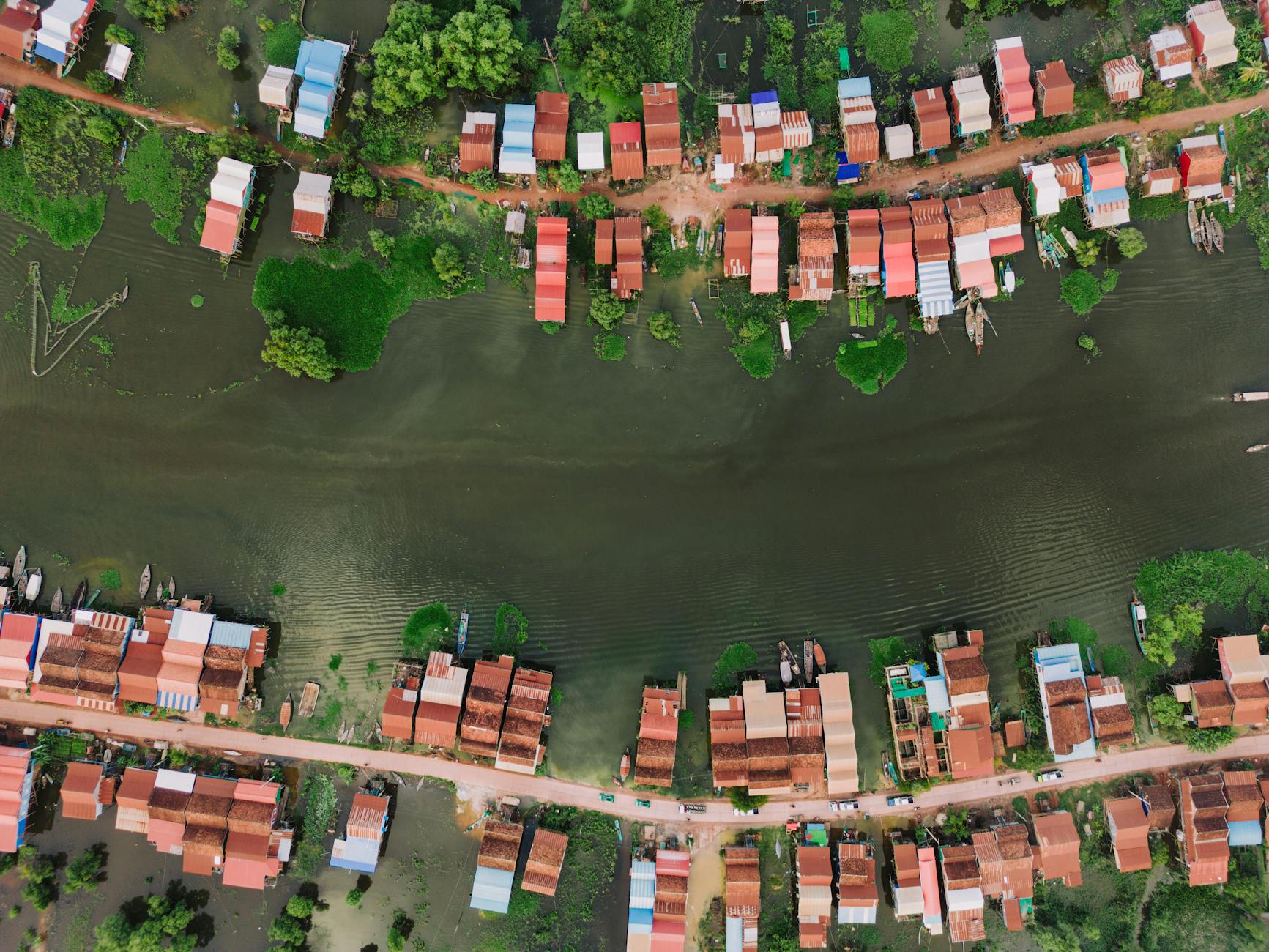
Cambodia builds for climate with a directness that deserves respect. Stilt houses answer floodwater. Deep eaves answer rain. Ventilation answers the fact that air, when trapped, becomes an enemy. Beauty follows function here more often than the reverse, though no one says so that crudely. A house lifted above the ground is already a philosophy.
Cambodian art distrusts emptiness. Even when a surface appears calm, some patient intelligence has passed over it and left a pattern, a polish, a pressure of fingers. Silk weaving carries river light inside it. Silverwork for ritual bowls and ceremonial objects knows how to catch shadow as well as shine. Lacquer, carving, painted temple ceilings, apsara gestures in dance costumes: the hand remains visible, which is another way of saying the human presence has not been edited out.
The apsara is the country’s most misread image. Foreigners see grace and stop there. Grace is the least interesting part. The hand positions are exact. The torso holds composure under strain. Every bend of the fingers suggests that elegance is a discipline before it becomes pleasure. In classical dance, art is not self-expression. It is codified emotion so refined that it begins to look supernatural.
Cambodia’s modern art carries a wound and refuses melodrama. Too much was broken in the 1970s for innocence to survive as a style. Yet painters, musicians, filmmakers, tattoo artists, and craftspeople keep working in Phnom Penh, in Battambang, in quieter provincial workshops where the market is thin and the commitment real. Survival has its own aesthetic. It prefers precision to grand declaration.
Visit a market stall selling handwoven krama scarves and you meet the same principle in humbler form. The checked cotton cloth is useful, ceremonial, political, intimate. It can wipe sweat, carry a child, shade the neck, signal belonging. Very few objects deserve the word national. This one does. A country sometimes condenses into fabric.
He arrives in the story with a spear, a ship, and the confidence of a man who thinks destiny has invited him personally. What matters is not whether every detail is factual, but that Cambodia remembered its beginning as a marriage with Soma, the local serpent princess, which says a great deal about how power imagined its own legitimacy.
She is the woman too many summaries hurry past, though the whole legend turns on her. Cambodia's political imagination begins with a local princess who does not disappear into the foreign hero's story but anchors it, which is why Neang Neak still haunts Khmer symbolism and marriage imagery.
He left less stone than some of his successors, but more idea. His genius was to turn ritual into statecraft, staging a ceremony so effective that later centuries remembered it as the moment Cambodia became more than a collection of rival powers.
He seized power, fought hard, and built harder. Angkor Wat was not just an act of devotion; it was a king's attempt to freeze authority in sandstone, and the temple outlived every military calculation that produced it.
He took power late, after disaster, which may explain the urgency of everything he did. The serene faces of Bayon belong to a reign born from trauma, and behind the Buddha-king image one senses a ruler trying to heal a wounded country by building faster than grief.
She was not ornamental royalty. Inscriptions present her as a learned woman, active in Buddhist education, which makes her one of the clearest reminders that Cambodia's court culture was shaped not only by warrior-kings but by women who taught, wrote, and influenced doctrine.
He spent his reign trying to preserve a kingdom squeezed by Siam and Vietnam, a task that required patience more than glory. Letters, diplomacy, and cultural patronage were his weapons, and his tragedy was to understand the danger clearly without having the power to remove it.
No one performed Cambodia more brilliantly, or more dangerously, than Sihanouk. He won independence, cultivated glamour, made films, changed titles as easily as costumes, and still could not prevent the country from sliding into catastrophe once the Cold War closed its hand around it.
He was not a demonic abstraction but an educated revolutionary who turned ideology into mass death with terrifying administrative calm. Cambodia cannot be understood if he is treated as a monster from outside history; the horror lies precisely in how human, organized, and deliberate the regime was.
Where his father dazzled, Sihamoni withdraws. A former ballet dancer and cultural figure, he embodies a monarchy that survives now less through political intervention than through continuity, restraint, and the quiet symbolism of endurance after rupture.
This is the short route for travelers who want Cambodia's political nerve center without pretending three days can cover the whole country. Start in Phnom Penh for riverfront history, markets, and the capital's hard 20th-century story, then drop south to Takéo for older temple ground and a quieter provincial tempo before looping back.
This route moves east instead of circling back toward the capital. Siem Reap gives you Angkor at full scale, Sambor Prei Kuk adds the earlier brick chapter that most travelers skip, and Kratie trades temple stone for Mekong light, river islands, and Irrawaddy dolphins if the timing works.
This is a Cambodia route for people who prefer texture over box-ticking. Battambang brings art spaces, French-era facades, and bamboo train absurdity; Kampot shifts into river town calm and pepper country; Kep ends the trip with crab markets, sea air, and a shoreline that still feels half-retired from the tourist economy.
Two weeks gives you room to cross Cambodia the long way, from the eastern plateau provinces to the Gulf of Thailand. Mondulkiri and Ratanakiri deliver waterfalls, red-dirt roads, and highland landscapes that feel far from Angkor; Sihanoukville is the practical ferry gate, and Koh Rong is where you cash in the travel time with sand and sea.
Dawn meal. Plastic stool, charcoal pork, broken rice, pickles, clear broth. Solo before work, families on scooters, office clerks in pressed shirts.
Breakfast only. Cold rice noodles, green fish gravy, banana blossom, herbs. Women in market clothes, schoolchildren, grandmothers, everyone before 9 a.m.
Lunch or dinner. Spoon, banana-leaf cup, steamed fish custard, rice on the side. Family tables, wedding feasts, careful conversation.
Midday home food. Deep bowl, vegetables, herbs, prahok, rice, shared plates. Grandmothers, cousins, long kitchens, ceiling fans.
Late lunch, early dinner. Beef cubes, lime-salt-pepper dip, lettuce, tomato, rice or fries. Friends, beer, unhurried appetite in Phnom Penh or Kampot.
Seaside ritual. Crab from the morning catch, green peppercorns, quick wok fire. Hands, shells, cold drinks, family noise in Kep.
Roadside pause. Sugarcane through rollers, ice, plastic bag or tall cup. Heat, dust, scooter helmets, immediate silence.

Most EU, US, UK, Canadian, and Australian travelers need a tourist visa for Cambodia. The official e-Visa costs USD 30, is single-entry, and allows a 30-day stay; visa on arrival is still available at Techo International Airport in Phnom Penh, Siem Reap-Angkor, and Sihanoukville. Submit the Cambodia e-Arrival card at arrival.gov.kh within 7 days before flying.
Cambodia runs on two currencies at once: the official one is the riel, but US dollars are used for hotels, transport, tours, and plenty of restaurant bills. Bring clean, untorn USD notes, because damaged bills are often refused, and expect small change in riel at roughly 4,100 KHR to 1 USD. Cards work in better hotels and upscale restaurants, but cash still does the real work.
Most long-haul travelers reach Cambodia with one stop in Bangkok, Singapore, Kuala Lumpur, Ho Chi Minh City, Hanoi, Seoul, or Guangzhou. The main international gateways are Techo International Airport for Phnom Penh, Siem Reap-Angkor for the temples, and Sihanoukville for the coast and islands. Cambodia is easy to reach by air; it is not a country you plan around international rail.
Buses and minivans still carry most travelers between Phnom Penh, Siem Reap, Battambang, Kampot, and Kep, while domestic flights save time on longer hops to Sihanoukville and back. Royal Railway is slow but useful on the Phnom Penh to Kampot to Sihanoukville line and on the route toward Battambang. Ferries from Sihanoukville are the standard way to reach Koh Rong.
Cambodia has two real seasons, not four. Dry season runs from November to April, with the most comfortable weather from November to January; wet season runs from May to October, when heavy afternoon rain turns the countryside bright green and the Tonle Sap swells dramatically. March and April are the hardest months for heat, often pushing 38 to 40C.
Mobile data is easy to get in Phnom Penh, Siem Reap, Kampot, and other main traveler hubs, and hotel or cafe Wi-Fi is usually good enough for route planning and calls. Card payments are still patchy, but QR payments are common among locals through ABA and other Cambodian banking apps. Short-stay visitors should treat cash as the default and data as easy.
Cambodia is manageable for independent travelers, but road safety is the thing to take seriously. Night buses, overloaded minivans, and casual scooter rentals cause more trouble than petty crime, especially outside the main cities. Keep an eye on official border advisories, carry small bills, and use reputable transport between towns.
Bring small USD notes in good condition. Torn, stained, or heavily creased bills are often rejected, even when the amount is low.
Royal Railway is good when you want a slow daylight ride between Phnom Penh, Kampot, and Sihanoukville, or toward Battambang. It is not the fastest option, so check schedules before building a whole day around it.
Reserve Siem Reap and Phnom Penh stays early if you are traveling between December and January. Angkor season fills the better mid-range hotels first, and the late-booking bargains shrink fast.
Spend a little more on reputable operators for intercity routes, especially after dark. The cheapest minivan is often where Cambodia's road-safety problem becomes your problem.
Restaurants do not require tipping, but rounding up or leaving 5 to 10 percent for good service is normal if no service charge is already on the bill. Guides and private drivers expect tips more than cafe staff do.
Mobile data is easy in cities, less predictable once you are on boats or beaches. Download tickets, maps, and hotel details before leaving Sihanoukville for Koh Rong.
Dress modestly for temples and active religious sites: shoulders covered, shorts below the knee if you can manage it. Cambodia is relaxed in plenty of ways, but monks and shrine spaces still run on visible respect.
Explore Cambodia with a personal guide in your pocket
Audio guides for 1,100+ cities across 96 countries. History, stories, and local insight — offline ready.

Yes, in most cases you do. Cambodia is easy to enter, but it is not visa-free for most Western passport holders; the usual tourist options are the official e-Visa or visa on arrival, both for a 30-day stay, and air travelers now also need the e-Arrival card.
Yes, by regional standards it is still affordable. Budget travelers can manage on roughly USD 25 to 40 a day, mid-range travelers usually land around USD 60 to 110, and the real budget jumps come from Angkor passes, private drivers, island boats, and domestic flights rather than food.
Bring US dollars first. Cambodia's official currency is the riel, but hotels, transport, tours, and many restaurant bills are still priced in USD, while small change often comes back in riel.
November to January is the easiest window for most travelers. Those months are drier, cooler, and better for long temple days in Siem Reap, city walking in Phnom Penh, and river or road travel across the country.
Yes, but not everywhere that matters. Better hotels, upscale restaurants, and some shops in Phnom Penh and Siem Reap take cards, often with a surcharge, while tuk-tuks, markets, guesthouses, and smaller towns still work mainly on cash.
Yes, with normal caution, but transport is the weak point. Road accidents, night driving, overloaded buses, and casual scooter use create more risk than street crime for most visitors.
Bus or minivan is usually the practical choice, and train can work if the timetable lines up with your day. Royal Railway serves the southern line toward Kampot and Sihanoukville and the northwestern line toward Battambang, but services are limited and slow.
Yes, if you can live with afternoon downpours. From May to September the country turns greener, hotels get cheaper, temple crowds thin out, and Tonle Sap landscapes look fuller, though coastal crossings and some lowland travel become less predictable.
PassApp is one of the most useful for local rides in cities such as Phnom Penh, Siem Reap, Battambang, Sihanoukville, and Kampot. Mapping, messaging, and hotel apps work well on mobile data, but local QR payment systems are still more useful for residents than short-stay travelers.
Last reviewed