Introduction
The drumbeat reaches you before the gate comes into view — a low, rolling thunder that makes the ribs hum. In Gitega, Burundi’s new-old capital, royal drummers still balance 1.2-metre ingoma on their heads while dancing barefoot in the dust. The same sound once announced a king’s arrival; now it greets the twice-daily minibus from Bujumbura.
At 3,900 ft the air is thin enough to sharpen smells: fermenting banana beer outside a compound, charcoal smoke from brochette stalls, the sweet rot of jackfruit in the central market. Colonial brick stands beside reed-walled courtyards; the 1955 national museum occupies what was a Belgian administrative post, while 200 m away the parliament installed in 2019 meets in a glass box that still smells of wet concrete.
Distances here compress. You can walk from the German Boma hill—its 1912 fortress now painted police-blue—to the cathedral whose twin spires skewer the horizon in 12 minutes, passing roadside welders who repurpose AK-47s into hoes. Detour one block south and women sell sambaza the size of paper clips, scooped from enamel bowls for 200 francs a handful. The city feels like a living index: every turn cross-references monarchy, mission, colony, republic, all within earshot of the drum.
What Makes This City Special
Royal Drums at Gishora
Fifteen minutes out of town, drummers in crimson-and-white tunics balance 80 cm ingoma on their heads, then drop into call-and-response polyrhythms that once signalled the Mwami’s authority. UNESCO listed the ritual in 2014; arrive by 10 a.m. to watch the full set, and say yes when they invite you to join the circle.
Two Palaces, One Hill
The National Museum (1955) holds the last monarch’s leopard-skin throne a five-minute walk from the fenced compound of Mwambutsa IV’s 1930s palace—brick corridors now empty, acoustics perfect for a whispered history lesson. Stand between them and you can sight the German Boma uphill, a 1912 fort turned police post that still closes the skyline.
Kiganda Forest Pocket
No entrance booth, just a footpath that starts behind the seminary and climbs into 40 hectares of bracken and bridelia where colobus tails flash white against the mist. Locals come for Sunday picnics; you’ll probably have the upper glade to yourself if you arrive before eight.
Historical Timeline
Where Royal Drums Still Echo
From sacred monarchy to modern capital in the heart of Africa
First Europeans Arrive
Richard Burton and John Hanning Speke stumbled into Burundi's highlands, their boots sinking in red clay paths that would one day lead to Gitega. The court drummers at Gishora heard rumors of pale men asking questions about lakes and kingdoms. No one yet understood these strangers would redraw every border.
German Protectorate Imposed
The kingdom became German East Africa by treaty signed far away in Europe. Gitega's royal court kept beating their drums, but now colonial administrators counted heads for taxation beneath the jacaranda trees. The sacred drums that once summoned warriors now echoed past newly built German administrative offices.
Gitega Planned and Mapped
German surveyors laid out Gitega's modern street grid with military precision. Where royal processions once followed winding cattle paths, straight roads connected the Residenz to the market. The smell of fresh-cut eucalyptus planks mixed with incense from the royal compound as two worlds learned to coexist.
Louis Rwagasore Born
In a royal compound near Gitega's Christ the King Cathedral, Louis Rwagasore entered the world already bound for history. The drums beat for his birth, same as they had for centuries of princes. He would grow up watching colonial administrators from his father's palace windows, learning both German discipline and the weight of royal responsibility.
Ntare V Born
Charles Ndizeye was born in the royal palace during the last years of colonial rule. As crown prince, he played among the same courtyards where his ancestors had held court for three centuries. The Belgian administrators who ran the protectorate taught him French while palace elders taught him the language of the drums.
National Museum Opens
Belgian curators opened Burundi's first cultural museum in Gitega to preserve what colonization was rapidly changing. Royal regalia, sacred drums, and ancestral artifacts moved from palace shrines to glass cases. For the first time, common citizens could see the leopard-skin throne their king once sat upon.
Independence Achieved
The Belgian flag came down in Bujumbura while Gitega's royal drums celebrated a freedom that felt uncertain. Louis Rwagasore, now prime minister, returned to his birthplace to promise that the old kingdom would become a modern nation. His assassination three months later shattered those dreams.
Monarchy Abolished
Captain Micombero's soldiers surrounded the Gitega palace at dawn. Ntare V, just 19, signed away three centuries of royal rule while drums that once announced kings now fell silent. The sacred drums of Gishora were packed away, their royal purpose ended by a military decree.
King Ntare Executed
Ntare V returned to Gitega seeking reconciliation and walked into a trap. In the same prison where colonial administrators once held rebels, soldiers shot the last king of Burundi. The royal drums that had survived centuries now had no one to play for, their heartbeat silenced by gunfire.
Pope John Paul II Visits
The Polish pope celebrated mass in Gitega's Christ the King Cathedral, his white robes billowing in the highland breeze. Twenty thousand faithful filled the streets where royal processions once passed. For one morning, drums and church bells rang together over the hills.
Polytechnic University Founded
Modern concrete rose where royal cattle once grazed. Gitega Polytechnic's first students studied engineering in classrooms built on palace grounds, their laptops glowing where courtiers once carried torches. The city that educated kings began educating engineers.
Royal Drums UNESCO Listed
UNESCO declared Burundi's royal drum ritual an Intangible Cultural Heritage. The same rhythms that once summoned warriors to battle now echoed through university lecture halls. Young drummers at Gishora learned rhythms their great-grandfathers played for kings, but now performed for tourists.
Capital Status Announced
President Nkurunziza decreed Gitega would become Burundi's political capital. Government ministries began moving from sultry Bujumbura to the cool highlands where royal drums once ruled. Construction crews transformed quiet colonial streets into corridors of power.
Prison Fire Kills 38
Flames swept through Gitega's overcrowded prison in the night. Screams echoed off walls built during colonial times, walls that once held the last king. The city that had survived coups and executions faced its deadliest disaster while the new parliament building rose just kilometers away.
Government Fully Relocated
The final ministry moved into Gitega's new government quarter, glass towers rising above traditional compounds. Parliament convened where royal drums once announced the king's decisions. From sacred monarchy to democratic republic, the drums still beat — but now they welcome delegates from around the world.
Notable Figures
Louis Rwagasore
1932–1961 · Independence leaderHe learnt politics arguing with Belgian priests in the mission school on what is now Rue du 13-Octobre. Today the avenue bears his name and the bar where he once toasted freedom serves banana beer under fairy-lights—he’d probably approve.
Ntare V of Burundi
1947–1972 · Last king of BurundiCrowned at Gishora, the drums he danced to still roll across the same courtyard every afternoon. If he returned, he’d find the palace roof gone but the beat unchanged—history looped, not erased.
Photo Gallery
Explore Gitega in Pictures
A panoramic view of the rolling hills and residential neighborhoods surrounding Gitega, the capital city of Burundi.
Ana Kenk on Pexels · Pexels License
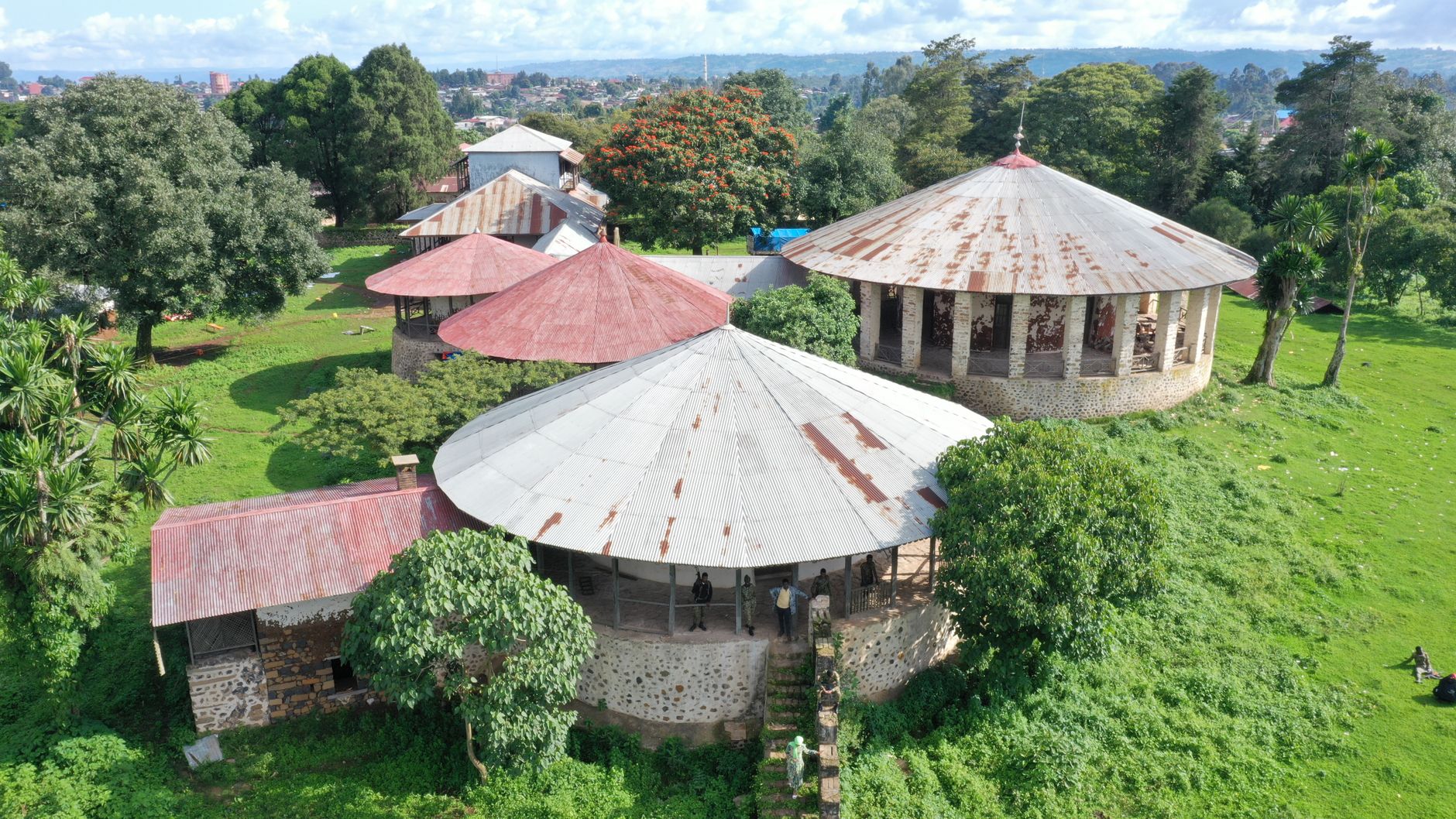
An aerial perspective captures the unique circular architecture and lush surroundings of a historic site in Gitega, Burundi.
Christian Alemu on Pexels · Pexels License
An elevated perspective of Gitega, Burundi, capturing the unique blend of residential architecture, industrial buildings, and the scenic mountainous landscape.
Alex Levis on Pexels · Pexels License
The late afternoon sun illuminates the distinctive architecture and tree-lined streets of Gitega, the political capital of Burundi.
Mad Knoxx Deluxe on Pexels · Pexels License
Practical Information
Getting There
Fly into Bujumbura International (BJM) — the only gateway with scheduled service. From the airport, RN3 runs 101 km east to Gitega; allow 1 h 45 min by pre-booked taxi (≈ 80 USD) or hop a shared minibus from the central station (6 USD, 2.5 hrs). Gitega’s own airstrip (GID) has no commercial flights as of 2026.
Getting Around
No metro, tram or city bus card exists. Flag a moto-taxi (500–1,000 BIF in-town) or squeeze into yellow-striped taxi-buses that loop the market–museum–cathedral circuit. Distances are walkable but sidewalks vanish; night travel is discouraged by both UK and US advisories. Hire a driver for Gishora or Songa (≈ 25 USD half-day).
Climate & Best Time
Gitega sits at 1,504 m; daytime highs hover 24–26 °C year-round. Long rains peak in March–April; short rains in October–November. Come June–September for cobalt mornings and mud-free footpaths—this is also when drummers schedule most performances. Nights drop to 12 °C, so pack a fleece even in ‘summer’.
Language & Currency
Kirundi opens doors; French handles signage and menus. English is spotty outside larger hotels. Prices post in Burundian Franc (BIF) but guesthouses quote USD; bring clean post-2013 50- or 100-dollar bills. No ATMs outside Bujumbura dispense USD—stock up before you leave the capital.
Safety
Daytime Gitega is low-key, but UK FCDO warns against walking after dark anywhere in Burundi. Keep photocopies of your visa; police roadblocks pop up on the airport road. Leave the former central market area before dusk—US Embassy staff are prohibited there—and carry small BIF notes to avoid flashing cash.
Tips for Visitors
Book Drums Early
Gishora shows fill up—secure your royal drum performance slot the day you arrive. Moto-taxis leave from the central market for 3,000 BIF.
Carry Small Franc Notes
Break large bills at the museum desk; market women and moto drivers rarely have change. A 100-franc coin covers the hand-washing water bowl.
Eat by Power Cuts
Restaurants serve dinner around 18:00 before the evening blackout. Bring a torch; the grilled-brochette stalls keep going by kerosene lamp.
Sunrise on Mount Songa
Leave at 05:00 for the 40-minute walk; the 360° view catches first light over the royal hills. No guardrail—watch your footing.
Ask Before Drums
Photography at Gishora is welcome, but request permission if performers are carrying ancestral drums on their heads. A 2,000 BIF tip is polite.
Explore the city with a personal guide in your pocket
Your Personal Curator, in Your Pocket.
Audio guides for 1,100+ cities across 96 countries. History, stories, and local insight — offline ready.
Audiala App
Available on iOS & Android
Join 50k+ Curators
Frequently Asked
Is Gitega worth visiting compared to Bujumbura? add
Yes—Gitega gives you Burundi’s only UNESCO-listed drum ritual and the country’s best museum in one walkable day. The capital move in 2019 means you’re watching a city invent itself in real time, not just ticking colonial leftovers.
How many days do I need in Gitega? add
Two full days cover the essentials: royal drums, national museum, palace site, central market and Mount Songa at sunrise. Add a third day if you want the Karera waterfalls or source-of-the-Nile side-trip.
Can I get there from Bujumbura in a day? add
Yes—shared minivans leave Bujumbura’s central station every 30 min (3 h, 15,000 BIF). The last return van departs Gitega at 16:30; after that you’ll need a private taxi (≈120,000 BIF).
Is it safe to walk around Gitega at night? add
Stick to lit central streets around the cathedral and market; side roads go pitch-black during power cuts. Police patrol the museum hill, but after 21:00 take a moto-taxi door-to-door.
Do I need a guide for the museums? add
Signage is mostly French; a French/English guide costs 10,000 BIF at the National Museum and is worth it for the royal regalia back-stories. Gishora includes a guide in the 15,000 BIF entry.
What does a day trip to Gishora cost? add
Budget 40,000 BIF total: 6,000 BIF moto-taxi round-trip, 15,000 BIF entrance, 10,000 BIF guide tip, plus drinks. Taxis want 35,000 BIF one-way—haggle or share.
Sources
- verified Visit Burundi – Gitega — Official timings, entrance fees and access notes for Gishora Drum Sanctuary, National Museum, Mount Songa and German Boma.
- verified TripAdvisor Gitega Attractions — Real-time crowd warnings for drum performances and updated moto-taxi prices collected from 2026 reviews.
- verified Take Your Backpack – Gitega — Practical transport schedules, market hours and power-cut dining patterns reported by travellers on the ground.
Last reviewed: