movie
African cinema capital
Ouagadougou hosts FESPACO, founded in 1969 and still the biggest festival in African film. Few capitals have built a cultural reputation this outsized on cinema alone.
Burkina Faso matters because its real spectacle is cultural, not scenic: painted Kassena houses, ancient iron furnaces, film history, mask traditions, and cities like Ouagadougou and Bobo-Dioulasso that still shape West Africa far beyond their tourist count.
EntryeVisa usually required; rules vary by passport
BA Burkina Faso travel guide starts with a hard truth: this is West Africa's cultural heavyweight, and current security advice has to shape any serious plan.
If you're researching Burkina Faso, you probably want two answers fast: what makes the country distinct, and whether a trip is realistic right now. The first answer is easy. Few places in West Africa pack as much cultural weight into one landlocked plateau. Ouagadougou carries the political pulse and the legacy of FESPACO, the continent's biggest film festival. Bobo-Dioulasso gives you the old commercial crossroads, the Dioula quarter, and live-music nights that feel earned rather than staged. Then the map starts to widen: Banfora for waterfalls and sugar-country greenery, Tiébélé for Kassena wall painting, Loropéni for stone walls that still raise more questions than archaeologists can settle.
The country's appeal is not grand scenery in the postcard sense. Burkina Faso works through texture: laterite roads, market smoke, mosque mud walls, carved masks, sorghum beer in a courtyard, and greetings that take their time because politeness here is part of the social contract. Around Kaya, UNESCO-listed iron-smelting sites push the story far deeper than colonial borders. In Sindou, wind-cut rock spires rise from the southwest like a stage set built by geology. In Nazinga, elephants and crocodiles replace the museum label with something more convincing. And in Dédougou, mask traditions still carry ritual force instead of being trimmed to fit a visitor schedule.
Iron, Earth, and Trade, c. 800 BCE-1400 CE
Picture a furnace mouth in the dark near present-day Kaya, its clay walls breathing sparks into the Sahel wind while ironworkers feed it charcoal and ore. Long before the name Burkina Faso existed, this plateau already knew specialists, ritual, and technical nerve. The ferrous metallurgy sites later recognized by UNESCO were not improvised village fires; they were organized industrial landscapes, with slag heaps rising like low black hills.
Ce que l'on ignore souvent, c'est que iron here was never just a material. Archaeological evidence and oral memory both suggest a world in which smelting carried social power, and some furnaces were shaped in ways that linked metalwork to fertility and birth. A blade, a hoe, a spearhead: each began in a place where heat was managed with almost ceremonial precision.
Then the stone walls of Loropéni appear in the southwest, and the story shifts from furnace to caravan. Between roughly the 11th and 14th centuries, traders moved gold, kola, salt, and news across this inland world, and Loropéni stood in that traffic like a locked chest. Its laterite blocks still hold their line with unnerving calm, which is one reason the site feels less ruined than interrupted.
No one can name every hand that built those walls. Most scholars connect them to the Lohron or Koulango sphere and to the gold routes feeding larger West African economies, but the silence of the enclosure matters as much as the scholarship. It was abandoned without the theatrical signs of conquest, and that quiet ending prepared the stage for the kingdoms that would later rise across the plateau.
The first masters of this land were anonymous ironworkers, the kind history rarely names even when whole societies stood on their labor.
Local elders long described Loropéni as a place where the dead still negotiated, a phrase more haunting than any legend of buried treasure.
The Mossi Kingdoms, c. 1400-1896
A white horse breaks from the north at dusk, its rider dressed not for marriage but for war. That is how the founding legend begins: Yennenga, princess of Dagomba, horsewoman, daughter too gifted for her father's comfort, escapes and rides into the bush where she meets the hunter Rialé. Their son Oubri becomes the ancestor of the Mossi ruling line, and myth turns into statecraft.
In Ouagadougou, power learned ceremony early. The Mogho Naaba, ruler of the central Mossi kingdom, did not govern by brute force alone; he governed through rank, ritual, ministers, and a court whose etiquette made politics visible. When one king died, accounts say the fires of the capital were extinguished and relit from the new sovereign's flame, an image so elegant one almost forgets its hard meaning: legitimacy had to be staged before it could be obeyed.
The Mossi states were never solitary. Yatenga in the north built its own reputation through cavalry, trade, and dynastic quarrels sharp enough to keep griots busy for generations. Succession disputes could tear a court apart, yet the kingdoms endured, adapting faster than many of their larger neighbors expected.
This is where Burkina Faso acquires one of its oldest political habits: resistance without illusion. Mossi forces raided, retreated, regrouped, and repeatedly denied outside empires the easy victory they wanted, including the Songhai at their height. The courtly order centered on Ouagadougou outlived those pressures, and its ceremonial memory still reaches into the present.
Yennenga survives half as legend and half as political ancestor, which is often the fate of women who found dynasties and then get turned into symbols.
Mossi tradition made the white stallion a lasting emblem of authority, which is why the horse still carries national meaning far beyond the founding tale.
Conquest and Colonial Rewiring, 1896-1960
The scene changes brutally: boots, rifles, paper treaties, and royal compounds suddenly forced to negotiate with men who arrived measuring land they did not yet control. In the 1890s, French military expeditions pushed across the Mossi kingdoms and beyond, defeating rulers, rearranging authority, and turning living political systems into administrative units. A court could survive humiliation more easily than it could survive filing cabinets.
What followed was not a clean annexation but a long colonial sorting of people, roads, taxes, and labor. The territory became Haute-Volta, Upper Volta, named not for a people or a dynasty but for rivers the colonial state could map. Entire communities were drawn into labor migration, especially toward Côte d'Ivoire, while old capitals such as Ouahigouya and Ouagadougou were kept, reduced, or repurposed according to imperial convenience.
Bobo-Dioulasso tells another side of the story. Muslim trade networks, local elites, and colonial commerce met there under new rules, and the town became one of the great urban hinges of the territory. Ce que l'on ignore souvent, c'est que colonial rule relied not just on force but on selective partnership: chiefs retained, chiefs sidelined, merchants encouraged, dissent watched.
Yet even in this period of imposed order, the country kept storing future arguments. Educated elites emerged, anti-colonial politics sharpened, and memory split into two loyalties that would never quite reconcile: the prestige of ancient courts and the imported machinery of the modern state. Independence in 1960 did not erase that tension. It inherited it.
Guimbi Ouattara of Bobo-Dioulasso understood earlier than most that diplomacy with outsiders could save a city for a while, though never on equal terms.
The French abolished Upper Volta outright in 1932 and divided its territory among neighboring colonies, then restored it in 1947 when administrative logic and local politics demanded the map be redrawn again.
Independence, Coups, and the Sankara Revolution, 1960-1987
Independence arrived with flags, speeches, pressed suits, and the brittle optimism of a state expected to become coherent overnight. Maurice Yaméogo became the first president in 1960, but the new republic quickly discovered how thin formal sovereignty could feel when institutions were fragile, inequality was old, and the army had learned to watch politics at close range. Burkina Faso's early decades read like a parade of uniforms interrupted by civilian hope.
Then Thomas Sankara enters the story, and the air changes. A captain with a motorcycle, a quick tongue, and the nerve to speak of debt, dignity, women's emancipation, vaccination, and self-reliance as if they belonged in the same sentence, he took power in 1983 and renamed the country Burkina Faso in 1984: the land of upright people. It was one of those political gestures that manages to be linguistic, moral, and theatrical all at once.
Ce que l'on ignore souvent, c'est how material his revolution tried to be. Officials were pushed toward simpler lifestyles; tree-planting campaigns fought desertification; women were appointed to visible roles; vaccination drives reached millions of children. Sankara understood symbols, certainly, but he also cared about cotton, grain, roads, and the humiliations of dependence.
The tragedy is inseparable from the charisma. On 15 October 1987, Sankara was killed in a coup led by Blaise Compaoré, his former comrade, and one of Africa's most arresting political lives ended at 37. The revolution did not simply fail. It was interrupted, and its memory became more dangerous in death than it had been in office.
Thomas Sankara could speak like a tribune and live like a man suspicious of comfort, which is why admiration for him still carries a distinctly personal charge.
Sankara reportedly insisted on modest official habits down to cars and wardrobes, turning state style itself into an argument against privilege.
Cinema, Uprising, and an Uneasy Present, 1987-2026
After Sankara's death, Blaise Compaoré governed for 27 years with a cooler instinct for survival. He reopened alliances, softened the revolutionary edge, and made Burkina Faso look stable from a distance, though many Burkinabè knew the price of that stability by heart. Political life narrowed; memory was managed; the unfinished business of 1987 waited in plain sight.
And yet this same country kept producing something magnificently unruly: culture. Ouagadougou became the capital of African cinema during FESPACO, where filmmakers, critics, students, and dreamers filled screening halls and argued late into the night over images, truth, and money. A nation with limited means insisted on grandeur of another sort, and that insistence remains one of Burkina Faso's most elegant acts of self-definition.
In 2014, Compaoré tried to extend his rule and found the street less patient than he imagined. Protesters burned the National Assembly, he fled, and the old script of permanence collapsed in a matter of days. The years after that brought elections, another coup attempt, then, from 2015 onward, a far darker crisis as jihadist violence spread, civilians were killed, and whole regions were shaken or emptied.
So the present must be told honestly. Burkina Faso today is a country of artistic brilliance, political memory, and severe insecurity at once. That is not a contradiction. It is the consequence of every earlier chapter, from the authority of the Mossi courts to the unresolved wound of Sankara, and it explains why places such as Ouagadougou, Bobo-Dioulasso, Kaya, and even the ancient calm of Loropéni now belong to one of West Africa's most moving and most difficult national stories.
Blaise Compaoré was never loved in the manner of Sankara; he lasted because he understood power as duration, not enchantment.
The trophy for FESPACO's top prize is named the Étalon de Yennenga, which means the country's founding horsewoman still gallops through its modern imagination.
Burkina Faso does not speak. It changes register. In Ouagadougou, a sentence may begin in French, bend into Mooré for authority, then finish in Dioula because the market prefers efficiency to grammar. The ear learns quickly that language here is not decoration or identity theater; it is a tool chest, a family archive, a diplomatic instrument.
Greetings come before purpose. You do not arrive with your question held out like a receipt. You ask about the night, the children, the heat, the body's peace, and only then do words begin to deserve trust. A country is a table set for strangers.
One word explains much: laafi. It means health, yes, but also calm, balance, the fact that life has not slipped its hinge. When someone asks after your laafi, they are not being polite in the thin European way. They are checking whether your existence is still properly attached to the world.
This is why Burkina Faso can feel severe and tender at once. Speech has rules, but the rules are generous. In Bobo-Dioulasso, in Koudougou, in Kaya, the most elegant person in the room is often the one who knows exactly how long to greet before getting to the point.
The cuisine of Burkina Faso begins with millet, sorghum, maize, rice. Not luxury. Intelligence. These grains have lived with dry seasons longer than empires have lasted, and they know what a body needs at noon when the light turns metallic and the dust decides to enter everything, including your thoughts.
Tô is the great lesson. A smooth mound of millet, sorghum, or maize paste, dipped by hand into okra sauce, baobab-leaf sauce, peanut sauce, or a dark preparation sharpened by soumbala, the fermented néré seasoning whose perfume startles the novice and comforts everyone else. Texture rules here. The hand understands before the tongue does.
Then babenda arrives and all sentimentality dies. Rice, greens, beans, dried fish, soumbala: a dish that tastes bitter, smoky, intelligent, almost corrective. It does not flatter you. It tells you what hunger is for.
Elsewhere the country loosens its collar. In Bobo-Dioulasso, grilled fish comes with onion, tomato, and pepper, and you eat it with the practical concentration bones require. In the southwest near Banfora, mangoes and sugarcane soften the air for a moment. But even sweetness behaves with discipline.
Burkinabè etiquette has one magnificent principle: human beings are not to be used abruptly. A greeting is not a corridor leading to real business. The greeting is the proof that business, friendship, curiosity, bargaining, all of it, can happen without insult. Europe could learn from this and will not.
The right hand matters. Shared bowls matter. Pace matters. If you sit to eat, you do not pounce as though competing with the table. You take your place in the quiet geometry of the meal, reading the edge of the communal dish, recognizing that appetite also has manners.
Respect for elders is visible, audible, almost architectural. A younger person does not simply contradict. They circle, soften, prepare the ground. What sounds indirect to a hurried foreigner is often refinement: the refusal to bruise another person's dignity merely to save thirty seconds.
In Tiébélé, in village courtyards outside Ouahigouya, in family compounds on the outskirts of Ouagadougou, this etiquette has the force of poetry. Each formula says: you are not alone here. That is an introduction and a warning.
Few countries have wagered so much on cinema with so little interest in glamour. Burkina Faso made film into civic life. Since 1969, FESPACO in Ouagadougou has treated African cinema not as a niche pleasure but as a continental argument conducted in dark rooms, courtyards, queues, bars, and impossible traffic.
The prize itself says everything: the Étalon de Yennenga, named after the warrior princess who rides through Mossi memory on a white horse. Another nation might have chosen a neutral acronym, a ministerial plaque, a polite abstraction. Burkina Faso chose a woman fleeing paternal control and founding a line. Good taste, finally.
During the festival, Ouagadougou changes tempo. Tailors cut outfits for screenings. Debates spill into the street. A filmmaker from Dakar, a student from Bobo-Dioulasso, a journalist from Paris, and a man selling brochettes may all have opinions on framing, politics, and whether this year's jury lost its nerve. This is culture behaving like daily bread.
Cinema here is not an imported mirror. It is a house in which Africa insists on seeing itself by its own light. That the world's largest African film festival grew on this dry plateau feels less surprising the longer you stay.
Burkina Faso does not pursue monumentality in the imperial manner. It prefers walls that keep the trace of fingers. In Tiébélé, Kassena houses are painted with black, white, and red-brown geometry so precise they look mathematical until you stand close and see the grain of earth, the patience, the domestic pride. A façade can be both shelter and sentence.
These surfaces are not folk ornament for the tourist lens. They are maintenance, inheritance, a visible code of care. The wall must be repaired before the rain. The motif must be renewed before it fades into indifference. Beauty here is not frozen. It is re-applied.
Then Loropéni alters the scale. Stone walls in the southwest, laterite blocks rising from the earth with the stubbornness of a secret kept for centuries, linked to the old gold routes and still surrounded by questions historians cannot fully settle. A ruin is often most eloquent when it refuses confession.
Even the great mud mosque of Bobo-Dioulasso understands this law: architecture lives because hands return to it. Earthen buildings demand attention, replastering, ritual labor. Neglect is fatal. In Burkina Faso, permanence is not stone against time. It is care repeated.
Music in Burkina Faso is not arranged in neat museum categories. It belongs to ceremonies, courtyards, funerals, festivals, long nights, and to the difficult business of making a body answer rhythm before the mind has drafted its opinion. The balafon does this with particular elegance. A few struck wooden keys, and suddenly the air has joints.
In Bobo-Dioulasso, music often feels older than the street around it. Mandé currents meet local traditions; balafons converse with drums, voices with call-and-response insistence, and the song moves less like a performance than like news carried collectively. One person begins. The group decides whether it will live.
Mask festivals near Dédougou make the point even more sharply. Rhythm is not accompaniment. It is command. The masked figure enters only because the drums have opened the door, and everyone present knows that sound can organize space faster than any official.
Then modern Burkina Faso arrives with electric guitars, studio production, dance floors, and urban swagger, especially in Ouagadougou. Yet even amplified music keeps one foot in ceremony. The old pulse survives every modernization attempt. It usually wins.
Ouagadougou hosts FESPACO, founded in 1969 and still the biggest festival in African film. Few capitals have built a cultural reputation this outsized on cinema alone.
Tiébélé is known for Kassena houses covered in hand-painted geometric murals, while markets in Ouagadougou and Bobo-Dioulasso still trade in bronze, leather, weaving, and mask-making with real local depth.
Loropéni preserves a pre-colonial stone enclosure linked to the gold trade, and the ferrous metallurgy sites near Kaya push the country's story back into the first millennium BCE. Burkina Faso's past is older and more technically sophisticated than many travelers expect.
Burkina Faso has no coast and almost no mountains, so its beauty comes from shape and light: the Sindou Peaks, dry river corridors, laterite plains, and the greener southwest around Banfora.
Nazinga is one of the country's strongest wildlife draws, with elephants, crocodiles, and birds gathering around water in the dry season. The best sightings usually come between November and February, when roads are easier and vegetation is thinner.
This is a cuisine built on millet, sorghum, rice, okra, peanuts, and the deep fermented note of soumbala. Dishes like tô, babenda, riz gras, and poulet bicyclette tell you more about climate and daily life than any museum panel could.
12 cities — start with the ones we'd send you to first.
Every two years in February, the city that gave the world its most unpronounceable capital also gives it FESPACO, the oldest and largest African film festival, turning dusty boulevards into an open-air cinema nation.
Burkina Faso's second city runs on Dioula trade rhythms and jazz — the Grand Marché and the 1963 Sankara-era train station anchor a town that has always moved at its own, unhurried frequency.
In the far southwest, sugarcane fields give way to the Cascades de Karfiguéla and the surreal mushroom-rock formations of the Dômes de Fabédougou, landscapes so improbable they look like a geologist's fever dream.
Cotton capital and cradle of political dissent, Koudougou produced some of the country's sharpest union voices and still holds a market that moves more raw cotton by hand than most people will see in a lifetime.
Gateway to the Sahel and sitting near the UNESCO-listed ancient iron-smelting sites at Tiwêga, Kaya is where the plateau starts thinning toward the north and the laterite turns a deeper, more insistent red.
On the Mouhoun River's western arc, Dédougou hosts the biennial FESTIMA mask festival, when dozens of ethnic groups converge to perform masquerades that are not performances for tourists but obligations to the living and
Eastern crossroads toward the W National Park transboundary reserve, Fada sits in Gourmantché country where the oral tradition of divination — reading the world through lines drawn in sand — is still practiced as a serio
The old northern capital of the Yatenga Mossi kingdom, where the Mogho Naaba's provincial court once administered a cavalry state, and where the weekly market still organizes itself around the same spatial logic as it di
A UNESCO World Heritage stone enclosure whose four-meter laterite walls were built on trans-Saharan gold trade routes around 1000 CE and then deliberately abandoned — no siege, no fire, just silence — which is the detail
The center of the country is where state power, Mossi history, and contemporary urban life meet. Ouagadougou sets the pace, Koudougou offers a calmer provincial counterpoint, and Tiébélé adds one of Burkina Faso's most memorable architectural traditions within reach of the capital.
The southwest feels softer after the central plateau: more vegetation, stronger Dioula presence, and some of the country's most rewarding food and music. Bobo-Dioulasso is the obvious anchor, Banfora adds lakes and sugar-country scenery, and Sindou delivers the laterite rock formations most travelers remember years later.
Burkina Faso's deep southwest is where archaeology and wildlife sit close together, though never as casually as a brochure would imply. Loropéni holds the country's best-known pre-colonial stone ruins, while Nazinga is the practical wildlife counterweight, with long drives and sparse infrastructure very much part of the equation.
The east opens into longer road stages, thinner tourist infrastructure, and a more austere rhythm than the greener southwest. Fada N'Gourma is the gateway city here, useful for understanding how far Burkina Faso stretches toward Niger and Benin, and for travelers who want the country beyond its usual cultural stops.
Northern Burkina Faso is defined less by monuments than by climate, movement, and the old logic of Sahelian trade and authority. Ouahigouya is the best-known urban anchor, while Kaya further east connects the region to UNESCO-listed ancient iron-working sites and to the drier belt that shapes daily life.
Around Dédougou, cultural life is tied to mask traditions that still matter far beyond festival branding. This western zone makes the most sense for travelers who care about ceremony, performance, and rural cultural geography rather than a checklist of monuments.
Burkina Faso's history runs from ancient metallurgy and Mossi courts to revolution, cinema, and a difficult present.
Archaeological evidence points to ancient ironworking traditions across the territory of present-day Burkina Faso. Near what is now Kaya, later furnace sites would show that metal production here was organized, skilled, and socially important.
In the southwest, the walls of Loropéni begin to take shape as part of a trading world linked to gold and caravan routes. The enclosure still feels startlingly intact, which is one reason it holds such force today.
Oral tradition places the horsewoman Yennenga at the beginning of the Mossi dynasties. Her story gives Burkina Faso a founding narrative shaped by flight, love, and royal defiance rather than by a single battle date.
Mossi state formation consolidates around the line of Oubri, the traditional first ruler of the Ouagadougou kingdom. Court ritual and dynastic authority begin to define politics on the central plateau.
At the height of Songhai power, major expeditions strike Mossi territory but do not secure lasting control. The result matters: Burkina Faso's medieval political story is one of resilience, not easy submission.
The northern Mossi kingdom of Yatenga emerges as a major power, wealthy from trade and infamous for succession struggles. It becomes one of the key poles of precolonial politics in the region.
Remembered in oral tradition as a forceful ruler, Naaba Kango becomes one of Yatenga's emblematic kings. His reputation rests on reunification, military grit, and the stern theater of royal honor.
French military columns defeat major rulers and fold the territory into the expanding colonial order. Courts survive in altered form, but sovereignty passes to an empire with maps, taxes, and rifles.
France formally establishes Haute-Volta, drawing a colonial territory from older political landscapes. The name comes from rivers, not peoples, which says much about the administrative imagination behind it.
The colonial administration abolishes Upper Volta and partitions its territory among neighboring colonies. Borders prove less permanent than colonial rhetoric liked to claim.
France recreates Upper Volta after political pressure and administrative reconsideration. The territory reappears, carrying with it the outlines of the future independent state.
Upper Volta becomes independent on 5 August 1960, with Maurice Yaméogo as its first president. The flag changes quickly; the harder work of building stable institutions does not.
The Pan-African Film and Television Festival of Ouagadougou begins and steadily grows into the most important film gathering on the continent. Culture becomes one of Burkina Faso's most durable claims to international stature.
Captain Thomas Sankara seizes power and launches one of Africa's most memorable revolutionary experiments. His politics mix austerity, anti-imperial language, social reform, and a sharp instinct for symbols.
Sankara renames the country Burkina Faso, commonly glossed as the land of upright people. The change is more than cosmetic; it is an attempt to give the state a moral vocabulary rooted in local languages.
On 15 October 1987, Sankara is assassinated during the coup that brings Blaise Compaoré to power. Burkina Faso enters a new era haunted by the revolution it has just buried.
The Ruins of Loropéni gain UNESCO recognition, bringing international attention to one of West Africa's most enigmatic stone sites. A place once tied to caravan routes enters the global heritage canon.
Mass protests erupt when Blaise Compaoré moves to extend his long presidency. The National Assembly burns, the old order collapses, and he flees the country.
Attacks linked to jihadist groups intensify and then spread across large parts of the country. Security, displacement, and the authority of the state become central facts of daily life.
The Ancient Ferrous Metallurgy Sites of Burkina Faso join the World Heritage List, confirming the deep antiquity of technical skill on this plateau. The country is reminded that its history did not begin with kingdoms or colonizers.
Burkina Faso sees two military takeovers in 2022 as frustration over insecurity and governance sharpens. The cycle of force returning to politics, familiar since independence, proves far from finished.
Iron, Earth, and Trade
The first masters of this land were anonymous ironworkers, the kind history rarely names even when whole societies stood on their labor.
Picture a furnace mouth in the dark near present-day Kaya, its clay walls breathing sparks into the Sahel wind while ironworkers feed it charcoal and ore. Long before the name Burkina Faso existed, this plateau already knew specialists, ritual, and technical nerve. The ferrous metallurgy sites later recognized by UNESCO were not improvised village fires; they were organized industrial landscapes, with slag heaps rising like low black hills.
Ce que l'on ignore souvent, c'est que iron here was never just a material. Archaeological evidence and oral memory both suggest a world in which smelting carried social power, and some furnaces were shaped in ways that linked metalwork to fertility and birth. A blade, a hoe, a spearhead: each began in a place where heat was managed with almost ceremonial precision.
Then the stone walls of Loropéni appear in the southwest, and the story shifts from furnace to caravan. Between roughly the 11th and 14th centuries, traders moved gold, kola, salt, and news across this inland world, and Loropéni stood in that traffic like a locked chest. Its laterite blocks still hold their line with unnerving calm, which is one reason the site feels less ruined than interrupted.
No one can name every hand that built those walls. Most scholars connect them to the Lohron or Koulango sphere and to the gold routes feeding larger West African economies, but the silence of the enclosure matters as much as the scholarship. It was abandoned without the theatrical signs of conquest, and that quiet ending prepared the stage for the kingdoms that would later rise across the plateau.
Local elders long described Loropéni as a place where the dead still negotiated, a phrase more haunting than any legend of buried treasure.
The Mossi Kingdoms
Yennenga survives half as legend and half as political ancestor, which is often the fate of women who found dynasties and then get turned into symbols.
A white horse breaks from the north at dusk, its rider dressed not for marriage but for war. That is how the founding legend begins: Yennenga, princess of Dagomba, horsewoman, daughter too gifted for her father's comfort, escapes and rides into the bush where she meets the hunter Rialé. Their son Oubri becomes the ancestor of the Mossi ruling line, and myth turns into statecraft.
In Ouagadougou, power learned ceremony early. The Mogho Naaba, ruler of the central Mossi kingdom, did not govern by brute force alone; he governed through rank, ritual, ministers, and a court whose etiquette made politics visible. When one king died, accounts say the fires of the capital were extinguished and relit from the new sovereign's flame, an image so elegant one almost forgets its hard meaning: legitimacy had to be staged before it could be obeyed.
The Mossi states were never solitary. Yatenga in the north built its own reputation through cavalry, trade, and dynastic quarrels sharp enough to keep griots busy for generations. Succession disputes could tear a court apart, yet the kingdoms endured, adapting faster than many of their larger neighbors expected.
This is where Burkina Faso acquires one of its oldest political habits: resistance without illusion. Mossi forces raided, retreated, regrouped, and repeatedly denied outside empires the easy victory they wanted, including the Songhai at their height. The courtly order centered on Ouagadougou outlived those pressures, and its ceremonial memory still reaches into the present.
Mossi tradition made the white stallion a lasting emblem of authority, which is why the horse still carries national meaning far beyond the founding tale.
Conquest and Colonial Rewiring
Guimbi Ouattara of Bobo-Dioulasso understood earlier than most that diplomacy with outsiders could save a city for a while, though never on equal terms.
The scene changes brutally: boots, rifles, paper treaties, and royal compounds suddenly forced to negotiate with men who arrived measuring land they did not yet control. In the 1890s, French military expeditions pushed across the Mossi kingdoms and beyond, defeating rulers, rearranging authority, and turning living political systems into administrative units. A court could survive humiliation more easily than it could survive filing cabinets.
What followed was not a clean annexation but a long colonial sorting of people, roads, taxes, and labor. The territory became Haute-Volta, Upper Volta, named not for a people or a dynasty but for rivers the colonial state could map. Entire communities were drawn into labor migration, especially toward Côte d'Ivoire, while old capitals such as Ouahigouya and Ouagadougou were kept, reduced, or repurposed according to imperial convenience.
Bobo-Dioulasso tells another side of the story. Muslim trade networks, local elites, and colonial commerce met there under new rules, and the town became one of the great urban hinges of the territory. Ce que l'on ignore souvent, c'est que colonial rule relied not just on force but on selective partnership: chiefs retained, chiefs sidelined, merchants encouraged, dissent watched.
Yet even in this period of imposed order, the country kept storing future arguments. Educated elites emerged, anti-colonial politics sharpened, and memory split into two loyalties that would never quite reconcile: the prestige of ancient courts and the imported machinery of the modern state. Independence in 1960 did not erase that tension. It inherited it.
The French abolished Upper Volta outright in 1932 and divided its territory among neighboring colonies, then restored it in 1947 when administrative logic and local politics demanded the map be redrawn again.
Independence, Coups, and the Sankara Revolution
Thomas Sankara could speak like a tribune and live like a man suspicious of comfort, which is why admiration for him still carries a distinctly personal charge.
Independence arrived with flags, speeches, pressed suits, and the brittle optimism of a state expected to become coherent overnight. Maurice Yaméogo became the first president in 1960, but the new republic quickly discovered how thin formal sovereignty could feel when institutions were fragile, inequality was old, and the army had learned to watch politics at close range. Burkina Faso's early decades read like a parade of uniforms interrupted by civilian hope.
Then Thomas Sankara enters the story, and the air changes. A captain with a motorcycle, a quick tongue, and the nerve to speak of debt, dignity, women's emancipation, vaccination, and self-reliance as if they belonged in the same sentence, he took power in 1983 and renamed the country Burkina Faso in 1984: the land of upright people. It was one of those political gestures that manages to be linguistic, moral, and theatrical all at once.
Ce que l'on ignore souvent, c'est how material his revolution tried to be. Officials were pushed toward simpler lifestyles; tree-planting campaigns fought desertification; women were appointed to visible roles; vaccination drives reached millions of children. Sankara understood symbols, certainly, but he also cared about cotton, grain, roads, and the humiliations of dependence.
The tragedy is inseparable from the charisma. On 15 October 1987, Sankara was killed in a coup led by Blaise Compaoré, his former comrade, and one of Africa's most arresting political lives ended at 37. The revolution did not simply fail. It was interrupted, and its memory became more dangerous in death than it had been in office.
Sankara reportedly insisted on modest official habits down to cars and wardrobes, turning state style itself into an argument against privilege.
Cinema, Uprising, and an Uneasy Present
Blaise Compaoré was never loved in the manner of Sankara; he lasted because he understood power as duration, not enchantment.
After Sankara's death, Blaise Compaoré governed for 27 years with a cooler instinct for survival. He reopened alliances, softened the revolutionary edge, and made Burkina Faso look stable from a distance, though many Burkinabè knew the price of that stability by heart. Political life narrowed; memory was managed; the unfinished business of 1987 waited in plain sight.
And yet this same country kept producing something magnificently unruly: culture. Ouagadougou became the capital of African cinema during FESPACO, where filmmakers, critics, students, and dreamers filled screening halls and argued late into the night over images, truth, and money. A nation with limited means insisted on grandeur of another sort, and that insistence remains one of Burkina Faso's most elegant acts of self-definition.
In 2014, Compaoré tried to extend his rule and found the street less patient than he imagined. Protesters burned the National Assembly, he fled, and the old script of permanence collapsed in a matter of days. The years after that brought elections, another coup attempt, then, from 2015 onward, a far darker crisis as jihadist violence spread, civilians were killed, and whole regions were shaken or emptied.
So the present must be told honestly. Burkina Faso today is a country of artistic brilliance, political memory, and severe insecurity at once. That is not a contradiction. It is the consequence of every earlier chapter, from the authority of the Mossi courts to the unresolved wound of Sankara, and it explains why places such as Ouagadougou, Bobo-Dioulasso, Kaya, and even the ancient calm of Loropéni now belong to one of West Africa's most moving and most difficult national stories.
The trophy for FESPACO's top prize is named the Étalon de Yennenga, which means the country's founding horsewoman still gallops through its modern imagination.
Burkina Faso does not speak. It changes register. In Ouagadougou, a sentence may begin in French, bend into Mooré for authority, then finish in Dioula because the market prefers efficiency to grammar. The ear learns quickly that language here is not decoration or identity theater; it is a tool chest, a family archive, a diplomatic instrument.
Greetings come before purpose. You do not arrive with your question held out like a receipt. You ask about the night, the children, the heat, the body's peace, and only then do words begin to deserve trust. A country is a table set for strangers.
One word explains much: laafi. It means health, yes, but also calm, balance, the fact that life has not slipped its hinge. When someone asks after your laafi, they are not being polite in the thin European way. They are checking whether your existence is still properly attached to the world.
This is why Burkina Faso can feel severe and tender at once. Speech has rules, but the rules are generous. In Bobo-Dioulasso, in Koudougou, in Kaya, the most elegant person in the room is often the one who knows exactly how long to greet before getting to the point.
The cuisine of Burkina Faso begins with millet, sorghum, maize, rice. Not luxury. Intelligence. These grains have lived with dry seasons longer than empires have lasted, and they know what a body needs at noon when the light turns metallic and the dust decides to enter everything, including your thoughts.
Tô is the great lesson. A smooth mound of millet, sorghum, or maize paste, dipped by hand into okra sauce, baobab-leaf sauce, peanut sauce, or a dark preparation sharpened by soumbala, the fermented néré seasoning whose perfume startles the novice and comforts everyone else. Texture rules here. The hand understands before the tongue does.
Then babenda arrives and all sentimentality dies. Rice, greens, beans, dried fish, soumbala: a dish that tastes bitter, smoky, intelligent, almost corrective. It does not flatter you. It tells you what hunger is for.
Elsewhere the country loosens its collar. In Bobo-Dioulasso, grilled fish comes with onion, tomato, and pepper, and you eat it with the practical concentration bones require. In the southwest near Banfora, mangoes and sugarcane soften the air for a moment. But even sweetness behaves with discipline.
Burkinabè etiquette has one magnificent principle: human beings are not to be used abruptly. A greeting is not a corridor leading to real business. The greeting is the proof that business, friendship, curiosity, bargaining, all of it, can happen without insult. Europe could learn from this and will not.
The right hand matters. Shared bowls matter. Pace matters. If you sit to eat, you do not pounce as though competing with the table. You take your place in the quiet geometry of the meal, reading the edge of the communal dish, recognizing that appetite also has manners.
Respect for elders is visible, audible, almost architectural. A younger person does not simply contradict. They circle, soften, prepare the ground. What sounds indirect to a hurried foreigner is often refinement: the refusal to bruise another person's dignity merely to save thirty seconds.
In Tiébélé, in village courtyards outside Ouahigouya, in family compounds on the outskirts of Ouagadougou, this etiquette has the force of poetry. Each formula says: you are not alone here. That is an introduction and a warning.
Few countries have wagered so much on cinema with so little interest in glamour. Burkina Faso made film into civic life. Since 1969, FESPACO in Ouagadougou has treated African cinema not as a niche pleasure but as a continental argument conducted in dark rooms, courtyards, queues, bars, and impossible traffic.
The prize itself says everything: the Étalon de Yennenga, named after the warrior princess who rides through Mossi memory on a white horse. Another nation might have chosen a neutral acronym, a ministerial plaque, a polite abstraction. Burkina Faso chose a woman fleeing paternal control and founding a line. Good taste, finally.
During the festival, Ouagadougou changes tempo. Tailors cut outfits for screenings. Debates spill into the street. A filmmaker from Dakar, a student from Bobo-Dioulasso, a journalist from Paris, and a man selling brochettes may all have opinions on framing, politics, and whether this year's jury lost its nerve. This is culture behaving like daily bread.
Cinema here is not an imported mirror. It is a house in which Africa insists on seeing itself by its own light. That the world's largest African film festival grew on this dry plateau feels less surprising the longer you stay.
Burkina Faso does not pursue monumentality in the imperial manner. It prefers walls that keep the trace of fingers. In Tiébélé, Kassena houses are painted with black, white, and red-brown geometry so precise they look mathematical until you stand close and see the grain of earth, the patience, the domestic pride. A façade can be both shelter and sentence.
These surfaces are not folk ornament for the tourist lens. They are maintenance, inheritance, a visible code of care. The wall must be repaired before the rain. The motif must be renewed before it fades into indifference. Beauty here is not frozen. It is re-applied.
Then Loropéni alters the scale. Stone walls in the southwest, laterite blocks rising from the earth with the stubbornness of a secret kept for centuries, linked to the old gold routes and still surrounded by questions historians cannot fully settle. A ruin is often most eloquent when it refuses confession.
Even the great mud mosque of Bobo-Dioulasso understands this law: architecture lives because hands return to it. Earthen buildings demand attention, replastering, ritual labor. Neglect is fatal. In Burkina Faso, permanence is not stone against time. It is care repeated.
Music in Burkina Faso is not arranged in neat museum categories. It belongs to ceremonies, courtyards, funerals, festivals, long nights, and to the difficult business of making a body answer rhythm before the mind has drafted its opinion. The balafon does this with particular elegance. A few struck wooden keys, and suddenly the air has joints.
In Bobo-Dioulasso, music often feels older than the street around it. Mandé currents meet local traditions; balafons converse with drums, voices with call-and-response insistence, and the song moves less like a performance than like news carried collectively. One person begins. The group decides whether it will live.
Mask festivals near Dédougou make the point even more sharply. Rhythm is not accompaniment. It is command. The masked figure enters only because the drums have opened the door, and everyone present knows that sound can organize space faster than any official.
Then modern Burkina Faso arrives with electric guitars, studio production, dance floors, and urban swagger, especially in Ouagadougou. Yet even amplified music keeps one foot in ceremony. The old pulse survives every modernization attempt. It usually wins.
Burkina Faso has few figures as alive in public memory as Yennenga, the horsewoman whose escape story still frames national origins. Whether every detail is documented matters less than the political truth carried by the tale: a kingdom begins with a woman who refused the role assigned to her.
Oubri stands where legend turns into state formation. In Mossi memory he is not just a son of Yennenga; he is the man who gave the story institutions, territory, and a ruling line durable enough to shape Ouagadougou centuries before it became a modern capital.
Oral tradition remembers Naaba Kango as the kind of ruler who had to rebuild authority while everyone around him still carried the memory of civil war. His reputation rests not on court elegance but on hard northern politics: cavalry, alliances, and the refusal to retreat when prestige was on the line.
In Bobo-Dioulasso, Guimbi Ouattara moved through the late 19th century with the poise of someone who knew that diplomacy could be as decisive as war. Local memory still treats her as more than a notable woman; she was a strategist who dealt with traders, rulers, and colonial pressure while men wrote the official reports.
Yaméogo had the thankless role of being first, which often means being blamed for every weakness a new state inherits. His presidency gave independent Upper Volta a face, but it also revealed how quickly one-party habits and personal power could harden after the flag ceremony ended.
Ki-Zerbo spent his career insisting that Africans must write and think their own history with rigor, not accept a borrowed script. In Burkina Faso, he became that rare figure who could move from archive to public square without losing moral authority.
Sankara still dominates the national imagination because he made politics feel like an ethical test, not merely a contest for office. He gave the country its current name, spoke about dignity in a language ordinary people could hear, and died young enough to remain permanently unfinished.
Compaoré is tied to Burkina Faso through longevity and shadow. He presided over decades of apparent continuity, but every discussion of his rule circles back to October 1987 and to the question of what kind of stability can grow from a political assassination.
Kaboré matters because Burkina Faso's history is not only written in coups and charters; it is projected on screens as well. Through cinema and film training, he helped make Ouagadougou one of the great cultural capitals of Africa, a city where stories became a national art form.
This is the shortest route that still shows two very different faces of Burkina Faso: the capital's political and market energy in Ouagadougou, then the painted Kassena compounds of Tiébélé to the south. It suits travelers who have little time and want one city plus one rural cultural stop rather than a rushed national sweep.
The southwest gives you Burkina Faso's most approachable contrast: music and old quarters in Bobo-Dioulasso, greener scenery around Banfora, then the eroded rock towers of Sindou. This is the country's clearest first overland route if you want architecture, food, and landscape without pretending the country is easy beach-holiday territory.
This is a long, dry-country route for travelers interested in Sahelian Burkina Faso rather than its better-known southwest. Kaya brings iron-smelting history within reach, Fada N'Gourma opens the eastern axis, and Ouahigouya shows the northern Mossi world where distances, climate, and logistics matter as much as the sights.
This two-week route is for travelers who want regional variety instead of a greatest-hits loop: central Burkina around Koudougou, mask-country links through Dédougou, wildlife near Nazinga, then the stone enclosure at Loropéni in the far southwest. It works best with a private driver, flexible timing, and a willingness to treat road conditions as part of the trip rather than an inconvenience.
Right hand, small pinch, quick dip, swallow. Lunch table, family bowl, weekday hunger, no speeches.
Rice, bitter greens, beans, dried fish, soumbala. Rainy season memory, Mossi table, spoon or shared dish, serious company.
Tomato rice with meat and vegetables, served at weddings, baptisms, Sunday gatherings. Plate, spoon, noise, cousins.
Grilled village chicken, firm flesh, onion, mustard, pepper. Fingers, baguette, roadside stand, evening appetite.
Beef or liver skewers over charcoal. Street corner, raw onion, bread, night conversation.
Millet drink with ginger, tamarind or lemon, sometimes chili. Midday heat, plastic cup, market pause.
Sorghum beer for courtyards, ceremonies, patient talk. Shared benches, slow drinking, older rhythms.

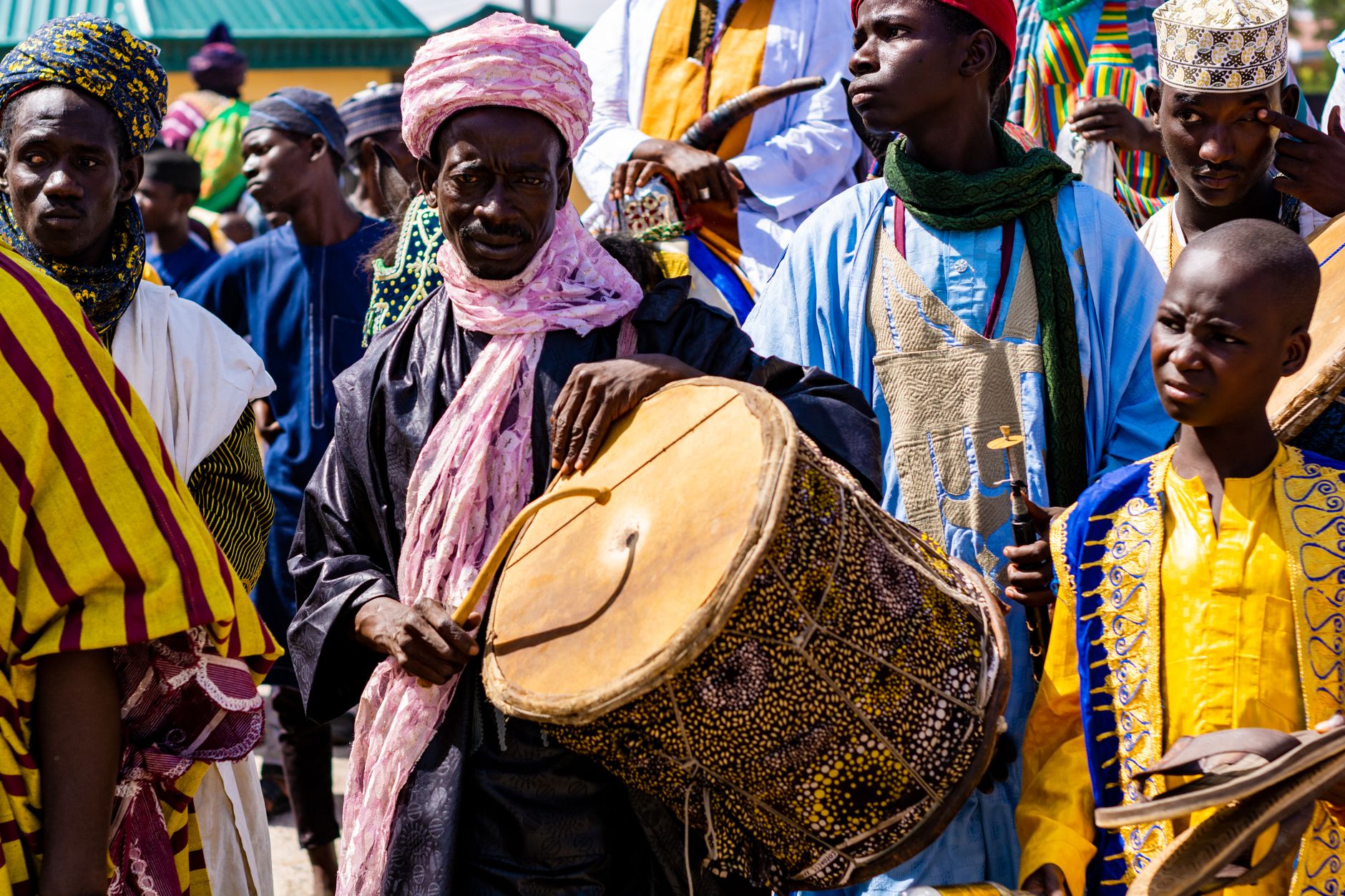

Practical travel to Burkina Faso in April 2026 is constrained by a hard reality: the U.S., UK, Canada, Australia, France, and Germany all warn against all travel or the functional equivalent because of terrorism, kidnapping, violent crime, and political instability. That affects insurance, road movement, and whether an independent leisure trip is sensible at all, including on routes linking Ouagadougou, Bobo-Dioulasso, Banfora, or Fada N'Gourma.
Most foreign travelers need a visa, and Burkina Faso's official eVisa portal says short-stay visas cover visits up to 90 days. U.S. citizens face an extra complication: the U.S. State Department says Burkina Faso suspended visas for U.S. citizens on 30 December 2025, so checking directly with the nearest embassy is not optional.
Burkina Faso uses the West African CFA franc, abbreviated XOF, fixed at EUR 1 = XOF 655.957. Cards work in larger hotels and a few urban businesses in Ouagadougou and Bobo-Dioulasso, but outside that narrow band this is a cash economy.
Most arrivals use Ouagadougou by air, then continue overland if security conditions allow. Overland border crossings exist with Mali, Niger, Benin, Togo, Ghana, and Côte d'Ivoire, but current government advisories make long cross-border road planning a poor gamble.
Domestic travel is mostly by road: shared taxis, intercity buses, hotel-arranged cars, and private drivers for higher-risk routes. Distances are manageable on paper, but checkpoints, road conditions, and security constraints can turn a map line between Koudougou, Dédougou, or Ouahigouya into a very long day.
November to February is the easiest window, with cooler dry-season weather, better roads, and fewer rain-related disruptions. March to May brings fierce heat, often above 40C, while June to September is the rainy season, when flooding, mud, and higher malaria risk complicate travel to places like Nazinga, Tiébélé, or Sindou.
Expect workable mobile coverage in major cities such as Ouagadougou, Bobo-Dioulasso, and Koudougou, then thinner service as you move into reserve areas or smaller towns. Buy a local SIM if you travel at all, keep offline maps downloaded, and do not assume reliable data on roads toward Loropéni, Nazinga, or Fada N'Gourma.
Use XOF cash for almost everything outside upper-end hotels. Break large notes in Ouagadougou or Bobo-Dioulasso before heading toward Banfora, Tiébélé, Nazinga, or Loropéni.
Burkina Faso is a road country, not a rail itinerary. Build plans around realistic driving days, checkpoints, and heat rather than optimistic map distances.
Choose hotels with cancellation flexibility and direct phone confirmation. Security changes can make a route possible one week and foolish the next.
Get mobile data in Ouagadougou on arrival and download offline maps immediately. Coverage weakens fast once you leave the main urban corridors.
Carry your yellow fever certificate with your passport, not in checked luggage. Entry rules mention health documentation, and this is the paper border officials are most likely to want.
Private drivers raise daily costs sharply, but they can save wasted days and reduce risk on complex routes. In current conditions, time and security often cost more than the room.
Do not rush into requests. In Ouagadougou, Koudougou, or a village near Tiébélé, the greeting is part of the interaction, not dead time before the useful part.
Big lunches and early evening street food are easier to find than late-night restaurant service outside the main cities. In Bobo-Dioulasso or Banfora, eat when places are busy rather than assuming all-day kitchens.
Explore Burkina Faso with a personal guide in your pocket
Audio guides for 1,100+ cities across 96 countries. History, stories, and local insight — offline ready.

No, not by the standard most leisure travelers should accept. As of April 2026, multiple Western governments advise against all travel or the functional equivalent because of terrorism, kidnapping, violent crime, and political instability, which also affects insurance and road movement.
Probably yes. Burkina Faso's official eVisa system says foreign travelers need a visa unless exempt, short-stay visas cover up to 90 days, and several government advisories say travelers should arrange entry permission before departure rather than rely on arrival formalities.
Not through the normal assumption you might make from older guidebooks. The U.S. State Department says Burkina Faso suspended visas for U.S. citizens on 30 December 2025, so Americans need to check directly with the nearest Burkina Faso embassy before booking anything.
November to February is the easiest season. Days are drier and cooler, roads are more reliable, and wildlife viewing near places like Nazinga is better because animals concentrate near water.
More than you would for a card-friendly trip in Europe. Burkina Faso is largely cash-first outside bigger hotels and a few urban businesses, so even travelers sleeping in decent hotels should expect to pay many daily costs in XOF notes.
Technically yes, but practical decisions depend on the current security picture, not just distance. Road travel exists, yet advisories, checkpoints, and changing local conditions mean a route that looks routine on a map may not be wise on the ground.
Not at the budget end, but current security realities distort costs fast. A simple cash-based trip can sit around XOF 20,000 to 35,000 a day, while private drivers, stronger logistics, and safer hotel choices push the daily cost far higher.
Yes, you should assume you do. Official entry guidance and travel health sources consistently point to yellow fever documentation as part of the paperwork you need alongside your passport and visa.
French is the official language and the safest common option for visitors. In daily life you will also hear Mooré, Dioula, Fulfulde, and other national languages, and a polite greeting in French goes further than blunt efficiency.
Last reviewed