Introduction
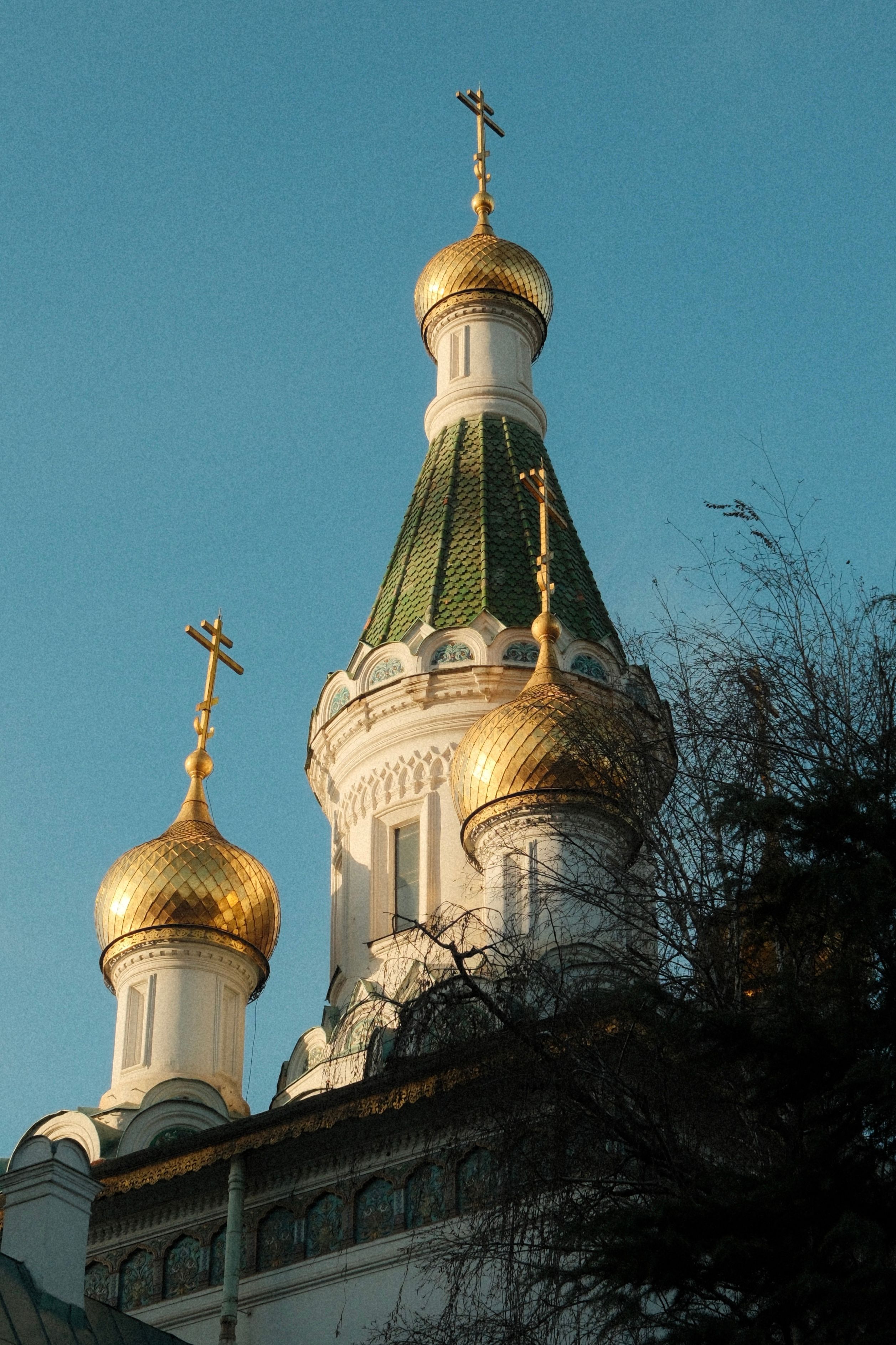
Five green onion domes rise over Saint Nicholas Church in Sofia, Bulgaria like a piece of Moscow set down in the middle of a Balkan capital. Visit because this small church does more than photograph well: it folds empire, exile, bombing, prayer, and present-day politics into one glittering stop on Tsar Osvoboditel Boulevard. The gold catches your eye first. The crypt keeps you longer.
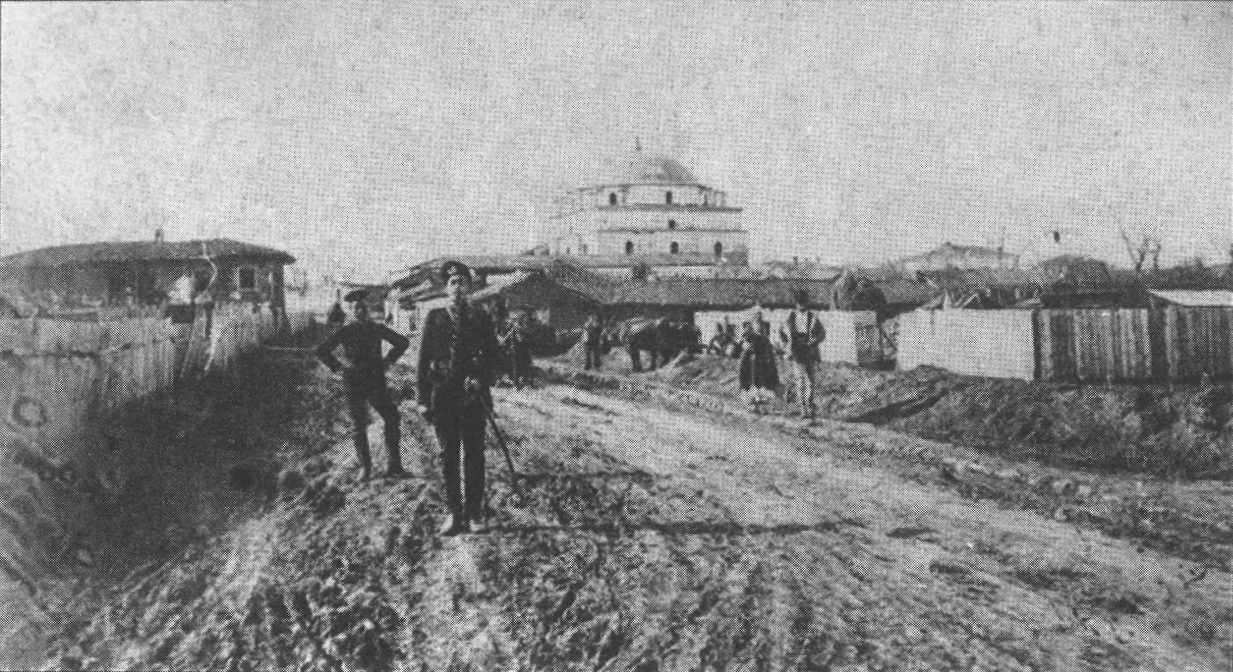
Documented records show the church was built between 1907 and 1914 for the Russian diplomatic mission, on the site of the former Saray Mosque. That alone tells you what kind of place this is. A church, yes, but also a statement in brick and ceramic about who mattered in Sofia after liberation from Ottoman rule.
Step inside and the scale shifts. Street noise drops away, candle smoke hangs in the air, and the painted surfaces pull your gaze upward while central Sofia rushes on outside toward Alexander Nevsky Cathedral and the government quarter.
Most visitors come for the domes and leave remembering the crypt of Archbishop Seraphim Sobolev, where people still tuck handwritten prayers beside his tomb. That's the real reason to stop here. Saint Nicholas Church looks ornamental from the pavement, then turns unexpectedly intimate once you're inside.
TOP 10 Things to do in Sofia, Bulgaria 2024!
The Travel BossWhat to See
The Five Gilded Domes on Tsar Osvoboditel
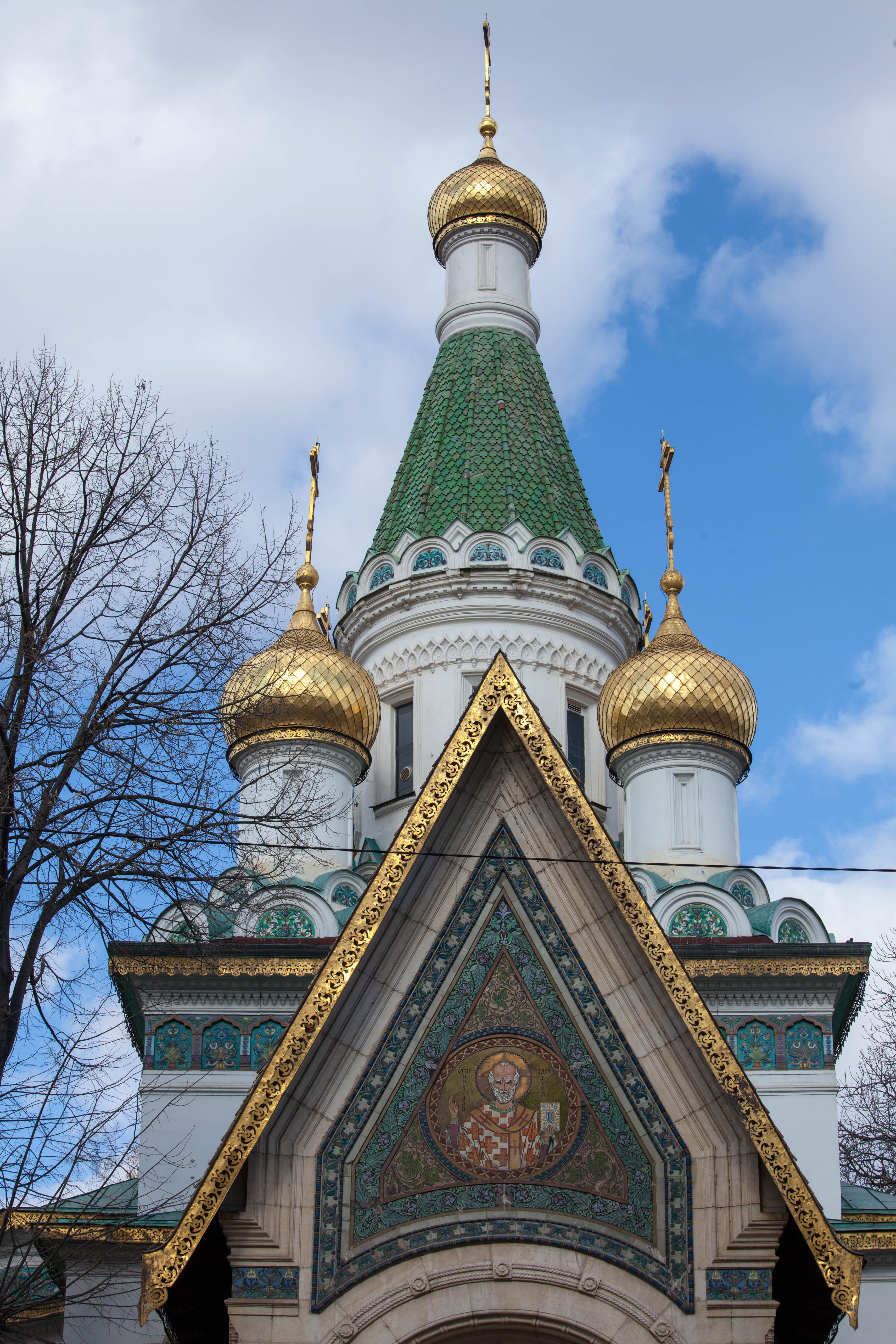
Saint Nicholas Church looks almost mischievous on Tsar Osvoboditel Boulevard: a compact white building that suddenly lifts five gold onion domes above Sofia's yellow cobblestones, as if a piece of Moscow had been set down between government facades. Mikhail Preobrazhenski built it between 1907 and 1914 for the Russian diplomatic mission, and the central dome rises 19 meters, about the height of a six-story townhouse, which is just enough to make the church feel improbably vertical for its small footprint. Walk to the garden side rather than stopping at the front gate; the traffic noise drops, the green majolica roof starts to show, and the whole building makes more sense as an object of careful ornament rather than a postcard prop.
The Ceramic Iconostasis and the Dark Interior
Outside, the church flashes gold. Inside, it lowers its voice. The room is small, closer to a jewel box than a cathedral nave, with murals dimmed by candle smoke and time, incense hanging in the air, and an iconostasis made entirely of ceramic, a rare choice in Bulgaria and a copy of the one in Kyiv's St Vladimir's Cathedral. Most visitors glance up, take in the chandeliers, and leave too quickly; stand still long enough for your eyes to adjust and the place shifts from decorative to intimate, a useful counterpoint if you have just come from the scale and thunder of Alexander Nevsky Cathedral.
Down to St Seraphim, Then Out to the Garden
The real center of gravity is below the church, in the crypt of St Seraphim Sobolev, where people come with folded notes, private requests, and the kind of silence that tells you this is still a working place of petition, not a preserved relic. Go downstairs first, then come back up and circle into the small garden by the Pushkin monument; that sequence changes the church from a pretty exterior into something lived in, and it also sets up a strong cross-section of Sofia's religious core if you continue on to St Nedelya Church.
Photo Gallery
Explore Saint Nicholas Church in Pictures

The quiet courtyard of the Saint Nicholas Church in Sofia, Bulgaria, showcases traditional Orthodox architecture nestled among modern city buildings.
Gitanes232 · cc0

The beautifully decorated interior of Saint Nicholas Church in Sofia, Bulgaria, showcases traditional Orthodox iconography and intricate woodwork.
TodorBelomorski · cc by-sa 4.0

The historic Saint Nicholas Church in Sofia, Bulgaria, sits uniquely tucked beneath a modern architectural overpass in the city center.
TodorBelomorski · cc by-sa 4.0

The interior of Saint Nicholas Church in Sofia, Bulgaria, showcases traditional Orthodox architecture with detailed frescoes and a carved wooden iconostasis.
TodorBelomorski · cc by-sa 4.0

The entrance of the historic Saint Nicholas Church in Sofia, Bulgaria, featuring a traditional religious icon above the wooden door.
Gitanes232 · cc0

A collection of sacred icons displayed against the historic brick interior of the Saint Nicholas Church in Sofia, Bulgaria.
TodorBelomorski · cc by-sa 4.0

The historic Saint Nicholas Church in Sofia, Bulgaria, sits uniquely nestled beneath a modern pedestrian bridge in the city center.
TodorBelomorski · cc by-sa 4.0

A glimpse into the historic interior of the Saint Nicholas Church in Sofia, showcasing traditional religious iconography and ancient brickwork.
TodorBelomorski · cc by-sa 4.0

A peaceful view of the Saint Nicholas Church in Sofia, Bulgaria, showcasing its modest white architecture and welcoming arched entrance.
TodorBelomorski · cc by-sa 4.0

The entrance to the historic Saint Nicholas Church in Sofia, Bulgaria, showcasing its traditional architectural style and religious iconography.
TodorBelomorski · cc by-sa 4.0

The historic Saint Nicholas Church in Sofia, Bulgaria, nestled beneath a modern architectural walkway.
TodorBelomorski · cc by-sa 4.0

A serene view of the entrance to the Saint Nicholas Church in Sofia, Bulgaria, framed by lush greenery and potted plants.
TodorBelomorski · cc by-sa 4.0
Videos
Watch & Explore Saint Nicholas Church
TOP 10 Things to do in Sofia, Bulgaria 2024!
Sofia – One of Europe's Oldest Cities | Travel Tips for Bulgaria's Capital
In the crypt, look for the handwritten letters left near St. Seraphim's tomb. They are easy to miss if you arrive focused on the domes, but they reveal what this church means to Sofia now.
Visitor Logistics
Getting There
Saint Nicholas Church stands at 3 Tsar Osvoboditel Blvd., about an 8-minute walk west from Sofia University metro on lines M1 and M4, or 9-12 minutes northeast from Serdika through the historic center. From Alexander Nevsky Cathedral, walk southwest along the yellow cobbles of Tsar Osvoboditel for about 5 minutes; by car, you are in Sofia's Blue Zone, where parking is paid and usually harder to find than a seat on the metro.
Opening Hours
As of 2026, the best-supported working hours are daily from 08:00 to 18:30. The church reopened on October 11, 2023 after a diplomatic closure, and it now functions again as an active Orthodox church, so access can tighten during liturgies, feast days, or special services.
Time Needed
Give it 10-20 minutes for the onion domes, a quick look inside, and a candle. Give it 20-35 minutes if you want the crypt as well, and up to an hour if you plan to sit quietly and watch the steady stream of people leaving letters for St. Seraphim.
Accessibility
The approach is easy: central pavements, flat urban ground, and entrances from both the boulevard and the small garden. Inside is less certain, and the crypt is likely a problem for wheelchairs because visitor reports describe reaching it by going outside and down stairs; I found no confirmed lift or accessible toilet.
Cost & Tickets
As of 2026, standard entry appears to be free, with no booking system and no skip-the-line option for ordinary visits. That makes this one of central Sofia's better short stops: step in, look up, then spend your money on coffee instead.
Tips for Visitors
Dress Quietly
Treat this as a working Orthodox church, not a photo backdrop. Cover shoulders and knees, take off hats, keep your phone silent, and move with more restraint than you would in a large cathedral because the space is small and every footstep carries.
No Interior Photos
Assume exterior photos are fine and interior photos are not. Recent visitors say the ban inside is enforced, flash is a bad idea even when photography is allowed for ceremonies, and a drone over this government-and-embassy district would be asking for trouble.
Go To Crypt
Most guidebooks stop at the domes, which misses the point. Go down to the crypt if it is open: that is where Sofians leave letters to St. Seraphim, and the church stops being a postcard and becomes a living piece of the city.
Pair Nearby
This works best as part of a short central Sofia walk with Alexander Nevsky Cathedral and, farther southwest, St Nedelya Church. The distances are small, the route is handsome, and the contrast between these churches tells you more about Sofia than any single stop can.
Eat Nearby
For something almost absurdly close, Arbat sits right by the church and leans into the Russian-Ukrainian-Caucasian menu; expect mid-range prices. Cafe Wien is handy for coffee nearby, and La Vita e Bella near Alexander Nevsky works if you want a longer lunch with mains running from about 10 to 60 leva depending on how ambitious you feel.
Central City Caution
The church stands in one of Sofia's safer-feeling central districts, so the main nuisance is ordinary capital-city petty theft rather than anything church-specific. Watch your pockets on the metro and in underpasses around Serdika, and do not bother hailing random taxis when the walk is this short.
Where to Eat
Don't Leave Without Trying
Legé Bar & Diner
local favoriteOrder: The Bulgarian kebapche and kyufte are local favorites, but their international burgers and craft cocktails are also crowd-pleasers.
A lively spot with a mix of traditional Bulgarian and modern international dishes. The atmosphere is vibrant, and the food consistently earns rave reviews.
Martines Specialty Coffee Shop & Roastery Sofia
cafeOrder: Their single-origin espresso and Bulgarian pastries like banitsa are must-tries, paired with a cozy, relaxed vibe.
A go-to for coffee lovers, with some of the best beans in Sofia. The baristas are passionate, and the space is perfect for a quiet break.
Italian Sandwiches & salads
quick biteOrder: Their prosciutto and mozzarella panini, along with the fresh Caprese salad, are simple but perfectly executed.
A no-frills spot for quick, high-quality Italian sandwiches. Ideal for a fast, satisfying meal without sacrificing taste.
בלקן פאלאס סופיה
local favoriteOrder: The grilled meats and meze platters are well-regarded, offering a taste of traditional Balkan flavors.
A hidden gem with a focus on authentic Balkan dishes. The small but dedicated following suggests a quality experience.
Dining Tips
- check For a distinctly Bulgarian meal, prioritize Izbata Tavern or similar local taverns.
- check Rainbow Factory Veslets is a strong breakfast/brunch stop, blending specialty coffee with Bulgarian breakfast items.
- check Mekitsa & Coffee is the go-to for trying classic Bulgarian fried-dough breakfast without a big meal commitment.
Restaurant data powered by Google
Historical Context
Domes Over a Fault Line
Saint Nicholas Church compresses a rough century of Sofia into one compact plot of land. Documented sources show the church replaced the Saray Mosque after its demolition in 1882, then rose between 1907 and 1914 as a Russian Revival chapel for the imperial diplomatic mission at 3 Tsar Osvoboditel Boulevard.
That origin matters. This was never just a parish church for the nearest block; it was an outpost of influence in the same central district where Bulgaria staged its capital and where Russian memory also found monumental form in Alexander Nevsky Cathedral.
Archbishop Seraphim and the Church That Changed Sides
Archbishop Seraphim Sobolev arrived in Bulgaria in 1921, after the Russian Revolution had scattered clergy and believers across Europe. For him, Saint Nicholas Church was no decorative embassy chapel. It was a lifeline for émigrés who had lost a country, legal protection, and any clear idea of where the future would be found.
Documented church sources and later studies describe the church as the emotional center of Russian exile in Sofia after 1917. Then war broke the building open. In 1944, bombing damaged the church so badly that the roof collapsed and parts of the south wing were destroyed, turning Seraphim's task from spiritual care into survival amid rubble and suspicion.
The turning point came after the war, when the church's role shifted again from exile refuge toward a more formal Moscow-linked presence, a process scholars date unevenly and church authorities narrate differently. Seraphim died on 26 February 1950 and was buried in the crypt here, but his personal stake never really vanished: he had tried to keep a displaced flock intact while the institution around him changed hands, changed patrons, and changed meaning.
A Church Built as Diplomacy
Documented municipal and tourism sources name Mikhail Preobrazhenski as the architect and date construction to 1907-1914. The Russian Revival design, with its clustered domes and glazed ornament, reads almost like portable statecraft. Even the details argue the point: a majolica image of Alexander Nevsky over the south entrance and an iconostasis modeled on Kyiv's St Vladimir Cathedral linked the building to a wider sacred-political network, not to neighborhood convenience.
Bombs, Repairs, and a Living Tomb
The church's prettiness can fool you. Documented sources show the 1944 bombing of Sofia tore through the building, and restoration followed in 1945-1946 under the Sofia Metropolis, which means the church survived because people decided it should. Today the strongest living tradition gathers below ground, at Seraphim's tomb, where visitors still leave letters asking for help; that practice is well attested, even if devotional accounts about its exact origin drift into pious retelling.
Listen to the full story in the app
Your Personal Curator, in Your Pocket.
Audio guides for 1,100+ cities across 96 countries. History, stories, and local insight — offline ready.
Audiala App
Available on iOS & Android
Join 50k+ Curators
Frequently Asked
Is Saint Nicholas Church worth visiting? add
Yes, especially if you want one Sofia church that feels alive rather than merely decorative. The gold onion domes catch your eye first, but the real pull is downstairs at the tomb of St. Seraphim, where locals still leave handwritten prayers. It is also one of the clearest places in central Sofia to feel how religion, politics, exile, and memory ended up packed into one small building.
How long do you need at Saint Nicholas Church? add
Most visitors need 20 to 35 minutes. That gives you enough time to walk around the exterior, step inside the compact main church, and visit the crypt if it is open. Stay closer to an hour if you want quiet time, candles, or a slower look at the ceramic iconostasis.
How do I get to Saint Nicholas Church from Sofia city center? add
Walk if you are already in central Sofia; the church sits at 3 Tsar Osvoboditel Blvd. and is easy to reach from the ceremonial core. From Serdika, expect about 9 to 12 minutes on foot, and from Sofia University metro about 8 minutes west along Tsar Osvoboditel. If you are coming by metro, Sofia University on lines M1 and M4 is usually the easiest stop.
What is the best time to visit Saint Nicholas Church? add
Early morning or late afternoon is best. The church is smaller than it looks from outside, so quiet hours make a difference, and the light on the white walls and gold domes is softer then. Avoid major liturgy times if you want space, but go during a service if you want the smell of incense, the chant, and the place at full voltage.
Can you visit Saint Nicholas Church for free? add
Yes, entry appears to be free. I found no official ticketing system and no evidence of paid standard admission. Treat it as a working Orthodox church, though, which means access can tighten during services or special events.
What should I not miss at Saint Nicholas Church? add
Do not miss the crypt of St. Seraphim and the ceramic iconostasis upstairs. Most people photograph the domes, glance inside, and leave too fast. The crypt tells you why locals come, and the iconostasis shows that this was built as an imperial statement, not just a pretty neighborhood chapel.
Is Saint Nicholas Church open every day? add
Usually yes, with recent listings giving daily hours of about 08:00 to 18:30. Those hours are consistent across multiple travel and local directory sources, though official tourism pages confirm the church is active without posting a timetable. Check close to your visit if timing matters, because church access can change around liturgies or feast days.
Sources
-
verified
Visit Sofia - Russian Church
Official city tourism page used for the address, historical outline, architectural features, and location in central Sofia.
-
verified
Sofia Municipality - Russian Church of St Nicholas the Miracle-Maker
Municipal source used for construction dates, architect Mikhail Preobrazhenski, Russian Revival design, iconography, and the ceramic iconostasis.
-
verified
UNESCO World Heritage Centre - Boyana Church
Used to confirm that Saint Nicholas Church is not Sofia's UNESCO-listed church; Boyana Church is.
-
verified
Bulgaria Info Guide - The Church of St Nicholas the Miracle-Maker
Used for corroborating the 1882 mosque demolition, the 1914 consecration, and the church's general visitor profile.
-
verified
Religions (MDPI) - academic article on the Russian Church in Sofia
Academic source used for ownership disputes, wartime damage, restoration chronology, and the church's changing jurisdiction.
-
verified
Athos Guide - Seraphim Sobolev
Used for Archbishop Seraphim's biography and his role in Russian Orthodox life in Bulgaria from 1921.
-
verified
Pravoslavie.ru - article on Archbishop Seraphim
Used to confirm Seraphim's leadership in Bulgaria and his burial at the church.
-
verified
BTA - Saint Seraphim of Sofia article
Used for Seraphim's death date in 1950 and the 2016 canonization context tied to the crypt's devotional importance.
-
verified
Tripadvisor - Saint Nikolas Russian Church
Used for recent visitor evidence on free entry, atmosphere, and the practical expectation that interior photography is restricted.
-
verified
Tripadvisor - Saint Nikolas Russian Church reviews page
Used for visitor reports on the crypt, dress expectations, and no-photos enforcement inside the church.
-
verified
Tripadvisor - Saint Nikolas Russian Church transit page
Used for walking times from Sofia University and Serdika metro stops.
-
verified
AIEMA Sofia - Getting There
Used to confirm Sofia University station serves metro lines M1 and M4.
-
verified
Visit Sofia - Luggage Storage
Used to confirm Serdika station connections and nearby central visitor infrastructure.
-
verified
Moovit - Russian Church transit stop listing
Used for nearby surface transport stops and walking distances.
-
verified
BNR Radiobulgaria - The Miracles of St Nicholas the Wonder Worker Church
Used for the living custom of leaving letters and petitions connected to St. Seraphim's tomb.
-
verified
BNR Radiobulgaria - St Seraphim devotional practice
Used for the church's present-day role as a pilgrimage and prayer site, especially the crypt.
-
verified
mospat.ru - canonization news
Used to confirm the 2016 canonization of St. Seraphim.
-
verified
BNR - church reopening notice
Used to confirm the church reopened after the 2023 closure.
-
verified
mospat.ru - church functioning news
Used as recent evidence that the church remains active liturgically.
-
verified
Tweekends - Russian Church Sofia
Used for practical visit timing estimates and corroboration that entry is free.
-
verified
TripHobo - Saint Nikolas Russian Church
Used for estimated visit duration.
-
verified
SoSofia - Russian Church listing
Used for local context on the crypt, the church's everyday Sofia identity, and the importance of St. Seraphim.
-
verified
Harina.bg - Ruska tsarkva
Used for contemporary Bulgarian atmosphere notes about the church and its devotional character.
Last reviewed: