Introduction
This Brunei travel guide starts with the surprise most first-timers miss: the country is quieter, greener, and far stranger than its oil-state stereotype.
Brunei rewards travelers who like places that reveal themselves slowly. In Bandar Seri Begawan, the golden dome of Sultan Omar Ali Saifuddien Mosque rises above a river city that feels measured rather than hectic, while Kampong Ayer stretches across the Brunei River on stilts with schools, mosques, shops, and family homes linked by boardwalks. That contrast matters. You get a capital of marble, ceremony, and royal symbolism, then a water settlement with 1,300 years of lived history a few minutes away by boat.
The country is small enough to cross without drama, but each district shifts the mood. Kota Batu holds the older story of the sultanate, Muara gives you Brunei's practical coastline rather than a resort fantasy, and Jerudong shows the polished suburban edge of the capital belt. Drive west and the oil towns of Seria and Kuala Belait replace river heritage with pumpjacks, broad roads, and the logic of petroleum wealth. Head through Tutong and the scenery loosens into forest, villages, and a less edited version of the country.
Then Brunei changes again in the east. Ulu Temburong and Bangar open onto one of the region's rare stretches of protected old-growth rainforest, where canopy walkways rise 60 meters above the ground and river journeys still shape the day. The Temburong Bridge Corridor has made that landscape far easier to reach, but it hasn't turned it into a theme park. That's the real draw here: a sovereign state where mosque domes, proboscis monkeys, nasi katok stalls, and primary forest still sit inside one coherent national rhythm.
A History Told Through Its Eras
Before the sultans, the river already knew how to rule
Po-ni and the River Kingdom, 6th century-14th century
Morning comes first on the Brunei River: wet heat, mangrove shadow, the slap of hull against tide. Long before Bandar Seri Begawan had its domes and ministries, this estuary fed a court the Chinese sources called Po-ni, a trading state that sent tribute across the South China Sea and received ceramics, silk, and attention in return. Ce que l'on ignore souvent, c'est que Brunei enters history not as a jungle backwater but as a port with manners, ambition, and a talent for being noticed.
Chinese records place Po-ni in the diplomatic world of the Tang and Song courts, and by 977 an embassy is said to have arrived with gifts dramatic enough to impress an emperor, including a live rhinoceros. One can imagine the scene: officials in layered robes, scribes sharpening brushes, and this beast from Borneo standing in the middle of imperial ritual like a piece of political theatre. That is how small courts survive. They do not shout. They choose their spectacle.
At Kota Batu, where shards of imported ceramics have surfaced from the soil, archaeology confirms what the chronicles only hint at: this river mouth was plugged into a larger maritime world. Whoever controlled the tidal approach controlled camphor, beeswax, forest produce, and the inland routes that fed them downstream. Geography did the first half of the work. Human calculation did the rest.
And then comes the mystery every old state keeps close. Local tradition preserves origin stories of noble ancestors and miraculous beginnings, but the real secret is simpler and more interesting: Brunei's early rulers understood that water is a form of architecture. Before the stone tombs, before the royal genealogy, the river had already chosen the capital. The later sultanate would inherit that logic, and turn it into dynasty.
The earliest rulers of Po-ni remain shadowy, but their greatest achievement was clear: they made a river estuary behave like a court.
A Chinese account from 977 describes Po-ni sending a live rhinoceros as tribute, a diplomatic gesture so extravagant that it still feels slightly mischievous.
A grave at Kota Batu, a new faith, and a marriage that changed everything
Conversion and the Making of the Sultanate, 14th century-15th century
A dynasty often begins in silence: a wedding contract, a whispered conversion, a grave no larger than the man beneath it. Brunei's court tradition names Sultan Muhammad Shah as the first Muslim ruler, though the dates remain disputed and the chronicles were written later, under descendants with every reason to dignify the founding scene. Even so, the broad movement is clear. Between the 14th and 15th centuries, the rulers of Brunei turned toward Islam and, with it, toward a new map of prestige.
This was not only a matter of belief. It was trade, language, law, and alliance. Muslim merchants linked Gujarat, Melaka, Java, and the islands to the east; a ruler who joined that world gained more than a creed. He gained a vocabulary of legitimacy. Ce que l'on ignore souvent, c'est que conversion in maritime Southeast Asia was often as intimate as it was political: a marriage into a Muslim family, a port full of foreign merchants, a court deciding which future would pay.
The old Javanese text Nagarakretagama lists Barune among the places within Majapahit's orbit in 1365. That detail matters. Islam allowed Brunei's rulers to step out of one imperial shadow and into another, one better suited to the sea lanes of the age. A ruler could now present himself not as a provincial subordinate but as a sovereign in a Muslim world stretching far beyond Borneo.
Go to Kota Batu and the founding story shrinks to human scale. The royal tombs do not blare. They wait. Under carved stone and shade, the first Muslim rulers are less abstractions than family elders who made an irreversible choice, one that bound Brunei to court ritual, scripture, and dynastic continuity. From that choice came the state that still exists today.
Sultan Muhammad Shah is remembered less as a warrior than as the ancestor who understood that a change of faith could also be a change of destiny.
The founder's conversion is often told as a courtly religious moment, yet many historians suspect a marriage alliance did as much to shape it as any sermon.
Captain of Songs and the empire that reached Manila
Imperial Brunei, c. 1485-1578
Empire in Brunei did not announce itself with vast stone palaces. It moved by fleet, marriage, tribute, and rumor. Under Sultan Bolkiah, remembered as Nakoda Ragam, the Captain of Songs, Brunei reached the height of its power, extending influence across northern Borneo and deep into the southern Philippines, including the politics of Manila before the Spanish conquest. The title alone tells you what sort of court this was: a ruler could be admired for music and feared for power, and no one found the combination odd.
Picture the river at dusk during Bolkiah's reign. Oared craft slide past stilted settlements, envoys arrive with gifts, and somewhere in the palace quarter a court performance folds poetry into statecraft. A Malay ruler of this era did not separate culture from authority. Song, ceremony, lineage, and war all spoke the same language. That is why Nakoda Ragam endured in memory. He conquered, yes, but he also understood display.
Ce que l'on ignore souvent, c'est how far Brunei's web extended. When the Spanish later entered Manila in 1571, they encountered Muslim nobles and political ties that bore the mark of Brunei's earlier reach. This was not a local river kingdom pretending at grandeur. For a brief, brilliant period, Brunei mattered in the geopolitics of the region.
The proof today is unexpectedly modest. Bolkiah's tomb at Kota Batu sits above the river, more elegy than triumph. Frangipani, calligraphy, weathered stone. That is often how empire survives in Southeast Asia: not in giant walls, but in graves, titles, and the afterlife of alliances. And then, of course, came the Spaniards, who mistook temporary occupation for victory.
Sultan Bolkiah, the Captain of Songs, remains Brunei's most magnetic ruler because he made empire feel like performance and performance feel like destiny.
Brunei's greatest imperial ruler was remembered not only for fleets and territory but for music, an artistic reputation that became part of his political legend.
From the Spanish sack to oil wealth: how a small court refused to disappear
Fire, Contraction, and Reinvention, 1578-1984
In 1578 the Spanish came up the Brunei River with soldiers, Filipino auxiliaries, missionaries, and imperial appetite. Governor Francisco de Sande occupied the capital for roughly 72 days after Sultan Saiful Rijal withdrew inland, and the invaders described a court rich in gold, silk, and ceremonial display. One can almost see their astonishment: a humid river capital at the edge of Borneo that turned out to be wealthier, more connected, and more politically sophisticated than they had expected.
But occupation is not the same as possession. Disease, climate, and supply did what swords did not. The Spanish burned the main mosque and left; Saiful Rijal returned to a damaged capital and rebuilt. That episode matters because it set a pattern Brunei would repeat for centuries. It could lose ground, lose ports, lose prestige, and still preserve the core institution that mattered most: the sultanate itself.
The 19th century was harsher. Civil conflicts, court rivalries, and pressure from foreign adventurers cut the kingdom down to size. James Brooke, the future White Rajah of Sarawak, entered Brunei's politics through rebellion and favor; territory slipped away; the British presence hardened. By 1888 Brunei had accepted British protection, and by 1906 a Resident advised the court on almost everything except Islam and Malay custom. Small states often vanish at this stage. Brunei did not.
Then oil changed the script. The 1929 discovery at Seria turned a diminished protectorate into a state with revenue, leverage, and a future. Later rulers, especially Sultan Omar Ali Saifuddien III, used that wealth to shape a modern monarchy whose symbols remain visible in Bandar Seri Begawan: the white marble of Sultan Omar Ali Saifuddien Mosque, the ceremonial confidence of the capital, the careful preservation of royal authority. Independence arrived on 1 January 1984, but it had been staged for decades.
And yet the oldest Brunei still lingers over water. In Kampong Ayer, life continues on stilts much as it has for centuries, only now with schools, mosques, and speedboats. The bridge to the present is literal as well as historical: from Kota Batu's royal graves to the modern skyline, from Seria's oil wells to the state that calls itself the Abode of Peace. The next chapter is not about survival. It is about what a monarchy does once survival is no longer the only question.
Sultan Omar Ali Saifuddien III had the rare gift of making modernity look ceremonial rather than disruptive, which is one reason his memory still structures the capital.
Brunei's great 20th-century transformation began not in the capital but at Seria, where oil was struck in 1929 and the kingdom's finances acquired an entirely new backbone.
The Cultural Soul
The Politeness Hidden in a Particle
Brunei speaks in layers. Standard Malay stands upright in schools, ministries, headlines. Brunei Malay slips sideways through kitchens, boats, car rides, office corridors. English waits nearby, useful and unruffled. In Bandar Seri Begawan, a single conversation can cross all three without warning, as if changing shoes between rooms.
One word explains more than a dictionary can: bahasa. It means language, yes, but also breeding, timing, the exact pressure with which a sentence should touch another person. You can know every noun and still fail at bahasa. You can master grammar and remain a barbarian. This strikes me as one of Brunei's finest inventions.
Then comes bah, the small miracle. A particle, almost nothing, and therefore powerful. It can soften an order, confirm a joke, shorten a distance. Hear it in Kampong Ayer and you understand that speech here does not merely carry meaning; it arranges relations with the delicacy of lacquered boxes. A country is often betrayed by its pronouns. Brunei is revealed by its particles.
Sago, Smoke, and the Discipline of Appetite
Brunei's food is discreet until it reaches your tongue. Then it becomes impossible to ignore. Ambuyat, the national dish, looks like a dare: translucent sago starch, twirled with bamboo sticks, swallowed rather than chewed. The seduction lies in the cacah, that ferocious dip of tamarind, chili, herbs, and shrimp paste which gives the starch its soul. Blankness can be a form of genius.
Nasi katok tells another truth. Rice, fried chicken, sambal, paper wrapping, no ceremony. It is the meal of late hours, quick hunger, cars parked under fluorescent light, office workers who know the correct stall and guard its address like family gold. In a wealthy oil state, the beloved national reflex is still a humble packet you can hold in one hand. I admire the honesty.
Then the leaf-wrapped kingdom begins: kelupis, pulut panggang, selurut, wajid Temburong. Brunei likes food that arrives swaddled, steamed, grilled, smoked, hidden until the fingers perform the unveiling. In Tutong market or on the road toward Ulu Temburong, opening one of these parcels feels almost indecent. The perfume of leaf, rice, coconut, and fire rises all at once. Etiquette disappears. Hunger wins.
The Art of Never Forcing a Door
Brunei's etiquette is a masterpiece of softness. Nobody lunges. Nobody colonizes the conversation. Refusal rarely arrives as a blunt object; it comes padded, angled, made survivable. Silence is not an empty space here. It is furniture.
This has moral beauty. It also has comic potential for the impatient foreigner, who keeps waiting for the direct answer and receives instead a series of gracious weather systems moving around the point. But the point is the grace. Public life in Brunei prefers smoothness to friction, and the result is a social atmosphere that can feel almost liquid.
Dress follows the same logic. Near mosques, ministries, and formal spaces in Bandar Seri Begawan, clothing does not shout individuality; it acknowledges the room. Shoes come off. Voices drop. Hands are offered with care. In many countries, manners are decoration. In Brunei, they are architecture.
Gold Dome, Wet Air, Measured Time
Islam in Brunei is not background. It edits the day. Prayer times cut through humidity and traffic; the rhythm reaches offices, homes, river settlements, malls. The country does not perform piety with theatrical excess. It lives inside it, which is more serious.
The Sultan Omar Ali Saifuddien Mosque in Bandar Seri Begawan understands spectacle, of course: gold dome, marble, lagoon, ceremonial barge, the whole composition reflected in still water as if heaven had hired an architect. Yet the real force is not visual. It is temporal. The building tells the city when to gather, when to pause, when to remember scale.
At Jame' Asr Hassanil Bolkiah, and in the quieter prayer halls beyond the famous monuments, religion becomes tactile. Cool floors under bare feet. Sleeves adjusted. A whispered instruction. The smell of air-conditioning, fabric, and rain carried in from outside. In many places faith declares itself. In Brunei, it regulates temperature, posture, and time until devotion feels almost like climate.
A Capital Built on Water and Restraint
Brunei's architecture does not believe in constant crescendo. It knows when to withhold. A government building may sit in dignified calm, then flash a gilded detail. A wooden house may look plain from the road, then reveal carved screens, patterned tiles, a geometry of shadows under the eaves. The national aesthetic is not poverty of gesture. It is edited luxury.
Kampong Ayer remains the great lesson. More than a picturesque water village, it is an urban idea that has refused extinction for over a millennium: houses on stilts, schools on stilts, mosques on stilts, daily life suspended above the Brunei River with a composure that makes solid ground seem slightly overrated. Boardwalks creak, boats stitch the water, children run where visitors place each step with caution. Civilization, here, wears timber.
At Kota Batu, the older Brunei appears in fragments: tombs, ceramics, traces of power arranged along the river that made the sultanate possible. Geography wrote the first draft. The built world answered. Even the modern link of the Temburong Bridge Corridor carries the same obsession: how to cross water without insulting it.
Gold Used Like a Whisper
Brunei understands the old danger of gold. Too much of it and one gets vulgarity. Too little and one gets cowardice. The country has chosen a third path: gold as punctuation. A dome. A thread in tenunan fabric. A royal emblem. A detail on a ceremonial object. Enough to remind you that monarchy here is not an abstract constitutional footnote but a visible grammar.
Kain tenunan may be the purest expression of this instinct. Hand-woven cloth, often carrying metallic thread, ceremonial without becoming stiff, patient enough to reward close looking. Pattern in Brunei does not scream innovation. It repeats, refines, controls itself. This is design as discipline.
Even official spaces in Bandar Seri Begawan reveal the preference. Symmetry, polish, floral motifs, crescents, emblems, immaculate surfaces, then sudden softness in curtains or carpets. The result is neither minimalist nor baroque. It is ceremonial modernity, a phrase I usually distrust and here accept because Brunei makes it literal. A state can decorate itself into absurdity. This one usually stops one second before.
What Makes Brunei Unmissable
Mosques and monarchy
Bandar Seri Begawan compresses Brunei's political imagination into a few square kilometers: gold domes, lagoon reflections, royal regalia, and state ceremony made visible in stone and marble.
Kampong Ayer life
Kampong Ayer is not a heritage set piece but a working water settlement of stilt houses, schools, and mosques. A short boat ride shows how the Brunei River shaped the country long before roads did.
Rainforest without crowds
Ulu Temburong delivers old-growth Borneo with canopy walks, longboats, and serious humidity, but without the queue-and-selfie fatigue that shadows better-known jungle parks.
Proboscis monkey rivers
Dusk cruises near the capital offer some of the most reliable wildlife viewing in the country. You come for the odd, magnificent nose; you stay for the mangroves and the falling light.
Sago and street food
Brunei's food is better than its international reputation suggests, from slippery ambuyat dipped in sharp cacah to cheap, near-ubiquitous nasi katok wrapped for eating fast.
Cities
Cities in Brunei
Bandar Seri Begawan
"The capital floats between a 28-hectare water village and a gold-domed mosque that reflects itself in the Brunei River at every tide."
Kampong Ayer
"Forty-two villages on stilts, home to 30,000 people, a functioning city on water where children commute to school by wooden speedboat."
Seria
"The oil town where a single nodding-pump donkey still works the beach and the Billionth Barrel Monument marks the moment Brunei's modern wealth was made literal."
Kuala Belait
"The quiet frontier town at Brunei's western edge, where the road to Sarawak begins and the oil-worker cafés serve the country's most no-nonsense nasi katok."
Tutong
"A mid-country market town on the Tutong River where the Saturday tamu draws Kedayan farmers selling jungle ferns, fresh turmeric, and hand-rolled ambuyat supplies."
Muara
"The port district at Brunei's northern tip, where container ships pass a mangrove shoreline and the country's only real public beach stretches into the South China Sea."
Bangar
"The administrative capital of Temburong district, a one-street river town that serves as the staging post before the old-growth dipterocarp forest closes in around you."
Ulu Temburong
"Inside Brunei's eastern enclave, a canopy walkway sits 60 metres above primary rainforest that has never been logged, reached only by longboat up the Temburong River."
Labi
"A single road cuts south from Seria into the Belait interior, ending at longhouses where the Iban community still maintains the forest knowledge that preceded the oil economy by centuries."
Kota Batu
"The archaeological site three kilometres upriver from BSB where Tang-dynasty ceramics surface from the ground and the grave of Brunei's first Muslim sultan still receives fresh flowers."
Jerudong
"A royal suburb that contains the Empire Hotel — a palace-scaled folly of Italian marble and a chandelier reportedly worth USD 1 million — and a free public park built at a cost the government stopped publicising."
Temburong Bridge Corridor
"The 30-kilometre crossing that finally stitched Brunei's severed eastern enclave to the mainland in 2020, running over open sea and mangrove in a single unbroken arc."
Regions
Bandar Seri Begawan
Capital River District
Bandar Seri Begawan is where Brunei shows its polished public face: domes, museums, ministry buildings, and a river that still decides the city's shape. Kampong Ayer and Kota Batu sit close enough to turn the district into a compact lesson in how a water settlement became a sultanate capital.
Muara
Brunei Bay and the Open Coast
Muara feels looser than the capital, with port traffic, beach air, and roads that point outward rather than inward. Jerudong sits on the same broad coastal arc, giving this region its mix of seaside leisure, suburban sprawl, and practical transport links.
Tutong
Tutong Heartland
Tutong is the middle distance of Brunei: less ceremonial than Bandar Seri Begawan, less industrial than Belait, and better at showing the country's everyday tempo. The district rewards travelers who like local markets, river settlements, and drives where the scenery changes by degrees rather than spectacle.
Kuala Belait
Belait Oil Country
Kuala Belait and Seria are where Brunei's oil-and-gas reality stops being an abstract budget line and starts shaping the landscape. Roads are broader, company housing appears, and the national story shifts from court ritual to petroleum, wages, and the long reach of Brunei Shell.
Bangar
Temburong Forest Enclave
Bangar is the modest front door to Brunei's most dramatic terrain. Ulu Temburong and the Temburong Bridge Corridor define the region now: one is old-growth forest and river travel, the other is a 2020 engineering line that changed how the enclave fits into the rest of the country.
Suggested Itineraries
3 days
3 Days: River Capital and Royal Brunei
This is the compact first-timer route: one base, short distances, and the parts of Brunei that explain the country fast. Bandar Seri Begawan gives you the mosques and museums, Kampong Ayer gives you the river logic the capital grew from, and Kota Batu adds the older royal footprint without turning the trip into a long transfer day.
Best for: first-timers, architecture lovers, short stopovers
7 days
7 Days: Coast Road to the Oil Belt
This westbound route follows the practical spine of the country from the capital district to the Belait coast. It mixes beaches, roadside food, market-town Brunei, and the oil-country edge around Seria and Kuala Belait, where modern Brunei starts to make more economic sense.
Best for: road-trippers, return visitors, travelers who want more than the capital
10 days
10 Days: Rainforest and the Long Bridge East
This route is built around Temburong, the part of Brunei that still feels like a forest country first and a state second. Bangar works as the small-town base, Ulu Temburong gives you the canopy and river days, and the Temburong Bridge Corridor turns what used to be a logistical nuisance into a striking over-water drive.
Best for: wildlife travelers, hikers, people who want Brunei beyond museum walls
14 days
14 Days: Deep Brunei Without Repeating Yourself
This is the country-wide route for travelers who like quiet places, small shifts in landscape, and time to see how Brunei changes once you leave the ceremonial core. Labi brings in rural Belait and forest roads, while the sequence from the coast to the far west keeps the trip geographically tidy instead of bouncing back and forth.
Best for: slow travelers, photographers, travelers building a full Brunei report
Notable Figures
Sultan Muhammad Shah
d. c. 1402 · Founding sultan of the Muslim dynastyHe stands at the hinge between legend and document, which is exactly where dynasties prefer their founders. Brunei remembers him as the ruler who accepted Islam and turned a river kingdom into a sultanate with a future longer than anyone then alive could have imagined.
Sultan Bolkiah
r. c. 1485-1524 · Imperial rulerPosterity called him Nakoda Ragam, the Captain of Songs, which tells you almost everything about his charm. He was the rare ruler whose reputation rests on melody as much as conquest, and under him Brunei reached the widest horizon it would ever know.
Sultan Saiful Rijal
d. 1581 · Sultan during the Spanish attackHistory is unkind to rulers who retreat, yet Saiful Rijal understood something the invaders did not: climate and patience could be allies. He outlasted a European occupation not by theatrical heroics but by refusing to hand the enemy the decisive battle it wanted.
Pengiran Muda Hashim
d. 1846 · Bruneian prince and chief ministerHe appears in the story like a courtier from a great historical serial: intelligent, pressured, negotiating with a foreign adventurer he could not fully control. His alliance with James Brooke helped solve one rebellion and opened the door to a larger territorial unraveling.
James Brooke
1803-1868 · Rajah of SarawakHe was not Bruneian, which is precisely why he matters so much in Brunei's story. Brooke arrived as a helpful outsider, earned gratitude, and left with territory, title, and a dynasty of his own; few men have turned local disorder into personal monarchy so efficiently.
Sultan Abdul Momin
r. 1852-1885 · Sultan in an age of contractionNo ruler envies the part he was handed. Abdul Momin spent his reign defending what remained of Brunei while the map kept shrinking, a sad and stubborn labor that makes sense only if one remembers how near the state came to disappearing altogether.
Sultan Omar Ali Saifuddien III
1914-1986 · 28th Sultan and architect of modern BruneiHe had the instinct of a stage director and the patience of a constitutional craftsman. The mosque that bears his name in Bandar Seri Begawan is not only a house of prayer; it is his marble argument that Brunei could modernize without giving away its soul.
Sultan Hassanal Bolkiah
born 1946 · 29th Sultan of BruneiFew living monarchs embody continuity as visibly as he does. His long reign has turned Brunei from protectorate to wealthy independent state, while keeping royal ritual at the very center of public life rather than letting it drift into ceremony for tourists.
Photo Gallery
Explore Brunei in Pictures

Stunning Brunei landmark reflecting in calm water during vibrant sunset.
Photo by Bojána Noémi Molnár on Pexels · Pexels License
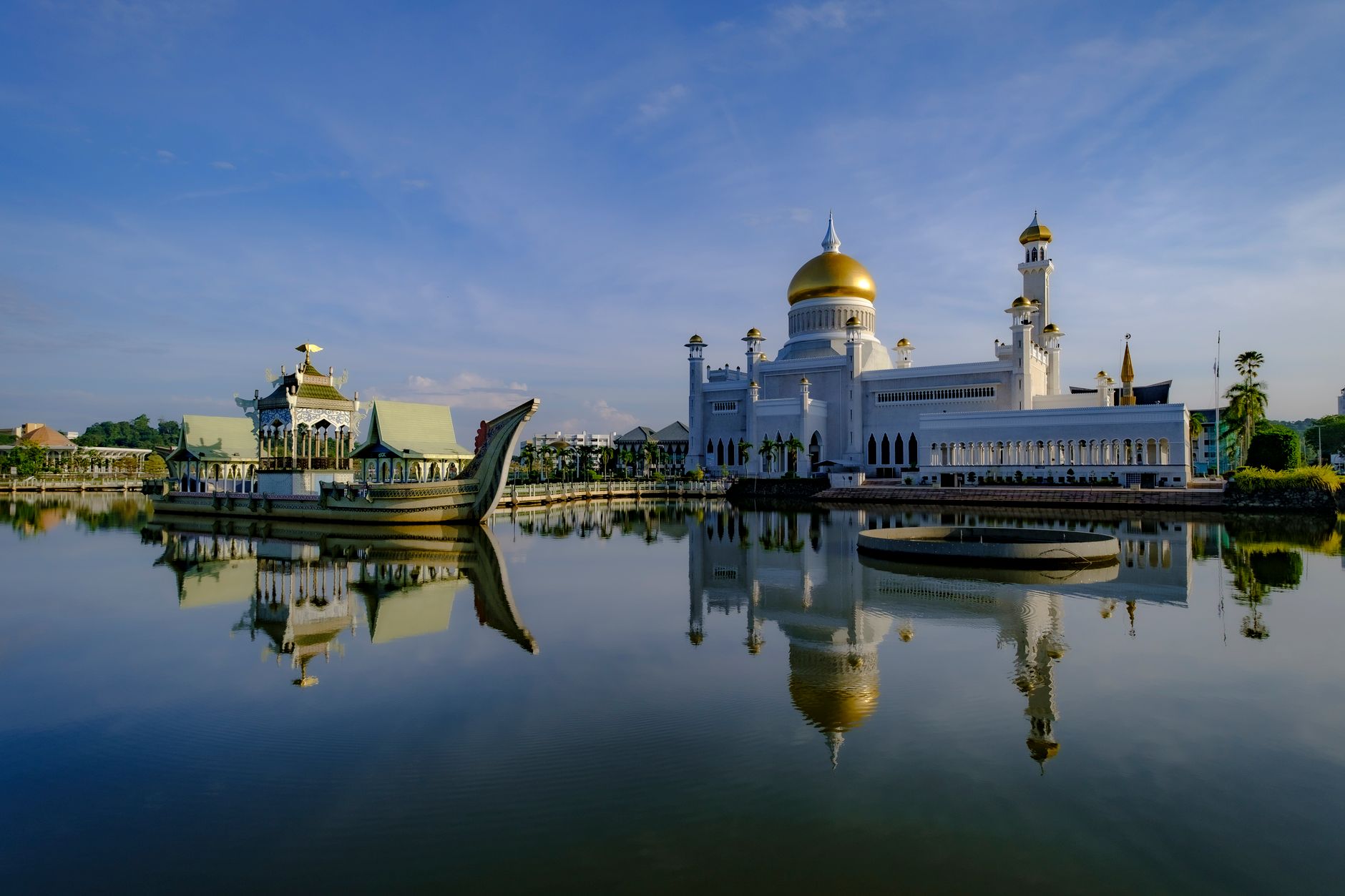
Stunning view of Omar Ali Saifuddien Mosque with its reflection in Brunei, captured at sunrise.
Photo by Dian is Light on Pexels · Pexels License

A modern glass escalator in a spacious atrium with bright natural lighting.
Photo by Random Freeloader on Pexels · Pexels License
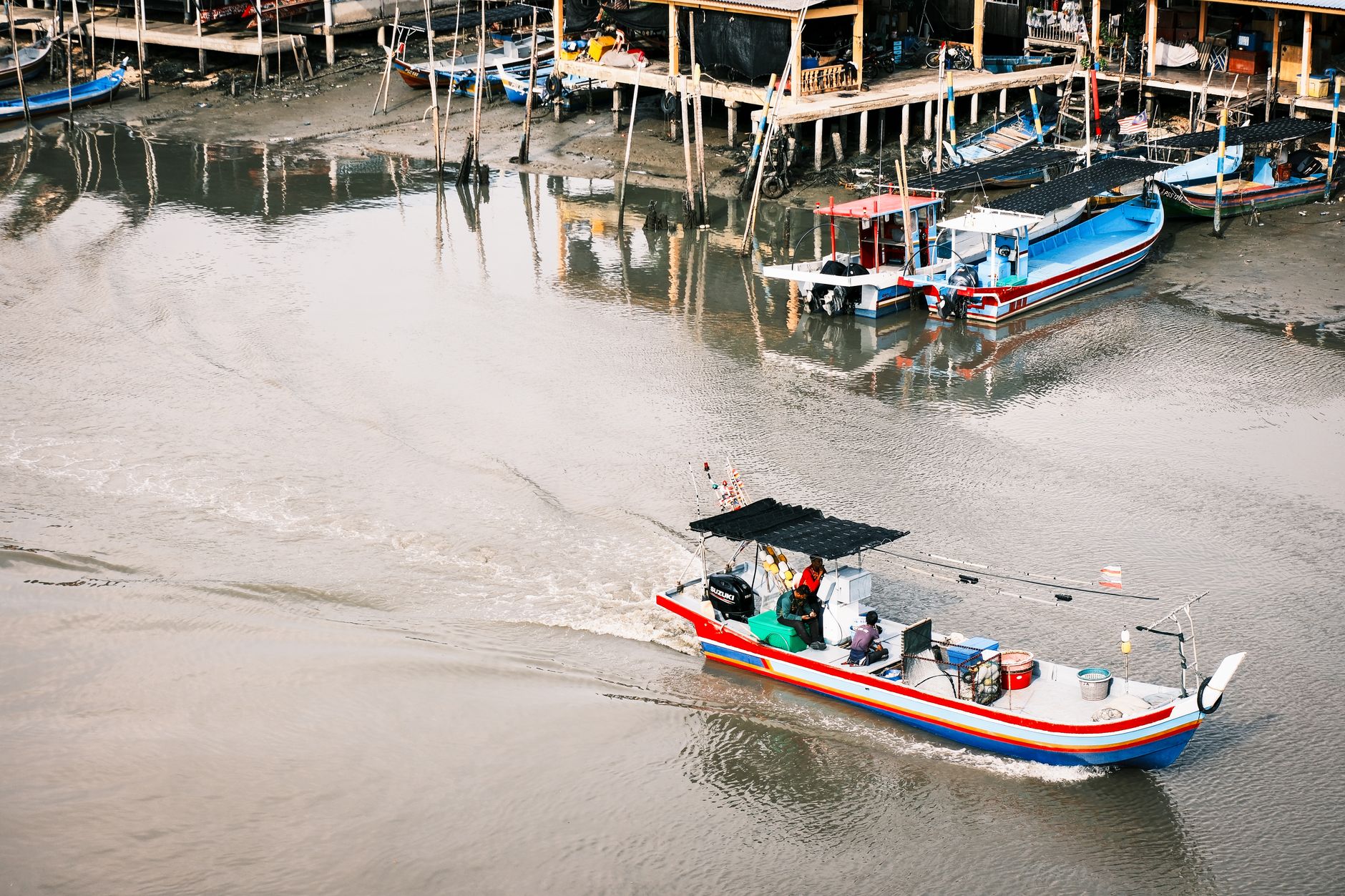
A colorful fishing boat navigates a calm river near stilted buildings in Perlis, Malaysia.
Photo by Afifi Zakaria on Pexels · Pexels License
Practical Information
Visa
Brunei is not in Schengen, and a Schengen visa does nothing here. US and UK passports are visa-free for up to 90 days, most EU passports also get 90 days, Canadians get 14 days, and Australians usually enter on a 30-day visa on arrival; your passport should be valid for at least 6 months, and travelers are commonly asked to complete the Brunei E-Arrival Card and health declaration before landing.
Currency
The local currency is the Brunei dollar, and it trades at par with the Singapore dollar, which also circulates widely. Cards work in hotels, malls, and larger restaurants, but cash still matters for buses, small food stalls, water taxis in Kampong Ayer, and rural stops beyond Bandar Seri Begawan.
Getting There
Most visitors arrive through Brunei International Airport, about 15 minutes from Bandar Seri Begawan. Overland entry from Sarawak is practical via Sungai Tujoh near Miri or Kuala Lurah near Limbang, and ferries still connect the Serasa terminal with Labuan.
Getting Around
Dart is the ride-hailing app that actually works in Brunei; Grab and Uber do not. Bandar Seri Begawan is manageable by bus, water taxi, and short car rides, but a rental car makes Tutong, Seria, Kuala Belait, Labi, and Ulu Temburong much easier, especially if you want to move on your own schedule.
Climate
Expect 29-32C days, heavy humidity, and rain in every month. February and March are usually the easiest months for first trips and forest excursions, while November through January can turn jungle plans in Ulu Temburong into a wet slog.
Connectivity
Mobile coverage is solid around Bandar Seri Begawan, Muara, Jerudong, Tutong, Seria, and Kuala Belait, then gets patchier once you push into Temburong forest or rural Belait. Buy a local SIM at the airport or in town if you need maps and Dart, and do not assume every river or rainforest stop will give you a stable signal.
Safety
Brunei is one of the safer countries in Southeast Asia for street crime, and the bigger risks are practical ones: heat, dehydration, slick walkways, and underestimating river or jungle conditions. Dress modestly near mosques and government buildings, do not treat alcohol rules casually, and take overstaying your visa seriously because penalties can be harsh.
Taste the Country
restaurantAmbuyat
Twirl with candas. Dip into cacah. Swallow at family tables, feast tables, restaurant tables in Bandar Seri Begawan.
restaurantNasi katok
Rice, fried chicken, sambal, paper wrap. Eat late, eat fast, eat in cars, offices, roadside stalls.
restaurantKelupis
Unwrap leaf. Slice, share, dip in peanut sauce or curry at weddings, Eid visits, long afternoons.
restaurantPulut panggang
Buy at market counters. Peel the leaf, hold with fingers, eat warm at breakfast or between errands.
restaurantSoto
Broth, noodles, herbs, lime. Morning meal, family meal, rainy-day meal in Tutong and Bandar Seri Begawan.
restaurantSelurut
Peel the cone downward. Bite from the opening. Tea, gossip, plastic chairs, market shade.
restaurantWajid Temburong
Leaf parcel, sticky rice, palm sugar. Nibble slowly on the road back from Ulu Temburong.
Tips for Visitors
Cash Still Matters
Budget for small notes and coins. A BND 1 bus fare, a water taxi in Kampong Ayer, or a cheap nasi katok stop is easier with cash than with a card.
No Trains
Brunei has no passenger rail at all. If you are planning country-wide movement, think in terms of rental car, Dart, bus, or ferry rather than trying to build an itinerary around nonexistent train links.
Dress for Mosques
Cover shoulders and knees when visiting mosques, and check prayer times before you set out. Non-Muslim visitors are usually welcome outside prayer periods, but this is not a place for improv dressing.
Book Temburong Early
Bangar and Ulu Temburong have far fewer rooms and tour slots than the capital. Lock in accommodation and rainforest day trips before you arrive if your trip falls on a holiday weekend or during school breaks.
Eat by the Clock
Brunei runs on earlier meals than some visitors expect, and options thin out late at night outside Bandar Seri Begawan. Keep a list of reliable food courts and order dinner before you end up hungry on a quiet road in Tutong or Belait.
Negotiate Water Taxis
Short hops in Kampong Ayer usually cost about BND 2-5, but confirm the fare before you step in. The ride is part transport, part sightseeing, and drivers know when a visitor is improvising.
Heat Is the Issue
Crime is rarely the thing that ruins a day here; humidity is. Carry water, slow your pace after midday, and treat jungle walks in Ulu Temburong as tropical outings rather than casual park strolls.
Explore Brunei with a personal guide in your pocket
Your Personal Curator, in Your Pocket.
Audio guides for 1,100+ cities across 96 countries. History, stories, and local insight — offline ready.
Audiala App
Available on iOS & Android
Join 50k+ Curators
Frequently Asked
Do I need a visa for Brunei with a US passport? add
Usually no, for tourism stays up to 90 days. Your passport should be valid for at least 6 months, and you should still check current arrival-card and health-declaration requirements before flying.
Is Brunei expensive for tourists in 2026? add
No, not by regional capital-city standards. A careful traveler can manage on about BND 50-125 a day because many sights in Bandar Seri Begawan are free and local food is cheap, while mid-range comfort pushes the budget closer to BND 170-360.
Can you drink alcohol in Brunei as a tourist? add
You cannot buy alcohol in normal shops or bars because public alcohol sales are banned. Non-Muslim visitors may import a limited personal allowance, but public drinking is not the local norm and this is not a country to test the edges of the rule.
Is Bandar Seri Begawan worth visiting, or should I go straight to the rainforest? add
Bandar Seri Begawan is worth at least two full days. It explains the monarchy, the mosque architecture, and the river city logic that make Ulu Temburong feel like part of the same country rather than a separate nature add-on.
How do you get to Kampong Ayer from Bandar Seri Begawan? add
The normal way is by short water taxi across the Brunei River. Boats leave from jetties near the city center, the crossing takes minutes, and agreeing the fare before boarding keeps the exchange simple.
What is the best month to visit Brunei? add
February is usually the safest bet, with March close behind. You still get heat and humidity, but the rainfall pattern is often kinder for city walks, river trips, and canopy excursions in Ulu Temburong.
Can you travel around Brunei without a car? add
Yes for the capital district, not comfortably for the whole country. Bandar Seri Begawan, Kampong Ayer, Muara, and some nearby sights work with Dart, buses, and water taxis, but Tutong, Seria, Kuala Belait, and Labi are much easier with your own wheels.
How many days do you need in Brunei? add
Three days covers the capital well; seven gives you a proper west-coast road trip; ten lets you add Temburong without rushing. The right number depends on whether you want just Bandar Seri Begawan and Kampong Ayer or the fuller country picture through Belait and the forest east.
Sources
- verified Brunei Tourism — Official visitor information used for airport access, transport basics, bus fares, water taxis, and car-rental guidance.
- verified Ministry of Foreign Affairs, Brunei Darussalam — Authoritative visa-arrangement and entry-policy source for passport rules, visa-free periods, and transit information.
- verified UK Foreign, Commonwealth & Development Office Travel Advice: Brunei — Used for entry formalities, overstay penalties, safety framing, and current traveler-facing procedural checks.
- verified U.S. Department of State Travel Advisory: Brunei — Used for driving, safety, and practical travel conditions from a current government advisory source.
Last reviewed: