Plan and listen to Zeppelin Hangar At Santa Cruz Air Force Base with Audiala.
Audio guide in your pocket, itinerary in your browser. Built for the way you actually visit.
Introduction
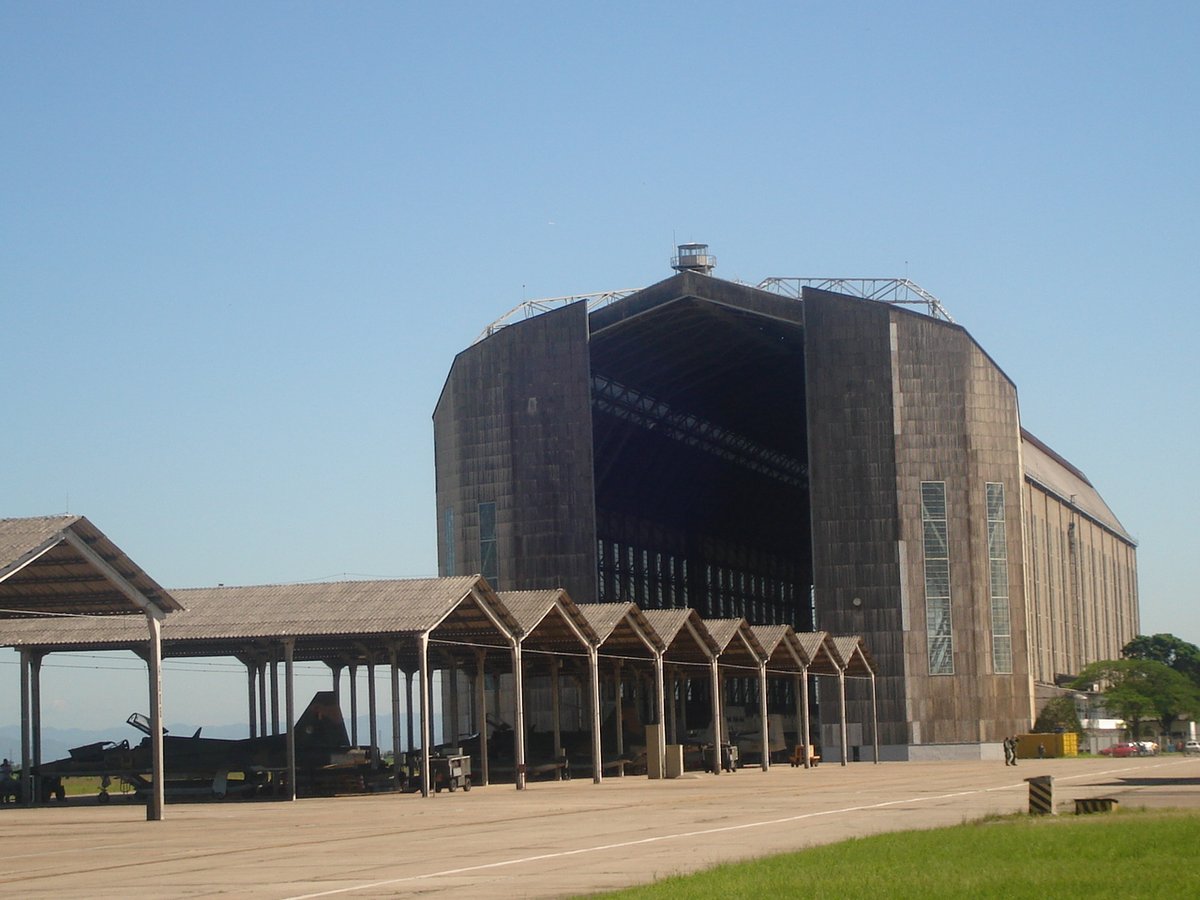
Located about 50 kilometers west of downtown Rio de Janeiro, the Zeppelin Hangar at Santa Cruz Air Force Base (Base Aérea de Santa Cruz) is a rare and monumental relic from the golden age of aviation. Built in the mid-1930s to accommodate the German rigid airships LZ 127 Graf Zeppelin and LZ 129 Hindenburg, it is the only original surviving Zeppelin hangar in the world. This colossal structure not only symbolizes a pioneering era in transatlantic flight but also underscores Brazil’s strategic importance in early global aviation and its subsequent military significance during World War II.
Today, the hangar continues to serve as part of an active air force base while offering limited but unforgettable guided tours. Visitors experience firsthand the impressive engineering of the 1930s, explore its historical role in international aviation, and witness its ongoing legacy in the Brazilian Air Force. This comprehensive guide details the hangar’s history, architectural features, visitor access, ticketing, accessibility, and related attractions—providing all the information needed to plan a remarkable visit (airports-worldwide.com; zeppelin-museum.de; fab.mil.br).

Early Development and Zeppelin Operations (1930s)
The vision for the Zeppelin Hangar began in the early 1930s, when Germany’s Luftschiffbau Zeppelin and Deutsche Luft Hansa sought to establish regular transatlantic airship service between Europe and South America. Brazil’s geographic location made it a natural terminus for these monumental flights, with Rio de Janeiro as the key destination. Construction of the Santa Cruz hangar started in 1934, culminating in its inauguration on December 26, 1936 (airports-worldwide.com).
This immense structure, measuring about 274 meters in length, 58 meters in width, and up to 58 meters in height, was designed to house and maintain the world’s largest airships. The hangar included a hydrogen production facility, railway connections for passengers and cargo, and advanced engineering solutions to facilitate the safe docking and maintenance of the Zeppelins. The airships carried passengers, mail, and freight, linking Germany and Brazil with unprecedented speed and comfort (zeppelin-museum.de).
Wartime Transition and Allied Control (Late 1930s–1940s)
The outbreak of World War II dramatically altered the hangar’s trajectory. Following the Hindenburg disaster in 1937 and the end of regular airship flights, the facility transitioned to military use. In 1942, as Brazil joined the Allies, the site became an official air force base (Força Aérea Brasileira, FAB), playing a vital role in anti-submarine operations and maritime patrols in the South Atlantic (airports-worldwide.com; masterbombercraig.wordpress.com). The base also hosted U.S. Navy blimps, which contributed to convoy protection and anti-submarine warfare.
Postwar Evolution and Heritage Status
With the end of World War II, Santa Cruz Air Force Base remained a cornerstone of Brazilian military aviation. The Zeppelin Hangar, though no longer serving airships, was repurposed to support modern aircraft and military operations. Over the decades, the base has housed fighter, reconnaissance, and search-and-rescue units (airports-worldwide.com).
Recognizing its historical and architectural value, the hangar was officially designated a National Heritage Site by the Instituto do Patrimônio Histórico e Artístico Nacional (IPHAN) in 1998, ensuring its protection and preservation (Defesa em Foco; IPHAN Official Site). It is celebrated as a unique testament to the era of giant airships and Brazil’s aviation heritage.
Architectural Features and Engineering Legacy
The Zeppelin Hangar’s sheer scale sets it apart: 274 meters long, 58 meters wide, and 58 meters high. Its massive steel framework, constructed with both German engineering and Brazilian labor, has withstood the region’s coastal climate for nearly a century. The hangar features:
- 80-ton motorized sliding doors at its southern entrance, still operational today.
- Four rolling roof platforms for airship maintenance.
- A network of foundation piles for stability on soft soil near Sepetiba Bay.
- A command tower rising 61 meters above ground, providing panoramic views (Defesa em Foco).
The structure’s size and design reflect advanced engineering of the 1930s and its status as a global aviation landmark (Google Sightseeing).
Visiting the Zeppelin Hangar: Practical Information
Visiting Hours and Access
Due to its location on an active military base, the Zeppelin Hangar is not open for daily public visits. Access is granted only via pre-arranged guided tours or during special events such as heritage days. Typical tour times are between 9:00 AM and 4:00 PM, but exact schedules vary. Always check the Brazilian Air Force official site or Santa Cruz Air Force Base page for current availability.
Tickets and Guided Tours
Admission is usually free, but advance booking is mandatory. Prospective visitors must contact the base’s public relations office to request permission, provide identification details, and comply with security protocols. Group tours and educational visits are possible with prior arrangements.
Accessibility
The hangar is wheelchair accessible, with ramps and paths designed for visitors with mobility needs. However, due to the site’s historic nature, some areas may have limited accessibility. Comfortable footwear and sun protection are recommended, as parts of the tour may include outdoor walking.
Getting There
By Car:
- From downtown Rio, take Avenida Brasil/BR-101 towards Santa Cruz.
- Follow signs to the Santa Cruz neighborhood and the air force base entrance.
By Public Transport:
- Take the SuperVia suburban train to Santa Cruz Station, then use a taxi or rideshare to reach the base.
By Taxi/Rideshare:
- The journey from central Rio takes about 1–1.5 hours, depending on traffic.
Nearby Attractions
While in Santa Cruz, consider visiting the Guaratiba Environmental Protection Area for natural scenery, or explore Rio’s beaches and other cultural landmarks during your trip.
Frequently Asked Questions (FAQ)
Q: How can I visit the Zeppelin Hangar?
A: Visits must be arranged in advance through the Brazilian Air Force or Santa Cruz Air Force Base. There are no regular public visiting hours.
Q: Is there an entrance fee?
A: Admission is typically free, but tours require prior registration.
Q: Are guided tours available?
A: Yes, all visits are guided and must be booked ahead of time.
Q: Is the hangar accessible for wheelchair users?
A: Yes, but some historic areas may be challenging; contact the base in advance to discuss accessibility needs.
Q: Can I take photographs inside the hangar?
A: Photography is usually allowed during tours, except in restricted zones.
Q: How do I get to the hangar from central Rio?
A: By car or taxi (about 1–1.5 hours), or by train to Santa Cruz Station followed by a short taxi ride.
Related Articles
- History of Brazilian Air Force Bases
- Top Historical Sites in Rio de Janeiro
- The Legacy of the Graf Zeppelin
Listen to the full story in the app
The whole Zeppelin Hangar At Santa Cruz Air Force Base,
told well.
Audio guides for 1,100+ cities across 96 countries. History, stories, and local insight — offline ready.
Verified, and shown.
Researched and written by the Audiala editorial team from historical records, architectural archives, and local expertise.
Researched from Wikidata, Wikipedia & official sources · fact-checked · How we make our guides →