Plan and listen to Igreja De Nossa Senhora Da Penha with Audiala.
Audio guide in your pocket, itinerary in your browser. Built for the way you actually visit.
Introduction
Perched atop a dramatic granite outcrop in Rio de Janeiro’s North Zone, the Igreja de Nossa Senhora da Penha de França—commonly known as Igreja da Penha—is a landmark of deep religious, historical, and cultural significance. Established in 1635, this sanctuary is renowned for its neo-Gothic architecture, 382-step granite staircase, and panoramic city views. The church’s origins intertwine local legend and centuries-old Marian devotion, making it a beacon for pilgrims, worshippers, and tourists. This comprehensive guide details everything you need to know about visiting Igreja da Penha: its history, visiting hours, ticket information, accessibility, travel tips, and more—ensuring a rewarding experience at one of Rio de Janeiro’s most treasured historical sites (Rio Times Online; WikiRio; Guia da Semana).

Origins and Foundation Legends
The origins of Igreja da Penha date to 1635, when Captain Baltazar de Abreu Cardoso, the landowner, reportedly survived a snake attack on the granite hilltop after praying to the Virgin Mary. According to legend, a lizard intervened, saving his life and inspiring him to construct a chapel in gratitude, dedicated to Nossa Senhora da Penha de França (Rio Times Online; Projeto Ex-Votos do Brasil). The devotion to Our Lady of Penha originated in 15th-century Spain and was brought to Brazil by Portuguese settlers, with the sanctuary in Rio becoming a crucial center for this Marian tradition (Rio Cidade Maravilhosa).
Architectural Evolution
Early Structures
The original chapel of 1635 was modest, but as devotion grew, Captain Baltazar donated the land in 1728, allowing the Venerable Brotherhood of Nossa Senhora da Penha to oversee its expansion. By the 18th century, the sanctuary featured a larger church with a single tower and bells (Rio Cidade Maravilhosa).
19th-Century Developments
In 1819, the iconic 382-step staircase was completed, fulfilling a promise by a couple seeking a child (Rio Memórias). By 1870, the church was rebuilt to accommodate the influx of pilgrims.
20th-Century Expansion
Architect Luiz de Moraes Júnior gave the sanctuary its current Eclectic-Neo-Gothic form in 1902, adding twin towers and distinctive pointed arches. The 25-bell carillon, imported from Portugal, was installed in 1925, and the complex continued to expand, including the addition of event spaces and a museum (Rio Times Online).
Religious and Cultural Significance
Pilgrimage and Devotion
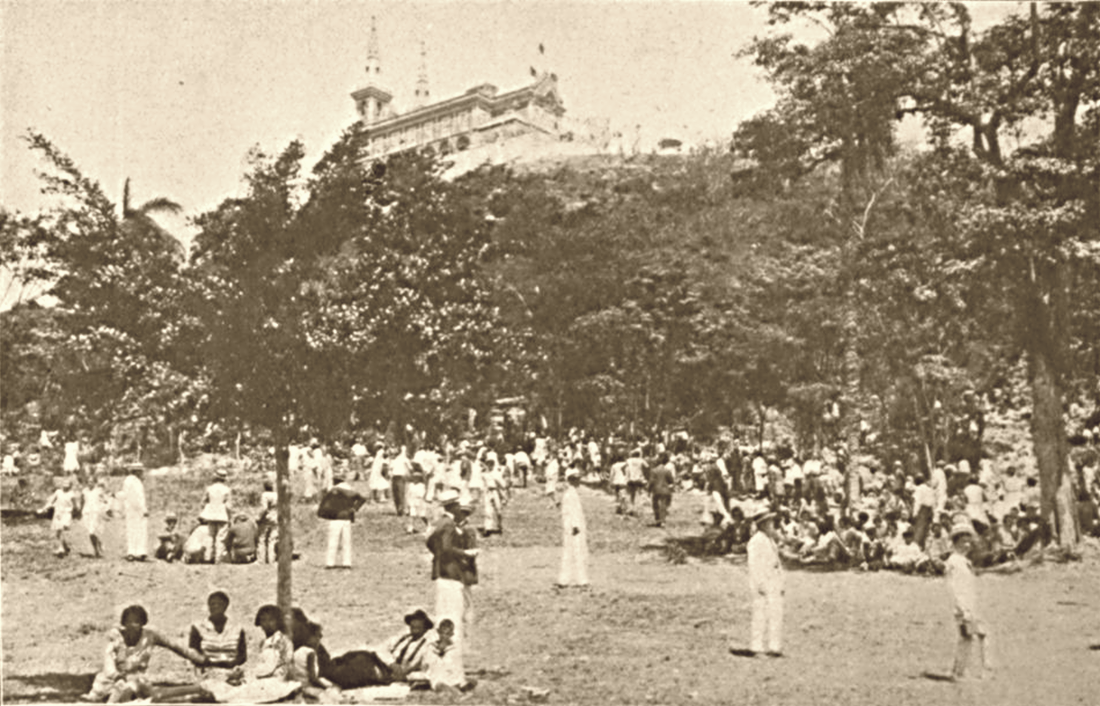
Igreja da Penha is a major pilgrimage site, with thousands ascending the staircase—often on their knees—as an act of faith or penance. The sanctuary features a museum of ex-votos, the Sala dos Milagres, and various chapels, all testifying to the depth of Marian devotion (Riotur).
Festa da Penha
Every October, the Festa da Penha transforms the church into a vibrant center of religious and cultural celebration, blending processions, Masses, music, dance, and food. It’s one of Rio’s oldest and most significant festivals, drawing tens of thousands of visitors (WikiRio).
Ecclesiastical Status
The church has been successively honored:
- Aggregated to the Papal Basilica of Santa Maria Maggiore (1935)
- Elevated to Perpetual Sanctuary (1966)
- Declared Archdiocesan Marian Sanctuary (1981)
- Elevated to Minor Basilica by Pope Francis (2016) (Rio Times Online; Rio Cidade Maravilhosa)
Visiting Information: Hours, Tickets, and Access
Visiting Hours
The sanctuary is open daily from 7:00 AM to 6:00 PM; the funicular (bondinho) operates from 8:00 AM to 5:30 PM. Hours may extend during festivals—confirm current times on the official website or by calling +55 21 3219-6262.
Tickets and Admission
General admission is free, including access to the funicular. Special events or exhibitions may require tickets—check ahead for any exceptions (Guia da Semana).
How to Get There and Accessibility
Transportation
- By Car/Taxi/Ride-share: Ample on-site parking is available; taxis and Uber are recommended for convenience and safety (hurfpostbrasil.com).
- By Public Transport: Multiple bus lines serve the Penha neighborhood; the Penha metro station is nearby, but a short connecting bus or taxi ride is needed (encontrapenharj.com.br).
Accessibility
The recently renovated funicular is free and accommodates up to 500 people per hour, making the sanctuary accessible to those with mobility challenges, the elderly, and families with young children.
Special Events and Guided Tours
- Festa da Penha: October’s main festival includes processions, live music, and food stalls.
- Other Events: Religious celebrations and concerts occur year-round; check the events calendar.
- Guided Tours: Available by prior arrangement or during special events—ideal for insights into history and architecture.
Nearby Attractions
Explore Penha’s local markets and eateries, the Guanabara Bay viewpoints, and nearby historic sites like the Cemitério da Penha. For a broader Rio itinerary, combine your visit with landmarks such as Christ the Redeemer, Sugarloaf Mountain, and the Botanical Garden (hurfpostbrasil.com).
Photographic Spots
- Staircase Landings: Capture panoramic views of Rio’s North Zone, Corcovado, and Sugarloaf Mountain.
- Neo-Gothic Façade: The church’s twin towers and pointed arches are best photographed in golden hour light.
- Sanctuary Forecourt: Ideal for wide shots of the basilica and the cityscape.
Visitor Tips and Safety
- Dress Code: Wear modest clothing (covered shoulders/knees). Lightweight, comfortable attire is recommended; bring a jacket for cooler mornings (tagvault.org).
- Behavior: Maintain respectful silence, especially during services; minimize noise and avoid flash photography.
- Safety: The sanctuary is well-patrolled, but remain vigilant for pickpockets during busy events. Use ride-share or licensed taxis, avoid walking alone at night, and keep valuables secure (hurfpostbrasil.com).
- Facilities: Restrooms, water fountains, snack bar, religious goods shop, confessionals, and a large event amphitheater available (igrejadapenharj.org.br).
- Language: Basic Portuguese or a translation app will enhance your visit.
Frequently Asked Questions (FAQ)
Q: What are the Igreja da Penha visiting hours?
A: Open daily from 7:00 AM to 6:00 PM; funicular from 8:00 AM to 5:30 PM.
Q: Is there an entrance fee or tickets needed?
A: General admission and funicular are free. Special events may require tickets.
Q: How do I reach the sanctuary?
A: By car, taxi, Uber, or public bus; the funicular provides summit access.
Q: Is the site accessible for people with disabilities?
A: Yes, the funicular and on-site ramps ensure accessibility.
Q: When is the best time to visit?
A: Early mornings on weekdays offer a quieter experience; October’s festival is lively but crowded.
Q: Are guided tours available?
A: Yes, during special events or by prior arrangement.
Discover More
The Igreja de Nossa Senhora da Penha stands as a testament to Rio de Janeiro’s rich religious, cultural, and architectural heritage. Whether you seek spiritual reflection, architectural marvels, or panoramic vistas, this sanctuary delivers a memorable experience. To stay informed about Igreja da Penha visiting hours, events, and tips, download the Audiala app and follow us on social media. Plan your visit to immerse yourself in one of Brazil’s iconic historical sites.
Listen to the full story in the app
The whole Igreja De Nossa Senhora Da Penha,
told well.
Audio guides for 1,100+ cities across 96 countries. History, stories, and local insight — offline ready.

Verified, and shown.
Researched and written by the Audiala editorial team from historical records, architectural archives, and local expertise.
Researched from Wikidata, Wikipedia & official sources · fact-checked · How we make our guides →