An introduction.
Researched by the Audiala editorial team from historical records, architectural archives, and local expertise.
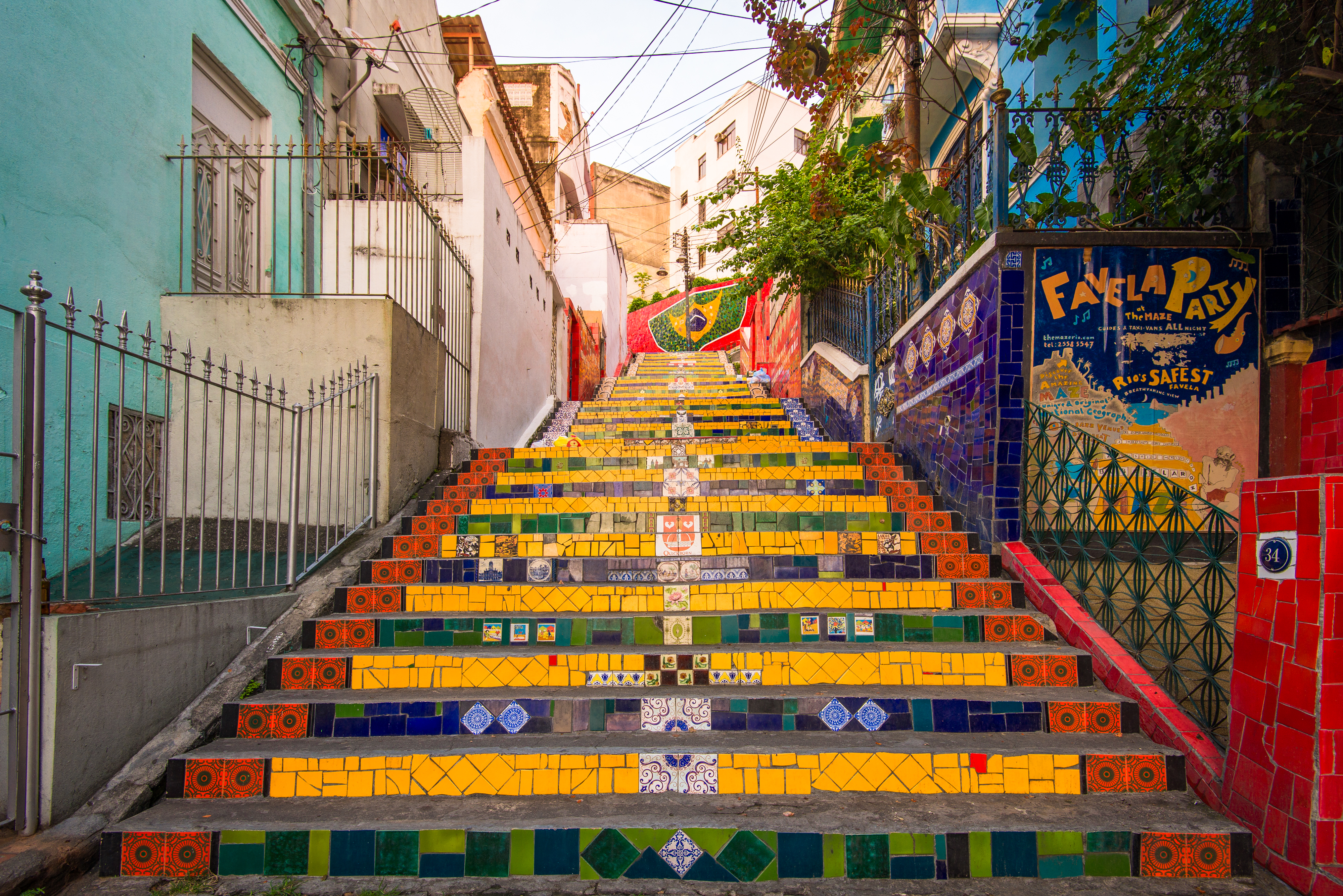
AA staircase covered in more than 2,000 tiles from over 60 countries sounds like public art by committee; Escadaria Selarón in Rio de Janeiro, Brazil, was the obsession of one man. You come for the riot of red, cobalt, and yellow, then stay because the place keeps slipping out of the postcard frame: part self-portrait, part neighborhood shortcut, part open-air argument about what a city should preserve. Few spots in Rio reward slow looking this well.
The steps climb Rua Manuel Carneiro from Lapa toward Santa Teresa, a steep link between nightlife below and hillside calm above. Feet hit the mosaic with a hard ceramic click, music drifts up from the bars near the Arcos da Lapa, and every few meters a new tile pulls your eye sideways to Peru, Angola, Japan, or a corner of Portugal.
Most visitors think they are looking at a 1990s attraction. Documented records and local heritage sources tell a better story: the staircase itself is older, part of an older route on the slope below the Convent of Santa Teresa, while the mosaic skin that made it famous was created between about 1990 and Jorge Selarón's death in 2013.
That difference matters. Escadaria Selarón is worth visiting because it shows Rio in layers at once: colonial hill path, neglected urban stair, personal artwork, global icon, and now a protected public site the city is still learning how to care for.
01 What to see.
The Lower Steps from Rua Manuel Carneiro
The Middle Climb and the Quiet Upper Reach
Walk It as a Threshold: Lapa to Santa Teresa
02 In pictures.


Plan and listen to Escadaria Selarón with Audiala.
Audio guide in your pocket, itinerary in your browser. Built for the way you actually visit.
Tickets & tours.
These are guided options from our partners — same price as booking direct.
Prices are indicative — final pricing and availability are confirmed at checkout. Audiala may earn a commission from bookings made through these links.
Also on GetYourGuide
More tours for Escadaria Selarón
Curated from GetYourGuide. Same price as official, free cancellation on most.

Sugarloaf Cable Car
from
€40

Rio de Janeiro: Hang Gliding Adventure
from
€257

Rio de Janeiro: Santa Teresa Tram Tour, Selarón Steps & Lapa
from
€61

Rio de Janeiro: Christ Redeemer, Selaron steps & Sugarloaf
from
€116

Rio: Arraial do Cabo Scuba Diving Day Trip
from
€224
Prices shown are indicative — final pricing and availability are confirmed at checkout. Audiala may receive a commission from bookings made via these links.
03 Visitor logistics.
The practical scaffolding for a good visit — kept short.
Getting There
Escadaria Selarón runs between Rua Joaquim Silva in Lapa and Rua Manuel Carneiro in Santa Teresa, about a 5-minute walk from the Arcos da Lapa. From Cinelândia station on Metro Lines 1 and 2, count on 10-15 minutes on foot via Rua Evaristo da Veiga and Rua Joaquim Silva; from Glória station, about 10 minutes via Rua da Glória and Rua Teotônio Regadas. Uber and taxis can drop you near the lower steps, while driving is less graceful: street parking is thin, and nearby paid lots include Rio Antigo Park at R. Teotônio Regadas, 41 and Safety Park at R. da Lapa, 86.
Opening Hours
As of 2026, local tourism sources treat the staircase as a public artwork open 24 hours a day, including weekends and holidays. No official seasonal schedule has been posted, and I found no 2026 closure notice for the steps themselves, though city works announced in July 2025 may still affect circulation on the surrounding streets.
Time Needed
Give it 15-30 minutes if you want the classic lower-step photo and a short climb. A better visit takes 20-40 minutes, enough to walk the full 215 steps, spot the tile fragments from dozens of countries, and let the sound of Lapa fade as Santa Teresa starts to take over. Add an hour if you plan to keep going uphill for cafes, viewpoints, or the tram area.
Accessibility
The staircase itself is not wheelchair-friendly: 215 tiled steps rise in a continuous slope, more like climbing a low-rise building than crossing a street, and no elevator or step-free route runs through the artwork. Nearby access is better than the stairs suggest, since Cinelândia and Glória metro stations are accessible, and city works announced in 2025 included ramps and sidewalk upgrades around the approach streets.
Cost & Tickets
Entry is free, and as of 2026 no ticket, timed slot, or official booking system exists because this is a public staircase, not a gated attraction. Paid tours may stop here, but you are paying for the guide, not admission, and the only line that regularly forms is the one for the famous photo angle near the bottom.
05 Tips for visitors.
Small things that change the day.
Go Early
Early morning changes the mood completely. The tiles catch softer light, the lower steps are easier to photograph, and you avoid the late-morning crush when people queue for the same shot like they're boarding a flight.
Phone Tight
Treat the lower Lapa side as a busy city corner, not an open-air studio. Local reporting and recent traveler accounts keep repeating the same rule: visit in daylight, keep your phone put away between shots, and use rideshare if you are arriving at dusk or later.
Shoot Higher Up
Most visitors stop at the bottom and wait for the postcard frame. Climb past that bottleneck. A few landings higher, the crowd thins, the mosaic details get stranger, and your photos stop looking like everyone else's.
Drone Reality
Drones are a bad fit here. Brazilian rules require registration for drones over 250 g, a 30-meter horizontal buffer from uninvolved people, and extra authorization for foreign drones, which makes a crowded staircase in central Rio close to impossible to film legally.
Eat Uphill
Skip the first convenience snacks if you want an actual meal and keep going toward Santa Teresa. Bar do Mineiro is the classic move for feijoada and pastel de feijoada, Café do Alto does an excellent northeastern Brazilian brunch, and Sobrenatural works if you want seafood with live-music energy; all sit in the budget-to-mid-range or mid-range bracket, with Território Aprazível reserved for a splurge.
Make It A Route
The staircase makes more sense as a hinge than as a stand-alone stop. Pair it with the Arcos da Lapa below, then continue uphill to Parque Glória Maria or the Bondinho de Santa Teresa, and you feel Rio switch tempo under your feet.
Where to Eat
Don't Leave Without Trying
Dining Tips
- check Feijoada is best for lunch, not dinner, as it's a traditional midday meal in Rio.
Restaurant data powered by Google
04 A history of reinvention.
A Staircase That Refused To Stay Finished
Long before the tiles, this was a working stair on the slope beneath the Convent of Santa Teresa, whose documented history reaches back to the mid-18th century and whose earlier religious presence is attributed to the early 17th. The climb linked lower Lapa to the hill above; by the late 20th century, sources describe it as worn, shabby, and easy to ignore.
Then a Chilean-born artist turned neglect into spectacle. Records show Jorge Selarón began repairing the steps around 1990, and sources point to 1994 as the moment the tile-clad mosaic phase came into focus. What looks spontaneous today was built piece by piece, with grout, salvaged ceramics, and stubbornness.
Jorge Selarón Bet His Life On These Steps
Jorge Selarón, born in 1947 in Chile, lived beside the staircase and treated it less like a commission than a private compulsion made public. Multiple contemporary reports say he financed the work by selling paintings, often while under financial strain, so the stake for him was painfully direct: money, shelter, and the legacy of the only artwork he seemed to believe mattered.
The turning point came when a few repaired steps became an ever-expanding mosaic. By the 2000s the staircase had turned into an international emblem of Rio, dense with flags, devotional fragments, and roughly 300 hand-painted tiles showing a pregnant Black woman, a figure Selarón called a personal problem from his past and never explained.
Another turning point came on 10 January 2013, when Selarón was found dead on the staircase he had spent more than two decades remaking. After that, the city had to do something he never did: define an ending. Municipal teams documented the work in 2013 so conservators could preserve a last known state, and permanent historic protection followed in August 2015.
Older Than The Mosaic
A Living Object Becomes Heritage
Listen to the full story in the app
The whole Escadaria Selarón,
told well.
Audio guides for 1,100+ cities across 96 countries. History, stories, and local insight — offline ready.

06 Frequently asked.
The questions travellers send us most about Escadaria Selarón.
Is Escadaria Selarón worth visiting?
Yes, especially if you want a Rio sight that feels handmade rather than polished. The staircase runs 125 meters, about the length of a city block, and its 215 steps are covered in tiles, mirrors, flags, and repeated painted figures that reward slow looking. Go for the famous photo if you must, then keep climbing; the upper stretch into Santa Teresa is usually calmer and far more interesting.
How long do you need at Escadaria Selarón?
Give it 20 to 40 minutes for a proper visit. That covers the full climb, a few pauses to scan the tile details, and time to dodge the photo queue at the bottom. If you plan to continue into Santa Teresa or stop for a drink nearby, an hour makes more sense.
How do I get to Escadaria Selarón from Rio de Janeiro city center?
The easiest route from central Rio is metro to Cinelandia or Gloria, then a 10 to 15 minute walk. From the Arcos da Lapa, the staircase is about 5 minutes on foot, tucked between Lapa below and Santa Teresa above. Rideshares can also drop you near the foot of the steps on Rua Joaquim Silva or Rua Manuel Carneiro.
What is the best time to visit Escadaria Selarón?
Early morning is the best time to visit Escadaria Selarón. The light is softer, the heat is lower, and the lower steps are less clogged with people waiting for the same centered photo. Weekday mornings also feel less frantic, while rainy days can make the tiles slick underfoot.
Can you visit Escadaria Selarón for free?
Yes, Escadaria Selarón is free to visit. It is a public staircase, not a ticketed museum, and current local tourism sources treat it as generally open 24 hours a day. You pay only if you join a guided tour or stop for food, drinks, or souvenirs nearby.
What should I not miss at Escadaria Selarón?
Do not miss the middle and upper sections of the staircase. Most people stop at the lower selfie bottleneck, but the better visit lies higher up, where you can spot donated tiles from dozens of countries, mirrored flashes in the grout, and Selarón's repeated image of a pregnant Black woman, a motif he called a personal mystery. Also keep an eye out for the Arabic-inscribed tiles that were repositioned in 2022, a small detail that says a lot about how this place is still being argued over and cared for.
Verified, and shown.
Researched and written by the Audiala editorial team from historical records, architectural archives, and local expertise.
Provided the staircase length of 125 meters, the count of 215 steps, the 1990 start date, and current visitor basics including 24-hour access and best-known location details.
Confirmed free entry, public-street status, address references, and the short walking distance from the Arcos da Lapa.
Confirmed the 1990 start of Selaron's transformation and supported the site's status as one of Rio's headline attractions.
Used for recent traveler reports on crowding, photo lines, early-morning advantages, and realistic visit duration.
Supported the practical reading that the staircase is treated as open 24 hours daily.
Used for walking directions from Cinelandia and route details for reaching the steps from central Rio.
Confirmed Cinelandia as a nearby metro station and supported the metro-plus-walk route from the city center.
Confirmed Gloria as another nearby metro option for reaching the staircase.
Supported visit length estimates, practical advice on the climb, and the idea that the staircase works best as more than a quick photo stop.
Supported heritage and physical-description details, including the scale and public-art character of the staircase.
Confirmed the April 27, 2022 city action to reposition six tiles with Arabic inscriptions after requests from the Muslim community.
Used for the recurring motif of the pregnant Black woman and the estimate of roughly 300 hand-painted tiles carrying that image.
Used to avoid the common mistake of calling the staircase itself a UNESCO World Heritage Site; the listing applies to Rio's broader Carioca Landscapes.
Supported the practical weather reading behind recommending drier, clearer conditions and extra caution on wet steps.
Last reviewed
Researched from Wikidata, Wikipedia & official sources · fact-checked · How we make our guides →