Plan and listen to Conjunto Escultórico Da Praça João Pessoa with Audiala.
Audio guide in your pocket, itinerary in your browser. Built for the way you actually visit.
Introduction
Situated at the heart of João Pessoa, the capital of Paraíba, the Conjunto Escultórico da Praça João Pessoa is a profound emblem of the city’s rich historical and political heritage. This iconic sculptural ensemble, located within Praça João Pessoa (also known as Praça dos Três Poderes), offers an immersive experience that connects visitors to the legacy of João Pessoa Cavalcanti de Albuquerque—a pivotal political figure whose assassination in 1930 had a transformative impact on Brazilian history.
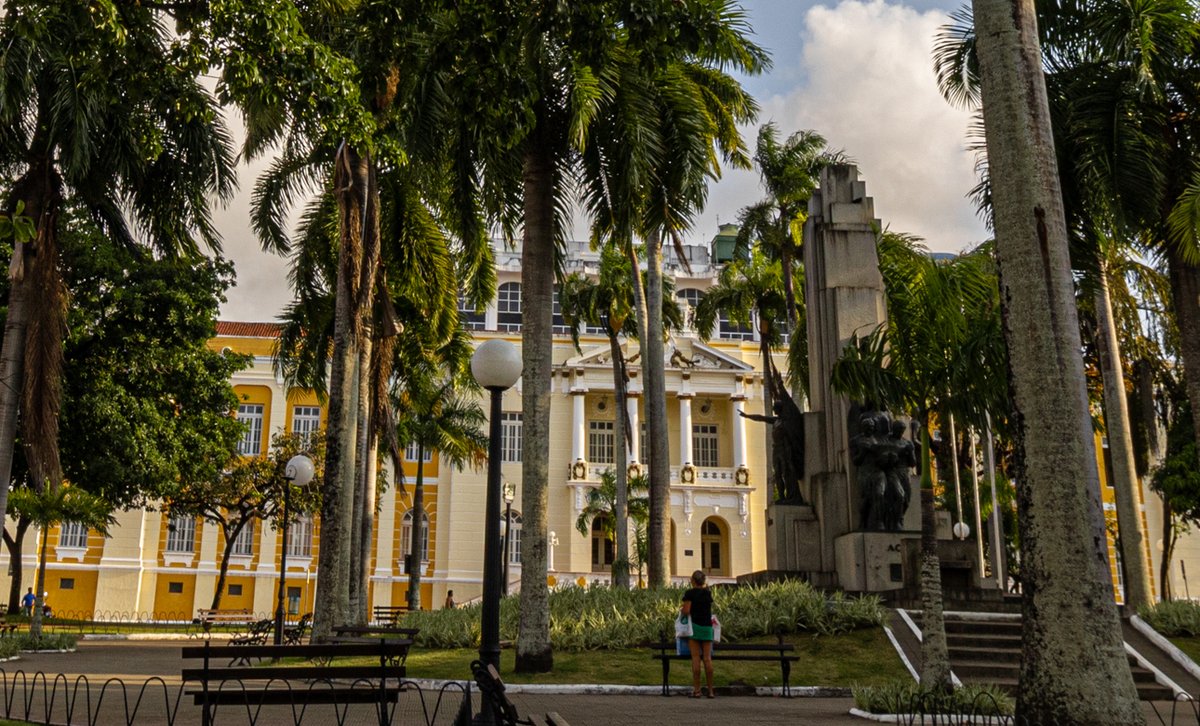
Surrounded by neoclassical and eclectic government buildings such as the Palácio da Redenção, the Legislative Assembly, and the Tribunal de Justiça, the square not only reflects the three branches of state power but also serves as a vibrant hub for cultural events, festivals, and daily civic life. This guide provides detailed information on visiting hours, accessibility, ticketing, nearby attractions, and practical tips, ensuring you make the most of your visit to one of João Pessoa’s most significant landmarks (ipatrimonio; minhajoaopessoa.com.br; Ate Onde Eu Puder Ir).

Historical Foundations and Significance
Colonial Origins and Political Context
The origins of Praça João Pessoa trace back to the late 16th century, shaped by Jesuit missionaries who influenced the area’s earliest architecture. Over centuries, the square evolved into the political nucleus of João Pessoa, surrounded by key government buildings. It was renamed in 1930 in honor of João Pessoa Cavalcanti de Albuquerque, whose assassination sparked the Brazilian Revolution of 1930, a turning point in the nation’s political trajectory (paraondeir.blog; encyclopedia.com).
Symbol of Power and Civic Life
Known as Praça dos Três Poderes, the square embodies the convergence of executive, legislative, and judicial authority, making it the symbolic heart of state power. Its enduring political relevance is matched by its role as a living cultural venue, hosting festivals, public gatherings, and civic ceremonies throughout the year (minhajoaopessoa.com.br).
The Sculptural Ensemble: Artistic and Symbolic Features
Composition and Symbolism
The Conjunto Escultórico comprises four distinct sculptures:
- Ação (Action)
- Civismo (Civism)
- Nego
- Estátua do Presidente João Pessoa (Statue of President João Pessoa)
These works, predominantly cast in bronze and set upon stone, celebrate the ideals of civic virtue and collective memory. The central statue of João Pessoa anchors the ensemble, commemorating his contributions and serving as a focal point for reflection and remembrance (ipatrimonio; Ate Onde Eu Puder Ir).
Formal Elements
- Material: Bronze and stone for durability and gravitas.
- Scale: Larger-than-life statues for visual prominence.
- Texture: Realistic modeling with smooth and detailed surfaces.
- Spatial Arrangement: Set within landscaped gardens and open pathways, encouraging engagement and contemplation.
Cultural Value
The ensemble is more than an artistic installation—it is a site of collective devotion, hosting official ceremonies and local commemorations. It stands as an enduring narrative of Paraíba’s civic pride and historical memory (Brasil Fiscaliza; Offbeat Destinations).
Architectural Highlights and Urban Setting
Surrounding Monuments and Buildings
Praça João Pessoa is framed by some of the city’s most important architectural landmarks:
- Palácio da Redenção: The oldest seat of government in Brazil, dating to 1586, with significant Jesuit influence.
- Legislative Assembly and Tribunal de Justiça: Represent the state’s legislative and judicial branches.
- Faculty of Law: Notable for its preserved Jesuit-era tower.
- Centro Histórico: The historic center, a UNESCO-listed area comprising hundreds of protected buildings (minhajoaopessoa.com.br; e-a-a.com).
Urban Layout and Landscape
The square’s design emphasizes symmetry, open vistas, and integration with lush landscaping. Shaded areas, flowerbeds, and benches create a welcoming environment, while the surrounding streets connect visitors to other historic sites (en.wikipedia.org).
Visitor Information: Hours, Tickets, Accessibility, and Tips
Hours and Admission
- Open 24/7: Praça João Pessoa is a public space accessible at all hours.
- Free Entry: No tickets are required to visit the square or the sculptural ensemble.
Accessibility
- Wheelchair Accessible: The square offers paved paths and ramps, though some areas may have uneven surfaces due to the historic setting.
- Public Transport: Well-served by buses, taxis, and ride-sharing services. Parking is available in surrounding streets, but can be limited during peak times.
Practical Tips
- Best Time to Visit: The dry season from September to February is ideal for outdoor sightseeing and photography (Weather Atlas; Best Time To).
- Guided Tours: Local agencies offer walking tours that include detailed historical context.
- Safety: The area is generally safe during the day, but standard urban precautions are advised.
- Amenities: Benches and shaded areas are available; public restrooms are limited.
- Language: Portuguese is the primary language; translation apps may be helpful.
Nearby Attractions and Experiences
- Palácio da Redenção: Historic government seat, also home to the ashes of João Pessoa (Blog Meu Destino).
- Centro Cultural São Francisco: Noted for art exhibitions and concerts.
- Praça Antenor Navarro: Lively square with colorful façades and cultural venues (Bahia.ws).
- Mercado Central: Ideal for sampling local cuisine and crafts.
- Hotel Globo and Casa da Pólvora: Significant sites within walking distance.
For further exploration, consider using digital resources or QR codes sometimes available on-site for maps and additional information (ipatrimônio).
Practical Visitor Advice
- Dress comfortably for walking and bring sun protection.
- Arrive early or late in the day for optimal lighting and fewer crowds.
- Respect the monuments and avoid climbing or disruptive behavior.
- Stay hydrated and plan restroom stops, as facilities in the square are limited.
- Check event calendars for festivals or public ceremonies that may enrich your visit (g1.globo.com).
FAQ – Frequently Asked Questions
Q: What are the opening hours?
A: The square is open 24/7 as a public space.
Q: Is there an entry fee?
A: No, visiting the square and monument is free.
Q: Are guided tours available?
A: Yes, local operators offer historical walking tours.
Q: Is the site accessible for people with disabilities?
A: Most areas are accessible, with some uneven surfaces due to the historic nature.
Q: What is the best season to visit?
A: The dry season (September–February) has the best weather.
Q: What are some nearby attractions?
A: Palácio da Redenção, Centro Cultural São Francisco, Praça Antenor Navarro, Mercado Central, and others.
Summary and Recommendations
The Conjunto Escultórico da Praça João Pessoa is a must-visit destination, encapsulating the city’s historical depth, political heritage, and vibrant civic culture. Its thoughtfully designed sculptures, symbolic placement among the city's primary government buildings, and integration with João Pessoa’s historic center make it a highlight for any traveler. The square’s accessibility, free entry, and availability of guided tours enhance the experience, while nearby attractions offer further opportunities to immerse yourself in local history and culture.
For the best experience, visit during the dry season, take advantage of guided tours or digital resources, and allow time to explore the surrounding Centro Histórico. By doing so, you’ll gain a richer understanding of João Pessoa’s role in Brazilian history and its ongoing celebration as a cultural and political hub (ipatrimonio; minhajoaopessoa.com.br; Ate Onde Eu Puder Ir).
Listen to the full story in the app
The whole Conjunto Escultórico Da Praça João Pessoa,
told well.
Audio guides for 1,100+ cities across 96 countries. History, stories, and local insight — offline ready.
Verified, and shown.
Researched and written by the Audiala editorial team from historical records, architectural archives, and local expertise.
Researched from Wikidata, Wikipedia & official sources · fact-checked · How we make our guides →