
Wildlife Inside City Limits
Gaborone Game Reserve packs zebra, kudu and vervet monkeys into five square kilometres you can cycle around before lunch. It’s the only African capital with a fenced wildlife reserve inside its own borders.
The first thing you notice is the silence. Gaborone, capital of Botswana, greets you with wide boulevards and jacarandas dropping purple confetti on empty sidewalks—no honking, no hawkers, just heat vibrating over concrete. Somewhere a hornbill laughs like a rusty hinge. You’ve landed in a city built for 20,000 that somehow became home to 250,000, and it still hasn’t decided whether to stretch or stay quaint.
Researched from Wikidata, Wikipedia & official sources · fact-checked · How we make our guides →
GThe first thing you notice is the silence. Gaborone, capital of Botswana, greets you with wide boulevards and jacarandas dropping purple confetti on empty sidewalks—no honking, no hawkers, just heat vibrating over concrete. Somewhere a hornbill laughs like a rusty hinge. You’ve landed in a city built for 20,000 that somehow became home to 250,000, and it still hasn’t decided whether to stretch or stay quaint.
Most capitals shout; Gaborone murmurs. The parliament buildings look like a high-school science block, the national museum shares a fence with a car-wash, and the best live music might be spilling from a university parking lot. That modesty is deliberate: when Britain cut the ribbon in 1966, they handed over a grid drawn by planners who’d never seen a baobab. The result is a city you can walk across in an hour, yet every side street ends in a koppie where baboons stare down office workers eating vetkoek for breakfast.
What keeps people here is the hush between surprises. One minute you’re in a glass bank lobby watching kudu jerky being sold next to forex, the next you’re tracking rhino spoor ten kilometres out at Mokolodi while the city’s water tower blinks like a distant lighthouse. Gaborone doesn’t insist on itself; it lets the Kalahari press in at the edges, lets weekend cowboys park pick-ups outside jazz clubs, lets the beer be cheaper than the taxi home. Stay long enough and the quiet stops feeling empty—it starts sounding like space being saved for whatever happens next.
What makes this place worth slowing down for.
Gaborone Game Reserve packs zebra, kudu and vervet monkeys into five square kilometres you can cycle around before lunch. It’s the only African capital with a fenced wildlife reserve inside its own borders.
The Three Dikgosi Monument features life-size 2005 statues cast by Mansudae Art Studio from Pyongyang, a surreal Cold-War souvenir watching over the CBD traffic circle.
Thapong Visual Arts Centre occupies the former magistrate’s court; inside you’ll smell fresh oil paint and hear printmakers pull litho stones across century-old parquet floors.
Kgale Hill’s granite spine catches first light at 05:45; baboons stare you down while the city grid glints 300 m below.
Where to wander, by quarter — each with its own rhythm.
The city’s original spine is still its social artery. By day, civil servants in neatly knotted ties queue for seswaa rolls at pavement stalls; by night, the same benches host break-dance crews and prayer circles. The 1960s parliament block—raw concrete, no fence—sits opposite craft stalls selling wire bicycles. Everything is within three blocks: Supreme Court, national archives, the last bookstore that still stamps purchase dates inside covers.
Before there was a capital, there was this Tswana settlement, and it refuses to be gentrified. Red-earth lanes curl between rondavels and jacarandas, chickens dart under corrugated gates, and the air smells of woodsmoke and sorghum beer. Stop at the roadside stand where an auntie ladles mogodu (tripe stew) into enamel bowls for 25 pula—price includes a politics lecture and a blessing.
Where embassies hide behind bougainvillea and Lebanese families run 24-hour bakeries that perfume the 3 a.m. streets with cardamom. The pavements are cracked enough to sprout acacia saplings, giving the suburb a half-abandoned film-set glamour. Follow the sound of Congolese soukous to a backyard bar lit by a single blue bulb; the barman pours two shots for every one you order—he calls it the Broadhurst exchange rate.
By daylight it’s engine parts and welding sparks. After 5 p.m. the warehouses convert: one becomes a skate park, another a Thai pop-up, a third a vinyl-only nightclub where the DJ insists on 45-minute Setswana folk interludes. Come hungry—taco trucks colonize the loading bays, and the best suya is grilled over an oil-drum cut in half by a guy who used to fit exhaust pipes.
Gated estates and golf-course sprinklers create a mirage of suburban Arizona dropped on the Highveld. Behind the walls, though, you’ll find shebeens serving home-brewed khadi sweet enough to rot wisdom teeth, and kids racing donkey carts past the 14th green. Friday night brings poolside Afro-house parties where admission is a bag of ice and a story about the city that isn’t true—yet.
A city younger than most of its residents, built on ancient diplomacy
Archaeologists find the earliest human occupation layers across what will become Botswana's southeast. Quartz tools scatter the ridges; bones of extinct megafauna lie beneath the red earth. These hunter-gatherers leave no names, only the first chapter of a very long story.
Oral histories place the Bakwena people moving south along the Notwane River, establishing cattle posts where Gaborone now stands. They call the ridge Kgale - 'the place that tests your breath'. The valley's sweet grass and permanent pools make it perfect for herds.
Kgosi Gaborone enters the world in a year no one records. He will grow up to lead the Tlôkwa people and give his name - slightly mangled by colonial clerks - to a future capital. The baby can't know that 140 years later, a city will rise where his cattle once grazed.
Khama III, Sebele I and Bathoen I board the RMS Avondale Castle, bound for London with one goal: keep Cecil Rhodes out. They walk into the Colonial Office smelling of cattle dust and determination. Their successful petition secures Bechuanaland as a British protectorate, not a company colony.
Victorian red-brick arrives in the bush. The new magistrate's court - complete with corrugated iron roof and a veranda for afternoon tea - becomes the administrative heart of the protectorate's southern district. Locals call it 'the house of papers' because white men shuffle so many inside.
The future first president takes his first breath 250 kilometers northeast of where Gaborone will stand. His royal blood and Oxford education will prove the perfect combination for steering Botswana to independence. The infant's cry echoes toward a destiny he can't possibly imagine.
Surveyors drive the first pegs into thorn-scrub veld. Gaberones - named for the chief whose people once grazed here - becomes the planned capital because it's close to South Africa's railway but safely inside Botswana's border. Architects work from drawings spread on the bonnets of Land Rovers.
At 12:01 AM on September 30th, the Union Jack comes down and the new blue-black-white flag rises over the tiny Parliament building. Seretse Khama becomes president of the world's 20-poorest country. In the new capital, streetlights flicker on for the first time as champagne corks pop.
A single-storey concrete block on Independence Avenue displays 100,000 artifacts in glass cases that still smell of fresh putty. The first exhibition pairs Iron Age tools with modern basketry, making the point that culture here runs deep. Schoolchildren file past, seeing their grandparents' lives labeled 'history'.
Concrete wings sprout from the 1968 building, creating Botswana's first purpose-built art space. The inaugural show hangs canvases by black South African exiles alongside San rock-painting reproductions. It's a quiet act of cultural diplomacy - beauty as resistance against apartheid's shadow next door.
Tjawangwa Dema arrives in Gaborone's Princess Marina Hospital, crying in Setswana that will later shape into English verse. She'll grow up to perform poetry that travels from rural kgotlas to London stages, carrying Botswana's voice in rhythmic carry-on luggage.
South African agents detonate a car bomb outside Vernon Nkadimeng's Gaborone flat, killing him instantly. The blast shatters windows at the nearby Cuban embassy and reminds everyone that Botswana's neutrality exists at gunpoint. Mourners fill the Anglican cathedral where his coffin rests draped in ANC colors.
White rhinos return to the ridge south of town, flown in by cargo plane and released into 3,000 hectares of restored bushveld. Schoolchildren watch through fence mesh as animals their grandparents hunted now graze under protection. The city learns to share its backyard with creatures larger than taxis.
The 19-year-old from Gaborone's Block 8 neighborhood becomes the first black African Miss Universe. Her victory speech mentions HIV/AIDS prevention before a global television audience. Back home, traffic stops as neighbors dance in the streets, proving this quiet capital can produce world-beaters.
Five-meter bronze statues of the 1895 London delegation rise above the CBD, cast by North Korean artisans from an old photograph. The monument costs 15 million pula and sparks fierce debate: heroic memorial or expensive propaganda? Tourists pose between the chiefs' outstretched hands while office workers hurry past.
Athletes from 54 nations march into the new 25,000-seat stadium as dancers in animal skins perform beneath LED screens. The city builds its first metro line - actually a rapid bus lane - to move crowds along the old railway reserve. For two weeks, Gaborone feels like the center of a continent rather than Africa's quiet corner.
The normally gentle city locks down hard. Main Mall becomes a ghost market where only essential shops sell mealie-meal through metal grates. Government converts the Sir Seretse Khama International Airport parking lot into a drive-through testing site, proving again that this capital adapts fast when survival demands it.
The people who shaped the city — and were shaped by it.
He turned a dusty railway siding into a capital and still haunts Parliament’s verandas at dusk. Today he’d probably laugh at the city’s traffic lights, then slip into Botswana Craft for a beer and politics.
The London typist who became Botswana’s queen mother never stopped calling Gaborone home. She’d still recognise the jacarandas she planted along Independence Avenue.
Her verses about taxi-rank lullabies now echo in Thapong’s open-mic nights. She’d tell you the city’s heartbeat is the syncopated knock of combi doors.
The Tlôkwa leader never saw concrete, yet his name now labels glass towers. He’d probably prefer the view from Kgale Hill—still empty of buildings, full of sky.
Maru-a-Pula’s drama room forged the voice that later filled off-Broadway houses. He returns each December to test new monologues on the school’s outdoor stage.
Where locals actually book dinner — not the tourist menus.
Shredded salt-beef shoulder pounded into fibres, served on stiff white maize porridge; order it at Main Mall canteens before 11 a.m. while the meat is still warm from the pot.
Spicy tomato-and-bean relish ladled over everything—tastes like peri-peri met baked beans and refused to leave.
Deep-fried bread pockets stuffed with curried mince; sold from steel drums outside Game City mall for P10 a pop.
Sit on the deck overlooking the waterhole—order the 400 g T-bone with pap and chakalaka while rhinos drink 40 m away.
Inside Thapong Arts Centre; sip a single-origin flat white under canvases that smell of turpentine and ambition.
Small things that change how the city treats you.
Start the Kgale Hill trail at 5:45 am; the sun breaks over the Kalahari scrub exactly 23 minutes later and the baboons are still asleep.
Pavilion Restaurant runs a dedicated seswaa & pap buffet every Friday 12-2 pm—arrive by 11:45 or the goat version sells out.
Shared minivans to Mokolodi leave from the Main Mall rank—P12 each way, no fixed timetable, just flag any combi with ‘Mokolodi’ on the windscreen.
The Three Chiefs bronze faces north; stand on the Parliament side at 4 pm for perfect light without lens flare off the bronze.
Tap water is safe, but carry 1.5 L per person on any hike—Kgale and Mokolodi have zero refill points.
The city, as it actually looks.

The striking modern architecture of Stanbic Heights and the iTowers glows against the night sky in Gaborone, Botswana.
charlotte Agyarko on Pexels
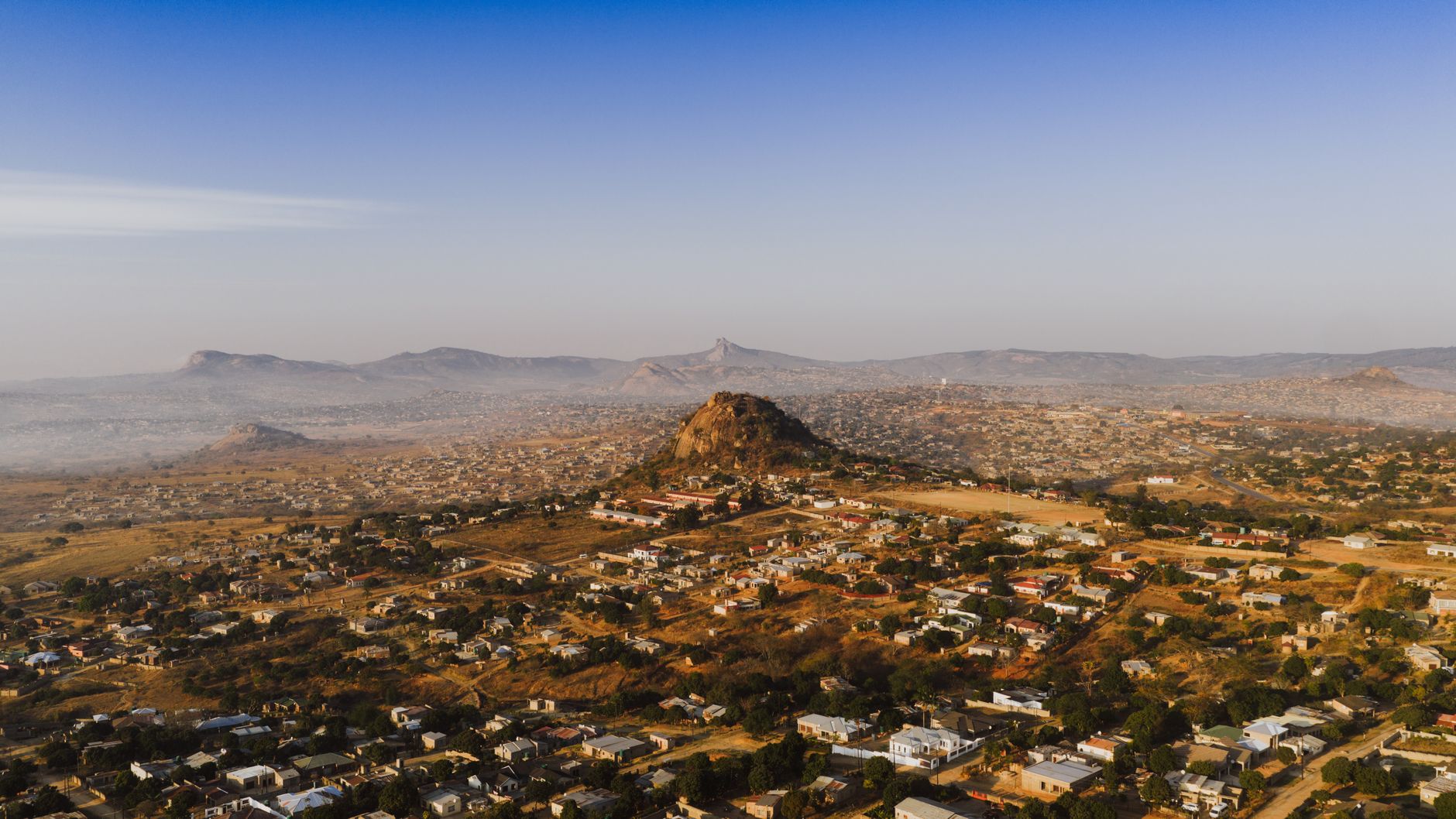
A stunning aerial perspective of Gaborone, Botswana, showcasing the city's unique topography with residential neighborhoods nestled near a prominent rocky hill.
Kelly on Pexels

An aerial perspective captures the extensive railway network cutting through a residential neighborhood in Gaborone, Botswana, under a bright, cloud-filled sky.
Alex Levis on Pexels

An elevated drone perspective captures the unique architectural layout of a stadium in Gaborone, Botswana, set against a backdrop of urban sprawl and natural vegetation.
Silver Works on Pexels
Yes, if you’re curious about Africa’s youngest capital city. You can hike at dawn, watch rhinos by lunch, and still make it back for craft gin at Riverwalk—all without leaving cell range.
Two full days cover the city’s signature trio: Kgale Hill sunrise, Mokolodi rhinos, and the National Museum. Add a third if you want a slow day of coffee, gallery hopping, and Bahurutshe cultural village.
Street crime exists but stays petty; keep phones off car seats, walk in groups after 10 pm in the CBD. Baboons on Kgale pose the more predictable threat—hide your snacks.
Cards work almost everywhere, but keep P100 in small notes for combi fares and Thapong’s honesty-box coffee. ATMs are scarce south of the A1 so fill up near Main Mall.
Airport shuttle minibus, P60, meets every arriving flight. Taxis quote P250–300—negotiate hard or wait ten minutes for the shuttle to fill.
Ready to book?
Fly into Sir Seretse Khama International Airport (GBE) 15 km north of town; Ethiopian, Airlink and Air Botswana land daily. Highway A1 runs south to Lobatse and north to Francistown; no passenger trains operate into Gaborone since Botswana Railways suspended service in 2022.
No metro, tram or light rail exists. Combis (15-seat minivans) ply colour-coded routes for P5–P10 cash; shared taxis cruise main roads. Ride-hailing apps (Bolt, inDriver) work patchily in 2026. No city-wide transit card—carry small pula notes.
Winter nights drop to 4 °C in July; October afternoons hit 32 °C. Rain falls almost only between November and March (145 mm in January). Visit April–May or August–September for 25 °C days, clear skies and zero mud on the trails.
Botswana pula only; ATMs dispense P10–P200 notes. Cards accepted at malls and hotels—carry cash for combis, craft stalls and roadside braai stands.
0 places, one continuous walking route. Free with your first city.